Luke 23:41
And we indeed justly; for we receive the due reward of our deeds: but this man hath done nothing amiss.
Translations
And we indeed justly; for we receive the due reward of our deeds: but this man has done nothing amiss.
King James Version, KJV Cambridge Paragraph Bible, Webster Bible, Revised Version, American Standard Version
And we indeed justly; for we receive the due reward of our deeds: but this man hath done nothing amiss.
and we indeed righteously, for things worthy of what we did we receive back, but this one did nothing out of place;'
and we indeed justly, for we receive the just recompense of what we have done; but this [ man] has done nothing amiss.
And, we, indeed, justly,—for, things worthy of what we have done, are we duly receiving, but, this man, nothing amiss, hath done.
Berean Standard Bible, Majority Standard Bible
We are punished justly, for we are receiving what our actions deserve. But this man has done nothing wrong.”
And we indeed justly, for we receive the due reward for our deeds, but this man has done nothing wrong.”
And with reason; for we have the right reward of our acts, but this man has done nothing wrong.
We are in deede righteously here: for we receiue things worthy of that we haue done: but this man hath done nothing amisse.
Douay-Rheims (Challoner revision)
And we indeed justly, for we receive the due reward of our deeds; but this man hath done no evil.
Pictures
Cross-references 20 of 31
- Luke 23:34-37
Then said Jesus, Father, forgive them; for they know not what they do. And they parted his raiment, and cast lots.
Jesus prays for his executioners amid mockery at the cross.
- Isaiah 53:5
But he was wounded for our transgressions, he was bruised for our iniquities: the chastisement of our peace was upon him; and with his stripes we are healed.
Christ suffers the punishment due for others’ sins.
- Matthew 27:42
He saved others; himself he cannot save. If he be the King of Israel, let him now come down from the cross, and we will believe him.
Mockers say Jesus saved others but cannot save himself.
- 1 Peter 2:24
Who his own self bare our sins in his own body on the tree, that we, being dead to sins, should live unto righteousness: by whose stripes ye were healed.
Christ suffered innocently and bore sins so others might live righteously.
- Isaiah 53:12
Therefore will I divide him a portion with the great, and he shall divide the spoil with the strong; because he hath poured out his soul unto death: and he was numbered with the transgressors; and he bare the sin of many, and made intercession for the transgressors.
Jesus was numbered with transgressors, though declared innocent.
- Isaiah 53:7
He was oppressed, and he was afflicted, yet he opened not his mouth: he is brought as a lamb to the slaughter, and as a sheep before her shearers is dumb, so he openeth not his mouth.
The servant suffers silently, like a lamb led to slaughter, without defending himself.
- Matthew 27:44
The thieves also, which were crucified with him, cast the same in his teeth.
Both thieves initially mocked Jesus before one rebuked the other.
- John 19:18
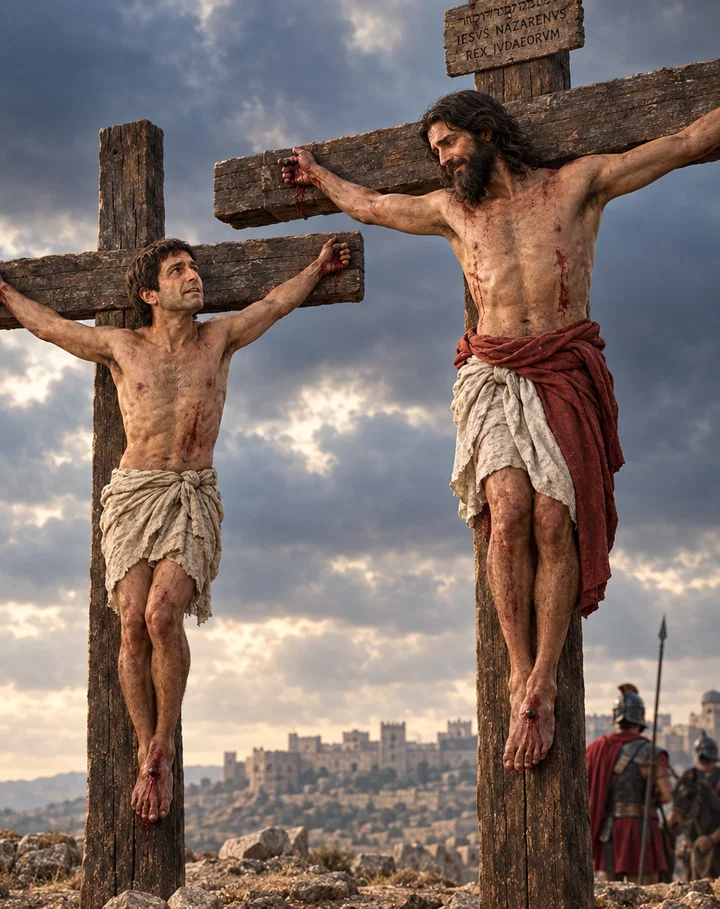
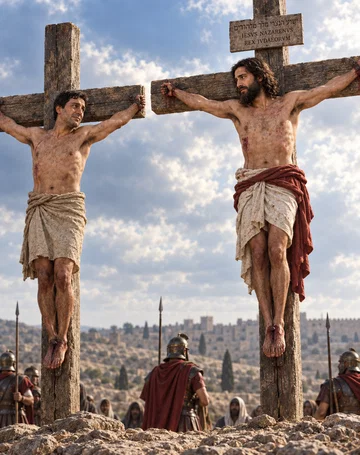
Where they crucified him, and two other with him, on either side one, and Jesus in the midst.
Both describe Jesus crucified between two others, including the guilty man’s recognition of his innocence.
- 1 Peter 2:22
Who did no sin, neither was guile found in his mouth:
Affirms that Jesus committed no sin.
- Mark 15:27
And with him they crucify two thieves; the one on his right hand, and the other on his left.
The condemned man acknowledges his just punishment while Jesus is crucified beside him.
- Luke 23:4
Then said Pilate to the chief priests and to the people, I find no fault in this man.
Pilate and the thief both declare Jesus innocent.
- 2 Corinthians 5:21
For he hath made him to be sin for us, who knew no sin; that we might be made the righteousness of God in him.
The sinless Christ bears sin for us and gives us his righteousness.
- Acts 10:38
How God anointed Jesus of Nazareth with the Holy Ghost and with power: who went about doing good, and healing all that were oppressed of the devil; for God was with him.
Jesus went about doing good, and the condemned man declared him innocent.
- Mark 15:39
And when the centurion, which stood over against him, saw that he so cried out, and gave up the ghost, he said, Truly this man was the Son of God.
The centurion confesses Jesus as God’s Son, while the thief acknowledges his innocence.
- Matthew 27:40
And saying, Thou that destroyest the temple, and buildest it in three days, save thyself. If thou be the Son of God, come down from the cross.
The crowd mocks Jesus and challenges him to come down from the cross.
- John 19:4
Pilate therefore went forth again, and saith unto them, Behold, I bring him forth to you, that ye may know that I find no fault in him.
Pilate declares that he finds no fault in Jesus.
- Luke 23:32-33
And there were also two other, malefactors, led with him to be put to death.
The crucifixion scene sets the context for the rebuke.
- Luke 23:47
Now when the centurion saw what was done, he glorified God, saying, Certainly this was a righteous man.
The centurion declares Jesus righteous at his death.
- 1 Peter 3:18
For Christ also hath once suffered for sins, the just for the unjust, that he might bring us to God, being put to death in the flesh, but quickened by the Spirit:
The just Christ died for the unjust.
- John 19:32
Then came the soldiers, and brake the legs of the first, and of the other which was crucified with him.
The thieves’ legs were broken while they were still alive.
Commentary
Each commentary is drawn from primary sources: the writings of Ellen G. White and Adventist pioneers and periodicals. Each commentary is separate. Its own words are not a quotation; follow the references to read the source passages.
Ellen G. White
27 sources
On Calvary one dying criminal rebuked his fellow sufferer, confessing that they were punished justly for their own crimes while Jesus had done nothing wrong.Ms 96, 1904, par. 11–13RH Aug 26, 1909Ms 140, 1908, par. 45–47Ms 83, 1910, par. 29–32 His words uphold the complete sinlessness and innocence of Christ even while He was reviled and mocked on the cross.RH Aug 26, 1909ST Jul 25, 18783SP 159.1 They express faith that the suffering Jesus is Lord, Messiah, Redeemer and King with right and power to forgive sin and remember him when He comes into His kingdom.Lt 102, 1905, par. 12–17Ms 52, 1897, par. 17–205RED 77.3–78.2ST Dec 14, 1904 Christ's promise of a place in Paradise in answer shows that even the vilest sinner near death who looks to Jesus in faith may receive pardon, peace and salvation through His merits.Ms 130, 1909, par. 39–40Ms 81, 1910, par. 245RED 77.3–78.23SP 158.1–2 Yet that last-moment mercy is no reason to delay repentance, for his faith was accepted on the only light he had, while those with duty shown from the Word must act on it lest neglected light leave them in darkness.3SP 159.1Ms 16, 1895, par. 23
Words and Setting
The saying belongs to the crucifixion at the place called Calvary outside the boundaries of Jerusalem, where felons and murderers were executed, where Christ suffered without the gate as substitute for transgressors to sanctify the people with His own blood and to redeem them from the curse of the law by being made a curse, as Adam and Eve were banished from Eden for transgression.DA 741.1–2 It belongs to the leading from the judgment-hall to Calvary, when news of condemnation spread through Jerusalem and a vast multitude of all classes and ranks flocked toward the place of crucifixion, including disciples and believers from the city and surrounding region who joined the throng following the Saviour because the priests and rulers were bound by promise not to molest His followers if He Himself were delivered to them.DA 741.3 The words were spoken by the repentant criminal rebuking his fellow criminal, forming the contrast at the cross where one condemned man mocked Jesus while the other prayed to Him in faith.RH Aug 26, 1909Ms 140, 1908, par. 45–47Ms 83, 1910, par. 29–32
It is the dying thief's admission that he and the other criminal suffer justly and receive the due reward of their deeds, while Jesus has done nothing wrong or amiss and has committed no sin.Ms 96, 1904, par. 11–13RH Aug 26, 1909Ms 140, 1908, par. 45–47Lt 102, 1905, par. 12–17Ms 130, 1909, par. 39–40 His settled conviction declares with no question, doubt, or reproach that Jesus suffers as a criminal persecuted unto death yet is sinless.Ms 52, 1897, par. 17–20
The speaker was not a hardened criminal, though his morals had been corrupted by base association.5RED 76.2–3 In common with the Jews he had shared the belief that Messiah would soon come, had heard Jesus and been convicted by His teachings, then through the influence of priests and rulers had turned away and sought to drown conviction in pleasure until corrupt associations led him into open crime for which he was condemned to the cross.5RED 76.2–3 He had been with Jesus in the judgment hall and on the way to Calvary, had heard Pilate declare Him a just man, and had marked His Godlike deportment and pitying forgiveness of His tormentors, and acknowledged in his heart that Jesus is the Son of God.5RED 76.2–3
His conviction that he suffered justly and Jesus was sinless came through Christ's appearance and unresisting suffering without one word of reproach, and through hearing passersby defend Christ, repeat His sayings, and tell His works.Ms 52, 1897, par. 17–20ST Dec 14, 1904 It rested on remembered reports that He healed the sick and those with grievous maladies and pardoned transgression and sin, on the words of weeping believers, and on seeing and reading the title This is Jesus the King of the Jews above the Saviour's head amid grief and mockery, with the Holy Spirit illuminating his mind until the chain of evidence joined together.Ms 52, 1897, par. 17–20ST Dec 14, 1904 The seed dropped into his heart and convicted him of past transgressions and guilt, of a God to be feared and a future to tremble at, and of a future judgment where all must stand before the judgment seat of Christ and each receive according to works.Ms 52, 1897, par. 17–20ST Dec 14, 1904 The thief was a guilty criminal deserving his punishment, yet he was far less guilty than those who condemned Christ to death, whose crimes were more heinous than his, especially the priests, scribes and rulers who took active part in demanding the death of the Son of God.Ms 45, 1897, par. 20–22Ms 84a, 1897, par. 8
Sinless Saviour Revealed
The dying declaration upholds the complete sinlessness and innocence of Christ even while He hung reviled and mocked on Calvary.RH Aug 26, 1909ST Jul 25, 1878 His recognition of that innocence testified that Jesus was no impostor but remained true to His character and mission through the end of His earthly life.ST Jul 25, 18783SP 159.1 Through faith the thief grasped who Jesus is in humiliation and apparent defeat as Messiah and Son of God and Lord.5RED 77.3–78.2ST Jul 25, 18785RED 76.2–3 In Jesus bruised, mocked, and hanging on the cross he saw the Lamb of God that takes away the sin of the world and the world's Redeemer, convinced by the central cross inscribed This is Jesus the King of the Jews.Ms 52, 1897, par. 17–20ST Dec 14, 1904ST Jul 25, 1878 That faith grasped Him as a sin-pardoning Saviour with right and power to forgive sin even in humiliation and apparent defeat.RH Aug 26, 1909Lt 102, 1905, par. 12–17
The thief's appeal expresses faith in a Saviour who can forgive sin even as He dies.Ms 96, 1904, par. 11–13Lt 102, 1905, par. 12–17 Christ's answer shows He still had the right and power to pardon in humiliation.RH Aug 26, 1909Lt 102, 1905, par. 12–17 While in His humanity He suffered the hatred and revenge of a God-hating people because He acknowledged Himself the Son of God, in His divinity He was still at work.Ms 84a, 1897, par. 8 As the propitiation for the sins of the whole world, Christ alone could offer the suffering criminal forgiveness and alone was free to undertake suretyship for the guilty criminal.11MR 345.1Ms 84a, 1897, par. 8 Jesus suffered crucifixion despite being innocent, enduring mockery, insult, and cruelty.Lt 1a, 1861, par. 2–5
He was taken away from His disciples and given into the hands of wicked men, with His own nation clamoring for His blood.ST Jul 7, 1898 Herod and his soldiers plaited the crown of thorns for His brow, clothed Him in the purple robe and bowed before Him in mockery while striking Him with the reed, scourged Him as the worst of criminals while the murderous Barabbas was chosen in place of the beloved Teacher, and lifted Him up on the cross to die as a malefactor.ST Jul 7, 1898 His suffering and what He gave up for humanity put the cost of Christian self-denial in perspective.Lt 1a, 1861, par. 2–5 This is the taking away of the Bridegroom, bringing days of trial and temptation when the presence of the Comforter is not clearly discerned, giving cause to mourn and fast, trying faith and causing hope and courage to fail.ST Jul 7, 1898
Faith Pardon and Warning
The confession is repentance and trust, an act of faith and prayer asking to be remembered when Christ comes into His kingdom.Ms 81, 1910, par. 245RED 77.3–78.23SP 158.1–2ST Jul 25, 1878Ms 45, 1897, par. 20–22 That faith was accepted at the close of probation, honored quickly with love, compassion and power by the promise of a place with Him in Paradise.Ms 81, 1910, par. 24ST Jul 25, 1878Ms 45, 1897, par. 20–22 In turning to Jesus in faith the dying thief found peace and acceptance with God, forgiveness, peace and assurance.5RED 77.3–78.23SP 158.1–2Ms 45, 1897, par. 20–22
The gospel was preached to the dying thief, showing that even a guilty person near death, even the vilest and guiltiest sinner near death, who looks to Jesus in faith may receive pardon, salvation and victory through His merits.5RED 77.3–78.23SP 158.1–2ST Jul 25, 1878Ms 45, 1897, par. 20–22 The pardon given while Jesus Himself suffered on the cross shows His love and willingness to forgive a repentant sinner even in suffering, and that Christ can impress a sinner in the midst of suffering.Ms 130, 1909, par. 39–40DA 751.3–4 That looking to Jesus in faith and being pardoned reveals the Lord's loving compassion, tender consideration, pity and willingness to save those who cannot save themselves, trusting His power to save and give victory, just as those who looked on the uplifted brazen serpent in the wilderness lived.Ms 45, 1897, par. 20–22
The two thieves represent two classes of mankind, for all have suffered the poison of sin.3SP 159.3 Those who look to and believe in Jesus lifted on the cross, as the believing thief did, will live forever, while those who refuse to believe will die without hope.3SP 159.3
The last-moment salvation is no reason to delay repentance, for neglected light can leave a sinner in deeper darkness.3SP 159.1 The thief waited until the last moment because until then he had no light, while others have had their duty shown from the Word of God.Ms 16, 1895, par. 23 Those who receive understanding at the end and accept it with intelligent faith find favor with Christ, and his faith was accepted even at the last moment.3SP 159.1
His salvation shows that Christ would forgive and save even a guilty person who yielded and confessed.Ms 149, 1904, par. 13–15 Judas could likewise have been saved if he had confessed his betrayal.Ms 149, 1904, par. 13–15
Christ's compassion in dying agony, answering quickly with love, compassion and power, pledges to save all who repent and turn to Him, so that all who trust in the merits of the Lamb of God gain eternal life.ST Dec 14, 1904 It leaves an example that calls Christians to speak sympathy and compassion to the tempted and tried instead of making guilt appear in the worst light.ST Dec 14, 1904
Sources
Pioneers and periodicals
98 sources
On the cross one of the two men crucified beside Jesus rebuked his fellow criminal and owned that they were suffering justly for their own deeds while Jesus had done nothing wrong.ST Nov 26, 1894ST May 28, 1896ST Nov 13, 1884RH Jul 4, 1865ST Nov 26, 1894 His admission took full responsibility without excuse or self-defense, in humility and true sense of sin that marks real repentance wrought by the Holy Spirit.ST Sep 5, 1911RH Sep 25, 1856ST Nov 19, 1896RH Sep 25, 1856 His words set the guilt of the criminals against the complete sinlessness and spotlessness of Jesus, whose unjust condemnation was the shedding of innocent blood to atone for others in the sinner's place.RH Aug 26, 1909ST Apr 22, 1913RH May 26, 1904ST Apr 25, 1900ST Mar 20, 1907 That confession was joined to saving faith that owned Jesus as Lord, Messiah, Saviour and coming King able to give eternal life, though He hung bleeding and dying without crown or glory, forsaken and mocked.ST Jul 25, 1878RH Oct 30, 1855ST Jun 1, 1904RH Sep 25, 1856ST Feb 20, 1901 So the dying thief was saved by repentance and faith with righteousness imputed without works, giving hope that even the vilest and most helpless sinner can find pardon at the last hour by asking, yet his deathbed salvation remains exceptional and does not excuse the living from duty today.ST Jul 25, 1878ST Dec 23, 1913ST Dec 23, 1897ST Apr 7, 1914ST Nov 2, 1915
Crucifixion Setting and Speaker
The words were spoken on the cross at Calvary by one of the two criminals crucified beside Jesus, as the penitent thief's rebuke to his fellow thief who mocked and railed on Jesus.ST Nov 13, 1884RH Jul 4, 1865ST Nov 26, 1894ST Jan 31, 1911 He first joined in reviling Jesus but then changed to repentance as Jesus' patient suffering touched his heart, so that he acknowledged his own punishment was just while declaring Jesus innocent.RH Jul 4, 1865RH Feb 8, 1915ST Nov 1, 1910 In that reply he confessed that he and the other condemned man suffered justly and received the due reward of their deeds, and declared that Jesus had done nothing wrong.RH Jul 4, 1865ST Nov 26, 1894ST Nov 1, 1910
The verse belongs to the account of Jesus' trials and crucifixion and death, in a chapter dealing with those trials and crucifixion, and it directs attention to the crucifixion narrative and to Christ's promise to the penitent thief in answer to his request to be remembered when Christ came into His kingdom.ST Jun 11, 1896ST Oct 4, 1910RH Feb 11, 1862 Its circumstantial details accord with the customs and political practices of the time.RH Feb 11, 1862 Jesus of Nazareth shed innocent blood on the stairs of the Pretorium, and after the sacrifice was consummated Joseph of Arimathea in tears begged Pilate for permission to bury Him, which Pilate granted and ordered soldiers to superintend the interment lest it be profaned.RH Jul 16, 1861 A few days afterward the sepulcher was found empty because Jesus had risen from the dead as He had foretold, which His disciples published everywhere.RH Jul 16, 1861
The scene occurred on preparation day, Friday, when Jesus was laid in the tomb, after which the women bought sweet spices intending to anoint Jesus, rested the Sabbath day, and came to the sepulcher early the first day of the week expecting to anoint His body, but found the stone rolled away and Jesus risen. The crucifixion occurred in A.D. 31, in the same year as His resurrection and ascension, at the close of a public ministry of nearer three years and six months than three years and three months.ST Sep 22, 1909 At the cross the verse divides the penitent believing malefactor from the impenitent unbelieving one, so that when Jesus died only one penitent thief acknowledged Him and paid Him homage.ST Aug 19, 1880ST Dec 17, 1896ST Jul 25, 1911
The record of the crucifixion and resurrection mentions the seventh day and the first day in immediate connection, and the two days have traveled side by side in unbroken succession ever since the cross, with Jews, Christians, and others all agreeing in their reckoning.ST Feb 1, 1905 The day Christ recognized as the Sabbath then was certainly the true seventh day from the beginning, so there has been no loss of the day's identity between the crucifixion and the present.ST Feb 1, 1905 If Sunday is kept in true succession from the cross the seventh day is kept in the same succession.ST Feb 1, 1905
Confession of Deserved Punishment
The condemned man openly admits that he and the other man crucified with Jesus suffer justly and receive the due reward of their deeds.ST Nov 26, 1894ST May 28, 1896ST Mar 20, 1901ST May 11, 1904ST Mar 20, 1901 His punishment is deserved because of what he has done, while Jesus has done nothing wrong.ST Nov 26, 1894ST May 28, 1896ST May 11, 1904ST Oct 15, 1894 The admission contrasts their guilt with the innocence of Jesus.ST Mar 20, 1901ST Mar 20, 1901ST Oct 15, 1894
The rebuke calls the other criminal to fear God even while both lie under the same condemnation.ST Dec 14, 1904RH Oct 30, 1855 It is spoken as a sin-polluted life is about to close, from conviction that there is a God to fear and a future to tremble at.ST Dec 14, 1904RH Oct 30, 1855 The acknowledgment of just suffering joins confession of guilt with declaration that Jesus has done nothing amiss, introducing the plea to be remembered when He comes into His kingdom.RH Oct 30, 1855
The confession accepts responsibility without blaming others, making excuses, justifying self, or defending self.ST Sep 5, 1911ST Nov 19, 1896RH Sep 25, 1856ST Mar 20, 1907ST Sep 5, 1911 He speaks as one humbled and self-abased by remembrance of past iniquities, admitting his ungodliness and that his punishment is just.ST Sep 5, 1911ST Nov 19, 1896RH Sep 25, 1856 He faces his condition as a lost, hell-deserving sinner and confesses it plainly, and recognizing the innocence of Christ brings such a person near to the kingdom of happiness.RH Sep 25, 1856ST Mar 20, 1907ST Sep 5, 1911
Humility and a right sense of sin shown in the admission mark a finished work of the Holy Spirit.RH Sep 25, 1856 That readiness to admit being a poor hell-deserving sinner marks all God's children.RH Sep 25, 1856RH Sep 25, 1856 Though life after conversion was short, every part of a believer's character is traceable in him, and humility together with faith, prayer, and brotherly love proves the repentance real and in deed and truth and not in name only.RH Sep 25, 1856
Suffering can be the acknowledged just consequence of one's own sins and deeds, in contrast with Jesus who suffered innocently to atone for the sins of others.RH Sep 17, 1901RH Mar 4, 1909 Personal sin is why the sufferer languishes and sighs, while Jesus suffered and died for sinners despite having done no wrong.RH Sep 17, 1901RH Mar 4, 1909 The thief's crime, for which he was convicted and justly suffered, was also sin against God because it violated the law of God, whose penalty is eternal death.ST Dec 23, 1897
The humble admission of just suffering contrasts with the harder heart of the sneering Pharisee who trusted in his own righteousness.ST Jul 20, 1904ST Feb 6, 1896 His humble repentance stands against hard-hearted self-righteousness.ST Jul 20, 1904ST Feb 6, 1896 Joined to the testimony that Jesus was innocent, the confession with the events at the crucifixion moved onlookers to remorse for sharing in the death of the Holy One.RH Jun 25, 1867
Testimony to Christ's Innocence
The dying criminal declares that Jesus has done nothing wrong, affirming His complete innocence, sinlessness and spotlessness even while He hangs reviled and mocked.RH Aug 26, 1909ST Apr 22, 1913ST Jan 17, 1911 All others have sinned and transgressed God's law, but Christ alone can truthfully be called innocent.ST Mar 20, 1907ST The confession belongs to a faith that grasps Jesus as a sin-pardoning Saviour with right and power to forgive sin even in humiliation and apparent defeat.RH Aug 26, 1909 It models accepting responsibility rather than defending self, and recognizing His innocence brings a person near to the kingdom of happiness.ST Mar 20, 1907 The thief is thus an example of a sinner saved despite never observing the seventh-day Sabbath or being baptized.ST The same truth answers Pilate's declaration that Jesus had done nothing wrong and should be released.ST Jan 17, 1911
The saying sets the guilt of the two condemned men against the innocence of Jesus, confessing just punishment on the one side and righteousness on the other.RH May 26, 1904ST Apr 25, 1900 It affirms that His condemnation and death were unjust and that innocent blood was shed.ST Apr 25, 1900RH Jul 16, 1861 After the sacrifice was consummated Joseph of Arimathea in tears begged permission to bury Him, which was granted with soldiers ordered to superintend the interment lest it be profaned, and a few days afterward the sepulcher was found empty because He had risen as foretold, which His disciples published everywhere.RH Jul 16, 1861 The confession joined to appeal shows belief in Jesus for salvation.RH May 26, 1904
Jesus suffered innocently to atone for the sins of others, dying in the sinner's place as bearer of sin.RH Sep 17, 1901ST Apr 22, 1913 Though spotless and having done no wrong, He died on a shameful cross as a priceless sacrifice for others, with His innocent death marked by darkness, rent rocks, opened graves, the grief of creation and angels, the tomb, and His promised return in glorious majesty and power to reign forever.ST Jul 25, 1878 He was crucified though He had done nothing amiss, dying for sinners out of kindness, dying for each person, and that death for others calls for love to Him in return and willingness to do anything for Him.ST Jan 1, 1894 He had done nothing deserving death, yet died with sin laid upon Him; His death was caused by our sin, and His righteousness is the only ground on which sinners may be received into glory.RH Aug 27, 1861
Recognition of His righteous character came from seeing His life and patient suffering on the cross, which overcame enmity and reconciled the heart.ST Aug 27, 1894ST Aug 27, 1894 It rested on what was remembered of His healing the sick and pardoning sin, on the words of weeping believers, on seeing and reading the title above His head and hearing passers-by repeat it with grief or mockery, with the Holy Spirit illuminating the mind until the chain of evidence joined together.ST Dec 14, 1904 In Jesus bruised, mocked and hanging is seen the Lamb of God that takes away the sin of the world.ST Dec 14, 1904 His life, represented by His blood, destroyed enmity and made at one with God, so that atonement is not by material blood itself but by His life removing enmity and joining people to God.ST Aug 27, 1894 His self-forgetful love in forgetting His own anguish to listen to the dying thief, to care for His weeping mother, to pray for His murderers, and to spend His whole life in forbearance, magnanimity, benevolence and self-renunciation is perfect loveliness of character, yet in no instance going a hair's breadth beyond what the law requires.ST Aug 28, 1884ST Sep 11, 1884RH Sep 18, 1860 From subjection to His parents in childhood and youth to living only for the good of those around Him and the glory of His Father, His whole demeanor was the moral law perfectly observed, drawn out in living characters, magnifying the law and making it honorable by full compliance.ST Aug 28, 1884ST Sep 11, 1884
The recognition testifies that Jesus was no impostor but remained true to His character and mission to the end.ST Jul 25, 1878 He is pure and noble, suffering and dying as an innocent victim, and His death is a triumph of eternal righteousness.ST Apr 8, 1903 He was lifted up as a malefactor although His only offense was going about doing good, lifting no hand in self-defense and uttering no reproach against persecutors.ST Jul 22, 1897 Even hanging as a reproach of men and despised of the people He proved His power to save others by saving the penitent thief, yet Himself He could not save.ST Jul 22, 1897
Thief's Faith and Repentance
The rebuke confesses just punishment and declares Jesus innocent, and with that confession goes repentance, saving faith and an appeal for mercy to be remembered when He comes into His kingdom.RH Oct 30, 1855ST Sep 5, 1911ST Nov 19, 1896 That coming into the kingdom was still future when the request was made, and the answer was assurance of a place with Him in Paradise to be fulfilled in the future, not on the day of the crucifixion.ST Nov 30, 1915ST Jun 11, 1896 The honest admission of guilt as a lost sinner stands together with recognition of innocence and a look beyond the crowd's judgment to Jesus and His coming kingdom.RH Oct 30, 1855ST Nov 19, 1896
The faith openly called Him Lord and believed He would have a kingdom and was able to give eternal life and glory.ST Jul 25, 1878RH Sep 25, 1856 Through faith the dying Jesus was seen as Messiah and Son of God, and trusted as Redeemer and Saviour despite humiliating circumstances, with probation closing and salvation at the last moment.ST Jul 25, 1878ST Aug 17, 1915 This was believed when He hung faint, bleeding and dying, numbered with transgressors and counted accursed, with strength dried up and life drawing to the grave.RH Sep 25, 1856ST Feb 20, 1901 Nothing was seen but agony and weakness, suffering and pain under dishonorable punishment, deserted, mocked, despised, blasphemed and rejected, with no sceptre, royal crown, outward dominion, glory, majesty, power or signs of might.RH Sep 25, 1856ST Feb 20, 1901 The whole nation denied Him shouting crucify Him and claiming no king but Caesar, the chief priests and Pharisees with the learned and reputedly wise condemned Him as guilty of death, as a false prophet and blasphemer, and His own disciples forsook Him and fled while His mission seemed a failure.RH Sep 25, 1856ST Feb 20, 1901
While the disciples remained silent in faithlessness, and the heathen Roman captain with limited understanding could only declare Him the Son of God, the fellow prisoner hanging on a cross made a full and alone confession of the stricken Saviour.ST Jun 1, 1904 This was as Jesus trod the winepress alone from Gethsemane to the cross with none of the people with Him.ST Jun 1, 1904 The change from railing to repentance came as Jesus' patient suffering touched his heart.ST Aug 8, 1900ST Nov 1, 1910 Despite the hostile scene and the popular view, with Jesus mocked and appearing forsaken by God, he weighed the evidence, believed Jesus innocent and true and would come into His kingdom, and appealed to Him for salvation, showing a sinner can seek and receive pardon even in the most forbidding circumstances.ST Aug 8, 1900ST Feb 20, 1901ST Nov 1, 1910 His marvelous faith pierced the gloom-cloud of the cross and saw the eternal triumph and glory beyond.ST Feb 20, 1901
Repentance and saving faith were seen in works that under those trying circumstances cost more than under ordinary circumstances.ST Aug 27, 1896 He labored before an immense throng of bitter opposers to persuade his fellow sufferer to repent, and he prayed to Jesus for final salvation.ST Aug 27, 1896 For want of time and opportunity he could not do all the works God requires of man, yet he did all he could do, and God accepted his will and good desires to perform the rest.ST Aug 27, 1896 Had his life been prolonged God would have held him to the duty of performing those works, and had he then persistently and permanently refused the works of God he would have lost pardon and justification by disregarding his vows at conversion and blotting out faith and repentance.ST Aug 27, 1896
Confession of sins and of the justice of punishment before God, Christ and the world, with recognition of Jesus as the One who had done nothing amiss, the sinless One and Saviour of the world, is becoming acquainted with Him at the cross.ST Sep 21, 1904ST Apr 7, 1914 That confession of guilt and recognition of Christ as Saviour, joined to unwavering faith in the answering assurance of Paradise, is dying to sin by repentance and confession and being quickened into new life, being spiritually crucified with Christ.ST Sep 21, 1904 In this he stands as representative of all penitent and converted sinners.ST Sep 21, 1904 In helpless condition he poured out his sin-sick soul in asking for righteousness and a place with his Lord in His kingdom, and by that asking alone with entire surrender of self he obtained forgiveness and promise of a home in Paradise, proving life is secured only by asking in prayer, never by purchase with gold or by works of penance.ST Apr 7, 1914ST Aug 29, 1911 He embraced his first opportunity to turn instantly and without reservation, throwing himself on mercy, finding true riches at his last moment of opportunity and seizing them, though fear of death may produce only false repentance without true sense of sin or willingness to turn from it.ST Aug 29, 1911ST Mar 25, 1903
Even on the cross He continued His mission to reach the robber beside Him, loving both thieves and taking time to save the penitent one while dying in agony.ST Aug 17, 1915ST Jun 14, 1905ST Sep 5, 1911ST May 20, 1897 Though hanged as a malefactor whose only offense was going about doing good, He lifted no hand in self-defense and uttered no reproach against persecutors.ST Jul 22, 1897 There He proved power to save others by saving the penitent thief, yet Himself He could not save without abandoning others to perish.ST Mar 20, 1901ST Jul 22, 1897
Doctrine of Salvation Proved
The confession that just punishment was being received for personal crimes, joined to the declaration that Jesus had done nothing wrong, followed by sincere repentance and faith in Christ, shows how a sinner may be saved despite having no life-work that can endure the test of judgment.ST Dec 23, 1913ST Nov 2, 1915 Hanging helpless beside Jesus at Calvary, beholding Him as the Son of God and accepting Him by faith as Saviour, the penitent thief confessed his own just condemnation, poured out his sin-sick soul in asking for righteousness and a place with his Lord in His kingdom, and by that asking alone obtained forgiveness and promise of a home in Paradise.ST Apr 7, 1914 His victory proves that life is secured in the only way it ever can be secured, by asking in prayer with entire surrender of self, never by purchase with gold or by works of penance.ST Apr 7, 1914 God imputes righteousness without works to those who receive Christ as their sacrifice for sin, and the dying thief rejoicing in the fountain opened for sin and cleansed illustrates that even one vile as he was may be washed from sin.ST Nov 2, 1915ST Sep 2, 1886
The thief was dying while the living person who invokes him remains alive, so his case does not excuse a living person from church membership, baptism, and giving.ST Nov 6, 1893 His circumstances made baptism impossible, showing that a believer may be saved without receiving baptism when there is no opportunity to do so, and he would have been baptized if he had the opportunity, but Jesus accepted him as he was and assured him of a place in His kingdom.RH Mar 26, 1914ST Sep 11, 1907 He became a member of the true Church despite having no visible connection to a church society, and stands as an example of a sinner who could be saved despite never observing the seventh-day Sabbath or being baptized.ST Sep 25, 1907ST All people have sinned, unlike Christ, who alone did not transgress God's law.ST That salvation without water baptism threatens the doctrine of baptismal essentialism, so those who held it maintained that he was baptized with blood from the Saviour's wounded side, or else had been baptized before his conviction. Christ's own baptism counts for those unable to be baptized but not for rebels against ordinances.
The thief's request was for Jesus to remember him when He came into His kingdom, an event still future.ST Nov 30, 1915 The admission that deserved punishment was being received accords with penitence in recognizing Jesus as Saviour, and Jesus promised him a place with Him in Paradise, but that promise is to be fulfilled in the future, not on the day of the crucifixion. The promise points to a place, not merely a condition, but does not say where paradise is located.RH Aug 13, 1914
Confession of sins joined to recognition of Christ's righteousness redeemed the thief as seeing Christ's life and suffering brought him to confession.ST Aug 27, 1894 Christ's life, represented by His blood, destroyed the enmity in the thief's heart and made him at one with Christ, so the atonement is not made by material blood itself, but by Christ's life, which removes enmity and joins people to God.ST Aug 27, 1894 Even a dying thief has open access to God, for however deep the midnight moment when a person finds himself in the sudden arms of death, winged prayer can bring an instant Saviour, wherever he is.RH Jul 30, 1857 No saintliness, proficiency in piety, eloquence, earthly rank, sharp ordeal, costly passport, painful expiation, price or personal merit is needed, but only simple prayer like the thief's, and this access in every place at every moment comes freely and instantly and constantly through what cost the sinner nothing yet is costliest of all: the blood of the atonement, the Saviour's merit, and the name of Jesus.RH Jul 30, 1857
Jesus on the cross forgot His own anguish to listen to the dying thief and to care for His weeping mother, just as He prayed for His murderers and spent His whole life in forbearance, magnanimity, benevolence and self-renunciation.ST Aug 28, 1884 That self-forgetful love is perfect loveliness of character, yet in no instance did it go a hair's breadth beyond what the law requires, but was neither more nor less than the law perfectly observed, drawn out in living characters, magnifying the law and making it honorable by full compliance with its demands.ST Aug 28, 1884 That attention never stepped beyond the circle the law had drawn, for from being subject to His parents in childhood and youth to living only for the good of those around Him and for the glory of His Father, His whole demeanor was the law perfectly observed.ST Sep 11, 1884 His conduct, including His attention to the dying thief, conformed perfectly to God's law even as He suffered the cross innocent of wrongdoing while the condemned men deserved their punishment.RH Sep 18, 1860
Comfort and Warning Applied
The thief's confession that he suffered justly for deeds that were both crime and violation of God's law whose penalty is eternal death gives hope that even the vilest sinner can turn at the last hour and find pardon.ST Jul 25, 1878ST Dec 23, 1897 Though his sin was great and his profession of faith came late on the cross where it would bring only derision, his faith was accepted and he was assured a place in the eternal kingdom, proving God's love and saving power through Christ toward the vilest at the final hour.ST Dec 23, 1897 Even the vilest may receive pardon and salvation through Christ's merits by recognizing Jesus as Redeemer, trusting Him, and finding peace and acceptance with God while declaring His innocence.ST Jul 25, 1878 A dying sinner with little time left who has not known God can still turn to Him and trust that Christ's sacrifice has been made and accepted. Jesus shows mercy even at the point of death and receives one who turns to Him, so a dying person who prays to Him may be assured of mercy still.ST Apr 7, 1881 Even those who have sinned and face death need not despair of salvation, for the dying thief was saved on the cross.ST Jun 7, 1905 Christ can accept and save a sinner even near death at the eleventh hour, and the saving work belongs to Christ and not to the one who points the sinner to Him.RH Jun 30, 1903
Salvation while dying is exceptional, for the thief is one of the very few so saved because he heard the gospel then and embraced it at once, unlike those who had often heard it before.RH Sep 26, 1854RH Aug 14, 1860 His is an exceptional example of repentance near death by embracing the gospel while dying.RH Aug 14, 1860 He perfected Christian character in a very short time, but his conversion was an emergency case like the turning of water into wine at Cana, not the normal lifetime of growth and development Christian character requires.RH Jan 28, 1902 What he did in moments requires a lifetime for others, yet steady growth in an even Christian experience has just as much divine power in it as his sudden conversion and that of Paul.RH Jan 28, 1902
The dying thief's case does not excuse a living person from duty, for he was dying while the one invoking him remains alive, so church membership, baptism, and giving claimed unnecessary from his example remain required of the living.ST Nov 6, 1893 Genuine repentance and faith can bring forgiveness even at life's final hour when guilt is confessed and Jesus' innocence recognized, yet fear of death may produce only false repentance without a true sense of sin or willingness to turn from it.ST Aug 29, 1911 Death itself or a bare claim of faith does not prove genuine repentance, so a condemned murderer's unverified claim to be at peace with Jesus calls for modesty, though a murderer may truly repent and be saved where evidence of repentance appears.ST Apr 12, 1883 The thief is remembered as putting trust in Jesus even at the end of life, and forgiveness and the offer of eternal life were available even in his final hours.ST Dec 22, 1881ST Aug 8, 1900 The call to receive life is for today since delay may mean losing the offer forever.ST Aug 8, 1900 Judgment will reveal which deathbed repentances were effective, and those who knew God's will but disobeyed may feel sorrow and regret when too late to find pardon.RH Sep 30, 1858
Christ's quick answer of love, compassion, and power promising Paradise pledges to save all who repent and turn to Him, so that all who trust in the merits of the Lamb of God gain eternal life.ST Dec 14, 1904 His compassion in dying agony leaves an example calling Christians to speak sympathy and compassion to the tempted and tried instead of making guilt appear in the worst light.ST Dec 14, 1904 Christ saw and loved what was good even in the expiring thief, and for the sake of saving that good forgot, forgave, and put out of sight what was bad.RH Jun 2, 1904 That is the pattern for loving one another despite differences and faults and making the best of one another, instead of fixing attention only on weak points, magnifying, irritating, and aggravating them until life becomes unendurable and happiness and usefulness are destroyed.RH Jun 2, 1904RH Jul 22, 1902 Telling the story of Jesus' rejection and suffering on the cross for the people He came to save can move even hostile listeners to abandon violence, seek the Gospel, and ask forgiveness.ST Dec 18, 1901
His suffering on the cross shows the depth of His love and anguish in bearing the world's sorrow and caring for souls.RH Jan 16, 1908 He refused to be turned aside from His holy mission by persuasions to compromise principle and enter politics, so that His followers might successfully resist the same persuasions in all time to come.ST Jul 25, 1911 Every compromise with the world or with worldly principles and methods makes Christians and churches losers, and Gethsemane, the crown of thorns, the cross of Calvary, and the triumphant resurrection are better than such compromise.ST Jul 25, 1911 His being taken away and given into wicked hands, with His own nation clamoring for His blood, Herod and soldiers crowning Him with thorns, clothing Him in purple, mocking and striking Him, scourging Him while Barabbas was chosen, and lifting Him up to die as a malefactor, is the taking away of the Bridegroom bringing days of trial and temptation when the Comforter's presence is not clearly discerned.ST Jul 7, 1898 Those days give cause to mourn and fast, trying faith and causing hope and courage to fail.ST Jul 7, 1898
Even beside the Saviour on the cross a seeking sinner could still be called to repentance.RH Dec 26, 1907 Of the two thieves crucified with Jesus, one repented and Jesus forgave him, while the other was lost.ST Aug 21, 1907 The converted thief rescued at Calvary was one of three converted there on the day of the crucifixion.ST Dec 5, 1916 His recognition that he received the just consequence of his deeds while Jesus had done nothing wrong calls sinners to confess their wrongs and turn from them.RH Sep 17, 1872
Sources