Luke 23:18
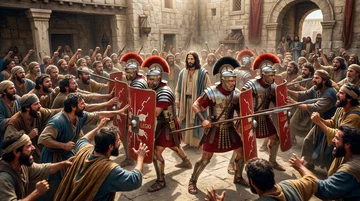
And they cried out all at once, saying, Away with this man, and release unto us Barabbas:
Translations
American King James Version, Webster Bible
And they cried out all at once, saying, Away with this man, and release to us Barabbas:
King James Version, KJV Cambridge Paragraph Bible
And they cried out all at once, saying, Away with this man, and release unto us Barabbas:
But they cried out all together, saying, Away with this man, and release unto us Barabbas:
But they cried out all together, saying, Away with this man, and release unto us Barabbas:—
and they cried out — the whole multitude — saying, 'Away with this one, and release to us Barabbas,'
But they cried out in a mass saying, Away with this [ man] and release Barabbas to us;
But they cried aloud, with the whole throng, saying—Away with this man! and release unto us Barabbas:—
Berean Standard Bible, Majority Standard Bible
But they all cried out in unison: “Away with this man! Release Barabbas to us!”
But they all cried out together, saying, “Away with this man! Release to us Barabbas!”—
But with loud voices they said all together, Put this man to death, and make Barabbas free.
Then all ye multitude cried at once, saying, Away with him, and deliuer vnto vs Barabbas:
Douay-Rheims (Challoner revision)
But the whole multitude together cried out, saying: Away with this man, and release unto us Barabbas:
Pictures
Cross-references 20 of 32
- Matthew 27:21-22
The governor answered and said unto them, Whether of the twain will ye that I release unto you? They said, Barabbas.
The crowd chooses Barabbas and demands Jesus’ crucifixion.
- John 18:39-40
But ye have a custom, that I should release unto you one at the passover: will ye therefore that I release unto you the King of the Jews?
Pilate offers a Passover release, and the crowd chooses Barabbas instead of Jesus.
- Mark 15:11
But the chief priests moved the people, that he should rather release Barabbas unto them.
The chief priests persuade the crowd to demand Barabbas instead of Jesus.
- John 19:15
But they cried out, Away with him, away with him, crucify him. Pilate saith unto them, Shall I crucify your King? The chief priests answered, We have no king but Cæsar.
The crowd rejects Jesus as king and insists that he be taken away and crucified.
- Matthew 27:17
Therefore when they were gathered together, Pilate said unto them, Whom will ye that I release unto you? Barabbas, or Jesus which is called Christ?
Pilate offers the crowd a choice between Jesus and Barabbas.
- Matthew 27:21
The governor answered and said unto them, Whether of the twain will ye that I release unto you? They said, Barabbas.
The crowd chooses Barabbas instead of Jesus.
- Matthew 27:24-25
When Pilate saw that he could prevail nothing, but that rather a tumult was made, he took water, and washed his hands before the multitude, saying, I am innocent of the blood of this just person: see ye to it.
Pilate releases Barabbas, washes his hands, and the crowd accepts responsibility for Jesus’ blood.
- Luke 23:4
Then said Pilate to the chief priests and to the people, I find no fault in this man.
Pilate declares Jesus innocent before the crowd chooses Barabbas.
- Matthew 27:15
Now at that feast the governor was wont to release unto the people a prisoner, whom they would.
Describes the feast custom of releasing a prisoner.
- Acts 3:14
But ye denied the Holy One and the Just, and desired a murderer to be granted unto you;
The people rejected Jesus and asked for a murderer to be released.
- John 19:6
When the chief priests therefore and officers saw him, they cried out, saying, Crucify him, crucify him. Pilate saith unto them, Take ye him, and crucify him: for I find no fault in him.
The rulers demand Jesus’ crucifixion, though Pilate finds no fault in him.
- Matthew 27:19
When he was set down on the judgment seat, his wife sent unto him, saying, Have thou nothing to do with that just man: for I have suffered many things this day in a dream because of him.
Pilate’s wife warns him about Jesus in a dream.
- Luke 23:33
And when they were come to the place, which is called Calvary, there they crucified him, and the malefactors, one on the right hand, and the other on the left.
The demand for death ended in Jesus’ crucifixion at Calvary.
- Luke 23:25
And he released unto them him that for sedition and murder was cast into prison, whom they had desired; but he delivered Jesus to their will.
Pilate yields to the demand and releases Barabbas instead of Jesus.
- John 19:1-5
Then Pilate therefore took Jesus, and scourged him.
Jesus is scourged and crowned with thorns as the crowd demands Barabbas.
- Mark 15:7
And there was one named Barabbas, which lay bound with them that had made insurrection with him, who had committed murder in the insurrection.
Identifies Barabbas as an insurrectionist and murderer.
- Mark 15:9
But Pilate answered them, saying, Will ye that I release unto you the King of the Jews?
Pilate asks whether to release Jesus or Barabbas.
- Mark 15:15
And so Pilate, willing to content the people, released Barabbas unto them, and delivered Jesus, when he had scourged him, to be crucified.
Pilate releases Barabbas and delivers Jesus to be crucified.
- Mark 15:13-14
And they cried out again, Crucify him.
The crowd cried out for Jesus to be crucified.
- Matthew 27:26
Then released he Barabbas unto them: and when he had scourged Jesus, he delivered him to be crucified.
same scourging as a criminal witnessed by disciples
Commentary
Each commentary is drawn from primary sources: the writings of Ellen G. White and Adventist pioneers and periodicals. Each commentary is separate. Its own words are not a quotation; follow the references to read the source passages.
Ellen G. White
53 sources
At the feast it was customary for the governor to free one prisoner whomever the people chose, and Pilate set Jesus against Barabbas hoping the crowd would spare Jesus.COS 148.5–75RED 61.1ST Jul 11, 1878 With one voice they roared together for Jesus to be taken away and for Barabbas to be released to them, to Pilate's great astonishment.5RED 61.1Ms 11, 1896, par. 5–6Ms 25, 1896, par. 17–18 Barabbas was a notorious robber, thief and murderer, while Jesus was the innocent and holy Son of God who had done them no harm.COS 148.5–75RED 61.1Lt 59, 1895, par. 31–33Ms 25, 1896, par. 17–18Lt 30, 1902, par. 5–6 The priests and rulers stirred the multitude to this fury, and behind them Satan with evil angels worked to destroy Christ and cut off heaven from earth.5RED 61.1Ms 136, 1899, par. 30–33Ms 150, 1899, par. 3–5ST Apr 15, 1897 In choosing Barabbas they rejected the Holy One and chose Satan personified, a choice every person still repeats by associates, life and character in whom they take as king.Ms 11, 1896, par. 5–6Ms 25, 1896, par. 17–18Ms 23, 1900, par. 7–9Ms 39, 1894, par. 15–1616MR 259.3–260.1
Trial Setting Before Pilate
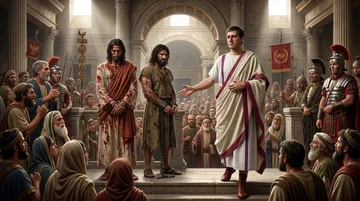
It was the custom at the feast for the governor to release to the people one prisoner, whomever they wanted, and Pilate seized on that offer of a choice between Jesus and Barabbas as a way to save Jesus.COS 148.5–75RED 61.1ST Jul 11, 1878 That custom of setting free one condemned prisoner at the great national festival was a pagan and unjust practice.Ms 112, 1897, par. 33–34 Pilate put the offer forward because he knew Jesus was true and innocent, having repeatedly found no fault in Him, and because he knew the priests had brought Jesus to the judgment hall for envy.ST Jul 11, 1878Ms 112, 1897, par. 33–34 He knew also that even bound and accused, the power in Jesus was the power of God and not of a common man.Ms 112, 1897, par. 33–34
To stir pity so the multitude would decide the punishment already inflicted was enough, Pilate had Jesus scourged in front of them, but the hope was vain.DA 735.1–55RED 63.1 While Pilate hesitated, the insistence of the crowd grew, pressing him to choose the guilty prisoner instead of Jesus.COS 148.1–4DA 735.1–5 He asked them whom they wanted released, putting to them what he should do with Jesus who is called Christ.ST May 17, 1899ST Apr 15, 1897 Through weakness he let an enraged mob override justice, and though declaring he found no fault in Christ he delivered the innocent Christ to them to be crucified.ST Nov 2, 1882ST May 17, 1899Lt 12, 1911, par. 8–11ST Apr 15, 1897
The demand went up all at once with one voice, a united roar of voices like wild beasts and like the hoarse cry of demons.5RED 61.1Ms 11, 1896, par. 5–6Ms 25, 1896, par. 17–18ST Apr 15, 1897 It came from people determined not to let Jesus go free.DA 735.1–5 To Pilate it was a matter of great astonishment.5RED 61.1 The cry belonged to the forcing of Jesus upon the Roman governor by the Jewish priests and rulers, and it shows the opposition He endured while remaining faithful as Pilate faced the decision about Jesus.RH Nov 11, 1915COS 145.4–5
Jesus and Barabbas Contrasted
Barabbas was a notorious, hardened criminal, a robber, thief and murderer, a condemned rebel who claimed to be the Messiah.COS 148.5–75RED 61.1Lt 30, 1902, par. 5–6DA 733.1–4ST Nov 2, 1882 The crowd chose him to be released instead of Jesus when the customary release of one prisoner chosen by the people was offered, demanding that Jesus be taken away and Barabbas be given to them.COS 148.5–75RED 61.1Ms 136, 1899, par. 30–33 He was set against the innocent Saviour in hope of rousing the people to a sense of justice, but the demand for him, first started by the priests and then taken up by the mob, exposed rejection of the innocent Saviour who had done them no harm.5RED 61.1Lt 30, 1902, par. 5–6DA 733.1–4
He was a false Christ who pretended to be Christ and claimed religious power and a right to establish a different order of things and to set the world right.Ms 112, 1897, par. 33–34 He did great wickedness by theft and robbery and murder and claimed whatever he seized was his own under satanic delusion, doing wonderful things through satanic agencies.Ms 112, 1897, par. 33–34 Against him stood Jesus, the innocent and holy Prince of heaven, the Son of God who made the world and all things therein, pure from every taint of evil.Lt 59, 1895, par. 31–33Ms 25, 1896, par. 17–18Ms 150, 1899, par. 3–5 Christ embodies goodness, truth and righteousness and had done the people no harm, yet the criminal and murderer was freed while the Son of God was condemned to die.Lt 30, 1902, par. 5–6Ms 150, 1899, par. 3–5
Christ left the royal throne of God and came to earth to save people and to win a crown of immortality for humanity, yet was discarded by the very people He came to save with a murderer chosen in His place.Ms 11, 1896, par. 5–6 His divine character shone through His humanity, with a countenance expressive of the Father's image.Ms 11, 1896, par. 5–6Ms 78, 1893, par. 55–56 Stripped to the waist, pale, with a crown of thorns on His head, with long cruel stripes from which blood flowed freely, and with face stained with blood and marked by exhaustion and pain, Jesus was placed side by side with Barabbas after being scourged in front of the multitude in vain hope of stirring pity so they would decide the punishment was enough.5RED 63.1 Even in that condition His noble character stood out in marked contrast with Barabbas, a chief robber whose every feature proclaimed a debased and hardened desperado, a notorious guilty man set in striking contrast to Christ in innocence against guilt.5RED 63.1Ms 112, 1897, par. 33–34
The crowd's demand to release Barabbas instead of Jesus meant the cross that had been prepared for Barabbas was brought out and laid upon Jesus's bruised and bleeding shoulders, so Jesus suffered in Barabbas's place.ST Jul 18, 1878 Crosses were also placed upon the companions of Barabbas to suffer death at the same time with Jesus.ST Jul 18, 1878 Jesus bore His burden only a few rods before He fell fainting to the ground from loss of blood and excessive weariness and pain.ST Jul 18, 1878
Powers Moving the Crowd
The cry for Barabbas was first started by the priests and then taken up by the mob, for the priests, rulers and elders persuaded the people, inflamed them to insane fury, and stirred them up to demand Barabbas instead of Jesus.5RED 61.1Ms 136, 1899, par. 30–33Lt 30, 1900, par. 5–6Ms 53, 1894, par. 26–27ST Nov 2, 1882 The religious leaders and guides who should have led in right paths persuaded the poor, ignorant multitude to make that choice, and their influence allowed an enraged mob to override justice.ST Nov 2, 1882RH Aug 20, 1901SW 63.1 The same spirit remains in those who despise the remedy that could save and transform them, warning that human guidance cannot be trusted in place of Christ.Ms 53, 1894, par. 26–27
False witnesses helped stir the lawless mob to frenzy, while the people's ignorance and trust in human leaders made them vulnerable to manipulation and led them to denounce Christ.Ms 150, 1899, par. 3–5SW 63.1 Behind the united cry stood Satan, the great apostate, with evil angels working through the priests and rulers and inspiring their rebellion.Ms 150, 1899, par. 3–5ST Apr 15, 1897 Having confederated with the priests and rulers of the Jewish nation to kill Christ, he worked with fierce determination to destroy the champion of God and of truth and by one desperate act to cut off all communication between the world and heaven.ST Apr 15, 1897
The crowd's demand was driven by satanic frenzy and demonic influence, expressing rejection of Christ whose divine character shone through His humanity and alignment with Satan's rebellion in preference to the Son of God.Ms 78, 1893, par. 55–56Ms 39, 1894, par. 15–16 Satan himself stood at the head of those who reviled Him and led the cruel mob in its abuse.Lt 12, 1911, par. 8–11 People cried out against Him because His pure life and holy teaching convicted them of sin, rebuked their sins, exposed their iniquities and condemned them.Lt 16, 1888, par. 60–61CT 424.3–425.1STE 59.321MR 169.5–170.1 For the same reason men hate the Bible and oppose the Word of God, because its truth troubles the conscience and will not let them sin just as they please and carry along their hereditary and cultivated traits of character while they want their own ideas cherished as the mind of God.CT 424.3–425.121MR 169.5–170.1
The demand of the multitude is the response given to all who live a conscientious life and bear testimony to the claims of God, the evil of sin and the judgment to come.Lt 25b, 1892, par. 27–28 Such witnesses are called disturbers of Israel because their testimony awakens apprehension in the soul, offends pride and arouses opposition, proving that evil is ever warring against good because some have an interest in maintaining every kind of evil in constant and severe conflict with the prince of darkness that continues now.Lt 25b, 1892, par. 27–28 Those shouting had mingled their voices in rejection of Christ and took an active part in His death, taking His blood upon themselves and their children.ST May 17, 1899 The people who had hailed Him as king turned fickle to hiss at and revile Him and cry for His death, and the same voices that cried for Jesus to be taken away and crucified later praised Herod.ST May 17, 18994RED 102.2–103.13SP 343.27RED 76.3
Meaning of Choosing Barabbas
In choosing Barabbas the crowd rejected Christ, the Holy One of Israel, when tested with obedience leading to life or disobedience leading to death, expressing obedience to eternal death rather than obedience to eternal life.Ms 23, 1900, par. 7–9COL 293.1–3 He who had left the royal throne of God and come to earth to save people and to win a crown of immortality for humanity was discarded by the very people He came to save, with a murderer chosen in His place.Ms 11, 1896, par. 5–6 Placed side by side at His trial, Christ with countenance expressive of the Father's image and Barabbas a thief and a murderer, they were offered for release, and when asked whom to release the crowd answered like the bellowing of wild beasts to do away with Christ and release Barabbas.Ms 11, 1896, par. 5–6 Their choice reflected their moral taste, and those who make a like choice share the portion of thieves and murderers.Ms 198, 1899, par. 28–30
In choosing Barabbas before Christ, men chose Satan personified, aligned with Satan's rebellion, and Satan was exalted on that occasion as on every such occasion.Ms 25, 1896, par. 17–18Ms 39, 1894, par. 15–1616MR 259.3–260.1 Man was given the opportunity to choose between Barabbas and Jesus Christ, the Son of God who made the world and all things therein, and the cry for Barabbas went up as a roar of voices like wild beasts.Ms 25, 1896, par. 17–18 Barabbas in character represented Satan as the god of this world, and under demonic influence the crowd chose that thief and murderer in preference to the Son of God.Ms 39, 1894, par. 15–16Ms 39, 1894, par. 10 Satan thus stirred the world to reject the Son of God in His holy character and choose a robber and murderer in His place, succeeding in his desperate war to perpetuate sin and gain supremacy over earthly kingdoms.RH Aug 20, 1901Ms 39, 1894, par. 10 The religious leaders and guides who should have led in right paths persuaded the poor, ignorant multitude to make that choice.RH Aug 20, 1901
The choice displays a spirit opposed to Christ, who came to save rather than destroy human life.Ms 55, 1886, par. 28–30 It rejects the divine Son of God, the personification of the only true God in goodness, mercy, untiring love, and sympathy with human woe, and accepts a murderer in His place.Ms 40, 1897, par. 30–33 The demand shows the hatred of evil against good and proves that evil is ever warring against good because some have an interest in maintaining every kind of evil.Lt 25b, 1892, par. 27–28 It is the response given to all who live a conscientious life and bear testimony to the claims of God, the evil of sin, and the judgment to come, who are called disturbers of Israel because their testimony awakens apprehension in the soul, offends pride, and arouses opposition, and the same hatred seen in the days of Christ continues now in constant and severe conflict with the prince of darkness.Lt 25b, 1892, par. 27–28 Jesus was the Life and Light of the world, yet His own nation clamored for His blood and chose the murderous Barabbas in place of their beloved Teacher, though the world did not know or receive Him.ST Jul 7, 1898Lt 93, 1893, par. 20–22
Choice Repeated in Life
The cry to take Jesus away and release Barabbas is still made today, for by associates, by life, and by character each person individually demonstrates which one is chosen and whom to have as king.Ms 11, 1896, par. 5–6Ms 25, 1896, par. 17–1816MR 259.3–260.1 The crowd discarded the very One who had left the royal throne of God to save people and win a crown of immortality for humanity, choosing a murderer in His place.Ms 11, 1896, par. 5–6 When Christ was placed side by side with Barabbas, His countenance expressive of the Father's image stood against a thief and murderer, yet the answer to whom to release came like the bellowing and roar of wild beasts to do away with Christ and release Barabbas.Ms 11, 1896, par. 5–6Ms 25, 1896, par. 17–18 In choosing Barabbas before Christ, men chose Satan personified, and Satan was exalted on that occasion as on every such occasion when people cry Barabbas and in effect say crucify Christ.Ms 25, 1896, par. 17–1816MR 259.3–260.1
That choice represents siding with the world against Christ, and those who do not belong to Christ or refuse Him and choose the world are classed with murderers and unbelievers.Ms 14, 1893, par. 13–14Lt 93, 1893, par. 20–22 Jesus was the Life and Light of the world, yet the world did not know or receive Him, and that rejection of Christ is repeated whenever He is refused for the world.Lt 93, 1893, par. 20–22 The choice illustrates the opposing sides people must choose between, Christ and the apostate, with responsibility for that choice and its influence on others, a choice first made under the influence of priests and rulers for a thief and robber instead of Christ.Lt 30, 1900, par. 5–6
The choice reveals what people do when they are not under the control of God's Spirit or when they reject God's grace, showing the spirit of those who stand under the powers of darkness in a coming great crisis.Lt 59, 1895, par. 31–33Ms 53, 1894, par. 26–2719MR 277.1–278.1 When asked to choose between Jesus, the innocent and holy Prince of heaven, and Barabbas, a thief and murderer, the crowd demanded Barabbas, and human nature still turns against Christ and despises the remedy that could save and transform.Lt 59, 1895, par. 31–33Ms 53, 1894, par. 26–2719MR 277.1–278.1 The same spirit remains in human hearts that can be driven by opposition to Christ, so human guidance cannot be trusted in place of Christ while remaining loyal to Him.Ms 53, 1894, par. 26–27 The scenes of betrayal, rejection, and crucifixion have been reenacted and will again be reenacted on an immense scale, with people filled with the attributes of Satan under great deluding power.Ms 40, 1897, par. 30–33 Even now the decision is being made and the scenes enacted at the cross are being reenacted in churches departed from truth and righteousness, revealing what human nature will be and do when the love of God is not an abiding principle and His restraining Spirit is removed.Ms 40, 1897, par. 30–33
Those who give their affections to any leader but Christ come under entrancing infatuation, turn from hearing truth to believe a lie, are ensnared, and by every action repeat the cry for Barabbas and against Christ.Ms 40, 1897, par. 30–33 To the degree light is refused and rejected there is misconception and misunderstanding, and those who reject Christ and choose Barabbas work under ruinous deception where misrepresentation and false witness grow under open rebellion.Ms 40, 1897, par. 30–33 Rejecting the divine Son of God, the personification of the only true God in goodness, mercy, untiring love, and sympathy with human woe, and accepting a murderer in His place, shows what human nature can and will do when under the control of the great apostate.Ms 40, 1897, par. 30–33 The choice is repeated when people reject Christ in the person of His saints, for Christ the innocent Son of God was murdered because He spoke truths people did not want to hear, and so are His followers.Lt 31, 1898, par. 13
The same bitter hatred and malignity Satan showed against Christ he now shows against those keeping the commandments of God because they will not worship the institution of the papacy, stirring the whole world against them through wicked men.RH Aug 20, 1901 The religious guides who should have led in right paths persuaded the poor ignorant multitude to choose a robber and murderer in place of the Son of God, and allowing envy, hatred, and unbelief to control the heart still leads to persecuting the people of God even as the Jews persecuted Christ.RH Aug 20, 1901 The Christian world professes Christ while rejecting the law, thus virtually crucifying the law as the Jews crucified Christ.Ms 5, 1872, par. 38–39 Men hate the Bible and oppose the Word of God for the same reason the Jews cried away with Christ, because His pure life and holy teaching convicted them of sin, rebuked their sins, exposed their iniquities and condemned them, and its truth troubles the conscience and will not let them sin just as they please and carry along their hereditary and cultivated traits while they want their own ideas cherished as the mind of God.Ms 5, 1872, par. 38–39CT 424.3–425.121MR 169.5–170.1
Judgment and Scripture Connections
At the final judgment the lost will see the condemnation of Christ as it truly was and will hear their own rejection of Him repeated in the cry to release Barabbas.Ms 77, 1906, par. 13–14 At Christ's coming those who rejected light and refused obedience will recognize the sacrifice and love they rejected and will hear that cry again as part of the condemnation they chose.RH Nov 22, 1906 That rejection stands in contrast to Christ's resurrection and later recognition as King of Glory, when those who called for His removal will acknowledge His divinity and every mouth will be closed.Lt 90, 1898, par. 28–29
Angels in heaven witnessed the cruel deeds by which men put Christ to open shame, when wicked men took Him, humiliated, mocked and condemned Him, and demanded His death while calling for the release of Barabbas, a robber and murderer.Lt 12, 1911, par. 8–11 The decision was a sight for the heavenly universe, watched from the heavenly courts by angels with intense interest, as the people with one voice chose between Barabbas and Christ the Son of God and cried with frenzied hearts to crucify Christ and release Barabbas.Lt 12, 1911, par. 8–11ST Apr 15, 1897 On the cross of Calvary the Redeemer suffered a cruel death of shame, and by His death He proved the falsity of Satan's charges against God and vindicated God in the sight of the angels as One willing to make in man's behalf the greatest sacrifice that could be made.Lt 12, 1911, par. 8–11
The same people who chose a robber and murderer and demanded His crucifixion later heard the disciples by the Holy Spirit declare that the humiliated, spit-upon, thorn-crowned, crucified Man is the Prince of Life at the right hand of God, and learned it was the Son of God they had crucified.ST May 17, 1899 Seeing their beloved Teacher condemned as a criminal and the murderous Barabbas chosen instead tried the disciples' faith and caused hope and courage to fail, giving them cause to mourn and fast when the Bridegroom was taken from them.ST Jul 7, 1898Ms 3, 1898, par. 20–21 That fickleness of people who had hailed Him as king turning to hiss, revile and cry for His death was a test the disciples had been prepared to face, so they would not be overwhelmed when the crowd condemned their Lord.4RED 102.2–103.1 The same murderous spirit that demanded Jesus be taken away appeared again in the crowd's shout against Paul, Away with him.SLP 217.1–2
Sources
Pioneers and periodicals
50 sources
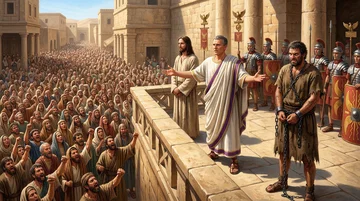
The crowd with one voice demanded that Jesus be taken away and that Barabbas be released to them instead, answering Pilate's proposal to chastise Jesus and let him go under the feast custom of releasing whatever prisoner the people desired.ST Nov 19, 1894ST Mar 13, 1901ST Nov 9, 1882ST Mar 13, 1901ST Oct 7, 1886 Pilate repeatedly declared that he found no fault and no cause for death in Jesus and was willing to release him, yet the crowd persisted until their voices prevailed.ST Jul 11, 1878ST Mar 27, 1901ST May 31, 1899 The man they chose was a notorious robber, murderer and criminal convicted of insurrection and sedition.ST Nov 2, 1882ST Jan 17, 1911ST Mar 13, 1901 In that choice they rejected the innocent Lamb of God and Son of God for a robber and murderer, a cry started by the priests and rulers and taken up by the mob behind whom stood Satan stirring the world to reject the Son of God.ST Nov 2, 1882RH Aug 20, 1901ST May 17, 1899ST Oct 7, 1886RH Jun 24, 1915 Those who cried to do away with Christ will in the last day cry for the rocks and mountains to fall on them to hide them from his wrath, and the same cry is repeated today when people put away the commandments of God and choose the traditions of the man of sin.RH Nov 22, 1906ST Jul 23, 1912RH Jul 15, 1875
Trial Setting and Wording
The cry was raised all at once, all together, in direct answer to Pilate's announcement that he would chastise Jesus and release him, demanding that Jesus be taken away and that Barabbas be released to them instead.ST Nov 19, 1894ST Mar 13, 1901ST Mar 13, 1901 It was the people's answer when Pilate formally asked whom they wished him to release.ST May 17, 1899ST Nov 9, 1882 The demand came under the feast custom by which the governor released one prisoner whomever the people desired, when Pilate asked, Whom will ye that I release unto you, and set Jesus who is called Christ against Barabbas.ST Nov 9, 1882ST Oct 7, 1886ST Nov 9, 1882 He did so as an opportunity to save Jesus, setting the innocent Saviour against the notable robber and murderer to rouse a sense of justice.ST May 17, 1899ST Oct 7, 1886
Pilate repeatedly declared that he found no fault in Jesus and no cause for him to be put to death, and was willing to release him.ST Jul 11, 1878ST Mar 27, 1901ST May 31, 1899 Yet the crowd persisted in demanding condemnation and crucifixion despite his innocence, until their voices prevailed.ST Mar 27, 1901ST May 31, 1899ST Aug 20, 1896 The one they chose in his place was Barabbas, a notorious robber chief, robber and murderer, a criminal charged with and convicted of insurrection, sedition and murder.ST Nov 2, 1882ST Jan 17, 1911ST Mar 13, 1901RH Jun 24, 1915 He had been arrested as a leader in the Galilean unrest, which connects with the massacre ordered by Pilate.ST Feb 16, 1882
The setting was the Passover at Jerusalem, with the city full of people clamoring for his death and throngs filling the city and temple who had come to meet and hear the far-famed Teacher and judge for themselves whether he was Christ.RH Jul 16, 1861RH Nov 23, 1916 Temple funds had been used to bribe the crowd, and Pilate feared unrest but lacked enough soldiers to suppress it.RH Jul 16, 1861 A sentence from the Roman governor of Judea was necessary before proceeding to execution, because the power of life and death was vested in the Roman governor, and the account is minutely accurate and consistent with the customs, opinions, political events, manners and institutions of that time.RH Feb 11, 1862
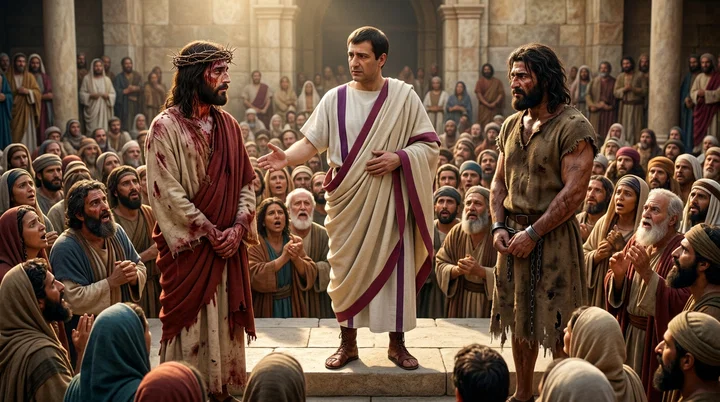
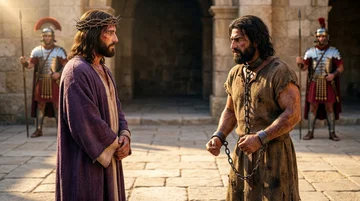
Pilate had Jesus scourged in front of the multitude in the vain hope of stirring pity so the crowd would judge the punishment enough, then placed Jesus side by side with Barabbas for comparison.ST Oct 7, 1886 Jesus stood stripped to the waist showing long cruel stripes with blood flowing freely, with a crown of thorns on his head and his face stained with blood and marked by exhaustion and pain, yet his noble character could not be hidden.ST Oct 7, 1886 Beside him stood Barabbas as a robber chief whose every feature proclaimed a debased and hardened desperado, in marked contrast to Jesus.ST Oct 7, 1886 The two prisoners thus stood side by side as the mob cried for Jesus' crucifixion and for Barabbas' release, and Barabbas recognized Jesus as the boy who had once fed him when he was wounded and starving, yet nevertheless joined the cry against him.ST Jan 17, 1911
Meaning of the Choice
The shout chose a robber and murderer rather than the Son of God, the innocent Lamb of God.ST May 17, 1899RH Jun 24, 1915 It pressed on with demands to crucify him until Pilate, though declaring he found no fault in him, delivered the innocent Christ to be crucified, and the people took his blood upon themselves and their children.ST May 17, 1899 Barabbas had been convicted of practically the same crime of which the rulers charged Jesus and for which they demanded his death, while Jesus was declared innocent.ST Mar 13, 1901 That contrast exposed the insincerity of the Jews, and Pilate's inconsistency in placing a man he had declared innocent on a par with one convicted and leaving the fate of the innocent to the choice of his avowed enemies, in repeatedly asking the people to approve what he knew was his duty, and in offering to scourge an innocent man to appease anger.ST Mar 13, 1901
The demand revealed a preference for a man associated with violent resistance to Roman rule over Jesus, who taught obedience and submission.ST Nov 9, 1882ST Oct 4, 1910 It was part of rejecting Jesus and choosing a violent man who promised deliverance from Roman rule.ST Oct 4, 1910 The Jews rejected Jesus because he did not meet their proud expectation of what the Messiah should be and do, for through centuries of backsliding and pride they had narrowed promises of world salvation to mainly temporal salvation for themselves, expecting the Messiah to subdue their enemies and exalt them as world-leaders with a material kingdom centered at Jerusalem.ST Jul 16, 1902 They failed to discern that spiritual redemption, a spiritual kingdom, and salvation from sin came first in importance and first in time, and that promises of earthly dominion referred to more remote events, so when Jesus presented a spiritual kingdom and salvation from sin that message was unwelcome to minds fixed on the earthly, and his declaration that his kingdom was not of this world led them to call for his removal.ST Jul 16, 1902
In rejecting Jesus the rightful King and demanding his removal, culminating in the cry to crucify him, the people rejected him as their king and chose Barabbas instead, choosing Caesar and human authority in the place of God.ST May 14, 1902RH Jun 29, 1916ST Jan 24, 1906 This rejection expressed their preference for Caesar's rule, and their later efforts to escape Roman power stood against the choice they had made, while the demand for a human ruler instead of God bore bitter fruit when they declared Caesar their king.ST May 14, 1902RH Jun 29, 1916 Jesus is the humble Prince of Peace and King of love, whose kingdom is universal and everlasting, and he is to reign in people's lives, saving them completely.RH Jun 29, 1916 This rejection was part of the abomination that signaled Jerusalem's coming judgment.ST Jan 24, 1906
The demand to release Barabbas instead of Jesus meant the cross that had been prepared for Barabbas was brought out and laid upon Jesus' bruised and bleeding shoulders, so Jesus suffered in Barabbas' place.ST Jul 18, 1878 Crosses were also placed upon the companions of Barabbas to suffer death at the same time with Jesus, and Jesus bore his burden only a few rods before he fell fainting to the ground from loss of blood and excessive weariness and pain.ST Jul 18, 1878 The cry to do away with Jesus and release Barabbas drew no word of retaliation from Jesus.ST Oct 27, 1898 Though innocent, he endured torture and mockery from Herod's and Pilate's soldiers, was scourged, beaten, bruised and bleeding yet unresentful and unresisting, and was handed over to be crucified.ST Oct 27, 1898ST Mar 13, 1901 He knew that this rejection and his coming death were part of the sacrifice through which he would make atonement for human sin and bring salvation to the world, and his life was sacrificed so that human lives might be saved.ST Jul 1, 1897ST Mar 13, 1901
Powers Behind the Cry
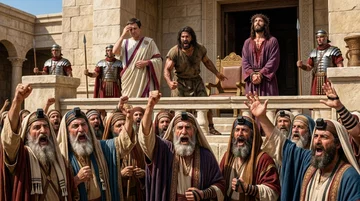
The cry to do away with Jesus and release Barabbas was started by the priests, chief priests and rulers and taken up by the mob, who stirred up and persuaded the multitude until the popular cry against him became widespread and almost deafening.ST Nov 2, 1882ST Oct 7, 1886ST Mar 26, 1912 It resounded through the hall like the hoarse cry of demons, to Pilate's great astonishment.ST Oct 7, 1886 Behind that united frenzied cry stood Satan, the great apostate, stirring the world to reject the Son of God and choose a robber and murderer in his place.RH Aug 20, 1901ST Jul 23, 1912ST Apr 15, 1897 He had confederated with the priests and rulers of the Jewish nation to kill Christ, working with fierce determination to destroy the champion of God and of truth and by one desperate act to cut off all communication between the world and heaven.ST Apr 15, 1897 His influence could turn people into liars and murderers and stir a mob against the Prince of Life.ST Jul 23, 1912
That decision was a sight for the heavenly universe, watched from the heavenly courts by angels with intense interest.ST Apr 15, 1897 The Jews would yield neither to law nor justice in the declarations of both Pilate and Herod, who found no crime in Jesus and found him worthy of no punishment, nor to pity at the sight of the scourged, beaten, bruised, bleeding, unresentful and unresisting Christ.ST Oct 27, 1898 Pilate feared them and remained undecided, yet listened to the mob and sent an innocent man to the cross as a criminal, and the demand reflects the power of prejudice.ST Oct 27, 1898ST Aug 20, 1896 Pilate and Herod were sorry yet went on in wrongdoing, showing that sorrow that does not turn the sinner from sin is not the God-given sorrow that breaks and heals the heart.RH Sep 22, 1863
The people's demand opposed God's will, for the crowd rejected Christ who is himself the Voice of God, and its insistence led the earthly ruler to take his life.ST May 31, 1899ST Jun 28, 1905 The voice of the people is the voice of God only when individuals are commissioned by him to speak his will.ST Jun 28, 1905 The scene shows the madness of sin and the cruelty of the world's treatment of Jesus.RH Jun 10, 1862 It belonged to his approach to the cross and descent into the depths of humiliation, when he in whom the disciples' hopes of eternal life were centered was in the hands of wicked men and was scourged as the worst of criminals.ST Jul 7, 1898 Witnessing this tried the disciples' faith and caused their hope and courage to fail, giving them cause to mourn and fast when the Bridegroom was taken from them.ST Jul 7, 1898
Judgment and Future Reckoning
The united cry for Barabbas was the rejection of the Messiah by His own people, choosing a murderer over the Son of God and refusing the salvation offered through Him.RH Aug 19, 1873 That rejection came despite the Scriptures and the sacrifices that pointed to His coming, ministry, suffering, and resurrection.RH Aug 19, 1873 It was a choice of Caesar instead of their rightful King, putting human authority in the place of God.ST Jan 24, 1906 That choice brought judgment upon the nation, including the destruction of Jerusalem, mass slaughter, and dispersion, and it stood as part of the abomination that signaled coming judgment.RH Aug 19, 1873ST Jan 24, 1906
Those who cried to do away with Christ will in the last day cry for the rocks and mountains to fall on them to hide them from the wrath of the One they condemned, with no escape.RH Jul 15, 1875 At Christ's coming, those who rejected light and refused obedience will recognize the sacrifice and love they rejected.RH Nov 22, 1906 They will hear that cry again as part of the condemnation of Christ they chose.RH Nov 22, 1906 Those who rejected and crucified Him, whom Satan's influence had turned into liars and murderers against the Prince of Life, will then see Him as King of Kings and Lord of Lords.ST Jul 23, 1912
The cry belongs to the account in which the Jewish priests and rulers forced the Roman governor to do their will, with the elders and chief priests leading the demand for Jesus to be crucified and Barabbas released.RH Nov 11, 1915RH Jun 15, 1911 Jesus endured the abuse of the mob in a silence that amazed all who watched, and Pilate marveled at it.RH Jun 15, 1911 Pilate repeatedly pronounced Jesus innocent and called Him a just person, and he was troubled all the more when he heard that Jesus had claimed to be the Son of God, knowing He was different from any man he had ever met.RH Jun 15, 1911 Yet because the terrible demon-like howling of the mob prevailed in the crisis, Pilate permitted Jesus to be led away and crucified, though Jesus remained faithful under the opposition.RH Nov 11, 1915RH Jun 15, 1911 In marvelous love for the murderers of His Son, God the Father still sent Jesus first to those same men to bless them by turning every one of them away from his iniquities.RH Jun 15, 1911
His condemnation and crucifixion marks the path His followers may also have to walk.RH Dec 24, 1867 They too may be misunderstood, cast out, and treated as vile after the pattern of the innocent Jesus rejected and the wicked murderer Barabbas chosen in His place.RH Dec 24, 1867 His example teaches them to bear hardship meekly and to seek God's approval rather than the world's.RH Dec 24, 1867
Present Warning and Application
The same cry sounds louder today, not in words but in deeds, when people set aside the commandments of God and choose instead the pleasing traditions of the man of sin.RH Jul 15, 1875 Those who join in that present rejection will at last call in vain for the rocks and mountains to fall and hide them from the wrath of the soon-coming Lord, with no escape from it.RH Jul 15, 1875 Deliverance lies only in keeping both the commandments of God and the faith of Jesus, which prepares for a home in the earth made new.RH Jul 15, 1875
The same bitter hatred and malignity once aimed at Christ is now aimed at those who keep God's commandments because they will not worship the institution of the papacy.RH Aug 20, 1901 Through wicked men the whole world is stirred against them, and whenever envy, hatred, and unbelief are allowed to rule the heart, the result is persecution of God's people just as the Jews persecuted Christ.RH Aug 20, 1901 The demand to put Christ out of the way falls on him in the person of his people, when religious lawmakers employ civil power to silence those whose worship differs from their own, including over Sunday observance.ST That united clamor which placed the Son of God on the cross proves that popular sentiment has no truth or justice as its foundation and cannot make enforcement right, including enforcement of Sunday laws.STST May 10, 1910
The same spirit appears when familiar wrongdoing is tolerated while challenging conduct is condemned, as when common Sunday activities pass without notice yet alarm is raised over an Adventist teacher sawing lumber.ST Dec 18, 1893 Christ is still unwanted as an intruder, put away swiftly by bloody hands, with dominant religion feeling no need for such a Christ.ST Jul 26, 1883 Great Christendom cherishes a Christ afar off yet will have nothing to do with a personal Jesus coming soon to reign literally upon the earth, and those who profess they would welcome him would likely reject him if, as before, he denounced the powerful and associated with publicans and the lower orders.ST Jul 26, 1883RH Jun 6, 1871
The scene lays bare what people do when they reject God's grace, for they come under the control of a spirit opposed to Christ. That same spirit still dwells in human hearts, so human guidance cannot be trusted in place of Christ by those who would remain loyal to him. Passion, violence, and force employed to defend religion or religious custom, as in the like cry raised against Paul, produce only wickedness and are not Christ's way, for he taught a nobler one.ST Sep 23, 1897
Sources