Luke 7:36
And one of the Pharisees desired him that he would eat with him. And he went into the Pharisee’s house, and sat down to meat.
Translations
American King James Version, King James Version, KJV Cambridge Paragraph Bible
And one of the Pharisees desired him that he would eat with him. And he went into the Pharisee’s house, and sat down to meat.
And one of the Pharisees desired him that he would eat with him. And he went into the Pharisee's house, and sat down at table.
Revised Version, American Standard Version
And one of the Pharisees desired him that he would eat with him. And he entered into the Pharisee’s house, and sat down to meat.
And a certain one of the Pharisees was asking him that he might eat with him, and having gone into the house of the Pharisee he reclined (at meat),
But one of the Pharisees begged him that he would eat with him. And entering into the house of the Pharisee he took his place at table;
And a certain one of the Pharisees was requesting him, that he would eat with him; and, entering into the house of the Pharisee, he reclined.
Berean Standard Bible, Majority Standard Bible
Then one of the Pharisees invited Jesus to eat with him, and He entered the Pharisee’s house and reclined at the table.
One of the Pharisees invited him to eat with him. He entered into the Pharisee’s house and sat at the table.
And one of the Pharisees made a request that he would take a meal with him. And he went into the Pharisee's house and took his seat at the table.
And one of the Pharises desired him that hee would eate with him: and hee went into the Pharises house, and sate downe at table.
Douay-Rheims (Challoner revision)
And one of the Pharisees desired him to eat with him. And he went into the house of the Pharisee, and sat down to meat.
Pictures

Cross-references
- Luke 7:47
Wherefore I say unto thee, Her sins, which are many, are forgiven; for she loved much: but to whom little is forgiven, the same loveth little.
Jesus connects great forgiveness with great love.
- Luke 7:41-43
There was a certain creditor which had two debtors: the one owed five hundred pence, and the other fifty.
The forgiven debtors illustrate that greater forgiveness leads to greater love.
- Matthew 26:6-13
Now when Jesus was in Bethany, in the house of Simon the leper,
This recounts a distinct anointing of Jesus at a meal in Bethany.
- Luke 7:48-50
And he said unto her, Thy sins are forgiven.
Jesus declares forgiveness and life to the woman.
- Luke 7:44
And he turned to the woman, and said unto Simon, Seest thou this woman? I entered into thine house, thou gavest me no water for my feet: but she hath washed my feet with tears, and wiped them with the hairs of her head.
Jesus contrasts Simon’s failure to provide water with the woman’s washing of his feet.
- Luke 11:37-54
And as he spake, a certain Pharisee besought him to dine with him: and he went in, and sat down to meat.
Cited as evidence that the invitation was meant to expose Jesus to accusation.
- Luke 5:29
And Levi made him a great feast in his own house: and there was a great company of publicans and of others that sat down with them.
listed together as witnesses to eating and drinking
- Matthew 9:10-11
And it came to pass, as Jesus sat at meat in the house, behold, many publicans and sinners came and sat down with him and his disciples.
Jesus eats with sinners.
- Mark 14:3
And being in Bethany in the house of Simon the leper, as he sat at meat, there came a woman having an alabaster box of ointment of spikenard very precious; and she brake the box, and poured it on his head.
Records the Bethany meal setting associated with Luke’s account.
- Luke 19:5-7
And when Jesus came to the place, he looked up, and saw him, and said unto him, Zacchæus, make haste, and come down; for to day I must abide at thy house.
Christ accepts Zacchaeus as his host.
Commentary
Each commentary is drawn from primary sources: the writings of Ellen G. White and Adventist pioneers and periodicals. Each commentary is separate. Its own words are not a quotation; follow the references to read the source passages.
Ellen G. White
12 sources
Luke 7:36 opens the account of a meal at the Pharisee Simon's house, where Simon invites Jesus to eat and Jesus enters the house and sits down to eat.DA 5572SP 382.32SP 381.119MR 259.1–3Ms 24, 1891, par. 88 The host is Simon of Bethany, a Pharisee healed of leprosy who was drawn to Jesus by that healing.DA 557.1–2 He had openly joined His followers and acknowledged Him as a teacher, and from gratitude he held a feast for Jesus and His disciples, while still only hoping He might be the Messiah without accepting Him as Saviour and without a transformed character.DA 557.1–2
Jesus' acceptance shows His genial and beneficent character and deliberate mission to seek the company of wealthy and influential people.MH 24.215MR 132.2–3 He joined ordinary social gatherings, attended their feasts, and took interest in their lives in order to reach their hearts and reveal imperishable riches.MH 24.26T 173.2MYP 406.2 By His presence He gave them opportunity to become acquainted with Him and know His character.15MR 132.2–3 Going into the Pharisee's house was not worldly conformity or approval of error but liberal mercy, refusing seclusion and self-righteous bigotry and giving no excuse for Pharisaical preeminence.15MR 132.2–3
By His presence, precious teachings, and generous conduct He won the hearts of those who honored Him.15MR 132.2–3 He thereby revealed the marked contrast between His life and teachings and the spying, condemning, bigoted, and selfish ideas of salvation held by Pharisees who blamed every move not in harmony with their rules.15MR 132.2–3 Without adopting the usual conversation of such gatherings, Jesus used the dinner to give lessons suited to the needs of His hearers.19MR 259.1–36T 173.2MYP 406.2 He taught with tact and made truth clear and compelling rather than forcing belief, and thereby taught His disciples by example how to conduct themselves among both religious and nonreligious people.19MR 259.1–3Ms 24, 1891, par. 886T 173.2MYP 406.2
At this meal He pardoned Mary Magdalene, showing Himself as a friend of women who is ready to help and forgive.ST The setting contrasts outward hospitality with the humility, love, and gratitude that follow forgiveness, since Simon felt superior to the sinful woman who came to Jesus and failed to show Jesus the care due an honored guest, while the woman's loving attention showed gratitude for mercy.2SP 381.1 Simon thought he loved Jesus, but his love was self-righteous and false, and it was exposed when Jesus honored a poor, sorrowful, repentant woman above him, showing that true love for Christ can never dwell in a self-righteous heart.RH Sep 25, 1900
Not to see one's own deformity and sinfulness is not to see the beauty of Christ's spotless character, so the more humble the view of self the more clearly Jesus is seen and appreciated.RH Sep 25, 1900 The degree of love for God depends on the clearness and fullness of conviction of sin learned by the law and on seeing the perils sin brings and gratitude for deliverance.RH Sep 25, 1900 Jesus exposed Simon's neglect and unbelief but corrected him with patient kindness rather than public denunciation.2SP 382.3 Leading him with tact, He brought him to recognize that the one forgiven more loves more and that Christ must love most the person He forgave most, so that Simon recognized the greatness of his debt to Jesus, repented, and became humble and self-sacrificing.2SP 382.319MR 259.1–3Ms 24, 1891, par. 88
Sources
Pioneers and periodicals
49 sources
One of the Pharisees, Simon, invited Jesus to eat with him at his house at Capernaum, and Jesus entered and took his place at the meal in the customary reclining manner.ST Apr 9, 1894ST Jun 13, 1900ST Apr 9, 1894ST Jun 9, 1881RH Dec 10, 1901 Simon gave him no kiss of greeting, no water for his feet, and no oil for his head, treating the invitation itself as honor enough.ST Aug 5, 1886ST Feb 7, 1884RH Jun 16, 1868ST Jun 9, 1881 Jesus came not merely to share the meal but to seek the lost, mingling even with Pharisees and entering their homes while remaining distinct from their spirit.RH Nov 19, 1908ST Apr 10, 1907ST Jun 28, 1905 There a sinful woman came with ointment in gratitude for much forgiveness, washing his feet with tears, wiping them with her hair, kissing them and anointing them, and he received, cleansed and pardoned her.STRH Dec 3, 1867RH May 12, 1903ST Aug 13, 1902ST Jul 28, 1898 Her great love shows what she had received, for in the parable of the two debtors both are freely forgiven and the one forgiven more loves more, teaching forgiveness of one another and of enemies in order to be delivered from revenge, hate and anger.ST Apr 7, 1898RH May 12, 1903ST Aug 13, 1902
Invitation, Host and Setting
At Capernaum during the second circuit through Galilee, one of the Pharisees invited Jesus to eat with him, and Jesus entered the house and sat down to meat.ST May 17, 1899 That meal provides the setting where a sinful woman of the city comes with an alabaster cruse of ointment, the Pharisee questions inwardly, and Jesus teaches and forgives.ST May 17, 1899 The host is a Pharisee named Simon, who invited Jesus to eat at his house, and Jesus accepted the invitation, entered, and took his place at the meal.ST Apr 9, 1894ST Apr 9, 1894ST Apr 9, 1894 This acceptance opens the account of the sinful woman's anointing and forgiveness, in which she comes to him, kisses his feet, receives comfort and pardon, and hears his teaching about forgiveness and faith, while Simon regards her touch as disgraceful.ST Jun 13, 1900ST Apr 9, 1894ST Apr 9, 1894RH Dec 22, 1904ST Aug 13, 1902
Simon had been a leper whom Jesus healed, restoring his manhood and rescuing him from the leper's home.ST Jan 3, 1911 Jesus ate as guest in Simon's house as the guest of honor, with the disciples and others sitting at table with him.ST Oct 9, 1879RH Oct 16, 1913 The occasion gave social fellowship and relief from the demands of public work.RH Oct 16, 1913 At that meal her anointing was published to all present when the odor of the ointment filled the house, and some disciples showed displeasure while Judas openly condemned it as wasteful extravagance, though as treasurer of the united funds he dishonestly appropriated means designed for God's service and was a stranger to the devotion that moved her.ST Oct 9, 1879 Simon was influenced by their words until his heart was filled with unbelief, so that he hated the woman, felt humbled before his guests, almost regretted the feast, and judged in his secret heart that Jesus was no prophet and should hold no communication with her because of her past life, even though Jesus had healed him and now showed gracious favor to Mary whose sins were many.ST Oct 9, 1879ST Jan 3, 1911ST Aug 5, 1886
The invitation was probably meant to draw Jesus into a private setting where he might be compromised and evidence found against him, as shown by the later scene in Luke 11:37-54.ST May 17, 1899 The invitation showed unusual consideration because Pharisees were careful about whom they ate with for fear of ritual defilement through association, suggesting Simon was drawn to Jesus.ST Jun 9, 1881 His courtesy gave way to cold condescension when Jesus accepted.ST Jun 9, 1881 Simon professed to be a follower of God but had committed grievous sins, and Jesus accepted the dinner because he came into the world to save sinners.RH Dec 10, 1901
The meal was eaten in customary reclining style, with guests resting on couches around a low table and their feet extending behind them while conversing together.ST Jun 9, 1881RH Dec 10, 1901 It took place in a setting where guests and visitors could mingle.ST Jun 9, 1881 There Simon's strict religious formality and concern for respectability contrasted with Jesus' compassionate welcome toward a shamed, penitent woman who came in gratitude and hope of restoration.ST Jun 9, 1881
Customs and Neglected Hospitality
A proper welcome included a greeting kiss, provision for washing the guest's feet, anointing the head and beard with oil, and washing hands before eating.ST Jun 9, 1881 These courtesies gave refreshment to the traveler and secured ceremonial cleanliness.ST Jun 9, 1881 They belonged to the customary manner of receiving a guest at a meal such as the one in the Pharisee's house.ST Jun 9, 1881
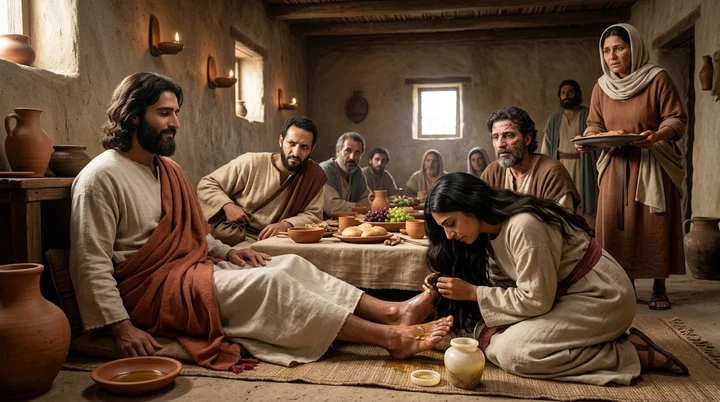
Guests were given water so they could wash their own feet, but washing another person's feet was not the ordinary duty or expectation of a host.ST Aug 5, 1886ST Feb 7, 1884RH Jun 16, 1868 Simon treated the invitation itself as sufficient honor and gave Jesus no water for His feet.ST Oct 9, 1879ST Aug 5, 1886ST Feb 7, 1884RH Jun 16, 1868 The penitent woman washed His feet with her tears and wiped them with her hair, and her act was a token of love, not an act of customary hospitality.ST Aug 5, 1886ST Feb 7, 1884RH Jun 16, 1868 Jesus reproved Simon's omission when her act raised the matter, and this shows that the feet-washing at the Lord's Supper was not a lesson in hospitality.ST Feb 7, 1884RH Jun 16, 1868 Her loving attention contrasts with the host's neglect, and Jesus commended her heartfelt courtesy.ST Oct 9, 1879ST Aug 5, 1886
Anointing Event and Parallels
Luke 7:36-50 describes an anointing in which Jesus' feet were anointed, and anointing the feet was an ordinary act of honor and hospitality.ST May 12, 1914 Mary also anointed Jesus' head, and the act carried the deeper meaning of preparing his body for burial, so the accounts that mention his feet and the account that mentions his head give different features of the same event and not conflicting details.ST May 12, 1914 Those who distinguish the occasions hold that the anointing at the Pharisee's house is not necessarily the same event as the anointing described in Matthew 26:6-16 or at Bethany, since similar events may be placed together in Scripture even when they occurred at different times.ST Sep 20, 1899ST Sep 20, 1899
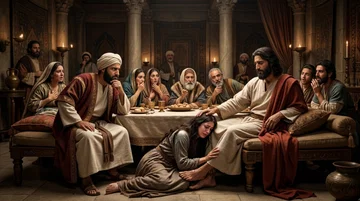
Luke 7:36 sets the scene at a meal in a Pharisee's house where Jesus is present and a sinful woman comes to honor him despite scorn from the company.RH Dec 3, 1867 She is Mary Magdalene, a great sinner whose sins were many, who silently expresses repentance, love and gratitude because much has been forgiven her.RH Dec 3, 1867RH May 12, 1903ST Aug 5, 1886 She brings an alabaster cruse of ointment and humbly anoints his feet with all she has, doing what she could, washing his feet with her tears and wiping them with her hair, with tears, hair, kisses and ointment honoring a Saviour whom others treat with neglect.RH Dec 3, 1867RH May 12, 1903ST Aug 13, 1902 Though she has not audibly asked for forgiveness, Jesus knows her heart, comforts and heals the sin-stricken woman seeking pardon, and her great love shows what she has received.RH May 12, 1903ST Aug 13, 1902
At that meal her anointing was published to all present when the odor of the ointment filled the house with fragrance.ST Oct 9, 1879 Some of the disciples showed displeasure at her act and Judas openly condemned it as wasteful extravagance, though as appointed treasurer of the united funds of the disciples he dishonestly appropriated to himself means designed for the service of God and was a stranger to the deep devotion and homage that moved her.ST Oct 9, 1879 Simon was influenced by their words until his heart was filled with unbelief, and he judged that because of her past life Jesus should hold no communication with her.ST Oct 9, 1879 The scene in Simon's house centers on an anonymous penitent woman adoring Jesus, and her adoration was service to the Lord, placing her among the many anonymous women who served him and showing the conspicuous place women occupy in the primitive church and in the four Gospels. The verse stands as an example of honoring someone with precious ointment while still alive, rather than waiting until they can no longer hear or receive such kindness.RH Jul 3, 1913
Forgiveness, Love and Faith
Luke 7:36 opens the account of the parable of the two debtors in Luke 7:35-50, which teaches the forgiving spirit and is to be studied with the parable of the unforgiving servant in Matthew 18:21-35.ST Apr 7, 1898 It is one of the most important lessons for Christians to learn, bearing on forgiving one another and forgiving enemies.ST Apr 7, 1898 The aim of forgiveness is the deliverance of self and others from sin by putting revenge, hate, and anger out of the heart and gaining victory over self, and by influencing others to repent and forsake sin, because hate inflames hate but love kindles love, and learning from God's forgiveness teaches how to forgive others.ST Apr 7, 1898
In the parable both debtors are freely forgiven, and the one forgiven more loves more, for forgiveness gives rise to love and love and forgiveness are inseparable.RH May 12, 1903 At the meal in the Pharisee's house a sin-stricken woman seeking pardon humbly anointed his feet with all she had and wiped them with her hair, and her great love shows what she has received and that she has done what she could.RH May 12, 1903ST Aug 13, 1902 Though she had not audibly asked for forgiveness, he knew her heart and the condemning thoughts of Simon.RH May 12, 1903
Here he pardoned Mary Magdalene and comforted and healed her, speaking forgiveness and life to one sinful woman and showing the value he places on saving a single soul.STST Apr 4, 1911ST Jul 8, 1886 He allowed the penitent woman to approach and touch him, revealing his gentleness and tenderness as a friend of women ready to help and forgive, in whose treatment of her God's character is made known.STST Feb 25, 1897 The penitent woman who washed his feet with her tears and wiped them with her hair received cleansing from sin through contact with him, illustrating that faith reaching him receives his life, which purifies and heals.ST Jul 28, 1898
He knew Simon's hidden thoughts and sins, yet did not expose or humiliate him before the guests, and his love led Simon toward humility and contrition.RH May 12, 1903ST Jan 3, 1911 He had entered Simon's house not merely to share a meal but to teach, knowing what would happen and wanting Simon to recognize himself as a pardoned sinner whose gratitude should have honored the love behind Mary's costly gift.ST Dec 10, 1894 Simon's resentment showed pride and jealousy and failure to understand his own need for pardon.ST Dec 10, 1894
Simon thought he loved Jesus, but his love was self-righteous and false, exposed when Jesus honored a poor, sorrowful, repentant woman above him, for true love for Christ can never dwell in a self-righteous heart.RH Sep 25, 1900 Not to see one's own deformity and sinfulness is not to see the beauty of Christ's spotless character, and the more humble the view of self the more clearly Jesus is seen and appreciated.RH Sep 25, 1900 The degree of love for God depends on the clearness and fullness of conviction of sin learned by the law, on seeing the perils sin brings, and on gratitude for deliverance.RH Sep 25, 1900
At Simon's table Simon and his friends condemned Mary as a sinner for washing Christ's feet and doubted he was a prophet for receiving her, reasoning that if he were a prophet he would have known who and what manner of woman touched him, and if he had known he would have spurned her.RH Aug 27, 1914 Christ refused to condemn her and defended her deed as good and acceptable to him.RH Aug 27, 1914 He rewarded her outward touch with his inward touch in binding up her broken heart and anointing her with the oil of joy for mourning, because he had already lifted her up by casting out her evil and forgiving the same sin over and over, so her kneeling was pure worshipful gratitude and not service only, and to have voiced their condemnation would have broken her heart.RH Aug 27, 1914
Simon's strict religious formality and concern for respectability contrasted with Jesus' compassionate welcome of a shamed, penitent woman who came in gratitude and hope of restoration, while she kissed his feet and Simon regarded her touch as disgraceful.RH Dec 22, 1904ST Jun 9, 1881 Jesus welcomed the guilty, timid woman's silent expression of love through tears even in the presence of austere hypocrisy.RH Sep 4, 1855 When the proud Pharisee brought repentant Mary before Jesus and accused her, the contrast showed the Pharisee more guilty before God than Mary because he had greater light and knowledge, and that guilt also depends on the motives behind an act.RH Jul 28, 1910
Mission Pattern and Christian Conduct
By entering the Pharisee's house to eat with him, Jesus did the work of the great missionary, visiting homes as part of what he did for the people he came to save.RH Nov 19, 1908 He mingled with people from every class, including those regarded as degraded, without favoring the high or rich over the low or poor, and he was humble and friendly with sinners in order to save them.RH Jan 8, 1914 He accepted the Pharisee's invitation to dine at his house, where a sorrowful sinner came to him, being present among the socially respected for the sake of the outcast and broken.ST Apr 10, 1907 He entered Simon the sinner's house and dined with him because he was seeking lost souls, engaging with both Simon and Mary Magdalene, who washed his feet with her tears and wiped them with her hair.RH Jan 8, 1914
He went among the Pharisees to save sinners while remaining distinct from them and the spirit of the world, not adopting their principles or customs.ST Jun 28, 1905 They could learn from him, though he learned from them only how greatly they needed salvation.ST Jun 28, 1905 He drew near to sinners instead of standing aloof, allowing the sinful woman weeping at his feet to touch him and anoint him. Simon thought this tolerance proved lack of prophetic insight and nullified his high claims, reasoning that if he were a prophet he would have known who and what manner of woman touched him, and if he had known he would have spurned her.
Jesus answered by showing that her outward touch was acceptable to him and that he had rewarded it by his inward touch in binding up her broken heart and anointing her with the oil of joy for mourning. He received and ate with sinners so they might in turn receive him and have power to become the sons of God and sit down at the marriage supper of the Lamb. His successful following, seeking, and watching for the lost makes the highest joy in heaven. He accepted an invitation to dine in a Pharisee's home even though the host was covetous, showing that he does not reject people or homes because they are wealthy.RH Apr 8, 1902
In his mission to save the lost he met Mary Magdalene the sinner and spoke to her in words of love and hope.ST Oct 2, 1893 Consorting with publicans and sinners in this way does not justify going into dives on a drinking spree and leaving appointed work undone.ST Oct 2, 1893 The sinful woman came to him despite the Pharisee's disapproval, showing that sinners should not let shame or fear keep them from Jesus.ST Apr 9, 1894 They can abide with him, and their sin will be driven away.ST Apr 9, 1894
The meal teaches not to condemn sinners now, because condemning can ruin them and bring eternal ruin on the condemner.RH Aug 27, 1914 Simon and his friends condemned Mary as a sinner for washing Christ's feet and doubted he was a prophet for receiving her, but Christ refused to condemn her and defended her deed as a good work.RH Aug 27, 1914 He knew he had already lifted her up seven times by casting out her evil and forgiving the same sin over and over, and her kneeling was pure worshipful gratitude and not service only, so that to have voiced their condemnation would have broken her heart.RH Aug 27, 1914 Her act of devotion was also wrongly assigned a base motive, and Jesus was imagined to have reason to forbid it, which warns against condemning people by inventing evil motives for their actions.RH Sep 22, 1874 Each person should therefore ask how many times Christ has given him another chance and cast the same evil from his own heart, remembering that sins other than adultery can be just as heinous in God's sight.RH Aug 27, 1914
The scene where the sinful woman from the street came to Jesus while he ate and bathed his feet with her tears and wiped them with her hair shows what heaven is like.RH Oct 28, 1915 It is life with Jesus with all the conflict of human sin left out, with peace, joy, victory, triumph, life, love, and tireless, faithful, unselfish service going on forever.RH Oct 28, 1915 That heaven is reached by following Christ today, tomorrow, and the day after through prayer and right living.RH Oct 28, 1915 Coming after the lesson drawn from the teaching of John the Baptist, the anointing begins a wonderfully interesting, touching, uplifting, and pathetic account giving material for meditation and spiritual growth every day.ST Mar 24, 1909
With the miracles and teaching in Luke 4:31-7:50, including the healing of the centurion's servant and the raising of the widow's son at Nain, it speaks of the goodness and mercy of God and stands in mighty contrast to Israel's low condition in the time of the judges.ST Mar 24, 1909 By going into the Pharisee's house and sitting down to eat at Simon's table, Jesus showed he had a true human body and came like one of ourselves eating and drinking.ST Apr 11, 1878 He was born as other children are born, walking on earth, breathing its air, drinking its waters, and living upon its food as all other men do, dependent on the physical supports of life.ST Apr 11, 1878
Sources