Mark 11:13
And seeing a fig tree afar off having leaves, he came, if haply he might find any thing thereon: and when he came to it, he found nothing but leaves; for the time of figs was not yet.
Translations
American King James Version, King James Version
And seeing a fig tree afar off having leaves, he came, if haply he might find any thing thereon: and when he came to it, he found nothing but leaves; for the time of figs was not yet.
and seeing a fig tree afar off having leaves, he came, if haply he might find any thing thereon: and when he came to it, he found nothing but leaves; for the time of figs was not yet.
And seeing a fig-tree afar off, having leaves, he came, if haply he might find any thing on it: and when he came to it, he found nothing but leaves: for the time of figs had not yet come.
Revised Version, American Standard Version
And seeing a fig tree afar off having leaves, he came, if haply he might find anything thereon: and when he came to it, he found nothing but leaves; for it was not the season of figs.
and having seen a fig-tree afar off having leaves, he came, if perhaps he shall find anything in it, and having come to it, he found nothing except leaves, for it was not a time of figs,
And seeing from afar off a fig-tree which had leaves, he came, if perhaps he might find something on it. And having come up to it he found nothing but leaves, for it was not the time of figs.
and, seeing a fig-tree from afar, having leaves, he came… if, therefore, he should find aught in it, and, coming up to it, nothing, found he, save, leaves; for it was not, the season, of figs.
Berean Standard Bible, Majority Standard Bible
Seeing in the distance a fig tree in leaf, He went to see if there was any fruit on it. But when He reached it, He found nothing on it except leaves, since it was not the season for figs.
Seeing a fig tree afar off having leaves, he came to see if perhaps he might find anything on it. When he came to it, he found nothing but leaves, for it was not the season for figs.
And seeing a fig-tree in the distance with leaves, he went to see if by chance it had anything on it: and when he came to it, he saw nothing but leaves, for it was not the time for the fruit.
And seeing a fig tree afarre off, that had leaues, he went to see if he might finde any thing thereon: but when he came vnto it, hee found nothing but leaues: for the time of figges was not yet.
Douay-Rheims (Challoner revision)
And when he had seen afar off a fig tree having leaves, he came if perhaps he might find any thing on it. And when he was come to it, he found nothing but leaves. For it was not the time for figs.
Pictures
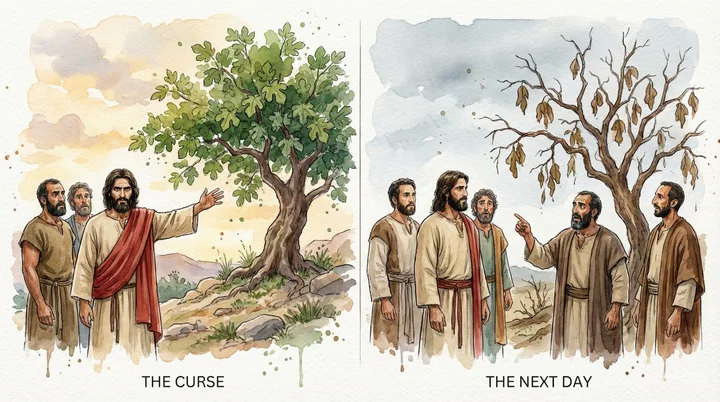
Cross-references
- Matthew 21:18-19
Now in the morning as he returned into the city, he hungered.
This parallel account describes Christ cursing the fruitless fig tree.
- Mark 11:20-21
And in the morning, as they passed by, they saw the fig tree dried up from the roots.
continuation of same fig-tree events
- Luke 13:6-9
He spake also this parable; A certain man had a fig tree planted in his vineyard; and he came and sought fruit thereon, and found none.
The barren tree illustrates the parable’s warning that the time comes to cut down an unfruitful tree.
- Matthew 7:16-20
Ye shall know them by their fruits. Do men gather grapes of thorns, or figs of thistles?
Fruit reveals what a life produces and tests its profession.
- Mark 11:21
And Peter calling to remembrance saith unto him, Master, behold, the fig tree which thou cursedst is withered away.
Peter recalls Jesus’ curse and the fig tree’s withering.
- Genesis 3:7
And the eyes of them both were opened, and they knew that they were naked; and they sewed fig leaves together, and made themselves aprons.
The fig leaves fail to conceal Adam and Eve’s nakedness, like outward show failing to hide barrenness.
- Matthew 21:20-22
And when the disciples saw it, they marvelled, saying, How soon is the fig tree withered away!
The disciples see the fig tree withered, and Jesus teaches about faith and prayer.
- John 15:8
Herein is my Father glorified, that ye bear much fruit; so shall ye be my disciples.
Its call to bear much fruit frames the lesson drawn from the barren fig tree.
- Matthew 3:10
And now also the axe is laid unto the root of the trees: therefore every tree which bringeth not forth good fruit is hewn down, and cast into the fire.
Fruitless trees are cut down and cast into the fire.
- Romans 6:22
But now being made free from sin, and become servants to God, ye have your fruit unto holiness, and the end everlasting life.
True fruit contrasts with a leaves-only profession.
- Mark 11:22-25
And Jesus answering saith unto them, Have faith in God.
The lesson on faith is listed among the lessons in this section.
Commentary
Each commentary is drawn from primary sources: the writings of Ellen G. White and Adventist pioneers and periodicals. Each commentary is separate. Its own words are not a quotation; follow the references to read the source passages.
Ellen G. White
61 sources
Hungry, Jesus saw afar off a fig tree covered with leaves, came to it expecting fruit, and searched it thoroughly but found nothing but leaves, for ripe figs were not yet generally in season.3SP 17.2–3ST Jul 21, 1909ST Feb 21, 1878Ms 109, 1909, par. 5512MR 406.2–3 Since figs normally appear before the leaves open, a tree already in full foliage promised well-developed fruit and its show of leaves proved deceptive.3SP 17.2–3Ms 7a, 1886, par. 12–13Ms 32, 1898, par. 1–3Ms 58, 1895, par. 7–11ST Jul 21, 1909 The leafy but fruitless tree was an acted parable of the Jewish nation, richly favored with truth and opportunity yet barren in piety and good works, whose outward religion of ceremony and temple concealed pride, selfishness, hypocrisy and oppression.DA 580.2–581.2DA 580Ms 7a, 1886, par. 12–13Ms 32, 1898, par. 1–3Ms 21, 1902, par. 31–32 Its leaves stand for profession without inward life, while the fruit Christ hungers for and must have is humility, love, righteousness, self-sacrifice, obedience and souls won to salvation.Ms 58, 1895, par. 7–11Ms 168, 1902, par. 10–11DA 582.3–583.2FE 50.1Lt 16, 1888, par. 43 Therefore His cursing and withering of the tree declares the certain doom of fruitlessness, fulfilled in Jerusalem's destruction, and stands as a living warning to all churches and professors to the close of history that show without service brings judgment.ST Feb 15, 1899Ms 32, 1898, par. 11–123SP 19.212MR 406.2–3Lt 35, 1895, par. 8–9
Setting and Natural Meaning
Hungry, Jesus saw afar off a fig tree having leaves, came to it expecting to find fruit upon it, and searched its branches thoroughly from topmost twig to lowest bough but found nothing but leaves.3SP 17.2–3Ms 109, 1909, par. 5512MR 406.2–3Ms 67, 1903, par. 25–26Ms 32, 1898 Its rich foliage promised abundant fruit, yet it flaunted its flourishing branches in the very face of justice with only a show of leaves to satisfy His need.Ms 109, 1909, par. 5512MR 406.2–3Ms 67, 1903, par. 25–26Lt 120, 1907, par. 1–2Ms 32, 1898 The journey was from Jerusalem to Bethany.Ms 21, 1902, par. 29–30 Those who place it the other way hold it was from Bethany to Jerusalem.Ms 168, 1902, par. 10–11
Figs normally begin to grow and appear before the leaves open, so a tree already covered with full foliage gave reason to expect fruit and promised well-developed fruit.Ms 7a, 1886, par. 12–13Ms 32, 1898, par. 1–3ST Jul 21, 1909ST Feb 15, 1899ST Feb 21, 1878 The other trees had not yet put forth leaves, while this tree appeared unusually advanced and likely to have well-developed figs.Ms 7a, 1886, par. 12–13ST Jul 21, 1909ST Feb 15, 1899DA 581.3–582.1 Ripe figs were generally not yet in season, especially on the elevated height of Olivet and the highlands near Jerusalem, though they could be found in some places.3SP 17.2–3ST Jul 21, 1909ST Feb 21, 1878DA 581.3–582.1 Its full covering of leaves therefore raised an expectation that its branches did not meet, for its lush appearance falsely suggested that fruit was present.Ms 58, 1895, par. 7–11ST Jul 21, 1909ST Feb 21, 1878DA 581.3–582.1
The tree's beautiful, flourishing leafiness was deceptive and concealed its barrenness.3SP 17.2–3Ms 58, 1895, par. 7–11DA 581.3–582.13SP 18.1–2 Jesus used it as a symbol to teach divine truth.3SP 17.2–3
Judgment Upon Fruitless Israel
Finding nothing but leaves declares the doom of a fruitless people, and the withering that followed was an acted parable and a miracle given within hours to open the disciples' eyes to Israel's true condition and the retribution to fall upon Jerusalem after the vain last appeal.DA 580.2–581.2DA 580Ms 21, 1902, par. 31–32DA 584.2 That last appeal had come when priests and rulers heard the multitude echo the prophetic voice in answer to who He was, yet refused it as inspiration and tried to silence the people and denounce Jesus to Roman officers as a rebel about to seize the temple and reign as king in Jerusalem.DA 580.2–581.2 Against temporal kingship He declared He had not come to establish temporal rule, that He would soon ascend to His Father and His accusers would see Him no more until He comes again in glory, when too late for salvation they will acknowledge Him.DA 580.2–581.2 He then passed unnoticed to the temple, looked upon it with sorrowful eyes while it stood quiet, withdrew with His disciples to Bethany, and was not to be found when the people sought Him to place Him on the throne.DA 580.2–581.2 For the time He gave the dumb, unconscious tree moral character and made it a responsible agent to teach truth, so the disciples would ever remember the terrible result of fruitlessness.Ms 21, 1902, par. 31–3212MR 406.2–3
The leafy, fruitless tree represents the Jewish nation and its kingdom, richly favored by God with truth, gifts, and opportunities yet barren in piety and good works.Ms 7a, 1886, par. 12–13Ms 32, 1898, par. 1–3Ms 58, 1895, par. 7–11ST Feb 21, 1878Ms 65, 1912, par. 31–32 Its foliage gave reason to expect fruit, for figs normally appear before the leaves open and the other trees had not yet put forth leaves, so full foliage promised well-developed fruit even though ripe figs were generally not yet in season.Ms 7a, 1886, par. 12–13Ms 32, 1898, par. 1–3Ms 58, 1895, par. 7–11ST Feb 21, 1878 Its pretentious appearance and lack of fruit became a sign of judgment, rejecting Christ and bringing destruction upon itself and Jerusalem, and the lesson also stands that greater light brings greater obligation and religion without fruit is vain.Ms 7a, 1886, par. 12–13Ms 32, 1898, par. 1–3 Its leaves showed a profession of faith, but it bore no fruit, and although the Jews continued for forty years after the event, they were spiritually dead.Lt 35, 1895, par. 8–9STMW7 59.2–3
Its leaves represented impressive outward religion, ceremonies, traditions, temple, and priests, concealing pride, self-sufficiency, vain-glory, selfishness, corruption, hypocrisy, greed, cruelty, oppression, and ignorance of God's requirements.DA 582.3–583.2ST Feb 21, 18783SP 18.1–212MR 406.2–3Ms 65, 1912, par. 31–32 The people were consumers, not producers, and the priests as representative men corrupted others by false principles.12MR 406.2–3Ms 65, 1912, par. 31–32 Their attractive, flourishing foliage with no fruit made a beautiful and promising show, while temple worship and ceremonies were only an outward covering for pride, oppression, and iniquity.ST Feb 21, 18783SP 18.1–2 Jesus searched the tree thoroughly from topmost bough to lowest branch but found nothing but leaves, exposing pretentious profession without fruit.12MR 406.2–3
Christ came seeking the fruits of righteousness in return for the gifts and opportunities God had given so Israel could bless the world, but pride and self-sufficiency kept them from love, benevolence, self-sacrifice, compassion, and concern for others and for others' salvation.DA 582.3–583.2ST Jul 21, 1909 The lack of fruit represented the absence of humility, love, benevolence, self-sacrifice, and concern for others.DA 582.3–583.2 Refusing to impart blessing, they would lose God's grace, for refusing to share blessing would leave them without it, and the tree's withering showed the ruin that would follow when grace was removed.DA 582.3–583.2ST Jul 21, 1909
The curse and withering, pronounced with mournful reluctance under an offended God, shows sudden and certain ruin, righteous anger, and the sentence on the nation, with the tree withered and dead by the next morning under the power of its Creator.ST Feb 15, 189912MR 406.2–3Lt 80, 1901, par. 13 Its blighting represented God's righteous anger and pointed to Jerusalem's doom and destruction.ST Feb 15, 1899ST Jan 10, 1878 That doom was joined with the cleansing of buyers and sellers from the temple courts, prefiguring future punishment of the nation.12MR 406.2–3 The tree's curse represented condemnation and judgment on a people given sacred responsibilities and spiritual advantages yet remaining fruitless, a nation that had separated from God through pride and apostasy and had lost the ability to recognize its Redeemer.ST Feb 15, 1899Lt 35, 1895, par. 8–9STMW7 59.2–3
Brought by God's power from Egypt to become trees of righteousness for His glory and favored with every spiritual advantage and every advantage from Heaven for more than a thousand years, the nation abused mercy, invited judgment, and determined its own destruction.Ms 21, 1902, par. 31–32DA 584.2 The tree's destruction showed the result of their choice.DA 584.2 The curse of withering declares the punishment that must come on fruitless profession and agrees with His lament that Jerusalem did not know the things belonging to its peace.Ms 21, 1902, par. 31–32
Contrast With the Gentiles
The other trees around it, leafless as well as fruitless, stand for the Gentiles, who did not share Israel's advantages and made no boastful claim to superior piety or to knowledge of God.Ms 32, 1898, par. 1–3Ms 58, 1895, par. 7–11Lt 35, 1895, par. 8–9ST Feb 21, 1878STMW7 59.2–3 Unlike the single tree in full leaf, they put forth no profession of serving God and therefore promised no godliness to be found.DA 582.3–583.2Lt 35, 1895, par. 8–9ST Feb 21, 1878STMW7 59.2–3ST Jul 21, 1909
The clause that the time of figs was not yet describes their condition, for they had not yet received the light and their time to bear fruit as a blessing to the world had not yet come.Ms 32, 1898, par. 1–3Ms 58, 1895, par. 7–11Lt 35, 1895, par. 8–9ST Feb 21, 1878STMW7 59.2–3 Conscious of need and weakness, they longed for a better day and for clearer light and hope.Ms 32, 1898, par. 1–33SP 18.3Ms 58, 1895, par. 7–11ST Feb 21, 1878 They waited in that expectancy rather than in pretended fullness, still looking for the day of light to dawn.3SP 18.3DA 582.3–583.2ST Feb 21, 1878ST Jul 21, 1909
Their lack of fruit therefore raised no expectation and brought no disappointment, since no show of leaves had invited search.3SP 18.3DA 582.3–583.2ST Feb 21, 1878ST Jul 21, 1909 By contrast, Israel's greater blessings, privileges, and profession made its failure more culpable, because it had abused what God had given while claiming to be fruitful.3SP 18.3DA 582.3–583.2ST Feb 21, 1878ST Jul 21, 1909
Meaning of Leaves and Fruit
Leaves without fruit are outward show and profession of faith without inward life.Ms 168, 1902, par. 10–11FE 50.1Lt 16, 1888, par. 43Ms 65, 1912, par. 2–321MR 167.3 They are habit without heart, as when prayer and presenting Bible truth become mere habit after first love is left, under spiritual blindness, hardness of heart, stubbornness of mind and deficiency of service.Ms 168, 1902, par. 10–11 They are a show of religion without the grace of God working in the heart, exerting a harmful influence, and knowledge and religious form without repentance and faith or without God's inner work.FE 50.1Lt 16, 1888, par. 4321MR 167.3 They are saying but not doing, and honoring the law in profession while obedience is lacking, so that an apparently faithful, flourishing profession brings no glory to God.Ms 65, 1912, par. 2–35T 146.1
The fruit sought is humility, love, goodness, righteousness and truth, answering goodness with heart devotion and service.Ms 58, 1895, par. 7–11DA 582.3–583.2 It is benevolence, self-denial, self-sacrifice, compassion and concern for others, unselfish service, obedience, and Christlike character and works.Ms 58, 1895, par. 7–11DA 582.3–583.2ST Feb 15, 1899 It is piety, zeal for God and a deep yearning of soul to save fellow men from unbelief and ruin, with souls led to light and salvation.Lt 190, 1903, par. 3ST Feb 15, 1899 Those who truly keep the commandments are like flourishing, fruit-bearing trees.Ms 65, 1912, par. 2–3
Christ still comes to His people hungering to find in them the fruits of righteousness, and He must have fruit, not leaves alone.Ms 168, 1902, par. 10–11Ms 109, 1909, par. 55Ms 67, 1903, par. 25–26 Leaves may appear ever so inviting, but they are not satisfying to His divine soul.Lt 190, 1903, par. 3Ms 67, 1903, par. 25–26 When only leaves are offered, the spiritual needs of people remain unsupplied, though He pledged His life to save them by His grace and righteousness.Ms 65, 1912, par. 12 The fruit He searches for in families, workers and institutions is virtue revealed in the life that tells in the saving of the soul unto eternal life, borne when the vineyard is worked through training and hopeful evangelistic labor.Lt 190, 1903, par. 3Lt 120, 1907, par. 1–2
Greater light brings greater obligation, so profession, privileges or religious appearance not matched by practice is vain.Ms 7a, 1886, par. 12–13 Outward claims without the fruit of a faithful life, pretension without goodness or obedience, bring judgment.Ms 7a, 1886, par. 12–13Ms 65, 1912, par. 2–3
Prophetic Setting and Fulfillment
The cursing belongs to what was done after the triumphal ride into Jerusalem, recorded together with the accounts of the entry and the withering by the next morning.DA 580.2–581.2DA 580.1 That ride was the dim foreshadowing of the coming in the clouds of heaven with power and glory amid the triumph of angels and the rejoicing of the saints.DA 580.1 Then will be fulfilled the words that they would not see Him until they say Blessed is He that cometh in the name of the Lord, and Zechariah's vision of looking on Him whom they pierced and mourning for Him will be fulfilled.DA 580.1 This is what was foreseen when the city was beheld and wept over, seeing in the temporal ruin of Jerusalem the final destruction of the people guilty of the blood of the Son of God.DA 580.1
It was given as a significant object lesson to open to the disciples the true condition of Israel and the retribution to fall upon Jerusalem, for they saw Jewish hatred but did not yet see where it would lead.DA 580.2–581.2 It followed the vain last appeal to Jerusalem, when priests and rulers heard the multitude echo the prophetic voice in answer to Who is this, yet refused it as inspiration and tried to silence the people.DA 580.2–581.2 They denounced Jesus to the Roman officers as a rebel about to seize the temple and reign as king in Jerusalem.DA 580.2–581.2 Against temporal kingship He declared He had not come to establish temporal rule, but would soon ascend to His Father and His accusers would see Him no more until He comes again in glory, when too late for salvation they will acknowledge Him.DA 580.2–581.2 He then passed unnoticed to the temple and looked upon it with sorrowful eyes while it stood quiet, then withdrew with His disciples to Bethany and was not to be found when the people sought Him to place Him on the throne.DA 580.2–581.2
For the time the dumb, unconscious tree was given moral character and made a responsible agent to teach truth, so the disciples would ever remember the terrible result of fruitlessness.Ms 21, 1902, par. 31–3212MR 406.2–3 Coming to the leafy tree and finding nothing but leaves testified to disappointment that the Jewish nation bore no fruit to the glory of God despite being favored with every spiritual advantage.Ms 21, 1902, par. 31–32 Brought by God's power from Egypt to become trees of righteousness for His glory, yet for more than a thousand years abusing mercy and inviting judgment, they determined their own destruction.Ms 21, 1902, par. 31–32 The rich foliage promised abundant fruit, and the thorough search from topmost bough to lowest branch found only leaves, exposing pretentious profession without fruit.12MR 406.2–3 The curse of withering, so that it withered away by the next morning under the power of its Creator, declared the punishment that must come on fruitless profession and agreed with the lament that Jerusalem did not know the things belonging to its peace.Ms 21, 1902, par. 31–3212MR 406.2–3 Its doom represented the Jewish nation, especially the priests as its representative men who corrupted the people by false principles, whose doom would be as sudden and certain as that of the tree, prefiguring righteous anger and future punishment and joined with the cleansing of buyers and sellers from the temple courts.12MR 406.2–3
Condemned and destroyed for barrenness, the blighted tree was to stand as a living warning appeal to all Christian churches, repeating its lesson in every age to the close of earth's history.Ms 32, 1898, par. 11–12ST Feb 15, 1899 The fruitless tree is the condition of the Jews in Christ's day and the present condition of professed Christians who make a show without piety, self-denial, self-sacrifice, compassion for man, zeal for God, and deep yearning of soul to save fellow men from unbelief and ruin.Ms 32, 1898, par. 11–12ST Feb 15, 1899 God with heaven beholds such fruitlessness and will condemn those who trample the law of Jehovah.Ms 32, 1898, par. 11–12ST Feb 15, 1899 That includes making His Sabbath memorial and sign and covenant between Him and His commandment-keeping people a despised thing of naught, and exalting a rival spurious sabbath enforced by oppressive laws.Ms 32, 1898, par. 11–12ST Feb 15, 1899 To all who trample that ordained law is spoken the sentence spoken to the Jewish nation, Thou hast destroyed thyself.Ms 32, 1898, par. 11–12ST Feb 15, 1899
Warning to Churches Today
The leafy but fruitless tree stands as a living warning to all Christian churches and all Christians to the close of earth's history.Ms 32, 1898, par. 11–123SP 19.2DA 584.1ST Feb 15, 1899ST Jul 21, 1909 It represents professed Christians both in Christ's day and now who make a show without piety, self-denial, self-sacrifice, compassion, zeal for God, and a deep yearning to save others from unbelief and ruin.ST Feb 21, 1878Ms 32, 1898, par. 11–12DA 584.1ST Feb 15, 1899 It is the formal, selfish, boastful, hypocritical professor whose outward prosperity and signs of life conceal barrenness, whose leaves are pretentious outward religion without repentance and faith.ST Feb 21, 1878ST Jun 24, 18893SP 19.2DA 584.1ST Jul 21, 1909 Its fate teaches that God with heaven beholds such fruitlessness and will condemn those who trample the law of Jehovah, make His Sabbath memorial and sign between Him and His commandment-keeping people a despised thing of naught, and exalt a rival spurious sabbath enforced by oppressive laws.Ms 32, 1898, par. 11–12ST Feb 15, 1899
This vain pretense of outward profession without inward reality is hateful to Christ.3SP 19.2DA 584.1ST Jul 21, 1909 It is living for self, planning and studying to please self and gathering for self in all the affairs of life instead of performing unselfish service and helping fellow men in every possible way, so that self becomes so large that he cannot see anything else and is not in touch with humanity.DA 584.1ST Jul 21, 1909 It is thinking oneself an excellent Christian yet not living out Christ's merciful, unselfish life and not understanding what constitutes service for God, for no one can live the law of God without ministering to others.DA 584.1 It is observing the forms of worship without repentance or faith, honoring the law of God in profession while obedience is lacking, saying but not doing.3SP 19.2DA 584.1ST Jul 21, 1909 The open sinner is in a more favorable condition before God and less guilty than he who professes to serve God but bears no fruit to His glory.3SP 19.2DA 584.1ST Jul 21, 1909
The tree pictures ministers and people and church members who profess to serve God and keep His law.Ms 168, 1902, par. 10–115T 257.2RH Jun 9, 190318MR 199.4–200.2 Christ still comes to His people hungering to find in them the fruits of righteousness, searching its branches from the lowest bough to the topmost twig, but many have nothing but leaves to offer Him.Ms 168, 1902, par. 10–115T 257.2RH Jun 9, 1903 Their leaves are outward habit without inward life, praying to God and presenting Bible truth from habit while having left their first love and lost what would make their service acceptable, fallen under spiritual blindness, hardness of heart, stubbornness of mind, and deficiency of service.Ms 168, 1902, par. 10–11RH Jun 9, 190318MR 199.4–200.2 Those who neglect the work entrusted to them risk judgment, withering, and loss, for such defective service is unacceptable to God.Ms 168, 1902, par. 10–115T 257.2RH Jun 9, 1903
God looks in man for piety, self-denial, self-sacrifice, compassion for man, zeal for God, goodness, and a deep yearning of soul to save fellow men from unbelief and ruin.Ms 32, 1898, par. 11–12ST Feb 15, 1899Lt 118, 1896, par. 1–4 True Christians use their God-given opportunities to do good and serve others, while heart devotion to Him and service answer His goodness and love.ST Feb 21, 1878Lt 118, 1896, par. 1–4 Abundant leaves without fruit represent a profession of following Christ that produces no good fruit, and the fruitless tree is therefore fit to be cut down as useless.ST Jun 24, 1889DA 584.1ST Feb 15, 1899 A life that offers only profession while neglecting this fruit risks losing heaven, for to all who trample that ordained law Christ speaks the sentence spoken to the Jewish nation, Thou hast destroyed thyself.ST Feb 15, 1899Lt 118, 1896, par. 1–4
Young people must develop the abilities God has given them and cultivate heart and character, and work with resolute purpose shaped by Christ's grace joined with intelligent and earnest effort to save souls and not disappoint Him by appearing ready while producing no useful fruit.GW92 349.1Ms 217, 1902, par. 55T 403.2 Leaves without fruit means doing restaurant, medical, and gospel work without giving the moral remedy, the Word of life, to perishing souls and leading them to see light and salvation.Ms 217, 1902, par. 5 To keep up such work is to play at a work of everlasting importance and to work under false pretenses, which God forbids.Ms 217, 1902, par. 5 Fruit that must be found is souls led to light and salvation, and workers and youth must be trained and placed where sacred influences surround them so they watch for souls as those who must give an account.Ms 217, 1902, par. 5
The same judgment that cursed the tree for lack of fruit threatens a church that fails to bear spiritual fruit, and the Battle Creek church's institutions and outward standing do not excuse worldly influence or failure to obey God.TBC1882 70.3–71.1 It represents Seventh-day Adventist churches if there is no reconversion, having lost the love of God, which means absence of love for one another, while self is cherished and strives for supremacy, bringing such lack of godliness despite great light given and abundant opportunity for bearing much fruit. Jesus looked upon the pretentious yet fruitless tree and with mournful reluctance pronounced its doom, after which under the curse of an offended God it withered and died.Lt 80, 1901, par. 13 The lesson must be applied to themselves by reforming while there is still time and by walking in the light while they have the light, or the candlestick will be removed.Lt 80, 1901, par. 13
Leaves-only barrenness is the condition produced when commercial enterprises for gain of means are brought into His institutions, working counter to the purpose for which they were established, bringing spiritual loss and detracting from the influence God desires to attend the work.Lt 120, 1907, par. 1–2 The fruit Christ searches for to satisfy His need is virtue revealed in the lives of His workers that tells in the saving of the soul unto eternal life, which He still searches for in His institutions, for Christ hungers for fruit and must have fruit, not leaves alone.Ms 109, 1909, par. 55Lt 120, 1907, par. 1–2 Leaves mean outward show, like families who spend much time dressing for display and clothing their children in fashionable, worldly attire, while the fruit means the character and works Christ hungers for and must have.Ms 109, 1909, par. 55Ms 67, 1903, par. 25–26 The fig tree bearing nothing but leaves pictures churches fast being converted to the world that have beautiful music and splendid decorations yet are fruitless, and as the Lord exposed the fig tree so He will expose these hypocrites.6MR 321.3 The barren fig tree also represents some of God's appointed human helpers and resources for His people who defraud the Lord and prove fraudulent, whereas God is always an inexhaustible fountain of wisdom and strength who from age to age raises up human helpers by His appointed means, and these God-given agencies will not prove fraudulent when they do not defraud Him.Ms 65, 1912, par. 11
Leaves picture unconsecrated, unconverted, unsanctified lives in thought, heart, and life whose outward profession and claims conceal a life that yields nothing when examined by God.Lt 1, 1882, par. 1–35T 146.121MR 167.4–168.1 They are daily characters contradicting great light: pride, selfishness, irritability, discontent, uncharitableness, evil-speaking, and impure thoughts, desires, and passions, revealing no inward victory over sin or likeness to Christ.5T 146.121MR 167.4–168.1 Their influence harms the church and does not bring glory to God.Lt 1, 1882, par. 1–35T 146.1Lt 35, 1888, par. 2 Such a person who appears promising yet bears no useful fruit is like a worthless tree at the final accounting, while a life bearing fruit brings glory to God.Lt 35, 1888, par. 2
The full covering of leaves promised well-developed fruit, because figs begin to grow before the leaves open, and although ripe figs were generally out of season on the highlands near Jerusalem, this tree appeared unusually advanced; Jesus found only leaves.ST Jul 21, 1909 The tree represents those who make a show of life but bear no fruit to God's glory, a profession of truth that lacks its power in the life.ST Jul 21, 19094T 614.1FE 50.1 Its curse applies personally to those who display knowledge and religious form but lack repentance, faith, and the inner work of God, putting outward work in place of God's inner work.Lt 16, 1888, par. 4321MR 167.3 Christ searches closely for the good fruit of a changed life, and those who claim to be Christians but reject light and remain fruitless, displaying outward signs of life and prosperity that conceal barrenness, must undergo thorough spiritual renewal, reform, and heart devotion, or face God's curse and lose heaven.4T 614.1FE 50.1Lt 45, 1891, par. 9–11
Sources
Pioneers and periodicals
58 sources
Seeing a tree in full leaf on the Monday morning as He came hungry from Bethany to Jerusalem, He had reason to expect early figs upon it, because figs normally form before the leaves open, yet on searching it He found nothing but leaves.ST Jul 21, 1909ST May 22, 1907ST Feb 22, 1877RH Jan 29, 1914 Its show of foliage was a false promise, an outward pretension of fruitfulness concealing barrenness.ST Feb 15, 1899ST Sep 4, 1879ST Feb 22, 1877ST Oct 4, 1899ST Feb 22, 1877 The fruitless tree was Israel, especially its priests and leaders, flourishing in religious forms, knowledge and high profession of holiness while corrupted by pride and yielding no righteousness, compassion or self-sacrificing love to God and men.ST Jul 21, 1909ST May 22, 1907RH May 22, 1913ST Sep 9, 1875RH Feb 16, 1905 The other trees, bare and leafless, were the Gentiles, who made no claim to superior piety and therefore raised no such expectation or disappointment, while Israel's greater light and privilege made its guilt greater.ST Feb 21, 1878ST Jul 21, 1909ST Jul 21, 1909RH Feb 16, 1905 So leaves are mere outward profession and respectability, while fruit is inward life shown in repentance, faith, obedience, humility, kindness and zeal to save others, and the withering of the tree stands as a living warning to churches in every age that profession without such fruit will be inspected, judged and cut down.ST Feb 15, 1899ST Oct 4, 1899RH Jan 17, 1871ST Oct 4, 1899RH Jan 17, 1871
Fig Tree's Words Explained
The tree stood in full leaf, and that full covering promised well-developed fruit, because figs begin to grow before the leaves open in spring so that a tree already covered with leaves would reasonably be expected to have fruit.ST Jul 21, 1909ST Feb 15, 1899ST Feb 21, 1878ST May 22, 1907ST Feb 22, 1877 Its foliage was premature and unusually advanced, making a show of bearing though it had none, and its attractive flourishing appearance raised an expectation its branches did not meet.ST Jul 21, 1909ST Feb 21, 1878ST Feb 22, 1877ST Feb 22, 1877 Ripe figs were generally out of season on the highlands near Jerusalem, yet this tree looked unusually early, and since some trees bore winter figs ripening in early spring that could be gleaned, He approached hoping to find something to eat.ST Jul 21, 1909RH Jan 17, 1871
By contrast, those who hold the other teaching say its leaves gave no sign of fruit to find, since figs were not in season.ST Oct 4, 1899 When He came to it and searched it He found nothing but leaves, neither blossoms nor fruit.ST Feb 15, 1899ST Sep 4, 1879RH Dec 24, 1872ST Apr 13, 1904 It was hungry work to seek food on it, for He came hungry hoping to find food and evoked only the image of outward appearance without the expected fruit, the time for figs having not yet come.RH Dec 24, 1872ST Apr 13, 1904
That show of leaves without fruit was a deception, with large pretensions and outward promise concealing barrenness.ST Feb 22, 1877ST Feb 22, 1877ST Aug 6, 1896 Its early leaves made it stand out from the other trees and falsely suggest it had fruit, a false show of growth and life without producing fruit.ST Oct 4, 1899ST Feb 22, 1877 Its purpose was to bear fruit, and its leaves represented large pretensions while its lack of fruit represented fruitlessness.ST Oct 4, 1899ST Aug 6, 1896
Time Place and Action
The incident happened early on Monday morning of Passion Week, the second day of Christ's final week and the third day before the Passover.RH Jan 29, 1914RH Jan 29, 1914 Coming hungry from Bethany to Jerusalem over the Mount of Olives the day after the triumphal entry, He approached the leafy tree hoping to find fruit.RH Jan 29, 1914ST Nov 17, 1898 The previous evening He had entered the temple only to look around and return to Bethany, two days after the feast at Bethany.ST Oct 5, 1882 On that Monday He cursed the fig tree and on the same day cleansed the temple, taught and healed.ST Oct 5, 1882RH Jan 29, 1914 The tree cursed that morning was found withered by the next morning when the disciples noticed it.ST Oct 5, 1882RH Jan 29, 1914
The scene stands in Mark 11, with the same scene also recorded in Matthew 21 and John 12, while its fullest account is in Luke 19.ST He knew the tree had no figs before He reached it.ST Oct 4, 1899 Yet He came to teach from nature the law that every living thing must grow, work and bear.ST Oct 4, 1899ST Jun 3, 1908 The action was an acted parable, a dramatic picture meant to convey moral truth and effect rather than a judicial sentence treating the tree as a moral being under condemnation.RH Jan 17, 1871
The lack of fruit does not show that He lost His temper or acted from irritation, passion or vindictiveness.RH Jan 17, 1871 Peter's later use of curse means He condemned the tree.RH Jan 17, 1871 He pronounced with mournful reluctance that no one would eat fruit from it again.RH Jan 29, 1914RH Jan 17, 1871 The disciples remembered the event the next day, showing it was meant as solemn instruction.RH Jan 17, 1871 It illustrates that even the Son of God felt hunger and need, so a believer's lack of food does not mean God has rejected or ceased to love him.
Judgment on Fruitless Israel
The leafy but fruitless tree was a type and symbol of the Jewish nation and church and its leaders, including priests, scribes, Pharisees and Sadducees, whose profession was not matched by fruit for God.ST Feb 15, 1899ST May 22, 1907RH May 22, 1913RH Feb 16, 1905RH Jan 17, 1871 Its attractive, flourishing, showy foliage represented special piety, knowledge of God, religious forms and high professions of holiness, yet the people were corrupted, hypocritical and ignorant of His requirements.ST Feb 21, 1878ST Feb 15, 1899ST Sep 9, 1875 Separated from God by pride and apostasy, they had lost the ability to recognize their Redeemer.ST Feb 15, 1899
Jesus coming to the tree seeking fruit represents His coming to Israel seeking the fruits of righteousness.ST Jul 21, 1909 God had given Israel gifts and opportunities to bless the world, but pride and self-sufficiency kept them from love to God and others, self-sacrifice, compassion and concern for others' salvation.ST Jul 21, 1909 Refusing to share blessing would leave them without grace.ST Jul 21, 1909
The other trees, bare and leafless, represented the Gentiles, who also lacked godliness but had made no claim to superior piety, service or goodness.ST Feb 21, 1878ST Jul 21, 1909RH Feb 16, 1905 For them the time of figs had not yet come, expressing waiting, a sense of need and longing for clearer light and a day of hope.ST Feb 21, 1878ST Jul 21, 1909RH Feb 16, 1905 Their lack therefore raised no expectation or disappointment.ST Jul 21, 1909
Israel's greater blessings, privileges and light made it accountable, so abusing what God had given increased its guilt beyond that of an open sinner.ST Jul 21, 1909ST Jul 21, 1909RH Feb 16, 1905 The tree's blighting and sentence symbolized God's righteous anger and the ruin and destruction of Jerusalem.ST Feb 21, 1878ST Feb 15, 1899ST Feb 21, 1878ST Jan 10, 1878 Cursed just before Christ's passion, its withering declared that after three years of special care plus one final year of reprieve the year of respite had ended and doom was fixed.RH Apr 2, 1908
Profession Without True Fruit
Leaves are outward profession of religion and religious forms without inward reality, including ordinary morality, social respectability and responsible conduct, profession of being guided by God's word and familiarity with the evidences of faith, even when that profession itself looks brown and dusty.ST Feb 24, 1881RH Jan 17, 1871RH Jan 17, 1871ST Jan 20, 1881ST Aug 6, 1896 The leafy tree with nothing but leaves is the hypocrite with large pretensions, and its foliage flaunted before the world provides the image of outward appearance without the fruit the Master seeks when He searches it.ST Feb 24, 1881RH Jul 25, 1871ST Aug 6, 1896 Good conduct and social duties are valuable, but they are not a substitute for spiritual fruits and not the distinctive fruit of Christian life.RH Jan 17, 1871RH Jan 17, 1871
Fruit is the higher Christian life and inward reality, namely prayerful communion with God, love for God, renewed life, repentance, faith and obedience, self-denial, patience, gentleness, meekness and humility, selfless sympathy and kindness toward others including secret kindness, patient submission, compassion, zeal for God, self-sacrifice, compassion for man and a deep yearning of soul to save fellow men from unbelief and ruin.ST Feb 15, 1899ST Jul 21, 1909RH Jan 17, 1871RH Jan 17, 1871RH Jun 21, 1870 Fruit includes patient submission, self-denial, secret kindness and obedience in public duties, while impressive display alone is not what God values, and forms of worship and profession of obedience without repentance, faith and obedience are fruitless.ST Jul 21, 1909RH Jun 21, 1870 A life spent only for self and only appearing active is useless and ends in ruin, and at the judgment a life without good fruit is like a tree with leaves only and brings condemnation.RH Jun 21, 1870
Mere profession is a bare theory while real possession is a real living experience, for fruitful Christians are connected with Heaven and intelligent in the things of God, feasting upon the words of life with truth and love as their meditation.ST Feb 24, 1881RH Mar 6, 1900 The nominal professor appears to others what the true believer really is, and Christians are to possess renewed life and shine as a source of light and help to those seeking the way.ST Mar 8, 1899RH Mar 6, 1900 Outward religious activity, prayer and presenting Bible truth are not enough and not genuine experience when first love is lost and the heart becomes spiritually blind, hard-hearted and stubborn, and then service is defective and unacceptable to God.RH Jun 9, 1903ST Jul 21, 1909ST Mar 8, 1899
A tree that makes a show of life and growth without producing fruit violates its purpose to bear fruit, for its early leaves make it stand out and falsely signal fruitfulness, attracting attention while bearing nothing.ST Oct 4, 1899ST Oct 4, 1899ST Feb 22, 1877 Such hypocrisy cannot hide barrenness from the Lord's scrutiny and judgment at His inspection, and its judgment illustrates that God's patience has a limit and those who do not fulfill the purpose of their being will be cut down.ST Oct 4, 1899ST Oct 4, 1899ST Feb 22, 1877 Half-way converts bear nothing but leaves, with branches hanging over the church side of the wall while roots stay on the world's side, seen in failure to attend church on wet Sundays and prayer-meetings and readiness to spend on horse-flesh, fine harness and fine turnouts rather than giving to the Lord's work and sending missionaries to the famishing, whereas whole-souled fruitfulness makes doing good a luxury and gives up personal luxury to help fellow pilgrims.ST Jan 20, 1881 Souls who have embraced the truth and had years of experience yet have not strength to stand alone in the truth with the help God has promised and are incapable of helping others to the light are like that barren tree, apparently flourishing with leaves but found upon search to have neither blossoms nor fruit, nothing but leaves.ST Sep 4, 1879 A professing servant of God who bears no fruit is more guilty than an open sinner and his empty profession is hateful to Christ.ST Jul 21, 1909
God's patience has a limit, as also shown by the fig tree in Luke's parable, and the fruitless tree with abundant leaves but no good fruit is therefore fit to be cut down as useless.ST Jun 24, 1889ST Oct 4, 1899ST Oct 4, 1899 Without the fruit of love that Christian hearts yield, leaves or outward appearance which should only shade and shield the fruit leave branches as good as dead, cumbering the ground in vain despite sun and rain and mellow soil and the gardener's watch-care and toil, with days numbered and perhaps few. Yet the gardener pleads for one more year with more labor, enriched soil and pruned limbs, and then at harvest if no fruit is found the ax will lay the slothful tree to the ground. Those who are true may have eternal life as staunch trees of righteousness, while the fruitless remain trifling idlers cumbering the ground.
Call to Fruitful Service
The withering was left to stand as a living warning appeal to all Christian churches in every age to the close of earth's history, repeating its lesson again and again.ST Feb 15, 1899 What He looks for in man is piety, self-denial, self-sacrifice, compassion for man, zeal for God, and a deep yearning of soul to save fellow men from unbelief and ruin.ST Feb 15, 1899 The fruitless condition of the Jews in His day is the present condition of the churches, seen by the Lord and all heaven as trampling upon the ordained law of Jehovah and making the covenant between God and His commandment-keeping people a thing of naught.ST Feb 15, 1899 To all who trample that law He speaks the sentence spoken to the Jewish nation, Thou hast destroyed thyself.ST Feb 15, 1899
The same barren tree stands for Seventh-day Adventist churches if there is no reconversion. With mournful reluctance doom was pronounced upon the pretentious but fruitless tree, and under the curse of an offended God it withered away. The loss is the love of God, which means absence of love for one another, while self is cherished and strives for supremacy and brings such lack of godliness. Great light has been given and abundant opportunity for bearing much fruit, but selfishness has come in, and the lesson must be applied while there is still time or the candlestick will be removed.
To find only leaves is to meet the Master at the final judgment with no fruitful work after wasted days occupying useful ground.RH Sep 1, 1859RH Dec 24, 1872ST Apr 8, 1903 Outward promise without earnest deeds, fulfilled commitments, passing pleasures, or outward activity is not lasting fruit, and a life that appears fruitful but bears no good fruit has nothing to show.RH Sep 1, 1859ST Feb 21, 1878RH Dec 24, 1872 Believers are therefore urged to work while there is still time and gather a harvest for Him, so they may meet Him with a harvest rather than grieve over a life in which not one good deed was done.ST Feb 21, 1878RH Dec 24, 1872RH Nov 1, 1870 Barrenness that pleads for mercy calls for patience and another season in which fruit may yet be borne rather than immediate judgment.ST Apr 29, 1875RH Feb 16, 1911 That added time means pruning of unfruitful branches, enriched soil, more labor, leaving distractions behind, and turning to Christ by faith in His shed blood, which alone makes a fruitful life possible that can offer good fruit to God.ST Apr 29, 1875
The tree withered when God's sustaining power was withdrawn, having no life or strength of its own. So the Christian likewise does not stand by acquired strength but depends moment by moment on divine life. Under such judgment God may try, discipline, or punish, and men should answer with confession as well as profession while continuing to trust His faithfulness.ST May 31, 1910 They must be made perfect before seeing the Saviour, having nothing to recommend them to the Heavenly Father except the blood of Christ, trying harder than ever to overcome every sin in order to see Christ when He comes and be like Him, working out salvation with fear and trembling while striving for a crown of immortality.RH Nov 1, 1870
The fruit the Master seeks when He comes to His professed people, His fig tree, is doing all that can be done in His cause, especially missionary labor.ST Aug 28, 1879ST Mar 18, 1880 It is acts of zeal, self-denial, and service for the salvation of others, including patient submission, secret kindness, and obedience in public duties, and such fruitfulness brings the plaudit of a good and faithful servant.RH Jul 6, 1869ST Mar 18, 1880RH Jun 21, 1870 To have only leaves is to meet Him without that work, exposing weak, poorly reared, inactive and selfish Christians who make a show of leaves with no fruit to offer at His inspection.ST Aug 28, 1879ST Mar 18, 1880 At the judgment a life without good fruit is like a tree with leaves only and brings condemnation, for impressive display alone is not what God values, and a life spent only for self and only appearing active is useless and ends in ruin.RH Jul 6, 1869RH Jun 21, 1870
The withering warns those who withhold the Lord's tithe of the fearful consequence of failing to return what belongs to God.ST Feb 23, 1915 It calls canvassers to earnest, patient, industrious service and a life that develops real character and useful results, not merely outward promise, lest the worker offer the Master nothing when He comes seeking fruit.RH Dec 17, 1903 It warns those who devote themselves so exclusively to secular pursuits that they lose the force and luster of the truth, lest they stand before the Master withered and fruitless though He looks for precious fruit at His coming.ST Oct 14, 1889 By contrast between a tree loaded with fruit and one withered and dry, children are taught to become fruitful workers for Jesus by helping others come to Him.RH Nov 12, 1914 A fruitless profession can turn seekers away in despair and extinguish their hope, while fruitful Christians possessing renewed life shine as a source of light and help to those seeking the way.ST Mar 8, 1899
Sources