Mark 14:45
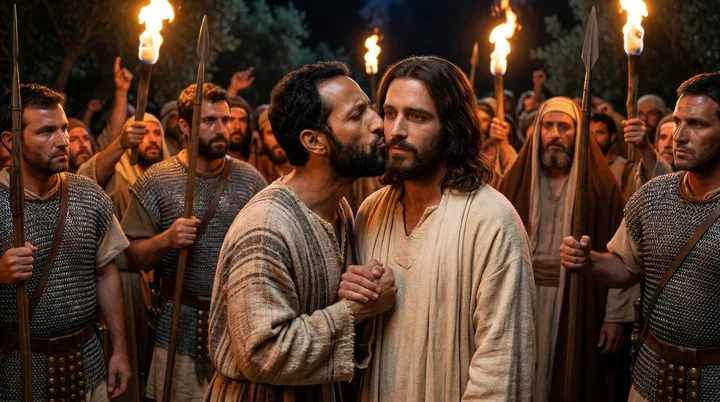
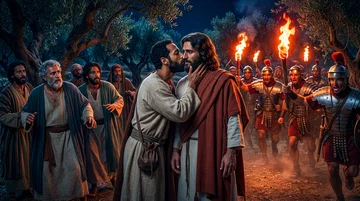
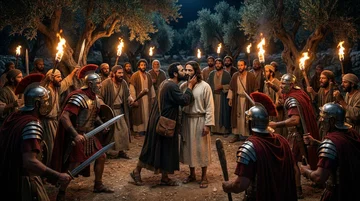
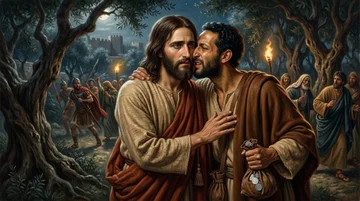
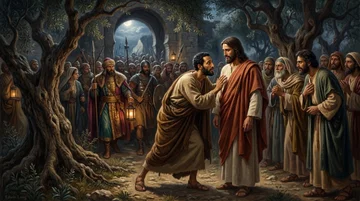
And as soon as he was come, he goeth straightway to him, and saith, Master, master; and kissed him.
Translations
And as soon as he was come, he goes straightway to him, and says, Master, master; and kissed him.
King James Version, KJV Cambridge Paragraph Bible
And as soon as he was come, he goeth straightway to him, and saith, Master, master; and kissed him.
And as soon as he was come, he goeth immediately to him, and saith, Master, master; and kissed him.
Revised Version, American Standard Version
And when he was come, straightway he came to him, and saith, Rabbi; and kissed him.
and having come, immediately, having gone near him, he saith, 'Rabbi, Rabbi,' and kissed him.
And being come, straightway coming up to him, he says, Rabbi, Rabbi; and he covered him with kisses.
And, coming, straightway, stepping forward to him, he saith—Rabbi! and openly kissed him.
Going directly to Jesus, he said, “ Rabbi!” and kissed Him.
Going directly to Jesus, he said, “ Rabbi, Rabbi!” and kissed Him.
When he had come, immediately he came to him and said, “ Rabbi! Rabbi!” and kissed him.
And when he had come, he went straight to him and said, Master; and gave him a kiss.
And assoone as hee was come, hee went straightway to him, and saide, Haile Master, and kissed him.
Douay-Rheims (Challoner revision)
And when he was come, immediately going up to him, he saith: Hail, Rabbi; and he kissed him.
Pictures
Cross-references
- Luke 22:47-48
And while he yet spake, behold a multitude, and he that was called Judas, one of the twelve, went before them, and drew near unto Jesus to kiss him.
Judas betrays Jesus with a kiss, and Jesus names the betrayal.
- Matthew 26:48-49
Now he that betrayed him gave them a sign, saying, Whomsoever I shall kiss, that same is he: hold him fast.
Judas identifies Jesus to the arresting crowd with a kiss.
- John 18:1-12
When Jesus had spoken these words, he went forth with his disciples over the brook Cedron, where was a garden, into the which he entered, and his disciples.
John recounts Judas leading the arresting party to Jesus, who submits to arrest.
- Matthew 26:50
And Jesus said unto him, Friend, wherefore art thou come? Then came they, and laid hands on Jesus, and took him.
Jesus addresses Judas as a friend at his betrayal.
- Matthew 26:57-75
And they that had laid hold on Jesus led him away to Caiaphas the high priest, where the scribes and the elders were assembled.
Parallel account of Jesus’ arrest and Peter’s denial.
- Luke 22:54-62
Then took they him, and led him, and brought him into the high priest’s house. And Peter followed afar off.
Parallel account of Jesus’ arrest and Peter’s denial.
- Mark 14:50
And they all forsook him, and fled.
The disciples flee after Jesus is arrested.
- Mark 14:38
Watch ye and pray, lest ye enter into temptation. The spirit truly is ready, but the flesh is weak.
Jesus urges watchfulness and prayer against temptation before the betrayal.
- John 13
Now before the feast of the passover, when Jesus knew that his hour was come that he should depart out of this world unto the Father, having loved his own which were in the world, he loved them unto the end.
An account of the Supper and the feet-washing ceremony.
- Matthew 26:45
Then cometh he to his disciples, and saith unto them, Sleep on now, and take your rest: behold, the hour is at hand, and the Son of man is betrayed into the hands of sinners.
Both describe Jesus being betrayed into sinners’ hands.
Commentary
Each commentary is drawn from primary sources: the writings of Ellen G. White and Adventist pioneers and periodicals. Each commentary is separate. Its own words are not a quotation; follow the references to read the source passages.
Ellen G. White
10 sources
This took place on Passover night when Jesus went with His disciples to Gethsemane under a broad full moon, while the tents of Jerusalem's pilgrims lay quiet.DA 685.2DA 685.1 It was the night of His last agony, and after earnest conversation He became strangely silent and utterly sad.DA 685.2 He felt shut out from the light of God's sustaining presence in which He had always walked, as He who knew no sin was numbered with transgressors and bore the guilt of fallen humanity and the iniquity of all upon Himself.DA 685.2 He dreaded sin and the wrath of God against transgression and feared to be shut out forever from His Father's love, with His soul exceeding sorrowful even unto death.DA 685.2
As He approached the garden the disciples marked a change they had never seen before, an utter sadness and silence that deepened as He proceeded, yet they dared not question Him as to the cause.DA 685.3 His form swayed as if about to fall, every step was taken with labored effort, and He groaned aloud as if suffering under a terrible burden.DA 685.3 Twice His companions supported Him or He would have fallen to the earth, while they looked anxiously for His usual place of retirement that He might rest.DA 685.3 He knew the betrayal awaited Him and had just told them the betrayer was near.ST May 20, 1889 He knew His betrayal and condemnation would bring humiliation, rejection, and death, and He had prepared them to face the fickleness of the world without resting their faith on popular opinion.4RED 102.2–103.1
Judas came straight to Jesus as a familiar friend, addressed Him with the title of Master, and kissed Him.Ms 42, 1897, par. 23–27ST Dec 9, 1897ST Jun 6, 18785RED 23.2–24.1 The kiss was the prearranged signal by which the arresting soldiers and crowd would identify Jesus to seize Him, thus turning an act of greeting and honor into the means of betrayal.Ms 42, 1897, par. 23–27ST Dec 9, 1897 Judas did this because he believed Jesus would escape and would not allow Himself to be taken.Ms 42, 1897, par. 23–27ST Dec 9, 1897 Jesus did not reject but accepted the traitor's kiss and answered with a sorrowful appeal exposing the betrayal by asking about betraying Him with a kiss.ST Jun 6, 18785RED 23.2–24.1 That appeal should have stirred Judas's conscience and shows unmatched forbearance, love, and pity even toward the one betraying Him.ST Jun 6, 18785RED 23.2–24.1
Judas remained defiant and unrepentant toward that appeal, having yielded himself to Satan's control.ST Jun 6, 1878 Thus Jesus was betrayed in Gethsemane after His long agony there by Judas, one of His professed disciples.ST May 20, 1889Ms 107, 1893, par. 2 He was arrested by a band of men and soldiers carrying staves and spears.Ms 107, 1893, par. 2
Sources
Pioneers and periodicals
14 sources
In Gethsemane Judas comes with an armed mob to hand Jesus over to be bound and taken to suffering and death.ST May 20, 1889ST Mar 14, 1906ST Mar 11, 1886 He goes straight to Jesus as a familiar friend, addresses Him with the respectful title Master, and kisses Him.ST Dec 9, 1897ST Jun 6, 1878ST Feb 7, 1900 The kiss is no ordinary greeting but the agreed signal by which the crowd will recognize and seize Jesus.ST Dec 9, 1897ST Feb 7, 1900ST Feb 7, 1900 Its courtesy covers treachery, for the man who has sold his Lord betrays Him under the show of affection.ST Feb 7, 1900ST Feb 7, 1900ST Jun 11, 1896 Jesus does not reject the kiss but sorrowfully appeals to him over betraying the Son of man with a kiss, showing unmatched forbearance, love and pity, yet Judas, yielded to Satan's control, remains defiant and unrepentant.ST Dec 9, 1897ST Jun 6, 1878
Setting and Arrest
The greeting belongs to the passage from the Passover supper to Gethsemane, where Judas brought a mob and Jesus was taken.ST Mar 11, 1886 It comes in Gethsemane just after Jesus told His disciples that the betrayer was near.ST May 20, 1889 There the traitor comes burdened by guilt and shame to hand the Son of God over to die.ST May 20, 1889RH Mar 14, 1865
It belongs to the arrest in the garden by an armed crowd that seized Him.ST Mar 14, 1906ST Jan 8, 1902 That arrest led to His being bound and taken to Annas.ST Mar 14, 1906 It stands within the shadow of suffering and the cross through which the way to heaven was shown.ST Jan 8, 1902
Kiss and Its Warning
Judas went straightway directly to Jesus as a familiar friend and addressed him with the respectful title Master, even Rabbi.ST Dec 9, 1897ST Jun 6, 1878ST Feb 7, 1900ST Jan 31, 1911ST Feb 24, 1887 The kiss he gave was in itself the customary greeting, yet he had made it the agreed signal by which his companions and the crowd that came to take Jesus would recognize and identify him and seize him for arrest.ST Dec 9, 1897ST Feb 7, 1900ST Feb 7, 1900ST Jun 11, 1896ST Jan 31, 1911 Those who hold this add that he thus pointed Jesus out to the arresting party and to the people with them.ST Jun 11, 1896ST
The respectful address stands in stark contrast to the deed, for the kiss was treachery and not affection, an act of outright betrayal by the man who had sold his Lord.ST Feb 7, 1900ST Feb 7, 1900ST Jun 11, 1896STST Jan 31, 1911 He did this believing Jesus would not allow himself to be taken, yet he had yielded himself to Satan's control.ST Dec 9, 1897ST Jun 6, 1878 When Jesus sorrowfully appealed to him over betraying the Son of man with a kiss, an appeal that should have stirred his conscience, Judas remained defiant and unrepentant, while Jesus did not reject the traitor's kiss but showed unmatched forbearance, love, and pity.ST Jun 6, 1878
His words of honor and his kiss were hollow homage that mocked Christ under the appearance of loyalty, making the kiss a picture of concealed hostility disguised as allegiance.RH Dec 29, 1863ST Feb 24, 1887 It therefore warns that outward profession can deny Christ in life and lead quickly from false reverence to open rejection and abuse.RH Dec 29, 1863
Sources