Mark 14:44
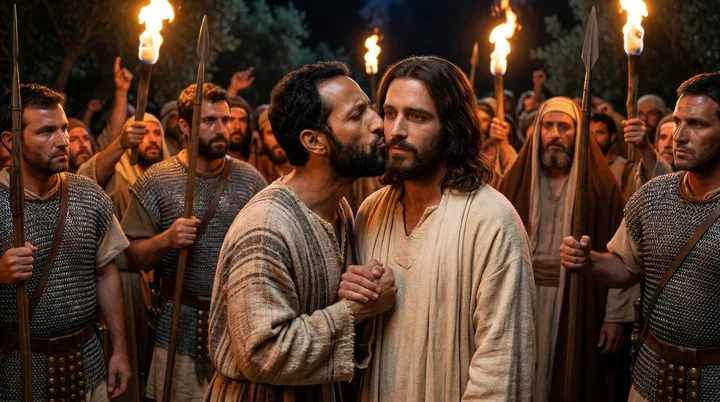
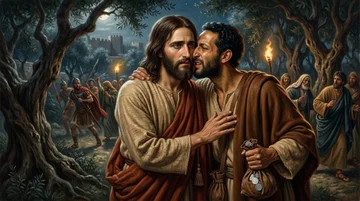
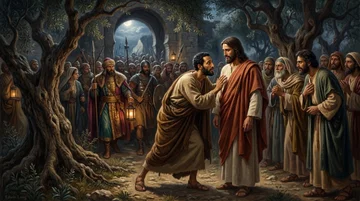
And he that betrayed him had given them a token, saying, Whomsoever I shall kiss, that same is he; take him, and lead him away safely.
Translations
American King James Version, King James Version, KJV Cambridge Paragraph Bible
And he that betrayed him had given them a token, saying, Whomsoever I shall kiss, that same is he; take him, and lead him away safely.
And he that betrayed him, had given them a token, saying, Whomsoever I shall kiss, that same is he; take him, and lead him away safely.
Revised Version, American Standard Version
Now he that betrayed him had given them a token, saying, Whomsoever I shall kiss, that is he; take him, and lead him away safely.
and he who is delivering him up had given a token to them, saying, 'Whomsoever I shall kiss, he it is, lay hold on him, and lead him away safely,'
Now he that delivered him up had given them a sign between them, saying, Whomsoever I shall kiss, that is he; seize him, and lead [ him] away safely.
He that is delivering him up hath given an agreed sign unto them, saying—Whomsoever I shall kiss, he, it is! Secure him, and be leading away, safely.
Berean Standard Bible, Majority Standard Bible
Now the betrayer had arranged a signal with them: “ The One I kiss is the man; arrest Him and lead Him away securely.”
Now he who betrayed him had given them a sign, saying, “ Whomever I will kiss, that is he. Seize him, and lead him away safely.”
Now he who had been false to him had given them a sign, saying, The one to whom I give a kiss, that is he; take him, and get him away safely.
And he that betraied him, had giuen them a token, saying, Whomsoeuer I shall kisse, he it is: take him and leade him away safely.
Douay-Rheims (Challoner revision)
And he that betrayed him, had given them a sign, saying: Whomsoever I shall kiss, that is he; lay hold on him, and lead him away carefully.
Pictures
Cross-references
- Luke 22:47-48
And while he yet spake, behold a multitude, and he that was called Judas, one of the twelve, went before them, and drew near unto Jesus to kiss him.
Judas identifies Jesus with a kiss, and Jesus calls it betrayal.
- Matthew 26:48-50
Now he that betrayed him gave them a sign, saying, Whomsoever I shall kiss, that same is he: hold him fast.
Judas identifies Jesus to the arresting crowd with a kiss.
- John 18:2-5
And Judas also, which betrayed him, knew the place: for Jesus ofttimes resorted thither with his disciples.
Judas leads the arresting party to Jesus in the garden he knew.
- Mark 14:50
And they all forsook him, and fled.
The disciples flee after Jesus is betrayed and arrested.
- Luke 22:47
And while he yet spake, behold a multitude, and he that was called Judas, one of the twelve, went before them, and drew near unto Jesus to kiss him.
Judas approaches Jesus to kiss him as the betrayal’s signal.
- Acts 1:16
Men and brethren, this scripture must needs have been fulfilled, which the Holy Ghost by the mouth of David spake before concerning Judas, which was guide to them that took Jesus.
Cited in connection with Judas and those who accompanied him.
- John 13:1-17
Now before the feast of the passover, when Jesus knew that his hour was come that he should depart out of this world unto the Father, having loved his own which were in the world, he loved them unto the end.
Named in connection with the supper and its setting.
- Matthew 26:53
Thinkest thou that I can not now pray to my Father, and he shall presently give me more than twelve legions of angels?
Jesus says he could summon more than twelve legions of angels.
- Mark 14:12-16
And the first day of unleavened bread, when they killed the passover, his disciples said unto him, Where wilt thou that we go and prepare that thou mayest eat the passover?
Describes the preparation for the supper before the arrest.
Commentary
Each commentary is drawn from primary sources: the writings of Ellen G. White and Adventist pioneers and periodicals. Each commentary is separate. Its own words are not a quotation; follow the references to read the source passages.
Ellen G. White
9 sources
The token belongs to the night in Gethsemane during Christ's last agony, in a place He had often visited for meditation and prayer but never before with a heart so full of sorrow.DA 685.2 Through His earthly life He had walked in the light of God's presence, always doing what pleased the Father, but there He seemed shut out from sustaining light as He was numbered with transgressors to bear the guilt of fallen humanity, with the iniquity of all laid upon Him who knew no sin.DA 685.2 Sin appeared dreadful to Him, and the weight of guilt tempted Him to fear being shut out forever from His Father's love while He felt the terrible wrath of God against transgression, His soul exceeding sorrowful even unto death.DA 685.2 The betrayal began the ordeal of His agony and death, and the disciples had been prepared for this trial and for the fickleness of former followers so they would not be overwhelmed when He was betrayed, condemned, and reviled.4RED 102.2–103.1 The betrayer was Judas, one of His professed disciples, and after the long agony in the Garden of Gethsemane a band of men and soldiers with staves and spears arrested Him.Ms 107, 1893, par. 2
Judas had prearranged the kiss as the signal by which the armed mob would recognize Jesus and seize Him: the man he kissed was the one to take and lead away.ST May 20, 1889Ms 42, 1897, par. 23–27DA 685.1ST Dec 9, 18975RED 23.2–24.1 He told them to take Jesus and lead Him away safely because he believed Jesus would escape and would not allow Himself to be captured.Ms 42, 1897, par. 23–27ST Dec 9, 1897
He carried out the signal by approaching Jesus as a familiar friend and kissing Him while addressing Him as Master, turning a sign of affection and friendship into an act of betrayal.ST May 20, 1889Ms 42, 1897, par. 23–27ST Dec 9, 1897ST Jun 6, 1878 Jesus did not reject but accepted the traitor's kiss, showing forbearance, love, and pity toward Judas.ST May 20, 1889ST Jun 6, 18785RED 23.2–24.1 He answered with sorrow and a direct appeal that should have stirred Judas's conscience.ST Jun 6, 1878 Judas remained defiant, having given himself over to Satan's control.ST Jun 6, 1878
Sources
Pioneers and periodicals
11 sources
In Gethsemane after the Passover supper Judas brought the mob to arrest Jesus.ST May 20, 1889ST Dec 9, 1897ST Mar 14, 1906ST Jun 11, 1896ST Mar 11, 1886 He had arranged beforehand that the man he kissed was Jesus, whom they were to seize and lead away securely.ST May 20, 1889ST Dec 9, 1897ST Jun 11, 1896ST Jan 8, 1902ST Jan 31, 1911 The kiss turned a sign of affection, friendship, and greeting into a false, treacherous, and deceptive act of betrayal used to identify him.ST May 20, 1889ST Dec 9, 1897ST Jun 6, 1878ST Jun 11, 1896ST Jan 31, 1911 It was a deceptive sign for arrest, turning greeting into treachery.ST Jun 11, 1896ST Jan 31, 1911ST Feb 24, 1887 Judas approached Jesus as a familiar friend and greeted him as Master while giving the signal.ST Dec 9, 1897ST Jun 6, 1878RH Mar 6, 1866
Judas gave the sign believing that Jesus would not allow himself to be taken.ST Dec 9, 1897 He came burdened with guilt, handing the Son of God over to those who would put him to death.RH Mar 14, 1865 He remained defiant in the act, having given himself over to Satan's control.ST Jun 6, 1878 Jesus did not reject the traitor's kiss but accepted it with sorrow, forbearance, love, and pity, answering with a direct appeal meant to stir Judas's conscience.ST May 20, 1889ST Jun 6, 1878
After Jesus was apprehended, the disciples forsook him and fled, and he was bound and taken to Annas.ST Mar 14, 1906 He was mistreated after arrest before being crucified that same afternoon, with the arrest and crucifixion occurring on the fifteenth day of the month, the first day of the Feast of Unleavened Bread, which fell on Friday.ST Mar 11, 1886 Professing loyalty while giving the arrest signal shows how a person can profess allegiance to Christ while betraying him in practice, applied to lukewarm Christians who claim to honor God while reaching for the world, bringing reproach on his cause and dishonor to his name.RH Mar 6, 1866 Betraying the Lord with a kiss illustrates concealed hostility disguised as loyalty.ST Feb 24, 1887
Sources