Matthew 26:48
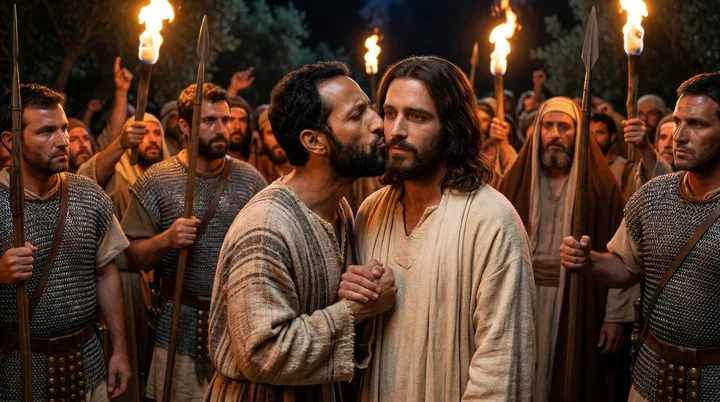
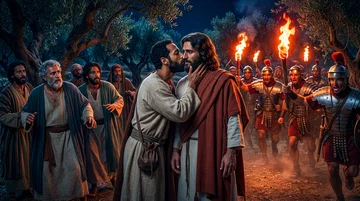
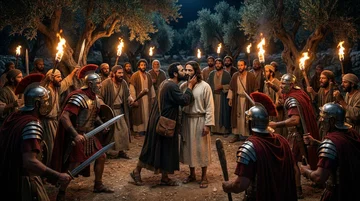
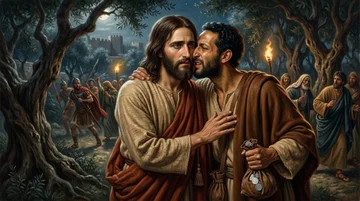
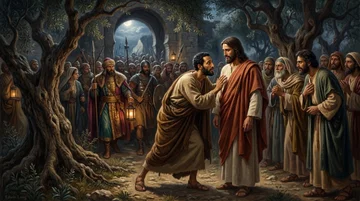
Now he that betrayed him gave them a sign, saying, Whomsoever I shall kiss, that same is he: hold him fast.
Translations
American King James Version, King James Version, KJV Cambridge Paragraph Bible
Now he that betrayed him gave them a sign, saying, Whomsoever I shall kiss, that same is he: hold him fast.
Now he that betrayed him, gave them a sign, saying, Whomsoever I shall kiss, that same is he; hold him fast.
Revised Version, American Standard Version
Now he that betrayed him gave them a sign, saying, Whomsoever I shall kiss, that is he: take him.
And he who did deliver him up did give them a sign, saying, 'Whomsoever I will kiss, it is he: lay hold on him;'
Now he that delivered him up had given them a sign, saying, Whomsoever I shall kiss, he it is: seize him.
And, he who was delivering him up, gave them a sign, saying—Whomsoever I shall kiss, he, it is,—secure him.
Berean Standard Bible, Majority Standard Bible
Now the betrayer had arranged a signal with them: “ The One I kiss is the man; arrest Him.”
Now he who betrayed him had given them a sign, saying, “ Whoever I kiss, he is the one. Seize him.”
Now the false one had given them a sign saying, The one to whom I give a kiss, that is he: take him.
Now he that betraied him, had giuen them a token, saying, Whomesoeuer I shall kisse, that is he, laie holde on him.
Douay-Rheims (Challoner revision)
And he that betrayed him, gave them a sign, saying: Whomsoever I shall kiss, that is he, hold him fast.
Pictures
Cross-references 20 of 22
- Luke 22:47-48
And while he yet spake, behold a multitude, and he that was called Judas, one of the twelve, went before them, and drew near unto Jesus to kiss him.
Judas identifies Jesus with a kiss as the sign of his betrayal.
- Mark 14:44-45
And he that betrayed him had given them a token, saying, Whomsoever I shall kiss, that same is he; take him, and lead him away safely.
Judas identifies Jesus with the agreed kiss before the arrest.
- John 18:2-5
And Judas also, which betrayed him, knew the place: for Jesus ofttimes resorted thither with his disciples.
Judas leads the arresting party to Jesus in the garden.
- Matthew 27:3-4
Then Judas, which had betrayed him, when he saw that he was condemned, repented himself, and brought again the thirty pieces of silver to the chief priests and elders,
Judas regrets betraying Jesus and confesses that he betrayed innocent blood.
- Matthew 26:15
And said unto them, What will ye give me, and I will deliver him unto you? And they covenanted with him for thirty pieces of silver.
Judas’s betrayal sign accompanies his agreement to deliver Jesus for thirty pieces of silver.
- Matthew 26:56
But all this was done, that the scriptures of the prophets might be fulfilled. Then all the disciples forsook him, and fled.
The disciples forsook Jesus and fled after his betrayal.
- John 13:26-27
Jesus answered, He it is, to whom I shall give a sop, when I have dipped it. And when he had dipped the sop, he gave it to Judas Iscariot, the son of Simon.
Jesus identifies Judas as the betrayer before his arrest.
- Matthew 26:24
The Son of man goeth as it is written of him: but woe unto that man by whom the Son of man is betrayed! it had been good for that man if he had not been born.
Jesus warns that the betrayer remains accountable despite events being foretold.
- Matthew 27:5
And he cast down the pieces of silver in the temple, and departed, and went and hanged himself.
Judas’s betrayal ends in remorse and suicide.
- John 18:6
As soon then as he had said unto them, I am he, they went backward, and fell to the ground.
The mob falls backward at Jesus’ words before Judas gives the arresting sign.
- Matthew 26:57
And they that had laid hold on Jesus led him away to Caiaphas the high priest, where the scribes and the elders were assembled.
Jesus is taken from the arrest to face his accusers.
- Zechariah 11:12-13
And I said unto them, If ye think good, give me my price; and if not, forbear. So they weighed for my price thirty pieces of silver.
The thirty pieces paid to Judas fulfill the foretold price.
- Acts 1:18-19
Now this man purchased a field with the reward of iniquity; and falling headlong, he burst asunder in the midst, and all his bowels gushed out.
Identifies the field bought with the betrayal money as Aceldama.
- Luke 22:3
Then entered Satan into Judas surnamed Iscariot, being of the number of the twelve.
Satan entered Judas, who betrayed Jesus.
- Luke 22:52-53
Then Jesus said unto the chief priests, and captains of the temple, and the elders, which were come to him, Be ye come out, as against a thief, with swords and staves?
both spoken to the arresting leaders in Gethsemane
- Psalms 41:9
Yea, mine own familiar friend, in whom I trusted, which did eat of my bread, hath lifted up his heel against me.
Predicts betrayal by a close friend.
- John 12:4-6
Then saith one of his disciples, Judas Iscariot, Simon’s son, which should betray him,
Judas’s rebuke over the ointment preceded his betrayal of Jesus.
- Luke 22:22
And truly the Son of man goeth, as it was determined: but woe unto that man by whom he is betrayed!
Jesus’ betrayal is foretold, and the betrayer is held responsible.
- John 18:8
Jesus answered, I have told you that I am he: if therefore ye seek me, let these go their way:
Jesus surrenders himself but shields the eleven
- Matthew 27:1-2
When the morning was come, all the chief priests and elders of the people took counsel against Jesus to put him to death:
The authorities take Jesus to Pilate after condemning him.
Commentary
Each commentary is drawn from primary sources: the writings of Ellen G. White and Adventist pioneers and periodicals. Each commentary is separate. Its own words are not a quotation; follow the references to read the source passages.
Ellen G. White
36 sources
On Passover night in Gethsemane Judas carried out his agreed sign by coming close to Jesus as a familiar friend and kissing Him repeatedly while urging the priests and mob to seize Him and hold Him fast.DA 721.2Ms 93, 1897, par. 1DA 695.1–696.2ST Jun 6, 18785RED 23.2–24.1 They acted literally, laying violent hands on Him and binding firmly the hands that had only done good.DA 721.2Ms 93, 1897, par. 1Ms 100, 1897, par. 1–3 He gave the kiss and the urgent command because he fully expected Jesus to manifest divine power and escape from His captors as He had escaped enemies before.DA 721.2Ms 93, 1897, par. 1Ms 100, 1897, par. 1–3 Behind that expectation greed had become the ruling motive of his life, so that stung by reproof he sold his Lord for thirty pieces of silver, the price of a slave.5RED 45.2–46.1COS 133.2Lt 40, 1901, par. 7–9 Jesus did not refuse the traitor's kiss but met it with sorrowful forbearance, calling him Friend and asking whether he betrayed the Son of man with a kiss, to rouse his conscience and give an example of love and pity without parallel.DA 695.1–696.2ST Jun 6, 18785RED 23.2–24.1
The Kiss in Gethsemane
On Passover night Jesus in company with His disciples slowly made His way to the garden of Gethsemane, a place He had often visited for meditation and prayer.DA 685.1DA 685.2 It was under a broad and full moon shining from a cloudless sky, while the city of pilgrims' tents was hushed into silence.DA 685.1 The betrayal and arrest there is also told in Mark 14:32-50, Luke 22:39-53 and John 18:1-12, after His long agony in conflict with satanic agencies striving to divorce Him from God.DA 685Ms 107, 1893, par. 2Ms 95, 1897, par. 10–12 A band of men and soldiers carrying staves and spears came to seize Him there.Ms 107, 1893, par. 2
That night was His last agony, and He came strangely silent and exceeding sorrowful even unto death under the weight of guilt He must bear.DA 685.2DA 685.3 Upon Him who knew no sin was laid the iniquity of fallen humanity, and throughout His life He had walked in the light of God's presence, but now He seemed shut out from God's sustaining presence and numbered with the transgressors.DA 685.2 Sin appeared so dreadful to Him and God's wrath against transgression so terrible that He was tempted to fear it would shut Him out forever from His Father's love.DA 685.2 The disciples marked the change, never before seeing Him so utterly sad and silent, with a strange sadness that deepened as He proceeded.DA 685.3 His form swayed as if about to fall, every step was taken with labored effort and groaning aloud as if suffering under the pressure of a terrible burden, twice He was supported by His companions or He would have fallen to the earth, while great drops of blood came from His skin.DA 685.3Ms 95, 1897, par. 10–12
Judas remembered his agreed and arranged part and carried it out, coming close to Jesus as a familiar friend.DA 695.1–696.2ST Jun 6, 18785RED 23.2–24.1 He greeted Him, took His hand, and kissed Him repeatedly with expressions of love while pretending sympathy.DA 695.1–696.2ST Jun 6, 18785RED 23.2–24.1Ms 95, 1897, par. 10–12 He gave the traitor's kiss boldly and defiantly with no disposition to relent, because honor, fidelity and human tenderness had utterly forsaken him.ST Jun 6, 18785RED 23.2–24.1 It was an apparently friendly gesture concealing murderous intent, a Judas hand offered as a signal to identify Jesus for arrest.DA 695.1–696.2Ms 191, 1901, par. 1–3
He had told the priests, elders, temple police and mob who came to Gethsemane that the one he kissed was Jesus, urging them to seize Him and hold Him fast and securely.DA 721.2Ms 93, 1897, par. 1Ms 100, 1897, par. 1–3 The captors acted on his words literally, laying violent hands on Jesus and binding firmly the hands that had only done good, to prevent escape or rescue.Ms 93, 1897, par. 15RED 23.2–24.1 Their cords caused Him much pain.Ms 93, 1897, par. 1
The kiss begins the trial and death that followed, for Christ was seized at midnight in Gethsemane after betrayal and taken away at night for judgment.ST Nov 30, 18828MR 241.2–242.3 He was dragged from one tribunal to another amid mockery and violence, as though He were a murderer.ST Nov 30, 1882 After He took the cup and drank it, the betrayal handed Him over to be abused in person, crowned with thorns pressed into His temples, nailed through hands and feet, and hung on the cross with two thieves.Ms 78, 1910, par. 29
Judas's Motives and Remorse
Judas gave the kiss as the agreed signal because he fully expected Jesus to manifest divine power and escape from His captors.DA 721.2Ms 93, 1897, par. 1 He had seen Jesus escape His enemies many times before and believed He would deliver Himself now.Ms 100, 1897, par. 1–3 He expected Jesus to keep the mob helpless and prostrate, to flash forth His brightness and glory to extinguish them, and to pass out unharmed from their midst.Ms 100, 1897, par. 1–3 Angels already surrounded Jesus, and the throng falling to the ground had full evidence that He was the power of God.Ms 100, 1897, par. 1–3
He meant the betrayal as a test that would settle doubts about Jesus, for if Jesus were the Messiah the people would rally to Him and proclaim Him king.DA 721.1 He expected that victory to magnify his own name, to give him credit for placing the king on David's throne, and to secure him a position next to Christ in the new kingdom.DA 721.1Ms 149, 1904, par. 11–12 He added the urgent command to seize Jesus and hold Him fast and securely so that when blamed he could defend himself and deny responsibility by pointing to that instruction.DA 721.2Ms 93, 1897, par. 1 He schemed in this way to keep the bribe money for his own use while leaving the priests cheated of their prisoner, for he had no thought Jesus would permit Himself to be taken but believed Jesus would not allow Himself to be taken and would deliver Himself from His enemies.5RED 45.2–46.1Lt 40, 1901, par. 7–9
Greed had become the ruling motive of his life, and love of money perverting his nobler nature made him a fit agent of Satan.5RED 45.2–46.1COS 133.2 Stung by the implied rebuke of his covetous spirit when Mary anointed Jesus with costly ointment, he yielded to the tempter and sold his Lord for thirty pieces of silver, the price of a slave.5RED 45.2–46.1COS 133.2 His betrayal illustrates how selfish gain and dishonest business practices sacrifice Christ.Lt 40, 1901, par. 7–9 He despised afterward the covetousness Jesus had reproved which had tempted him to sell the Saviour for a few pieces of silver.3SP 125.3
He had been accepted among the disciples despite his faults so that Christ's teaching and example could help him recognize and correct them, with the same opportunity as the others to learn.GC88 43.25T 557.1 Instead he cherished sin and indulged it and invited Satan's temptations, and when his faults were reproved he resisted reproof and became angry.GC88 43.24SP 44.1–45.1 He cherished an unchecked spirit of superiority and desire for authority, followed a path of unchecked temptation, and remained a hearer and not a doer who failed to value and follow the light received.RH Sep 9, 19095T 557.14SP 44.1–45.1 Honor, fidelity and human tenderness utterly forsook him because he gave himself up to Satan's control and had no power to resist him.ST Jun 6, 18785RED 23.2–24.1
From the betrayal onward he did not lose sight of the Saviour but kept Jesus in sight, eagerly expecting Him to surprise His enemies by appearing as the Son of God and setting at naught their plots and power.5RED 45.2–46.13SP 125.3 Only when Jesus willingly submitted and meekly suffered abuse, trial, condemnation and death did he realize he had betrayed his Master to death and sold his divine Master to shame and death.DA 721.3–45RED 45.2–46.13SP 125.3 Then his heart smote him as he remembered how kind and considerate Jesus had ever been to him.5RED 45.2–46.13SP 125.3 He fell into hopeless remorse and anguish that ended in hanging himself.5RED 45.2–46.1
Christ's Forbearance and Warning
Jesus did not refuse or reject the traitor's kiss but met it with a trembling, sorrowful voice, calling him Friend and asking why he had come and whether he betrayed the Son of man with a kiss.DA 695.1–696.2ST Jun 6, 18785RED 23.2–24.1 Judas had remembered his agreed part and carried it out by coming close as a familiar friend, taking His hand, greeting Him and kissing Him repeatedly with pretended sympathy and expressions of love, boldly and defiantly with no disposition to relent.DA 695.1–696.2ST Jun 6, 18785RED 23.2–24.1 Honor, fidelity and human tenderness had utterly forsaken him because he had given himself to Satan's control with no power to resist.ST Jun 6, 18785RED 23.2–24.1 The appeal was meant to rouse the betrayer's conscience and touch his stubborn heart, and in receiving the kiss with gentleness and patience and forbearance and love and pity without parallel, still longing to save Judas from ruin, He gives an example to His followers.ST Jun 6, 18785RED 23.2–24.1ST Aug 21, 1879Ms 149, 1904, par. 11–12
The boldness of Judas in touching Jesus restored the courage of the awed mob, so that they then laid violent hands on Jesus and bound the hands that had only done good.5RED 23.2–24.1 The betrayal and arrest became a severe test of the disciples' faith, the crisis for which He had strengthened His faithful followers beforehand because He knew the trial awaiting them.4RED 102.2–103.1DA 394.2–3 His presence in the earlier crisis helped them face the ordeal of His betrayal, condemnation and crucifixion, in contrast to the fickleness of those who had once followed Him.4RED 102.2–103.1DA 394.2–3
Judas had been accepted among the disciples despite his faults so that teaching and example could help him recognize and correct them, yet he cherished sin, indulged it and invited Satan's temptations, and when reproved became angry and resisted reproof until he was led to betray his Master.GC88 43.24SP 44.1–45.1 The kiss therefore illustrates how those who profess godliness may betray people who reprove them for their good when opportunity arises.GC88 43.2 It serves as a pattern for professed believers who accuse their fellow believers and for self-confident people who reject correction and persist in their own way, for by doing so they serve Satan as Judas did even if unknowingly, show Satan's spirit, and may betray Christ rather than surrender their will.GC88 43.2IRCUP 35.15T 690.1
His betrayal was the result of hearing teachings without doing them and failing to value and follow the light received, though he had the same opportunity as the other disciples to learn.5T 557.14SP 44.1–45.1Lt 34a, 1886, par. 41Lt 34, 1886, par. 39–42 Though connected with Jesus and given the benefit of His teaching and example, he did not let his character be shaped by it but remained a hearer and not a doer, showing that failure to be changed invites betrayal.4SP 44.1–45.1Lt 34a, 1886, par. 41Lt 34, 1886, par. 39–42 He stands as the betrayer in contrast to following Christ's example, and his apparently friendly gesture is a Judas hand concealing murderous intent.ST Apr 8, 1913Ms 191, 1901, par. 1–3 A kiss of Christ given in love and peace and reconciliation is not betrayal, and God is pleased when divine joy and praise and thanksgiving proceed from the lips of those who so kiss Him.Ms 75, 1897, par. 2
After taking the cup and drinking it He was handed over by betrayal to be taken, abused in person, crowned with thorns pressed into His temples, nailed through hands and feet, and hung on the cross with two thieves.Ms 78, 1910, par. 29 While suffering on the cross with pierced hands and passing through death, He accepted the thief who acknowledged Him in His humiliation, pardoned his sins, and promised to be with Him that day in paradise.Ms 78, 1910, par. 29
Sources
Pioneers and periodicals
68 sources
The verse records a prearranged sign by which Judas agreed to identify Jesus to the armed party with a kiss so they could recognize, seize, and hold him fast.ST Feb 7, 1900RH Nov 18, 1862RH Feb 5, 1914ST Jun 11, 1896 A kiss was a customary greeting and outward sign of affection, fellowship, and recognition, which Judas turned into a cover for treachery and murderous intent.ST Jun 11, 1896RH Dec 30, 1862RH Jul 12, 1870STRH Jan 23, 1866 Judas was one of the chosen Twelve who had lived with Jesus, heard his teaching, and seen his glory, yet led the mob in Gethsemane at night and gave the Son of God into their hands.RH Mar 14, 1865RH Jan 20, 1916ST Jan 8, 1902ST Nov 4, 1897RH Jun 10, 1875 Jesus did not reject or resist the traitor's kiss but bore it with patience, love, serenity, and pity without parallel, even appealing to the betrayer's conscience.ST Jun 6, 1878ST Aug 21, 1879RH May 26, 1868RH May 4, 1911 The kiss therefore shows that profession of allegiance can be outwardly affectionate while lacking truth and life, concealing envy, hatred, and greed, and that such offenses and apostasies are to be expected even among Christ's closest followers.ST Oct 14, 1880RH Jul 12, 1870ST Feb 17, 1904ST Mar 25, 1889RH Sep 2, 1873
Sign Words Explained
The verse records a prearranged sign by which Judas agreed to identify Jesus to the arresting party with a kiss so that they could recognize him and seize him.ST Feb 7, 1900RH Nov 18, 1862RH Feb 5, 1914STST Jan 31, 1911 That kiss was an act of treachery by a disciple, greeting and kissing him in Gethsemane to mark him out and enable them to take him.RH Nov 18, 1862STST Jan 31, 1911RH Dec 8, 1859 It belonged to the nighttime arrest, delayed because the authorities feared an uproar among the people during the feast, and after the kiss they seized him and before the crowd knew what had happened he was brought to trial and condemned.RH Nov 18, 1862RH Feb 5, 1914 The instruction joined to the sign was to hold him fast, to seize him and take him away safely.ST Feb 7, 1900ST Jun 11, 1896
Those hired to seize him had hired Judas for the express purpose of identifying Jesus by the kiss so they would not take the wrong man.RH Aug 2, 1906 Yet his work proved after all unnecessary, because Jesus gave himself up by answering that he was Jesus of Nazareth, leaving Judas standing with the mob with swords and clubs and torches with nothing for him to do.RH Aug 2, 1906 After the mob fell as dead and rose again, Judas remembered his forgotten task and gave the traitorous kiss, while Jesus made plain that he read his heart, and the mob then seized Jesus.RH Aug 2, 1906
A kiss was normally a customary greeting and an outward sign of affection, fellowship, and recognition.RH Jul 12, 1870STRH Jan 23, 1866 As such it could be used to conceal a treacherous and unfriendly heart, disguising betrayal beneath tokens of fellowship, and the contrast shows that a holy kiss is marked by sincerity and purity, so that holiness and not the act of kissing itself is what matters.RH Jul 12, 1870STRH Jan 23, 1866 Judas carried out his agreed part by coming close to Jesus as a familiar friend, greeting him, taking his hand, and giving the kiss boldly and defiantly with no disposition to relent.ST Jun 6, 1878STST Feb 17, 1904 He signaled the betrayal with that friendly greeting and kiss.STST Feb 17, 1904
Arrest Night History
The betrayal took place at night in Gethsemane after agony and prayer, where a crowd came armed to seize him and hand him over to his enemies to be mocked and crucified.RH Mar 14, 1865ST Jan 8, 1902ST Nov 4, 1897 It belongs to the Gethsemane scene that contrasts those who betray or sleep with the few who stay awake to watch with their Lord, and it turns a sign of affection into an act of betrayal by marking Jesus for arrest with a kiss.ST Jan 8, 1902ST Nov 4, 1897 That betrayal at Gethsemane is linked with the price of the treason being used to buy Aceldama.RH Aug 29, 1871 Judas came at the head of a mob with swords and clubs and torches, with harsh cries as they took him, having been hired for the express purpose of identifying Jesus by a kiss so they would not take the wrong man.RH Aug 2, 1906RH Feb 27, 1872ST Sep 9, 1930
His work proved unnecessary after all because Jesus gave himself up by answering that he was Jesus of Nazareth, causing the mob to fall as dead and then rise again, leaving Judas standing with the mob with nothing to do until he remembered his forgotten task.RH Aug 2, 1906 Only then did he give the traitorous, deceitful kiss to identify Jesus for arrest while Jesus made plain that he read his heart, after which the mob seized him.RH Aug 2, 1906RH Feb 27, 1872 He may not at first have thought he would become the betrayer or understood that his actions would lead to condemnation, and he recognized what he had done and repented only when it was too late.RH Feb 27, 1872 The nighttime arrest had been delayed because the authorities feared an uproar among the people during the feast, and once Judas identified Jesus by a kiss and they seized him, he was brought to trial and condemned before the crowd knew what had happened.RH Feb 5, 1914
The verse belongs to the account of arrest and trials before the Sanhedrin and the chief priests and elders, forming with the Lord's Supper, the agony, and the betrayal part of the day on which Christ suffered and died for humanity.ST Feb 3, 1909RH Feb 13, 1872 Those proceedings after betrayal and arrest were illegal and irregular, but the record kept by his enemies would not call them illegal or irregular.ST Jan 28, 1903 Religious prosecutors and persecutors never keep a record of their work that condemns that work, and the true history of such religious persecution is recorded only in the records on high.ST Jan 28, 1903 At midnight in Gethsemane Christ was seized after betrayal and dragged from one tribunal to another amid mockery and violence as though he were a murderer.ST Nov 30, 1882ST Nov 4, 1897
One of the Twelve betrayed him and another denied him, and at Calvary all forsook him.ST Apr 3, 1928 His being taken by the mob at Gethsemane occurred when God permitted the forces of evil to act and remained within God's eternal purpose in the conflict between good and evil. The arrest after the Passover supper began events dated to Friday, the fifteenth day of the month, the first day of the Feast of Unleavened Bread, with mistreatment and crucifixion that afternoon.ST Mar 11, 1886 Those who held a different reckoning identified the betrayal as occurring on Wednesday, the fourth day of the week.RH Mar 25, 1862
Judas the Betrayer
Judas was one of the chosen Twelve, a disciple and professed follower who had lived with Jesus and heard his teaching.RH Jan 20, 1916RH Sep 2, 1873ST May 15, 1879 He had walked and talked with him and had seen his glory mingled with his humanity.RH Yet he led the mob and gave the Son of God into their hands to die.RH Mar 14, 1865RH Jan 20, 1916 Having begun among the apostles, he turned away and sold his Master.RH Jun 10, 1875
His fall was not sudden, for he had gradually cherished evil thoughts and yielded to selfish, ambitious and carnal desires.RH Jan 20, 1916 Along with those desires he yielded to a spirit of superiority along a path of unchecked temptation.RH Sep 9, 1909RH Jan 20, 1916 Temptation at last brought him to act on what he had cherished.RH Jan 20, 1916
Honor, fidelity and human tenderness had utterly forsaken him because he gave himself up to Satan's control and had no power to resist him.ST Jun 6, 1878 Before the end Satan had hovered over him, causing him at times to fall beneath his power.RH Dec 7, 1916 Then Satan entered into him after he received the sop, after which he surrendered wholly to Satan's control.RH Dec 7, 1916
While giving a kiss of affection, envy, hatred and even murder were in his heart.ST Mar 25, 1889 His betrayal was tied to greed for pieces of silver, and its lesson is to guard against greed.RH Sep 18, 1900 He left the Last Supper to betray his Master and friend for a paltry sum, knowingly acting against the loyalty his outward conduct professed.RH Oct 26, 1905 For thirty pieces of silver he handed Jesus over to his enemies.RH Sep 26, 1871ST Aug 17, 1915
He agreed to deliver Jesus for thirty pieces of silver, the price connected with the prophecy of the rejected shepherd.ST Jan 10, 1911 The price of that treason was used to buy Aceldama.RH Aug 29, 1871 The betrayal in Gethsemane was committed by one of his own, who had sold him.ST Aug 17, 1915
He expected Jesus to reveal himself as the Son of God and miraculously escape, but Jesus submitted meekly to abuse and condemnation.RH Nov 20, 1913 Seeing this, Judas recognized the full extent of his crime and felt remorse and anguish.RH Nov 20, 1913 He declared that he had betrayed innocent blood and testified that Jesus was innocent.RH Feb 8, 1915ST May 11, 1915 He may not at first have thought he would become Jesus' betrayer or understood that his actions would lead to Jesus' condemnation, and he repented only when it was too late.RH Feb 27, 1872 This betrayal led on to despair and suicide by taking his own life.RH Dec 7, 1916RH Nov 20, 1913
In his kiss of betrayal he is the counterpart of Absalom, with nothing in his character to admire.RH Aug 2, 1864 He is as foul a traitor as Absalom, who used beauty and address to supplant an indulgent and noble father.RH Aug 2, 1864 Absalom's hatred for the seducer of Tamar ended in assassination, and his rebellion was parricidal and incestuous.RH Aug 2, 1864
Jesus Enduring Betrayal
The kiss that marked him for seizure was an unworthy deed, and he bore it with patience, giving an example of patience in bearing God's holy will in all things.RH May 26, 1868 He met the betrayer with patience, and his response stands in contrast to those who avoid contact with people they call defiled, showing love and serenity toward his betrayer and persecutors.RH May 4, 1911
He did not reject the traitor's kiss and did not resist it, and in receiving it he gives an example of forbearance, love, and pity without parallel, even toward Judas.ST Jun 6, 1878ST Aug 21, 1879 He met the kiss with trembling sorrowful voice, saying Friend, wherefore art thou come, and Betrayest thou the Son of man with a kiss, an appeal that should have roused the betrayer's conscience and touched his stubborn heart.ST Jun 6, 1878
By being betrayed by one of his own disciples, denied by another, and forsaken by all, he knew the fickleness of friends and the wound of betrayal.RH May 10, 1860 In enduring betrayal he took human infirmity, sorrow, mistrust, and wounding as his own, and he knows what assault, malignity, and faithlessness feel like.RH May 10, 1860 His sympathy is therefore human yet divine, tender, clinging, and personal, entwining around every bodily, mental, and spiritual infirmity, giving ground for love, confidence, hope, joy, praise, and bold coming for mercy and grace to help in time of need.RH May 10, 1860
When a disciple drew a sword to resist the seizure that followed the kiss, he rebuked him and ordered him to put it away, saying those who take the sword will perish by it. Though he could have called on the Father for more than twelve legions of angels, his refusal to resist by force shows his kingdom is not established through earthly power or violence. His followers are therefore not to use the sword or worldly force to advance or protect his spiritual kingdom.ST Sep 13, 1905
Prophecy Doctrine Church
The kiss arranged beforehand to point out Jesus to those come to take him fulfilled the prediction that the Messiah would be betrayed by an intimate friend.RH Nov 18, 1862 That betrayal belonged to what had been foretold, yet being foretold did not make the deed good nor take away guilt, and woe is pronounced upon the one who betrays him.ST Jun 4, 1912 With Isaiah 53 and Acts 2, the sign stands as support for the claim that Christ's sacrifice was divine, because he poured out his soul unto death and made his soul an offering for sin.RH Oct 4, 1864
The act shows the antichristian spirit already at work before Jesus' death, in that outward loyalty as a professed disciple can hide opposition to him.ST May 10, 1905 That a follower of Christ could betray him proves that following him did not mean the follower's actions represented his principles.ST May 15, 1879 That one of the chosen Twelve brought about his apprehension, while the disciples present forsook him and fled and Peter denied with cursing and swearing that he knew him, proves that offenses, trials, and apostasies occur even among his closest followers.RH Sep 2, 1873 Such trials in the church are therefore to be expected and should not discourage believers as though some strange thing had happened, and Peter's conversion and restoration to favor shows the merciful Saviour receives the fallen back.RH Sep 2, 1873
The betrayal stands after his life and before his condemnation, crucifixion, burial, resurrection, ascension, and second advent, and telling it as part of that whole story moves the feelings of thousands of hearers.RH Oct 12, 1869 The kiss has become an image of betrayal illustrating that betrayal cannot make the Word of God perish.RH Sep 28, 1916
Kiss as False Profession
Judas turned a greeting into treachery by making a kiss the agreed signal to point out Jesus for seizure and safe removal.ST Jun 11, 1896RH Dec 30, 1862RH Jun 20, 1912 That kiss disguised murderous intent as affection, and its outward friendliness was so convincing that the other apostles did not suspect him.ST Jun 11, 1896RH Dec 30, 1862ST Oct 28, 1889 A kiss was a customary greeting, yet it could hide a treacherous and unfriendly heart, and in this case envy, hatred and even murder lay behind an affectionate sign.STST Mar 25, 1889RH Jan 23, 1866 Outward affection can therefore conceal evil feeling, sin begins in the thoughts and feelings of the heart, and hidden hostility under tokens of fellowship is like this betrayal.STST Mar 25, 1889RH Jan 23, 1866
The act shows that profession of allegiance to Christ can be false even in one close to Him, for the kiss joined profession to betrayal.ST Oct 14, 1880RH Jul 12, 1870ST Feb 17, 1904 It outwardly displayed allegiance and professed love while lacking the life and truth of Christ, as in heartless religious profession and concealed treachery that honors with the lips while acting against the one professed to be honored.RH Apr 28, 1868ST Feb 24, 1887RH Jun 26, 1856 Such profession, which feeds on folly and vice and clings to the world while calling Christ precious, will avail nothing in His terrible day.ST Oct 14, 1880RH Jul 12, 1870 By contrast a holy kiss is marked by sincerity and purity, so that holiness and not the mere act of kissing is what matters.ST
The kiss was a false show of loyalty with a selfish aim that brought shame on the Master, and its lesson is to guard against greed for gain like pieces of silver.RH Oct 28, 1915RH Sep 18, 1900 Believers will meet the same kind of betrayal, being kissed on the cheek and then sold by those near them for thirty pieces of silver.RH Sep 26, 1871 Such betrayal belongs among life's real misfortunes with its steep places and thorns, alongside scorn that crucifies between two thieves and bereavement that shuts kindred in the sepulcher, and dreading it beforehand wastes ammunition and leaves strength gone when it comes.RH Sep 26, 1871
To betray Christ is truly to serve Satan, and the same malicious spirit works when professed believers act as accusers of the brethren even ignorantly.ST Dec 2, 1886 Those who lend themselves to that work represent Satan's spirit, and as spies were on Christ's track then so they are on the track of His followers now, so that the time has come when it is not safe to put confidence in a friend or a brother.ST Dec 2, 1886 The same subtle, treacherous deception covering deadly intent appears when a treacherous man hides among God's calm, upright, faithful, earnest people and deceives them with a kiss until ready to spring upon them with poisoned fangs, and even faithful people are not proof against flattery and deception.RH The kiss was not friendship but a mask for betrayal and murderous intent, like a handkerchief hiding an assassin's hand, showing that a loving sign can hide a hostile purpose to destroy what stands for God.RH Apr 8, 1909
Applied to Sunday legislation, pleas for personal liberty are such a kiss, covering an attempt to destroy the Sabbath, and are very much akin to anarchy.RH Apr 8, 1909 The Word of God likewise has many Judases who betray it with a kiss, professing friendship and loyalty while working against it under the appearance of affection, yet the Word survives that betrayal and endures.ST Dec 27, 1905RH Oct 7, 1915 The same sign supplies the measure for a proposed defense of corrupt church leaders as a betrayal of Christ even worse than that kiss.RH Jun 27, 1871 Its image also names the betrayal of brave men who sacrifice themselves for liberty as the sting of Judas' kiss, and it stands as the example of betraying Christ in contrast to following Christ's example.ST Apr 8, 1913ST Jul 4, 1900
Sources