Mark 14:63
Then the high priest rent his clothes, and saith, What need we any further witnesses?
Translations
Then the high priest rent his clothes, and says, What need we any further witnesses?
King James Version, KJV Cambridge Paragraph Bible, Webster Bible
Then the high priest rent his clothes, and saith, What need we any further witnesses?
Revised Version, American Standard Version
And the high priest rent his clothes, and saith, What further need have we of witnesses?
And the chief priest, having rent his garments, saith, 'What need have we yet of witnesses?
And the high priest, having rent his clothes, says, What need have we any more of witnesses?
And, the High-priest, having rent asunder his inner-garments, saith—What, further, need have we, of witnesses?
Berean Standard Bible, Majority Standard Bible
At this, the high priest tore his clothes and declared, “ Why do we need any more witnesses?
The high priest tore his clothes and said, “ What further need have we of witnesses?
And the high priest, violently parting his robes, said, What more need have we of witnesses?
Then the hie Priest rent his clothes, and sayd, What haue we any more neede of witnesses?
Douay-Rheims (Challoner revision)
Then the high priest rending his garments, saith: What need we any further witnesses?
Pictures

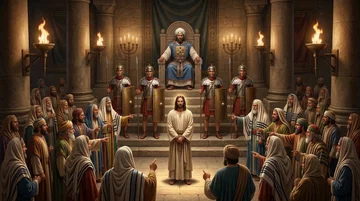
Cross-references
- Matthew 26:65-66
Then the high priest rent his clothes, saying, He hath spoken blasphemy; what further need have we of witnesses? behold, now ye have heard his blasphemy.
The high priest tears his clothes and the council condemns Jesus for blasphemy.
- Luke 22:71
And they said, What need we any further witness? for we ourselves have heard of his own mouth.
The council says Jesus’s own words supply testimony.
- John 18:19-23
The high priest then asked Jesus of his disciples, and of his doctrine.
John recounts Jesus’ questioning before the high priest.
- John 2:19-21
Jesus answered and said unto them, Destroy this temple, and in three days I will raise it up.
Jesus’ saying about raising the temple in three days was cited by witnesses at the trial.
- Daniel 7:13-14
I saw in the night visions, and, behold, one like the Son of man came with the clouds of heaven, and came to the Ancient of days, and they brought him near before him.
Jesus invokes the Son of man coming with heaven’s authority.
- Matthew 27:1
When the morning was come, all the chief priests and elders of the people took counsel against Jesus to put him to death:
parallel account of same hearing
- Mark 15:1
And straightway in the morning the chief priests held a consultation with the elders and scribes and the whole council, and bound Jesus, and carried him away, and delivered him to Pilate.
parallel account of same hearing
- John 7:51
Doth our law judge any man, before it hear him, and know what he doeth?
states law requiring hearing before judgment that trial violated
Commentary
Each commentary is drawn from primary sources: the writings of Ellen G. White and Adventist pioneers and periodicals. Each commentary is separate. Its own words are not a quotation; follow the references to read the source passages.
Ellen G. White
4 sources
The rending of the garments and the cry for no more witnesses belong to the hearing of Jesus before Caiaphas and his court in the judgment hall, with the high priest himself presiding.DA 698.1–700.5DA 6985RED 35.3–36.2 It came in hurried midnight proceedings after Jesus had been bound and led over the brook Kedron past gardens and olive groves to the palace of Annas.DA 698.1–700.5 Annas was the ex-high priest still recognized by the people as high priest, and before him was held a preliminary examination in advance of the formal trial before Caiaphas and the Sanhedrim.DA 698.1–700.5
The priests were laboring to secure condemnation on two grounds, blasphemy by which to condemn Him before the Jews and sedition as a disturber of the peace by which to condemn Him before the Romans.DA 698.1–700.5 This double aim arose because under Roman rule the Sanhedrim could only examine a prisoner and pass judgment for the Roman authorities to ratify.DA 698.1–700.5 Their midnight seizure by a mob and questioning violated their own law that every man should be treated as innocent until proved guilty and that the law does not judge a man before hearing him and knowing what he does.DA 698.1–700.5
In the excitement of the trial Jesus stood calm and dignified while Caiaphas and the others displayed hostility.5RED 35.3–36.2 Caiaphas demanded that Jesus perform a miracle, but received no answer.5RED 35.3–36.2 The scene set the divine majesty of Christ against the earthly authority and splendor of the high priest.5RED 35.3–36.2 The tearing of the clothes followed Jesus' identification of Himself as the Christ and His words of the Son of man coming in glory.5RED 39.3–40.2 The high priest presented the act as horror at blasphemy and declared that further witnesses were unnecessary, so that Jesus' own words were made the ground for the verdict of death.5RED 39.3–40.2
Sources
Pioneers and periodicals
8 sources
Mark 14:63 belongs to Jesus' hurried trial before the Sanhedrin, the Jewish authorities, in the judgment hall, where the high priest Caiaphas presided and confronted Him.ST May 27, 1889ST Mar 14, 1906ST May 25, 1904 The proceedings only pretended to follow legal forms and were unjust throughout, for the law required two witnesses to agree.ST May 27, 1889ST May 25, 1904 The witnesses' testimony failed to agree, yet the authorities accepted the testimony of two false witnesses in order to condemn Him.ST May 25, 1904ST Dec 1, 1898 Caiaphas, who presided, was jealous of Jesus and regarded Him as a rival.ST May 27, 1889
After Jesus truthfully answered the charge put to Him under oath, declaring Himself to be the Christ, the Son of the Most High, Caiaphas tore his clothes and declared that no further witnesses or evidence were needed.ST May 27, 1889ST Mar 6, 1901ST Dec 1, 1898 The tearing of the clothes was a display of holy horror meant to make Caiaphas appear jealous for Heaven's honor, and it expressed his claim that Jesus had committed blasphemy.ST May 27, 1889ST Mar 6, 1901 Caiaphas used Jesus' answer to end the search for testimony, treating His words as sufficient grounds for condemnation.ST May 27, 1889ST Mar 6, 1901ST Dec 1, 1898 He pressed the council toward condemning Jesus and stirred the people against Him.ST May 27, 1889ST Mar 6, 1901
The council convicted Him under Jewish law, in which blasphemy was punishable by death, and asked Pilate to carry out the sentence.ST Mar 15, 1877ST May 25, 1904 This religious conviction is distinct from the Roman charge on which Pilate ultimately sentenced Him.ST Mar 15, 1877 The verse belongs to the account of Christ's rejection and abuse, where hollow homage to Him can turn quickly into open outrage, as mockery gives way to smiting and buffeting.RH Dec 29, 1863 The confrontation in the judgment hall is an example of a circumstance in which His followers should remain close to Him rather than follow afar off.ST Mar 14, 1906
Sources