Matthew 26:65
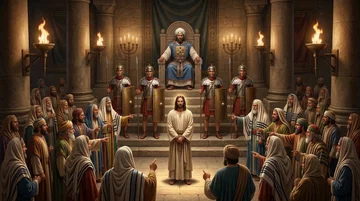
Then the high priest rent his clothes, saying, He hath spoken blasphemy; what further need have we of witnesses? behold, now ye have heard his blasphemy.
Translations
Then the high priest rent his clothes, saying, He has spoken blasphemy; what further need have we of witnesses? behold, now you have heard his blasphemy.
King James Version, KJV Cambridge Paragraph Bible, Webster Bible
Then the high priest rent his clothes, saying, He hath spoken blasphemy; what further need have we of witnesses? behold, now ye have heard his blasphemy.
Revised Version, American Standard Version
Then the high priest rent his garments, saying, He hath spoken blasphemy: what further need have we of witnesses? behold, now ye have heard the blasphemy:
Then the chief priest rent his garments, saying, — 'He hath spoken evil; what need have we yet of witnesses? lo, now ye heard his evil speaking;
Then the high priest rent his clothes, saying, He has blasphemed: what need have we any more of witnesses? behold, now ye have heard the blasphemy.
Then, the High-priest rent asunder his garments, saying—He hath spoken profanely! What further need have we, of witnesses? Lo! now, ye have heard the profanity!
At this, the high priest tore his clothes and declared, “ He has blasphemed! Why do we need any more witnesses? Look, now you have heard the blasphemy.
At this, the high priest tore his clothes and declared, “ He has blasphemed! Why do we need any more witnesses? Look, now you have heard His blasphemy.
Then the high priest tore his clothing, saying, “ He has spoken blasphemy! Why do we need any more witnesses? Behold, now you have heard his blasphemy.
Then the high priest, violently parting his robes, said, He has said evil against God: what more need have we of witnesses? for now his words against God have come to your ears:
Then the hie Priest rent his clothes, saying, Hee hath blasphemed, what haue wee any more neede of witnesses? beholde: nowe yee haue heard his blasphemie.
Douay-Rheims (Challoner revision)
Then the high priests rent his garments, saying: He hath blasphemed; what further need have we of witnesses? Behold, now you have heard the blasphemy:
Pictures

Cross-references 20 of 21
- Mark 14:63-64
Then the high priest rent his clothes, and saith, What need we any further witnesses?
The high priest tears his clothes and the council condemns Jesus for blasphemy.
- Luke 22:66-71
And as soon as it was day, the elders of the people and the chief priests and the scribes came together, and led him into their council, saying,
Records the leaders’ questioning and accusation against Jesus, ending with their demand for no further witness.
- Daniel 7:13
I saw in the night visions, and, behold, one like the Son of man came with the clouds of heaven, and came to the Ancient of days, and they brought him near before him.
Jesus’ words about the Son of Man coming with heaven’s clouds echo the vision.
- Matthew 27:1-2
When the morning was come, all the chief priests and elders of the people took counsel against Jesus to put him to death:
The council’s trial leads to Jesus’ condemnation and delivery to Pilate.
- Leviticus 21:10
And he that is the high priest among his brethren, upon whose head the anointing oil was poured, and that is consecrated to put on the garments, shall not uncover his head, nor rend his clothes;
The law forbids the high priest to rend his clothes, which Caiaphas did.
- Matthew 26:59-60
Now the chief priests, and elders, and all the council, sought false witness against Jesus, to put him to death;
Failed false testimony preceded the high priest’s condemnation of Jesus.
- Isaiah 53:7
He was oppressed, and he was afflicted, yet he opened not his mouth: he is brought as a lamb to the slaughter, and as a sheep before her shearers is dumb, so he openeth not his mouth.
Jesus held his peace before his accusers.
- John 19:7
The Jews answered him, We have a law, and by our law he ought to die, because he made himself the Son of God.
They invoked their law to condemn Jesus for blasphemy.
- John 18:19-23
The high priest then asked Jesus of his disciples, and of his doctrine.
Jesus is questioned by the high priest and accused of speaking blasphemy.
- John 10:30
I and my Father are one.
same claim to oneness with Father that drew blasphemy charge
- Matthew 26:61
And said, This fellow said, I am able to destroy the temple of God, and to build it in three days.
The charge about rebuilding the temple was found insufficient.
- Leviticus 10:6
And Moses said unto Aaron, and unto Eleazar and unto Ithamar, his sons, Uncover not your heads, neither rend your clothes; lest ye die, and lest wrath come upon all the people: but let your brethren, the whole house of Israel, bewail the burning which the LORD hath kindled.
rending clothes disqualified Caiaphas
- Joel 2:13
And rend your heart, and not your garments, and turn unto the LORD your God: for he is gracious and merciful, slow to anger, and of great kindness, and repenteth him of the evil.
should have rent heart not robe
- Luke 22:67-68
Art thou the Christ? tell us. And he said unto them, If I tell you, ye will not believe:
repeats the priests' question and Jesus' answer
- John 2:19
Jesus answered and said unto them, Destroy this temple, and in three days I will raise it up.
Jesus’ saying about raising the temple in three days is cited at his trial.
- Isaiah 53:8-9
He was taken from prison and from judgment: and who shall declare his generation? for he was cut off out of the land of the living: for the transgression of my people was he stricken.
The Messiah was condemned and suffered under color of justice.
- Matthew 27:11-14
And Jesus stood before the governor: and the governor asked him, saying, Art thou the King of the Jews? And Jesus said unto him, Thou sayest.
Jesus remains silent when accused before Pilate.
- John 14:9
Jesus saith unto him, Have I been so long time with you, and yet hast thou not known me, Philip? he that hath seen me hath seen the Father; and how sayest thou then, Shew us the Father?
same claim to reveal the Father that drew blasphemy charge
- Luke 22:54-62
Then took they him, and led him, and brought him into the high priest’s house. And Peter followed afar off.
parallel account of arrest and trial
- John 5:18
Therefore the Jews sought the more to kill him, because he not only had broken the sabbath, but said also that God was his Father, making himself equal with God.
Claiming God as his Father is understood as making himself equal with God.
Commentary
Each commentary is drawn from primary sources: the writings of Ellen G. White and Adventist pioneers and periodicals. Each commentary is separate. Its own words are not a quotation; follow the references to read the source passages.
Ellen G. White
26 sources
When Jesus stood on trial for His life before Caiaphas and the Sanhedrin, He declared under oath that He is the Christ, the Son of God, who would sit at the right hand of power and come in the clouds of heaven.COS 130.1–2Ms 51, 1897, par. 12Lt 52a, 1896, par. 4 At that word the high priest tore his robe and lifted his hands as in holy horror, declaring it blasphemy needing no further witnesses, and the council at once answered that He was guilty of death on His own testimony.COS 130.1–2Ms 51, 1897, par. 12Ms 111, 1897, par. 5–10 His outrage was feigned zeal to impress the people and hide inward exultation, for he was convicted that Jesus was akin to God yet in passion and fury refused to rend his heart and confess Him.Ms 111, 1897, par. 5–105RED 39.3–40.2ST Jun 27, 1878 By rending his priestly garment he broke God's express law that no priest rend his robes, placed himself under condemnation, and ended his priesthood as the last act of a perverted order with no connection to God.Ms 111, 1897, par. 5–10Ms 102, 1897, par. 15–1612MR 388.3–4 Jesus spoke no blasphemy but truth, and at His coming in majesty His divinity will be forever settled, so that the priest who accused Him and all His enemies will be silenced and compelled to bow and confess Him King of Glory.Lt 52a, 1896, par. 4COL 170.3Lt 90, 1898, par. 28–29
Trial Setting and Verdict
Matthew 26:65 belongs to Jesus' trial for His life before Annas and Caiaphas and the Sanhedrin council, including His early-morning examination at the palace of Caiaphas where He was accused and questioned and reviled.DA 6985RED 35.3–36.25RED 27.1 It was a mock trial with only the appearance of legal process, kept secret so the people could not hear and offer vindicating testimony about His mighty works.5RED 27.15RED 33.1 Such testimony would have turned indignation against the council, defeated its plans, and led to His release and renewed honor.5RED 33.1 Amid that mockery the sharper pain to His heart was hearing His beloved disciple deny Him with cursing and swearing.5RED 27.1
In the judgment hall Caiaphas presided seated on the throne of judgment with Jesus standing at its foot, judges and those specially interested on either side, Roman soldiers ranged on the platform below the throne, and the multitude watching.ST Jun 13, 18783SP 115.3–116.2 Caiaphas stood in gorgeous robe with glittering tiara and costly breastplate upon which the light of God's glory had often flashed in former days, in strong contrast to Jesus in coarse, homely habiliments.ST Jun 13, 18783SP 115.3–116.2 Yet the One tried at an earthly throne had formerly reigned in the courts of heaven crowned and clothed in brightness with holy angels attending Him.5RED 35.3–36.2ST Jun 13, 18783SP 115.3–116.2 Jesus stood calm and serene and majestic and dignified with a holy influence emanating from Him while the wildest excitement prevailed around, so that even the hardened multitude questioned whether one of Godlike presence should be sentenced as a common criminal.ST Jun 13, 18783SP 115.3–116.2 Caiaphas was struck with admiration and convicted that He was akin to God but banished the thought, spoke in sneering haughty tones demanding a mighty miracle which Jesus ignored as though He heard not, and hastened the trial when he perceived the influence Jesus was gaining.ST Jun 13, 18783SP 115.3–116.2
While the council was being called together Annas and Caiaphas questioned Jesus to provoke a statement they could use to His disadvantage.3SP 113.2 Two charges were prepared to secure condemnation in different courts, blasphemy to condemn Him among the Jews and being a disturber of the peace and leader of rebellion to condemn Him by the Romans.3SP 113.2 The chief priests and elders used hired false witnesses and false statements brought against Him from jealousy and fear that He would gain authority, rejecting Him as king and seeking His death, reflecting the spirit of the scribes and Pharisees who opposed Him.ST Feb 5, 1880Lt 50, 1889, par. 6–9 The mock trial and hired false testimony show how base and fallen the priesthood had become.ST Feb 5, 188012MR 388.3–4 Yet the declarations that He was without fault and that innocent blood had been betrayed testified to Christ's innocence and exposed the accusations as false, and God overruled the heinous crime so that Christ's death made Him the Redeemer of mankind and Saviour of the world.ST Feb 5, 188012MR 388.3–4
Under solemn oath Jesus openly and voluntarily declared in the most public manner that He is the Christ, the Son of God, the Son of man who would sit at the right hand of power and be seen coming in the clouds of heaven.COS 130.1–2Ms 51, 1897, par. 125RED 39.3–40.2ST Jun 27, 18783SP 120.2–121.1 The high priest fully understood the claim as divine power and Godhead and oneness with the Father so that to see Him is to see the Father.Lt 52a, 1896, par. 4 Jesus knew the declaration would secure His condemnation and gave the designing priests exactly the testimony they sought.5RED 39.3–40.2ST Jun 27, 18783SP 120.2–121.1 At that declaration the high priest tore his garments and robe, lifting his hands toward heaven as if in holy horror and speaking in a voice calculated to rouse the excited people to violence, to give the impression of jealousy for the insulted majesty of Heaven.COS 130.1–2Ms 51, 1897, par. 125RED 39.3–40.2ST Jun 27, 18783SP 120.2–121.1 He declared He had spoken blasphemy and that there was no further need of witnesses or preliminaries because the council had heard it directly for itself, making His condemnation rest on His own words rather than on proof of wrongdoing.COS 130.1–2Ms 51, 1897, par. 12DA 698.1–700.55RED 39.3–40.2ST Jun 27, 1878 The judges and council at once answered that He was guilty of death and deserving of death.COS 130.1–2Ms 51, 1897, par. 125RED 39.3–40.2ST Jun 27, 18783SP 120.2–121.1
Priest's Motive and Downfall
Caiaphas was a Sadducee who denied the resurrection of the dead and judgment and a future life and did not want to face standing at the bar of God to be awarded according to his works.Ms 102, 1897, par. 5–6DA 707.2–708.1 Christ's words about sitting at the right hand of power and coming in the clouds, about resurrection and final judgment, cut him to the quick and brought before his mind as a panorama the scenes of the final judgment.Ms 102, 1897, par. 5–6DA 707.2–708.1 He saw the graves giving up their dead with secrets he had hoped were hidden forever, and himself standing before the eternal Judge whose all-seeing eye reads the soul and brings hidden mysteries to light, to be judged according to his deeds.Ms 102, 1897, par. 5–6DA 707.2–708.1 Maddened by satanic fury that a prisoner should assail his most cherished theories, rather than face that truth he rent his robe so the people would see his pretended horror and demanded without further preliminaries or witnesses that Jesus be condemned for blasphemy.Ms 102, 1897, par. 5–6DA 707.2–708.1
His outrage and horror were feigned and pretended, an outward show of zeal against blasphemy done to impress the people and to give those present the impression of jealousy for the insulted majesty of Heaven.5RED 39.3–40.2ST Jun 27, 18783SP 120.2–121.1DA 707.2–708.1RH Jun 12, 1900 With hands lifted toward heaven as if in holy horror and with a voice calculated to rouse the excited people to violence, he concealed a heart full of wickedness without vital connection to God.5RED 39.3–40.2ST Jun 27, 18783SP 120.2–121.1RH Jun 12, 1900 Inwardly the priests and judges exulted in the advantage gained through Jesus' voluntary public confession under solemn oath and hid their malicious satisfaction.5RED 39.3–40.2ST Jun 27, 18783SP 120.2–121.1 The act was driven by conviction mingled with passion and fury with himself for believing Christ's words, so that instead of rending his heart under a deep sense of truth and confessing Jesus as the Messiah he rent his robes in determined resistance.Ms 111, 1897, par. 5–10DA 707.2–708.1
By that rending in pretended zeal he did the very thing the Lord had commanded should not be done and transgressed the law of the God of heaven.Ms 111, 1897, par. 5–10Ms 102, 1897, par. 15–16 Under no circumstances were priests to remove their turbans or rend their robes on pain of death, because nothing but perfection in dress and attitude, in word and spirit, could acceptably represent the holiness and perfection of God and the sacredness of the heavenly service, while finite man may rend his own heart in contrite humility.Ms 111, 1897, par. 5–10 So he placed himself under the penalty of death and the condemnation of God and made himself liable to be arraigned before the Sanhedrin.Ms 111, 1897, par. 5–10Ms 102, 1897, par. 15–16 In pronouncing sentence on Christ as a blasphemer he acted as priestly judge and officiating high priest, but not by the appointment of God, acting under the inspiration of Satan and fulfilling the work of the enemy of God beneath a gorgeous priestly dress, in a corrupt and perverted use of priestly authority to accuse the Holy One of Israel of blasphemy, a course done again and again by priests and rulers.Ms 102, 1897, par. 15–1612MR 388.3–4
The rent garment ended his priesthood; by his own action he disqualified himself for the priestly office.Ms 102, 1897, par. 15–16 The rending marked the filling up and end of the priestly service, the last work of an entirely perverted order of priests that had become base and corrupt with no longer any connection with God and with truth and righteousness hateful to them.Ms 102, 1897, par. 15–16Ms 101, 1897, par. 4–5 That baseness was shown in the mock trial hiring men to testify under oath to falsehood so that Jesus might be condemned.12MR 388.3–4Ms 101, 1897, par. 4–5 After the condemnation of Christ he could not act without showing the most unreasonable passion, scourged by a tortured conscience without the sorrow that leads to repentance.Ms 102, 1897, par. 15–16
Vindication and Solemn Warnings
The charge of blasphemy fell upon a truthful claim, for the answer declaring Him the Christ, the Son of God, was a claim to divine power and Godhead and oneness with the Father, so that to see Him is to see the Father.Lt 52a, 1896, par. 4 Even under insult and scorn and mockery and rejection and shame He spoke no guile, and His words are truth to be believed and rested in, backed by His giving His divine life as a ransom for many.Lt 52a, 1896, par. 4 He was accused as a blasphemer because of His faithfulness to God.COL 170.3
When He was denied and rejected by men and stood as a criminal at Pilate's bar, the high priest in hypocritical horror falsely charged Him with blasphemy.Lt 90, 1898, par. 28–29 At His coming His divine nature is plainly revealed in majesty and glory, exalted and precious to believers, and the question of His divinity is forever settled.Lt 90, 1898, par. 28–29 Then the priest who accused Him is confronted with the risen and glorified Christ, his mouth is closed and his mistake is exposed, and with all His enemies and mockers he is compelled to withhold recognition and honor no longer but to bow and confess His divinity as King of Glory.Lt 90, 1898, par. 28–29
The rending of the robe was an outward show concealing a heart without vital connection to God, when Caiaphas pretended horror at the declaration of Sonship and accused the Holy One of Israel of blasphemy, and it illustrates the danger of displaying sorrow outwardly without true repentance.RH Jun 12, 1900 As Christ was treated as a blasphemer for faithfulness, so His followers are likewise accused and misrepresented.COL 170.3 At Stephen's hearing a priest's similar act of tearing his robe signaled to Stephen that his testimony would soon be stopped, so he recognized it as his final testimony and abruptly ended his sermon.AA 100.1
Sources
Pioneers and periodicals
43 sources
Caiaphas tore his priestly garments in pretended holy horror after Jesus, put under solemn oath and silent until then, truthfully declared Himself the Christ, the Son of God who would sit at God's right hand and come in the clouds of heaven, and on hearing those words Caiaphas declared them blasphemy needing no further witnesses and called for judgment of death.ST May 27, 1889ST Jun 27, 1878ST Mar 6, 1901RH Feb 8, 1915ST Jan 10, 1911 The condemnation rested not on the hired false witnesses, whose accusations failed because their testimony did not agree, but on Jesus' own true declaration which the priests had sought.ST Feb 5, 1880ST Mar 6, 1901ST Dec 1, 1898ST Feb 20, 1901 He was blameless and innocent, for His words asserted His divinity and equality with God, yet the council condemned Him without fairly examining His claims or the Scriptures He fulfilled, which rightly applied would have acquitted Him.RH Oct 27, 1874RH Mar 31, 1863ST Feb 20, 1901RH Oct 27, 1874 The charge was an excuse and not the real reason, for His holy life exposed their wickedness and from jealousy and fear that the people would believe in Him they sought to destroy Him.ST Feb 5, 1880ST Mar 14, 1906ST Sep 2, 1889 By rending his clothes in fury Caiaphas violated God's command to the high priest not to rend his garments and by that very act disqualified himself for the priesthood.ST Jan 10, 1911ST Aug 21, 1907
Trial Setting and Sequence
The verse belongs to the night Jesus was betrayed and agonized in the garden, then arrested with utterly needless binding and forsaken by all the disciples so that He stood alone with His enemies.ST Mar 14, 1906RH Feb 13, 1872 He was taken first for examination before Annas the former high priest and father-in-law of Caiaphas, then before Caiaphas who then held the high priest's office, where suborned witnesses testified against Him.ST Mar 14, 1906ST Mar 28, 1906 The leaders in the plot sought to allay all jealousy and unite all possible against Him, and after trial before the chief priests and elders He was brought afterward before Pilate and Herod unto crucifixion.ST Mar 14, 1906RH Feb 13, 1872ST Mar 15, 1877 There were three trials by the high priest, Herod the king, and Pilate, and the sentence was carried into effect as a Roman execution and not an assassination, part of the events of the day He was crucified and of the account of His arrest and impending crucifixion.RH Feb 13, 1872ST May 8, 1879ST Mar 15, 1877
Caiaphas, the high priest and judge at the time, was a proud Sadducee and son-in-law of Annas who did not believe the dead would ever be raised to life again.RH Aug 14, 1860ST Aug 21, 1907 His palace was the place of unjust judgment on Christ's path to an ignominious Calvary and on to the judgment hall of an unjust Pilate.RH Aug 14, 1860 The trial took place in the judgment hall and palace, with Caiaphas presiding on the throne of judgment and Jesus standing at its foot, judges and those specially interested on either side, Roman soldiers ranged on the platform below the throne, and the multitude watching.ST Jun 13, 1878 Caiaphas rose in gorgeous robe with glittering tiara and costly breastplate upon which the light of God's glory had often flashed in former days, in strong contrast to the coarse habiliments and coarse garments of Jesus.ST Jun 13, 1878 He who had reigned in the courts of heaven crowned and clothed in brightness and attended by holy angels now stood at the foot of an earthly throne to be tried for His life.ST Jun 13, 1878
While the wildest excitement prevailed around, Jesus stood calm and serene and majestic and dignified, and a holy influence emanated from Him.ST Jun 13, 1878 Even the hardened multitude questioned whether a man of Godlike presence should be sentenced as a common criminal, and Caiaphas himself was struck with admiration for His bearing and convicted that He was akin to God.ST Jun 13, 1878 Caiaphas banished the thought and spoke in sneering, haughty tones asking Jesus to work one of His famous mighty miracles, which Jesus ignored as though He heard not.ST Jun 13, 1878 Perceiving the influence Jesus was gaining, Caiaphas hastened the trial.ST Jun 13, 1878 The proceeding was a mock trial and condemnation under the appearance of public justice, part of the account of Christ's rejection in which His enemies' treatment fulfilled the description of the suffering Messiah, showing how hollow words of homage can give way to mocking and open outrage and how outward profession can deny Him in practice.RH Nov 18, 1862RH Dec 29, 1863
Claim Heard and Outcry
What Caiaphas called blasphemy was Jesus' own answer after keeping silence, given when He was put under solemn oath before the living God to say whether He claimed to be the Christ, the Son of God.ST Jun 27, 1878ST Mar 28, 1906ST Dec 1, 1898 In that answer He truthfully declared Himself to be the Christ, Israel's promised Messiah, the Son of God and the Son of Man who would sit at God's right hand and come in heaven's clouds.ST Jun 27, 1878ST Mar 6, 1901RH Feb 8, 1915 He declared even that Caiaphas himself would see Him at His final second coming.RH Feb 8, 1915ST Jan 10, 1911ST Aug 21, 1907 He knew the declaration would secure His condemnation, and it gave the designing priests the testimony they sought.ST Jun 27, 1878ST Mar 28, 1906
The condemnation did not rest on the hired, suborned false witnesses.ST Feb 5, 1880ST Dec 1, 1898ST Feb 20, 1901 Their frivolous accusations failed because their testimony did not agree, and two agreeing witnesses were required, so the charge about the Jerusalem temple being pulled down and built up in three days was not enough to ground condemnation.ST Dec 1, 1898ST Feb 20, 1901
Caiaphas rent his priestly garments and mantle in fury, with hands lifted toward heaven.ST May 27, 1889ST Jun 27, 1878ST Jan 10, 1911 He spoke in a voice calculated to rouse the excited people to violence.ST May 27, 1889ST Jun 27, 1878 It was a display of outrage and pretended holy horror and jealousy for the insulted majesty of Heaven, done to make Jesus' claim appear to be blasphemy and to stir the people against Him.ST May 27, 1889ST Jun 27, 1878RH Jun 12, 1900 The outward show concealed a heart without vital connection to God.RH Jun 12, 1900
That tearing was forbidden to the high priest, yet Caiaphas did it, and by that very act disqualified himself for the priesthood, since God had commanded the priest not to rend his clothes lest he die.ST Jan 10, 1911ST Aug 21, 1907 He declared that no further witnesses were needed because those present had heard Jesus' own words for themselves, treating them as sufficient grounds for condemnation and evidence of guilt.ST May 27, 1889ST Jun 27, 1878ST Mar 6, 1901ST Dec 1, 1898ST May 8, 1879 He called for judgment that He was guilty of death, and the council then adjudged Him guilty of blasphemy and worthy of death.ST Jun 27, 1878ST Mar 6, 1901ST Mar 28, 1906 That verdict led to spitting on, striking, and mocking Him.RH Nov 5, 1872
Unjust Verdict Exposed
His words were true and He was blameless and innocent, and the mere charge of blasphemy does not prove guilt.RH Oct 27, 1874RH Mar 31, 1863RH Jun 18, 1861 His silence under false accusation was not evidence of guilt.ST Dec 6, 1883RH Jun 18, 1861 The council condemned Him without fairly examining His claims, without testing His fulfillment of prophecy, and without examining the Scriptures He appealed to.RH Oct 27, 1874RH Oct 27, 1874RH Oct 27, 1874 The law rightly applied would have acquitted Him, and the rejection could have been avoided by such examination.RH Oct 27, 1874RH Oct 27, 1874 The injustice arose from mistaken interpretation and from desire to punish rather than to conduct a fair trial.RH Oct 27, 1874
The charge of blasphemy was an excuse and not the real reason for putting Him to death.ST Sep 2, 1889 His holy life and pure teaching convicted the leaders of sin, but rather than submit and be changed they rebelled and sought to destroy the One whose life exposed their wickedness.ST Sep 2, 1889 From jealousy and fear that He would gain authority and that the people would believe in Him, and from desire to allay jealousy and unite all possible against Him, they pressed the plot against Him.ST Feb 5, 1880ST Mar 14, 1906RH Mar 31, 1863 Their act was a great moral crisis, one of the critical moments of the ages when the rulers of a nation write its doom.ST Mar 28, 1906 It was a heinous crime committed under the appearance of public justice in a mock trial, even though God overruled it so that Christ's death made Him the Redeemer of mankind and Saviour of the world, fulfilling the description of the suffering Messiah.ST Feb 5, 1880RH Nov 18, 1862
He was finally condemned not on the hired false witnesses, whose frivolous and disagreeing testimony could not ground condemnation, but for declaring Himself to be the Son of God.ST Feb 20, 1901 That declaration meant making Himself equal with God and was an assertion of His divinity, though He was the familiar Jesus who had lived among the people and served them.ST Feb 20, 1901 That divinity is the very foundation of hope.ST Feb 20, 1901 He was condemned before the high priest on the charge of blasphemy alone, for the charge of Sabbath-breaking was not brought at that trial.RH Jul 16, 1861ST Dec 6, 1883 His silence did not make the blasphemy accusation true nor admit Sabbath-breaking, and the verse cannot be used to claim He admitted breaking the Sabbath.ST Dec 6, 1883
Those who held otherwise taught that when He was arraigned before the high priest two accusations were brought against Him, that He had broken the Sabbath and that He made Himself equal with God.ST Dec 6, 1883 According to that teaching He denied neither charge nor sought to correct the impression, made upon friends as well as enemies, that He had broken the Sabbath.ST Dec 6, 1883 The connected accusation was that He blasphemed by claiming to be the Son of God, with further reports that He foretold the temple's ruin and claimed to be Messiah and King of the Jews.RH Jul 16, 1861
From Sentence to Cross
The Jewish council and ecclesiastical tribunal convicted Jesus of blasphemy as a criminal and false prophet, a crime punishable with death under Jewish ecclesiastical law.ST Mar 15, 1877ST Mar 28, 1911RH Feb 16, 1911 Caiaphas condemned Him for blasphemy after hearing His own testimony.ST Mar 15, 1877ST Mar 28, 1911ST Dec 24, 1912 They lacked authority to carry out the death penalty and had no power to enforce the death sentence, so they asked Pilate to execute the sentence.ST Mar 15, 1877ST Mar 28, 1911ST Dec 24, 1912
That religious charge of calling Himself the Son of God was no crime known to Roman municipal and political law.ST Mar 15, 1877ST Jun 7, 1899 To have alleged it before Pilate would have ended in the whole matter being scornfully dismissed.ST Mar 15, 1877ST Jun 7, 1899 Herod and Pilate found nothing worthy of death in Him and sought to discharge Him.ST Mar 15, 1877 The rulers would not formulate that charge there but stood on their dignity and demanded that Pilate carry out their sentence at their bidding.ST Mar 15, 1877ST Jun 7, 1899
Because the Jewish leaders had decided that public policy required His death, they abandoned the blasphemy ground before Pilate.ST Mar 15, 1877 They accused Him instead of high treason against Caesar for making Himself a king, and Pilate sentenced and crucified Him on that political charge.ST Mar 15, 1877 His crucifixion was thus also presented as a crime against the Roman state and an offense against Caesar.ST Mar 15, 1877ST Oct 1, 1896
The trial and verdict carry significance beyond a single event because they concern Jesus' mission and the course of history.ST Mar 6, 1901 They belong to the events of the day He was crucified: after His betrayal and agony in the garden He was tried before the chief priests and elders, before His condemnation by Pilate and crucifixion.RH Feb 13, 1872 There Caiaphas, acting as high priest and judge, condemned Jesus as guilty of blasphemy after hearing His words.RH Feb 13, 1872ST Mar 6, 1901
Warning and Discipleship Call
The rending of the clothes exposes the high priest and the religious leaders as the most bitter opposers of Christ in condemning Him as a blasphemer, showing that the ministerial class led the opposition in His day.RH Jul 25, 1854 Ministers now who stay silent about or oppose the warning of His near coming belong to that same class of evil servants.RH Jul 25, 1854 Those who quiet consciences by saying the Judgment is far off are of that class.RH Jul 25, 1854
As the leaders condemned Him without fairly testing His claims by Scripture, so those who read the Bible differently from established authorities may likewise be denounced as blasphemers or heretics even when they appeal to Scripture.RH Oct 27, 1874 The same spirit appears when priests try to obtain false testimony against Sabbath keepers after treating His words as blasphemy and claiming no further witnesses were needed.RH Jul 23, 1914 What He received from the Sanhedrin He would receive again from the Vatican if He returned to earth.RH Dec 13, 1906
He was condemned by the ecclesiastical tribunal as a blasphemer as the result of faithfulness in proclaiming the same blessed Gospel, always designed to do earth and its people good and not evil.ST Jun 7, 1899 That faithfulness reached all classes of people, from the poor outcast woman to the high priest and from the civil tax-gatherer to the Roman governor.ST Jun 7, 1899 The scene belongs to Christ in the judgment hall, a place of reproach, suffering and danger where disciples are tempted to deny the Master and follow afar off.ST Mar 14, 1906 Disciples must never deny Him there but keep close to Him and follow with Him under all circumstances in the judgment hall and toiling up Calvary just as on the Mount of Transfiguration or in the triumphal entry.ST Mar 14, 1906
The suffering involved in following Him runs through unjust judgment in the palace of a proud Caiaphas toward an ignominious Calvary and on to an unjust Pilate.RH Jul 30, 1867RH Aug 14, 1860 Christian perfection consists in resolutely taking up the cross and following Him there, not in rare spiritual experiences.RH Jul 30, 1867RH Aug 14, 1860 It is not found in uninterrupted transports of praise and ceaseless raptures of joy, nor in ecstasies and extraordinary revelations, nor in building a tabernacle upon Tabor and enjoying rare sights there.RH Aug 14, 1860
Hollow words of homage can give way to mocking and open outrage, showing how outward profession can deny Him in practice.RH Dec 29, 1863 Outward display of sorrow and horror can conceal lack of true repentance and a heart without vital connection to God.RH Jun 12, 1900 His rending of the robe in pretended horror at the declaration of Sonship illustrates that danger.RH Jun 12, 1900
Though harmless, He bore the indignity of condemnation, spitting, striking and mocking without resentment or complaint in order to save the very people who abused Him.RH Nov 5, 1872 His calm silence while condemnation was already determined gives an example for study that silence under false accusation is not evidence of guilt.ST Dec 1, 1898 By contrast the surrounding account of Peter's sword attack and later denial shows that forceful defense can reveal the aggressiveness of the human heart without showing the courage or progress of a regenerated life.RH Feb 5, 1914
Sources