Mark 14:64
Ye have heard the blasphemy: what think ye? And they all condemned him to be guilty of death.
Translations
You have heard the blasphemy: what think you? And they all condemned him to be guilty of death.
King James Version, KJV Cambridge Paragraph Bible, Webster Bible
Ye have heard the blasphemy: what think ye? And they all condemned him to be guilty of death.
Revised Version, American Standard Version
Ye have heard the blasphemy: what think ye? And they all condemned him to be worthy of death.
Ye heard the evil speaking, what appeareth to you?' and they all condemned him to be worthy of death,
Ye have heard the blasphemy; what think ye? And they all condemned him to be guilty of death.
Heard ye the profanity? What, to you, doth it appear? And they, all, condemned him to be, worthy, of, death.
Berean Standard Bible, Majority Standard Bible
You have heard the blasphemy. What is your verdict?”And they all condemned Him as deserving of death.
You have heard the blasphemy! What do you think?” They all condemned him to be worthy of death.
His words against God have come to your ears: what is your opinion? And they all said it was right for him to be put to death.
Ye haue heard the blasphemie: what thinke yee? And they all condemned him to be worthie of death.
Douay-Rheims (Challoner revision)
You have heard the blasphemy. What think you? Who all condemned him to be guilty of death.
Pictures

Cross-references
- Matthew 26:65-66
Then the high priest rent his clothes, saying, He hath spoken blasphemy; what further need have we of witnesses? behold, now ye have heard his blasphemy.
The high priest charges Jesus with blasphemy, and the council condemns him to death.
- Luke 22:66-71
And as soon as it was day, the elders of the people and the chief priests and the scribes came together, and led him into their council, saying,
The council questions Jesus, hears his answer, and treats it as grounds for condemnation.
- John 18:19-24
The high priest then asked Jesus of his disciples, and of his doctrine.
Jesus is questioned before the high priest and struck during his trial.
- Daniel 7:13
I saw in the night visions, and, behold, one like the Son of man came with the clouds of heaven, and came to the Ancient of days, and they brought him near before him.
Jesus’ claim to come with heaven’s clouds provokes the charge of blasphemy.
- Mark 14:56-59
For many bare false witness against him, but their witness agreed not together.
The witnesses’ accounts against Jesus did not agree.
- John 2:19-21
Jesus answered and said unto them, Destroy this temple, and in three days I will raise it up.
The temple saying is cited as testimony against Jesus.
- Isaiah 53:7
He was oppressed, and he was afflicted, yet he opened not his mouth: he is brought as a lamb to the slaughter, and as a sheep before her shearers is dumb, so he openeth not his mouth.
Jesus remains silent before his accusers, as the suffering servant does.
- Matthew 26:59
Now the chief priests, and elders, and all the council, sought false witness against Jesus, to put him to death;
The leaders sought false testimony to condemn Jesus to death.
- Mark 15:1
And straightway in the morning the chief priests held a consultation with the elders and scribes and the whole council, and bound Jesus, and carried him away, and delivered him to Pilate.
Continues the account with the next stage of the proceedings.
- Matthew 20:18
Behold, we go up to Jerusalem; and the Son of man shall be betrayed unto the chief priests and unto the scribes, and they shall condemn him to death,
Also applies the term to Jesus being condemned to death.
- Psalms 110:1
The LORD said unto my Lord, Sit thou at my right hand, until I make thine enemies thy footstool.
Jesus’ claim to sit at God’s right hand leads to his condemnation.
- Luke 23:14-15
Said unto them, Ye have brought this man unto me, as one that perverteth the people: and, behold, I, having examined him before you, have found no fault in this man touching those things whereof ye accuse him:
Pilate finds no offense in Jesus worthy of death.
- Matthew 27:23-25
And the governor said, Why, what evil hath he done? But they cried out the more, saying, Let him be crucified.
Pilate faces the crowd’s demand for Jesus’ execution.
Commentary
Each commentary is drawn from primary sources: the writings of Ellen G. White and Adventist pioneers and periodicals. Each commentary is separate. Its own words are not a quotation; follow the references to read the source passages.
Ellen G. White
4 sources
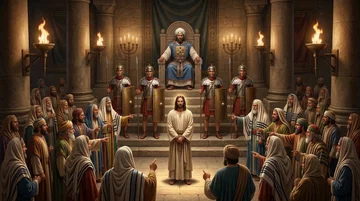
Mark 14:64 belongs to the scene in the judgment hall where Jesus is tried for His life before the high priest and an earthly court, standing at the foot of the judgment throne before the fully assembled council with Caiaphas as presiding officer.5RED 35.3–36.23SP 115.3–116.2 Caiaphas regarded Jesus as a rival because the simplicity, eloquence, and wisdom of His teaching drew large crowds and roused bitter jealousy.3SP 115.3–116.2 In outward setting the contrast was stark, for Caiaphas sat on the throne of judgment in gorgeous robe with glittering tiara and costly breastplate where the light of God's glory had often flashed, with judges and specially interested persons on either side and Roman soldiers ranged on the platform below, while Jesus stood at its foot in humble, coarse garb.5RED 35.3–36.23SP 115.3–116.2 Though so dressed, He is heaven's King who had reigned crowned in garments of brightness attended by holy angels.5RED 35.3–36.23SP 115.3–116.2
In bearing the contrast was as great, for Jesus stood calm, serene, majestic, and dignified with a holy influence emanating from Him amid wild excitement and the gaze of the multitude, against the agitated display and excited, malignant deportment of Annas and Caiaphas.5RED 35.3–36.23SP 115.3–116.2 Even the hardened multitude questioned sentencing a man of God-like presence as a common criminal, and Caiaphas, perceiving that influence, hastened the trial forward.3SP 115.3–116.2 Caiaphas himself was struck with admiration and conviction that Jesus was akin to God but banished the thought and in sneering, haughty tones asked Him to work a mighty miracle, which Jesus treated as though unheard.3SP 115.3–116.2
The verdict followed Jesus' declaration that He would sit at God's right hand and come in heaven's clouds as judge, thereby reversing the judgment then being passed on Him.5RED 39.3–40.2 The high priest treated Jesus' claim to be the Christ and Son of God as blasphemy and asked the judges for their verdict, and they all unanimously condemned Him as deserving death.DA 698.1–700.55RED 39.3–40.2 That unanimous death verdict was secured through a corrupt proceeding, even though Jesus had said nothing that gave His accusers a valid charge.DA 698.1–700.5
Sources
Pioneers and periodicals
12 sources
Mark 14:64 records the Jewish council's verdict that Jesus was guilty of blasphemy under Jewish law and deserving and worthy of death.RH Dec 10, 1861ST Mar 15, 1877RH Jul 25, 1854 The high priest presided over an informal and deeply unjust trial, bitterly jealous of Jesus' influence, and treated His truthful answer that He was the Christ, the Son of God, as blasphemy when he asked the council for its verdict.ST May 27, 1889ST May 27, 1889ST Dec 1, 1898 The death sentence was the intended result rather than a judgment based on valid witness, for the charges depended on false and conflicting testimony, with witnesses disagreeing yet agreeing He was guilty of death, though the law required two agreeing witnesses in a capital case and forbade trying such cases at night.ST May 27, 1889ST May 25, 1904RH Mar 14, 1865ST Dec 1, 1898 That sentence for a religious offense was not the basis on which Rome executed Him, for Pilate would not enforce it and Jesus was ultimately sentenced under the Roman charge of treason.ST Mar 15, 1877 As Christ was condemned to death as a blasphemer and deceiver, so the Papacy condemned believers as heretics and traitors and delivered them to civil powers for torture and execution, though putting even a heretic to death is itself a greater heresy.ST Jul 4, 1911
Trial Setting and Verdict
The council found Jesus guilty of blasphemy under Jewish law.ST Mar 15, 1877ST May 25, 1904 It condemned him as worthy of and deserving death.RH Dec 10, 1861RH Jul 25, 1854ST May 25, 1904RH Dec 29, 1863 The condemnation took place during an informal and deeply unjust trial presided over by Caiaphas, who was bitterly jealous of Jesus' influence and the crowds drawn to his teaching.ST May 27, 1889
The verse belongs to the account of Jesus' arrest and trial, in which he was bound and taken to the former high priest while his enemies sought to unite against him.ST Mar 14, 1906 It is part of the account of the closing events of his earthly life, which culminate in his triumph over death. It is part of the account of his final hours before his crucifixion.ST Mar 10, 1909 It shows his opponents as his most bitter enemies.RH Jul 25, 1854 It records his rejection and belongs to the movement from hollow homage to open outrage and rejection against him.RH Dec 29, 1863
Injustice of the Proceedings
The high priest treated Jesus' truthful answer that he was the Christ, the Son of God as blasphemy and asked the council to render its verdict upon it.ST May 27, 1889ST Dec 1, 1898 The condemnation to death that followed was the intended result of that announcement, not a judgment reached on the basis of valid witness against him.ST May 27, 1889ST Dec 1, 1898 The charges pressed against him depended on false testimony whose accounts conflicted with one another.ST May 27, 1889ST Dec 1, 1898 The witnesses disagreed in what they said, yet agreed that he was guilty of death, and the leaders condemned him despite the conflicting testimony.RH Mar 14, 1865
Jewish law required two witnesses to agree in a capital case, but the council relied on the testimony of two false witnesses.ST May 25, 1904 The trial was hurried through at night, although capital cases were not to be tried between sunset and sunrise, and it ended with condemnation of Jesus as worthy of death on the charge of blasphemy.ST May 25, 1904 That sentence of the Jewish council for a religious offense under Jewish law was not the basis on which Rome executed him, for Pilate would not enforce it.ST Mar 15, 1877 Jesus was ultimately sentenced under the Roman charge of treason.ST Mar 15, 1877
Meaning and Later Parallel
The condemnation declares Jesus to be deserving of death.RH Dec 10, 1861 The same word that is rendered damned in another phrase is applied to him in that condemnation.RH Dec 10, 1861 That word by itself therefore does not mean endless torment.RH Dec 10, 1861
Those who judged him counted him a blasphemer and treated his teaching as deception and subversion when they condemned him to death.ST Jul 4, 1911 In the same pattern, the Papacy condemned believers as heretics, infidels, apostates, or traitors.ST Jul 4, 1911 It delivered them to the civil powers for torture and execution.ST Jul 4, 1911 Even if those who were killed had been heretics, putting a heretic to death is itself a greater heresy.ST Jul 4, 1911
Sources