Mark 6:18
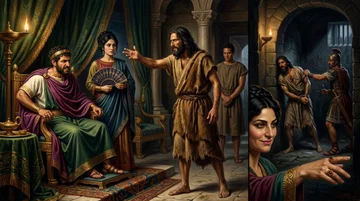
For John had said unto Herod, It is not lawful for thee to have thy brother’s wife.
Translations
For John had said to Herod, It is not lawful for you to have your brother’s wife.
King James Version, KJV Cambridge Paragraph Bible
For John had said unto Herod, It is not lawful for thee to have thy brother’s wife.
For John had said to Herod, It is not lawful for thee to have thy brother's wife.
Revised Version, American Standard Version
For John said unto Herod, It is not lawful for thee to have thy brother’ s wife.
for John said to Herod — 'It is not lawful to thee to have the wife of thy brother;'
For John said to Herod, It is not lawful for thee to have the wife of thy brother.
For John had been saying to Herod—It is not allowed thee, to have, the wife of thy brother.
Berean Standard Bible, Majority Standard Bible
For John had been telling Herod, “ It is not lawful for you to have your brother’ s wife!”
For John had said to Herod, “ It is not lawful for you to have your brother’ s wife.”
For John said to Herod, It is wrong for you to have your brother's wife.
For Iohn sayd vnto Herod, It is not lawfull for thee to haue thy brothers wife.
Douay-Rheims (Challoner revision)
For John said to Herod: It is not lawful for thee to have thy brother’s wife.
Pictures

Cross-references
- Matthew 14:3-4
For Herod had laid hold on John, and bound him, and put him in prison for Herodias’ sake, his brother Philip’s wife.
John rebukes Herod for taking his brother’s wife.
- Luke 3:19-20
But Herod the tetrarch, being reproved by him for Herodias his brother Philip’s wife, and for all the evils which Herod had done,
John rebuked Herod over Herodias, and Herod imprisoned him.
- Leviticus 20:21
And if a man shall take his brother’s wife, it is an unclean thing: he hath uncovered his brother’s nakedness; they shall be childless.
Forbids taking a brother’s wife while he lives.
- Leviticus 18:16
Thou shalt not uncover the nakedness of thy brother’s wife: it is thy brother’s nakedness.
Forbids taking a brother’s wife.
- Luke 9:7-9
Now Herod the tetrarch heard of all that was done by him: and he was perplexed, because that it was said of some, that John was risen from the dead;
Herod fears John has risen from the dead and asks to see Jesus.
- Matthew 14:6-11
But when Herod’s birthday was kept, the daughter of Herodias danced before them, and pleased Herod.
A parallel account of Salome’s dance and John’s death.
- Mark 6:22-25
And when the daughter of the said Herodias came in, and danced, and pleased Herod and them that sat with him, the king said unto the damsel, Ask of me whatsoever thou wilt, and I will give it thee.
rebuke remembered with birthday beheading demand
- Deuteronomy 25:5
If brethren dwell together, and one of them die, and have no child, the wife of the dead shall not marry without unto a stranger: her husband’s brother shall go in unto her, and take her to him to wife, and perform the duty of an husband’s brother unto her.
commands marrying childless deceased brother's widow
- Matthew 17:12-13
But I say unto you, That Elias is come already, and they knew him not, but have done unto him whatsoever they listed. Likewise shall also the Son of man suffer of them.
Jesus identifies John the Baptist as the Elijah who had come and suffered.
- Mark 6:26
And the king was exceeding sorry; yet for his oath’s sake, and for their sakes which sat with him, he would not reject her.
Herod keeps his oath while continuing an unlawful relationship.
- Matthew 11:1-11
And it came to pass, when Jesus had made an end of commanding his twelve disciples, he departed thence to teach and to preach in their cities.
parallel account of same imprisonment
- Acts 12:1-11
Now about that time Herod the king stretched forth his hands to vex certain of the church.
Herod persecutes the church and imprisons Peter, whom an angel delivers.
- Luke 1:17
And he shall go before him in the spirit and power of Elias, to turn the hearts of the fathers to the children, and the disobedient to the wisdom of the just; to make ready a people prepared for the Lord.
John came in Elijah’s spirit and power.
Commentary
Each commentary is drawn from primary sources: the writings of Ellen G. White and Adventist pioneers and periodicals. Each commentary is separate. Its own words are not a quotation; follow the references to read the source passages.
Ellen G. White
24 sources
John told Herod to his face and again and again that keeping his brother's wife Herodias while her husband was still living broke God's law.DA 214.1RH Oct 22, 19012SP 69.2 He set God's law before him, laid open his guilt, warned him of punishment to come, and urged him to break with her and obey wholeheartedly if he would have any part in the Messiah's kingdom.2SP 69.2ST Mar 1, 1883ST Nov 1, 1877 Herod was condemned in conscience, feared John as a just and holy prophet, heard him gladly, did many things he said, and came near to following the truth.DA 214.12SP 69.2RH Mar 11, 1873 Herodias in hatred fastened her hold on Herod, had John shut in prison, and then secured his beheading at a drunken birthday revel to gratify her revenge.DA 214.1RH Mar 11, 1873STCOS 144.2–3RH Apr 8, 1873 Such plain and pointed reproof of a ruler at the cost of freedom and life is the pattern for God's messengers, and John's death warns those in authority and those who love pleasure against intemperance and turning away after conviction.DA 214.1RH Oct 22, 1901EW 124.3–125.15RED 55.12SP 80.1
John's Rebuke and Setting
John spoke to Herod directly and repeatedly, telling him to his face that keeping his brother's wife Herodias was unlawful under God's law while her husband was still living.DA 214.12SP 69.22SP 76.1–77.1ST Mar 1, 1883ST Nov 1, 1877 He did not soften the charge but denounced the alliance as iniquitous and condemned their unlawful life together.DA 214.1RH Oct 22, 19012SP 76.1–77.1ST Mar 1, 1883ST Nov 1, 1877 The rebuke was plain and sharp truth that exposed the transgression.RH Oct 22, 19012SP 69.22SP 76.1–77.1
He set Herod face to face with the law of God, reproved the transgression, and warned of the future punishment that must fall upon the guilty.2SP 69.2ST Mar 1, 1883ST Nov 1, 1877 He told him he could have no part in the Messiah's kingdom unless he broke away from Herodias and with his whole heart obeyed the commandments of God.2SP 69.2ST Mar 1, 1883ST Nov 1, 18772SP 70.1RH Mar 4, 1873 He could not marry her in defiance of God's law and at the same time share in that kingdom, but must end the unlawful union and submit to God's restrictions.ST Mar 1, 1883ST Nov 1, 18772SP 70.1RH Mar 4, 1873
Herod had heard John's preaching in the territory east of Jordan under his own dominion.DA 214.1 He was held by a chain of lust through Herodias, a woman of vile passions who had gained his affections and controlled his mind, and who sought power and authority by becoming his wife.DA 214.12SP 69.2 Being weak in principle and vacillating in mind, he yielded to the pleasures of sin rather than submit to God's restrictions.2SP 69.22SP 70.1 He did not turn from intemperance and sin but persisted in it until his heart grew harder.2SP 70.1COS 144.2–3
Herod's Conviction and John's Death
Herod heard the rebuke with deep interest and was convicted and condemned in conscience, trembling under it and fearing John as a just and holy man and a true prophet.DA 214.12SP 69.2RH Mar 11, 1873 He heard him gladly, did many things he said, opened his mind to him, and asked what he must do to become his disciple.DA 214.12SP 69.2RH Mar 11, 1873 He was at first inclined to act on John's advice and told Herodias so, honored John, intended to release him from prison, and nearly followed the truth as his disciple.RH Mar 11, 18732SP 70.22SP 70.13SP 135.15RED 55.1
Herodias in intense hatred and anger sought revenge for the rebuke that condemned their unlawful life, fearing John might persuade Herod to change.2SP 76.1–77.12SP 70.22SP 70.1ST She fastened Herod more firmly in her toils and regained her favor and influence over him when he was weak and vacillating.DA 214.12SP 70.1 She thus induced him to cast John from the free air of the wilderness into a dungeon cell in the fortress prison, though Herod had intended to release him.DA 214.1RH Mar 11, 18732SP 70.2
Moved from active labor to gloom and inaction, John found week after week with no change weighing heavily on him until despondency and doubt crept over him.DA 214.2–215.2 His disciples still visited him and brought tidings of the works of Jesus and the crowds flocking to Him, yet questioned why if Jesus was the Messiah He did nothing to effect John's release and permitted His faithful herald to be deprived of liberty and perhaps of life, and those words bruised John's soul and suggested doubts that otherwise would never have arisen.DA 214.2–215.2 Like the Saviour's disciples he did not understand the nature of Christ's kingdom, expecting Jesus to take the throne of David and becoming perplexed and troubled when the Saviour made no claim to kingly authority.DA 214.2–215.2 He had declared that every valley must be filled and mountains and hills made low and crooked places straight and rough places plain, looking for the high places of human pride and power to be cast down, and had pointed to the Messiah as the One whose fan was in His hand to thoroughly purge His floor and gather the wheat into His garner and burn the chaff with unquenchable fire, and like Elijah in whose spirit and power he had come to Israel he looked for the Lord to reveal Himself by fire.DA 214.2–215.2
Herod punished John for the reproof and, during a drunken birthday revel where intemperance impaired judgment and left conscience dormant, honored his oath after the dance of Herodias's daughter and ordered John's execution to please Herodias.STCOS 144.2–3Ms 107, 1893, par. 1 He had been deeply impressed by John's teaching and called to reform but did not turn from intemperance and sin, and when faced with the choice to follow the truth he yielded to temptation.COS 144.2–3RH Apr 8, 18735RED 55.1 His martyrdom amid the feast shows how intemperance among men in authority allows a wicked demand to prevail, and later at Passover Herod was still with Herodias.Ms 107, 1893, par. 1 John had faithfully rebuked Herod for having his brother's wife, and Herod repeatedly remonstrated with yet murdered him to honor the oath and satisfy resentment.STRH Apr 8, 1873
After John's death his preaching still troubled Herod's conscience and its influence continued, with fear that God would punish him for his sin.STRH Apr 8, 1873 At first remorseful for the murder, Herod's conscience grew less sensitive as he continued in licentious sin until his moral sense was degraded and his sins seemed trifling to him, for turning away from truth after conviction leads deeper into iniquity.3SP 135.15RED 55.1 His enemies could take John's life because he bore witness against Herod, but they could not take away his hope or eternal life.Ms 16, 1895, par. 18
Pattern for Faithful Witness
John spoke plain sharp truth directly to the ruler's face, denouncing as unlawful his living with his brother's wife while her husband was still living, an iniquitous alliance that drew the anger of the woman and cost him first the free air of the wilderness for a dungeon cell in the fortress prison and then his life.DA 214.1RH Oct 22, 1901EW 124.3–125.1PK 140.3–141.1 His message grew more and more pointed in direct reproof of wrong, yet he would not preach smooth sermons, let policy take the place of faithfulness, allow grievous sin to go unrebuked, or move along silently to save himself from wrath.RH Oct 22, 1901STB 55.4STB 377.2 Faithful messengers must do the same, cutting men to the heart and speaking plainly against sin rather than remaining silent to avoid displeasing those who sin, so that the people will not be deceived.RH Oct 22, 1901STB 55.4STB 377.2PK 140.3–141.1
His imprisonment and martyrdom at the birthday feast came through impaired judgment and dormant conscience among men in authority, when a wicked demand was allowed to prevail.2SP 80.1 That end warns those who love pleasure and those in authority against intemperance, and calls for Christian temperance and self-government.2SP 80.1 The ruler had known the reprover was a true prophet and had nearly become his disciple, but having yielded to temptation and turned away from truth after conviction, his remorse faded as a licentious life degraded his moral sense until his sins seemed trifling to him, showing that turning from light after conviction leads deeper into iniquity.5RED 55.1
Sources
Pioneers and periodicals
57 sources
John told Herod to his face that taking his brother Philip's wife Herodias to be his own wife while Philip was still alive was against God's law governing family relations and was adultery.ST Dec 24, 1894ST Jun 7, 1899ST Mar 3, 1898ST Jan 2, 1893 He said it plainly, sharply and repeatedly, without softening the rebuke for Herod's royal rank, threats or offers, judging the matter by what was right rather than whether speaking was safe.RH Oct 22, 1901STST Feb 7, 1911 He called Herod to break from the unlawful union, put away his sin and obey God wholeheartedly, for he could have no part in the Messiah's kingdom while holding to it.ST Mar 1, 1883ST Nov 1, 1877RH Apr 8, 1873 The rebuke struck Herod's guilty conscience and stirred Herodias to resentment, hatred and plotting, which pressed his imprisonment at Macherus and his beheading on Herod's order after the birthday banquet oath.RH Mar 11, 1873STST Dec 15, 1887ST Aug 2, 1910ST Aug 2, 1910 He stands as a brave prophet who feared God rather than man, a model that faithful messengers must rebuke grievous sin in high places as well as lowly with plain truth that cuts to the heart, even at the cost of position, freedom or life.RH Oct 22, 1901ST Apr 20, 1882RH Dec 17, 1903RH Nov 25, 1858RH Jul 9, 1867
Setting and Unlawful Union
The saying belongs to the account of John's imprisonment and martyrdom, placing his condemnation of Herod within the events that led to his execution by beheading while he was imprisoned.STST Mar 3, 1898ST Feb 17, 1909RH Jan 10, 1871 The order was carried out in prison on Herod's command by a soldier who brought the head on a platter into the banquet hall.ST Sep 13, 1910 The events belong to Galilee around the spring of A.D. 28, with John imprisoned at Macherus, a fortress in Perea, and beheaded about a year later.ST Dec 24, 1894
The unlawful union was Herod Antipas taking Herodias and having her as his wife when she was the wife of his brother Philip, his older brother.ST Dec 24, 1894ST Jun 7, 1899ST Jun 7, 1899ST Jun 7, 1910 Herod had put away his own lawful wife, the daughter of Aretas king of Arabia, to take Herodias after winning her affections while staying at Philip's house.ST Mar 3, 1898ST Mar 2, 1904ST Dec 24, 1894 Herodias was also Herod's niece, making the union unlawful on that ground as well.ST Mar 3, 1898 The words it is not lawful invoke God's law forbidding a man to have his brother's wife and governing family relations, which John applied directly to Herod.RH Nov 1, 1864ST Mar 3, 1898ST Aug 2, 1910RH Jun 15, 1905 The rebuke concerned taking a brother's wife while the brother was still alive, which was adultery and unlawful indulgence of lust forbidden by the moral law, entirely different from marrying a deceased brother's widow after his death, which Scripture permits.ST Jan 2, 1893 John said this to Herod repeatedly, faithfully calling him to account and remonstrating with him, including asking where his lawful spouse was.STST Feb 7, 1911ST Dec 24, 1894ST Dec 26, 1892
John's Faithful Rebuke
John told Herod to his face, directly and plainly, that living with his brother's wife was unlawful.RH Oct 22, 1901ST Apr 17, 1879ST Mar 2, 1904RH Jul 20, 1916 The rebuke was sharp and stern truth, not softened because Herod was king, because of royal customs, or because of threats and offers.RH Oct 22, 1901RH Jul 20, 1916 He warned Herod specifically that taking his brother's wife was unlawful, even while Herod heard him gladly when he preached of the coming Messiah.ST Apr 17, 1879 He spoke plainly against the sin because he stood loyal to God rather than fearing men.RH Mar 2, 1905RH Jun 15, 1905RH Jul 20, 1916
He judged the matter by what was right rather than by whether speaking out was safe, even at the cost of his life.RH Mar 2, 1905RH Jun 15, 1905RH Jul 9, 1867 He applied the principles governing family relations and God's holy law to sin in high places, even in the king's court.RH Mar 2, 1905RH Jun 15, 1905RH Jul 9, 1867 His willingness to rebuke the king marks him as a moral hero and bold reformer who faced persecution for upholding truth.RH Mar 2, 1905RH Jul 9, 1867
He did not stay silent about Herod's adultery though it was a cherished court sin, nor did he avoid condemning it in order to keep preaching without opposition.RH Nov 25, 1858RH Nov 25, 1858 He did not keep silent to preserve access to Herod, and his example shows the gospel must speak against sin even when doing so is unpopular or closes doors to preaching.RH Nov 25, 1858RH Nov 25, 1858 Faithful messengers must rebuke grievous sin with truth that cuts men to the heart, rather than preach smooth sermons, let policy take the place of faithfulness, allow sin to go unrebuked, or move along silently to save themselves from wrath.RH Oct 22, 1901RH Nov 25, 1858RH Nov 25, 1858
He called Herod to reform, insisting he must put away his sin, break from the unlawful union, show repentance, and obey God wholeheartedly.RH Apr 8, 1873 God's forgiveness is for those who forsake their wrongdoing, and the rebuke refused to let Herod claim discipleship while continuing in it. Herod could not share in the Messiah's kingdom while maintaining that unlawful union under God's law.ST Mar 1, 1883ST Nov 1, 1877RH Mar 4, 1873 He had to end the relationship with his brother's wife and obey God's commandments wholeheartedly.ST Mar 1, 1883ST Nov 1, 1877RH Mar 4, 1873
Imprisonment Death and Conscience
John's rebuke laid bare Herod's sin and struck terror and fear into his guilty conscience, while it provoked Herodias to resentment, anger, hatred and a desire for revenge, making John her enemy for speaking against their unlawful life.RH Mar 11, 1873STST Mar 8, 1883ST Dec 15, 1887ST Aug 2, 1910 Herodias hated John for reproving her sins and sought revenge because he had spoken against their unlawful union.STST Mar 8, 1883ST Dec 15, 1887ST Sep 6, 1910 His repeated remonstrances stirred her resentment and fear that he might persuade Herod to change.ST
Herodias's anger at the rebuke helped bring about John's imprisonment, and she urged Herod on and pressed for it, with her demand following from her hostility.ST Aug 2, 1910ST Aug 2, 1910ST Aug 2, 1910ST Jun 19, 1907ST Nov 5, 1912 Herod knew John was a just prophet and regretted his anger at being confronted with the law, yet at her urging he imprisoned him.ST Aug 2, 1910 She feared his release because his denunciation exposed her conduct and brought public dishonor upon her and Salome, and her desire to silence him led her to plot his death.ST Sep 6, 1910
Herod had heard John gladly when he preached of the coming Messiah in the wilderness of Judea before crowds of princes and common people, bending his proud neck as a king's son to listen reverently and being pricked in heart over his sins.ST Feb 7, 1911ST Apr 17, 1879 He regarded John as a just prophet and a true prophet, feared and respected him, honored him, and intended to release him.RH Mar 11, 1873ST Aug 2, 1910ST Jun 19, 1907 He regretted his anger at being confronted and tried to protect John from Herodias.ST Aug 2, 1910ST Jun 19, 1907 The direct warning that taking his brother's wife was unlawful angered him and led him to imprison John.ST Apr 17, 1879
That protection failed when, after a birthday banquet marked by drunkenness and misplaced pride, an intoxicated Herod promised Herodias's daughter whatever she asked and then honored his oath by ordering the beheading in prison.STST Dec 24, 1894ST Jun 19, 1907 Rejection of God-sent reproof left him vulnerable to temptation and led step by step through drunkenness and pride into grave wrongdoing.ST Dec 24, 1894 His scrupulous regard for his oath did not excuse his continuing incestuous relationship, showing that observing one moral duty does not pardon another sin.RH Oct 16, 1860
The prophet's reproof of Herodias's sin fueled her resentment and desire to silence him.ST Sep 6, 1910 John's truthful reproof continued to trouble Herod after the execution, ringing in his ears, stirring his conscience, and returning as he reviewed his past and his ordering of John's death at his birthday feast.STRH Apr 8, 1873ST Feb 7, 1911 Herod feared God would punish him for his sin, feared John would rise from the dead and condemn him, and recognized the killing had cost him his peace.STRH Apr 8, 1873ST Feb 7, 1911ST Sep 13, 1910
While in prison for reproving Herod for taking his brother's wife, John was greatly disappointed because the kingdom was not set up, and the question came into his mind whether Jesus was the Messiah, a disappointment his disciples shared.ST Dec 26, 1892
Doctrine and Moral Obligation
John's appeal to the law against Herod shows the law forbidding a man to take his brother's wife was regarded as authoritative and still binding, not dead.RH Nov 1, 1864 His rebuke declared Herod's marriage to his brother Philip's wife unlawful, applying the law governing such family relations.ST Mar 3, 1898 Herod had put away his own lawful wife, the daughter of Aretas, and had taken Herodias after winning her affections while staying at Philip's house.ST Mar 3, 1898 Herodias was also Herod's niece, so the union was unlawful on that ground as well.ST Mar 3, 1898
Those in positions of authority are, like everyone else, accountable to God for their conduct.ST Mar 3, 1898 Herod's scrupulous regard for his oath did not excuse his continuing incestuous union with Herodias, illustrating that observing one moral duty does not pardon another sin.RH Oct 16, 1860 Herod's marriage stands as an example of a union that brought trouble and put people in a compromising position.ST Sep 27, 1910
John was the Lord's special messenger sent to announce the coming of the Messiah.ST Jul 13, 1904 His course showed the authorities that Herod would put him out of the way.ST Oct 11, 1899 That removal was the exercise of Herod Antipas's power to put John to death.ST Oct 11, 1899ST Jul 13, 1904
Example Warning and Application
John was a brave prophet who feared God but not man, whom the king could not silence.ST Apr 20, 1882 Trained in communion with God in the wilderness, he was authorized to challenge evil even when it stood in a king's court.RH Dec 17, 1903 Like Elijah he was a bold reformer who faced persecution for upholding truth by God's holy law, applying that law to sin in high places until hatred, imprisonment and beheading followed the exposure of sin.RH Jul 9, 1867 He is therefore a model for the modern preacher to dare to do right whatever the cost and to be as quick to rebuke iniquity in high places as among the lowly.ST Apr 20, 1882 His call to repentance reached even the king and did not spare sinning royalty, so that the king heard and trembled.ST Mar 13, 1907 Meekness did not make him timid or afraid to speak against a ruler when doing right.ST Feb 11, 1897
Faithful messengers must rebuke grievous sin with plain, sharp truth that cuts men to the heart.RH Oct 22, 1901 They must not preach smooth sermons, let policy take the place of faithfulness, allow sin to go unrebuked, or move along silently to save themselves from wrath.RH Oct 22, 1901 They must not keep silent about sin to preserve access or to continue preaching without opposition, for the gospel must speak against sin even when doing so is unpopular or closes doors.RH Nov 25, 1858 The anger that the rebuke of an unlawful union provoked, even unto death, does not alter that duty.RH May 11, 1869
Loyalty to God and truth can cost a person life, position, or friendships.ST Sep 8, 1898 John's faithful rebuke brought trouble and death, and his bold reproof cost him his life, illustrating how God's reprovers confronted wrongdoing among rulers and religious leaders.RH Nov 11, 1858 He judged the matter by what was right, not by whether speaking out was safe, and his willingness to rebuke the king even at the cost of his life marks him as a moral hero.RH Mar 2, 1905 For speaking God's truth to a licentious ruler he faced the hatred of the adulterous woman and was imprisoned and beheaded, and she was not content with his death but pierced his dead tongue.
Rejecting God-sent reproof leaves one vulnerable to temptation and leads step by step through drunkenness and misplaced pride into grave wrongdoing, even to the death of the reprover.ST Dec 24, 1894 The safe course is to heed the Lord's reproof rather than become entangled by yielding to temptation.ST Dec 24, 1894 Anyone like Herod who keeps a particular sin he cannot bear to have reproved deceives himself by supposing his joys are proof of conversion.ST Oct 2, 1893 The events surrounding the rebuke show how intemperance among people in authority contributed to the martyrdom at the birthday feast, warning against pleasure-seeking and calling for Christian temperance.ST Dec 15, 1887 That death is remembered as a ghastly tragedy in Herod's household that turned the king's feast into a scene of bloodshed, with John honored as a righteous prophet.ST Sep 13, 1910 He gave his life for his Master as a hero, though the frightening details of beheading and the head carried on a tray into a banquet hall were not suited to very young children.
Further points
The saying belongs to the account in which John lost his head because Herodias used her influence over Herod.ST Mar 8, 1899 It connects his death by the sword with Herod's moral weakness through a woman.ST Mar 8, 1899 That weakness allowed Herodias to turn Herod against the prophet who had condemned the union.ST Mar 8, 1899
Sources