Matthew 14:3
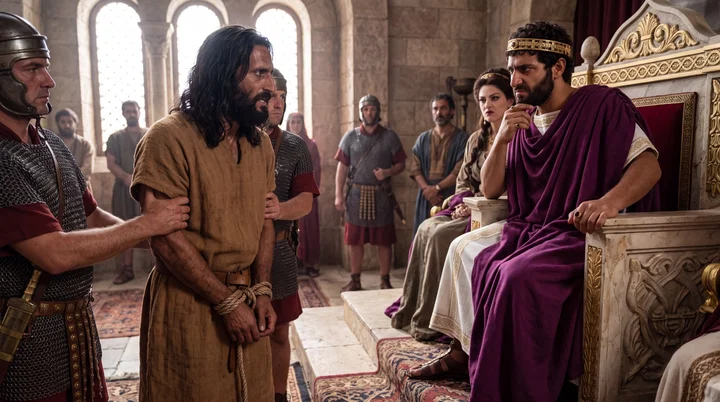
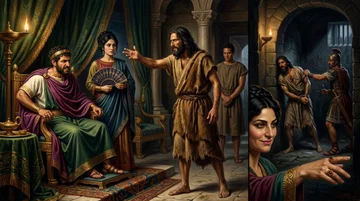
For Herod had laid hold on John, and bound him, and put him in prison for Herodias’ sake, his brother Philip’s wife.
Translations
American King James Version, King James Version, KJV Cambridge Paragraph Bible
For Herod had laid hold on John, and bound him, and put him in prison for Herodias’ sake, his brother Philip’s wife.
For Herod had laid hold on John, and bound him, and put him in prison for the sake of Herodias, his brother Philip's wife.
Revised Version, American Standard Version
For Herod had laid hold on John, and bound him, and put him in prison for the sake of Herodias, his brother Philip’s wife.
For Herod having laid hold on John, did bind him, and did put him in prison, because of Herodias his brother Philip's wife,
For Herod had seized John, and had bound him and put him in prison on account of Herodias the wife of Philip his brother.
For, Herod, seizing John, had bound him, and, in prison, put him away,—because of Herodias, the wife of Philip his brother;
Berean Standard Bible, Majority Standard Bible
Now Herod had arrested John and bound him and put him in prison on account of Herodias, his brother Philip’s wife,
For Herod had arrested John, bound him, and put him in prison for the sake of Herodias, his brother Philip’s wife.
For Herod had taken John and put him in prison because of Herodias, his brother Philip's wife.
For Herod had taken Iohn, and bounde him, and put him in prison for Herodias sake, his brother Philips wife.
Douay-Rheims (Challoner revision)
For Herod had apprehended John and bound him, and put him into prison, because of Herodias, his brother’s wife.
Pictures



Cross-references 20 of 35
- Mark 6:17-18
For Herod himself had sent forth and laid hold upon John, and bound him in prison for Herodias’ sake, his brother Philip’s wife: for he had married her.
Herod imprisons John after John rebukes his unlawful marriage to Herodias.
- Luke 3:19-20
But Herod the tetrarch, being reproved by him for Herodias his brother Philip’s wife, and for all the evils which Herod had done,
John rebukes Herod over Herodias, and Herod imprisons him.
- Leviticus 18:16
Thou shalt not uncover the nakedness of thy brother’s wife: it is thy brother’s nakedness.
Forbids taking a brother’s wife, the marriage John confronted.
- Leviticus 20:21
And if a man shall take his brother’s wife, it is an unclean thing: he hath uncovered his brother’s nakedness; they shall be childless.
Forbids taking a brother’s wife while her husband is alive.
- Matthew 11:2-3
Now when John had heard in the prison the works of Christ, he sent two of his disciples,
John’s imprisonment leads him to question Jesus about his identity.
- Matthew 11:11
Verily I say unto you, Among them that are born of women there hath not risen a greater than John the Baptist: notwithstanding he that is least in the kingdom of heaven is greater than he.
Christ declared John’s greatness despite his imprisonment and death.
- Matthew 14:10
And he sent, and beheaded John in the prison.
John is beheaded in prison after Herod imprisons him.
- Mark 6:20
For Herod feared John, knowing that he was a just man and an holy, and observed him; and when he heard him, he did many things, and heard him gladly.
Herod feared John and gladly listened to his preaching.
- Matthew 17:12-13
But I say unto you, That Elias is come already, and they knew him not, but have done unto him whatsoever they listed. Likewise shall also the Son of man suffer of them.
Jesus says Elijah had already come, and the disciples understand he means John the Baptist.
- Matthew 3:2
And saying, Repent ye: for the kingdom of heaven is at hand.
John’s call to repentance explains his dealing with Herod.
- Mark 6:16
But when Herod heard thereof, he said, It is John, whom I beheaded: he is risen from the dead.
Herod identifies Jesus as John, whom he beheaded, risen from the dead.
- Luke 9:7-9
Now Herod the tetrarch heard of all that was done by him: and he was perplexed, because that it was said of some, that John was risen from the dead;
Herod connects reports about Jesus with John’s death.
- Exodus 20:14
Thou shalt not commit adultery.
Herod’s union violated the prohibition against adultery.
- Luke 7:24
And when the messengers of John were departed, he began to speak unto the people concerning John, What went ye out into the wilderness for to see? A reed shaken with the wind?
Jesus describes John as steadfast despite his imprisonment.
- Matthew 11:14
And if ye will receive it, this is Elias, which was for to come.
John is identified as the promised Elijah who was to come.
- Matthew 4:12
Now when Jesus had heard that John was cast into prison, he departed into Galilee;
Jesus withdraws to Galilee after John is imprisoned.
- Matthew 11:2
Now when John had heard in the prison the works of Christ, he sent two of his disciples,
John hears of Jesus’ works while imprisoned.
- Matthew 14:9
And the king was sorry: nevertheless for the oath’s sake, and them which sat with him at meat, he commanded it to be given her.
Herod’s reluctance to execute John is noted.
- John 1:19-28
And this is the record of John, when the Jews sent priests and Levites from Jerusalem to ask him, Who art thou?
ministry of John cited as background
- Matthew 14:12
And his disciples came, and took up the body, and buried it, and went and told Jesus.
John’s disciples buried his body and reported it to Jesus.
Commentary
Each commentary is drawn from primary sources: the writings of Ellen G. White and Adventist pioneers and periodicals. Each commentary is separate. Its own words are not a quotation; follow the references to read the source passages.
Ellen G. White
36 sources
Herod Antipas seized John the Baptist, bound him and shut him in prison to please Herodias, his brother Philip's wife while her husband was still living.STDA 214.1DA 214.2–215.2 The union was unlawful and in transgression of God's law, and John fearlessly faced Herod with that fact and told him he could have no part in the Messiah's kingdom unless he broke from it and obeyed God's commandments with his whole heart.2SP 69.2ST Mar 1, 1883ST Nov 1, 1877EW 124.3–125.1SG1 29.2–30.1 Herodias, who had gained Herod's affections and sway over his mind, conceived intense hatred for the reproof and clung to revenge until John was destroyed.2SP 69.22SP 70.22SP 76.1–77.1ST Mar 1, 18832SP 70.1 Herod himself was convicted and troubled, honored John as a true prophet, reformed in many things and nearly became his disciple and intended to release him.2SP 70.22SP 76.1–77.1ST Mar 1, 1883 Yet he was weak and vacillating and would not give up his attachment and intemperance, but yielded to the pleasures of sin rather than submit to God's law, and John's imprisonment ended in his beheading to gratify Herodias's revenge.STST Mar 1, 1883ST Nov 1, 18773SP 135.12SP 70.1
Imprisonment and Its Causes
Herod Antipas himself laid hold on John the Baptist, bound him, and put him in prison, and he did it for the sake of Herodias, his brother Philip's wife.STDA 214.1DA 214.2–215.2SLP 255.24RED 103.2–104.1 The arrest was the direct result of John's condemnation of that union, and Herodias induced Herod to imprison him even while Herod himself was troubled by the call to repentance and would not free himself from his attachment to her.DA 214.1DA 214.2–215.2
The union John condemned was unlawful, for Herod had taken his brother's wife while her husband was still living, in transgression of the law of God.EW 124.3–125.1SG1 29.2–30.1RH Mar 4, 1873LC1 44.31RED 44.3 John plainly and faithfully told Herod to his face that living with Herodias was unlawful, fearlessly denouncing sin even though it was found in a ruler's household.DA 214.1DA 214.2–215.22SP 76.1–77.1MWISDAP 34.2GW 149.2–150.1 His testimony was straight and proving, pointed and fearless, imperiling his own life, yet he remained faithful even when speaking the truth cost him imprisonment and death.DA 214.2–215.2Lt 107, 1897, par. 4–5MWISDAP 34.2
Herodias conceived intense hatred for daring reproof of their crime and determined to be revenged, and she clung to her grievance and would not release her hold until John was destroyed.2SP 70.22SP 76.1–77.1RH Mar 4, 1873STLt 107, 1897, par. 4–5 She was exceedingly angry and could not rest, fearing that John's repeated remonstrances might persuade Herod and turn him against her.ST Mar 1, 1883ST Nov 1, 1877STLt 107, 1897, par. 4–5 She was a woman of vile passions, ambitious for power and authority, who had gained Herod's affections and controlled his mind.2SP 69.2RH Mar 4, 1873 After Herod opened his mind to John and told her he could not marry her in defiance of the law of God, she would not be thwarted but re-established herself in his favor, held her influence over him, and by that regained influence persuaded and influenced him to imprison John.ST Mar 1, 1883ST Nov 1, 18772SP 70.1RH Mar 4, 1873
John had brought Herod face to face with God's law, proclaiming practical truth and setting forth the future punishment of the guilty, and told him he could have no part in the Messiah's kingdom unless he broke away from his brother's wife and with his whole heart obeyed the commandments of God.2SP 69.2ST Mar 1, 1883ST Nov 1, 1877RH Mar 4, 1873 Herod was convicted and trembled at the exposure of his sins, was troubled, honored and feared John as a true prophet of God, and reformed his dissolute life in many things.DA 214.12SP 76.1–77.1RH Mar 4, 1873 He was inclined to act on John's counsel and heed him, greatly desired to break the chain of lust that held him, told Herodias he could not marry her in defiance of God's law, intended to release John, and had nearly become his disciple.ST Mar 1, 1883ST Nov 1, 18773SP 135.12SP 70.1RH Mar 4, 1873 Yet Herod was weak in principle and vacillating, would not give up his attachment and intemperance, and yielded to the pleasures of sin rather than submit to the restrictions of the law of God.ST Mar 1, 1883ST Nov 1, 18772SP 70.1COS 144.2–3RH Mar 4, 1873 Under his wife's influence he seized John and held him in prison though he still intended to release him, choosing sinful pleasure over obedience.2SP 70.1RH Mar 4, 1873LC1 44.3
Aftermath and Faithful Witness
John's imprisonment ended in his beheading to gratify Herodias's revenge, ordered during a drunken revel to please her.ST3SP 135.1COS 144.2–35RED 55.1ST Jul 11, 1878 At the point of decision Herod turned from the truth and light into darkness, falling into Satan's snare though he knew John was a true prophet and had nearly become his disciple.3SP 135.15RED 55.1ST Jul 11, 1878 He trembled with horror at the request for John's head, yet gave the order.ST Jul 11, 1878
The execution came at Herod's birthday feast, an occasion of gluttony and intoxication chosen by strategy to throw him off guard when intelligence would otherwise have controlled him.Ms 107, 1893, par. 1RH Mar 11, 18732SP 80.1 Intemperance among men in authority impaired judgment and sense of right and wrong, and with senses debased with wine Herod was entrapped by the captivating dance of Herodias's daughter into promising her anything she might ask.Ms 107, 1893, par. 1RH Mar 11, 18732SP 80.1 Herodias sought revenge because John had rebuked her and feared his repeated remonstrances might persuade Herod, and she clung to her grievance and would not release her hold until John was destroyed.STRH Mar 11, 1873 Herod wrongly treated his rash oath as binding him to fulfill even this murderous demand, choosing actual murder over the appearance of breaking his oath.STMs 107, 1893, par. 1 When the bleeding head was brought in before the guests they felt horror at the sight, and Herod could not endure it or close his vision to the painful sight.COS 144.2–3Ms 107, 1893, par. 1
Afterward Herod was tormented by guilt and remorse, and after hearing of Jesus' works he feared that John had risen to condemn him and bring punishment.ST3SP 135.15RED 55.1 He continued in sin with Herodias until his moral perceptions were degraded, his licentious life making his sins appear but trifles and his conscience far less sensitive.3SP 135.15RED 55.1ST Jul 11, 1878 After a year had passed, with time to consider his own life and character, he was still with his unlawful wife witnessing and going through the formal ceremonies as a Jew observing the annual Passover.Ms 107, 1893, par. 1 He later boasted to Jesus of the punishment he had inflicted on the prophet who had reproved him.ST Nov 2, 18823SP 136.1–2
While confined John could not hear Jesus in person, but his disciples told him about Jesus' mighty works and comforted him with what they had seen and heard.2SP 70.2RH Mar 4, 1873 Jesus possessed power to save His forerunner but allowed him to be left to violent death without asserting His authority as king.DA 380.1–2 This became a trial that led some who had accepted Christ through John's preaching to doubt John's mission and whether Jesus was the Messiah.4RED 103.2–104.1DA 380.1–2 It grieved the disciples and made them fear that Jesus, opposed by the scribes and Pharisees, might meet a similarly inglorious fate, feeding disappointment, impatience, unbelief and spiritual darkness.2SP 182.3DA 380.1–2 Jesus knew the storm gathering over John and withdrew to Galilee for a time to keep division between His disciples and John's from harming their work.4RED 23.12SP 139.1–2
John's pointed, straight testimony exposing wrongdoing shows that speaking the truth may imperil life and bring death.Lt 107, 1897, par. 4–5STB 55.4STB 377.2MWISDAP 34.2GW 149.2–150.1 Those who reprove sin are hated, and the plain testimony cuts the fleshly heart even to the joints and marrow as a savor of life unto life or of death unto death.Lt 107, 1897, par. 4–5 Yet such a message must still be given whether men will hear or refuse to hear, so that people are not deceived.Lt 107, 1897, par. 4–5STB 377.2MOPP 14.3–4 God's work will go forward without the refusers and will triumph with all who voice it with heart and soul.Lt 107, 1897, par. 4–5
Sources
Pioneers and periodicals
68 sources
Herod Antipas, tetrarch of Galilee, laid hold on John, bound him and shut him in prison because he had put away his lawful wife and taken Herodias, his brother Philip's wife, to be his own.ST Mar 2, 1904ST Mar 3, 1898RH Nov 12, 1861ST May 7, 1902ST Mar 2, 1904 John reproved him to his face that it was not lawful to have her, for taking a brother's wife while the brother lived was adultery and transgression of God's law.ST Mar 1, 1883ST Dec 15, 1887ST Mar 2, 1904ST Mar 3, 1898RH Nov 12, 1861 Herod was convicted and inclined to favor John and reform, yet he acted for Herodias' sake and remained under her influence, delaying to release him until he yielded to sin rather than obey the law.RH Mar 4, 1873ST Dec 15, 1887ST Mar 16, 1904ST Dec 15, 1887ST Feb 7, 1911 John stood as God's meek forerunner who feared not man, dealing with Herod as a religious reformer calling king and people to put away personal sin and prepare for the Messiah's kingdom, not as a political reformer seeking to change laws by force.RH Dec 17, 1903ST Mar 2, 1904ST Sep 27, 1910ST Feb 22, 1883ST Nov 15, 1905 His imprisonment of about a year ended in beheading at the birthday feast, sealing a faithful witness that echoed Elijah before Ahab and Jezebel and prepared the way for Christ's own suffering.ST Mar 2, 1904ST Sep 13, 1910ST Feb 7, 1911ST Jun 6, 1900RH Jul 9, 1867
Names Places and Time
The Herod of the verse is Herod Antipas, tetrarch of Galilee, son of Herod the Great who sought to kill Jesus in infancy, not Herod the Great himself nor Herod Agrippa.RH Nov 12, 1861ST May 7, 1902 He arrested and imprisoned John the Baptist, whom he afterward put to death.ST May 7, 1902RH Sep 5, 1865 This took place during the reign of Tiberius Caesar, while Herod was tetrarch of Galilee and Pontius Pilate was governor of Judea.RH Sep 5, 1865
The verse records three successive acts in order: Herod laid hold on John, bound him, and put him in prison for Herodias' sake, his brother Philip's wife, because John said it was not lawful for Herod to have her.ST Mar 2, 1904ST Mar 3, 1898ST Mar 3, 1898 Afterward he had him put to death.ST May 7, 1902RH Sep 5, 1865 After Jesus heard of John's death he withdrew to a quiet place for meditation, closing the period from his baptism by John in Jordan to John's death at Herod's hands.ST Feb 15, 1905ST Mar 10, 1898
The imprisonment belongs to about the spring of A.D. 28 in the third year of Jesus' ministry while he was in Galilee with his disciples.ST Dec 24, 1894ST Mar 3, 1898 John had then been imprisoned about a year, enduring severe testing.ST Mar 2, 1904ST Mar 3, 1898 He was beheaded the following year at about age 33.ST Dec 24, 1894ST Mar 3, 1898
John's prison and the birthday feast were at Machaerus, also called Macherus, a fortress in Perea near the Dead Sea on the borders of Arabia where Herod held his feast.ST Dec 24, 1894ST Mar 3, 1898 It stood on the top of a very high rocky hill surrounded by valleys of very great depth, the western valley running seven and a half miles to the Dead Sea and the eastern valley one hundred and seventy-five feet deep. It was built by Alexander Janneus against Arabian robbers and rebuilt by Herod the Great as an important point of defense, with a city around the rocky citadel, strongly fortified walls, very beautiful palaces, a large quantity of implements of warfare, great reservoirs of water, and natural fountains hot and cold, bitter, sweet, and medicinal.
The imprisonment is also located at Tiberias near Antipas's palace and banquet hall, in a prison cell close to the hall.ST Aug 2, 1910ST Sep 13, 1910ST Aug 23, 1910ST Sep 6, 1910 He was kept bound there a long time in a gloomy prison room lit only by afternoon sunlight through a tiny iron-barred window toward the west, where he could not breathe the free air of heaven.ST Sep 27, 1910ST Sep 27, 1910 There his disciples visited him, and he was alone except for his disciple just entered to tell of Jesus' miracles when he was killed kneeling calm and shining in prayer.ST Sep 27, 1910ST Sep 13, 1910 After his execution word had to be carried to Bethsaida and Capernaum for his disciples to bury him.ST Sep 27, 1910 Herodias had long waited for a fitting opportunity, which came during Herod's birthday celebration at Tiberias.ST Sep 6, 1910
Herodias was the wife of Herod's brother Philip and also the brothers' niece.ST Mar 2, 1904ST Mar 2, 1904 Herod put away his own lawful wife, the daughter of Aretas king of Arabia, and eloped with Herodias while visiting Philip in Rome, and Herodias left Philip to join Antipas.ST Mar 2, 1904ST Feb 7, 1911ST Mar 2, 1904ST Dec 24, 1894 John rebuked this unlawful marriage, demanding where the lawful wife was and calling Herod to restore Herodias to her lawful husband.ST Feb 7, 1911 Salome identified Philip as her father and resisted calling Antipas her father.ST Sep 6, 1910
Unlawful Union Condemned
John spoke to Herod face to face that keeping Herodias was not lawful, for taking his brother Philip's wife while Philip was still alive was adultery and transgression of God's law, and was incest in Antipas, unlike taking a brother's widow after death.ST Mar 2, 1904ST Mar 3, 1898RH Nov 12, 1861ST Jan 2, 1893RH Mar 10, 1868 His rebuke cost him seizure, binding, and imprisonment, and at last his life.ST Mar 2, 1904ST Mar 3, 1898RH Mar 10, 1868 The rebuke was not a single word but repeated confrontation with God's law and practical truth, setting before Herod the future punishment of the guilty.RH Mar 4, 1873ST Dec 15, 1887ST Dec 24, 1894 He demanded where the lawful wife was, for Herod had put away his lawful wife, the daughter of Aretas, while Herodias had left Philip to join Antipas.ST Dec 24, 1894 He called Herod to restore Herodias to her lawful husband and to put away personal sin because the kingdom of God was at hand, telling him he could have no part in the Messiah's kingdom unless he broke from his brother's wife and with his whole heart obeyed God's commandments.ST Mar 1, 1883ST Nov 1, 1877RH Mar 4, 1873ST Dec 15, 1887
Herod acted for Herodias' sake and remained under her influence, hardening himself against the reproof.RH Mar 4, 1873ST Dec 24, 1894 Herodias conceived intense hatred toward John for daring to expose their crime and determined to be revenged, regarding him as a deadly enemy whose triumph over them must be stopped.RH Mar 4, 1873ST Aug 2, 1910ST Sep 6, 1910 She feared his repeated remonstrances might persuade Herod, so she wanted him silenced and dead to protect her safety, standing, power, and ambition as a woman of vile passions ambitious for power and authority who had gained his affections and controlled his mind.RH Mar 4, 1873STST Mar 2, 1904 She called him an ignorant prophet, while Salome still identified Philip as her father and resisted calling Antipas her father.ST Sep 6, 1910 Herod himself did not at first want John put to death, though Herodias determined that it should happen.ST Mar 2, 1904
Herodias worked by concealment and strategy rather than open demand.RH Mar 11, 1873ST Aug 2, 1910 She falsely portrayed John as a robber who must be confined for the people's good, while concealing her revenge, though Herod knew John as the prophet of the Lord who had done no harm.ST Aug 2, 1910 She knew Herod's weak points and knew that while intelligence controlled him she could not obtain John's death under ordinary circumstances.RH Mar 11, 1873 So she long waited for a fitting opportunity and looked to Herod's birthday as an occasion of gluttony and intoxication to throw him off guard.RH Mar 11, 1873ST Sep 6, 1910 As part of that scheme she urged Salome to dance at the birthday celebration at Tiberias.ST Sep 6, 1910ST Sep 6, 1910
Herod was inclined to regard John favorably, honoring and fearing him as a true prophet, and was inclined to heed his warning, which would have meant ending the unlawful marriage.ST Mar 1, 1883ST Mar 16, 1904ST Dec 15, 1887 He meant to release John and intended to act on his advice, even telling Herodias he could not marry her in defiance of God's law.ST Mar 1, 1883RH Mar 4, 1873ST Dec 15, 1887 But he delayed release from fear of displeasing Herodias.RH Mar 11, 1873ST Dec 15, 1887 Because he was weak in principle and vacillating, Herodias re-established herself in his favor, regained influence over him, and held her mind over him until he yielded to the pleasures of sin rather than submit to the restrictions of God's law.ST Mar 1, 1883ST Nov 1, 1877RH Mar 4, 1873RH Mar 11, 1873ST Dec 15, 1887
Herod's Conviction and Guilt
Herod had heard John preaching in the wilderness of Judea together with prince and common people, and was pricked in heart for his sins and bowed his proud neck to listen reverently.ST Feb 7, 1911 Convicted by John's appeal to God's law, he trembled as practical truth was proclaimed and the future punishment of the guilty was set forth, honored and feared John as a true prophet of God, had the secrets of his heart and life laid open, and opened his mind to him.RH Mar 4, 1873RH Mar 11, 1873ST Jul 11, 1878 He greatly desired to break the chain of lust that held him, told Herodias he could not marry her in defiance of the law of God, reformed his dissolute life in many things, and very nearly became John's disciple under conviction of the Spirit of truth.RH Mar 4, 1873RH Mar 11, 1873ST Jul 11, 1878 John's plain but kind reproof disturbed him, yet if he had humbled himself and repented it could have brought him peace instead of distress.RH Dec 22, 1868 Though inclined to act on John's counsel and intending to release him, he delayed from fear of displeasing Herodias, who was determined John should die and knew that while intelligence controlled Herod she could not obtain his death, so she worked by strategy through gratification of intemperate appetite and looked to the birthday occasion of gluttony and intoxication to throw him off guard.RH Mar 4, 1873RH Mar 11, 1873
The soldiers whom John addressed were marching with an army Herod had raised by draft to fight Aretas, whose daughter, Herod's former wife, had fled to him for redress, and that army was raised to defend Herod's adultery.RH Sep 30, 1862 Herod's scruple about keeping his rash oath did not excuse his living in incest with Herodias, and illustrates the danger of treating care over one wrong as if it excused another.RH Oct 16, 1860 He wrongly treated the oath as binding him to fulfill even a murderous demand, choosing actual murder over the appearance of breaking his oath, while Herodias clung to her grievance and would not release her hold until John was destroyed.ST Impaired judgment and dormant conscience from intemperance left men in authority unable to act justly, for Herod had been partaking freely of intoxicating wine and the feast was marked by gluttony and intoxication.ST Dec 15, 1887ST Mar 3, 1898
After beheading John, Herod lost his peace so that it would never again rest in him, and was tormented by guilt and fear of punishment.STST Sep 13, 1910 Hearing of Jesus' works he feared John had risen and would condemn him, trembling lest the Pharisee doctrine of resurrection be true despite his Sadducee denial of resurrection from the dead.STST Sep 13, 1910 He trembled with horror at the request for John's head and afterward felt the keen stings of remorse, but at the very point of decision fell into Satan's snare and turned from light into darkness.ST Jul 11, 1878 His licentious life more and more degraded his moral perceptions until his sins appeared but trifles and his conscience became far less sensitive, and he later boasted to Jesus of the punishment he had inflicted on the prophet.ST Nov 2, 1882ST Jul 11, 1878 Herod had lost his own head to a woman, and by losing his head to a woman caused John to lose his head to the sword.ST Mar 8, 1899
John's Faithful Witness
John came from the wilderness as God's trained messenger, the Baptizer in the Jordan, the meek and humble forerunner who did not quail before Herod.RH Dec 17, 1903ST Sep 27, 1910ST Feb 11, 1897 Because he had looked upon God and seen the Majesty of Heaven, man was not to be feared.ST Feb 11, 1897 His stand proves meekness is not a vacillating disposition, a weak spirit, timidity in doing right, or readiness to yield to public opinion or expediency, but is consistent with the greatest strength of character.ST Feb 11, 1897 One trained by God is authorized to challenge evil conduct even in high places.RH Dec 17, 1903
John dealt with Herod as a religious reformer, not as a social or political reformer.ST Nov 15, 1905 He made no appeal to reform the laws and called for no throwing off of physical and political shackles by force.ST Nov 15, 1905 His independence from Herod's court allowed him to speak freely against sin, for had he lived at court he might have been spared but could not have rebuked so freely.ST Feb 22, 1883 He preached repentance to everyone including the king as a messenger of mercy preparing hearts for the Lord, not merely to condemn or to frighten into repentance.ST Mar 2, 1904ST Nov 15, 1905 He simply admonished Herod to put away personal sin concerning Herodias because the kingdom of God was at hand, from which all necessary reforms would logically follow.ST Nov 15, 1905
John courageously opposed wrongdoing among the powerful and was arrested and imprisoned after rebuking iniquity, and his faithful reproof cost him imprisonment and life.ST Apr 20, 1882RH Nov 11, 1858 His plain but kind reproof of the unlawful union disturbed Herod, and had Herod humbled himself and repented it would have brought him peace instead of distress.RH Dec 22, 1868 His bold appeal to God's law aroused Herodias's hatred, and he was ultimately beheaded to gratify it, showing the persecution faced by a reformer who reproves sin in high places.RH Jul 9, 1867 He went to the king's house to proclaim God's truth to a licentious ruler and faced the hatred of the adulterous woman, and his willingness to suffer and to resist self-indulgence shows that great self-denial makes great character. His suffering did not mean his God-appointed witness was wrong, and his nonconformity had God's approval because he stayed loyal to his mission of preparing the way and proclaiming salvation through forgiveness rather than seeking honor, not because others should copy his outward dress or manner.
John remained in prison about a year and endured severe testing.ST Mar 2, 1904 Kept bound a long time in a gloomy prison room lit only by afternoon sunlight through a tiny iron-barred window toward the west, where he could not breathe the free air of heaven, he was visited by his disciples and heard through them of Jesus' mighty works.ST Sep 27, 1910 In that setting he wavered and sent to ask whether Jesus was He that should come.ST Sep 27, 1910ST Dec 26, 1892 He then remembered the dove-like form at the Jordan and the Eternal's voice declaring Jesus to be the Beloved of the Father, the Son of the Highest, the Anointed of Israel, the Shiloh of Jacob, the Desire of the Nations, and Jesus' works fulfilling Scripture strengthened his faith so he no longer doubted.ST Mar 2, 1904ST Sep 27, 1910 He believed Jesus could open his prison doors by the same power that made the lame walk, the dumb shout, lepers cleansed, and the dead son of the widow of Nain rise, yet he was ready to perish without seeing Him again, trusting he would stand in his lot at the end of the days, and he was forgiven.ST Sep 27, 1910
His imprisonment made him a fellow sufferer with Christ and the faithful martyrs who followed, and he sealed his testimony with his blood.ST Mar 2, 1904 He paid the penalty for faithfully proclaiming the truth against the unlawful marriage to Herodias, who had been his brother Philip's wife, though Herod had been inclined to regard him favorably and accepting the warning would have meant ending that marriage.ST Mar 16, 1904 Though cast into prison and beheaded, and though perishing alone in the dungeon at Herod's hand, his life and death were victories of faith and a success in God's measure through faithfulness to duty and to what is pure, good, and true.STRH Sep 15, 1904ST Dec 2, 1889 His suffering for Christ was a weighty trust and high honor, not a sign he was less great or honored than Enoch who was taken to heaven or Elijah who ascended in a chariot of fire.ST Those who suffer or lose things for Christ gain a triumph that outweighs earthly loss and endures through eternity, and winning his Master's approval is the chief aim of life.ST Mar 16, 1904RH Sep 15, 1904
Martyrdom and Aftermath
The imprisonment came to its end at Herod's birthday feast amid music and dancing and revelry.ST Sep 13, 1910ST Feb 7, 1911 When Herod asked what gift should be given, the answer came that John's head should be given that day in a charger.ST Feb 7, 1911 Herod ordered Rufus son of Varro to open the cell in the king's name and to bring John's head on a large charger seized from the banquet table.ST Sep 13, 1910 The soldier hesitated in astonishment while the guests awoke from drunken stupidity in horror.ST Sep 13, 1910 The killing of John the Baptizer, a just and righteous prophet, was a ghastly tragedy.ST Sep 13, 1910ST Sep 13, 1910
John was alone in the cell except for Matthias his disciple, who had just entered to tell him of Jesus of Nazareth doing mighty miracles.ST Sep 13, 1910 He was kneeling in prayer, calm and shining, when a fierce Roman soldier entered with drawn sword.ST Sep 13, 1910 The sword flashed and his bloody head fell, staining a bystander's raiment.ST Sep 13, 1910 It was sent on a platter as a costly gift to Herodias through her daughter, to keep Herod's oath.ST Sep 13, 1910 Herodias afterward pierced his dead tongue with a bodkin. Chuza regarded the murder as a ghastly, unforgettable tragedy committed amid the banquet revelry.ST Sep 13, 1910
John's faithful rebuke of the unlawful marriage had led to his seizure, binding, and imprisonment, but Herodias's later revenge could not silence his teaching.ST Dec 15, 1887 His death made him a public example and brought more people to declare themselves his disciples.ST Dec 15, 1887 His rejection and death followed the people's failure to receive him as a prophet sent by God, the promised Elijah come to prepare a people for the Lord.RH Mar 3, 1904 Judas had expected Christ to arrange John's release, so John's beheading disappointed him and contributed to his questioning of Christ's work.RH Jul 26, 1906
The beheading and the presentation of the head belong to an account whose details can frighten very young children, though John's death for his Master may stir admiration in older boys. The imprisonment is recalled as an example of the wicked persecuting the righteous.RH Jul 18, 1865 That wrong will end when God eternally separates the righteous from the wicked.RH Jul 18, 1865
Prophetic Type and Place
John's warning ministry in the spirit of Elijah before Christ's first advent was a prophetic pattern of the earlier conflict between a bold prophet and a wicked ruler and scheming woman.ST Jun 6, 1900 Herod Antipas imprisoned John because John reproved him over Herodias, who was the lawful wife of his brother Philip, and his bold appeal to God's law aroused Herodias's hatred until John was beheaded to gratify it.ST Jun 6, 1900RH Jul 9, 1867 Herod with his guilty relationship and his people were as guilty as Ahab and Israel had been, Herodias acted like Jezebel, and John's persecution echoed Elijah's.ST Jun 6, 1900 He was the promised Elijah come to prepare a people for the Lord, yet his rejection and death followed the people's failure to receive him as a prophet sent by God.RH Jul 9, 1867RH Mar 3, 1904
John was cut off in eclipse by Herod, unlike Elijah who was translated without seeing death in a glorious end.ST Aug 7, 1901 So John and his times did not meet all requirements of the type in Elijah just as Elijah and his times did not meet all of the antitype in John.ST Aug 7, 1901
Together with the days of Elijah, the days of John typify the last days, and John together with Elijah typifies the work and character of God's servants in the last days.ST Aug 7, 1901 Herod appears as a nominal, local ruler bewitched by Herodias, a low, designing woman.ST Aug 7, 1901 It was a time of apostasy different in form from Elijah's day but not less evil, marked by cold, self-righteous, ceremonial, hypocritical formalism in Pharisaism, infidel, critical, loose liberalism in Sadduceeism, low business morals, and gross commercialism invading even the temple precincts.ST Aug 7, 1901 The coming of the Lord was then impending, indicated by prophecy and heralded in mighty power by John as the messenger of Christ, who called people to repent, to turn to obedience to God, and thus prepare for Christ's coming, so that even then if His own people had received Him with all the heart the destruction of people and city would have been averted.ST Aug 7, 1901
John's imprisonment and death show the place of his work in connection with Christ's ministry: it prepared the way, continued until the work of Jesus was well established, and then came to an end.ST Mar 10, 1898 It belongs to the closing event of the portion of Christ's life from His baptism in Jordan by John to John's death at the hands of Herod.ST Mar 10, 1898 His death foreshadowed Jesus' own suffering and death. He was cut off before he could see the triumph of his work, while Jesus was still recognized by only a few, though had Herod received the saving truth John preached it could have saved him.ST Apr 28, 1898
The imprisonment at Tiberias is connected with Isaiah's promise of release for captives, depicting expectation that Jesus would free John from prison.ST Aug 23, 1910 It is also connected with the law against taking a brother's wife in Leviticus 18:16 and 20:21, since Herod imprisoned John because John reproved him for taking his brother's wife while his brother was still alive, which was adultery and unlawful, unlike marrying a brother's widow after his death.ST Jan 2, 1893
Lessons for Faithfulness
Herod laid hold on John and put him in prison because John rebuked him to his face for taking Herodias, his brother Philip's wife. RH Nov 25, 1858 John would not keep silent about that adultery in order to preserve his opportunity to preach, but openly confronted the ruler's cherished sin. RH Nov 25, 1858 To address a powerful person's favored wrong in this way can bring trouble and death, imprisonment that ends a ministry. RH Nov 25, 1858
Herod was living in incest with Herodias, yet made a scruple of keeping his oath, and that care over one point did not excuse the other sin. RH Oct 16, 1860 It is dangerous to treat partial morality as if strictness in one wrong atones for continuance in another. RH Oct 16, 1860 Herod's enjoyment of life was no proof that he was converted while he refused to bear reproof for his sin with his brother's wife. ST Oct 2, 1893
The imprisonment belongs to the train of events leading to John's martyrdom at the birthday feast, where intemperance among men in authority helped bring about his death. ST Dec 15, 1887 Impaired judgment and dormant conscience left those responsible unable to act justly. ST Dec 15, 1887 Herod had been partaking freely of intoxicating wine, and the account therefore carries a temperance lesson. ST Mar 3, 1898 The dance of Herodias and Salome that led to the Baptist's death is a warning against dancing, which does not mark a person as Christian and may associate the dancer with an immoral example. ST Apr 28, 1909
John the Baptist was Christ's forerunner, one of the greatest minds in biblical history and the greatest human prophet, cut off before he could see the triumph of his work while Jesus was still recognized by only a few. ST Apr 28, 1898ST Sep 20, 1905 He preached the saving truth that could have saved Herod had Herod received it. ST Apr 28, 1898 His standing before rulers to reprove them and then enduring imprisonment is an example of enduring persecution while serving God. ST Nov 3, 1898
Sources