Matthew 14:9
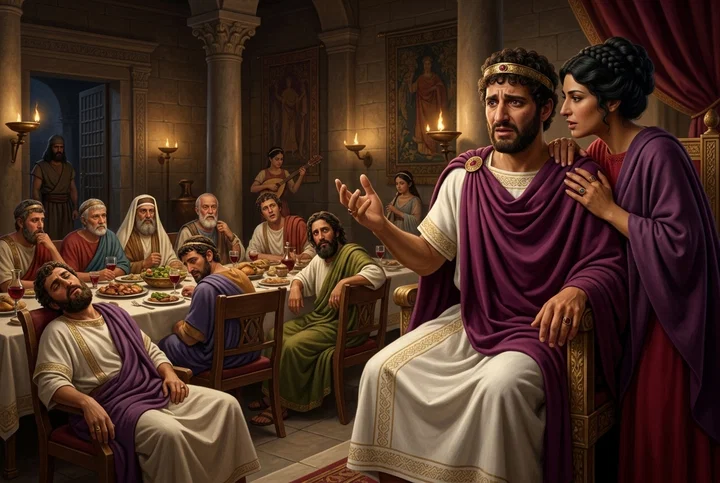
And the king was sorry: nevertheless for the oath’s sake, and them which sat with him at meat, he commanded it to be given her.
Translations
American King James Version, King James Version
And the king was sorry: nevertheless for the oath’s sake, and them which sat with him at meat, he commanded it to be given her.
And the king was sorry: nevertheless for the oaths’ sake, and them which sat with him at meat, he commanded it to be given her.
And the king was sorry: nevertheless for the sake of the oath, and of them who sat with him at table, he commanded it to be given her.
And the king was grieved; but for the sake of his oaths, and of them which sat at meat with him, he commanded it to be given;
And the king was grieved; but for the sake of his oaths, and of them that sat at meat with him, he commanded it to be given;
and the king was grieved, but because of the oaths and of those reclining with him, he commanded [it] to be given;
And the king was grieved; but on account of the oaths, and those lying at table with [ him], he commanded [ it] to be given.
And the king, though grieved, yet, because of the oaths and the guests, ordered it to be given;
Berean Standard Bible, Majority Standard Bible
The king was grieved, but because of his oaths and his guests, he ordered that her wish be granted
The king was grieved, but for the sake of his oaths and of those who sat at the table with him, he commanded it to be given,
And the king was sad; but because of his oaths and because of his guests, he gave the order for it to be given to her;
And the King was sorie: neuerthelesse because of the othe, and them that sate with him at the table, he commanded it to be giuen her,
Douay-Rheims (Challoner revision)
And the king was struck sad: yet because of his oath, and for them that sat with him at table, he commanded it to be given.
Pictures
Cross-references
- Mark 6:26-28
And the king was exceeding sorry; yet for his oath’s sake, and for their sakes which sat with him, he would not reject her.
Herod regrets his oath but orders John’s death for its sake.
- Luke 3:19-20
But Herod the tetrarch, being reproved by him for Herodias his brother Philip’s wife, and for all the evils which Herod had done,
John rebuked Herod for his wrongdoing, and Herod imprisoned him.
- Mark 6:20
For Herod feared John, knowing that he was a just man and an holy, and observed him; and when he heard him, he did many things, and heard him gladly.
Herod feared John, recognized his holiness, and listened to him gladly.
- Matthew 14:4
For John said unto him, It is not lawful for thee to have her.
John rebuked Herod for his unlawful marriage to Herodias.
- Luke 9:9
And Herod said, John have I beheaded: but who is this, of whom I hear such things? And he desired to see him.
Herod recalls beheading John while asking who Jesus is.
- Luke 7:19-28
And John calling unto him two of his disciples sent them to Jesus, saying, Art thou he that should come? or look we for another?
Continues the account of John’s imprisonment and his questions about Jesus.
- Exodus 20:13
Thou shalt not kill.
Herod’s oath led him to violate the commandment against killing.
- Mark 6:23
And he sware unto her, Whatsoever thou shalt ask of me, I will give it thee, unto the half of my kingdom.
supplies the half-of-kingdom wording of the promise
- Mark 6:21
And when a convenient day was come, that Herod on his birthday made a supper to his lords, high captains, and chief estates of Galilee;
Herod’s feast for his lords and captains is where he kept his oath.
- Leviticus 18:16
Thou shalt not uncover the nakedness of thy brother’s wife: it is thy brother’s nakedness.
The law John invoked against Herod’s marriage to his brother’s wife.
- Mark 6:16
But when Herod heard thereof, he said, It is John, whom I beheaded: he is risen from the dead.
Herod identifies the risen man as John, whom he had beheaded.
- Luke 23:8
And when Herod saw Jesus, he was exceeding glad: for he was desirous to see him of a long season, because he had heard many things of him; and he hoped to have seen some miracle done by him.
Herod is eager to see Jesus but does not seek the truth.
- Matthew 14:2
And said unto his servants, This is John the Baptist; he is risen from the dead; and therefore mighty works do shew forth themselves in him.
Herod fears that Jesus is John risen from the dead.
- Luke 23:11
And Herod with his men of war set him at nought, and mocked him, and arrayed him in a gorgeous robe, and sent him again to Pilate.
Herod mocked Jesus during his sufferings.
- Matthew 11:2-3
Now when John had heard in the prison the works of Christ, he sent two of his disciples,
John sends from prison to ask whether Jesus is the coming one.
Commentary
Each commentary is drawn from primary sources: the writings of Ellen G. White and Adventist pioneers and periodicals. Each commentary is separate. Its own words are not a quotation; follow the references to read the source passages.
Ellen G. White
32 sources
Herod was genuinely distressed, horrified and remorseful at the demand for John's head, yet he commanded the execution because he felt bound by his rash oath and feared to seem fickle and dishonorable before his dinner guests.DA 220.6–221.3RH Apr 8, 18732SP 76.1–77.1 The demand came at his birthday feast of gluttony and revelry, when his powers were enervated by luxurious food and stimulating drink and he was entrapped by the daughter's dance into promising whatever would be asked.Ms 107, 1893, par. 1RH Mar 11, 1873SPBC 147.3 Intemperance had beclouded his senses, perverted justice and mercy, and deadened holy impulse, giving Satan opportunity to test whether he would exalt his oath and royal honor above God's law not to kill rather than humble himself and ask release from the vow.RH Apr 8, 1873ST Mar 15, 18832SP 79.1–3 He let concern for reputation outweigh conscience, wrongly believing the oath bound him and choosing the real guilt of murder over a false charge of perjury, which brought lasting dishonor instead of honor.DA 220.6–221.3RH Apr 8, 18732SP 76.1–77.1 His guilty torment afterward hardened into deeper darkness as he continued in sin, showing the danger of yielding to Satan's snare at the point of conviction and warning those in responsibility against intemperance, rash promises, and social pressure to do known wrong for approval.RH Apr 8, 1873ST Mar 15, 18833SP 135.1COS 144.2–33SP 136.1–2
Feast Setting and Decision
John had been imprisoned by Herod Antipas because he had plainly rebuked Herod for his unlawful marriage to Herodias, and Herodias hated him for that reproof, sought revenge, and through her influence pressed for his death.DA 214.1EW 124.3–125.1Lt 107, 1897, par. 4–5ST Nov 2, 18823SP 136.1–2 Herod himself honored and feared John as a true prophet of God, for John had laid open the secrets of his heart and life and his reproofs had struck terror to his guilty conscience.3SP 135.1RH Mar 11, 1873ST Jul 11, 1878 In many things Herod had reformed his dissolute life under that conviction and had come very near to becoming John's disciple, even designing to release him from prison.3SP 135.1COS 144.2–3RH Mar 11, 18735RED 55.1ST Jul 11, 1878 He delayed only through fear of displeasing Herodias and refusal to turn from sin, so that while his intelligence controlled him Herodias could not obtain John's death despite repeated efforts to gain his consent.COS 144.2–3RH Mar 11, 18735RED 55.1
Herodias therefore waited for Herod's birthday feast as her opportunity, an occasion of gluttony, intoxication, revelry, feasting and dancing.RH Apr 8, 1873Ms 107, 1893, par. 1RH Mar 11, 1873 Herod's habitual love of luxurious food and stimulating drink constantly enervated and deadened his moral and physical powers and warred against the earnest appeals of the Spirit that had convicted his heart.RH Mar 11, 1873 When indulged they aroused passion and the lower passions, lowered the tone of mental and moral character, beclouded the senses, removed the fear of God, and lowered sensibility to moral improvement.RH Apr 8, 1873ST Mar 15, 1883RH Mar 11, 1873 At the feast he was entrapped by the captivating, alluring dance of Herodias's daughter into a rash oath to grant whatever was asked, offering her anything with his senses debased by wine.Ms 107, 1893, par. 1RH Mar 11, 1873SPBC 147.3
When the demand came for John's head, Herod's sorrow was real distress, regret, horror, and keen remorse for putting to death one he knew to be a true prophet to gratify the revenge of a cruel woman.2SP 76.1–77.1DA 221.4–222.12SP 80.2Ms 107, 1893, par. 1ST Jul 11, 1878 If told at the start of the feast what he would do before its close he would have denied he could do such a deed, and while sober he would have recoiled with horror from beheading him.RH Apr 8, 1873 Yet for the oath's sake and for them that sat at meat with him he commanded it to be given, feeling bound by his promise and fearing to appear fickle, dishonorable, and oath-breaking before his guests.DA 220.6–221.3RH Apr 8, 18732SP 76.1–77.1DA 221.4–222.1ST His drunkenness and desire to impress the company had weakened his judgment, perverted his ideas of justice and mercy, and made reason servant to baser passions, putting the mind in animal excitement.DA 220.6–221.3RH Apr 8, 1873ST Mar 15, 1883
Herod gave his guests opportunity to release him by protest, for they could have urged him to spare John and their remonstrance might have allowed him to spare the prophet.DA 220.6–221.3RH Apr 8, 1873DA 221.4–222.1 But their silence and intoxication left him without that protest, leaving John's life in his hands, and if they had kept vigor of intellect calm reason would have borne sway and they would have recoiled with horror.DA 220.6–221.3RH Apr 8, 1873RH Apr 8, 18732SP 79.1–3 He was tested before his guests whether to exalt his oath and his honor and dignity as king above God's law not to kill, or to humble himself and ask to be released from his rash vow.RH Apr 8, 18732SP 79.1–3 Satan seized the opportunity through Herodias to secure the death of one of the greatest prophets God sent, and with deadened sensibilities unable to see facts clearly or make right decisions, Herod and his company pronounced sentence of death with the life of an innocent and exalted prophet in the balance.RH Apr 8, 1873RH Mar 11, 18732SP 80.1 Concern for reputation, honor, and appearances thus overruled conscience, regard for John, and moral principle, so that wrongly believing his oath bound him he chose the real guilt of murder over a false charge of perjury, an act that brought lasting dishonor rather than preserving his honor.DA 220.6–221.3RH Apr 8, 18732SP 76.1–77.1ST2SP 79.1–3
Guilt and Moral Warning
The order was carried out at the banquet itself, turning a night of frivolity and dissipation into the occasion for beheading one of the greatest prophets God ever sent.ST2SP 80.2 His faithful call for reform was thereby silenced.2SP 80.2 Danger had been gathering around John, and death was soon to follow.2SP 139.1–2
Afterward Herod's guilty conscience tormented him with fear that God would punish him for the sin he had committed.ST Haunted by John's preaching, he could not shut from his mind the sight of the bleeding head brought in before his guests.Ms 107, 1893, par. 1 That horror was real, and he carried that guilt with his unlawful wife Herodias for a year afterward, even while going through the formal ceremonies as a Jew observing the annual Passover.Ms 107, 1893, par. 1
His keen remorse did not last, for continued licentious life hardened his heart and dulled his moral perceptions until his sins seemed trivial to him.3SP 135.15RED 55.1ST Jul 11, 1878 He became capable of worse crimes, even boasting of having punished John when Jesus stood before him as a prisoner.3SP 136.1–2ST Jul 11, 1878 Yet when he heard of Jesus and His mighty works he was terror-stricken with the thought that John whom he had beheaded was risen from the dead, while still desiring to see Jesus and force a miracle from Him.ST Jul 11, 1878
His course shows the danger of resisting truth after conviction.3SP 135.1 At the point of decision, when he had very nearly become John's disciple and his conscience was still sensitive, he yielded to Satan's snare instead of the Spirit's conviction.3SP 135.15RED 55.1ST Jul 11, 1878 He turned from light he knew was true and killed a prophet he knew was true, and turning from conviction by the Spirit of truth led him into deeper darkness.3SP 135.15RED 55.1ST Jul 11, 1878
John's faithful, pointed message exposing deception cost him his life.STB 377.2STB 55.4MWISDAP 34.2 Such a message may cost the messenger his life, yet it is to be spoken plainly so that people will not be deceived.STB 55.4MOPP 14.3–4Lt 399, 1904, par. 14–15 His death led many who had accepted Christ to doubt John's mission and whether Jesus was the Messiah.4RED 103.2–104.1
The verse warns against intemperance, which made reason servant to baser passions, weakened intellect, perverted ideas of justice and mercy, and led to rash choices with grave consequences.RH Apr 8, 1873ST Mar 15, 1883 It especially warns those entrusted with responsibility, for impaired judgment and dormant conscience allowed the birthday feast to end in the martyrdom of God's prophet, calling for Christian temperance.RH Apr 8, 18732SP 80.1 It warns against keeping a rash oath made under excitement and against letting concern for guests and social approval govern a man to do what he knows is wrong to preserve honor.RH Apr 8, 1873ST Mar 15, 1883RP 14.1 It warns against worldly amusements and the alluring impression made by dancing, by cheap common talk, flattery, and foolish witticism spoken to create a laugh.RP 14.1Lt 57, 1895, par. 25 Like the dance that swayed Herod, such deceptive working leads toward the broad road and wide gate that opens to ruin, is trading in the merchandise of Satan, is recorded in the books of heaven, and will appear in its true light before the guilty at the judgment.RP 14.1SPBC 147.3Lt 57, 1895, par. 25
Sources
Pioneers and periodicals
67 sources
The king was Herod Antipas, who was grieved by the demand for John's head yet commanded it to be given for his rash oath's sake and for fear of losing face before those dining with him.ST Dec 15, 1887ST Mar 2, 1904ST Mar 3, 1898 He wrongly believed the oath bound him, and so chose the real guilt of murder over breaking a sinful promise, exalting his honor before his guests above God's law not to kill.RH Apr 8, 1873RH Apr 8, 1873RH Oct 16, 1860ST Mar 2, 1904 The oath was made and kept under feasting, dancing and intoxicating wine that beclouded reason, perverted justice and mercy, and left self-control weakened, warning that intemperance in rulers brings grave harm to others.RH Apr 8, 1873ST Mar 15, 1883RH Mar 11, 1873ST Dec 15, 1887ST Dec 12, 1906 John suffered for faithfully warning Herod of his unlawful marriage, and his beheading was apparent defeat but triumph of faith, for true victory is measured by faithfulness to duty rather than earthly outcome.ST Mar 16, 1904RH Sep 15, 1904ST Dec 2, 1889 Herod's remorse never quieted but deepened afterward, while John's day of weak civil power yielding to a controlling woman amid corruption typifies the last days and the work of God's servants then.STRH Apr 8, 1873ST Jun 6, 1900ST Aug 7, 1901
Herod, Feast, and Setting
The king is Herod the tetrarch, Herod Antipas, the ruler who imprisoned John the Baptist and put him to death.RH Nov 12, 1861ST May 7, 1902 He is son of Herod the Great who sought to murder Jesus in infancy, and uncle of Herod Agrippa who killed the apostle James, yet distinct from both though sharing the name Herod.RH Nov 12, 1861 In this verse he acts as the murderer of John, commanding John's death to be carried out.RH Nov 12, 1861
He was inquisitive about truth without loving it, crafty, incestuous, superstitious, and later the mocker of Jesus in His last sufferings.RH Nov 12, 1861 He was a weak, wicked ruler whose guilty relation to Herodias and persecution of God's prophet echoed Ahab and Jezebel's opposition to Elijah.ST Jun 6, 1900
The command was given at Herod's birthday feast, a supper in his royal palace on the summit overlooking Galilee for his lords, high captains and chief estates of Galilee.ST Dec 24, 1894RH Aug 29, 1865ST Mar 3, 1898 The feast was held at Machaerus, the strong fortress east of the Dead Sea on a very high rocky hill on the borders of Arabia.ST Dec 24, 1894ST Mar 3, 1898 It was built by Alexander Janneus and rebuilt and fortified by Herod the Great with walls, palaces, stores of weapons and reservoirs of water.
The beheading followed about a year after events dated to the spring of A.D. 28.ST Dec 24, 1894 It occurred in the third year of the ministry of Jesus while Jesus was in Galilee with His disciples, after John had been imprisoned one year, when John was 33 years old.ST Mar 3, 1898
Herodias plotted to use the feast to secure John's death because John condemned her relation to Herod and she treated him as a threat.ST Sep 6, 1910ST Sep 6, 1910ST Sep 6, 1910 She feared the public shame John's survival would bring, promised her daughter rewards, and persuaded Salome to dance before Herod and ask for John's head, using Herod's offer and pleasure-seeking mood as the opportunity.ST Sep 6, 1910ST Sep 6, 1910ST Sep 6, 1910 Her hatred sought his head and received it with fiendish joy.ST Feb 10, 1881
Herod honored and feared John as a true prophet of God, had in many things reformed his dissolute life, and intended to release him but feared displeasing Herodias.RH Mar 11, 1873ST Dec 15, 1887ST Sep 6, 1910 Under ordinary circumstances Herodias could not obtain John's death despite repeated efforts, so she waited for the birthday as an occasion of gluttony, intoxication, feasting and weakened self-control to carry out her strategy.RH Mar 11, 1873ST Dec 15, 1887
Sorrow, Oath, and Guests
The king was grieved and sorry at the demand for John's head, yet for his oath's sake and for the sake of those dining with him he commanded it to be given and sent to have John beheaded in the prison.ST Dec 15, 1887ST Mar 2, 1904ST Mar 3, 1898ST Mar 16, 1904RH Sep 28, 1916 He felt bound by his rash oath and feared losing face and dishonoring himself before his dinner guests, so concern for reputation and the guests' judgment overruled moral principle.ST Dec 15, 1887ST Mar 2, 1904RH Sep 28, 1916ST Mar 2, 1904 His yielding came despite being troubled by John's reproof, for he chose sin rather than obedience to God's law.ST Dec 15, 1887RH Nov 11, 1858 John's death followed his faithful warning to Herod about his unlawful marriage, and though he suffered for proclaiming truth he won his Master's approval, which is life's main aim.ST Mar 16, 1904
His reluctance shows he did not want John put to death, yet he valued doing right less than keeping a rash promise and keeping public approval.ST Apr 20, 1882ST Mar 2, 1904 His scrupulous concern for the oath stands in contrast with his life in incest with Herodias, showing that keeping one obligation does not excuse another sin.RH Oct 16, 1860 Wrongly believing his oath bound him, he ordered John's death rather than risk appearing to break his word before his guests.STST Apr 20, 1882 In so doing he chose the real guilt of murder over a false charge of perjury.ST
He waited for his guests to object and would have spared John if they had spoken, for he had given them opportunity to release him.RH Apr 8, 1873ST Dec 15, 1887 He even asked those present to release him from keeping the oath, since he knew John was just and holy.ST Sep 13, 1910ST Sep 13, 1910 No one spoke to release him, and their silence, scorn and sneering looks stirred his pride and reckless bravado.ST Sep 13, 1910ST Sep 13, 1910 Their intoxication left them unable to offer remonstrance or urge him to spare John, so he ordered the execution rather than lose face before them.RH Apr 8, 1873ST Sep 13, 1910 The act brought lasting dishonor rather than preserving his honor.RH Apr 8, 1873
His sorrow was real horror and keen remorse for putting to death one he knew to be a true prophet to gratify the revenge of a cruel woman, at a time when his conscience was still sensitive and he had very nearly become John's disciple.ST Jul 11, 1878 In another sense his sorrow was trembling fear that the Pharisees' doctrine of resurrection is true and that John as a just man will rise from the dead to condemn him, contrary to his Sadducean fathers who deny resurrection from the dead.ST Sep 13, 1910 Keeping the oath cost him the peace of his bosom, a peace that would never again rest in him.ST Sep 13, 1910 John had pricked his heart by preaching against his sins and confronting him over his lawful spouse the daughter of Aretas, and as a proud prince he had bent to listen reverently with prince and commoner in the wilderness of Judea.ST Feb 7, 1911 John had made known to him the secrets of his heart and life, and his reproofs had struck terror to his guilty conscience, so that Herod honored and feared him as a true prophet of God, had in many things reformed his dissolute life, and designed to release him from prison, delaying only through fear of displeasing Herodias.RH Mar 11, 1873RH Nov 11, 1858 Herod had punished John for speaking against him, yet under ordinary circumstances while intelligence controlled him Herodias could not obtain John's death despite repeated efforts.RH Mar 11, 1873ST Nov 2, 1882
Command, Death, and Aftermath
Herod commanded that John be beheaded in the prison and that his head be brought on a platter taken from the banquet table.ST Mar 3, 1898ST Sep 13, 1910ST Sep 20, 1905 He gave the order carelessly and lightly, as if ordering wine, with put-on fierceness and haste, repeating it when the soldier hesitated in astonishment before guests who were horrified and staring as they wakened to what was happening.ST Sep 13, 1910 He picked a soldier he counted on to obey without question to carry out the command at once, and the beheading was done at Herodias's request to satisfy her, despite his sorrow over his oath and his guests.ST Sep 13, 1910ST Sep 13, 1910RH Sep 30, 1862 The soldier was one of the very soldiers of Herod's drafted army on its march to war with Aretas who had earlier questioned John about their duty, and by this order John the forerunner of Christ was killed after Herod ordered his execution.RH Sep 30, 1862ST Sep 20, 1905
One of Herod's guards, a repulsive fierce-appearing Roman soldier, was sent for John's head after long confinement in a gloomy prison room.ST Sep 27, 1910ST Sep 27, 1910 He entered the cell suddenly with drawn sword and announced the order to die.ST Sep 27, 1910 John at once fell on his knees in prayer with calm beautiful face shining with heavenly light, while the soldier's face grew black like a fiend.ST Sep 27, 1910ST Sep 13, 1910 The sword flashed in the afternoon sunlight streaming through the tiny iron-barred window set in the west wall, and in another instant the bloody head fell at the feet of the visiting disciple and stained his raiment.ST Sep 27, 1910 The disciple was Matthias, who rushed from the cell like a maniac clawing at fresh blood on his mantle to hide in the mountains, while Salome kept dancing with reckless abandon until the soldier returned with garment spattered and fingers dripping with blood to deliver the charger to the king for her.ST Sep 13, 1910
Herod turned livid and hesitated with gaze riveted on the head, his eyes starting as he reached with jeweled hand for the platter as if driven by irresistible force.ST Sep 13, 1910 Like one in a dream, dazed and bewildered, he lifted a strand of raven hair dripping crimson blood on the white marble floor and laid it beside the head.ST Sep 13, 1910 Then he gave the platter with its ghastly burden to the dancing girl, who trembled violently, keeping his oath to her and to Herodias at the cost of his own lasting peace.ST Sep 13, 1910ST Sep 13, 1910 She carried it by Herod's gift to her mother as proof her enemy had fallen, for he sent the head by the girl to her mother as a costly gift.ST Sep 13, 1910ST Sep 13, 1910
The killing made Herod's household a house of blood and murderers in a ghastly tragedy that ended the feast.ST Sep 13, 1910 Word of John's death went out toward Bethsaida and Capernaum that his disciples might go to bury him.ST Sep 27, 1910 News of it reached Jesus, who then withdrew to a quiet place for meditation.ST Feb 15, 1905 His guilty conscience afterward tormented him, and he feared God would punish him for the sin he had committed.ST His remorse deepened rather than quieted and did not leave his conscience quiet, his peace never again rested in him, and on the moonlit night afterward his guilty head was bowed, trembling and gloomy as he reviewed the deed he would regret as long as life lasted.RH Apr 8, 1873ST Feb 7, 1911ST Dec 15, 1887ST Sep 13, 1910
Rash Oaths and Corrupt Indulgence
The verse directly teaches the folly of making rash vows, and Herod's oath at the feast stands with Jephthah's vow as the example of that folly.ST Mar 10, 1898ST Mar 3, 1898 A rash promise does not justify doing evil.ST Oct 9, 1884 A vow that requires murder is better broken than kept.RH Sep 11, 1860ST Oct 9, 1884
Herod kept a rash oath made under the excitement of feasting, dancing and revelry, when eating and drinking to excess and freely partaking of intoxicating wine had put the mind in animal excitement and made reason the servant of baser passions.RH Apr 8, 1873ST Mar 3, 1898 That indulgence enervated and deadened moral and physical powers, beclouded the senses, perverted ideas of justice and mercy, lowered sensibility to moral improvement, and aroused the lower passions until holy impulses could no longer govern them.RH Apr 8, 1873ST Mar 15, 1883RH Mar 11, 1873 If intellect had kept its vigor, calm reason would have borne sway and recoiled with horror from beheading an innocent prophet; if told at the start of the feast what he would do before its close, Herod would have denied he could do it.RH Apr 8, 1873 Under ordinary circumstances, while intelligence controlled him, Herodias could not obtain John's death despite repeated efforts, so she waited for the birthday as an occasion of gluttony and intoxication when his deadened sensibilities could not see facts clearly and make right decisions.RH Mar 11, 1873
Indulgence can thus lead people to rash choices with grave consequences, for intemperance weakened Herod's reason and distorted his sense of justice and mercy.ST Mar 15, 1883 The warning reaches especially to people in authority, whose impaired judgment and sense of justice can bring grave harm to others.ST Dec 15, 1887 Its setting in a drunken court links strong drink and lust with crime.ST Dec 12, 1906
Herod was tested before his guests whether to exalt his oath above God's law not to kill in order to preserve his honor and dignity as king, or to humble himself and ask his guests to release him from his rash vow.RH Apr 8, 1873 Under the delusion that honor required keeping an oath made when nothing was too sacred to profane, he and his company pronounced sentence of death with the life of an innocent and exalted prophet in the balance.RH Apr 8, 1873 His concern for reputation overruled moral principle, and his guests, left by intoxication unable to offer remonstrance when he had given them opportunity, did not urge him to spare John.RH Apr 8, 1873ST Mar 15, 1883 The act brought lasting dishonor rather than preserving his honor, and led to results he would regret as long as life lasted.RH Apr 8, 1873RH Apr 8, 1873
The dancing at Herod's feast led to John's death and is the New Testament example most like dancing for pleasure.ST Feb 18, 1886 Salome's dance before the king and his guests connects directly with the demand for the execution and the king's following command.ST Aug 17, 1904ST Sep 13, 1910ST Apr 28, 1909 The usual associations of dancing, dancing parties and the ball-room are of such a character that Christians cannot take pleasure in them.ST Aug 17, 1904
Faithfulness, Prophecy, and Application
John suffered for proclaiming truth and faithfully warning Herod about his unlawful marriage, enduring persecution rather than turning from duty.ST Mar 16, 1904RH Mar 3, 1904 Though called by God as the herald of the King and approved in his nonconformity to the world, he perished in prison, and his fidelity to his mission cost him his life.ST Feb 1, 1905RH Mar 3, 1904 Although he suffered for the righteous reproof he gave, he won his Master's approval, which is life's main aim, and his death for his Master is heroic faithfulness.ST Mar 16, 1904RH Mar 3, 1904
His beheading was an apparent defeat but a triumph of faith, greater than any earthly loss and victorious through eternity.RH Sep 15, 1904 His life was a success even when he was imprisoned and killed, because true victory is measured by faithfulness to duty and love of what is pure, good and true, not by earthly outcomes.ST Dec 2, 1889ST Feb 4, 1913 His faithfulness to duty and to what was good and true made him a victor, even when the apparent earthly outcome was defeat.ST Dec 2, 1889ST Feb 4, 1913
He perished alone in Herod's dungeon, yet his death at Herod's hand is fellowship with Christ in suffering, an honor greater than Enoch's translation or Elijah's ascent.ST That death foreshadowed Jesus' own suffering and death.ST
The imprisonment and death belong to the life of Christ connected with the prophecies of His first advent.RH Apr 3, 1900 Herod was a weak, wicked ruler whose guilty relation to Herodias and persecution of God's prophet echoed Ahab and Jezebel's opposition to Elijah.ST Jun 6, 1900 He is seen as a nominal, local civil ruler bewitched by Herodias, a low, designing woman, surrendering weak civil power to a controlling woman against his own sorrow to satisfy his oath and his guests.ST Aug 7, 1901 That day was a time of cold self-righteous ceremonial formalism, infidel critical liberalism, low business morals, and gross commercialism invading even the temple, while John in mighty power heralded the impending coming of the Lord indicated by prophecy and called people to repent and turn to obedience to God to prepare for Christ, so that if Israel had received Him with all the heart the destruction of people and city would have been averted.ST Aug 7, 1901 Together with Elijah's day of open Baal or sun-worship under Jezebel, daughter of Ethbaal the Zidonian sun-worshiping king, ending in the treading down of God's law and persecution of the prophet in a union of church and state, John's day properly typifies the last days and the work and character of God's servants then.ST Aug 7, 1901
John was cut off by Herod because he preached saving truth which could have saved Herod if he had received it.ST Apr 28, 1898 His career ended in eclipse by Herod's command, standing opposite to Elijah, who was translated without seeing death and whose career ended gloriously.ST Apr 28, 1898ST Aug 7, 1901 This proves John and his times did not meet all the requirements of the type in Elijah.ST Aug 7, 1901
The account belongs to Matthew 14:1-21, which also contains the feeding of the five thousand.ST Jan 20, 1909 John was left to be beheaded despite hope he would be released from prison.RH Jul 26, 1906 The wordplay holds that Herod had already lost his head to a woman's influence before John lost his head to the sword.ST Mar 8, 1899 The command was given in his royal palace on the summit overlooking Galilee during a supper for his lords, high captains and chief estates of Galilee, where hardened by prosperity he let the daughter of Herodias dance before him and promised with an oath to give whatever she asked, even to half his kingdom, then ordered John's head brought in a charger and given to her while the feast went on.RH Aug 29, 1865 That palace now lies in ruins with its columns and marble floor broken and plowed over, its builder's name forgotten by the local plowman while pilgrims from every quarter honor his beheaded victim, exposing the vanity of worldly greatness.RH Aug 29, 1865
Herod yielded to sin rather than obey God's law, despite being troubled by John's reproof.ST Dec 15, 1887 Having very nearly become John's disciple when his conscience was still sensitive, he yielded at that point to Satan's snare instead of the Spirit's conviction, and began a degradation by licentious life that dulled his moral perceptions until his sins appeared trifles in his eyes and left him capable of worse crimes.ST Jul 11, 1878 So when he later heard of Jesus and His mighty works he was terror-stricken that John whom he beheaded was risen from the dead, yet still desired to see Jesus and force a miracle from Him as a prisoner.ST Jul 11, 1878
Sources