Translations
American King James Version, King James Version, KJV Cambridge Paragraph Bible, Webster Bible, Douay-Rheims (Challoner revision)
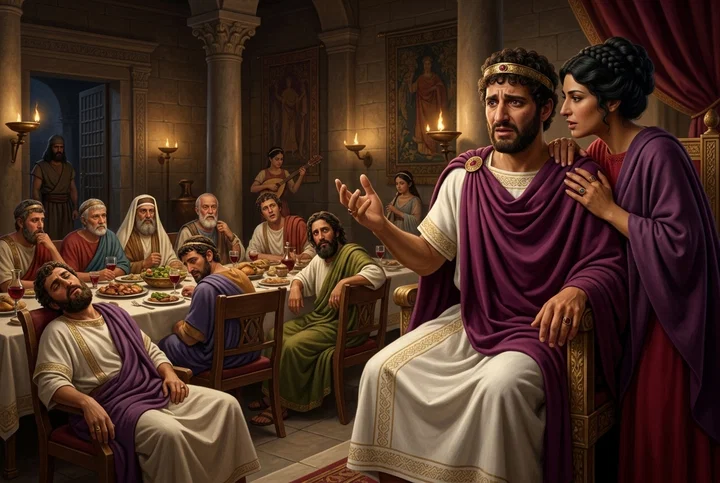
And he sent, and beheaded John in the prison.
and he sent, and beheaded John in the prison.
American Standard Version, World English Bible
and he sent and beheaded John in the prison.
and having sent, he beheaded John in the prison,
And he sent and beheaded John in the prison;
and sent and beheaded John in the prison.
Berean Standard Bible, Majority Standard Bible
and sent to have John beheaded in the prison.
And he sent and had John's head cut off in the prison.
And sent, and beheaded Iohn in the prison.
Pictures
Cross-references 20 of 29
- Mark 6:27-28
And immediately the king sent an executioner, and commanded his head to be brought: and he went and beheaded him in the prison,
Herod orders John beheaded in prison at Herodias’s urging.
- Luke 3:19-20
But Herod the tetrarch, being reproved by him for Herodias his brother Philip’s wife, and for all the evils which Herod had done,
John rebuked Herod, who imprisoned him.
- Matthew 11:11
Verily I say unto you, Among them that are born of women there hath not risen a greater than John the Baptist: notwithstanding he that is least in the kingdom of heaven is greater than he.
Christ calls John greater than those born of women.
- Acts 12:2
And he killed James the brother of John with the sword.
Herod’s execution of James recalls Herod’s earlier execution of John.
- Matthew 14:3-4
For Herod had laid hold on John, and bound him, and put him in prison for Herodias’ sake, his brother Philip’s wife.
John rebuked Herod over his unlawful marriage, leading to his imprisonment and death.
- Luke 9:9
And Herod said, John have I beheaded: but who is this, of whom I hear such things? And he desired to see him.
Herod recalls having John beheaded.
- Mark 6:16
But when Herod heard thereof, he said, It is John, whom I beheaded: he is risen from the dead.
Herod identifies Jesus as John risen from the dead.
- Luke 7:19-28
And John calling unto him two of his disciples sent them to Jesus, saying, Art thou he that should come? or look we for another?
John’s question about Jesus is followed by Jesus’ testimony to John’s prophetic ministry.
- Mark 6:20
For Herod feared John, knowing that he was a just man and an holy, and observed him; and when he heard him, he did many things, and heard him gladly.
Herod recognized John as righteous and holy, yet did not embrace the truth he heard.
- Matthew 2:16
Then Herod, when he saw that he was mocked of the wise men, was exceeding wroth, and sent forth, and slew all the children that were in Bethlehem, and in all the coasts thereof, from two years old and under, according to the time which he had diligently enquired of the wise men.
Herod’s massacre of Bethlehem’s children parallels Herod’s execution of John.
- Matthew 14:4
For John said unto him, It is not lawful for thee to have her.
John’s rebuke of Herod’s unlawful marriage led to his death.
- Matthew 11:2
Now when John had heard in the prison the works of Christ, he sent two of his disciples,
John sends his disciples from prison to ask Jesus whether he is the one to come.
- Matthew 14:2
And said unto his servants, This is John the Baptist; he is risen from the dead; and therefore mighty works do shew forth themselves in him.
Herod identifies Jesus as John raised from the dead.
- Mark 6:22-23
And when the daughter of the said Herodias came in, and danced, and pleased Herod and them that sat with him, the king said unto the damsel, Ask of me whatsoever thou wilt, and I will give it thee.
same dance and oath-bound promise
- Mark 6:28
And brought his head in a charger, and gave it to the damsel: and the damsel gave it to her mother.
same head in charger given to damsel
- Matthew 14:6
But when Herod’s birthday was kept, the daughter of Herodias danced before them, and pleased Herod.
birthday gives occasion for sending executioner
- Mark 6:21
And when a convenient day was come, that Herod on his birthday made a supper to his lords, high captains, and chief estates of Galilee;
same supper for lords and captains
- Matthew 3:3
For this is he that was spoken of by the prophet Esaias, saying, The voice of one crying in the wilderness, Prepare ye the way of the Lord, make his paths straight.
John’s mission prepared the way of the Lord.
- Matthew 3:7-12
But when he saw many of the Pharisees and Sadducees come to his baptism, he said unto them, O generation of vipers, who hath warned you to flee from the wrath to come?
John calls the religious leaders to repentance and rebukes them.
- Luke 23:8
And when Herod saw Jesus, he was exceeding glad: for he was desirous to see him of a long season, because he had heard many things of him; and he hoped to have seen some miracle done by him.
same Herod curious without loving truth
Commentary
Each commentary is drawn from primary sources: the writings of Ellen G. White and Adventist pioneers and periodicals. Each commentary is separate. Its own words are not a quotation; follow the references to read the source passages.
Ellen G. White
58 sources
Herod sent an executioner to behead John in the prison after a rash birthday promise secured through Herodias's daughter's dance to gratify Herodias's revenge for John's rebuke of her unlawful union with Herod.DA 220.6–221.3RH Apr 8, 18732SP 76.1–77.1STMs 107, 1893, par. 1
He did it reluctantly though he knew John was innocent, honoring his oath and fear of his guests more than God's command not to kill, while revelry, luxurious food and intoxicating drink had weakened his judgment and moral sense.RH Apr 8, 1873RH Apr 8, 1873DA 221.4–222.1ST Mar 15, 1883
The act silenced the faithful lips that had called Herod and sinners to repentance, making John a martyr for giving straight testimony against sin even at the cost of life.RH Apr 8, 18732SP 80.2Lt 107, 1897, par. 4–5STB 377.2
Once sober Herod was tormented with remorse for the rest of his life, and when he heard of Jesus and His mighty works he was terror-stricken that John had risen from the dead with greater power.STRH Apr 8, 18732SP 81.1
That Jesus permitted His forerunner to die without using His power to save him puzzled the disciples and tempted them to doubt His mission, which warns believers not to become discouraged or to blame Christ when He does not miraculously protect them or humble their enemies.DA 526.2–34RED 103.2–104.1Ms 87, 1897, par. 14DA 380.1–2
Setting and Imprisonment
Matthew 14:10 belongs to the imprisonment of John the Baptist under Herod Antipas, in whose territory John had spent much of his ministry.DA 214.1SG1 29.2–30.1EW 124.3–125.1LC1 44.31RED 44.3 John was confined because he had faithfully rebuked Herod for his unlawful alliance with Herodias, his brother's wife, in marrying her while her husband was still alive.DA 214.1SG1 29.2–30.1EW 124.3–125.1LC1 44.31RED 44.3 Herod had intended to release him, but through the influence of his wife John was kept in prison and then beheaded there before he could witness Jesus' miracles and ministry.SG1 29.2–30.1EW 124.3–125.1LC1 44.31RED 44.3
Herod listened to John and was troubled by his preaching, for he honored and feared him as a true prophet of God who made known the secrets of his heart and life and whose reproofs struck terror to his guilty conscience.DA 214.12SP 76.1–77.1RH Mar 11, 1873 In many things Herod had reformed his dissolute life under that influence and purposed to release him.2SP 76.1–77.1SG1 29.2–30.1RH Mar 11, 1873LC1 44.31RED 44.3 Herodias sought revenge for the truthful rebuke of their unlawful life and induced Herod to keep John in prison, since she could not gain his consent to slay John while intelligence controlled him.DA 214.12SP 76.1–77.1RH Mar 11, 1873
While confined John grew despondent and troubled as time passed without change, and the questions of his disciples about why Jesus did not free him deepened his doubts.DA 214.2–215.2 He expected the Messiah to take David's throne, overthrow oppressors, and bring decisive judgment, but he did not understand the nature of Christ's kingdom.DA 214.2–215.2 Jesus knew the approaching storm would soon fall upon John and sweep him away, and He temporarily withdrew to Galilee to avoid a division that could harm the work.4RED 23.12SP 139.1–2
Herod's Fateful Order
At the birthday feast Herodias turned her daughter's captivating dance and the impression it made on Herod into a rash promise to give her whatever she asked, and then prompted the demand for John's head to satisfy her own determined desire for revenge.DA 220.6–221.3STMs 107, 1893, par. 1RP 14.1 Herodias persisted until John was destroyed, and her demand brought his fate to a decision.ST Herod, his senses debased with wine while indulging in revelry, was entrapped by that promise.Ms 107, 1893, par. 1
He sent an executioner and commanded John to be beheaded in the prison.RH Apr 8, 18732SP 76.1–77.12SP 80.22SP 79.1–3 The head of the honored prophet of God was brought in before Herod and his guests, and the bleeding sight filled them with horror.RH Apr 8, 1873Ms 107, 1893, par. 1 Herod, who had heard John's preaching, could not endure the painful sight and could not close his vision to it.Ms 107, 1893, par. 1
He acted reluctantly, recognizing that John was innocent, and his oath and fear of seeming fickle outweighed that recognition.DA 221.4–222.1 He gave his lordly guests opportunity to speak in John's behalf and would gladly have saved his life if one had offered remonstrance, but they raised no objection.RH Apr 8, 1873DA 221.4–222.12SP 79.1–3 Their drunken silence helped bring about the death of God's messenger, for intoxicated with wine their tongues were paralyzed and they were unable to exercise reason or conscience.RH Apr 8, 1873DA 221.4–222.12SP 79.1–3
He wrongly treated his rash oath, made under the influence of intoxication, as more binding than God's commandment not to kill.RH Apr 8, 1873RH Apr 8, 1873 His oath and fear of losing reputation before his guests outweighed justice, and to save his own reputation he sacrificed an innocent prophet to preserve it.RH Apr 8, 18732SP 79.1–3 Absurdly treating his oath as binding him to an inhuman request, he chose the guilt of murder rather than being thought to have broken his oath.ST
Overeating and drunkenness at the feast had weakened judgment and distorted his sense of justice and mercy, and Herodias worked by strategy upon this weak point of intemperate appetite after she could not gain his consent to slay John while intelligence controlled him.ST Mar 15, 1883RH Mar 11, 1873 Luxurious food and stimulating drink, revelry and intoxication had debased the senses, enervated and deadened moral and physical powers, excited the lower passions, lowered the tone of mental and moral character, beclouded the senses, removed the fear of God, and paralyzed reason, conscience, and moral principle in Herod and his guests as slaves to brute appetite.RH Apr 8, 1873RH Apr 8, 1873Ms 107, 1893, par. 1RH Mar 11, 1873 Herodias waited for the birthday as an occasion of gluttony and intoxication and turned the company's impaired state into the decision that cost John his life.ST Mar 15, 1883RH Mar 11, 1873 With deadened sensibilities unable to see facts clearly and make right decisions, and with holy impulses unable to govern the passions against the earnest appeals of the Spirit that convict the heart to put away sin, the king's appetite, intoxication, and impaired judgment were used to bring about John's death.2SP 76.1–77.1RH Mar 11, 1873
The command sealed and silenced lips that had faithfully declared in trumpet tones the necessity of reform in Herod's life and called sinners to repentance.RH Apr 8, 1873 Thus a night of frivolity and dissipation brought the death of one of God's greatest prophets.2SP 80.2
Herod's Guilt Afterwards
Once sober Herod regretted the beheading for the rest of his life, and his remorse grew more severe as John's death and the prophet's warnings about God's knowledge of sin tormented his conscience.STRH Apr 8, 18732SP 81.1 When he first heard of Jesus and His mighty works he was terror-stricken and feared Christ was John risen from the dead and returned with greater power.ST5RED 55.1ST Jul 11, 1878 He knew John was a true prophet, had been convicted by the Spirit of truth, and had very nearly become his disciple.3SP 135.15RED 55.1ST Jul 11, 1878 Yet at the point of decision he gave in to Satan's snare and put him to death to gratify the revenge of a licentious and cruel woman.3SP 135.15RED 55.1ST Jul 11, 1878
After ignoring John's teaching and continuing in sin his heart hardened.COS 144.2–3 He felt remorse for a time, but his licentious life further dulled his conscience and degraded his moral perceptions until his sins seemed trivial and but trifles and his conscience grew far less sensitive.3SP 135.15RED 55.1ST Jul 11, 1878 The very act he while reason and judgment were perverted thought was maintaining his honor and dignity branded him forever with dishonor and made his name detestable.RH Apr 8, 1873 Herodias received the bloody head with fiendish satisfaction and exulted that his conscience would no more be disturbed, but her satanic conduct made her name notorious and abhorred and infamous, whereas John's reproofs and example in reform were enshrined in many hearts and extend through every generation to the close of time.RH Apr 8, 1873
John's death did not silence his teaching but made him a holy martyr in the hearts of his disciples and moved people privately convinced by him to publicly follow his cause, while Herodias's revenge brought her infamy rather than happiness.2SP 81.1 After a year of considering his own life and character Herod remained with his unlawful wife Herodias while observing the annual Passover as a Jew.Ms 107, 1893, par. 1 He later boasted to Jesus of the punishment he had inflicted on John for reproving him, but when Jesus stood before him Jesus gave him no answer.ST Nov 2, 18823SP 136.1–2
Disciples' Grief and Questions
John's beheading in prison brought grief and anxiety to Jesus' disciples.ST Mar 3, 18812SP 182.3 They feared that the hostility directed at Jesus might lead to a similar fate for Him, and that if John's life could end so ingloriously their Master might suffer the same amid the hostility of the scribes and Pharisees.ST Mar 3, 18812SP 182.3 John the forerunner languished in prison and died a violent death by beheading which Jesus permitted and did not prevent, though He possessed power to perform wonderful miracles, to reveal Himself in His true character, and to assert His authority as king.DA 526.2–3DA 380.1–2 Rather than assert a worldly royal right or avenge John's death, Jesus withdrew with His disciples, contrary to the hopes of Judas and others for aggressive action and a political kingdom.DA 718.1 This permission puzzled the disciples and raised the question why Christ did not use His power for John.DA 526.2–3 The Pharisees presented that question as an unanswerable argument against Christ's claim to be the Son of God, and with Jesus warning of trials, losses, and persecution, all were deeply troubled and asked whether He would forsake them in trial and whether they had mistaken His mission.DA 526.2–3
That failure to save John made the disciples impatient with Jesus, unbelieving, and blinded by love of honor.DA 380.1–2 They were eager to see Him exalted by the Pharisees who hated Him, and weary of being reviled as deceivers and counted as followers of a false prophet, with a painful way made no easier.DA 380.1–2 It brought great spiritual darkness until some questioned whether Jesus was an impostor as the Pharisees asserted and whether He would ever assert His authority as king.DA 380.1–2 Some who had accepted Christ through John's preaching were led by his imprisonment and death to doubt John's mission and whether Jesus was the Messiah they had expected.4RED 103.2–104.1 John's disciples were inclined to blame Christ for not performing a miracle to save him, which warns that believers may become discouraged or dissatisfied when Christ does not miraculously protect them or humble their enemies.Ms 87, 1897, par. 14
John's life was sorrowful and self-denying, and he was cruelly beheaded before he could see and enjoy the power manifested by Christ.Lt 1, 1858, par. 22–25 Yet his perishing alone in the dungeon did not make him less great or less honored than Enoch who was translated to heaven or Elijah who ascended in a chariot of fire.MH 478.2ST Aug 17, 1915 Fellowship with Christ in His sufferings is the most weighty trust heaven can bestow upon men and the highest honor.MH 478.2 His death alone in prison was a suffering for Christ and a great honor.MH 478.2ST Aug 17, 1915
Pattern for Later Persecution
Matthew 14:10 records that Herod Antipas had John the Baptist beheaded in prison.SLP 255.2ST May 29, 1884 That murder was a crime against God's servant.SLP 255.2ST May 29, 1884 It belongs to the opposition of the Herod family to God's messengers and to the history of rulers in Agrippa's family who opposed God's messengers.SLP 255.2ST May 29, 1884 It stands among the crimes associated with God's displeasure and the disasters that befell these kings.SLP 255.2ST May 29, 1884
An earlier Herod ordered the prophet John to be beheaded while John was in prison.RH Apr 27, 19117RED 67.2ST May 22, 1879AC1 67.23SP 334.1 Another Herod later followed this example by having James killed with the sword.RH Apr 27, 1911ST May 22, 1879AC1 67.23SP 334.1AA 143.1–2 The execution of John became the precedent and parallel recalled when Herod Agrippa sent James to death.RH Apr 27, 19117RED 67.2ST May 22, 18793SP 334.1AA 143.1–2
Herodias bears guilt for John's blood shed by beheading in prison.4SP 481.2–482.2 His execution is recalled among the guilty deeds exposed in the final judgment.4SP 481.2–482.2
Faithfulness and Moral Warning
John, the greatest prophet that ever lived, was beheaded in prison because he gave a straight and proving testimony to Herod about his sins and reproved him for his unlawful wife, whose exceeding madness would not rest until his head was brought in a charger.Lt 107, 1897, par. 4–5 Those who reprove in the gate are hated, for plain God-given testimony cuts the fleshly heart, piercing even to the joints and the marrow.Lt 107, 1897, par. 4–5 It works as a savor of life unto life or of death unto death.Lt 107, 1897, par. 4–5
His pointed message of warning and reproof could cost him his life, yet he spoke plainly so the people would not be deceived.STB 377.2STB 55.4MWISDAP 34.2Lt 399, 1904, par. 14–15 His message and testimony remained faithful even when it led to imprisonment and execution, as an example of pointed warning given without fear of the cost, including death.MOPP 14.3–4 His fate illustrates the danger faithful messengers face when they expose sin rather than soften the truth to avoid offending those who live in it.RH Sep 11, 1913MWISDAP 34.2 The testimony must still be given when required whether men will hear or refuse to hear and heed, the work of God will go forward without those who refuse and they are the losers, and those who voice with heart and soul the third angel's message will triumph with that message as John was faithful.Lt 107, 1897, par. 4–5
John's beheading warns against self-indulgence and pleasure that surrender reason and lead to grave injustice, for at Herod's birthday feast overeating and drunkenness weakened judgment and distorted his sense of justice and mercy, allowing Herodias to turn the company's impaired state into a decision that cost John his life.ST Mar 15, 1883 Herodias, unable to gain consent to slay John while intelligence controlled Herod, worked by strategy upon his weak point of intemperate appetite and waited for an occasion of gluttony and intoxication.RH Mar 11, 1873 Luxurious food and stimulating drink war against the earnest appeals of the Spirit that convict the heart to put away sin, enervate and deaden moral and physical powers, excite the lower passions, lower the tone of mental and moral character, and becloud the senses.RH Mar 11, 1873 They remove the fear of God, lower sensibilities to moral improvement so holy impulses cannot govern the passions, and make it impossible for deadened sensibilities to see facts clearly and make right decisions.RH Mar 11, 1873 His martyrdom resulted from intemperance among men entrusted with great authority, whose impaired judgment and sense of right and wrong failed to protect an innocent man, and the event warns those in authority and calls for Christian temperance.2SP 80.1
The dance of Herodias's daughter before Herod made an impression that moved him to the order to behead John in prison, and the episode illustrates how alluring, deceptive influences and an impression created by entertainment can lead people toward ruin.RP 14.1SPBC 147.314MR 122.1 Such actions are deceptive workings of the devil, are recorded in heaven for judgment, and will be seen in their true light at the judgment.SPBC 147.314MR 122.1 The same kind of ruinous impression is made by cheap common talk, flattering words, and foolish joking spoken to create a laugh.Lt 57, 1895, par. 25 Such speech and entertainment are Satan's merchandise, and all who indulge in them are trading in his goods.Lt 57, 1895, par. 25 Every such transaction is recorded in the books of heaven and will appear in its true light before the guilty at the last great day, when all will discern in them the alluring deceptive working of the devil to lead souls into the broad road and wide gate that opens to ruin.Lt 57, 1895, par. 25
Sources
Pioneers and periodicals
92 sources
Herod sent an executioner into the prison and John the Baptist was beheaded there.ST Mar 2, 1904ST Dec 24, 1894ST May 7, 1902 He had been seized and bound for the sake of Herodias, his brother Philip's wife, because he said the marriage was not lawful, and after the birthday dance and rash oath his head was demanded in a charger at her instigation.ST Mar 2, 1904ST Mar 3, 1898 Though Herod knew John was righteous and innocent and could have broken the oath, he sacrificed the prophet to keep his word before his guests and preserve his reputation, his judgment weakened by indulgence and drink.RH Apr 8, 1873RH Apr 8, 1873ST Mar 15, 1883ST Sep 13, 1910 John suffered martyrdom for faithfully reproving sin and sealing his testimony with his blood, and his death was not defeat but victory by God's measure.ST Mar 16, 1904ST Apr 20, 1882ST Mar 2, 1904RH Sep 15, 1904 Afterward his disciples buried him and told Jesus, who withdrew with His disciples apart for rest and private instruction, while the deed haunted Herod and foreshadowed Christ's own violent death.ST Mar 3, 1898ST Sep 13, 1910ST Jun 14, 1899
Setting and Historical Details
The verse means Herod sent an executioner into the prison and John the Baptist was there beheaded by order of Herod Antipas, though Herod was grieved and felt bound by his oath and regard for his guests, in fulfillment of the demand made by the daughter of Herodias.ST Mar 2, 1904ST Dec 24, 1894ST May 7, 1902ST Dec 20, 1910ST Jan 17, 1911 It was the murder of an innocent prophet by the sword, staining Herod's royal rule with blood. The imprisonment and beheading took place at Macherus, a fortress in Perea on the borders of Arabia where Herod's birthday feast was being held.ST Dec 24, 1894ST Mar 3, 1898
Macherus was a place of great natural beauty built on top of a very high rocky hill surrounded by valleys of very great depth, with the valley on the west running seven and a half miles down to the Dead Sea, the valleys on the north and south impassable, and the eastern valley one hundred and seventy-five feet deep. It was built by Alexander Janneus king of the Jews to repel Arabian robbers, and Herod the Great, considering it a very important point of defense for its natural strength, built a city around the rocky citadel, enclosed it with strongly fortified walls, built very beautiful palaces within, fitted it to sustain a long siege, put into it a large quantity of implements of warfare and a great many reservoirs of water, though it already had natural fountains hot and cold, bitter, sweet, and medicinal. The word desert in connection with John's imprisonment does not require a dry barren plain but can mean an uninhabited region.ST May 20, 1880 One account places his cell near Herod Antipas's palace at Tiberias during the birthday festivities, where Herodias had long hated him for reproving her sins and waited for opportunity to act.ST Sep 6, 1910
John had been seized, bound, and put in prison for the sake of Herodias his brother Philip's wife, because he said it was not lawful to have her, and Herod had wanted to put him to death but feared the multitude because they counted him as a prophet.ST Mar 3, 1898 The beheading followed Herod's birthday, when the daughter of Herodias danced and pleased Herod, he promised with an oath to give whatever she asked, and at her mother's instigation she requested John's head in a charger.ST Mar 3, 1898 Afterward the head was brought in a charger and given to the damsel who brought it to her mother, and his disciples came, took up the corpse, buried him, and went and told Jesus.ST Mar 3, 1898 The martyrdom occurred in the third year of Jesus' ministry while Jesus was in Galilee with His disciples, after John had been imprisoned one year, when John at age thirty-three was beheaded.ST Mar 3, 1898
Herod's hilltop palace overlooking the valleys of Galilee was the scene of the proud feast for his lords and high captains and chief estates of Galilee, where after the dancing and the oath to give whatever was asked even to half the kingdom, John's head was brought in a charger and given to the damsel while the feast went on.RH Aug 29, 1865 Herod is Herod Antipas the tetrarch, son of Herod the Great who attempted to murder Jesus in infancy and slaughtered the children at Christ's birth, uncle of Herod Agrippa I called the King in Acts 12 who killed James and arrested Peter, great-uncle of the younger Agrippa, and distinct from his nephew Herod Agrippa who murdered James.RH Nov 12, 1861ST May 7, 1902ST Feb 26, 1885ST Apr 8, 1897ST Jul 26, 1883 He was inquisitive about truth without loving it, crafty, incestuous, and superstitious, and later mocked Jesus in His last sufferings.RH Nov 12, 1861
The guard sent was Rufas the son of Varro, centurion of Herod's father, summoned by Herod beckoning at the banquet as one who would do his bidding and commanded with haste to go to the cell and bring back John's head upon a large charger seized from the banquet table, speaking carelessly and lightly and repeating the command when Rufas hesitated in astonishment, while some guests were horrified as if awakening from drunken stupidity.ST Sep 27, 1910ST Sep 13, 1910 He was a repulsive and fierce-appearing Roman soldier who entered the gloomy room where John had long been confined, crying out to prepare to die because Antipas had sent for his head because it was the king's birthday.ST Sep 27, 1910 John was alone in the cell except for Matthias his disciple, who had just entered to visit him and tell him about Jesus of Nazareth and His mighty miracles.ST Sep 27, 1910ST Sep 13, 1910 John at once fell on his knees and prayed, his face calm and beautiful and shining with heavenly light while the soldier stood beside him with drawn sword and face black like a fiend, the sword flashed in the afternoon sunlight streaming through the tiny iron-barred window set in the west wall, and in another instant the bloody head fell at Matthias' feet and stained his raiment before John had finished his prayers.ST Sep 27, 1910ST Sep 13, 1910ST Sep 13, 1910
Herod received the severed head on the platter from the executioner, turned livid and hesitated with eyes starting from their sockets as he looked at the ghastly head.ST Sep 13, 1910 As if driven by a force he could not resist he laid his jeweled hand on the gory head, then like one in a dream, dazed and bewildered, stooped and lifted a long strand of raven hair dripping great crimson drops of blood onto the white marble floor and laid it carefully on the charger beside the head, then gave the platter with its ghastly burden to the dancing girl, who was seized with violent trembling.ST Sep 13, 1910 Rufas returned with garment bespattered and fingers dripping with blood to deliver the charger to the king, while the dancer Salome continued dancing with reckless abandon until his return, and when the head fell at his feet Matthias rushed from the cell like a maniac clawing at fresh blood upon his mantle.ST Sep 13, 1910 The beheading through the intrigues of Herodias is a public historical fact of a kind most easy of detection and exposure if untrue, never contradicted by any ancient writer, and its uncontradicted circulation even by enemies testifies to the truth of the gospel narratives.RH Feb 11, 1862
Herod's Choice and Guilt
Though grieved, Herod commanded the execution for the sake of his oaths and for those eating with him, feeling bound by his oath and concerned about his guests, in fulfillment of the demand made by Herodias's daughter after her dancing pleased him on his birthday and his promise with an oath to give whatever she asked.ST Mar 2, 1904ST Mar 3, 1898 John had been seized, bound and put in prison for the sake of Herodias, his brother Philip's wife, because he said it was not lawful to have her, and Herod had wanted to put him to death but feared the multitude because they counted him as a prophet.ST Mar 3, 1898 After the beheading the head was brought in a charger and given to the damsel who brought it to her mother, and his disciples came, took up the corpse, buried him, and went and told Jesus.ST Mar 3, 1898
Herod knew John was righteous and innocent and had power to release him, yet failed to resist pressure from his guests and Herodias.ST Sep 13, 1910ST Dec 15, 1887 He gave his guests opportunity to speak in John's behalf and would gladly have saved his life if one had offered objection or remonstrance, but none spoke to save him.RH Apr 8, 1873ST Dec 15, 1887 They were intoxicated with wine and their tongues were paralyzed, and their drunken stupor and silence helped bring about the prophet's death.RH Apr 8, 1873ST Dec 15, 1887 Though he could have broken his oath and spared John, fear of losing face before his guests led him after wavering and waiting in vain for a way out to reluctantly order the execution in prison.ST Dec 15, 1887ST Sep 13, 1910 The death followed the frivolity and dissipation of a single night, silencing the prophet who had faithfully called Herod to reform and sinners to repentance.ST Dec 15, 1887
Intoxication and self-indulgence at the birthday feast had weakened the judgment of Herod and his guests.RH Apr 8, 1873ST Mar 15, 1883 Overeating, luxurious food and stimulating drink war against the earnest appeals of the Spirit, enervate and deaden moral and physical powers, excite the lower passions, lower the tone of mental and moral character, becloud the senses, remove the fear of God, and make it impossible for deadened sensibilities to see facts clearly and make right decisions.ST Mar 15, 1883RH Mar 11, 1873 Moral principle, the only safeguard of the soul, was paralyzed in Herod and his guests as slaves to brute appetite, distorting his sense of justice and mercy.RH Apr 8, 1873ST Mar 15, 1883 Strong drink and the lust stirred by Salome's dance are linked with the grave wrongdoing, and Herodias worked by strategy upon this weak point of intemperate appetite, waiting for the birthday as an occasion of gluttony and intoxication and turning the company's impaired state into the decision that cost John his life.ST Mar 15, 1883RH Mar 11, 1873ST Dec 12, 1906
Herod absurdly treated his rash oath made under intoxication as more binding than God's commandment not to kill, choosing the guilt of murder rather than being thought to have broken his oath.RH Apr 8, 1873ST His choice sacrificed an innocent prophet to preserve his reputation and to gratify revenge, and a vow can be better broken than kept when keeping it would do wrong.RH Apr 8, 1873STRH Sep 11, 1860 He thought carrying out the oath while reason and judgment were perverted would preserve his honor and dignity and maintain his honor before his lordly guests.RH Apr 8, 1873ST Mar 8, 1883 But the very act branded him forever with dishonor, made his name detestable, stained his royal rule with blood, and cost him his peace, which never again rested in his bosom.RH Apr 8, 1873ST Mar 8, 1883ST Sep 13, 1910 The murder brought him lasting dishonor even though it silenced John's voice.ST Mar 8, 1883
Herod had delayed killing John because he feared displeasing Herodias yet intended to release him.RH Mar 11, 1873ST Dec 15, 1887 He honored and feared John as a true prophet of God who laid open his heart and made known the secrets of his heart and life, whose reproofs struck terror to his guilty conscience, who had pricked him in heart so that he had nearly become his disciple, and in many things he had reformed his dissolute life.RH Mar 11, 1873ST Jul 11, 1878 Herodias could not gain consent to slay John while intelligence controlled him, so she worked upon his intemperate appetite.RH Mar 11, 1873 He had once, though the proud son of a kingly father, bent his haughty neck with prince and common people to listen reverently to John's preaching to the crowds in the wilderness of Judea about his lawful spouse, the daughter of Aretas king of Arabia, but after the demand for the head in a charger that very day amid music and dancing, the beheading left him guilty and haunted.ST Feb 7, 1911 He was inquisitive about truth without loving it, crafty, incestuous and superstitious, son of Herod the Great who attempted to murder Jesus in infancy and distinct from his nephew Herod Agrippa who murdered James, and he later mocked Jesus in His last sufferings and boasted to Him of the punishment inflicted on John.ST Nov 2, 1882RH Nov 12, 1861
John's death and the prophet's warnings about God's knowledge of sin tormented Herod's conscience.STST Jul 11, 1878 Though his fathers were Sadducees who deny resurrection, he trembled lest the Pharisees' doctrine be true and this just man should rise from the dead to condemn him.ST Jul 11, 1878ST Sep 13, 1910 He feared Christ was John risen with greater power, was terror-stricken at Jesus' mighty works, and said John had risen from the dead and mighty works showed forth in him.STST Jul 11, 1878 The request for John's head had filled him with horror at the time and brought keen stings of remorse, and once sober he regretted the act for the rest of his life.RH Apr 8, 1873ST Jul 11, 1878 Afterward his licentious life degraded his moral perceptions until his sins seemed but trifles and his conscience grew far less sensitive.ST Jul 11, 1878 The execution marked the end of the king's feast and revelry in his hilltop palace overlooking the valleys of Galilee, where he had made a supper for his lords and high captains and chief estates of Galilee and where John's head was brought in a charger and given to the damsel while the feast went on.ST Sep 13, 1910RH Aug 29, 1865 It shows worldly greatness ending in ruin and forgetfulness, for Herod and Herodias and his great men are gone and even the ploughman working among the broken columns and marble floors does not know his name, while pilgrims from every quarter still turn aside to honor the prison of his beheaded victim.RH Aug 29, 1865
Plotting of Herodias and Salome
The beheading was Herodias's revenge for John's faithful reproof of her unlawful life and unlawful marriage, because he told Herod the truth to his face and she had him imprisoned and worked persistently until he was destroyed.ST Mar 8, 1883RH Mar 11, 1873ST Dec 15, 1887 Herod delayed carrying out her wish because he feared displeasing her yet intended to release John, since he honored and feared him as a true prophet of God who laid open the secrets of his heart and life and whose reproofs struck terror to his guilty conscience.RH Mar 11, 1873ST Dec 15, 1887 In many things Herod had even reformed his dissolute life under that reproof, and Herodias could not gain his consent to slay John while intelligence controlled him, so she worked by strategy upon his weak point of intemperate appetite.RH Mar 11, 1873 John's death silenced his voice, yet his reproofs and example continued to influence people through succeeding generations.ST Mar 8, 1883
Herodias regarded John as a dangerous enemy because he condemned her conduct, hated him with a depth shown by seeking his death, feared his release would bring public dishonor, and waited for Herod's birthday as an occasion of gluttony and intoxication.RH Mar 11, 1873ST Sep 6, 1910ST Feb 10, 1881 She had long hated him for reproving her sins and was waiting for an opportunity to act during the birthday festivities.ST Sep 6, 1910 Luxurious food and stimulating drink war against the earnest appeals of the Spirit that convict the heart to put away sin, enervate and deaden moral and physical powers, excite the lower passions, lower the tone of mental and moral character, becloud the senses, remove the fear of God, and make it impossible for deadened sensibilities to see facts clearly and make right decisions.RH Mar 11, 1873
Herodias engineered the circumstances and manipulated the birthday feast and Herod's favor toward her daughter to carry out her plan, although Herod had not wanted John killed.ST Mar 2, 1904ST Sep 6, 1910 She instructed Salome to please Herod so she could obtain the prophet's death, persuading her by promising wealth, marriage, and status after Salome first reacted with horror.ST Sep 6, 1910ST Sep 6, 1910 Fearing that his release would bring public dishonor, she manipulated Salome into asking for his head and instructed her to ask for John the Baptizer's head, making the beheading the intended result of her hatred and Salome's compliance.ST Sep 6, 1910ST Sep 6, 1910 John had been imprisoned for about a year and endured a severe test of faith, faithfully sealing his testimony with his blood.ST Mar 2, 1904
John's rebuke of Herod involved Herodias the adulterous woman whose hatred he dared by proclaiming God's truth to a licentious ruler, and she was not satisfied with his death but further dishonored his severed head by piercing his dead tongue. His willingness to face this fate rather than indulge himself is a lesson in self-denial and faithful duty. She received the bloody head with fiendish satisfaction and fiendish joy and exulted that Herod's conscience would no more be disturbed, but her satanic conduct made her name notorious and abhorred and infamous.RH Apr 8, 1873ST Feb 10, 1881
The story connects dancing with Herodias and Salome to the events that led to John's death, so that dancing with them is association with his murder rather than a mark of Christian character.ST Apr 28, 1909
John's Faithful Martyrdom
The verse belongs to John's conflict with Herod, in which John fearlessly reproved sin and taught God's law, faithfully calling Herod to reform and calling sinners to repentance in trumpet tones, while Herod was convicted and inclined to heed him but ultimately chose sinful pleasure over obedience.RH Apr 8, 1873ST Dec 15, 1887ST Dec 15, 1887 Herod commanded the execution to keep an oath made under intoxication and to save his reputation before his guests, after waiting in vain for a way out and reluctantly ordering the execution in prison.RH Apr 8, 1873ST Dec 15, 1887 The command sealed lips that had faithfully declared the necessity of reform, and John's death followed the frivolity and dissipation of a single night as the sacrifice of one of God's greatest prophets.RH Apr 8, 1873ST Dec 15, 1887
John suffered martyrdom for faithfully proclaiming the truth and bringing the Gospel message to Herod about his unlawful marriage, becoming the victim of a woman's revenge.ST Mar 16, 1904ST Apr 20, 1882ST Mar 2, 1904 He dared to do what was right even when it cost him his life, and he faithfully sealed his testimony with his blood.ST Mar 16, 1904ST Apr 20, 1882ST Mar 2, 1904 Though he paid the world's penalty for faithfulness, he won his Master's approval, and seeking that approval is the proper aim of life.ST Mar 16, 1904
His faithful rebuke of the king's crimes and plain exposure of sin rather than softening the truth cost him his life.RH Sep 11, 1913RH Nov 11, 1858RH May 11, 1869RH Apr 5, 1906 He was beheaded in prison because he confronted Herod with his sin involving Herodias, and his death illustrates the danger faced by faithful reprovers and messengers who confront wrongdoing in rulers and religious leaders and expose sin rather than soften it to avoid offense.RH Sep 11, 1913RH Nov 11, 1858RH May 11, 1869RH Apr 5, 1906 His faithful witness cost him his life as an example of the personal sacrifice involved in fulfilling prophecy, for John the harbinger of Christ lost his life because he remained faithful to God.RH Apr 8, 1909RH Mar 20, 1879
He had been imprisoned for about a year and endured a severe test of faith, faithfully sharing in Christ's suffering and the suffering of later martyrs.ST Mar 2, 1904 His willingness to face this fate rather than indulge himself is a lesson in self-denial and faithful duty. Herodias, the adulterous woman whose hatred he dared, was not satisfied with his death but further dishonored his severed head by piercing his dead tongue. His faithfulness to his God-given mission led to imprisonment and loss of his head, a consequence faithful workers may face but not a reason to shrink from gospel work.RH Mar 20, 1879ST Feb 1, 1905
Though called by God to herald the King and approved by God in his nonconformity to the world, his faithful mission did not protect him from perishing in prison when he was beheaded.RH Aug 12, 1915ST Jun 17, 1886 His imprisonment and death were a dark providence whose reasons human understanding cannot fully penetrate, and his death is an example of a faithful servant suffering without miraculous deliverance, showing that the path of discipleship was painful even in early times.RH Aug 12, 1915ST Jun 17, 1886 His suffering was a sharing in Christ's sufferings, and his fate does not undermine confidence in God.RH Aug 12, 1915
He was beheaded in prison by one of Herod's own men under arms on the march to war against Aretas, at the request of Herodias.RH Sep 30, 1862 Those were the very soldiers he had charged by the Jordan to practice humanity and to abstain from unnecessary violence, pillage, rapine and lust and to be content with their wages.RH Sep 30, 1862
His death was not defeat but victory and success by God's measure.RH Sep 15, 1904ST Dec 2, 1889ST Feb 4, 1913 Though imprisoned and beheaded, his life of faith, duty, and love for what is pure, good, and true made him a victor, and as a brave man put to death by a coward his death was not his own defeat but the real defeat of the coward who killed him.RH Sep 15, 1904ST Dec 2, 1889ST Feb 4, 1913 Those who endure loss and suffering for Christ gain a triumph that outweighs what they lose and lasts through eternity.RH Sep 15, 1904
His lonely death in the dungeon did not make him less honored than Enoch, who was taken to heaven, or Elijah, who ascended in a chariot of fire.STST Aug 17, 1915RH Jan 6, 1916 Suffering and dying for Christ was a high honor and a weighty trust, even when its purpose and outcome cannot be seen.STST Aug 17, 1915RH Jan 6, 1916
He was put to death because he preached the gospel's saving truth, which Herod could have received and by which Herod could have been saved.ST Apr 28, 1898 He did not live to see Jesus' triumph, and his imprisonment and death came while Jesus was still recognized by only a few.ST Apr 28, 1898
His death is presented as a ghastly tragedy of a righteous prophet connected with Herod's banquet and dance before the king.ST Dec 15, 1887ST Sep 13, 1910 It was the sacrifice of one of God's greatest prophets after the frivolity of a single night, silencing the prophet who had faithfully called to reform.ST Dec 15, 1887
His death serves as a precedent for facing the same punishment without abandoning faithfulness.RH Dec 22, 1863RH Jan 10, 1871RH May 28, 1857 It is presented as an example of persecution against a faithful servant, to which Chrysostom compared his own possible beheading.RH Dec 22, 1863RH Jan 10, 1871RH May 28, 1857
Aftermath and Scriptural Connections
After the execution the head was carried in on a platter and handed to the girl who carried it to her mother, while his followers came for the body, buried it, and brought the news to Jesus.ST Mar 3, 1898 That news was one reason Jesus proposed a short withdrawal across the sea, for the disciples had just come back from their missionary tour and reported their work. He took the apostles apart into a desert place for rest, meditation and prayer, and for private instruction that could not be given before the multitude.ST Jun 14, 1899
Jesus had just heard of John's death when He withdrew to a quiet place for meditation, and that death forms the setting for taking the disciples aside before the feeding of the multitude.ST Feb 15, 1905 The death brought grief and anxiety to Jesus' disciples, who feared the hostility aimed at Jesus might bring a like fate upon Him.ST Mar 3, 1881 Instead of avenging John, Jesus withdrew with His disciples to a secluded place in the country.ST Dec 17, 1912ST Dec 24, 1894 That course disappointed Judas, who had expected Jesus to deliver John and secure his release, and when Jesus did not act according to worldly plans Judas's disaffection and doubts were deepened.ST Dec 17, 1912ST Dec 24, 1894RH Jul 26, 1906
The death warned Christ that His labors in Galilee must also soon end through rejection by the people, and it cast the shadow of His own violent death before Him.ST Jun 14, 1899 John's death in prison foreshadowed Jesus' suffering and death, of which the disciples were told though they remained more concerned about losing places of honor in His kingdom. John's imprisonment had been known through all Galilee and Judea, and word of his death was carried to Bethsaida and Capernaum so that his disciples could go and bury him.ST Sep 27, 1910
His death brought his work to an end after it had prepared the way for Christ and continued until the work of Jesus was well established.ST Mar 10, 1898 It closes the period that began with Christ's baptism in Jordan at John's hands and reached through the parable of the tares and the wheat, covering a year of beginnings and a year of development, after which opposition to Christ's work among the Jews grew constantly stronger.ST Mar 10, 1898 John was put to death by Herodias because of his message of reproof, rebuke and warning to Israel to prepare them for the Coming One.ST Jun 6, 1900 The whole scene reproduces the Elijah type in the days just before the first advent, with Herod Antipas the weak wicked king answering to Ahab, Herodias the crafty scheming ambitious woman answering to Jezebel in malignity, John the bold prophet with his soul-stirring message answering to Elijah, and the backslidden people and the persecution answering to Israel nine hundred years before Christ.ST Jun 6, 1900
Together the times of Elijah and John typify the last days, and together Elijah and John typify the work and character of God's servants in the last days, with the one little country as the type of the world and the one people as the type of all who profess His name.ST Aug 7, 1901 They belong to a time of apostasy different in form from Elijah's day but no less evil, marked by cold self-righteous ceremonial hypocritical formalism in Pharisaism, infidel critical loose liberalism in Sadduceeism, low business morals, and gross commercialism invading even the temple precincts.ST Aug 7, 1901 It came when the Lord's coming was impending as prophecy indicated, while John as Christ's messenger heralded Him in mighty power by calling the people to repent, turn to obedience, and thus prepare for His coming, so that hearty reception of Him by His own people would have averted the destruction of people and city.ST Aug 7, 1901 Yet unlike Elijah, who was translated without seeing death and whose career ended gloriously, John was slain and his career ended in eclipse, so John and his times did not meet all the requirements of the type in Elijah, just as Elijah and his times did not meet all of the antitype in John.ST Aug 7, 1901
Had the people received John as a prophet sent of God, he would have fulfilled the promised work of Elijah by preparing a people for the Lord and turning hearts toward what is right, but his beheading for his righteous reproof followed their refusal to receive his message.RH Mar 3, 1904 His beheading in prison is an example of the penalty that can follow faithful direct witness to truth and of the violence of religious intolerance.RH Dec 31, 1908 Antipas who had John beheaded in prison was Agrippa's great-uncle, and the murder with its martyrdom is recalled as part of a pattern in which members of Agrippa's family died or were disgraced soon after or in consequence of violence against God's people.ST Feb 26, 1885 An earlier Herod ordered the prophet John beheaded, a precedent recalled when Herod Agrippa sent James to be killed with the sword and arrested Peter, and another Herod later followed the example.RH Apr 27, 1911ST May 22, 1879 John's murder stands among the crimes of rulers in Agrippa's family who opposed God's messengers and faced disaster.ST May 29, 1884
Herod Antipas murdered John, who was Matthias's master, just as Pontius Pilate murdered Jesus, who was John's master.ST Jan 31, 1911 The two murders left the disciples fearful of the Jews, heart-sunken, without courage and without hope and with nowhere to go, proving they had no motive or boldness to steal away Jesus' dead body.ST Jan 31, 1911 The imprisonment and death of John belong to the life of Christ connected with the prophecies relating to the Saviour's first advent.RH May 15, 1900
Moral and Spiritual Lessons
The beheading gives a temperance lesson, for intemperance among those entrusted with great authority helped bring about the death of an innocent prophet when impaired judgment and dormant conscience prevailed at the birthday feast, warning those in authority to practice self-control and Christian temperance.ST Mar 10, 1898ST Dec 15, 1887 It stands as an example of the folly of making rash vows or promises, showing that the heart must be kept with all diligence because out of it are the issues of life.ST Mar 10, 1898ST Mar 3, 1898 The command came under a rash oath after free partaking of intoxicating wine, joining the warning against rash promises to the temperance warning.ST Mar 3, 1898
Overeating and drunkenness weakened judgment and distorted the sense of justice and mercy, allowing the impaired state of the company to be turned into a decision that cost the Baptist his life.ST Mar 15, 1883 His beheading therefore warns against self-indulgence and pleasure that surrender reason and lead to grave injustice.ST Mar 15, 1883 When keeping a vow would do such wrong, the vow can be better broken than kept.RH Sep 11, 1860
Though John paid the world's penalty for faithfulness as the victim of a woman's revenge for bringing the Gospel message about the unlawful marriage, he won his Master's approval, and seeking that approval is the proper aim of life.ST Mar 16, 1904 The account of the beheading and the head carried on a tray into the hall can present him to older boys as a hero who gave his life for his Master, but its graphic details can frighten very young children and may not suit their needs. The saying that John lost his head links his death by the sword to the loss of judgment through a woman.ST Mar 8, 1899
The execution did not silence his teaching, for his death made him a holy martyr, prompted people secretly convinced by him to become public disciples, and carried his influence through later generations.ST Dec 15, 1887 His reproofs and example in reform were enshrined in many hearts and extend through every generation to the close of time, even though his voice was silenced.RH Apr 8, 1873ST Mar 8, 1883 The act thought while reason and judgment were perverted to maintain honor and dignity branded the ruler forever with dishonor and made his name detestable, while revenge brought notoriety and infamy and deepened remorse.RH Apr 8, 1873ST Mar 8, 1883ST Dec 15, 1887
The command was given to keep an oath made under the influence of intoxication and to save reputation before lordly guests, when opportunity to speak in his behalf was offered but tongues were paralyzed because all were intoxicated with wine.RH Apr 8, 1873 Moral principle, the only safeguard of the soul, was paralyzed as slaves to brute appetite, and the lips that had faithfully declared the necessity of reform and called sinners to repentance in trumpet tones were sealed.RH Apr 8, 1873 The head was severed to gratify the revenge of the licentious woman, who received the bloody head with fiendish satisfaction and exulted that conscience would no more be disturbed, but her satanic conduct made her name notorious and abhorred and infamous.RH Apr 8, 1873 His life and martyrdom are held up for contemplation on a day devoted to his honor.ST Sep 20, 1905
Sources