Matthew 20:1
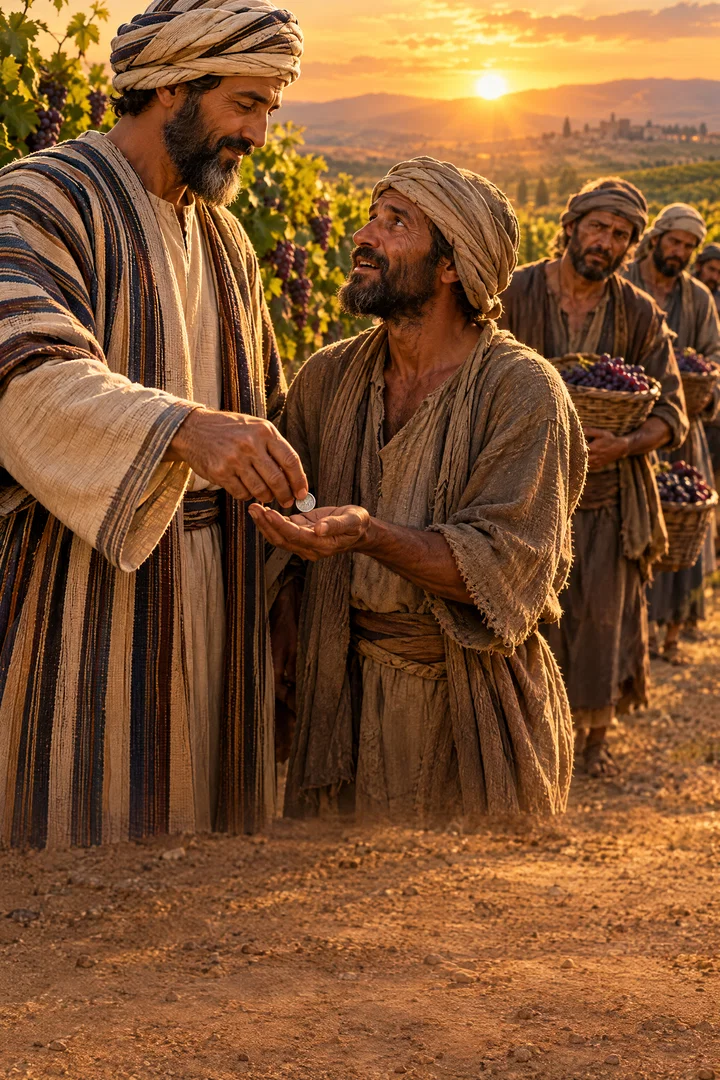
For the kingdom of heaven is like unto a man that is an householder, which went out early in the morning to hire labourers into his vineyard.
Translations
For the kingdom of heaven is like to a man that is an householder, which went out early in the morning to hire laborers into his vineyard.
For the kingdom of heaven is like unto a man that is an householder, which went out early in the morning to hire labourers into his vineyard.
KJV Cambridge Paragraph Bible, Revised Version
For the kingdom of heaven is like unto a man that is a householder, which went out early in the morning to hire labourers into his vineyard.
For the kingdom of heaven is like to a man that is a householder, who went out early in the morning to hire laborers into his vineyard.
For the kingdom of heaven is like unto a man that was a householder, who went out early in the morning to hire laborers into his vineyard.
'For the reign of the heavens is like to a man, a householder, who went forth with the morning to hire workmen for his vineyard,
For the kingdom of the heavens is like a householder who went out with the early morn to hire workmen for his vineyard.
For the kingdom of the heavens, is like, a man, a householder,—who went forth with the morning, to hire labourers into his vineyard;
Berean Standard Bible, Majority Standard Bible
“ For the kingdom of heaven is like a landowner who went out early in the morning to hire workers for his vineyard.
“ For the Kingdom of Heaven is like a man who was the master of a household, who went out early in the morning to hire laborers for his vineyard.
For the kingdom of heaven is like the master of a house, who went out early in the morning to get workers into his vine-garden.
For the kingdome of heauen is like vnto a certaine, housholder, which went out at the dawning of the day to hire labourers into his vineyarde.
Douay-Rheims (Challoner revision)
The kingdom of heaven is like to an householder, who went out early in the morning to hire labourers into his vineyard.
Pictures

Cross-references
- Matthew 9:37-38
Then saith he unto his disciples, The harvest truly is plenteous, but the labourers are few;
Both portray the Lord’s harvest as needing workers.
- Matthew 20:6-7
And about the eleventh hour he went out, and found others standing idle, and saith unto them, Why stand ye here all the day idle?
The householder calls idle workers into the vineyard and promises to give what is right.
- Matthew 20:16
So the last shall be first, and the first last: for many be called, but few chosen.
Concludes the parable with its reversal of first and last and distinction between called and chosen.
- Matthew 25:14-30
For the kingdom of heaven is as a man travelling into a far country, who called his own servants, and delivered unto them his goods.
Both portray servants accountable for faithfully using what their master entrusts to them.
- Matthew 19:30
But many that are first shall be last; and the last shall be first.
The parable illustrates Jesus’ saying that the first will be last and the last first.
- Matthew 21:28
But what think ye? A certain man had two sons; and he came to the first, and said, Son, go work to day in my vineyard.
Both describe people being sent to work in a vineyard.
- Luke 10:2
Therefore said he unto them, The harvest truly is great, but the labourers are few: pray ye therefore the Lord of the harvest, that he would send forth labourers into his harvest.
Both describe laborers sent to work in the harvest.
- Luke 14:16-20
Then said he unto him, A certain man made a great supper, and bade many:
The invitation to the supper echoes the call to enter the Lord’s work and the guests’ excuses.
- 1 Corinthians 3:9
For we are labourers together with God: ye are God’s husbandry, ye are God’s building.
Believers serving in the Lord’s vineyard are called laborers together with God.
- Matthew 20:6
And about the eleventh hour he went out, and found others standing idle, and saith unto them, Why stand ye here all the day idle?
The householder calls idle workers to labor, even at the eleventh hour.
- Matthew 20:8-10
So when even was come, the lord of the vineyard saith unto his steward, Call the labourers, and give them their hire, beginning from the last unto the first.
All the workers receive the same penny at evening, including those hired last.
- Matthew 20:12-15
Saying, These last have wrought but one hour, and thou hast made them equal unto us, which have borne the burden and heat of the day.
The workers object to equal pay, and the householder answers them.
- Matthew 21:33
Hear another parable: There was a certain householder, which planted a vineyard, and hedged it round about, and digged a winepress in it, and built a tower, and let it out to husbandmen, and went into a far country:
Both parables describe a householder and his vineyard.
- Matthew 22:1-14
And Jesus answered and spake unto them again by parables, and said,
The parable shows many invited to salvation, yet few chosen.
- Matthew 13:44
Again, the kingdom of heaven is like unto treasure hid in a field; the which when a man hath found, he hideth, and for joy thereof goeth and selleth all that he hath, and buyeth that field.
Both portray the kingdom through a costly commitment.
- John 4:36
And he that reapeth receiveth wages, and gathereth fruit unto life eternal: that both he that soweth and he that reapeth may rejoice together.
Workers gather a harvest and receive reward.
- Matthew 19:27-29
Then answered Peter and said unto him, Behold, we have forsaken all, and followed thee; what shall we have therefore?
Jesus continues by answering Peter’s question about the reward for following him.
- Luke 19:12-27
He said therefore, A certain nobleman went into a far country to receive for himself a kingdom, and to return.
Both parables urge faithful use of what the master entrusts.
Commentary part 1 of 2
Each commentary is drawn from primary sources: the writings of Ellen G. White and Adventist pioneers and periodicals. Each commentary is separate. Its own words are not a quotation; follow the references to read the source passages.
Ellen G. White
132 sources
The verse opens the parable of the vineyard workers, where a householder goes out early in the morning to the marketplace to hire laborers for his vineyard, following the familiar custom of finding workmen waiting to be employed.ST Jul 13, 19159T 73.3–74.1Ms 23, 1908, par. 33–36 The householder represents God in His dealings with the human family, and the vineyard represents His work and gospel ministry in the world as the field of service.Ms 19, 1897, par. 38–41COL 396.3–397.1ST Jul 13, 1915 The reward is given by grace as a gift and not earned as a debt by length or amount of work, so the first and the last share the same great eternal reward.COL 390.1COL 401.2–402.1ST Jul 13, 1915 The worth of service is measured by the spirit in which it is given — willingness, fidelity, love, humility and surrender of self — rather than by time worked or results accomplished, and it must be done in trusting faith rather than bargaining for a fixed reward.RH Aug 13, 1908RH Jul 24, 1900ST Jul 13, 1915RH Jul 24, 1900RH Jul 31, 1900 Those hired at the eleventh hour represent poor sinners who long delayed entering Christ's service yet are finally accepted when they come humbly and trustingly, as seen in the dying thief on the cross, and every Christian is therefore called to leave idleness and labor earnestly for souls while the opportunity remains.RH Jul 24, 1900RH Jul 24, 1900ST Jul 13, 19153T 202.1Ms 52, 1897, par. 26–27
Parable Story and Setting
The verse opens the parable of the vineyard workers, in which a householder goes out early in the morning to the marketplace to hire laborers for his vineyard.ST Jul 13, 19159T 73.3–74.1Ms 23, 1908, par. 33–36Ms 19, 1897, par. 38–41 The hiring reflects the familiar custom where those wanting work wait in the marketplace hoping to be employed and those needing workmen come there to find them.ST Jul 13, 1915ST Aug 9, 1899COL 396.3–397.1 The householder returns at different hours through the day to hire more workers, including at the eleventh hour, and at evening pays every worker the same agreed or fair wage, with those hired first receiving their set wage and those hired later receiving the same.ST Jul 13, 19159T 73.3–74.1Ms 87, 1899, par. 1–3RH Jul 24, 1900COL 396.3–397.1 Those hired first agreed to a stated wage while those hired later left the amount to the householder's discretion, trusting him to give what was right.ST Jul 13, 1915RH Jul 24, 1900COL 396.3–397.1RH Jul 24, 1900RH Jul 24, 1900 The difference in arrangement explains why equal payment is not unfair, for the first received what they agreed to while the last trusted the householder to do what was right, and the reward rests on his generous purpose rather than on the amount of labor performed.COL 396.3–397.1Ms 87, 1899, par. 8–9
The early workers complain at being made equal to those who worked briefly, but the householder has kept his agreement and asserts his right to do as he chooses in generosity.RH Jul 24, 1900ST Aug 9, 1899RH Jul 24, 1900 The story closes with the last first and the first last and many called but few chosen.Ms 87, 1899, par. 1–3RH Jul 24, 1900RH Jul 24, 1900 The parable was called forth by the disciples disputing who should be greatest and continues the answer to Peter's question what those who forsook all to follow Christ would receive.ST Aug 9, 1899 That answer is namely sitting on twelve thrones judging the twelve tribes in the regeneration and receiving a hundredfold and everlasting life for forsaking houses, family, or lands, with the warning that many first shall be last and the last first.ST Aug 9, 1899
The verse begins a lesson about the kingdom of heaven, Christian service, God's goodness, and the right principles of His favor and reward.Ms 23, 1908, par. 33–36Ms 19, 1897, par. 38–41COL 390.1 Service in God's work is open to people at different times, and God is generous in giving what is right.Ms 23, 1908, par. 33–36 His free grace cannot be earned by works, and the grasping hope of gaining righteousness as payment is mistaken.COL 390.1
Figures and Meanings
The householder who goes out early to hire is God, Christ, the Master in His dealings with the human family, coming to His people throughout the ages to call laborers into His vineyard, with particular force near the close of earth's history.Ms 19, 1897, par. 38–41COL 396.3–397.1ST Jul 13, 1915ST Jul 13, 1915COL 397.2–398.1 He hires at different hours and promises each what is right, keeping His agreement while remaining free in generosity to give equally to those hired later.Ms 19, 1897, par. 38–41COL 396.3–397.1ST Jul 13, 1915 Those hired first agree to a stated wage, while those hired later trust Him to give what is right.COL 396.3–397.1ST Jul 13, 1915COL 397.2–398.1 The vineyard is His work among the human family, the gospel ministry in its various lines and departments, the Lord's cause where means are brought into the treasury to sustain it.ST Jul 13, 1915COL 397.2–398.13T 121.1–2RH Jul 31, 1900Ms 87, 1899, par. 26–27 Every Christian man and woman is to be a worker in it, wide awake and zealous for the salvation of others, carrying His message and working with Christ.3T 202.1RH Jul 31, 1900Ms 87, 1899, par. 26–27
The vineyard is also the world as the field of service, God's great moral vineyard of world and church calling for workers in foreign lands and any place of usefulness.FE 512.4CE 46.1Ms 99, 1907, par. 3 It is the worldwide field, the whole world including its cities and villages, including unworked places destitute of facilities where memorials for truth should stand.YGBCOEP 39.3–40.2CE 46.1Lt 10, 1910, par. 11 It covers all portions of the field, including the Southern field and the most destitute regions, where labor means placing means in the Lord's treasury to place the work on a proper basis in every place rather than heaping abundance in expensive buildings in one place.YGBCOEP 39.3–40.2Lt 43, 1900, par. 6 Mission workers for this field need practical training, experience in cultivating the soil and manual labor, and daily godliness to take hold of any line of work where called.CE 46.1Ms 99, 1907, par. 3 The truth entrusted to its workers is of great worth, with angels working with God's appointed messengers while Satan seeks to hide its light by deceptive theories.Lt 10, 1910, par. 11
The laborers are His servants and employed servants, entrusted with weighty responsibilities and great light, called to carry His message, educate the youth, give faithful home training, and work carefully and intelligently while keeping free from worldly entanglement and bound to the living Source of power.Ms 19, 1897, par. 38–41RH Jul 31, 1900Ms 87, 1899, par. 26–27Lt 25a, 1890, par. 13Lt 60, 1888, par. 13 They are to serve from love and trust rather than as hirelings seeking reward in proportion to labor or comparing themselves with others, examining their hearts until self-exaltation and belittling others give way to love and dependence on God.RH Jul 31, 1900Ms 87, 1899, par. 26–27COL 396.1–2 In the reckoning of the parable the steward who pays is Christ, and the vineyard workers are those who serve God.Ms 87, 1899, par. 10 The men hired first early in the morning are those who will not work without the wages they themselves stipulate, making terms with God for a stated reward in exchange for a stated amount of work and treating their work as worth more than that of later comers, and at the close of the day they find themselves last.RH Jul 24, 1900Ms 87, 1899, par. 10Lt 93, 1899, par. 14Ms 142, 1903, par. 90
These first-hired also picture people with an envious, self-righteous, hireling spirit who think long service, hardship, and works earn heaven and claim preference and greater reward.ST Aug 9, 1899COL 399.5–401.1Ms 87, 1899, par. 16 They value the reward above the privilege of serving Christ, seek credit and place, and their complaints and faultfinding reveal self-advancement, distrust of God, and jealousy toward others, for God judges motives rather than outward appearances.ST Aug 9, 1899COL 399.5–401.1Ms 87, 1899, par. 16 The first-called Jews are of this class, regarding years of service as grounds for greater reward and resenting Gentiles receiving equal privileges in the things of God.COL 399.5–401.1 Though such workers may regard themselves as first, God counts those who serve with this spirit last, warning even first-called disciples against self-righteousness and the belief that human effort earns a place in heaven.ST Aug 9, 1899COL 399.5–401.1Ms 87, 1899, par. 10
Grace and True Service
The kingdom does not pay by the human rule that wages match work done, visible results, learning, position, or ability, but rewards according to generous goodness and gracious purpose rather than merit or ordinary standards.COL 396.3–397.1ST Jul 13, 1915Ms 29, 1911, par. 67Ms 87, 1899, par. 8–9ST Jul 13, 1915 The first-hired received the agreed sum while those hired later left the amount to the householder's discretion, trusting him to give what was right, so their reward rested on his purpose and not on the amount of labor performed.COL 396.3–397.1ST Jul 13, 1915RH Jul 24, 1900Ms 29, 1911, par. 67Ms 87, 1899, par. 8–9 Christ's kingdom follows God's own principles and purpose rather than copying human householders or human example, working steadily according to the laws of that kingdom.RH Jul 24, 1900Ms 87, 1899, par. 8–9
The reward is given by grace as a gift, not earned as a debt by amount or length of work, and no laborer can claim it as a right or stand above another.COL 390.1COL 401.2–402.1COL 397.2–398.1ST Jul 13, 1915COL 396.1–2 The grasping hope of gaining righteousness as payment, and the thought that men can do something toward earning a place in heaven, is mistaken and offensive to God.COL 390.1ST Jul 13, 1915 That self-reliant spirit imagines that after making certain advancement the Lord will come in to help, leaving an abundance of self and little of Jesus, with those who have advanced a little puffed up, thinking themselves superior, eager for flattery and jealous if not thought most important.ST Jul 13, 1915 God cannot work with those who manifest this narrow, self-caring, self-righteous spirit, for they are insensible to the working of His Spirit, and the reward is not of works lest any man should boast, but it is all of grace.ST Jul 13, 1915ST Jul 13, 1915
The first and the last share the same great eternal reward, so those who served longer should welcome rather than begrudge what is given to others, since all are saved by grace.ST Jul 13, 1915COL 401.2–402.1 The worth of service is measured by the spirit in which it is given — willingness, fidelity, love, humility, gratitude, surrender of self, and likeness to Christ — not by how long a person has worked or how much is accomplished.ST Jul 13, 1915RH Jul 24, 1900ST Jul 13, 19159T 74.2Ms 87, 1899, par. 8–9 Even the smallest duty done sincerely without self-seeking pleases God more than great work marred by selfishness, for God values the love and faithfulness with which people work and the likeness of Christ their work shows.ST Jul 13, 1915 God accepts even brief service when done humbly and trustingly as His coworkers, honoring grateful, humble trust and delighting in kindness to give a reward the workers know they have not earned.ST Jul 13, 1915COL 397.2–398.1
Service must be done in trusting faith rather than bargaining for a fixed reward or in a self-congratulatory spirit, for the late-hired trusted the householder to give what was right and to deal fairly and rightly, and their faith led to their being placed first.RH Jul 24, 1900Ms 29, 1911, par. 65Ms 87, 1899, par. 15Ms 29, 1911, par. 67COL 396.1–2 Complaining about His dealings wins no sympathy, and persistent grumbling shows the worker's heart needs to change.Ms 29, 1911, par. 65Ms 87, 1899, par. 15 Complaints about supposed unfairness and envy when others receive equal pay arise from selfish, unpurified hearts that fail to recognize the householder's liberality and goodness and his right to do what he chooses, though he has kept his agreement with the first.RH Jul 24, 1900RH Jul 31, 1900Ms 29, 1911, par. 66Ms 87, 1899, par. 15 A purified heart sees His action as generous, and the lesson closes that the last may be first and the first last, and many are called but few chosen.RH Jul 24, 1900Ms 87, 1899, par. 15
The parable rebukes jealousy, suspicion, envious comparisons, self-exaltation, faultfinding, and claims of merit, and self-exalting, faultfinding workers who seek credit, place, and recognition may be placed last.RH Jul 31, 1900ST Jul 13, 1915COL 401.2–402.1 It guards the first-called disciples against a narrow, self-caring, self-righteous spirit that values the reward above the privilege of serving Christ, revealing self-advancement, distrust of God, and jealousy toward others.COL 399.5–401.1ST Jul 13, 1915COL 397.2–398.1 The first laborers claimed preference and greater reward because of long service and hardship, as the first-called Jews regarded years of service as grounds for greater reward and resented Gentiles receiving equal privileges in the things of God.COL 399.5–401.1 Service should spring from love to God and others and from loving trust, not from eagerness for compensation or claim to merit or honor.COL 399.5–401.1COL 397.2–398.1
The continued invitation from early morning until the last hour does not excuse those who hear the first call to serve but neglect or refuse it, for those hired at the eleventh hour had been unemployed because no one had hired them and had not refused an earlier call.RH Jul 31, 1900COL 399.1 Those who refuse and later repent do well to repent, but it is unsafe to trifle with the first call of mercy.RH Jul 31, 1900COL 399.1 Accepting the invitation in theory is not enough; faith must work through love and purify the soul, shown in humble faith, obedience to the commandments, and service joined to Christ that does not seek to exalt self, appear clever, or disparage others, but works in love, dependence on God, and cooperation with Him.RH Jul 24, 1900RH Jul 31, 1900RH Jul 31, 1900 All time, ability, and means are entrusted by God, eternal life is His gift on condition of entire obedience, and each worker is accountable in a day of reckoning with expectation proportioned to ability and resources.RH Jul 31, 1900Lt 8, 1890, par. 35 The reward is for faithful work, not idleness, so the laborer who receives the penny is contrasted with the person who loiters in the marketplace, and those who do their appointed work with fidelity show by their fruit the character of that work.Ms 132, 1901, par. 17
Late Hired Workers
Those hired later and at the eleventh hour are poor sinners who long delayed entering Christ's service but are finally accepted, expecting little and content if Christ will receive them.RH Jul 24, 1900RH Jul 24, 1900Ms 87, 1899, par. 11–12 They are thankful for the opportunity to serve, leave their reward to Christ to give what is right, and work in trusting faith rather than bargaining for a fixed amount.RH Jul 24, 1900RH Jul 24, 1900Ms 87, 1899, par. 11–12 Their surprise and gratitude at receiving a full day's pay for short service show the householder's kindness and the generous reward they know they did not earn.RH Jul 24, 1900ST Jul 13, 1915Ms 87, 1899, par. 11–12 Their faith leads to their being placed first, for Christ values not only the work but the spirit in which it is done, and He accepts penitent sinners who come late in humble faith and obey His commandments.RH Jul 24, 1900ST Jul 13, 1915Ms 87, 1899, par. 11–12
God accepts even those whose service is brief when, grateful for being accepted, they work humbly and trustingly as Christ's coworkers.ST Jul 13, 1915COL 397.2–398.1ST Jul 13, 1915 The value of their work rests not on its amount, visible results, learning, position, or ability, but on willingness, fidelity, love, and humble trust.ST Jul 13, 1915COL 397.2–398.1ST Jul 13, 1915 God honors this grateful, humble trust and in kindness delights to give a reward they know they have not earned, for He rewards according to His gracious purpose and not human merit.ST Jul 13, 1915COL 397.2–398.1 Even those whose service is short and work humble will receive the reward if they follow Christ in simple faith and love.ST Jul 13, 1915COL 397.2–398.1ST Jul 13, 1915
The dying thief on the cross is such an eleventh-hour laborer, receiving as much reward as those who labored many hours.Ms 52, 1897, par. 26–27 In faith, patience, contrition, and earnestness he fully realized Jesus could save him, with hope mingled with anguish knowing that without Jesus he would be eternally lost.Ms 52, 1897, par. 26–27 Casting his helpless dying soul and body on Jesus Christ, he received the same reward as long labor.Ms 52, 1897, par. 26–27 Late-coming workers may likewise come from great error with few opportunities and receive light late, yet consecrate themselves to God's work.Lt 123, 1897, par. 24–28 They remain faithful to principle and duty, declare the whole counsel of God, and receive the reward for faithfulness, while those with greater light who reject Christ leave their place vacant and lose their place and crown.Lt 123, 1897, par. 24–28
Eleventh-hour workers include people who enter when the work has become harder and people more resistant, yet they remain faithful and receive their penny.10MR 170.2–3 When workers leave or die, the Lord calls others, including the young, to take their places and continue His work.10MR 170.2–3 Many souls still in the ranks of the world and in the churches, even the Catholic church, will come out at the end and join God's work.Ms 30, 1889, par. 73–79 Their zeal will far exceed that of those who have long stood in rank and file to proclaim the truth yet do not walk in the light, including Sabbathkeeping Adventists.Ms 30, 1889, par. 73–79 When the crisis over religious liberty and the battle for truth is upon them and the season of calamity comes, they will see it coming, come to the front, give the trumpet a certain sound, gird themselves with the whole armor of God, exalt God's law, hold the faith of Jesus, and maintain religious liberty.Ms 30, 1889, par. 73–79
House-to-house Bible work will prepare many to make right decisions during the crisis, even amid Satan's deceptive miracles.Ms 18, 1888, par. 30 People who accept the truth and become workers with Christ at the eleventh hour will receive the same reward as those who have served throughout the day.Ms 18, 1888, par. 30
Call to Present Labor
Every Christian man and woman in every sense of the word is called to be a worker in the Lord's vineyard, with an individual responsibility and appointed place and portion to tend, and none should remain idle. The vineyard has work for everyone and for all united, and persevering daily effort increases ability to serve effectively and bear fruit to God's glory. Service is to be wherever needed to the utmost of ability rather than seeking enjoyment or gain, and calls for personal sacrifice with self-sacrificing care for others and the cause of God.3T 202.14T 518.1–2TCBMP 201.14T 454.15T 386.1 Humility, faith, energy, perseverance and decision equip workers for its responsibilities, in bringing people out of darkness, establishing them in truth, and preparing them for Christ's coming, which God accepts as willing, devoted, unselfish labor.SBAWP 10.3–11.1
Hiring means God calls for human cooperation, for He does nothing without it, and the work is to be taken up wherever people are without waiting for a regular process or appointment. Each is to take it up right where he is, even in what are called irregular lines, stepping out of regular lines to do self-sacrificing work that wins souls. Those who do this learn by experience what it means to be laborers together with God.RCOC 114.5Lt 109, 1901, par. 12Ms 51, 1900, par. 11 Feeling a burden for souls, going out to labor, going without the camp bearing reproach, giving self wholly to God, and standing decidedly in the channel where God is working in step with His people belong to this work, while sitting at home calling the church to oneself with hints of special light leaves one self-deceived and in danger of missing heaven.Lt 58, 1890, par. 5–6
Labor in the vineyard means being wide awake and laboring zealously for the salvation of fellow men, availing of every opening to press truth upon those in darkness whose hearts are troubled over the signs of the times, and working in unison with heavenly messengers. It is the great harvest field of saving fellow men from perdition, presenting truth, explaining Scripture, lecturing on prophecy, warning sinners, visiting the sick and discouraged to help them find faith in Jesus, bringing people out of error, establishing them in truth, and preparing them for Christ's coming.3T 202.1TCBMP 201.13T 159.24T 75.4 Every accountable person can do good by using opportunities to help suffering people, and young men who consecrate themselves unreservedly and use powers of mind earnestly turn minds into a heavenly channel, walk in light, grow from light to strength, turn sinners to Christ, point the unbelieving and desponding heavenward, and at warfare's end are welcomed to their Lord's joy.CH 583.23T 159.2 Hundreds could be employed where now there is one, following Christ's example of self-denial, sacrifice, and faithful earnest labor through which God will accomplish a great work through the truth.ST Sep 4, 1879TCBMP 201.1
The call applies to enlarging the work into new fields and unworked portions rather than concentrating on churches that already have much light and many advantages, carrying truth where it has not reached until the work encircles the world. Ministers entrusted with the sacred warning message must make their principal labor for those who have not heard, venturing from shore to launch into the deep and cast the net where the fish are, opening new fields, raising churches, setting members and converts to work, and passing on to regions beyond.7T 255.2–3ST Sep 4, 1879 It applies to entering cities and villages with the warning message, sowing beside all waters, and especially to destitute fields such as the Southern field and large cities where people have not heard, for which the church is accountable in this probationary opportunity to develop character after Christ's pattern.RH Apr 7, 1910ST Oct 31, 1911RH Sep 28, 1905Ms 62, 1894, par. 3 Willing workers should take up such service without delay, responding with whole being, renewed courage and zeal, continuing until the work is thorough.RH Apr 7, 1910
Those who have received truth are called to consecrate themselves and work with Christ, which brings closer sympathy with Him, growth in spiritual life and knowledge, deeper understanding of His work and sacrifice, and fitness as valuable workers to win souls, while the promised wages are received later.SBAWP 13.27T 231.5 True laborers give themselves wholeheartedly to the utmost of ability, using all abilities in best service, with self-denial, sacrifice, prayer, faith, humility, energy, perseverance and decision, restraining natural appetites and passions, following Christ's example. They do not seek ease, pleasure, enjoyment, gain, cleverness or self-praise, do not excuse themselves for unpleasant duties or risk of disappointment and rebuffs, and do not measure every hour with exactness or study how little may be done to reach the lowest standard.GW92 47.3SBAWP 10.3–11.1RH Apr 13, 1905GW 80.25T 386.1 Their lives give evidence of the truth they share, and their work is effective.GW 80.2
Workers must not set the highest estimate on their own services, swell with pride and self-importance, seek to exalt self, belittle others, crowd out another to build up self, or engage in selfish rivalry. They are to compare efforts with the Saviour's, account themselves unprofitable servants, arouse to grasp the fullness of Christ to do much for Him, feel responsible for the health, spiritual strength and growth of the church, seek pure religion, and work in unity as links in a golden chain binding hearts to one another and to God to enlighten the world.SSP 13.1–2Lt 32, 1890, par. 7–95T 417.2 The vineyard is one great field even when servants labor in different parts, and its moral work is to be planned and carried forward without narrow rivalry.5T 417.2STMW9 63.1–2 Laborers need a converted heart and character, for the work is sacred and cannot be rightly done with unchanged heart, being like Jesus in mind, thoughts, words and actions, kept free from worldly entanglement and bound to the living Source of power to represent correctly what it means to be a Christian.3T 552.1Lt 60, 1888, par. 13 Duty is to be done carefully and intelligently without working unwisely to destroy or overweary nature and become unfitted for good work.Lt 60, 1888, par. 13
God can use young people who give themselves fully and devote abilities to spiritual work, and He sees potential in those who seem unlikely, unqualified, discouraging, overlooked, or with little education. By studying Scripture, growing in spiritual knowledge, continued learning, providence, and the Holy Spirit's power they can become earnest, capable workers who warn sinners, lead people to Christ, and speak with power, fitted for work suited to their abilities.FE 44.3CH 26.17T 271.1GW 36.2–3 Young people instead of pursuing pleasure or remaining indifferent are to serve faithfully and do the Lord's will as soul winners, in labor leading to eternal life and commended by the King.MYP 206.2–207.1 Beginners in neglected fields should be welcomed, trained and supported, learning humbly and giving themselves to the work as He prepares their place.GW 36.2–3 Preparing and training people for home and foreign mission fields supplies the vineyard's need for many workers, through schools that discipline the mind, develop its powers, direct them with understanding, teach common branches, present present truth, lecture on prophecy, bring practical godliness into daily experience, use manual labor and cultivation of the soil, and fit youth for any place of usefulness and the missionary field in foreign lands.3T 160.23T 159.2FE 45.1–2LSEGW 375.3–376.1CE 46.1 The church must go to work in Christ's spiritual vineyard for youth and children, and the Lord of heaven sees who does the required work.HCSSP 18.1
Ministers should put idle people to work, correct mistakes, and let them learn how to use abilities by exercising them, rather than hindering them by keeping them from practical service for further education.OEWP 36.1–37.1 Everyone who takes a stand for the gospel must be given practical instruction in earnest soul work with willing sacrifice and faithful, earnest, unselfish, persevering effort that does not consult inclination or ease, sowing truth with prayerful anxiety and unceasing activity so faith increases and work continues when teachers leave, and new converts should be impressed to work for others rather than depend on laborers from elsewhere.AA 186.2–3TBC1872 110.2 The vineyard includes the home, where older members cultivate it by patiently teaching younger children and sharing knowledge God has given, which is meaningful Lord's service.RH Jun 2, 1910 Mothers who remain with children through poverty and a harsh godless husband's opposition to train, pray, and counteract evil teaching do true vineyard labor rather than leaving family to seek other work, and faithful home training with cooperation between parents and school workers in education dearest to the Saviour's heart is required, using facilities within reach instead of laying off responsibility and becoming little better than idlers.Lt 25a, 1890, par. 13Lt 28, 1890, par. 23–2421MR 459.2–4 Serving God is not limited to pulpit preaching, for each can begin at home and with neighbors and friends, valuing souls met and taking up work at hand rather than remaining idle.Ms 42, 1894, par. 4–5
The vineyard image applies to circulating publications and canvassing with books that express faith and give light, including making them available at low prices so their light reaches those who might otherwise not read them, and their circulation should not be hindered.RH Aug 13, 1908 Those who share truth through missionary letters and literature after seeking God in prayer are workers being trained as acceptable workers, and office workers are to labor earnestly and faithfully for salvation of souls, treating work as sacred rather than ordinary employment, praying for and caring about even those not fully in truth.STPW91 15.13T 191.2RH Dec 10, 1914TBC1872 20.2 Turning to sell books and pictures without faith and light for better pay is refusing to labor in the vineyard and brings loss of time, fitness for ministry, and a worldly character.TBC1872 20.2 Entrusted property, abilities, resources and opportunities belong to Christ who bought them by blood and suffering, and are to be used while living to advance His work and place means in the treasury to establish it on a proper basis in every place; using them for selfish gain perverts them and can do great harm.3T 121.1–2TCBMP 156.13T 126.2–127.2TCBMP 164.2–165.2Lt 1, 1883, par. 60–63 Those with present-truth light are called to labor earnestly to bring others to it.Lt 1, 1883, par. 60–63
The Lord as householder sees the worldwide work and requires equity and just judgment, so means must not be absorbed in costly clothing, expensive buildings in one place, or one line of work while other places have nothing. Every building must be erected with reference to other needs, giving other parts a chance through many small sanitariums, treatment rooms in many cities, and hygienic restaurants, rather than blocking advance by selfish use of all means in one place.YGBCOEP 39.3–40.2 The vineyard covers all portions including the Southern field and most destitute regions, where means in the treasury should place work on a proper basis everywhere; heaping over-abundance in one place while others are left without culture or facilities is unfaithful stewardship before heaven, and working one portion requires planning for all with sanctified ability for proportionate work.Ms 109, 1909, par. 44Lt 43, 1900, par. 6 Laborers employed in God's service, whose work through God brings means into the treasury to sustain His cause, must be dealt with on fair, true and right principles as a sacred transaction between man and fellow man, giving them voice in wage decisions rather than handling them as inanimate objects without voice. Cutting wages without consent or understanding of their situation is unjust and unrighteous, reveals selfish character, brings families into strait places, want and oppression, and tempts, discourages and drives workers from the field.Ms 142, 1903, par. 65–66 Yet laborers must follow Jesus as Pattern in self-denial and not set a high price on labors nor desire higher and still higher wages, for that spoils spirituality in responsible men and misrepresents Christ's self-denial.Ms 109, 1907, par. 39–41
The Lord knows and watches over workers wherever they serve in different fields and places, teaching, leading and guiding His people throughout the vineyard, and His work is not confined to one central institution or controlled by human ties, nor should any part regard itself as independent.RH Jun 2, 1903Lt 180, 1901, par. 5–6Ms 46, 1903, par. 27Ms 19, 1911, par. 4 The church and its institutions are to send out laborers and support them with sympathy, opportunities to grow, experienced help for new work, and material support so they can remain in the field giving Bible readings and holding meetings to awaken interest.RH Jun 2, 1903Ms 46, 1903, par. 27Lt 28, 1895, par. 22Ms 19, 1911, par. 4 Those truly converted care about work throughout the great vineyard, not only their own institution or branch, and are ready to help wherever needed.8T 138.2–3 Those who after embracing truth and years of experience have no strength to stand alone and cannot help others to light are like a barren tree with leaves but neither blossoms nor fruit, while those who find and accept truth become intelligent helpers whose faith and works show labor for them was not in vain; God never does what man can do, yet He alone makes efforts effectual and can clothe humblest and weakest with wonderful power.ST Sep 4, 1879Ms 76, 1901, par. 5
Some in Vermont wrongly believed the Lord called them to vineyard work when it led them to burden the church instead of exercising and caring for their own families, and they should give up that belief.Lt 21, 1859, par. 3 Those truly called to proclaim the message bear its burden especially among new fields, using effort, prayer, holy living and teaching to raise up Sabbathkeepers rather than spending most time among believers who already understand, though some may assist without being called to serve wholly as traveling teachers from state to state.Ms 1a, 1859, par. 7–8 Gifts to Jesus through offerings that help others go out and work for those for whom He died support bringing people to Him, and capable colored youth with every advantage and proper training can become useful medical missionary workers among their own people, including conducting sanitariums at times with white workers' assistance, with patient persevering effort.21MR 223.3–62MR 79.2–80.4 Workers trained in their own languages are to take places quickly among foreigners brought by providence to doors to learn truth and carry it in their languages to all nations, and souls won are their hire.RH Oct 29, 1914 Medical missionaries are to work today to save souls especially in neglected fields rather than settle near established sanitariums for personal profit, and even the humblest servant can labor with reward of knowing what is right.Lt 233, 1905, par. 40–42Lt 31, 1879, par. 4
The vineyard and its workers are not to be viewed narrowly by imposing one required kind of experience on all, but each should seek direction from God about work to be done.2MR 62.2 Stewards in responsibility should heed appeals for destitute fields such as the Southern field and prepare the way with interest and help, but if they neglect and close their senses, laborers who understand the field's necessities are free to devise and plan, go anywhere, bring their case directly before unsealed hearts, and solicit means without it passing through any office or society.Lt 219, 1899, par. 1–2 The opportunity to give the final message of mercy is rapidly passing, so all who love Jesus must respond with whole being, act with renewed courage and zeal, make the most of remaining time, and continue until the work is thorough, with none remaining idle.RH Apr 7, 1910 The Southern mission work is hindered by unsanctified judgment and influence of some claiming to serve in the vineyard, and those with experience and ability who lay aside responsibilities become idle, bury talents, and add to the burden of those who continue.2T 114.2–4 Service in God's vineyard calls for strength from God.Ms 15, 1868, par. 16
Late Hired Workers
Those hired later and at the eleventh hour are poor sinners who long delayed entering Christ's service but are finally accepted, expecting little and content if Christ will receive them.RH Jul 24, 1900RH Jul 24, 1900Ms 87, 1899, par. 11–12 They come in humble, penitent faith, thankful for the opportunity to serve, leaving their reward to Christ and trusting the householder to give what is right rather than bargaining for a fixed reward.RH Jul 24, 1900RH Jul 24, 1900Ms 87, 1899, par. 11–12 Their surprise and gratitude show the householder's kindness, for they know they have not earned the generous payment they receive.RH Jul 24, 1900ST Jul 13, 1915Ms 87, 1899, par. 11–12 God accepts even those whose service is brief when they work humbly and trustingly as His coworkers, for the value of work rests not on its amount or visible results but on the spirit in which it is given.ST Jul 13, 1915COL 397.2–398.1ST Jul 13, 1915 He honors grateful, humble trust and delights to give a reward they know they have not earned, rewarding according to His gracious purpose rather than human merit, learning, position, or ability.ST Jul 13, 1915COL 397.2–398.1ST Jul 13, 1915
The dying thief on the cross is such an eleventh-hour laborer, who in faith, patience, contrition, and earnestness fully realized that Jesus could save him.Ms 52, 1897, par. 26–27 With hope mingled with anguish at knowing that without Jesus he would be eternally lost, he cast his helpless dying soul and body on Christ and received the same reward as long labor.Ms 52, 1897, par. 26–27 Late-coming workers may likewise come from great error with few opportunities and receive light late, yet consecrate themselves to God's work and remain faithful to principle and duty.Lt 123, 1897, par. 24–28 They declare the whole counsel of God and receive the reward for faithfulness, while those with greater light who reject Christ leave their place vacant and lose their place and crown.Lt 123, 1897, par. 24–28
The eleventh-hour workers include those who enter when the work has become harder and people more resistant, yet remain faithful and receive their penny.10MR 170.2–3 When workers leave or die the Lord calls others, including the young, to take their places and continue His work.10MR 170.2–3 Many souls still in the ranks of the world and in the churches, even the Catholic church, will come out at the end and join God's work.Ms 30, 1889, par. 73–79 Their zeal will far exceed that of those who have long stood in rank and file to proclaim the truth yet do not walk in the light, including Sabbathkeeping Adventists.Ms 30, 1889, par. 73–79
When the crisis over religious liberty and the battle for truth is upon them and the season of calamity comes, they will see it coming, come to the front, give the trumpet a certain sound, gird themselves with the whole armor of God, exalt God's law, hold the faith of Jesus, and maintain religious liberty.Ms 30, 1889, par. 73–79 House-to-house Bible work will prepare many to make right decisions during that crisis, even amid Satan's deceptive miracles.Ms 18, 1888, par. 30 Those who then accept the truth and become workers with Christ at the eleventh hour will receive the same reward as those who have served throughout the day.Ms 18, 1888, par. 30
Sources