Matthew 23:3
All therefore whatsoever they bid you observe, that observe and do; but do not ye after their works: for they say, and do not.
Translations
All therefore whatever they bid you observe, that observe and do; but do not you after their works: for they say, and do not.
All therefore whatsoever they bid you observe, that observe and do; but do not ye after their works: for they say, and do not.
all therefore whatsoever they bid you observe, that observe and do; but do not ye after their works: for they say, and do not.
All therefore, whatever they bid you observe, that observe and do: but do not ye according to their works: for they say, and do not.
Revised Version, American Standard Version
all things therefore whatsoever they bid you, these do and observe: but do not ye after their works; for they say, and do not.
all, then, as much as they may say to you to observe, observe and do, but according to their works do not, for they say, and do not;
all things therefore, whatever they may tell you, do and keep. But do not after their works, for they say and do not,
All things, therefore, whatsoever they tell you, do and observe,—but, according to their works, do ye not, for they, say, and do not, perform.
So practice and observe everything they tell you. But do not do what they do, for they do not practice what they preach.
So observe and practice everything they tell you to observe. But do not do what they do, for they do not practice what they preach.
All things therefore whatever they tell you to observe, observe and do, but don’ t do their works; for they say, and don’ t do.
All things, then, which they give you orders to do, these do and keep: but do not take their works as your example, for they say and do not.
All therefore whatsoeuer they bid you obserue, that obserue and doe: but after their workes doe not: for they say, and doe not.
Douay-Rheims (Challoner revision)
All things therefore whatsoever they shall say to you, observe and do: but according to their works do ye not; for they say, and do not.
Pictures
Cross-references 20 of 21
- Matthew 23:23
Woe unto you, scribes and Pharisees, hypocrites! for ye pay tithe of mint and anise and cummin, and have omitted the weightier matters of the law, judgment, mercy, and faith: these ought ye to have done, and not to leave the other undone.
Jesus contrasts exact tithing with neglect of judgment, mercy, and faith.
- Matthew 21:28-31
But what think ye? A certain man had two sons; and he came to the first, and said, Son, go work to day in my vineyard.
The two sons contrast professing obedience with actually doing the father’s will.
- Matthew 5:19
Whosoever therefore shall break one of these least commandments, and shall teach men so, he shall be called the least in the kingdom of heaven: but whosoever shall do and teach them, the same shall be called great in the kingdom of heaven.
Both texts distinguish teaching God’s commands from actually keeping them.
- Matthew 15:14
Let them alone: they be blind leaders of the blind. And if the blind lead the blind, both shall fall into the ditch.
Both warn against following blind, disobedient leaders.
- James 1:22
But be ye doers of the word, and not hearers only, deceiving your own selves.
Both contrast hearing or saying the word with doing it.
- Romans 2:21
Thou therefore which teachest another, teachest thou not thyself? thou that preachest a man should not steal, dost thou steal?
Challenges those who teach others but do not practice what they teach.
- Matthew 23:27-28
Woe unto you, scribes and Pharisees, hypocrites! for ye are like unto whited sepulchres, which indeed appear beautiful outward, but are within full of dead men’s bones, and of all uncleanness.
Christ rebukes leaders whose righteous appearance hides hypocrisy and uncleanness.
- Luke 20:46-47
Beware of the scribes, which desire to walk in long robes, and love greetings in the markets, and the highest seats in the synagogues, and the chief rooms at feasts;
Jesus warns against the scribes’ hypocritical conduct and exploitation.
- Matthew 5:20
For I say unto you, That except your righteousness shall exceed the righteousness of the scribes and Pharisees, ye shall in no case enter into the kingdom of heaven.
Christ requires righteousness surpassing the scribes’ and Pharisees’ limited obedience.
- Matthew 23:29-31
Woe unto you, scribes and Pharisees, hypocrites! because ye build the tombs of the prophets, and garnish the sepulchres of the righteous,
Prophets’ tombs display outward honor alongside hypocrisy and disowning their ancestors’ violence.
- Luke 11:39-54
And the Lord said unto him, Now do ye Pharisees make clean the outside of the cup and the platter; but your inward part is full of ravening and wickedness.
Jesus condemns religious leaders’ hypocrisy and wrongdoing in warnings echoed in Matthew 23.
- Titus 1:16
They profess that they know God; but in works they deny him, being abominable, and disobedient, and unto every good work reprobate.
Both describe professing belief while denying it through one’s actions.
- Mark 7:6
He answered and said unto them, Well hath Esaias prophesied of you hypocrites, as it is written, This people honoureth me with their lips, but their heart is far from me.
Both describe lip-honor without an obedient heart.
- Matthew 15:8
This people draweth nigh unto me with their mouth, and honoureth me with their lips; but their heart is far from me.
Both contrast outward religious words with inward or practical disobedience.
- Mark 7:9
And he said unto them, Full well ye reject the commandment of God, that ye may keep your own tradition.
Both charge rejecting God's command to keep human tradition.
- James 2:17-18
Even so faith, if it hath not works, is dead, being alone.
Both distinguish professed faith from the deeds that demonstrate it.
- Romans 2:13
( For not the hearers of the law are just before God, but the doers of the law shall be justified.
Both distinguish doing what is commanded from merely hearing it.
- 1 John 5:3
For this is the love of God, that we keep his commandments: and his commandments are not grievous.
Keeping God’s commandments is identified with love for God.
- Ezekiel 34:2-3
Son of man, prophesy against the shepherds of Israel, prophesy, and say unto them, Thus saith the Lord GOD unto the shepherds; Woe be to the shepherds of Israel that do feed themselves! should not the shepherds feed the flocks?
further describes self-seeking ministers
- Matthew 7:21
Not every one that saith unto me, Lord, Lord, shall enter into the kingdom of heaven; but he that doeth the will of my Father which is in heaven.
Those who do the Father’s will enter the kingdom.
Commentary
Each commentary is drawn from primary sources: the writings of Ellen G. White and Adventist pioneers and periodicals. Each commentary is separate. Its own words are not a quotation; follow the references to read the source passages.
Ellen G. White
46 sources
Christ commanded obedience to what the scribes and Pharisees taught from Moses' seat when it rightly conveyed God's law, but forbade copying their conduct because they spoke without practicing.ST May 2, 1878DA 610.1–611.2Ms 115, 1894, par. 1Ms 71, 1897, par. 1–3Ms 71, 1909, par. 25 Sitting in Moses' seat meant claiming Moses' authority as exalted interpreters and judges to expound the law from the written Scriptures.ST May 2, 1878DA 610.1–611.2Ms 71, 1897, par. 1–33SP 58.1 That obedience covered only what accorded with the law and was good, and did not endorse their added human traditions and commandments that burdened the people and hid God's Word.ST May 2, 1878DA 610.1–611.2Ms 115, 1894, par. 1 Their works were to be rejected because their words and lives contradicted each other, as they taught duties they neglected, made requirements exacting for others while evading them themselves, and kept outward forms and public piety without spiritual life, humility, mercy, faith and love.Ms 84, 1894, par. 10–13COL 278.42SP 73.33SP 58.1ST Mar 1, 1883 The rebuke was recorded to warn every age against letting human authority rule the conscience instead of Scripture and against following blind guides, since teaching the truth is vain unless teachers live it, make actions agree with words, and join profession with repentance, mercy and unselfish service.4SP 414.3RH Jun 7, 19063SP 57.1TEPD 30.1STMW7 37.1–2
Setting and Hearers
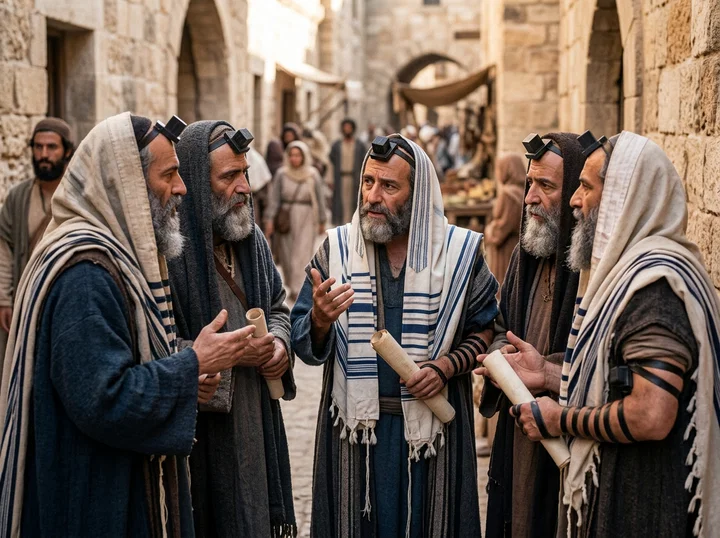
Christ spoke these words in the temple for the last time, on His final day of teaching there, when He exposed the character of the rulers and elders.Ms 71, 1897, par. 1–33SP 57.1Ms 81, 1893, par. 43 They belong to His woes and scathing denunciation of the scribes and Pharisees, spoken against the stern, bearded religious leaders in ornate robes and head coverings for their impenitence and opposition to truth and righteousness.DA 610Ms 175, 1897, par. 81
They were addressed to the scribes and Pharisees and to His disciples, with the multitude listening.Ms 71, 1897, par. 1–3ST Mar 1, 1883 In this way they both warned and condemned the rulers while instructing those who heard.ST Mar 1, 18833SP 57.1
They belong to a chapter describing blind religious guides who are spiritually blinded and cannot discern the relative importance of what they need to understand.7MR 234.4–235.1Lt 165, 1901, par. 11–14
Authority to Be Obeyed
To sit in Moses' seat is to claim the authority of Moses as exalted interpreters, teachers and judges of the law given by God, with authority to expound it.ST May 2, 1878DA 610.1–611.2Ms 71, 1897, par. 1–33SP 58.1 Jewish teachers stood to read the Scriptures and sat to expound them, so to sit in that seat is to teach the law from the Scriptures, from the written Word.Ms 71, 1897, par. 1–3 What is bidden from that seat is to be observed and done when it accords with the law, when it rightly conveys from Scripture what should be observed, and when it is good.ST May 2, 1878DA 610.1–611.2Ms 115, 1894, par. 1Ms 71, 1897, par. 1–3Ms 84, 1894, par. 10–13
That command does not endorse added traditions and human commandments, for those burdened people and distracted them from true religion.ST Mar 21, 1878ST Apr 28, 1898 By the time Christ spoke, priests were teaching human commandments as doctrine, with added traditions and ceremonies, and the people had become ignorant of God's Word.ST Mar 21, 1878ST Apr 28, 1898 Their authority as interpreters of the law did not make their example worthy of imitation, because they failed to practice the duties they imposed on others and taught duties they themselves neglected.ST May 2, 1878DA 610.1–611.2ST Mar 21, 18783SP 58.1ST Apr 28, 1898
What they taught from Moses' seat is to be observed and done, but their actions are not to be imitated because they do not practice what they say.Ms 115, 1894, par. 1Ms 71, 1897, par. 1–3Ms 84, 1894, par. 10–13 Their outward religious observance and strict forms lacked spiritual life, love and devotion, exposing the gap between religious words and actions.Ms 84, 1894, par. 10–13 Their lawful precepts are not made false by their hypocrisy, though they used lawful authority for unlawful ends and could repeat God's law without understanding it themselves.GC 102.13RED 59.1
Saying Without Doing Exposed
The command not to act after their works forbids copying the example of the scribes and Pharisees, for what they taught from Moses' seat was to be observed and done while their conduct was not to be imitated.Ms 115, 1894, par. 1Ms 71, 1897, par. 1–3Ms 71, 1909, par. 25 They are not to be followed in their wrong conduct nor are hearers to be misled by their ambitious pretensions, but only in what is good and right in their instruction.2SP 73.2ST Nov 1, 1877Lt 8, 1889, par. 14–15 The reason is that they say and do not, failing to practice what they say and refusing to bring their own works into agreement with the written Word and with the teaching they enjoined on others.Ms 115, 1894, par. 1Ms 71, 1897, par. 1–3Lt 8, 1889, par. 14–15 The same distinction allows meeting legal requirements for diplomas and examinations without adopting every subject or teaching method in the way of other schools, teaching required subjects from a standpoint consistent with biblical convictions such as warning about drugs and teaching geology in opposition to evolution.Ms 71, 1909, par. 25
Their words and actions contradicted each other, for they spoke but did not practice and taught duties they themselves neglected.Ms 84, 1894, par. 10–133SP 58.1ST Mar 1, 1883 They urged obedience while their own lives contradicted what they taught, claiming piety and seeking honor yet failing to live by what they taught.ST Nov 1, 1877RH Mar 4, 1873 They taught the law without bringing their own lives into line with the written Word, imposing requirements on others but not practicing what they taught.ST Jun 14, 1899 Their outward displays of devotion did not make them obedient to God's law nor give them humility, mercy, and love, purity of character, and a life pleasing to God, which true faith requires.ST Mar 1, 1883RH Mar 4, 1873
They made God's requirements exacting for others while using clever arguments to evade obedience themselves, professing obedience yet refusing the work appointed to them and defying His commands.COL 278.4 They burdened others with demands they would not help carry, imposing requirements without practicing them.ST Mar 1, 1883ST Jun 14, 1899 Their hypocrisy was joined to a rigid, self-important manner that resisted Christ's instruction, whereas Christ met people with generous, helpful care that those entrusted with truth should follow rather than imposing their own ways.Lt 2a, 1878, par. 11–12
Their outward religious observance, strict forms, ceremonies, and public show of devotion and piety did not make them obedient or doers of the truth they professed to teach.Ms 84, 1894, par. 10–13COL 278.1 That outward show lacked spiritual life, love, and devotion, and stood against their profession through desire for public honor and admiration and ambitious pretensions.Ms 84, 1894, par. 10–132SP 73.32SP 73.2 They pursued public admiration rather than purity of character and a life pleasing to God, and their claimed piety joined to seeking honor left them without humility, mercy, and love.ST Mar 1, 1883RH Mar 4, 1873
Their profession of holiness, obedience, righteousness, godliness, and sanctification was false and self-righteous, for they taught what was right but did not practice it.ST Jun 8, 1915Ms 127, 1899, par. 47RH Feb 27, 1900 They claimed godliness while openly transgressing God's law and failing what God commands, standing apart from their fellow men in self-righteous hypocrisy.Ms 127, 1899, par. 47RH Feb 27, 1900 Such failure showed lack of true love for God and others and refusal in action of the call to work with God in blessing the world and to accept His call to serve.ST Jun 8, 1915COL 278.4 Outward holiness and religious claims do not make a person faithful when conduct fails to match words, but call for deeds showing genuine love for God and service to others.RH Jun 23, 1910 A profession of sanctification is empty when conduct does not obey God's requirements but acts with pride, selfishness, or unkindness, contradicting the profession, misleading others by example, and showing that Christ has not been put on in humility and gracious character that makes others better and leads them to glorify God.ST Nov 13, 1879
Warning for Future Generations
The denunciation was not meant only for those then present but was recorded for future generations as an admonition to endure through every age and reach every people.4SP 414.33SP 57.1 It belonged to the final day of teaching in the temple, when the character of the rulers and elders was exposed, at once warning and condemning the rulers and instructing those who listened.3SP 57.1 That enduring warning guards in every age against human authorities ruling the conscience and assuming authority over conscience, a practice that has harmed the church.4SP 414.3RH Jun 7, 1906GC88 595.3–596.1 Scripture, rather than the priesthood, must rule the conscience as the infallible guide, even when lawful precepts are taught by those who use lawful authority for unlawful ends.GC 102.1 Lawful teaching is not made false by hypocrisy, but such conduct must not be copied.GC 102.1
The same warning forbids following blind religious leaders in their conduct when their actions contradict their teaching.4SP 414.3RH Jun 7, 1906GC88 595.3–596.1 It applies to those who teach what is right yet fail to practice it, and to those who claim authority over others while acting from pride and a desire to rule rather than the spirit of Christ.RH Jun 7, 1906GC88 595.3–596.1Lt 81, 1896, par. 6–8 Such conduct does not express God's authority nor make leadership a wholesome influence.Lt 81, 1896, par. 6–8 The scathing rebukes and woes spoken against the Pharisees were for their impenitence and their opposition to truth and righteousness, and were Christ upon the earth today priests and rulers guilty of the same would hear the same scathing rebukes and woes pronounced upon them.Ms 175, 1897, par. 81
Practicing What Is Preached
Knowing and teaching Bible truth is not enough, for truth must be practiced and lived by those who teach the Word. TEPD 30.1STMW7 37.1–218MR 45.4–46.2Lt 8, 1889, par. 14–15Ms 2, 1888, par. 7–10 Hearing what is right must be joined with doing it, and teachers must not put their own words in place of God's words as the scribes and Pharisees did. STMW7 37.1–2Lt 8, 1889, par. 14–15Ms 2, 1888, par. 7–10 Words that contradict one's actions lose their effect, and speaking without practicing what one teaches is empty and ineffective, while a life consistent with teaching commands respect. STMW7 37.1–218MR 45.4–46.2Lt 8, 1889, par. 14–15 When conduct contradicts words, that conduct is not to be followed, for inconsistency weakens influence and makes teaching ineffective. 18MR 45.4–46.2Lt 8, 1889, par. 14–15
Parents must teach obedience, frugality, self-denial and economy by daily example as well as by instruction, and Christians must practice what they preach. TEPD 30.1 Workers and teachers must make their actions agree with their words for the same reason. STMW7 37.1–218MR 45.4–46.2
The same distinction between lawful instruction and unworthy conduct applies to medical education, where legal requirements for a diploma and state certification and examinations may be met without adopting every method or teaching of worldly schools. Ms 72, 1909, par. 25Ms 71, 1909, par. 25 Required subjects can be taught from a different standpoint consistent with biblical convictions, such as explaining the dangers of drugs and teaching geology while rejecting evolution. Ms 72, 1909, par. 25Ms 71, 1909, par. 25
Professing to honor God's law while bearing no fruit is vain pretense hateful to Christ, like a leafy fig tree with no figs. DA 584.1ST Jul 21, 1909 Those who observe forms of worship without repentance and faith live for self and do not minister to others, saying what is right without doing it in merciful, unselfish service. DA 584.1ST Jul 21, 1909 A professed servant of God who bears no fruit to His glory is more guilty than an open sinner. DA 584.1ST Jul 21, 1909
Saying without doing makes the gospel void in practice when professed believers withhold themselves, enclose themselves within themselves, and speak warm words without clothing the poor, feeding and warming them, teaching them, or giving personal labor. Ms 6, 1897, par. 14–16 Such religion is indolent, slothful and frozen, only moral expressions without life and vitality, destitute of hope and faith and love, because the Word is not done and unselfish service is contemplated afar off instead of being brought into life from the very beginning of religious service. Ms 6, 1897, par. 14–16 Failure of this kind also appears in careless speech, in not keeping truth, and in watching for failings in others to build up and exalt self with an envious spirit, while God reads the intents and purposes of the heart. Ms 18, 1868, par. 7 Those guilty must take a humble place, be willing to be instructed and learn, seek with all the soul the inward adorning of a meek and quiet spirit, take heed to their ways, be converted, and make an entire change in life. Ms 18, 1868, par. 7
Those entrusted with truth should follow Christ's example of generous, helpful care rather than the Pharisees' example of imposing their own ways in a rigid, self-important manner that taught duties they did not practice and resisted His instruction. Lt 2a, 1878, par. 11–12 Though sitting in Moses' seat as authoritative leaders, they left God's flock unfed and merited censure, and the warning against following leaders' actions when conduct conflicts with teaching applies to church guidance today. 21MR 1.8 Teachers are to practice the Word they teach and instruct others with meekness and humility, rather than using influence against Christ. 21MR 1.8Lt 2a, 1878, par. 11–12
Sources
Pioneers and periodicals
71 sources
Spoken to the multitude and the disciples, the verse bids them observe and do whatever is taught from Moses' seat when it accords with the law and Scripture, but not to follow the works of the teachers, for they say and do not.ST May 2, 1878ST Mar 21, 1878ST Nov 1, 1899ST Nov 17, 1914 The scribes and Pharisees claimed the lawful place of expounding the law as teachers and judges, yet sought honor and display while burdening others with heavy demands and human traditions that made the word of God of none effect.ST May 2, 1878ST Mar 21, 1878RH Sep 20, 1853ST Jan 9, 1893RH Apr 29, 1873 In so directing the people before His death, Christ affirmed that the law taught from Moses' seat, including the Ten Commandments and the seventh-day Sabbath, remained in force and was to be observed rather than set aside.RH Jan 14, 1862RH Jun 10, 1862RH May 19, 1851RH Sep 2, 1873 He differed from those teachers because His life embodied what He taught, teaching with the authority that comes from living the truth while magnifying the law in its purity as reaching thoughts and intents of the heart.RH Jul 20, 1905ST Jan 9, 1893ST Mar 31, 1914RH Feb 24, 1859 Saying without doing is therefore false profession that displeases God and hinders His cause, for righteousness is right doing and faith is real only when lived in heart, character and daily deeds.ST Feb 3, 1909RH Oct 3, 1871RH Jul 13, 1916RH Mar 19, 1857ST Sep 15, 1887
Setting and Occasion
Jesus spoke these words to the multitude together with his disciples in the temple on Tuesday, his last day of teaching there before he left the temple forever.RH Jul 3, 1856RH Jan 29, 1914ST Mar 30, 1888 That discourse belonged to his denunciation of the Pharisees for hypocrisy, delivered just before he left the temple for the last time.RH Jan 29, 1914ST Mar 30, 1888 He had reproved the scribes and Pharisees for their sins and declared judgment upon the Jews, their city and their temple before departing.RH Dec 20, 1870 In that setting he directed that whatever those sitting in Moses' seat bade to be observed should be observed and done, because those occupying the lawful place of teaching and judgment carried authority to be obeyed in what they directed according to the law, while their works were not to be followed because they said and did not.RH Jul 3, 1856
The chapter stands as his strongest and most terrible expression of warning and judgment, forming the climax of warnings growing more and more terrible to the close of his ministry.ST Jul 15, 1908ST Feb 10, 1898 It contains fearful words pronounced upon those who rejected all the light and blessing offered to them, with woes pronounced against the hypocritical scribes and Pharisees.ST Jul 15, 1908ST Jan 6, 1887 These were words of woe against the teachers and responsible men of the nation, words that almost broke his heart.ST Sep 3, 1912 Yet he spoke them openly in denunciation of wrongdoing, not shrinking from confrontation and not withholding necessary truth to avoid anger.ST Dec 8, 1887 The warnings were given not to condemn men but so that through them men might seek the kingdom of God and his righteousness, as warnings and admonitions to the generation living at the time of his first advent.ST Oct 19, 1915ST Feb 10, 1898
The teaching looks to two great crises, the end of the Jewish nation and the end of the world.RH Apr 15, 1909 It portrays the leaders' claim that they would not have joined their fathers in killing the prophets.RH May 19, 1851RH Apr 3, 1855 That claim was exposed when their opportunity came and they rejected and killed the Messiah and persecuted his followers.RH May 19, 1851 Their actions in their hour and power of darkness showed the danger of rejecting God's truth and falling under deception, revealing the gap between their words and their actions.RH May 19, 1851RH Apr 3, 1855 The admonition to follow sound instruction but not imitate inconsistent conduct belongs to that exposure of teaching what was not practiced.RH Apr 15, 1909
Obedience and Example Distinguished
Those sitting in Moses' seat were to be obeyed in whatever they bade to be observed and done, because that seat was the lawful place of teaching and judgment.ST May 2, 1878ST Nov 1, 1899RH Jul 3, 1856ST Nov 1, 1899 When they gave instruction from that position according to the law and Scripture, what they taught was to be observed and done.ST May 2, 1878ST Mar 21, 1878ST Nov 1, 1899ST Nov 1, 1899 Their claim to Moses' authority as teachers and judges did not make their personal example worthy of imitation, and their assumed authority over the people and their own conduct were not to be followed.ST May 2, 1878ST Mar 21, 1878RH Jul 3, 1856 They failed to practice the duties they imposed on others, burdening the people with added traditions and ceremonies that distracted from true religion.ST May 2, 1878ST Mar 21, 1878ST Nov 1, 1899 In its true form their teaching agreed with Christ's, with this difference that He lived what He taught.
Their works were not to be followed, for they say and do not.ST May 2, 1878ST Nov 1, 1899ST Nov 17, 1914RH Jul 20, 1905 They taught what was right while failing to practice it themselves, preaching what they did not live.ST Nov 1, 1899ST Nov 17, 1914ST Nov 1, 1899 Therefore their teaching could be followed while their inconsistent personal example was to be rejected.ST May 2, 1878RH Jul 20, 1905ST Nov 1, 1899 Saying right things is not enough, for God values doing, and profession alone has no value apart from action.ST May 2, 1878ST Nov 17, 1914 The difference is that a Pharisee says but does not, while a saint may say little but does, since teaching lacks the authority that comes from living its truth, whereas teaching with authority embodies in life what is taught.ST Nov 17, 1914RH Jul 20, 1905
Sound instruction and good counsel should be followed even when the one giving it fails to live by it.RH Sep 27, 1870ST Mar 6, 1893ST Mar 6, 1893 A doctrine should not be rejected because some of its zealous advocates fail to live by it, but its truth should instead be shown in the lives of those who uphold it. Parents who have indulged harmful habits may still rightly warn their children to abstain from everything that would debase or ruin body and soul, such as intoxicating drink and tobacco, and above all God's precious truth is to be heeded.ST Mar 6, 1893ST Mar 6, 1893 When teachers' words and practice conflict their inconsistent teaching is not a reliable guide, and the Bible is the standard to follow.ST Aug 27, 1885 Teachings and actions should agree with one another and with God's will, for preachers, parents, and teachers must live by the principles they teach because example helps guide others.RH Sep 27, 1870
The contrast is summed in Ye Say and Do Not, pointing to speaking without acting.ST Jun 3, 1908 The same principle can be misappealed to when people claim that whatever religious leaders command should be observed and done in order to justify following human priests rather than the message calling them to obey the Great King.ST Mar 26, 1902
Hypocrisy of Scribes Exposed
The scribes and Pharisees sat in Moses' seat as expounders of the law, claiming his authority as teachers and judges whose instruction from the law was to be observed, yet their conduct was not to be imitated because they failed to practice the duties they imposed on others.ST May 2, 1878ST Mar 21, 1878ST Mar 1, 1883 They spoke but did not practice, their words and actions contradicting each other while they claimed piety and sought honor, titles, chief places and public admiration.ST Mar 1, 1883RH Mar 4, 1873RH Sep 20, 1853 Seeking honor and religious titles in this way is opposed to meekness, for they pursued display rather than purity of character and a life pleasing to God, lacking the humility, mercy and love that true faith requires.ST Mar 1, 1883RH Mar 4, 1873RH Sep 20, 1853 Their outward displays of devotion did not make them obedient to God's law, and their warning example is not to be copied when conduct contradicts teaching and exalts self.RH Mar 4, 1873ST Mar 31, 1914 Popular ministers who strive for mastery and superiority instead of serving in gentleness follow the same pattern, preaching Christ out of contention and envy rather than goodwill and love because they fear losing favor if God-fearing members see and cherish the light of truth, bringing loss of fame, decrease of membership and diminution of pay, a striving for mastery to be deprecated in all but especially in ministers.RH Apr 29, 1873
They burdened others with heavy demands they would not help carry, imposing requirements on others without bringing their own lives into line with the written Word.ST Mar 1, 1883ST Jun 14, 1899ST Mar 31, 1914 Their authority as interpreters of the law did not make their example worthy of imitation, for their added traditions and ceremonies burdened people and distracted them from true religion.ST Mar 21, 1878 They added their own traditions to the commandments given in purity until the word of God was made of none effect, teaching human commandments as doctrine.ST Apr 28, 1898ST Jan 9, 1893 By that time the people had become ignorant of God's Word, with hearts so filled with tradition that minds were blinded to the light of the gospel.ST Apr 28, 1898ST Jan 9, 1893
Their hypocrisy lay in honoring God with lips while hearts were far from Him, appearing holy while living with pride and covetousness and resisting truth when sins were rebuked.RH Jun 2, 1859 Their careful outward obedience did not excuse leaving aside the weightier matters of the law, including judgment, mercy, faith and love of neighbor, for their failure was not urging obedience but not living by what they taught and neglecting important duties.ST Jun 8, 1915ST Mar 31, 1914 Outward religious activity and possession of religious truth do not ensure personal godliness or a vital hold on God, since men may work to make converts, honor the prophets, build places of worship and pray at length while vital Christianity remains weak and individual spiritual decline follows.RH Jul 13, 1916 Their profession of holiness and obedience was false because they taught what was right but did not practice it, showing lack of true love for God and others and refusal in action of the call to work with God in blessing the world.ST Jun 8, 1915 Their punctiliousness about others and outward devotion therefore gave no humility, mercy and love, and did not make them obedient.ST Mar 1, 1883RH Mar 4, 1873
Jesus therefore condemned them as hypocrites because they pretended to teach God's law but failed to keep it, saying and doing not.ST Jan 9, 1893 He called these professed teachers blind leaders of the blind whose followers with them would fall into the ditch, and branded them as fools, vipers, children of hell, full of hypocrisy and iniquity for daring to trifle with the high commands of God.ST Jan 9, 1893 They are to be judged not only for false principles but also for upholding them while failing to live by what they taught.ST Jan 9, 1893ST May 27, 1913
Law and Sabbath Affirmed
Before His death Jesus directed the multitude and His disciples to observe what was taught from Moses' seat, while warning them not to imitate the conduct of those who taught it.RH Jan 14, 1862RH Jun 10, 1862RH May 19, 1851RH Oct 21, 1851 That direction shows that the whole law of Moses, including both the moral and the ceremonial law and therefore the Ten Commandments with the Sabbath commandment, remained in force until the cross and the crucifixion.RH Jan 14, 1862RH Jun 10, 1862RH May 19, 1851RH Oct 21, 1851 It therefore supports that during His ministry Jesus observed the law including the Sabbath rather than abolishing it or breaking the Sabbath.RH Jan 14, 1862RH Oct 21, 1851
Modern doctors of the law rightly confess that Sabbath means the seventh day, that the seventh day is the Sabbath of the Lord appointed at creation for the whole race, that the fourth commandment is universal and perpetual and as binding as the rest of the decalogue, that Christ came not to revoke the law, and that there is no New Testament law for the first day.RH Sep 2, 1873 Yet they transgress the law and teach others to transgress it by keeping Sunday on human institution and tradition of the elders outside the Bible.RH Sep 2, 1873
Applied to such teachers, the verse means their sound teaching about keeping God's commandments as written should be followed even when their practice contradicts it, while their Sunday-keeping example is to be refused and repented of.RH Mar 2, 1876ST Mar 26, 1885RH Sep 2, 1873RH Mar 2, 1876 Human tradition does not replace the commandment, and those who teach that sin is breaking God's law yet break the Sabbath and teach others to do so are examples of saying without doing.RH Mar 2, 1876ST Mar 26, 1885RH Apr 8, 1858 To acknowledge that the Sabbath law requires seventh-day observance yet plead inconvenience and keep Sunday instead is to face both ways and serve personal interests, and those who acknowledge the Ten Commandments as the rule of obedience yet do not observe the Sabbath are saying but not doing, so that consistency belongs to those who obey the law.RH Aug 17, 1869
The Sabbath commanded is the seventh day on which the Creator rested, a different day from the first day associated with Christ's resurrection.RH Mar 2, 1876 The commandment cannot require Jews to keep one day and Christians another, nor can it be satisfied by keeping just any one day after six days of labor.RH Mar 2, 1876
Christ and True Righteousness
Christ differed from the scribes because His life embodied what He taught, while their teaching lacked the authority that comes from living its truth.RH Jul 20, 1905 The people were to obey what was taught from Moses' seat, but not to imitate conduct that did not practice what was taught, for in its true form their teaching and Christ's agreed.RH Jul 20, 1905 He reproved their sins and hypocrisy without committing the same sins Himself, so His own life matched the righteousness He taught.RH Jul 20, 1905RH Feb 24, 1859
While pronouncing condemnation He magnified the law in all its purity, stripping off the traditions and commands of men and leaving God's law as it was given.ST Jan 9, 1893 They pretended to teach God's law but failed to keep it, adding their own traditions until the word of God was made of none effect, with hearts so filled with tradition that minds were blinded to the gospel.ST Jan 9, 1893 He branded such professed teachers as hypocrites, blind leaders of the blind whose followers would fall into the ditch, fools, vipers, children of hell, full of hypocrisy and iniquity for trifling with the high commands of God.ST Jan 9, 1893 In that same condemnation He showed the law to be so exceeding broad and deep that it searches out the very thoughts and intents of the heart, and showed He came to die because it had been broken.ST Jan 9, 1893 The warning is illustrated by leaders who imposed heavy burdens, sought honor and status, neglected love of neighbor, and thereby exalted self and violated the law they expounded, for the law requires love which does no harm to a neighbor, and loving neighbor as oneself sums up the last six commandments.ST Mar 31, 1914
Righteousness is right doing and character is revealed by deeds, so saying without doing is false profession.ST Feb 3, 1909RH Jun 23, 1910 Like the son who said I go, sir, they represented themselves as faithful and obedient in words, but time and testing proved the profession was not real because they had no true love, and this applies to all who claim to obey God's commandments without the love of God in the heart flowing to others.ST Feb 3, 1909RH Jun 23, 1910RH Feb 27, 1900 Those who pledge in the solemn covenant of the church to receive and obey God's word and give themselves to God's service and unite in saving the world, yet content themselves with words, do not cooperate with those doing God's service, remain idlers, and do not surrender the will, in life and character deny the sonship they profess and live a lie that ends in fatal deception.ST Feb 3, 1909 Outward religious activity and possession of religious truth do not ensure personal godliness or a vital hold on God, as seen when men could make converts, honor the prophets, build places of worship, and pray at length while vital Christianity remained weak.RH Jul 13, 1916RH Oct 20, 1904 Faith is real only when it is lived, shaping heart and character rather than remaining belief in the head, for lives reveal what is truly believed even when orthodox ideas are held.RH Jul 13, 1916ST Sep 15, 1887 Professing righteousness while failing to do what God commands is hypocrisy, and ostentatious piety without genuine obedience displeases God and ends in disappointment.RH Jun 23, 1910RH Feb 27, 1900RH Oct 20, 1904
A leafy fruitless fig tree with forms of worship without repentance, faith, or ministry to others is hateful to Christ and more guilty than the open sinner.ST Feb 3, 1909 Scripture can call people hypocrites even when they are not knowingly pretending to be pious, as with the Pharisees presented as sincere in religious profession yet charged with uncleanness.RH Sep 2, 1858
Consistent Christian Living
Saying one thing and doing another displeases God and breaks His commandments, and it remains a serious sin even among those professing godliness.RH Oct 3, 1871RH Mar 19, 1857 Such contradiction between profession and life keeps men ignorant of truth, hinders Christ's cause and discourages others from following Him.RH Oct 3, 1871RH Mar 19, 1857 It condemns a person by his own actions and undermines influence, leading others to doubt both sincerity and the religion professed.ST Oct 8, 1885 God's people are therefore called to separate from sin and live consistently with what they profess, letting conduct demonstrate faith.RH Oct 3, 1871ST Oct 8, 1885
Preachers, parents and teachers must live by the principles they teach, because example guides others and Christian usefulness requires a life matching the teaching given.RH Feb 9, 1860 Words without matching conduct cannot correct, counsel or guide another back to God, but work against teaching and undermine efforts for truth and righteousness.RH Feb 9, 1860RH Sep 24, 1903 Hearing what is good is vain when seeing what is evil, for virtue must be placed before children's eyes as well as sounded in their ears.RH May 6, 1858 A parent giving good instruction with a bad example brings food in one hand and poison in the other, and children by nature distaste the food and have appetite for the poison.RH May 6, 1858 Parents who talk continually about the Bible while living in criticism and failing to show its principles make religion harmful rather than living, causing children to resent even hearing Scripture.RH Jun 2, 1904
Right counsel is still to be obeyed even when the giver fails to live by it, and above all God's precious truth is to be heeded.ST Mar 6, 1893ST Mar 6, 1893 Parents who have indulged harmful habits may rightly warn children to abstain from everything that debases or ruins body and soul, such as intoxicating drink and tobacco, and what they bid that is right is to be observed while their bad works are not followed.ST Mar 6, 1893ST Mar 6, 1893 Boys should heed advice not to use tobacco even when the men advising smoke themselves.ST Jan 22, 1880 Acknowledged dress reform must be put into practice rather than professed while delayed, for believing a teaching true and important is not enough without doing what one accepts as right.RH Sep 1, 1868 Promises must be treated as binding and fulfilled unless sufficient reason prevents, since commandment-keepers must be doers and not merely say and not do.RH May 12, 1863 Leaders must not merely tell others to serve but serve themselves to inspire active work, and rulers who know of God and Christ must obey Him.ST Jul 7, 1914
Those professing to keep God's commandments should live by them and continue until Jesus comes, setting a right example in which life shows the faith expressed in words.RH Aug 5, 1852 Pledging in the solemn covenant of the church to receive and obey God's word, give themselves to God's service and unite in saving the world, they must not content themselves with words, remain idlers, refuse to cooperate with those doing God's service and refuse to surrender the will, for so in life and character they deny the sonship professed and live a lie ending in fatal deception.ST Feb 3, 1909 Righteousness is right doing and character is revealed by deeds, as when John and James by their later lives showed they did not merely claim ability to share Christ's suffering but lived out the commitment.ST Feb 3, 1909RH Oct 13, 1868 By contrast Catholic priests are described as saying but not doing, while believers' obedience to the commandments makes teaching credible.RH Dec 12, 1907 So too the man who condemns members for not practicing what they preach, while his own cold conduct of leaving quickly and scarcely greeting anyone helps create the coldness he complains about, illustrates professing a standard without living it.ST Jun 26, 1893
Those who leave the Bible unread on the shelf, read it hurriedly without meditation and refuse to listen while God talks through His Word put themselves in the position of those who heard Christ and saw His works yet said and did not.ST Sep 6, 1899 Seeing His walk, hearing His gracious words and wondrous works of healing and lifting the fallen and forgiving the sin-sick soul, yet treating the Word with neglect, is treating Father and Son with neglect and choosing refusal instead of obedience, coming under the woes of Matthew 23.ST Sep 6, 1899 Human authority must not rule the conscience and blind leaders must not be followed.RH Jun 7, 1906 Popular ministers who strive for mastery and superiority instead of serving in gentleness preach Christ of contention and envy rather than goodwill and love, fearing that God-fearing members seeing and cherishing truth will cost them favor, fame, membership and pay, and such striving is to be deprecated in all but especially in the Lord's ministers.RH Apr 29, 1873
Sources