Matthew 23:39
For I say unto you, Ye shall not see me henceforth, till ye shall say, Blessed is he that cometh in the name of the Lord.
Translations
For I say to you, You shall not see me from now on, till you shall say, Blessed is he that comes in the name of the Lord.
King James Version, KJV Cambridge Paragraph Bible, Revised Version, American Standard Version
For I say unto you, Ye shall not see me henceforth, till ye shall say, Blessed is he that cometh in the name of the Lord.
For I say to you, Ye shall not see me henceforth, till ye shall say, Blessed is he that cometh in the name of the Lord.
for I say to you, ye may not see me henceforth, till ye may say, Blessed [is] he who is coming in the name of the Lord.'
for I say unto you, Ye shall in no wise see me henceforth until ye say, Blessed [ be] he that comes in the name of [ the] Lord.
For I say unto you—in no wise, may ye see me, henceforth, until ye say, Blessed, is he that cometh, in the name of the Lord!
Berean Standard Bible, Majority Standard Bible
For I tell you that you will not see Me again until you say, ‘ Blessed is He who comes in the name of the Lord.’”
For I tell you, you will not see me from now on, until you say, ‘ Blessed is he who comes in the name of the Lord!’”
For I say to you, You will not see me from this time till you say, A blessing on him who comes in the name of the Lord.
For I say vnto you, ye shall not see mee henceforth till that ye say, Blessed is he that commeth in the Name of the Lord.
Douay-Rheims (Challoner revision)
For I say to you, you shall not see me henceforth till you say: Blessed is he that cometh in the name of the Lord.
Pictures
Cross-references 20 of 24
- Psalms 118:26
Blessed be he that cometh in the name of the LORD: we have blessed you out of the house of the LORD.
It blesses the one who comes in the Lord’s name, the acclamation Jesus says they will later use.
- Matthew 24:30
And then shall appear the sign of the Son of man in heaven: and then shall all the tribes of the earth mourn, and they shall see the Son of man coming in the clouds of heaven with power and great glory.
Christ’s return in glory is when they will see him again.
- Luke 13:35
Behold, your house is left unto you desolate: and verily I say unto you, Ye shall not see me, until the time come when ye shall say, Blessed is he that cometh in the name of the Lord.
Both say Jerusalem will not see Jesus until it welcomes the one coming in the Lord’s name.
- Zechariah 12:10
And I will pour upon the house of David, and upon the inhabitants of Jerusalem, the spirit of grace and of supplications: and they shall look upon me whom they have pierced, and they shall mourn for him, as one mourneth for his only son, and shall be in bitterness for him, as one that is in bitterness for his firstborn.
The rejected Christ is seen and mourned by those who pierced him.
- Matthew 21:9
And the multitudes that went before, and that followed, cried, saying, Hosanna to the Son of David: Blessed is he that cometh in the name of the Lord; Hosanna in the highest.
It repeats the blessing for the one coming in the Lord’s name.
- Revelation 1:7
Behold, he cometh with clouds; and every eye shall see him, and they also which pierced him: and all kindreds of the earth shall wail because of him. Even so, Amen.
The wicked see the glorified Christ they rejected and wail.
- Philippians 2:11
And that every tongue should confess that Jesus Christ is Lord, to the glory of God the Father.
Every tongue will confess that Jesus Christ is Lord.
- Acts 1:11
Which also said, Ye men of Galilee, why stand ye gazing up into heaven? this same Jesus, which is taken up from you into heaven, shall so come in like manner as ye have seen him go into heaven.
The angels promise that the same Jesus who ascended will return.
- Matthew 26:64
Jesus saith unto him, Thou hast said: nevertheless I say unto you, Hereafter shall ye see the Son of man sitting on the right hand of power, and coming in the clouds of heaven.
Christ says the Son of man will be seen coming in the clouds.
- Matthew 16:27
For the Son of man shall come in the glory of his Father with his angels; and then he shall reward every man according to his works.
Both foretell the Son of man’s future coming in glory to reward people.
- Luke 19:41-44
And when he was come near, he beheld the city, and wept over it,
Jerusalem’s rejection of Christ leads to its foretold destruction.
- Mark 11:9
And they that went before, and they that followed, cried, saying, Hosanna; Blessed is he that cometh in the name of the Lord:
It repeats the blessing for the one coming in the Lord’s name.
- John 12:13
Took branches of palm trees, and went forth to meet him, and cried, Hosanna: Blessed is the King of Israel that cometh in the name of the Lord.
Both texts bless the one coming in the name of the Lord.
- Luke 19:38
Saying, Blessed be the King that cometh in the name of the Lord: peace in heaven, and glory in the highest.
It repeats the blessing for the one coming in the Lord’s name.
- Acts 2:36-41
Therefore let all the house of Israel know assuredly, that God hath made that same Jesus, whom ye have crucified, both Lord and Christ.
Peter urges Christ’s rejecters to receive him; many respond and are baptized.
- Revelation 22:20
He which testifieth these things saith, Surely I come quickly. Amen. Even so, come, Lord Jesus.
Jesus repeats that He is coming quickly.
- John 14:1-3
Let not your heart be troubled: ye believe in God, believe also in me.
Jesus promises to come again and receive His followers.
- Matthew 11:20-24
Then began he to upbraid the cities where in most of his mighty works were done, because they repented not:
Jesus warns unrepentant cities and contrasts their judgment with repentance.
- Revelation 22:7
Behold, I come quickly: blessed is he that keepeth the sayings of the prophecy of this book.
Jesus repeats that He is coming quickly.
- 1 Thessalonians 1:10
And to wait for his Son from heaven, whom he raised from the dead, even Jesus, which delivered us from the wrath to come.
The same Jesus raised from the dead is awaited from heaven.
Commentary
Each commentary is drawn from primary sources: the writings of Ellen G. White and Adventist pioneers and periodicals. Each commentary is separate. Its own words are not a quotation; follow the references to read the source passages.
Ellen G. White
38 sources
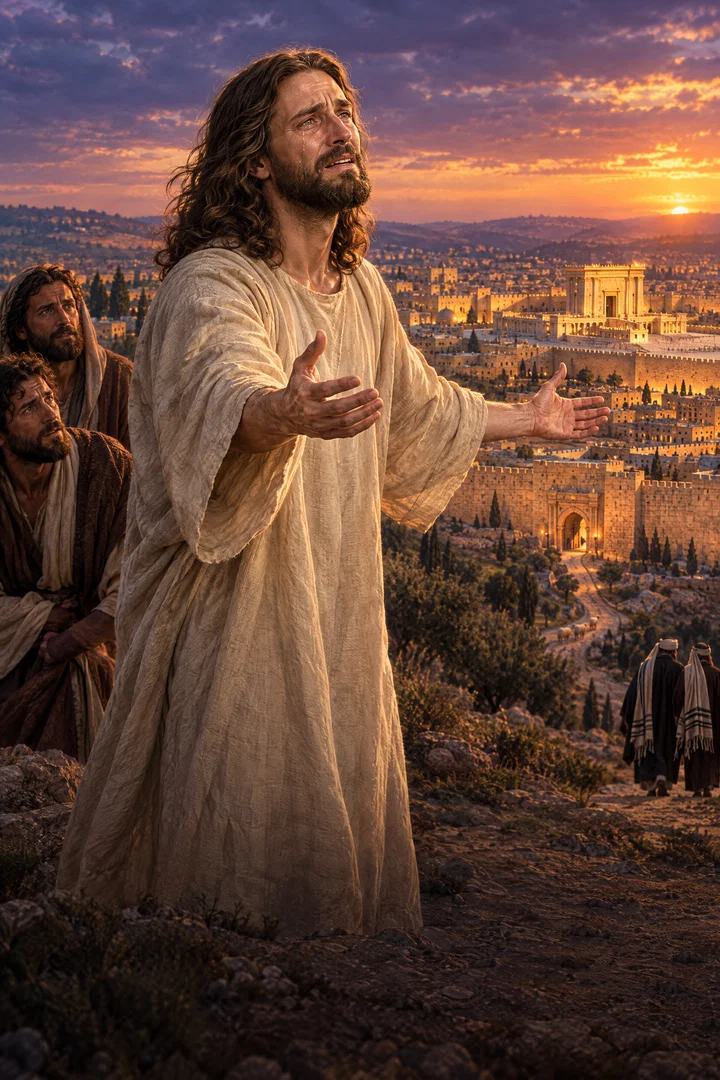
Spoken with tears on His final day of teaching in the temple as His farewell lament over Jerusalem, it declares that their house is left desolate and His presence is withdrawn so that they will see Him no more as a merciful Saviour offering life until they recognize Him as sent by God.DA 610ST May 2, 1878Ms 78, 1897, par. 21–2216MR 276.3Ms 77, 1899, par. 1–3 It is the pouring forth of long-suffering love after years of labor to save a favored people who would not be gathered and sheltered, and it places the guilt for the coming destruction of city and temple upon that generation itself for rejecting the help God sent.Lt 18a, 1906, par. 8–15Ms 13, 1892, par. 26–28Ms 71, 1897, par. 17–19 Its words point beyond the triumphal entry to His return in power and great glory as King, when those who rejected Him will without further proof acknowledge His divinity and every question of who He is is settled.3SP 9.1DA 580.1Ms 78, 1897, par. 27–29Lt 90, 1898, par. 28–293SP 15.2–16.1 That final acknowledgment comes too late for salvation, fulfilled most fully after the thousand years when the wicked are raised to behold His majesty and the marks of crucifixion and pronounce blessing upon Him with unwilling lips from hearts still hostile and unchanged.Ms 78, 1897, par. 27–29EW 250.2–251.1GC 662.1–2SG3 83.2SG1 214.1–215.1 It stands as a warning to every age that when light, mercy and reproof are persistently despised, probation ends and judgment must follow, as it did upon Jerusalem.Lt 18a, 1906, par. 8–15DA 587.1–3Ms 106, 1902, par. 27
Setting and Immediate Sentence
The words close the denunciation of the scribes and Pharisees and the lament over Jerusalem, spoken on the final day of teaching in the temple as the final appeal and the final departure from the temple forever.DA 610Ms 78, 1897, par. 21–223SP 69.2DA 620.43SP 57.1 They bid farewell to the hallowed courts, quitting the temple never to return, and were meant not only for those then listening but for people of every age, language and nation to the close of time.Ms 78, 1897, par. 21–223SP 69.23SP 57.1 It was the most solemn denunciation ever uttered against Jerusalem.Ms 78, 1897, par. 21–22
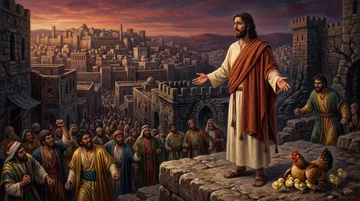
They were spoken with tears of great sorrow as the pouring forth of the very heart of God in His representative, the separation struggle and mysterious farewell of the long-suffering love of Deity, the expression of abused and rejected love after years of labor to convince to repentance and after every resource had been exhausted.Lt 18a, 1906, par. 8–15Ms 13, 1892, par. 26–28Ms 71, 1897, par. 17–19 They came after woes pronounced upon blind priests and unbelieving Pharisees whose leaders rejected the messages sent to them.Lt 18a, 1906, par. 8–15Ms 77, 1899, par. 1–3 Though loving Jerusalem and longing as a hen gathers her chickens to gather, shelter, protect and save its children, Christ grieved because they would not respond, rejecting in the most terribly momentous period of the highly honored and favored nation His yearning love and the help God sent to save them, bringing certain ruin and the wrath their sins deserved.Ms 13, 1892, par. 26–28Ms 71, 1897, par. 17–19Ms 92a, 1898, par. 36–40ST Dec 22, 1887
Their immediate sentence is that their house is left unto them desolate, Christ's presence is withdrawn, and they will not see Him henceforth until they acknowledge Him as coming in the Lord's name.16MR 276.3Ms 77, 1899, par. 1–3Ms 92a, 1898, par. 36–40Ms 37, 1899, par. 5–8 With God's presence withdrawn the temple would no longer be God's house, its services and ceremonies becoming empty, meaningless and a mockery.ST May 2, 18783SP 69.2DA 620.4 Jerusalem's time of probation and mercy ended, and Jesus would no longer be seen among them as a merciful Saviour offering redemption, help and life, though after heavy judgments fall they would long for the Deliverer once among them yet still refuse to see Him as a sin-pardoning Saviour.ST May 2, 1878Ms 78, 1897, par. 27–29Ms 37, 1899, par. 5–8
Joined to the declaration that the house is left desolate, the words place guilt and responsibility for destruction on that generation itself, bringing upon it all righteous blood from Abel to Zacharias.Ms 13, 1892, par. 26–28Ms 71, 1897, par. 17–19 The chosen nation must receive eternal retribution for refusal of Christ, the Jewish nation as a nation then divorced from God and the natural branches of the olive tree cut off.Ms 71, 1897, par. 17–19 The sentence accompanies the prediction spoken on leaving the temple that the city would be besieged, laid even with the ground with its children destroyed within it, and the temple completely destroyed with not one stone left upon another by the Roman legions because it knew not the time of its visitation, a prediction the disciples could hardly believe as they looked on the massive stones.Lt 18a, 1906, par. 8–15Ms 13, 1892, par. 26–28ST Dec 19, 1900
It exposes the guilt that brings this sentence: hypocrisy that worshiped the temple while working with Satan-inspired hatred to destroy in every way the One who made it sacred, murdering the prophets and rejecting and slaying the Son of God so that threatenings of divine wrath hang over Jerusalem.Ms 78, 1897, par. 21–22SLP 206.2–207.1 It rebukes spiritual blindness to the relative importance of truth, neglecting the weightier matters of the law of judgment, mercy and faith while attending closely to minor requirements, which must not be neglected.7MR 234.4–235.1Lt 165, 1901, par. 11–14 It foretells retribution for obstinate, persistent unbelief despite powerful evidence that He is the Son of God, which will bring terrible retribution.7RED 11.2–33SP 274.2–3
The lament distressed the disciples but they did not understand its full meaning.Ms 78, 1897, par. 54–57 They wrongly connected the coming judgment on Jerusalem with the second coming and expected Him to establish a temporal kingdom in Jerusalem and free them from Roman rule.Ms 78, 1897, par. 54–57
Fulfillment at Christ's Return
The words reach beyond the triumphal ride into Jerusalem, for that entry foreshadowed the return in the clouds with power and great glory, and they will be fulfilled in final triumph amid the triumph of angels and the rejoicing of the saints.3SP 9.1DA 580.1ST Jan 10, 1878 His kingdom was not a temporal rule on earth, for He would soon ascend to the Father, and His accusers and those who rejected Him at His first coming would see Him no more until He returns in glory.3SP 15.2–16.1ST Jan 10, 1878DA 580.2–581.2 Then He comes in power and great glory and divine glory as King of Glory, and without asking for a sign they will with overwhelming power acknowledge Him as sent and coming in the Lord's name.Ms 78, 1897, par. 27–29Lt 90, 1898, par. 28–293SP 15.2–16.1 In that hour they will recognize His divinity and honor Him, so that the question of His divinity is settled and every tongue confesses Him as Lord.Ms 78, 1897, par. 27–29Lt 90, 1898, par. 28–29
That later recognition comes too late for salvation and is not a day of joy to them.DA 580.1Ms 78, 1897, par. 27–293SP 15.2–16.1 After judgment falls they will long for the Deliverer once among them and be ready to bless Him whom they once cursed.Ms 78, 1897, par. 27–29ST Dec 19, 1900ST Dec 19, 1900 The rejected Jews will look upon the One they pierced and mourn bitterly.3SP 9.1ST Jan 10, 1878
The fulfillment comes after the thousand years, when at His return in terrible, fearful majesty and kingly majesty as King of kings and Lord of lords He calls forth the wicked dead in the same feeble, sickly bodies that went into the grave with the marks of the curse visible on all.EW 250.2–251.1SG3 83.2SG1 214.1–215.1 Among them are those who despised and mocked Him, smote Him with the reed, put the crown of thorns on His brow, spit on Him, drove nails through His hands and feet and thrust the spear into His side.SG1 214.1–215.1 Beholding Him in exceeding glory, looking on the marks of His crucifixion and knowing He is the very One they crucified and derided in His expiring agony, they are overwhelmed and pained by His majesty.EW 250.2–251.1SG1 214.1–215.1 They flee to hide in the rocks and shield themselves from His terrible glory, and with one accord in one long protracted wail of agony with terrible distinctness pronounce blessing on Him who comes in the name of the Lord.EW 250.2–251.1GC 662.1–2SG1 214.1–215.1
Their cry expresses recognition but not a change of heart, for it is forced from unwilling lips by the power of truth and is not inspired by love.EW 250.2–251.1GC 662.1–24SP 476.2 They rise with the same enmity and rebellious spirit they had in life and remain hostile and rebellious.GC 662.1–24SP 476.2 Their words bring no new probation, since a further opportunity would not soften their hearts or change their persistent resistance to God.GC 662.1–24SP 476.2
Warning and Present Application
The closing words belong to the end of the rebuke of those who kill and persecute the prophets, wise men and scribes sent to them, bringing upon that generation the guilt of all righteous blood from Abel to Zacharias.Ms 13, 1892, par. 26–28 He loved Jerusalem and would often have gathered its children as a hen gathers her chickens, but they would not, so He declared their house left desolate and withdrew Himself from their sight until they should acknowledge Him as coming in the name of the Lord.Ms 13, 1892, par. 26–28 This shows that He identifies Himself personally with His people, feels their wrongs as done to Himself, registers in heaven the contempt and suffering inflicted on them as done to Him, and will judge every action in the great day on that ground.Ms 13, 1892, par. 26–28 He wept over the city because it knew not the time of its visitation, and foretold its siege, its being laid even with the ground with its children destroyed within it, with not one stone of the temple left upon another.Ms 13, 1892, par. 26–28
His recorded denunciations of the scribes and Pharisees and His warnings against following blind leaders stand as an admonition to future generations concerning the harmful rule of human authority over conscience.GC88 595.3–596.1 Jerusalem had rejected God's warnings and the means of help provided for it, and its time of mercy had ended.DA 587.1–3 Though Jesus wept over the doomed city, He could not deliver it after it rejected the warnings of the Spirit, and its judgment warns people in every age that rejecting the Spirit's reproofs brings condemnation.DA 587.1–3
He spoke with tears of great sorrow after years of labor to convince to repentance and after pronouncing woes upon blind priests and unbelieving Pharisees, declaring the house desolate and His presence withdrawn until He should be acknowledged as coming in the name of the Lord.Lt 18a, 1906, par. 8–15 He then left the temple and foretold its complete destruction with not one stone left upon another, a prediction the disciples could hardly believe as they looked upon the massive stones.Lt 18a, 1906, par. 8–15Ms 13, 1892, par. 26–28 God deals in the same way with impenitent cities, sending messengers with reproof and warning, and when the messengers are despised and abused and patience and forbearance fail to turn hearts to Him, sending judgments as upon Jerusalem and upon San Francisco, which no human power can stand against.Lt 18a, 1906, par. 8–15 The lament reaches beyond Jerusalem to those today who have had great light and have seen wonderful manifestations of His power and goodness and mercy but have not fulfilled God's purpose for them.Ms 106, 1902, par. 27 Those who hear God's voice and cooperate with Him, using their capabilities in His service and walking in all humility of mind before Him, will receive His blessing, but those who forget His instruction and follow their own way are a dishonor to Him, and a time will come when their wrong course with its results and consequences must be met.Ms 106, 1902, par. 27
Sources
Pioneers and periodicals
50 sources
Jesus will be seen no more by those who rejected him until they acknowledge and welcome him as the one who comes in the Lord's name.ST Nov 1, 1899ST Mar 3, 1914ST Nov 7, 1916 It was his final lament over Jerusalem, spoken with parental tenderness and weeping after his repeated efforts to gather and save its people were refused.ST Dec 22, 1887ST Nov 1, 1899ST Mar 23, 1888 With these last words on leaving the temple never to return, he declared their house left desolate, no longer God's house, because his presence was withdrawn and its services had become empty ceremonies.ST May 2, 1878RH Jan 8, 1901ST Mar 23, 1888 The words will be fulfilled at his glorious return in triumph in the clouds, which his entry into Jerusalem foreshadowed, when those who pierced and rejected him look upon him and mourn.ST Jan 10, 1878 After judgment falls their recognition will come too late for salvation, and after the thousand years the whole wicked host will speak the acclamation as they see his power and majesty and admit their doom is just.ST Dec 19, 1900ST Dec 19, 1900ST Jan 19, 1882ST Mar 14, 1911
Context in Ministry
The saying stands as part of Jesus' final, forceful denunciation of the scribes and Pharisees for hypocrisy, pride, self-righteousness, covetousness, cruelty, oppression, avarice, caste spirit and hatred of reproof, exposing outward religious show that concealed inward evil and iniquity beneath it.ST Mar 23, 1888RH Jun 2, 1859ST Mar 23, 1888 It was his last warning after they persistently refused to recognize and repent of their wrongs, and after it he left the temple for the last time never to return.ST Mar 23, 1888ST Mar 23, 1888ST Mar 30, 1888 Their outward honor of God concealed hearts far from him, and they reacted against his rebuke.RH Jun 2, 1859
It closes his lament over Jerusalem, uttered with a parent's tenderness and weeping grief even while its people plotted against him and rejected the help sent to save them.ST Dec 22, 1887ST Mar 23, 1888ST Oct 18, 1899 He had made repeated efforts to gather and save its people and longed to shelter them, but they refused, and therefore their house was left desolate and they would not see him again until they acknowledged and welcomed the one who comes in the Lord's name.ST Nov 1, 1899ST Mar 23, 1888ST Oct 18, 1899 It is part of his pathetic lamentation over Jerusalem and over the Jews whose rejection brought certain ruin and the wrath their sins deserved.ST Dec 22, 1887ST Sep 2, 1875RH Aug 26, 1875
It belongs to his final message and final day of teaching in the temple, falling within that last temple address from which he departed from the precincts forever.RH Jan 29, 1914ST Nov 1, 1899ST Mar 30, 1888 There his woes stand in contrast to the blessings he had spoken on a mountain in Galilee, condemning not merely outward sinful acts but hidden corruption and hypocrisy, especially when those who pose as God's servants use their influence to lead others astray.ST Nov 1, 1899 They were directed against the teachers and responsible men of the nation, which deeply grieved him.ST Sep 3, 1912
It was spoken as his earthly ministry was drawing to a close and the cross was near, within prophetic instruction that warned of the doom of the Jews, their city and temple and of Jerusalem's destruction, and that prepared the disciples for what lay ahead.RH Apr 15, 1909ST Jan 6, 1887RH Dec 20, 1870 It belongs to his reproof of the scribes and Pharisees for their sins and his declaration of that doom.ST Jan 14, 1875RH Dec 20, 1870 The disciples did not understand the saying because they supposed the temple would stand forever and expected Christ to reign on David's throne in Jerusalem, so they called his attention to the temple's magnificence and strength and asked about its destruction and his coming.ST Jan 14, 1875RH Jan 8, 1901 His warnings here are the strongest and most terrible expression of judgment, growing more and more terrible to the close of his ministry, coming close upon the proclamation of the kingdom and the call to repentance, given not to condemn men but so that through it men may seek the kingdom of God and his righteousness.ST Feb 10, 1898
The lament turns from the Pharisees' warning that Herod wanted to kill him, after his declaration that he would keep casting out devils and healing and then be perfected and that he must go on his way because a prophet cannot perish outside Jerusalem, to grief over Jerusalem as the city that kills the prophets and stones those sent to her. He had often wanted to gather her as a hen gathers her brood under her wings, but they would not, and because of that refusal their house is left desolate and they will not see him again until they welcome him as coming in the name of the Lord.
Meaning of Saying
The saying means they would not see him again until they acknowledged and welcomed the one who comes in the Lord's name.ST Nov 1, 1899ST Mar 3, 1914ST Nov 7, 1916 It closes the lament over Jerusalem after repeated efforts to gather its people were refused and its house was left desolate.ST Nov 1, 1899ST Mar 3, 1914 It was spoken to the unbelieving Pharisees and scribes as testimony that he will come again.ST Nov 7, 1916
The words refer to seeing Christ himself.RH Jul 4, 1854 In connection with the promise that the Son of man will be seen coming in the clouds, they teach that Christ himself will return visibly and personally, not merely through a spiritual influence.RH Jul 4, 1854
After his death those who rejected him would no longer see him among them until he appeared again in glory.ST Dec 19, 1900ST Jan 10, 1878ST Jan 19, 1882 Then they would acknowledge him as Messiah and hail him with the words the crowds had used when he entered Jerusalem.ST Jan 19, 1882 After judgment fell they would long for the Deliverer they had refused and be ready to bless him, but their recognition would come too late for salvation.ST Dec 19, 1900ST Dec 19, 1900ST Jan 10, 1878ST Jan 19, 1882 His kingdom was not a temporal rule on earth, for he would ascend to his Father and come again in glory.ST Jan 10, 1878 Their eventual words would be an acknowledgment of his authority, not acceptance of his salvation, since they would still wish for the rocks and mountains to fall on them.ST May 8, 1907
The verse predicts his future glorious triumph as distant and in seemingly long-deferred, indeterminate time.ST Mar 3, 1909 He had offered to save Jerusalem with a glory greater than anything earth had ever witnessed, but because it would not receive him he withdrew from them.ST Mar 3, 1909 The promise held before the disappointed disciples the certainty of his return while preparing them for the sad disappointment of his rejection.ST Mar 3, 1909 That certainty was confirmed to them by the vision of his glory on the mount with Moses as type of the resurrected immortalized and Elijah as type of the translated immortalized.ST Mar 3, 1909
The verse is also taught to mean a coming of the Lord in providence to overthrow the Jewish nation and temple as a special act showing divine displeasure, by which the Jewish dispensation and age is ended.RH Sep 3, 1872 The disciples inferred from it that such a coming was joined to the destruction just foretold.RH Sep 3, 1872
Rejection and Desolation
These were his final words as he left the temple never to return, declaring that Jerusalem's house was left desolate.ST May 2, 1878RH Jan 8, 1901ST Mar 23, 1888 It would no longer be God's house, for God's presence was withdrawn from it and its services became empty ceremonies.ST May 2, 1878 Its people would not see him again until they acknowledged and welcomed the one who comes in the Lord's name.RH Jan 8, 1901ST Mar 23, 1888 His judgment followed repeated efforts to gather and save them, whom he still loved with a parent's tenderness.ST Mar 23, 1888
His departure from the temple precincts fittingly signaled the loss of its sacred role.RH Apr 15, 1909 The temple was left desolate because the people had rejected the one to whom its sacrifices and services pointed.RH Apr 15, 1909 That withdrawal marked the approaching end of the Jewish nation and the calamities soon to come upon it.RH Apr 15, 1909
They are fearful words pronounced upon those who had rejected all the light and blessing given them.ST May 2, 1878ST Jul 15, 1908 Jerusalem's time of probation had ended in a moral rejection by God.ST May 2, 1878RH Mar 6, 1855 Yet its destruction was deferred for a considerable time.RH Mar 6, 1855 This shows God's long-suffering mercy toward nations and peoples, that he does not overthrow them until their iniquity is full and there is no more hope of good from them.ST Feb 10, 1898
The lament offered to save Jerusalem with a glory greater than anything earth had ever witnessed, but she would not receive him.ST Mar 3, 1909 It pleaded with her people to come to him and be saved, while lamenting that they were unwilling.ST Sep 3, 1902 The appeal is an expression of divine love and mercy, showing that God has done all that wisdom and power can do to call sinners to turn to him.ST Sep 3, 1902 Their rejection of the help sent to save them brought certain ruin and the wrath their sins deserved, while he grieved over their fate and longed to shelter and save them.ST Dec 22, 1887
The saying accompanies the prediction of the doom of the Jews, their city and their temple and of the city's destruction.ST Dec 19, 1900ST Jan 14, 1875RH Dec 20, 1870 Because they rejected Christ as their merciful Savior, they would no longer see him among them.ST Dec 19, 1900 After judgment fell they would long for the Deliverer they had refused and be ready to bless him, but too late.ST Dec 19, 1900 That judgment was fulfilled when destruction came by the Roman legions.ST Dec 19, 1900
Persistently rejecting heaven's invitation to repent, as Jerusalem did, is willfully refusing God's will.ST Jul 8, 1930 It can harden the heart until it is no longer receptive to divine influence.ST Jul 8, 1930 In this way the way back to God is closed.ST Jul 8, 1930
Prophecy and Fulfillment
The acclamation will be fulfilled at his glorious return in triumph, when he comes in the clouds with power and glory amid the triumph of angels and the rejoicing of the saints.ST Jan 10, 1878 The triumphal ride into Jerusalem foreshadowed that return.ST Jan 10, 1878 At that time those who pierced and rejected him at his first coming will look upon him and mourn.ST Jan 10, 1878
In the great day of judgment unbelieving Jews who realize they killed the Prince of life will acknowledge him as the one who comes in the name of the Lord.RH Nov 17, 1868 Their confession expresses God's triumph, as the wicked are condemned out of their own mouths.RH Nov 17, 1868 His accusers will see him no more until he returns in glory, for his kingdom was not a temporal rule on earth.ST Jan 10, 1878 He was to ascend to his Father and come again in glory, and then they would acknowledge him, but their recognition would come too late for salvation.ST Jan 10, 1878
The verse is fulfilled after the thousand years when the wicked are raised to life.ST Mar 14, 1911 After Satan stirs the resurrected wicked to besiege and capture the holy city, Jesus and the redeemed appear in dazzling glory above the city.ST Mar 14, 1911 With one voice the whole wicked host then speaks the acclamation to him.ST Mar 14, 1911 As they behold the power and majesty of Christ and see the saints in glory and themselves cast out, they feel what they have lost and admit their doom is just.ST Mar 14, 1911 Then Satan is fully unmasked and confesses the justice of his sentence.ST Mar 14, 1911
The saying points to a future time, after the appointed period of the Gentiles has ended, when the redeemed gathered from every direction will be at Jerusalem and welcome Christ as the one who comes in the name of the Lord.RH May 30, 1854 They will share in the kingdom with Abraham, Isaac, and Jacob, while unbelieving Jews are excluded and face weeping and anguish.RH May 30, 1854 The Jews will not return to Jerusalem as unbelievers.RH Dec 15, 1868 Their return will come only as Christians acknowledging Jesus, since their rejection of the Saviour and dispersion followed disobedience to God's moral will.RH Dec 15, 1868
Doctrine and Application
The chapter to which the saying belongs exposes the difference between professed belief and the faith shown in life, revealing what was really believed through conduct.RH Jul 13, 1916ST Sep 15, 1887 Extensive religious activity could be pursued, the outward form of God's truth preserved, and yet vital personal godliness be lacking.RH Jul 13, 1916ST Sep 15, 1887 Missionary work, honor for the prophets, and worship practices did not prevent individual spiritual decline.RH Jul 13, 1916 The hypocrites denounced there could be sincere in the religion they professed, for scriptural hypocrisy includes false profession and self-deception and not only knowingly pretending to be what one is not.RH Jul 13, 1916RH Sep 2, 1858
The condemnation falls because human traditions were added to God's pure commandments until the word of God was made of none effect and minds were blinded to the light of the gospel.ST Jan 9, 1893 Those addressed are therefore called blind leaders of the blind whose followers will fall into the ditch with them, hypocrites for pretending to teach God's law while failing to keep it, fools, vipers, and children of hell, full of hypocrisy and iniquity for daring to trifle with the high commands of God.ST Jan 9, 1893 While branding them with that fearful condemnation, the law is magnified in all its purity as so exceeding broad and deep that it searches out the very thoughts and intents of the heart.ST Jan 9, 1893 That magnifying shows the reason for dying because the law had been broken, and by the pure gospel the traditions and commands of men are thus stripped off, leaving God's law as it was given.ST Jan 9, 1893
There is no continuing claim to special religious favor through descent from Abraham, since standing with God depends on faith in Christ and not on Jewish ancestry.RH Sep 9, 1858 The leaders claimed they would not have shared their ancestors' guilt in killing the prophets.RH May 19, 1851RH Apr 3, 1855 After rejecting the Messiah they took part in his death and in violence and persecution against him and his followers when the power of darkness came upon them, and that participation exposed the claim as false.RH May 19, 1851RH Apr 3, 1855
The woes fell on men who saw him walking about, heard of his wondrous works, listened to his gracious words, and knew of his miracles in healing the sick, lifting the fallen, and freeing the sin-sick soul from sin, yet rejected him.ST Sep 6, 1899 People today who neglect the Word of God place themselves in the same position, treating the Father and the Son as those men treated Christ, and come under the same woes.ST Sep 6, 1899 The sorrowful words over Jerusalem and its coming destiny therefore remain a present plea to leave worldly attachments and come to him before the time of judgment.ST Sep 6, 1899ST Dec 3, 1912
Sources