Luke 13:35
Behold, your house is left unto you desolate: and verily I say unto you, Ye shall not see me, until the time come when ye shall say, Blessed is he that cometh in the name of the Lord.
Translations
Behold, your house is left to you desolate: and truly I say to you, You shall not see me, until the time come when you shall say, Blessed is he that comes in the name of the Lord.
King James Version, KJV Cambridge Paragraph Bible
Behold, your house is left unto you desolate: and verily I say unto you, Ye shall not see me, until the time come when ye shall say, Blessed is he that cometh in the name of the Lord.
Behold, your house is left to you desolate. And verily I say to you, ye shall not see me, until the time shall come when ye shall say, Blessed is he that cometh in the name of the Lord.
Revised Version, American Standard Version
Behold, your house is left unto you desolate: and I say unto you, Ye shall not see me, until ye shall say, Blessed is he that cometh in the name of the Lord.
'Lo, your house is being left to you desolate, and verily I say to you — ye may not see me, till it may come, when ye may say, Blessed [is] he who is coming in the name of the Lord.'
Behold, your house is left unto you; and I say unto you, that ye shall not see me until it come that ye say, Blessed [ is] he that comes in the name of [ the] Lord.
Lo! your house is left to you. [And] I say unto you—In nowise shall ye see me, until ye say,—Blessed, is he that cometh in the name of the Lord!
Berean Standard Bible, Majority Standard Bible
Look, your house is left to you desolate. And I tell you that you will not see Me again until you say, ‘ Blessed is He who comes in the name of the Lord.’”
Behold, your house is left to you desolate. I tell you, you will not see me until you say, ‘ Blessed is he who comes in the name of the Lord!’”
Now see, your house is waste, and I say to you, You will not see me again till you say, A blessing on him who comes in the name of the Lord.
Beholde, your house is left vnto you desolate: and verely I tell you, ye shall not see me vntill the time come that ye shall say, Blessed is he that commeth in the Name of the Lord.
Douay-Rheims (Challoner revision)
Behold your house shall be left to you desolate. And I say to you, that you shall not see me till the time come, when you shall say: Blessed is he that cometh in the name of the Lord.
Pictures
Cross-references
- Matthew 23:38-39
Behold, your house is left unto you desolate.
Jesus declares Jerusalem’s house desolate and foretells a future welcome.
- Luke 19:41-44
And when he was come near, he beheld the city, and wept over it,
Jesus laments Jerusalem’s failure to recognize its visitation and foretells its destruction.
- Matthew 24:2
And Jesus said unto them, See ye not all these things? verily I say unto you, There shall not be left here one stone upon another, that shall not be thrown down.
Jesus foretells the destruction of the temple left desolate.
- Luke 21:20-24
And when ye shall see Jerusalem compassed with armies, then know that the desolation thereof is nigh.
Both foretell Jerusalem’s desolation and destruction by Roman forces.
- Matthew 23:39
For I say unto you, Ye shall not see me henceforth, till ye shall say, Blessed is he that cometh in the name of the Lord.
Both speak of seeing Jesus again and blessing his coming in the Lord’s name.
- Psalms 118:26
Blessed be he that cometh in the name of the LORD: we have blessed you out of the house of the LORD.
Gives the blessing quoted in Luke 13:35.
- John 1:11
He came unto his own, and his own received him not.
Messiah came to His own and was rejected
- Matthew 21:9
And the multitudes that went before, and that followed, cried, saying, Hosanna to the Son of David: Blessed is he that cometh in the name of the Lord; Hosanna in the highest.
Shares the blessing on the one who comes in the Lord’s name.
- Mark 11:9
And they that went before, and they that followed, cried, saying, Hosanna; Blessed is he that cometh in the name of the Lord:
Shares the blessing on the one who comes in the Lord’s name.
- John 12:13
Took branches of palm trees, and went forth to meet him, and cried, Hosanna: Blessed is the King of Israel that cometh in the name of the Lord.
Shares the blessing on the one who comes in the Lord’s name.
- Luke 19:38
Saying, Blessed be the King that cometh in the name of the Lord: peace in heaven, and glory in the highest.
Shares the blessing on the one who comes in the Lord’s name.
- Matthew 24:30
And then shall appear the sign of the Son of man in heaven: and then shall all the tribes of the earth mourn, and they shall see the Son of man coming in the clouds of heaven with power and great glory.
Describes Jesus’ return in glory.
- John 5:40
And ye will not come to me, that ye might have life.
Refusal to come to Christ for life explains the desolation pronounced on Jerusalem.
- Mark 15:38
And the veil of the temple was rent in twain from the top to the bottom.
The torn veil marks the temple’s abandonment and the end of its typical service.
- John 19:15
But they cried out, Away with him, away with him, crucify him. Pilate saith unto them, Shall I crucify your King? The chief priests answered, We have no king but Cæsar.
The cry rejecting Christ for Caesar brings desolation.
- Daniel 9:26
And after threescore and two weeks shall Messiah be cut off, but not for himself: and the people of the prince that shall come shall destroy the city and the sanctuary; and the end thereof shall be with a flood, and unto the end of the war desolations are determined.
Jesus foretells Jerusalem’s desolation, fulfilling Gabriel’s prediction.
Commentary
Each commentary is drawn from primary sources: the writings of Ellen G. White and Adventist pioneers and periodicals. Each commentary is separate. Its own words are not a quotation; follow the references to read the source passages.
Ellen G. White
14 sources
Weeping on Olivet while looking on Jerusalem and its temple, He lamented the city that kills the prophets and refuses His repeated longing to gather her children as a hen gathers her brood, speaking in anguish not for Himself but for those who felt no remorse.Ms 79a, 1910, par. 15–17Ms 128, 1899, par. 9–1221MR 166.3–5ST Feb 21, 1878 The house left desolate is the temple and the city itself, abandoned because God's presence is withdrawn so its services become empty forms.Ms 128, 1899, par. 9–123SP 69.2ST Feb 21, 1878 The declaration marks the end of probationary time and the last day of mercy, when by dishonoring God and rejecting light and entreaties the city seals its own doom and forges its own fetters, consummated when His own people crucify Him within a few short hours and the proud city is laid in ruins.ST Feb 27, 1896Ms 128, 1899, par. 9–12Lt 317, 1905, par. 12–153SP 69.221MR 166.3–5 His absence will last until a future time when they will welcome and acknowledge the one coming in the Lord's name, though those who held the other view teach they will acknowledge Him at His return in glory but too late for salvation.Ms 79a, 1910, par. 15–17Lt 317a, 1905, par. 14–18Lt 317, 1905, par. 12–153SP 15.2–16.1 Jerusalem here stands as a symbol of the world that rejects His grace, so the same warning now applies to everyone and to every household that refuses His calls and turns to sin, until grace can no longer be accepted.COL 236.2–237.1Lt 317a, 1905, par. 14–18ST Jun 30, 1909ST Feb 23, 1882
Words and Historical Setting
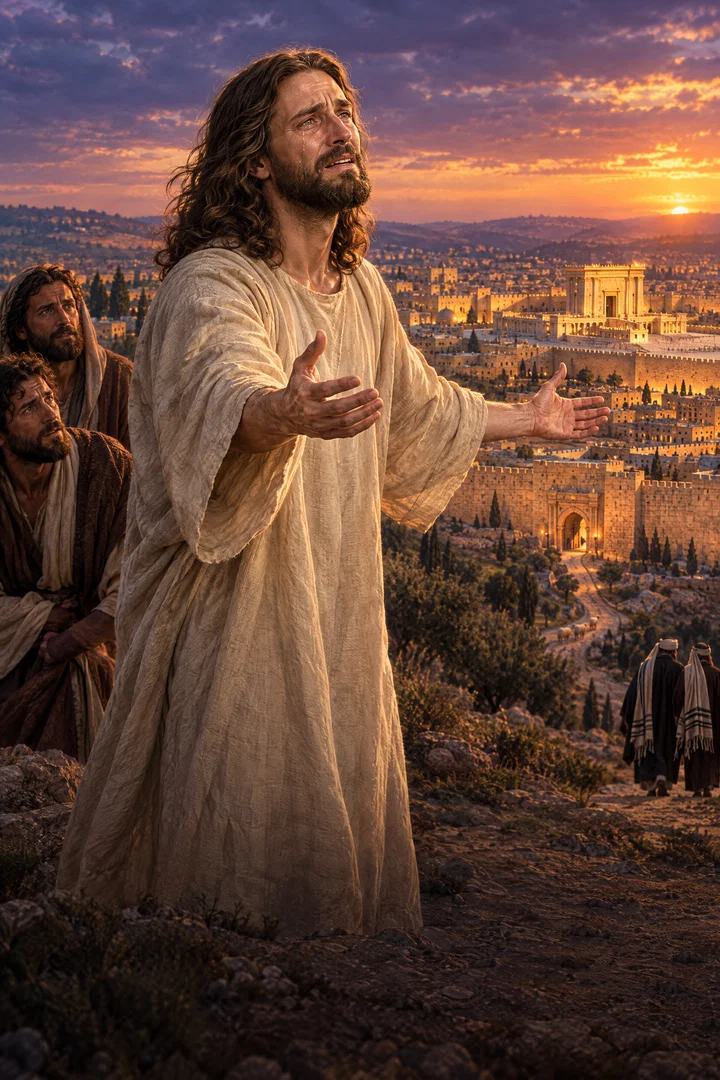
The lament stands immediately after the warning about the shut door and exclusion from the kingdom and after the answer to the Pharisees concerning Herod, that He must go on His appointed course because a prophet cannot perish outside Jerusalem.Ms 79a, 1910, par. 15–17 It was uttered in tears on the crest of Olivet during the triumphal entry, while He looked upon Jerusalem and its temple of white marble gilded by the setting sun.Ms 128, 1899, par. 9–12 At that moment the shouting multitude expected Him to take the throne of David and reign as a temporal prince.Ms 128, 1899, par. 9–12
It mourns Jerusalem which kills the prophets and stones those sent to her, and which refused His repeated desire to gather her children together as a hen gathers her brood under her wings.Ms 79a, 1910, par. 15–17Ms 128, 1899, par. 9–12 Israel had been given every advantage, yet rejected her messengers, and then for three years the divine Messenger Himself knocked at the gates, worked unselfishly, pleaded for admittance, scattered blessings, and with unwearied patience let waves of mercy return again and again against indifference, contempt, and closed rocky hearts.Ms 128, 1899, par. 9–1221MR 166.3–5 The wording marks deliberate refusal rather than inability, for it is ye would not, not ye could not.21MR 166.3–5
It was spoken in anguish and sorrow, not for Himself but for those who despised His love and rejected His mercy and felt no remorse, the last tears of rejected love over the disobedient city.Ms 128, 1899, par. 9–12ST Feb 21, 1878 His prophetic eye saw the future of Jerusalem even as He wept.Ms 128, 1899, par. 9–12 The house left desolate is the temple and the city, declared abandoned and desolate so that it is no longer the house of God.Ms 128, 1899, par. 9–12ST Feb 21, 18783SP 69.3–70.1 God's presence was withdrawn from the temple, its services and ceremonies became empty forms, its veil was to be rent, the glory God designed for the chosen nation removed, and the grace that brings salvation no longer heard in the city.Ms 128, 1899, par. 9–123SP 69.2 That declaration of coming ruin directly threatened the priests and rulers who heard it, and though its full meaning was not immediately understood, the words stayed with attentive listeners and later helped bring many to truth.3SP 69.3–70.1
Desolation, Judgment and Return
Desolation is being left alone after persistent refusal of all efforts to gather and save, bringing judgment and the withdrawal of mercy.ST Feb 27, 1896COL 236.2–237.1 The heart is hardened and given into the power of Satan until grace can no longer be accepted.COL 236.2–237.1 No greater manifestation of love can be given than has been given, and if the love of Jesus does not soften and subdue the soul there are no other means by which it can be reached.COL 236.2–237.1 The city is not forsaken because He desires to leave it to its doom, but because by dishonoring God and rejecting light, warnings, and entreaties it seals its own doom and forges its own fetters and loads its own cloud of wrath.21MR 166.3–5 He had long sought to save His people and was reluctant to pronounce judgment, but they would not receive His warnings and gracious invitations or come to Him for life.Lt 317, 1905, par. 12–1521MR 166.3–5
The verse marks the end of probationary time and the last day of mercy and pleading love.Lt 317, 1905, par. 12–153SP 69.221MR 166.3–5 When defiant resistance continues, retribution becomes inevitable and irrevocable, and the things belonging to peace are hidden from the eyes.21MR 166.3–5 It points to imminent destruction tied to sorrow over refusal and to the coming destruction of Jerusalem.ST Feb 27, 1896 That destruction is consummated when, within a few short hours, the Jews take the world's Redeemer by wicked hands and crucify Him, not Romans or Gentiles but the people for whom He had done so much, bringing final calamities upon themselves.Ms 128, 1899, par. 9–12 Then the house is left desolate and is no longer the house of God, its veil rent, the glory God designed for the chosen nation removed, and the grace that brings salvation no longer heard in the city.Ms 128, 1899, par. 9–12ST Feb 21, 1878
The cursing of the barren fig tree is the final symbolic action connected with that destruction.ST Feb 21, 1878 Refusal to repent and change practices brought the calamity that laid the proud city in ruins.DA 241.4 Yet when He wept the doom could still have been averted and escaped.ST Jun 30, 1909DA 241.4 If the people had honestly searched Scripture, recognized the evidence of His Messiahship, accepted His teaching, and repented and changed their practices while heaven's gift remained open for acceptance, they could still have repented and escaped that doom.ST Jun 30, 1909DA 241.4
The absence He announces lasts until a future time when they will welcome and acknowledge the one coming in the Lord's name, and until then they will not see Him.Ms 79a, 1910, par. 15–17Lt 317a, 1905, par. 14–18Lt 317, 1905, par. 12–153SP 69.2 His words also point to that future time when He will be seen and welcomed as coming in the Lord's name.3SP 69.2 He will be seen no more by His accusers until He returns in glory.3SP 15.2–16.1 Then they will acknowledge Him as the one who comes in the Lord's name, but too late for their salvation.3SP 15.2–16.1
Warning Beyond Jerusalem
Jerusalem in the lament stands as a symbol of the world that rejects and despises grace, so the grief over the city is also a warning to the world.ST Jun 30, 1909 Its desolation represents the doom awaiting all who reject grace.ST Jun 30, 1909 Yet when the tears were shed the doom could still have been escaped by repentance, while heaven's gift remained open for acceptance.ST Jun 30, 1909
The same warning rests now on everyone who refuses gracious calls and the message of mercy and fails to open the door of the heart, bringing loss of blessing and judgment.COL 236.2–237.1Lt 317a, 1905, par. 14–18 Desolation is being left alone after persistent rejection, with the heart hardened and given into Satan's power until grace can no longer be accepted.COL 236.2–237.1 No greater manifestation of love can be given than has been given, and if that love does not soften and subdue the soul there are no other means to reach it.COL 236.2–237.1 Each refusal strengthens unbelief and diminishes the chance of responding to the last appeal of mercy.COL 236.2–237.1 The words were spoken in sorrow over a people who would not see Him again until a future time when they would welcome the one coming in the Lord's name.Lt 317a, 1905, par. 14–18
A household becomes desolate in the same way when its members refuse His conditions and turn from His sacred influence to sinful customs and worldly amusements.ST Feb 23, 1882 He then sorrowfully withdraws, leaving the home without His presence to guide and bless it.ST Feb 23, 1882
Sources
Pioneers and periodicals
33 sources
Looking down on the beloved city with anguish shortly before his death, he closed his lament over Jerusalem by declaring its temple-house left desolate, forsaken by God and no longer his habitation.RH Jan 20, 1853RH Jan 20, 1853ST Jul 23, 1894RH Jul 21, 1868ST Jul 23, 1894 He had repeatedly desired to gather her children for protection and salvation as a hen gathers her brood under her wings, but they would not receive him as Messiah.ST Jul 23, 1894 Because in blindness, pride and self-righteousness they killed the prophets, knew not the day of visitation, and at last refused to believe him and delivered their King to death, mercy was withdrawn and the nation forfeited its right to be called God's peculiar people.ST Feb 27, 1896RH Jan 20, 1853RH Feb 23, 1911ST Dec 3, 1912 The sentence was sealed at his death when the veil was torn and the typical service ended, and was fulfilled about forty years later when the Romans took Jerusalem in A.D. 70 and the worldly sanctuary and the Jewish nation as a nation ceased to exist.RH Jan 20, 1853RH Feb 23, 1911RH Jun 11, 1901RH Jan 20, 1853RH Aug 4, 1863 In Jerusalem he beheld a symbol of the world that rejects his grace, so the same voice that wept over the city still pleads in love with the impenitent to turn while mercy calls, lest by rejecting light they be left desolate without his presence to guide and bless.ST Jun 30, 1909ST Feb 23, 1882ST Nov 23, 1904ST Dec 18, 1893ST May 15, 1879
Lament Over Jerusalem
The words close the chapter as the end of the lament over Jerusalem, coming after the warning that Herod wants to kill him, after his answer that he will continue to cast out devils and perform cures until he is perfected, after his statement that a prophet cannot perish outside Jerusalem, and after his grief that Jerusalem kills the prophets and stones those sent to her.ST Jul 23, 1894ST Sep 27, 1910ST Jul 23, 1894RH Aug 26, 1875 They are a note of woe and a touching account of slighted love, a pathetic lamentation over the city.ST Jul 23, 1894RH Aug 26, 1875 He speaks them looking down on the beloved city from the Mount of Olives east of Jerusalem, shortly before his death.RH Jul 21, 1868ST Jun 17, 1913 They are spoken with love and heart-anguish, with sorrow and tears over slighted love for a city that had not received him.ST Jul 23, 1894ST Jul 23, 1894ST Jun 17, 1913AUST Jul 12, 1920
He had repeatedly desired to gather her children for protection and salvation as a hen gathers her brood under her wings, but they refused and would not.ST Jul 23, 1894ST Jun 18, 1902RH Jan 8, 1861RH Aug 26, 1875 They would not receive salvation through him as Messiah, being unwilling to believe and choosing to climb up some other way.RH Jan 8, 1861 Their refusal threw away deliverance into freedom, light, joy and blessing in the chosen land, with all power of earth and heaven enlisted for them, frustrating so far as they were concerned the whole tide of heaven poured out for them.ST Jun 18, 1902 Because they refused his offer to gather and protect them, their house is left desolate.RH Aug 26, 1875 The house left desolate is the temple sanctuary at Jerusalem, the typical temple of the first covenant with its carnal ordinances and earthly services, a figure and pattern of heavenly things.RH Jan 20, 1853RH Mar 1, 1870RH Jan 20, 1853
Left desolate means forsaken by God and no longer his habitation or house of God.ST Feb 21, 1878RH Jan 20, 1853RH Jan 20, 1853 After the sentence the temple stood only nominally, its work accomplished and its services finished.RH Jan 20, 1853RH Feb 11, 1858 It gave place to the true tabernacle of God in heaven, where Christ serves as high priest, with no return to the type.RH Jan 20, 1853 They will not see him again until the time comes when they welcome the one who comes in the name of the Lord.ST Jul 23, 1894RH Aug 26, 1875
Fall of Temple and Nation
The desolation was pronounced because Jerusalem killed the prophets and stoned those sent to her, and was given to idolatry.RH Jan 20, 1853ST Dec 3, 1912RH Aug 7, 1855 Spiritual blindness, national pride, and self-righteousness kept the people from recognizing the day of their visitation and the things that belonged to their peace.ST Dec 3, 1912 Though rich and increased in goods, with painted synagogues, gorgeous temples, doctors, lawyers, Pharisees and hypocrites, highly educated and puffed up with worldly wisdom, they had not obeyed God's voice and kept His covenant and could not be saved without meeting God's conditions.RH Aug 7, 1855 The refusal threw away God's deliverance from Babylon into freedom and light and joy and blessing in His own chosen land, with all power of earth and heaven enlisted in their favor and God speaking to them by living prophets.ST Jun 18, 1902 Because they chose love of the world and fellowship with the heathen, and chose to climb up some other way rather than receive salvation through Him as Messiah, the whole tide of heaven poured out for them was frustrated and made vain so far as they were concerned, and their house was abandoned to desolation.ST Jun 18, 1902RH Jan 8, 1861
The final rejection came as the chosen nation moved toward killing the Redeemer, refusing to believe Him, desiring His death, delivering their King to Rome, and crying Away with Him, crucify Him, and We have no king but Caesar.RH Feb 23, 1911ST Jun 30, 1909 In so doing they rejected Him whose life condemned their sins and offered fullest salvation, and rejected Christ the one to whom the ceremonies of the temple pointed.ST Jun 17, 1913ST Mar 17, 1898 With that refusal mercy was withdrawn and the angel of mercy departed.ST Feb 27, 1896ST May 27, 1897 When the people crucified Christ and called for His blood to be on them and their children, the nation cut itself off from the Holy Spirit's wooing influence, forfeited all right and title to be called God's peculiar people, and ended God's sovereignty and theocracy over it as a nation, so that afterward men would seek God only as individuals.RH Feb 23, 1911ST May 27, 1897RH Aug 7, 1855ST Jun 30, 1909
The sentence was fulfilled first at His death when the temple veil was torn, showing both apartments abandoned by the symbol of God's presence and the typical service of the earthly temple ended.RH Aug 4, 1863ST Mar 17, 1898 The typical temple of the first covenant with its carnal ordinances, a figure and pattern of heavenly things, had its work accomplished and its services finished, was forsaken by God, and gave place to the true tabernacle of God in heaven with no return to the type.RH Jan 20, 1853 The priesthood passed from the Aaronic order to the Melchizedek order, with Christ as high priest of His people forever.ST Mar 17, 1898 The verse foretold coming ruin within less than forty years, in a city whose 3,500-year history of mortal strife had seen it seventeen times destroyed and as often rebuilt, now a place of grandeur and luxury and now a place of desolation.RH Jul 21, 1868 After Jesus pronounced the judgment the temple stood only nominally until the Romans took Jerusalem in A.D. 70 and destroyed it, when the worldly sanctuary ceased to exist, darkness came upon the Jews, and the Jewish nation as a nation ceased to exist.RH Jan 20, 1853RH Jun 11, 1901ST Jun 14, 1905RH Feb 11, 1858RH Aug 4, 1863
That completed national destruction and scattering under Titus brought their merited doom: Jerusalem had filled the cup of her iniquity and would be sold into the hand of the fierce Romans to go down in fire and blood.AUST Jul 12, 1920 From refusal the people went from worse to worse to following false christs and rebelling against the Roman power they had chosen, until thousands of Jews were destroyed in the siege, many were led away captive and sold into slavery, some died by slow starvation, and the rest were scattered to the four quarters of the earth.ST Jun 17, 1913ST Jun 30, 1909 The warning was sounded long beforehand over valley and temple and hill, together with other pleading prophetic voices, strange sights in the heavens, and a strange form walking the walls and streets crying night and day woe to Jerusalem.AUST Jul 12, 1920 The cursing of the barren fig tree was the final symbolic action connected with the destruction, and the little while of light still with them ended three and one-half years after the crucifixion when the apostles turned from the Jews to the Gentiles.ST Feb 21, 1878RH Jun 11, 1901
Present Warning and Appeal
In heart-anguish over the city of his love the house was declared left desolate, and in Jerusalem was beheld a symbol of the world that had rejected and despised grace, so that the weeping was for every stubborn heart.ST Jun 30, 1909ST Nov 23, 1904 The desolation meant impending ruin and doom, yet even when the tears were shed there might still have been repentance and escape, for a little space the Gift of heaven still waited for acceptance.ST Jun 30, 1909ST Nov 23, 1904 That lament over the city therefore warns the world that rejects grace, while showing that repentance and escape from judgment remain possible as long as heaven's gift stays open for acceptance and while mercy still calls.ST Jun 30, 1909ST Nov 23, 1904
The same voice that lamented over Jerusalem speaks in love to the impenitent today, pleading for the sinner to turn from evil ways and live.ST Nov 23, 1904ST May 15, 1879 When his call after repeated appeals is finally rejected he departs and leaves the house desolate, leaving the hearer to hardness of heart.ST Nov 23, 1904ST May 15, 1879 After death comes, calling for the Saviour is too late.ST Nov 23, 1904ST May 15, 1879
A household becomes desolate in the same way when its members refuse his conditions and turn from his sacred influence to sinful customs and worldly amusements, so that he withdraws in sorrow and leaves it without his presence to guide and bless it.ST Feb 23, 1882 Rejecting the light he gives leaves the house desolate, as seen when religious bodies reject the Sabbath message and, as light has spread, increasingly lack the Holy Spirit.ST Jul 16, 1902 The same desolation falls on a people who reject Christ and ally themselves with Rome in church-state union, after rulers and pastors surrender to papal influence in a union that dishonors Christ, and it stands as warning to those who deride people standing on God's Word.ST Dec 18, 1893ST Jul 16, 1902
The image of a house left desolate also describes the bereavement and sorrow that everyone must face, which borne submissively and met with God's light can become a source of blessing and mercy as God heals the wounds they bring.ST Nov 15, 1899 The words spoken over Jerusalem before its destruction, that its house would be left desolate, came to mind when New Richmond lay devastated by the cyclone, linking the ruined city with the desolation foretold for Jerusalem.ST Jul 12, 1899ST Nov 15, 1899
Sources