Matthew 23:5
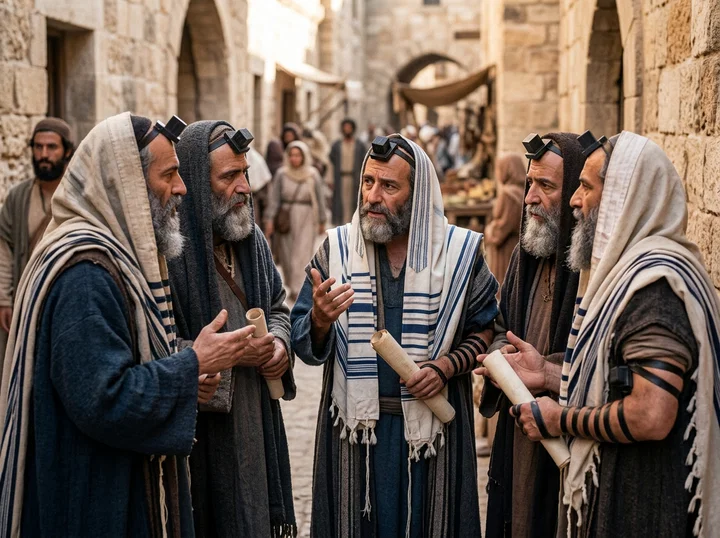
But all their works they do for to be seen of men: they make broad their phylacteries, and enlarge the borders of their garments,
Translations
American King James Version, King James Version, KJV Cambridge Paragraph Bible
But all their works they do for to be seen of men: they make broad their phylacteries, and enlarge the borders of their garments,
But all their works they do to be seen by men: they make broad their phylacteries, and enlarge the borders of their garments,
But all their works they do for to be seen of men: for they make broad their phylacteries, and enlarge the borders of their garments,
But all their works they do to be seen of men: for they make broad their phylacteries, and enlarge the borders of their garments,
'And all their works they do to be seen by men, and they make broad their phylacteries, and enlarge the fringes of their garments,
And all their works they do to be seen of men: for they make broad their phylacteries and enlarge the borders [ of their garments],
But, all their works, they do, to be gazed at, by men,—for they make broad their amulets, and make large their fringes,
All their deeds are done for men to see. They broaden their phylacteries and lengthen their tassels.
All their deeds are done for men to see. They broaden their phylacteries and lengthen the tassels of their garments.
But they do all their works to be seen by men. They make their phylacteries broad and enlarge the fringes of their garments,
But all their works they do so as to be seen by men: for they make wide their phylacteries, and the edges of their robes,
All their workes they doe for to be seene of men: for they make their phylacteries broad, and make long the frindges of their garments,
Douay-Rheims (Challoner revision)
And all their works they do for to be seen of men. For they make their phylacteries broad, and enlarge their fringes.
Pictures
Cross-references 20 of 22
- Deuteronomy 6:8
And thou shalt bind them for a sign upon thine hand, and they shall be as frontlets between thine eyes.
The command to bind God’s words on the hand and forehead became the basis for wearing phylacteries.
- Numbers 15:38-40
Speak unto the children of Israel, and bid them that they make them fringes in the borders of their garments throughout their generations, and that they put upon the fringe of the borders a ribband of blue:
Fringes on garment borders remind Israel to keep God’s commandments.
- Matthew 6:1
Take heed that ye do not your alms before men, to be seen of them: otherwise ye have no reward of your Father which is in heaven.
Both warn against practicing religion to be seen and praised by others.
- Deuteronomy 11:18
Therefore shall ye lay up these my words in your heart and in your soul, and bind them for a sign upon your hand, that they may be as frontlets between your eyes.
Commands binding God’s words on the hand and forehead, the basis for the phylacteries.
- Exodus 13:9
And it shall be for a sign unto thee upon thine hand, and for a memorial between thine eyes, that the LORD’s law may be in thy mouth: for with a strong hand hath the LORD brought thee out of Egypt.
God’s instruction is worn outwardly as a sign on the hand and between the eyes.
- Matthew 23:23
Woe unto you, scribes and Pharisees, hypocrites! for ye pay tithe of mint and anise and cummin, and have omitted the weightier matters of the law, judgment, mercy, and faith: these ought ye to have done, and not to leave the other undone.
Outward religious observance neglects the law’s weightier matters.
- Exodus 13:16
And it shall be for a token upon thine hand, and for frontlets between thine eyes: for by strength of hand the LORD brought us forth out of Egypt.
It describes a sign on the hand and between the eyes, the basis for the phylacteries.
- Mark 12:38
And he said unto them in his doctrine, Beware of the scribes, which love to go in long clothing, and love salutations in the marketplaces,
Both warn of scribes using conspicuous dress and conduct to seek attention.
- Luke 20:46
Beware of the scribes, which desire to walk in long robes, and love greetings in the markets, and the highest seats in the synagogues, and the chief rooms at feasts;
The parallel warning describes scribes seeking public recognition and honor.
- Matthew 23:27-28
Woe unto you, scribes and Pharisees, hypocrites! for ye are like unto whited sepulchres, which indeed appear beautiful outward, but are within full of dead men’s bones, and of all uncleanness.
Outward beauty and righteousness conceal inner uncleanness and hypocrisy.
- Matthew 6:5
And when thou prayest, thou shalt not be as the hypocrites are: for they love to pray standing in the synagogues and in the corners of the streets, that they may be seen of men. Verily I say unto you, They have their reward.
Both condemn religious acts performed to attract people’s notice.
- Matthew 23:14
Woe unto you, scribes and Pharisees, hypocrites! for ye devour widows’ houses, and for a pretence make long prayer: therefore ye shall receive the greater damnation.
Outward piety accompanies exploiting widows under pretense and condemnation.
- Deuteronomy 22:12
Thou shalt make thee fringes upon the four quarters of thy vesture, wherewith thou coverest thyself.
It commands tassels on the four corners of a garment.
- Luke 11:39-54
And the Lord said unto him, Now do ye Pharisees make clean the outside of the cup and the platter; but your inward part is full of ravening and wickedness.
earlier warning growing toward Matthew 23
- Luke 16:15
And he said unto them, Ye are they which justify yourselves before men; but God knoweth your hearts: for that which is highly esteemed among men is abomination in the sight of God.
earlier warning growing toward Matthew 23
- Isaiah 29:13
Wherefore the Lord said, Forasmuch as this people draw near me with their mouth, and with their lips do honour me, but have removed their heart far from me, and their fear toward me is taught by the precept of men:
Both describe outward displays of religion that conceal a heart far from God.
- Exodus 20:1-17
And God spake all these words, saying,
The garment reminder bears words expressing the commandments.
- Deuteronomy 6:5
And thou shalt love the LORD thy God with all thine heart, and with all thy soul, and with all thy might.
The garment reminder called Israel to love God supremely.
- Matthew 15:8
This people draweth nigh unto me with their mouth, and honoureth me with their lips; but their heart is far from me.
Outward honor of God contrasts with hearts far from him.
- Matthew 5:16
Let your light so shine before men, that they may see your good works, and glorify your Father which is in heaven.
Good works are seen by others and bring glory to God.
Commentary
Each commentary is drawn from primary sources: the writings of Ellen G. White and Adventist pioneers and periodicals. Each commentary is separate. Its own words are not a quotation; follow the references to read the source passages.
Ellen G. White
32 sources
Spoken in the temple in His final day of teaching to His disciples against the scribes and Pharisees, Christ exposed that all their religious works were done to be seen of men, making broad their strips of parchment bearing Scripture worn on forehead and arm and enlarging the borders of their garments into conspicuous badges to gain notice, admiration and reverence.DA 610.1–611.2DA 610Ms 5, 1882, par. 14–16Ms 71, 1897, par. 1–33SP 57.1 What God had commanded as a blue ribbon on the borders and His words as a sign on the hand and frontlets between the eyes was meant as an inward reminder of duty to love God supremely and the neighbor as self, shaping the mind and heart to appear in honest, kind and merciful actions rather than in mere visible display.DA 610.1–611.23SP 58.3–59.1ST Nov 1, 18772SP 74.1ST Mar 1, 1883 Their exactness in forms and show of piety, prayer, almsgiving and zeal sought honor for self and not obedience to God, while their lives opposed the law they taught in selfishness, hard-heartedness, exploitation of the poor, and neglect of its weightier principles of mercy, humility and love.Ms 5, 1882, par. 14–16Ms 71, 1897, par. 1–32SP 73.33SP 58.3–59.1ST Nov 1, 1877 Christ was not awed by such pretension but rebuked it with lessons of humility, compassion and love, for vanity and pride seeking fame from men bring only an earthly reward and are abhorrent to God, while the humble and contrite are heard in heaven.Ms 71, 1897, par. 1–3ST Apr 28, 1898ST Sep 27, 1877ST Apr 26, 1877 The denunciation was recorded as an admonition to future generations not to follow blind leaders or rest in formal outward religion, for office does not make men infallible and true reform must begin in the heart, and the same woe falls on later conspicuous religious dress and the Pharisaic spirit of pride and rule over conscience.4SP 414.3HSFM 185.2GC88 595.3–596.12T 87.2GC 102.1
Words and Historical Setting
Christ spoke these words in the temple on His final day of teaching, addressing the scribes and Pharisees in the hearing of His disciples as part of His woes and denunciation of the Pharisees.DA 610Ms 71, 1897, par. 1–33SP 57.1Ms 175, 1897, par. 81
The phylacteries were strips of parchment bearing portions of Scripture, worn on the forehead and head and on the wrists and arms, and the borders of the garments were enlarged for display.DA 610.1–611.2ST May 2, 1878Ms 5, 1882, par. 14–16Ms 71, 1897, par. 1–3 Making them broad and conspicuous turned them into badges worn to gain notice, admiration, reverence, and regard as devout.DA 610.1–611.2ST May 2, 1878Ms 84, 1894, par. 10–13ST Apr 28, 1898 Strict observance of such outward forms lacked spiritual life and devotion, leaving no room for transforming truth and covering lack of true godliness.Ms 84, 1894, par. 10–13ST Apr 28, 1898
God had commanded Israel to put a blue ribbon bearing words of the law on the borders of their garments as a reminder of duty to keep His commandments.ST Nov 1, 18772SP 74.1ST Mar 1, 1883RH Mar 4, 1873 That reminder called them to love God supremely and the neighbor as self, embracing duty to God and to neighbor.2SP 74.1ST Mar 1, 1883RH Mar 4, 1873 They made these displays more prominent and added words to what God specified even as their words, actions, and lives moved farther from the law, departed from purity and obedience, and opposed the law.ST Nov 1, 18772SP 74.1ST Mar 1, 1883RH Mar 4, 1873
The command to keep God's words as a sign on the hand and as frontlets between the eyes was meant to shape the mind and heart inwardly and be shown in righteous, kind, and merciful actions.DA 610.1–611.2ST May 2, 18783SP 58.3–59.1 The hands were to reflect honest and merciful conduct, and the eyes and countenance were to show a life guided by God's word.DA 612.1–2 Wearing Scripture visibly did not give God's law a deeper hold on mind or heart, and without letting it transform the life the signs became badges of showy devotion serving desire for public admiration and honor.DA 610.1–611.2ST May 2, 18783SP 58.3–59.1DA 612.1–2
The leaders addressed were stern, bearded men in ornate and costly robes, with distinctive head coverings and long robes, impressive clothing, and lofty manners.DA 6102SP 74.2–75.12SP 73.1 Their love of prominent places at feasts and in synagogues revealed desire for status rather than sincere godliness.Ms 5, 1882, par. 14–16 Praying at length in public and on street corners and giving alms to be seen, with concern for outward appearance taking precedence over purity of character and holiness of life, showed the same concern for outward appearance and status.Ms 69, 1912, par. 24–292SP 73.1
Hypocrisy Exposed and Rebuked
All their works, every good deed and religious work and ceremony and every show of zeal, were done to be seen of men, not to obey and honor God but to gain a name and esteem for self.Ms 5, 1882, par. 14–16Ms 71, 1897, par. 1–32SP 73.3ST Jun 14, 1899ST Apr 26, 1877 The aim was to win notice and approval and respect and honor and admiration and reverence, and to make others think them pious and holy and devoted.Ms 5, 1882, par. 14–16Ms 71, 1897, par. 1–32SP 73.3ST Jun 14, 1899HSFM 185.2 They made their devotion conspicuous by broadening their phylacteries and enlarging the borders of their garments, turning visible signs of religion into badges to draw eyes to their piety, and the same love of status appeared in their love of prominent places at feasts and in synagogues.Ms 5, 1882, par. 14–16Ms 71, 1897, par. 1–3ST Jun 14, 1899HSFM 185.2ST Sep 27, 1877 This description also fits later conspicuous religious dress and deference, as with State Church priests' clerical robes receiving public reverence as the ancient rabbis did.HSFM 185.2
Their outward display of devotion and sanctity and exactness in forms stood in sharp contrast to their conduct and character, for their lives opposed the law and did not reflect purity and holiness and obedience.2SP 73.3ST Nov 1, 1877ST Mar 1, 18832SP 74.1ST Mar 1, 1883 While professing to obey they refused real obedience, and did not live or do the truth they taught, for the signs that should have shaped heart and life into righteous and kind and merciful actions became mere badges of showy devotion serving desire for public admiration and honor.2SP 73.33SP 58.3–59.1ST Nov 1, 18772SP 74.1 They claimed lives wholly given to religion yet joined religion with exploitation of widows and the poor and selfish use of offerings, with hypocrisy and hard-heartedness and selfishness and lack of humility and charity and mercy and love for God.3SP 58.3–59.1ST Nov 1, 1877ST Mar 1, 1883 God had commanded a blue ribbon bearing words of the law on the garment borders as a reminder of duty to keep His commandments and to love God supremely and neighbor as self, with duty to God and neighbor, but they made these displays more prominent and added words to what He specified even as their words and actions moved farther from the law.3SP 58.3–59.1ST Nov 1, 18772SP 74.1ST Mar 1, 1883
They were spiritually blinded so they could not discern the relative importance of what they needed to understand, neglecting the weightier matters and principles of the law for matters of lesser importance.Ms 71, 1897, par. 1–37MR 234.4–235.1Lt 165, 1901, par. 11–14 Their strict observance of outward forms lacked spiritual life and devotion, and their self-righteous attachment to forms left no room for transforming truth.Ms 71, 1897, par. 1–3Ms 84, 1894, par. 10–13ST Apr 28, 1898 Driven by spiritual pride, this outward appearance of piety violated both the spirit and the letter of the law, covering lack of true godliness and making religion a burden of rituals and restrictions rather than a true representation of God.Ms 71, 1897, par. 1–3Ms 84, 1894, par. 10–13ST Apr 28, 1898ST Jun 14, 1899
Christ was not awed by these pretensions and gave them no word of approval or flattery, but rebuked them with lessons of humility and compassion and love. Seeking fame and honor from men, as in wearing long robes and standing praying on street corners and displaying religion to win public admiration, brought only an earthly reward and not the happiness or salvation He taught.ST Sep 27, 1877ST Apr 26, 1877 All such vanity and pride from self-righteousness and selfishness are abhorrent to God, while it is the humble and contrite whose prayers are heard in heaven. Their visible religious symbols did not keep them from being ignorant that the time for the Messiah to appear had come.ST Sep 27, 1877
Warning for Later Generations
Matthew 23:5 belongs to Christ's denunciation of the scribes and Pharisees and to His warning against following blind leaders.4SP 414.3GC88 595.3–596.1 That warning confronts their undue assumption of authority and was recorded as an admonition to future generations against allowing human authority to rule the conscience.4SP 414.3GC88 595.3–596.1 As in Jesus' day, religious leaders can misuse legitimate authority for wrongful ends, and their office does not make their conduct or commands infallible.GC 102.1 When clerical authority conflicts with Scripture, Scripture understood by the mind must govern conscience.GC 102.1
The broadening of phylacteries and enlarging of garment borders describes enlarging visible signs of religious dress to win notice and reverence, as the ancient rabbis did.HSFM 185.2 The same description applies to conspicuous clerical robes and the public deference received by State Church priests.HSFM 185.2 Were Christ upon the earth today, priests and rulers would hear the same scathing rebukes and woes pronounced upon them for impenitence and opposition to truth and righteousness.Ms 175, 1897, par. 81 For the Pharisaic spirit still appears in pride, contentiousness, and the desire to rule others, departing from the Bible standard and from humility learned at Jesus' feet.Lt 81, 1896, par. 6–8
The verse warns against performing religious acts to win people's notice while appearing devout and righteous outwardly with heart and motives remaining wrong.2T 87.2 True reform must begin in the heart, not in a show made for others.2T 87.2 Broadened phylacteries were part of a conspicuous, formal display of religion rather than heartfelt faith, coexisting with exploiting the poor.10MR 153.1–2Ms 69, 1912, par. 24–29 That outward show of righteousness belonged to a formal religion of rites and ceremonies, seen also in praying at length in public and giving alms to be seen, where visible religious practice did not mean heartfelt faith.Ms 69, 1912, par. 24–29
Sources
Pioneers and periodicals
72 sources
Jesus rebuked the scribes and Pharisees because they did all their religious works to be looked at and praised by people rather than to obey and honor God.ST Nov 1, 1899ST Nov 1, 1899ST Jan 14, 1875 They displayed this desire for human approval by making their phylacteries broad and their garment fringes long, seeking prominent places, public greetings, and titles of honor.ST Nov 1, 1899RH Sep 20, 1853ST Nov 5, 1912 A phylactery was a small leather box or parchment inscribed with Old Testament passages worn on the hand and forehead, and the borders were fringes with a commanded blue ribbon, both meant to remind of duty to keep the commandments, love God and neighbor, and shape heart and life toward righteousness and mercy.ST May 2, 1878ST Nov 1, 1877ST Mar 1, 1883RH Sep 27, 1870RH Apr 2, 1872 They perverted this by enlarging what God specified, wearing them for show on all occasions, and treating larger cases as signs of greater righteousness, so outward display and human tradition replaced genuine obedience.RH Apr 2, 1872ST Jul 8, 1897ST Jul 1, 1897 Their outward honor of God therefore covered hearts far from Him, lives opposed to the law, and neglect of love, mercy, and weightier duty, and all work done to be seen by men has no reward from God.ST Apr 28, 1898RH Jun 2, 1859ST Jan 9, 1893ST Feb 6, 1893
Setting and Occasion
Jesus spoke these words to the crowds and to his disciples in the temple on Tuesday as his earthly ministry neared its end.RH Apr 15, 1909RH Jan 29, 1914 It was part of his closing discourse outlining rebuke of the scribes and Pharisees, whose public religious profession contrasted with their lives and whose self-exaltation and love of position led them to disregard their own teaching.RH Apr 15, 1909 There he denounced the Jews for hypocrisy, and the rebuke came just before he left the temple for the last time.RH Jan 29, 1914ST Mar 30, 1888 The rebuke of their sins was given before he declared the doom of the Jews, Jerusalem, and the temple, and so contributes to the setting for his teaching in Matthew 24.RH Dec 20, 1870
The words belong to his terrible denunciations in Matthew 23, yet they do not contradict his meekness and compassion because they were spoken in a sweet solemn tone.RH Sep 26, 1865 They are fearful words and woes against the hypocritical scribes and Pharisees who rejected all the light and blessing offered to them.ST Jul 15, 1908ST Jan 6, 1887 They form his strongest and most terrible expression of warning and judgment, coming close upon the proclamation of the kingdom and the call to repentance, with warnings growing more and more terrible to the close of his ministry.ST Feb 10, 1898 The warning is given not merely to condemn men but so that men may seek the kingdom of God and his righteousness.ST Feb 10, 1898 He was engaged in open controversy, censuring not only false doctrines but the men themselves who held and spread false principles, as part of an unbroken course of controversy from the beginning of his public work in the synagogue at Nazareth until his death on the cross.ST May 27, 1913
The rebuke condemns religious leaders who sought honor and recognition from people and assumed over the people an authority that was not warranted, and this weakened the force of their teaching.RH Sep 20, 1853ST Jan 27, 1904 Their fondness for titles, prominent seats, and public greetings marks them as proud rather than meek, and therefore unlike the humble followers who inherit the promised blessing.RH Sep 20, 1853 They made a display of their religious status, dressing conspicuously and seeking public recognition and the highest places.ST Apr 13, 1915 These were warnings to the generation living at his first advent, and their conduct exemplifies the self-exalting behavior he reproved even in his own disciples.ST Oct 19, 1915ST Apr 13, 1915
Phylacteries and Borders
A phylactery was a small leather box holding parchment strips inscribed with passages from the Old Testament, worn as a token upon the hand and as frontlets between the eyes on the forehead, wrists and arms, with the larger forehead box worn conspicuously above the eyes.ST Nov 1, 1877ST Jun 14, 1899RH Sep 27, 1870RH Apr 2, 1872RH Jul 28, 1868 The borders of the garments were fringes with a commanded blue ribbon bearing words of the law.ST Nov 1, 1877ST Mar 1, 1883RH Mar 4, 1873 Some Jews continued wearing Scripture texts on forehead and arms to keep God's word continually before them and to help keep them from sin and trouble.RH Jul 28, 1868
God's command to keep His words as a sign upon the hand and as frontlets between the eyes and to put the blue ribbon upon the garments was meant as a reminder of duty to keep the commandments.ST May 2, 1878ST Nov 1, 1877ST Mar 1, 1883RH Mar 4, 1873 It was meant to remind of duty to love God supremely and the neighbor as oneself.ST Mar 1, 1883RH Mar 4, 1873 It was meant to shape the mind and heart and to lead to righteous, kind and merciful actions.ST May 2, 1878 It was meant to help keep the wearer from sin and trouble.RH Jul 28, 1868
The Pharisees perverted this by wearing phylacteries on all occasions to be noticed rather than generally at prayer, and by enlarging them and making the garment displays more prominent and adding to what God had specified as their words and actions departed further from the law.ST Nov 1, 1877ST Mar 1, 1883RH Mar 4, 1873RH Apr 2, 1872 The larger cases and squares were treated as signs of greater righteousness and the smaller ones as mere compliance, turning religious objects into a public measure of holiness.ST Jul 8, 1897 This treated virtue as coming from the object rather than from God and made human tradition seem like God's command.ST Jul 1, 1897
The broadening custom had no direct Old Testament basis but arose from rabbinic tradition appealing to the sign texts and grew after the Babylonian captivity when ritualism claimed virtue and righteousness through outward acts of the law as interpreted by the elders, so outward display and ceremonies replaced genuine worth.ST Jul 1, 1897 What was condemned was widening the garment borders and broadening the phylacteries to make virtue appear greater, not the wearing of the garment itself.ST Jul 1, 1897ST Jul 1, 1897
Motive and Hypocrisy
All their religious works were done to be looked at and noticed and praised by people, seeking human approval, respect and importance rather than obeying and honoring God through the law.ST Nov 1, 1899ST Nov 1, 1899ST Jan 14, 1875ST Jan 19, 1882ST Sep 15, 1887 The scribes and Pharisees, with the priests, rulers and Jewish teachers, performed their religious acts to win public notice, making their scripture containers wide and their garment fringes and borders long and large as outward and conspicuous displays of piety.ST Nov 1, 1899ST Nov 1, 1899ST Jan 14, 1875ST Jan 19, 1882 Their lives, not their religious claims, revealed what they truly believed, for faith is real only when it is lived and shapes the heart and character.ST Sep 15, 1887 Their display of religious observance obscured the law's spiritual purity and helped keep them from understanding the gospel.
The desire to appear important was shown in enlarged phylacteries and garment borders together with seeking the best places at feasts, the chief seats in synagogues, greetings in public places, titles of honor, long robes, public praying and ostentatious almsgiving.ST Nov 1, 1899RH Sep 20, 1853ST Nov 5, 1912RH Aug 21, 1860 Conspicuous length and appearance in dress was meant to attract notice and express pride, and conspicuous garments advertised supposed piety.ST Nov 5, 1912RH Aug 21, 1860ST Apr 13, 1915 Fondness for titles, prominent seats and public greetings marks such leaders as proud rather than meek, and therefore unlike humble followers who inherit the promised blessing.RH Sep 20, 1853 It was an example of the self-exalting behavior reproved even in his disciples.ST Apr 13, 1915
Their outward honor of God stood in contrast with hearts far from him and with lives opposed to the law.ST Nov 1, 1877ST Mar 1, 1883RH Feb 20, 1900RH Jun 2, 1859ST Jan 9, 1893 They pretended to teach God's law while failing to keep it, professed to obey but were not doers of the word they taught, and refused the obedience God required, so their outward religious life was pretense.ST Mar 1, 1883RH Feb 20, 1900ST Jan 9, 1893 They added their own traditions until the word of God was made of none effect, and their hearts were filled and their minds blinded to the light of the gospel.ST Jan 9, 1893 They wore passages of the law on forehead and wrists and enlarged garment displays with added words while conduct did not reflect purity, holiness or obedience, for God had commanded a blue ribbon as a reminder of duty to keep his commandments but they enlarged the displays while their lives opposed the law.ST Nov 1, 1877ST Mar 1, 1883
Such display covered lack of true godliness and helped make religion a burden of rituals and restrictions rather than a true representation of God.ST Apr 28, 1898ST Sep 13, 1877ST Jun 16, 1887 Religious practice came to emphasize outward signs and public piety, with enlarged phylacteries and garment borders taken as evidence of devotion.ST Apr 28, 1898ST Jun 16, 1887 Punctilious attention to visible details such as a garment's border must not displace the greater principles of duty, love, mercy toward the poor and helpless, and help in bearing burdens.ST Sep 13, 1877ST Jul 21, 1881RH Feb 3, 1903 Yet exact attention to visible religious forms concealed hypocrisy, hard-heartedness and selfishness, and conspicuous forms did not protect from sin or express genuine concern for others.ST Sep 13, 1877RH Feb 3, 1903
High religious profession did not protect from condemnation, for repentance and faithfulness were needed because outward display could conceal hypocrisy and selfishness.RH Sep 27, 1870 The Pharisees were sincere in religious profession yet false professors, showing that outward devotion and sincerity do not prove possession of true piety.RH Sep 2, 1858 Visible religious symbols and careful observance of forms did not prevent ignorance that the time had come for the Messiah to appear, nor did they show inward spiritual life and genuine faith, for outward observance was a form of religion without its power.ST Sep 27, 1877RH Sep 2, 1858ST Nov 20, 1884 Religious appearance and human esteem can leave a person falsely satisfied and unable to recognize spiritual need, with show of piety growing as communion with God diminished and praise from others deepening self-deception.ST Nov 20, 1884 Displaying religious texts on the person does not make one righteous or keep one from evil, for conspicuous observance did not prevent the murder of Christ.RH Nov 5, 1901
Seeking fame and honor from people brought only an earthly reward, not the happiness or salvation Jesus taught.ST Apr 26, 1877 Christ was not awed by pretensions of self-righteousness, selfishness and pride shown in great ostentation of piety by long robes and standing praying on street corners, and gave no word of approval or flattery but rebuked them by lessons of humility, compassion and love. All such vanity and pride are abhorrent to God, while it is the humble and contrite whose prayers are heard in heaven. Jesus acted in the opposite way, avoiding displays that could make his works seem a bid for popularity, performing no work for show and wearing no broad phylactery or other badge of recognition.ST Nov 5, 1912ST Oct 17, 1906 The farther men move from God's Word the broader they make phylacteries and the more conspicuous their garments, for outward display and ceremonies can replace genuine worth and faithfulness to God's principles.ST May 14, 1902
Rebuke and Judgment
Doing all religious works to be looked at and praised by people proves the charge that they say and do not, for they bound heavy demands on others while themselves acting only for show.ST Nov 1, 1899 The priests and elders performed religious ceremonies to be seen by people and to be regarded as pious and devoted, while refusing the obedience God required.RH Feb 20, 1900 Their outward religious life was pretense, professing to obey but not being doers of the word they taught, with human approval rather than obedience to God as their motive, displayed in wide scripture containers and long garment fringes together with seeking the best places at feasts, the chief seats in the synagogues, public greetings, and titles of honor.RH Feb 20, 1900ST Nov 1, 1899
For daring to trifle with the high commands of God while pretending to teach His law and failing to keep it, they were condemned as blind leaders of the blind whose followers fall into the ditch with them, as hypocrites, fools, vipers, children of hell, full of hypocrisy and iniquity.ST Jan 9, 1893 Their hypocrisy grew by adding their own traditions until the word of God was made of none effect and their hearts were filled and their minds blinded to the light of the gospel, while He magnified the law in all its purity as exceeding broad and deep, searching out the very thoughts and intents of the heart.ST Jan 9, 1893 Their pride and hypocrisy in outward displays of religion to win human notice brought condemnation as sinners rather than criminals.ST Oct 7, 1930 The rebuke for hypocrisy was given by One who reproved sins and hypocrisy yet was not guilty of the same sins Himself, and it stands as a warning against hypocrisy.RH Feb 24, 1859RH Mar 9, 1905
The rebuke belongs to fearful words against those who rejected all the light and blessing offered to them, spoken to the generation living at the first advent.ST Jul 15, 1908ST Oct 19, 1915 It was given for their sins before declaring the doom of the Jews, Jerusalem, and the temple, contributing to the setting for the teaching in Matthew 24.RH Dec 20, 1870 The Jewish leaders claimed they would not have shared in their ancestors' killing of the prophets, yet when their hour of darkness came they rejected and killed Jesus and persecuted His apostles and other saints, revealing that they had come under Satan's power.RH May 19, 1851
The same position and the same woes belong to those who treat God's Word lightly, leave the Bible on the shelf scarcely read, or read it hurriedly without meditation, because as a person treats the Word so that person treats the Father and the Son.ST Sep 6, 1899 This is the force of the woes pronounced on the Jews, the scribes and the Pharisees who saw Him walking about, heard of His wondrous works, listened to His gracious words, and heard of His miracles in healing, lifting the fallen, and telling the sin-sick soul to go and sin no more, yet still stood against Him.ST Sep 6, 1899
Warning and Application
All religious works done to gain human attention and praise stand condemned as making a show of piety, and wanting a prominent place in a public religious procession or displaying denominational religion before eyes and ears with banners and noise to let the world know greatness is doing works to be seen by people and forgets Christ and his teaching.ST Feb 6, 1893ST Feb 17, 1881ST Feb 12, 1880 True moral excellence does not pose as patient, gentle, or superior to ordinary people in order to be admired, for such display is artificial self-consciousness, while genuine goodness is inward, inclines toward what is lovely and shrinks from what is base, so that right doing becomes instinctive rather than staged saintliness.ST Feb 17, 1881 Work done to be seen has no reward from God and is not acceptable to him, and faithful service must not depend on being noticed or receiving recognition.ST Feb 12, 1880ST Jul 15, 1880RH Jul 2, 1908 Religious work to gain praise or exalt self is driven by self and impure motives rather than pure motives, and ministers and missionaries must instead preach and labor from concern for God's honor and people's salvation, having first known Christ and felt the truth's saving power in their own hearts.ST Feb 12, 1880ST Jul 15, 1880
The same doing all works to be seen and contending for superiority describes popular ministers who preach Christ of envy, strife, and contention rather than of goodwill and love, striving for masteries to keep the favor of the people.RH Apr 29, 1873 They fear that if God-fearing members see and cherish the light of truth they will lose fame, lose membership, and lose pay.RH Apr 29, 1873 Missionary work prompted by desire for human praise or self-exaltation is not accepted by God and receives no heavenly reward.ST Feb 12, 1880ST Jul 15, 1880
Conspicuous religious clothing such as broad phylacteries and enlarged garment borders was used to attract notice and claim extraordinary respect, and judging people worthy of special honor because of conspicuous apparel is contrary to true Christianity.ST Sep 26, 1906RH Nov 21, 1854RH Sep 20, 1906 Broad phylacteries and ornate religious surroundings display religious pride by making outward practices conspicuous to win human notice, in contrast with the scarce practice of faithful rebuke, justice, and opposition to oppression and sin.RH Nov 21, 1854 Long robes and phylacteries can make leaders appear devout while inner life remains spiritually empty, and such gilded appearance gives no bread of life to those hungry for faith and guidance.RH Sep 20, 1906 As with distinctive dress like turbans and other garments that mark religious identity, faith is better shown in life than in clothes, for mere forms of dress and worship differ from vital godliness. Christians need no conspicuous clothing, emblems, or badge of recognition, but are known by good works and by a clean, honest, self-sacrificing life that leads people to glorify God.ST Oct 17, 1906
Outward religious service does not please God, and the Sabbath is not kept at all in his sight unless kept as he commands from a holy heart, motive, and life made holy by his presence.ST Jul 21, 1881ST Oct 3, 1895 Punctilious attention to visible details such as a garment's border must not displace greater principles of duty, faith, and love, nor become display while weightier matters are neglected.ST Jul 21, 1881ST Mar 21, 1878 Compulsory rest is not pleasing to God nor beneficial to the compelled, and laws compelling outward observance of religious institutions only make men hypocrites like the Pharisees who were punctilious about others' conduct and did all works to be seen.ST Oct 3, 1895
Benevolent acts motivated by desire to be seen are outward religion shaped by worldly motives, and comparing oneself with others instead of measuring life by God's law and Christ's example deceives people into hoping for heaven while sinking to ruin.RH Dec 1, 1859 Extensive religious work and possession of truth in form did not keep the Jews from individual spiritual decline, for outward display and activity do not amount to vital personal godliness.RH Jul 13, 1916 Broad phylacteries no more make a saint than stubborn fasts or stated prayers do, for a tree is judged by what it bears, and grace abounds where charity is seen on the rounds of love to men.ST Dec 11, 1893 Show of piety can grow as communion with God diminishes, and praise from others deepens self-deception, leaving persons falsely satisfied and unable to recognize spiritual need.ST Nov 20, 1884 Displaying religious texts on the person does not make one righteous or keep from evil, as conspicuous observance did not prevent the murder of Christ.RH Nov 5, 1901 Conspicuous dress and traditions used to appear as God's people do not establish standing with God, who rejects pretension, and a nation's Christian standing like an individual's is known by fruits rather than outward displays.ST Nov 13, 1884
In the Jerusalem worship of that day ritual and outward form had come to dominate while selfish rulers sought honor, the deeper meaning of worship was obscured, and human traditions made God's commandments void.ST Aug 20, 1912 Shifting religious operation from the interior to the surface and valuing mechanical devices and lip profession whatever the testimony of heart and life is like wearing slips of parchment continually upon the forehead inscribed with devout recognition of God, and to secure formal acknowledgment of God, of Jesus Christ, and of the Bible in a national charter without account of the national spirit is to wear such a phylactery upon the forehead of the Constitution.RH Apr 29, 1873 Broad borders and large phylacteries bound about forehead and arm advertise the holiness of their long-faced wearer, yet such a minister of holy things may hold sternness and disgust toward a bound, blood-stained sufferer judged a heathen dog visited in wrath for sins, plead fear of defilement by touch, gather his robe to avoid contact, and pass by on the farther side.ST Nov 8, 1910 Outward devotion can serve human interests rather than God, as when a scribe nervously adjusts his broad phylactery while speaking sanctimoniously to justify the planned killing of Jesus.ST Dec 20, 1910
Sources