Matthew 25:20
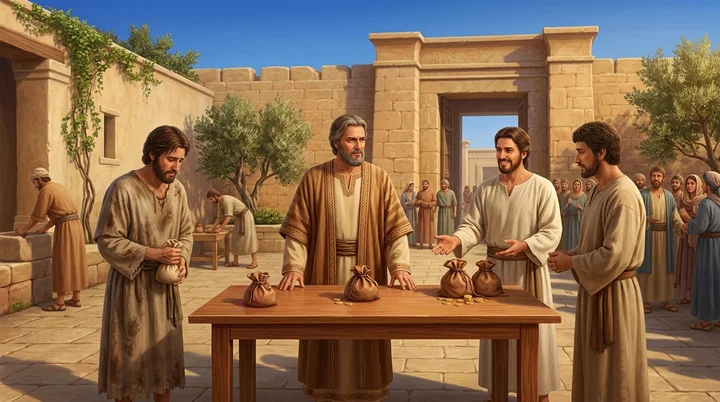
And so he that had received five talents came and brought other five talents, saying, Lord, thou deliveredst unto me five talents: behold, I have gained beside them five talents more.
Translations
And so he that had received five talents came and brought other five talents, saying, Lord, you delivered to me five talents: behold, I have gained beside them five talents more.
And so he that had received five talents came and brought other five talents, saying, Lord, thou deliveredst unto me five talents: behold, I have gained beside them five talents more.
And so he that had received five talents came and brought other five talents, saying, Lord, thou deliveredst unto me five talents: behold, I have gained besides them five talents moe.
And he that had received five talents, came and brought other five talents, saying, Lord, thou deliveredst to me five talents: behold, I have gained besides them five talents more.
Revised Version, American Standard Version
And he that received the five talents came and brought other five talents, saying, Lord, thou deliveredst unto me five talents: lo, I have gained other five talents.
and he who did receive the five talents having come, brought other five talents, saying, 'Sir, five talents thou didst deliver to me; lo, other five talents did I gain besides them.
And he that had received the five talents came to [ him] and brought five other talents, saying, [ My] lord, thou deliveredst me five talents; behold, I have gained five other talents besides them.
And he who the five talents had received, coming forward, brought other five talents, saying,—Lord! five talents, to me, thou didst deliver up: See! other five talents, I gained.
The servant who had received the five talents came and presented five more. ‘ Master,’ he said, ‘ you entrusted me with five talents. See, I have gained five more.’
The servant who had received the five talents came and presented five more. ‘ Master,’ he said, ‘ you entrusted me with five talents. See, I have gained five more besides them.’
He who received the five talents came and brought another five talents, saying, ‘ Lord, you delivered to me five talents. Behold, I have gained another five talents in addition to them.’
And he who had the five talents came with his other five talents, saying, Lord, you gave into my care five talents: see, I have got five more.
Then came he that had receiued fiue talents, and brought other fiue talents, saying, Master, thou deliueredst vnto me fiue talents: behold, I haue gained with them other fiue talents.
Douay-Rheims (Challoner revision)
And he that had received the five talents coming, brought other five talents, saying: Lord, thou didst deliver to me five talents, behold I have gained other five over and above.
Pictures
Cross-references 20 of 52
- Luke 19:12-27
He said therefore, A certain nobleman went into a far country to receive for himself a kingdom, and to return.
Both parables portray servants entrusted with resources and judged when their master returns.
- Matthew 25:26-30
His lord answered and said unto him, Thou wicked and slothful servant, thou knewest that I reap where I sowed not, and gather where I have not strawed:
The faithful servant’s gain contrasts with the buried talent and the unfaithful servant’s judgment.
- 1 Peter 4:10
As every man hath received the gift, even so minister the same one to another, as good stewards of the manifold grace of God.
Both texts teach that entrusted gifts should be faithfully used in service.
- Matthew 25:15-16
And unto one he gave five talents, to another two, and to another one; to every man according to his several ability; and straightway took his journey.
The master entrusts different amounts according to each servant’s ability, expecting them to use the talents.
- 2 Corinthians 5:10
For we must all appear before the judgment seat of Christ; that every one may receive the things done in his body, according to that he hath done, whether it be good or bad.
Both connect judgment with giving account for deeds done in life.
- Luke 12:48
But he that knew not, and did commit things worthy of stripes, shall be beaten with few stripes. For unto whomsoever much is given, of him shall be much required: and to whom men have committed much, of him they will ask the more.
Responsibility and return correspond to what each person has received.
- Revelation 22:12
And, behold, I come quickly; and my reward is with me, to give every man according as his work shall be.
Christ rewards each person according to their work at his coming.
- 1 Corinthians 4:2
Moreover it is required in stewards, that a man be found faithful.
Both emphasize the steward’s duty to be faithful with what is entrusted.
- Matthew 25:24-25
Then he which had received the one talent came and said, Lord, I knew thee that thou art an hard man, reaping where thou hast not sown, and gathering where thou hast not strawed:
The servant hides his talent out of fear, contrasting with the other servant’s faithful gain.
- Mark 13:34
For the Son of man is as a man taking a far journey, who left his house, and gave authority to his servants, and to every man his work, and commanded the porter to watch.
The master assigns each servant work while he is away.
- Romans 14:12
So then every one of us shall give account of himself to God.
Both teach that each person gives an account to God for what was entrusted to them.
- Luke 19:20-23
And another came, saying, Lord, behold, here is thy pound, which I have kept laid up in a napkin:
Faithful gain contrasts with the servant hiding entrusted money in a napkin.
- Luke 16:10
He that is faithful in that which is least is faithful also in much: and he that is unjust in the least is unjust also in much.
Faithfulness in small duties shows fitness for greater responsibility.
- Matthew 25:30
And cast ye the unprofitable servant into outer darkness: there shall be weeping and gnashing of teeth.
The servant who fails to use his talent is cast into outer darkness.
- Matthew 25:1-13
Then shall the kingdom of heaven be likened unto ten virgins, which took their lamps, and went forth to meet the bridegroom.
Both parables call for faithful readiness for Christ’s return.
- Matthew 25:29
For unto every one that hath shall be given, and he shall have abundance: but from him that hath not shall be taken away even that which he hath.
Faithful use of entrusted gifts brings increase, while neglect leads to loss.
- Matthew 25:26
His lord answered and said unto him, Thou wicked and slothful servant, thou knewest that I reap where I sowed not, and gather where I have not strawed:
Faithful gain contrasts with the rebuke of the servant who buried his talent.
- Luke 19:16-19
Then came the first, saying, Lord, thy pound hath gained ten pounds.
Both parables show servants reporting gains from entrusted money and receiving rewards.
- Luke 16:2
And he called him, and said unto him, How is it that I hear this of thee? give an account of thy stewardship; for thou mayest be no longer steward.
Both require stewards to give an account of what was entrusted to them.
- Luke 12:47
And that servant, which knew his lord’s will, and prepared not himself, neither did according to his will, shall be beaten with many stripes.
Both warn that servants who know the Master’s will are accountable for how they act.
Commentary part 1 of 5
Each commentary is drawn from primary sources: the writings of Ellen G. White and Adventist pioneers and periodicals. Each commentary is separate. Its own words are not a quotation; follow the references to read the source passages.
Ellen G. White
310 sources
The verse shows the servant entrusted with five talents putting them faithfully to work to gain five more and then coming to present both the original trust and the increase to his lord.ST Nov 20, 1884ST Apr 22, 1875COL 325.1–2 The traveling master is Christ leaving earth for heaven, and the servants are His professed followers bought at infinite price who must render an account, with watching meaning diligent work and continually increasing capabilities rather than idle waiting.Ms 94, 1902, par. 23–24Lt 23, 1885, par. 23–25 The present time while the Master is away is the trading time before probation ends, when every capability must be put out to use for fellow men rather than hidden.DA 91.1COL 352.4RCOC 19.2 Talents include positions, duties, skill, education, tact, perseverance, zeal, influence, means and time, all sacred capital still belonging to the Lord including the increase.MYP 210.1–2RH Aug 26, 19096T 439.4Ms 183, 1901, par. 5Lt 26, 1897, par. 24–26 Faithful servants who use five to gain five more will be rewarded, in contrast to slothful servants who bury their trust, for greater gifts bring greater responsibility requiring return with increase through good works and saving souls.FE 232.15T 277.1Ms 19, 1899, par. 32Lt 13, 1902, par. 3Ms 88a, 1905, par. 9–10
Verse Story and Setting
The servant who had received five talents traded with them, gained five more beside them, and came presenting both the original trust and the increase to his lord, showing that what is entrusted must be faithfully put to work and returned with increase rather than hidden.ST Nov 20, 1884ST Apr 22, 1875ST Oct 23, 1901Ms 25, 1908, par. 16Ms 19, 1899, par. 5–7 The talents are gifts and blessings belonging to God, to be used according to His Word and not merely human judgment, and they multiply when diligently and conscientiously used to glorify Him and advance the work of truth.ST Oct 23, 1901Ms 9, 1891, par. 1–3Ms 26, 1899, par. 4–8Ms 114, 1905, par. 6–13Lt 19b, 1892, par. 46–50 Investing what He lends in His cause to save souls brings the Master's approval and glory to God, and God rewards every servant who works with self-denying, self-sacrificing zeal for the salvation of souls.ST Apr 22, 1875Ms 25, 1908, par. 16Lt 19b, 1892, par. 46–50 The good steward returns his talents with interest while claiming nothing for himself, for there would have been no gain without the deposit and no interest without the principal, and his trading is done in sight of unseen intelligences with a witness constantly by his side.Ms 114, 1905, par. 6–13Lt 19b, 1892, par. 46–50Lt 35, 1898, par. 6–8
The talents entrusted include intellect, affections, speech, influence, and other powers and opportunities belonging to God, and each person has a sphere of service proportioned to powers and capacities.ST Jan 23, 1893CT 512.4–513.1ST Aug 1, 1911 No gift is too small to matter, for even a small gift put to use in faith and unselfish diligence can produce fruitful results and bring a fitting return to the Giver.ST Jan 23, 1893CT 512.4–513.1ST Aug 1, 1911 God values a gift by its proportion and motive and not merely its size, and He expects improvement and gains proportionate to what was received, rewarding each person according to work.CT 512.4–513.12T 666.1–23T 53.4 Wasting these gifts through careless words and conduct buries and corrupts them and lowers the minds of others, while faithful use benefits others and advances the truth.ST Jan 23, 1893ST Aug 1, 19112T 666.1–2 Refusing to use means for God's cause out of fear or treating them as one's own brings no reward, and falling short of developing gifts up to the standard light and privileges make possible leaves members accountable.2T 666.1–23T 53.41T 530.1–2
The verse belongs to the parable of the talents in Matthew 24-25, given shortly before entering Gethsemane, within the discourse spoken early in the morning after crossing the mount, among the last public parables.ST Nov 20, 1884COL 325.1–2 Together with the parable of the ten virgins it teaches the solemn duty of unselfish, watchful labor in God's cause and calls for readiness for Jesus' second coming in the clouds.ST Nov 20, 1884COL 325.1–2 Watching for Christ's coming means diligent work rather than idle waiting or meditation alone, requiring personal consecration and continually increasing capabilities.COL 325.1–2 The traveling master represents Christ leaving earth for heaven, and the servants represent professed followers bought at infinite price by His sufferings and blood to secure willing service, who must render an account and return His own with usury.4SP 311.2RH Jun 27, 1907
The lesson was given to the disciples for Christians living in the last days, and it binds servants now to waiting, watching, praying and working.ST Nov 20, 1884COL 325.1–2SG4 196.1 It is to be studied and compared with the life record with close, critical self-examination over how each is trading on the Lord's talents and whether putting them out to the exchangers.Ms 25, 1908, par. 16 Mere profession of faith has no value unless love is shown through works, and feelings are no criterion; assurance is known by working on nearest burdens and building character daily by grace.4SP 311.2 Abilities give no ground for boasting or exalting self over sincere workers, for the capital is the Lord's and not one's own for pleasure, and gifts call for humble dependence in continually receiving and imparting grace, with Jesus alone to be exalted.RH Jun 27, 1907
The present is the trading time while the Master is away before probation ends, in which God-given capabilities and opportunities must be used for the Master for fellow men and the widow and fatherless.Ms 25, 1908, par. 16 Having a name in the church book does not secure entrance into the kingdom of heaven.Ms 25, 1908, par. 16 Faithfulness is shown by working for the One who gave His life for the world, doing missionary work for those perishing in sins, and each one who has denied himself and purified his soul through belief of the truth at once does that work.Ms 25, 1908, par. 16 To bury talents means to withhold influence or money from His cause and let them lie dormant in the earth, and those who do so will be condemned when the Master comes to reckon. No person living is without a gift from God, from the highest to the lowest, and every individual is held responsible to make the most of it, for God keeps an account and requires His own with usury; those who misapply grace so it does not benefit others are consumers but not producers.Ms 34, 1901, par. 12–13
Special gifts do not warrant despising others, and devotion to service brings highest esteem.17MR 201.3–202.2 Every man, woman and child possesses varied talents which may be sanctified to the Master's use, to be prized as His gifts and sacredly consecrated to His glory, not used to glorify self.17MR 201.3–202.2 No one is to be so controlled as to express and act another man's mind, and talent is not for a favored class to look down on others as deficient in tact and intellect.17MR 201.3–202.2 Each from the lowest and most obscure to the highest has his place in the family of God and is a responsible agent to the Donor, to whom he must render an account of mental and physical endowments.17MR 201.3–202.2 It is not the number of talents that makes men valuable in His sight, but the way they appreciate and employ them, and the smallest gift is not to be ignored or despised; if faithful and humble, realizing dependence upon Him, they will receive wisdom as Daniel did and become trusted.17MR 201.3–202.2
Faithful stewardship lays up unfailing treasure in heaven by giving one's own means to the treasury while living rather than hoarding through fear, transferring to children, or giving only at death.4T 118.3TCBMP 154.23T 387.2 Property is talents lent to stewards to use for His glory, entrusted to the father himself, and children are not to become responsible for them.TCBMP 155.1TCBMP 154.2 Parents while of sound mind and judgment, with prayer and help of proper counsellors of experience in the truth who know the divine will, should dispose of their own property themselves to meet God's claims first and advance His cause, considering afflicted or struggling children in poverty who will make judicious use of means.TCBMP 155.1TCBMP 154.2 To place means in hands of unbelieving children who have abundance and are serving the world merely because they are children is a sin against the Master, and property willed principally to children with none for God or only a meager pittance becomes a curse to the heirs, a source of temptation and an open door to many dangerous and hurtful lusts, robbing God and self of heavenly treasure.TCBMP 155.1TCBMP 154.23T 387.2 Children who in direct or indirect way influence aged parents to divide property while living or will it mainly to them take fearful responsibilities, while believing children ought in fear of God to counsel and entreat parents to be true to profession and take a course God can approve.TCBMP 154.2
All are to be producers as well as consumers, serving others rather than avoiding responsibility, and must do their allotted work fully, for to do only one-third leaves the other two-thirds working against Christ.MYP 210.1–26T 439.4 Talents include positions of trust, duties and responsibilities, with five talents meaning larger responsibilities than two, as well as skill, education, tact, perseverance, zeal, life, health, reasoning powers and every moment.6T 337.3–338.2CH 288.2ST Jan 14, 1886CT 62.3 A worker faithful in little and least, thorough in everything, climbing every round with deep thought, mastery, solidity, intelligent knowledge, carefulness and thoroughness, proves fitness to bear heavier burdens and receive Well done, while grasping for the highest round without climbing step by step is self-inflation that falls short.HPMMW 32.1CH 288.2 Life and every ability are a sacred trust to be wisely improved in doing all possible good for His honor and fellow men, because results will be seen in eternity and the use of every talent will be examined at His coming.4SP 311.2ST Jan 14, 1886CT 62.3
Talents Defined and Shared
God gives to each person gifts according to ability, and even a small gift has a real purpose that must be faithfully used.Lt 41, 1899, par. 22–23Lt 47, 1898, par. 7Ms 179, 1897, par. 12–13 Humble work such as visiting homes can accomplish what brilliant gifts cannot, and the servant who rightly uses one talent is as truly rewarded as the servant who rightly uses five.Lt 41, 1899, par. 22–23Ms 56, 1890, par. 6 Trading wisely on one talent leads God to give ability to use a larger number, for that work is no less real than the work of five and calls for all the more earnest effort.Ms 138, 1903, par. 9Ms 56, 1890, par. 6 The talent of money is multiplied when used to spread truth, for one person brought into truth represents a doubling and that person bringing others a further increase.Ms 77, 1902, par. 51 Neglect to improve talents by use to gain others to render back to the Giver is backsliding that calls for confession and softening of heart under the Spirit, and daily choices shape the individual account each must give.Lt 47, 1898, par. 7Ms 179, 1897, par. 12–13
One talent traded upon gains another, two put out to usury gain two more, and four working on the same principle make eight.Lt 159, 1899, par. 9 This calls for daily consecration, dying to self and living the new life unto God, letting the breath of heaven circulate through the soul and taking up appointed work in a trustful happy mind that sees, understands and is kept safe from failure.Lt 159, 1899, par. 9 God gives every person work with means, opportunities and abilities proportioned to capability, and those with greatest trusts bear greatest responsibility.Lt 1, 1883, par. 60–63Lt 8, 1890, par. 35Lt 125, 1904, par. 10 Faithfulness means putting the same tact, sharpness and diligence into work for God as into temporal matters, investing and sacrificing to put the talent out to the exchangers by laboring with the whole soul to convert others from darkness of error to present truth.Lt 1, 1883, par. 60–63 God does not require the lowly and uneducated to work like champions of faith, nor poverty to give what it lacks, nor the feeble and sick to exert the energies of the healthy, but accepts earnest faithful use of even one according to what a person has.Lt 1, 1883, par. 60–63 No one is to remain idle aspiring after great things but to do present small work with fidelity in his own sphere, as rill, shrub, lamp and star each fill their place, for all time, property and self are loans from the Master who paid wages of His own blood and sufferings.Lt 1, 1883, par. 60–63
The talents are gems of truth to be appreciated and brought into character — Bible truth, preciousness of promise, justification by faith, righteousness of Christ — and trading means putting every ray of light and jot of influence on the Lord's side instead of burying self in earthly business.Ms 9, 1891, par. 17–20 The one-talent man has this work and is not excused, and if all influence and ability is used to plan money-making and lay up earthly treasure God calls him to account and takes away even what he has, even ability itself, for there is a gathering that scattereth and a scattering that increaseth.Ms 9, 1891, par. 17–20 Merely returning what was received does not satisfy the Lord, who holds men accountable for talents they might have possessed and good Christ died to make possible, with judgment referring not especially to actual transgressions but to neglect of doing what might have been done.Ms 53, 1902, par. 14–19 He who does not improve talents is a slothful untrustworthy servant unworthy of heavenly courts, disappointing the Master and responsible for souls lost through unfaithfulness, upon whom must fall the penalty of failing God's purpose.Ms 53, 1902, par. 14–19 A day of reckoning will reveal how each used or abused entrusted means and opportunities in proportion to ability and opportunity, and the return expected is proportionate to what each has been given.Lt 8, 1890, par. 35Lt 125, 1904, par. 10
Mere profession of belief does not save, for devils believe and tremble without right faith, and assurance of acceptance is not known by feelings which are no criterion but by going to work and taking up burdens lying next to you as laborers together with God.Ms 9, 1891, par. 10–12 Believers are God's husbandry and building whom God builds, for no one can build or cleanse himself from a single spot of sin, but by taking hold of God's power he builds for time and eternity.Ms 9, 1891, par. 10–12 Faithful use means having a molding influence, studying to bring solid timbers into character, cultivating right disposition and building character daily by grace from Christ, for a fractious fretting miserable temper cannot build for eternity nor enter His kingdom.Ms 9, 1891, par. 10–12 God measures not only what is done but what could have been done, and unused talents bring eternal loss even if the soul is not lost.MYP 309.2 People are accountable for time, influence, abilities and skills held in trust, and using them in earnest work for humanity's good is carrying out God's plan, with those who serve remaining learners as well as teachers.Ms 98, 1902, par. 31
Bringing other five talents means working to save souls, for salvation of one soul means saving of many because through that one Christ can work, letting heaven's light shine into the heart to be imparted to others.Lt 109, 1899, par. 36–37 This faithful increase is expected and required of all with talents of intellect and money used to advantage of God's work, not hidden in business tending to peril rather than saving of soul, and gain must be made now while it is day for night comes when no man can work.Lt 109, 1899, par. 36–37 No one is to give entrusted capabilities to another or give up stewardship of means for another to use, for that is unfaithfulness putting it out of his power to do work God lent him talents to do.Lt 43, 1899, par. 34–36 The Lord would have every man and woman manage his own business, handle his own talents, invest them in His cause, pray and work and study and plan and acquire more correct knowledge of working, doing wise trading with every dollar, because all means belongs to God and is to be appropriated as necessities of work demand including helping the poor and lifting the standard of truth.Lt 43, 1899, par. 34–36 Young people by grace of Christ with opportunities to know God can make this faithful productive use and return increase.Lt 12, 1893, par. 46
What is entrusted is sacred capital still belonging to the Lord including the increase, purchased at great cost by blood and sufferings to secure willing service, and no one with reason can excuse neglecting to return to God what is His.Ms 183, 1901, par. 5 The servant coming with five more shows diligent use must double the trust in God's service, and doing so reveals God's character to a sinful world.Ms 183, 1901, par. 5Lt 15, 1887, par. 7–8 Abilities and resources are loaned to be wisely improved, and faithful use even begun with little can multiply what is entrusted and bring revenue to God's work with divine commendation.Lt 15, 1887, par. 7–8 The talent grows through exercise, and faithful use of what a person has leads to greater responsibility and influence through giving self to God and letting the Holy Spirit shape character.Lt 26, 1897, par. 24–26 Talents are abilities suited to work He calls to do, not distributed capriciously, and no one is to sleep at post of duty, with responsibility growing more urgent as end of earth's history approaches.Ms 20, 1899, par. 7Ms 9, 1891, par. 6–8 Houses, lands and money are also trusts for which account is owed, to be put to fruitful use seeking opportunities to do good and advance His cause, for rescuing even one soul is worthwhile because that soul is worth more than a world.16MR 51.1
Servants must learn to trade before they can accumulate more, for the Master sees no profit in giving most precious truth to those who wait and do not use what is already committed.Lt 86, 1895, par. 7–8 Every servant is to begin trading on the very first endowment at once by putting goods out to the exchangers, calling attention of others to their value, presenting sacred truth by precept and example, seeking wisdom daily, searching Scriptures diligently and working in conscious partnership with God.Lt 86, 1895, par. 7–8 In that faithful trading the Lord educates workers and develops executive ability, the gospel becomes power and wisdom to the worker, life and character are transformed into Christ's until he is a living epistle known and read of all men, and efficiency comes from the Spirit working in the contrite humble soul sensing weakness and casting helplessness upon Christ.Lt 86, 1895, par. 7–8 No gift is too small to matter, and even the least talented can enlarge capabilities by doing best, for the Lord can use the smallest gift to advance His cause when its possessor has faith.Lt 111, 1903, par. 21–22 A small ability used faithfully from love is noticed and blessed, and a small offering given cheerfully is not despised, while God does not require the poor to give what they lack nor mourning over never-entrusted talents.Lt 1, 1883, par. 60–63
Christ's servants are entrusted with His interests during His absence and must faithfully use what He gave and give account at His return, with ministers and members responsible for caring for His work.5T 380.1 Abilities and opportunities are to be developed and used faithfully to cultivate powers and prepare to bear responsibilities, not to exalt self but to glorify God.5T 311.3 Each must ask how the Lord's talents are being used and not betray trust by giving strength of purpose, tact and skill to earthly things and only feeble diseased service to God, for God will not accept that and the eternal must not be made secondary to the temporal.RH May 17, 1906 Faithfulness means Christ dwelling in the heart, showing forth praises of Him who called out of darkness into marvelous light, falling not short in duty and being doers of word and not hearers only in whole-hearted effort to make His name a praise in earth.RH May 17, 1906
Faithful stewards use means to advance God's cause and bless others and receive greater responsibility and resources as they dispense them, returning talents with increase at reckoning.4T 123.3–124.1ST Nov 15, 1910 Gaining other talents requires education disciplining the mind, developing powers and directing them with understanding to be useful in advancing God's glory, including a school for entering ministers to learn common branches and more perfectly truths of God's word for this time with lectures on prophecies, so good abilities are greatly benefited by even a few months' instruction.3T 160.2 The church must improve what God committed to trust, and light received makes it responsible to let light shine that others glorify God.TCBMP 70.2–71.1 A person shut away by selfishness can become useful and work with Christ if selfishness shutting away from God's light and love is broken down.3T 534.1–2 Talents represent the Lord's goods including money and gifts of mind and body to be used for the Owner and extension of His kingdom, with account at Christ's second coming revealing whether wisely invested and reward according to works, so spending needlessly or withholding from God's work is unfaithful.Lt 99, 1895, par. 9–10
The present time is the period of stewardship when servants must trade with the Lord's goods, which are means, speech, influence and every capability to be used in Master's service and multiplied by wise investment through increased capacity.Lt 190, 1907, par. 12Lt 67, 1897, par. 1 God requires proportionate gain: three entrusted cannot return only two, while even one doubled secures place in Christ's service and final approval.Lt 190, 1907, par. 12 Devoting time, means and energies to self is terrible mistake for a professed Christian; faithfulness means denying self to follow Christ even accepting loss of life for His sake to find it unto life eternal.Lt 190, 1907, par. 12 Faithful trading means using light and means to sustain work in hard discouraging mission fields, so able workers are raised to carry last mercy message where truth never had standing and representatives sustaining work in all branches are added to the church.Ms 59, 1902, par. 55–56 The barren unworked condition of cities testifies to failure, and criticizing others instead of entering neglected fields and showing what can be done blocks wheels for those trying to work.Ms 59, 1902, par. 55–56
Every position of trust and honor is stewardship, and all influence, capability and knowledge are the Lord's goods to be returned by trading for Him, putting goods out to exchangers for advancement of cause to save souls.Lt 112, 1899, par. 1–3 Talents must be increased so truth and the third angel's message go to places never heard, doing work intelligently, not tying goods in business but using them to bring souls into truth.Lt 112, 1899, par. 1–3Lt 115, 1899, par. 1–2 Improving talents as faithfully as if reaping all benefits for self, manifesting unselfish interest in His property in word, spirit and deed as example of truth, causes His property to accumulate and spread knowledge through advance moves lifting standard in new places while way is open, and if faithful it will become steward's own through identification with the Redeemer.Lt 112, 1899, par. 1–3 Trading means employing whole mind, soul, heart and strength now, preparing soul to labor, seeking Lord in full surrender to do anything He directs, using means to bring souls to present truth rather than investing in worldly business binding resources needed for God's work.Lt 115, 1899, par. 1–2 As people receive truth and use talents the work advances and talents increase, and stewards must account and return with increase laying treasure in heaven.Ms 26, 1891, par. 36–39
The lesson applies to ministers who must faithfully develop gifts, serve with self-denial and Christlike character and keep advancing rather than becoming self-confident, careless or irreligious.TEPD 41.1 It applies to physicians whose opportunities to speak for Christ are precious, illustrating value of using and exchanging abilities to reach people and serve truth where different gifts and shared responsibilities help work prosper.RH Aug 13, 1914 Talents represent abilities and powers to be increased by faithful use, employed to bless others and honor God.6T 243.1–244.3 Entrusted talents including influence are to be carefully used to bring people to Christ, not turned into jest or denial.MYP 88.4MYP 391.1 Different servants have different gifts and none has every qualification, so they should work together rather than act independently, envy others' gifts or depreciate their work, making most of what is given to honor Him. Faithfulness belongs in daily business with self-sacrifice after Christ who suffered the just for the unjust.6T 243.1–244.3TEPD 41.1
Measure and Faithfulness
All powers of mind and body belong to God by purchase and are lent in trust to be cultivated, strengthened and increased by use for His glory, never to be spent in pleasing self or in harmful indulgence such as tobacco, nor withheld for worldly ambition.CE 245.1–2RH Dec 28, 1916ST Aug 23, 1883 Every youth is formed for activity with varied mental, moral and physical capabilities, time and intellect, and no one is his own master to do as he pleases; stewardship binds every believer through successive generations, including the sharing of light, and even the lowest humble service done for His will is accepted.ST Aug 23, 1883CE 138.2RH Aug 21, 1900 Each worker must value, develop and put to active diligent use the gifts and judgment entrusted, rather than leaving them unused or relying on a leader to direct every matter, for applying what is learned can draw others to seek training for Christ's service.STB 517.3–518.1CE 138.2RH Aug 21, 1900 Ability rightly recognized, prepared and employed according to capability grows by trading, so that humble visiting work may accomplish what brilliant gifts cannot, and rejecting the gospel and failing to use what is entrusted leads to loss of immortal life.STB 517.3–518.1RH Dec 28, 1916JIOKP 21.2
The servant who received five talents put them to productive use, gained five more, and returned all ten, illustrating wholehearted accounting in which all that is held is acknowledged as entrusted by Jesus and used not for self-serving but in complete service to God.MYP 41.1–2CT 476.1ST Jul 15, 1897 Faithfulness in what is least prepares for greater trust, while laziness and careless idleness contrast with the diligent steward; entrusted abilities and resources, great or small, are to be used humbly in God's work and in sharing knowledge with others.TCBMP 164.2–165.2CT 476.1LSEGW 276.2–277.2 Resources lent by the Lord are to be used wisely when called upon to advance His cause, for God holds each accountable for opportunities and expects diligent improvement through thorough, painstaking effort that yields greater service and helps others.RH Mar 10, 1903MYP 41.1–2CT 476.1 Added stewardship beyond present ability and responsibility becomes a burden that cannot be managed well, as when taking a father's property enlarged W. C.'s trust beyond what he could use for good and God's glory rather than selfish gain; returning what is lent sustains salvation against darkness, and growth in capability bears upon eternal destiny.TCBMP 164.2–165.2ST Jul 15, 1897
Greater gifts bring greater responsibility and require much accomplishment, with increase returned through good works, sharing truth, and saving others.5T 277.16T 425.2–426.1GW92 302.2–3 The time of trust will be followed by a day of reckoning when each must answer for gifts and opportunities, and unused capacities also count in the judgment; returning the means entrusted through faithful service leads to greater responsibility, and duties done in His name are rewarded and bring happiness.COL 362.5–65T 277.1ST May 24, 1883 All who profess Christ are accountable for gifts and for light and truth given them, must show union with Him through character and works, and that light will testify against those who turn from it.ST Sep 27, 18836T 425.2–426.1 To do nothing with talents and make little effort to share Christ's grace is sinful neglect that will meet the neglected at the judgment with conviction, for consecrated abilities are to be diligently increased and put to work for others.FE 232.16T 425.2–426.1
Influence, possessions, means and knowledge are entrusted by God to be devoted wholly to His glory and used for His call, and accountability covers not only what is done but abilities and opportunities that could have been used; unused powers bring loss.STOM 5.1RH Nov 12, 1903ST Jun 11, 1894 Varied gifts must be multiplied by active, zealous, self-denying work, learning how to employ talents by using them even with mistakes and correction, doing the work faithfully to the best of ability amid hardship rather than wasting opportunity in idleness.STE 147.1–149.1GW92 352.1 Money is to be put into missionary fields while opportunity lasts rather than into banks, for God proves stewards to see whether they will acknowledge Him in His gifts, advance His glory without exalting self or oppressing the poor, and render to Him what is His.ST Jun 11, 1894RH Mar 24, 1904 All the earth, its treasures, cattle, gold and silver remain His; He requires no offering for His need but receives the freewill offering of the humble contrite heart as grateful obedience, rewards with richest blessing, accepts improvement of time and talents as fruit of love, and counts obedience better than sacrifice, while without pure love even the costliest offering is too poor to accept.ST Jun 11, 1894RH Mar 24, 1904
Keeping entrusted blessings to self instead of sharing repeats unfaithful stewardship, and each must administer the trust personally under God rather than shifting responsibility to another body such as the conference.2T 114.2–4RH Nov 12, 1903 The talent means personal testimony, influence, strength, help and burden-bearing to bring souls to truth and sustain the church, and it must not be buried on the plea that testimony is unneeded where many believers already meet, by laying off burden and doing scarcely anything.GW92 422.22T 114.2–4 Faithful use demands double energy, watchfulness, prayer and diligent duty, taking special burden where labor would otherwise remain undone; burying brings dearth of soul, dwarfed spirituality, idleness in the vineyard, dead weight upon burden-bearers, and a fast-withered branch.TBC1882 66.12T 114.2–4 The church is weighed by whether its moral and spiritual condition matches the light, benefits and blessings given, and unused talents, imperfect fruit, or light become darkness leaving it wanting; faithful ministry means not merely preaching but coming close to hearts with skill and wisdom to present precious testing truth winsomely to win souls.TBC1882 66.1GW92 422.2
Condemnation comes not from lack of knowledge but from refusing advancing light, which becomes darkness proportionate to the light despised.ST Sep 27, 1883TBC1882 66.1 God alone judges capability and scrutinizes returns, expecting return proportionate to hereditary and cultivated ability, and He increases the gifts of faithful users unto eternal life while what does not grow is cut off.COL 362.5–66T 133.1STB 517.3–518.1 The five talents are every physical and mental capability to be carefully preserved and put to best and highest use to advance His glory by availing of provision made through Christ; to pervert powers and abuse gifts is failure to gain, bringing strict account for good that might have been done, since He claims the working of every faculty.COL 362.5–6CE 245.1–2 Wealth and other resources are talents for God's glory and human uplift, not self-indulgence or self-glorification, and faithful use includes giving and working with God for others' good rather than selfish gain.CH 16.1–2TCBMP 164.2–165.2
Wholehearted service is required because destiny hangs between being found wanting and joining the white-robed throng, and humble use whether great or small prepares for greater work.MYP 42.1ST Jul 15, 1897 Entrusted goods include resources to advance God's work and relieve sufferers, and to ignore that duty while spending on what harms others fails to return to God what is His.ST Jul 4, 1900RH Mar 10, 1903 Talents improved by wise use and accounted for to the Lord build the church through wise instruction, so that established resources help new fields even through self-sacrifice; pursuits that educate and benefit others make powers fruitful, while useless games engross the mind, lead to neglect of God, and waste what was given.MYP 42.1CT 274.3CT 476.1 Diligent use of opportunities is demanded, with thorough effort doubling what was lent for greater service to others.MYP 41.1–2CT 476.1
Christ has entrusted treasures to the church across generations, the gifts first given to the twelve passing to present workers, and each is accountable for abilities, influence and opportunities used in truth and cooperation with God; burying or wasting opportunity is unfaithfulness.Ms 42, 1898, par. 5–9Lt 26, 1897, par. 19–205MR 358.3 Bringing gain requires daily consecration, thanksgiving and tithes as property accumulates, holding all gifts, strength, faculties and capabilities as lent treasures to be used to best advantage for highest service and God's glory with nothing withheld, improved and perfected by use under a sense of wise and judicious accountability.Ms 31, 1899, par. 6–7Ms 33, 1899, par. 6–7 Talents include abilities, influence, intellect, workers, facilities, time and tenderness to bless humanity and restore His image, to be cultivated day by day through service and learning from Christ rather than wasted in idleness, folly or vanity during the probation given for improvement.Lt 26, 1897, par. 19–20Ms 33, 1899, par. 6–7 For a man with a family this requires right example and training children by precept and example to be intelligent, useful, educated and disciplined stewards who carry forward His work, each using God-given ability wherever placed to become a blessing beginning in the home, especially in labor to save souls in the cities rather than in self-service.Ms 31, 1899, par. 6–7Ms 40a, 1904, par. 3Ms 33, 1899, par. 6–7
Trading Gaining Souls
The servant who received five talents and brought five more shows that every believer is accountable for putting influence and ability to daily use for the Master during a probationary season, cultivating gifts through service rather than wasting them in idleness, folly, vanity, pride or self-indulgence, with neglect itself counted as sin and unfaithfulness forfeiting reward.Lt 26, 1897, par. 19–20Lt 70, 1886, par. 8–9Ms 52, 1900, par. 18–20Lt 9, 1868, par. 5–6Lt 35, 1895, par. 12–13 During Christ's absence His servants are to remain on duty to uplift those for whom He gave His life, working in faith as vessels of honor and putting the members to work instead of relying on preaching alone, in view of His soon coming and with destiny decided by faithfulness.Lt 70, 1886, par. 8–9Lt 72, 1902, par. 10Ms 52, 1900, par. 18–20 What is entrusted must be improved by diligent work while time lasts, with humility and careful judgment, for even what seems little is to be used to save perishing souls and honor Christ.Lt 26, 1897, par. 19–20Ms 52, 1900, par. 18–20Lt 9, 1868, par. 5–6
Trading on the Lord's goods is the privilege of displaying heaven's precious truth with tact, planning and personal labor to win all classes, giving the testing message, drawing souls to the spread table and compelling them to come in.Lt 31b, 1895, par. 16Ms 67, 1907, par. 9Lt 89, 1898, par. 12–13 It includes winning influential persons, preserving institutions, caring for body and soul in cooperation with Christ, relieving those fallen into distress, and laboring together with prayer as His right hand to work out benevolent purposes.Lt 31b, 1895, par. 16Ms 67, 1907, par. 9Lt 89, 1898, par. 12–13 Those who hide their means make no use of them and will be called to account as slothful, while those who feel responsibility and work with every power are the faithful who use means to best advantage and gain increase to give.Lt 31b, 1895, par. 16Ms 67, 1907, par. 9Lt 89, 1898, par. 12–13 Talents in this trading include reason, intellect, precious opportunities and entrusted means, to be improved rather than frittered on amusement and self-gratification, for indifference imperils eternal interests and lets the enemy conquer.16MR 259.1–2Ms 117a, 1901, par. 8
Exercising God-given ability brings grace for grace and endowment with the Holy Spirit, just as experience teaches success in temporal business, so workers become wise and faithful in spiritual and eternal things.18MR 269.1–3Lt 74, 1901, par. 18Lt 54, 1894, par. 1–3 Unused talents are to be brought into operation and developed by use, with cultivation extending from education in the church to regions beyond, and each generation receives its own trust on which future welfare depends.18MR 269.1–3Lt 74, 1901, par. 18Lt 54, 1894, par. 1–3 Talents are to be constantly multiplied without resting, especially as the end nears, with lamps replenished and work done while time remains before night, for they are gifts of grace entrusted as stewards to be faithfully improved.16MR 259.1–2Lt 74, 1901, par. 18Lt 54, 1894, par. 1–3 What is lent includes money, possessions, intellect, ability, knowledge and affection, to be valued through the love of Christ and used wisely in unselfish, self-sacrificing service to honor Christ and bless humanity rather than for selfish gratification or display.Ms 156, 1898, par. 8Ms 26, 1891, par. 6–9
The verse pictures faithful servants using five to gain five more who will be rewarded, in contrast to slothful servants who hide, waste or turn gifts to wrong purposes while complaining the Lord is unfair.Ms 19, 1899, par. 32Ms 25a, 1895, par. 15Ms 38, 1901, par. 21–23 Talents must not be slighted or abused but developed with a deep sense of accountability and a highest desire to magnify truth by practice, for in the day right upon us every steward will give account of use or abuse.Lt 13, 1902, par. 3Lt 80, 1894, par. 30–33Lt 47, 1893, par. 21–22 Faithful increase means employing every faculty to scatter blessing, shield the fatherless and defenseless, help the needy and destitute, supply means for education and the cause, economize and save instead of spending in prodigality, display, amusement and pride, since every wasted dollar robs God's treasury.Ms 19, 1899, par. 32Ms 88a, 1905, par. 9–10Lt 47, 1893, par. 21–22 Such service under Christ's supervision, including work for the suffering and needy and energetic use of influence and money to save souls, bears great results, grows grace and knowledge, develops efficiency, brings increased light and enters the Lord's joy.Ms 19, 1899, par. 32Lt 80, 1894, par. 30–33ST Dec 1, 1887
Believers are to increase talents by quickened zeal to win souls, sowing good seed beside all waters in His vineyard and reaping the harvest so the Master may receive His own with usury.Lt 91, 1892, par. 7Lt 12, 1893, par. 43–45Ms 43a, 1894, par. 6–10 The faithful steward perseveringly seeks the Lord, gives himself wholly, is willing to be and do anything even in humblest unpleasing circumstances, holding every capability and every dollar not as his own but as trustee to misapply not a farthing with eye single to God's glory.Lt 119, 1893, par. 19–20Lt 12, 1893, par. 43–45Ms 43a, 1894, par. 6–10 Whether one or five or ten, the requirement is the same to endure God's proving, to improve means, ability and intellect for His glory, to seek His Word and share knowledge of God, laying up heavenly treasure rather than spending on earthly advantage.Lt 119, 1893, par. 19–20Ms 43a, 1894, par. 6–103MR 69.1–3 Wealth so used is a sacred loan made spiritually successful by humble Christlike service to the needy and suffering in Christ's place, laying up treasure beside God's throne.Ms 22, 1898, par. 353MR 69.1–3
One talent rightly worked may gain another just as five gained five more, for gifts grow by faithful use in the given responsibility instead of idleness.Ms 65a, 1898, par. 20Lt 47, 1895, par. 87–88Ms 38, 1901, par. 21–23 Reward is not all gathered in this life but when judgment sits and books open, when earnest striving in self-denial and self-sacrifice will be seen and some of ordinary talents will be found to have striven more earnestly than those with larger trusts.Ms 173, 1907, par. 6Ms 38, 1901, par. 21–23 Time itself is a trust to every man, woman, youth and child, honored by valuing moments and keeping usefully employed to benefit self and bless others rather than misusing hours in doing nothing.Lt 127, 1897, par. 20–22Lt 47, 1895, par. 87–88 Refusing to work because highest wages cannot be had is idle folly, for it is better to work for moderate wages and appreciate labor, and giving money cannot replace this personal service of time on which missionary prosperity depends.Lt 127, 1897, par. 20–22Lt 47, 1895, par. 87–88 Doubling talents means being a working Christian as Christ worked, helping and blessing with unselfish love, preaching the gospel, healing suffering, avoiding criticism, and so being approved good and faithful, made ruler over many and entering the Lord's joy.Ms 173, 1907, par. 6Ms 38, 1901, par. 21–23
What is entrusted must sustain God's work, save the lost and bless others, with unselfish use credited in heaven and sheaves at harvest as recompense, expressed also by giving God the best possessions and service.AA 339.4ST Dec 1, 1887RH Mar 5, 1908 Workers hold commission from God, acknowledging Christ as Master and no earthly master, and in the last days amid temptation and departure faithfulness means genuine gospel medical missionary work, intelligent speech on truth's sacredness, pointing to present needs, bearing an inspiring message against perverted principle, watching for souls as those who must give account, and pointing to God's standard of righteousness.AA 339.4RH Nov 5, 1903ST Dec 1, 1887 Even the drunkard proves talents are given to honor God and bless the world as one capable of better things, and those who snare his soul, rob and degrade him while living in luxury will be required at God's hand who marks first cause and last effect and hears the cries of those made in His image and purchased with blood.MH 341.14T 562.4 Mental faculties given to men and women must not be perverted to Satan's service by mingling error with truth and tampering with false leaven, which prostitutes power, obscures landmarks and brings weakness, but are to be kept by jealously guarding simplicity of faith, warned by Solomon's apostasy against joining darkness with light.RH Mar 10, 1910TCBMP 166.1–169.1
Entrusted talents must advance the work by faithful investment including building meetinghouses, establishing sanitariums and starting schools that train workers, winning people to truth and hastening Christ's coming rather than selfish investment alone.RH Jul 14, 1904TCBMP 205.2RH Mar 5, 1908 They include wisdom and understanding to be developed by deeper experience of God and imparted as channels of blessing, and churches are to train members to carry truth and establish new churches.6T 320.1TCBMP 205.2 All powers and blessings are a trust to bless the world and honor the Creator, grounded in humanity formed in His image and pronounced very good, and when all was lost by sin redeemed by the gift of His dear Son so the fallen should live to use powers for others rather than self and perverse will.4T 562.4RH Mar 5, 1908 Laborers pure in heart and life who so use talents in the short time left, reaching common minds with plain pointed truth while souls perish for want of light, have God on their side and angels working with them, laying up eternal riches by winning souls instead of serving selfish desire.RH Jul 14, 1904RH Mar 5, 1908
Sources