Matthew 25:18
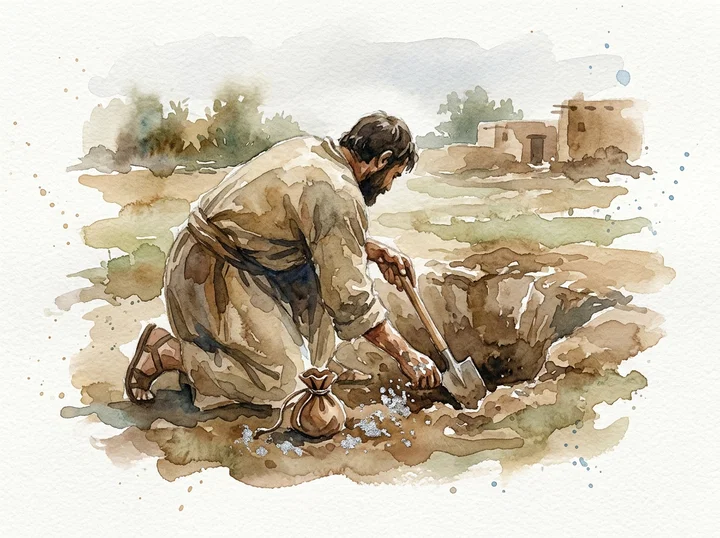
But he that had received one went and digged in the earth, and hid his lord’s money.
Translations
But he that had received one went and dig in the earth, and hid his lord’s money.
King James Version, KJV Cambridge Paragraph Bible
But he that had received one went and digged in the earth, and hid his lord’s money.
But he that had received one, went and digged in the earth, and hid his lord's money.
Revised Version, American Standard Version
But he that received the one went away and digged in the earth, and hid his lord’ s money.
and he who did receive the one, having gone away, digged in the earth, and hid his lord's money.
But he that had received the one went and dug in the earth, and hid the money of his lord.
But, he who the one had received, went away, and digged up ground, and hid the silver of his lord.
Berean Standard Bible, Majority Standard Bible
But the servant who had received the one talent went off, dug a hole in the ground, and hid his master’ s money.
But he who received the one talent went away and dug in the earth and hid his lord’ s money.
But he who was given the one went away and put it in a hole in the earth, and kept his lord's money in a secret place.
But he that receiued that one, went and digged it in the earth, and hid his masters money.
Douay-Rheims (Challoner revision)
But he that had received the one, going his way digged into the earth, and hid his lord’s money.
Pictures
Cross-references 20 of 35
- Matthew 25:27
Thou oughtest therefore to have put my money to the exchangers, and then at my coming I should have received mine own with usury.
The master rebukes the servant for hiding the money instead of putting it to use.
- Luke 19:13-26
And he called his ten servants, and delivered them ten pounds, and said unto them, Occupy till I come.
Both parables entrust servants with money and hold them accountable for its use.
- Luke 19:20
And another came, saying, Lord, behold, here is thy pound, which I have kept laid up in a napkin:
A servant hides his entrusted money instead of putting it to use.
- Revelation 22:12
And, behold, I come quickly; and my reward is with me, to give every man according as his work shall be.
Christ gives each person reward according to their work.
- Matthew 25:23
His lord said unto him, Well done, good and faithful servant; thou hast been faithful over a few things, I will make thee ruler over many things: enter thou into the joy of thy lord.
The faithful servant is commended and rewarded in contrast with the servant who hid his talent.
- Luke 12:48
But he that knew not, and did commit things worthy of stripes, shall be beaten with few stripes. For unto whomsoever much is given, of him shall be much required: and to whom men have committed much, of him they will ask the more.
Greater responsibility follows what a person has been entrusted with.
- Matthew 25:30
And cast ye the unprofitable servant into outer darkness: there shall be weeping and gnashing of teeth.
The servant’s failure to use his talent ends in judgment and outer darkness.
- Romans 14:12
So then every one of us shall give account of himself to God.
Each person must give an account to God for what they have received.
- Luke 16:10-12
He that is faithful in that which is least is faithful also in much: and he that is unjust in the least is unjust also in much.
Faithfulness with entrusted worldly goods shows fitness for greater responsibility and true riches.
- Matthew 25:24-25
Then he which had received the one talent came and said, Lord, I knew thee that thou art an hard man, reaping where thou hast not sown, and gathering where thou hast not strawed:
The servant gives his excuse for hiding the talent out of fear.
- Matthew 25:26
His lord answered and said unto him, Thou wicked and slothful servant, thou knewest that I reap where I sowed not, and gather where I have not strawed:
The master condemns the servant for burying and failing to use his entrusted talent.
- Matthew 25:29
For unto every one that hath shall be given, and he shall have abundance: but from him that hath not shall be taken away even that which he hath.
What is used well increases; what is neglected is taken away.
- 1 Peter 4:10
As every man hath received the gift, even so minister the same one to another, as good stewards of the manifold grace of God.
Entrusted gifts are to be faithfully used in service to others.
- Mark 13:34
For the Son of man is as a man taking a far journey, who left his house, and gave authority to his servants, and to every man his work, and commanded the porter to watch.
The absent Master gives each servant work to do.
- 1 Corinthians 4:2
Moreover it is required in stewards, that a man be found faithful.
Both require faithful use of what the Lord entrusts to his servants.
- Matthew 25:14
For the kingdom of heaven is as a man travelling into a far country, who called his own servants, and delivered unto them his goods.
The parable introduces the goods entrusted to the servants.
- Luke 19:17-19
And he said unto him, Well, thou good servant: because thou hast been faithful in a very little, have thou authority over ten cities.
Faithful use of entrusted money brings authority over cities.
- Luke 12:47
And that servant, which knew his lord’s will, and prepared not himself, neither did according to his will, shall be beaten with many stripes.
Both teach that knowing the master’s will while failing to act brings responsibility.
- Luke 19:12
He said therefore, A certain nobleman went into a far country to receive for himself a kingdom, and to return.
The nobleman goes away to receive a kingdom and return.
- Matthew 25:1-13
Then shall the kingdom of heaven be likened unto ten virgins, which took their lamps, and went forth to meet the bridegroom.
Both are parables that teach through vivid illustration.
Commentary part 1 of 4
Each commentary is drawn from primary sources: the writings of Ellen G. White and Adventist pioneers and periodicals. Each commentary is separate. Its own words are not a quotation; follow the references to read the source passages.
Ellen G. White
597 sources
The verse pictures the servant entrusted with a single talent going away and burying his master's money in the ground instead of trading with it, investing it and putting it diligently to work for increase.GW 296.9Lt 11, 1865, par. 2–3Ms 81, 1899, par. 1–7 The money remains the Lord's own sacred capital lent on trial, distributed to every person according to known ability so that even the least gift carries full responsibility to improve it.Ms 184, 1907, par. 1–5ST Jul 8, 1889STB 17.53T 53.44T 468.2 Hiding it means leaving God-given powers, time, means, influence and knowledge of truth unused and undeveloped through idleness, neglect and selfish use for worldly gain and self-gratification.RH Jun 27, 19075T 457.2–459.14T 46.1–47.1MYP 297 That neglect is rooted in laziness and a false fearful view of God as hard and exacting, yet having little, feeling unqualified or fearing loss gives no excuse when the gift could have been put to the exchangers and doubled.Lt 11, 1865, par. 2–3Ms 81, 1899, par. 1–7ST Oct 23, 1901Ms 9, 1891, par. 1–3Ms 150, 1899, par. 57–59 Every steward must give strict account at the reckoning, when faithful use even of one talent is increased and rewarded, while mere keeping without gain is condemned as wicked sloth and forfeits what was entrusted.RH Aug 21, 1900Lt 12, 1893, par. 19–21Lt 154, 1897, par. 14Ms 13, 1895, par. 12–15GW92 213.1
Verse Action and Setting
The servant who had received one talent went away, dug in the earth, and hid his lord's money instead of putting it to work, trading with it, investing it, improving it, increasing it, putting it out to be exchanged, and actively employing it in faithful stewardship under accountability to God.GW 296.9Ms 81, 1899, par. 1–7ST Oct 23, 1901Ms 19, 1899, par. 5–7Ms 25, 1908, par. 16 The failure was slothful, unfaithful stewardship in leaving an entrusted gift unused and undeveloped rather than diligently cultivating and doubling it in service, for which answer must be given when the Lord comes to reckon.GW 296.9Lt 11, 1865, par. 2–3ST Oct 23, 1901Ms 19, 1899, par. 5–7Ms 25, 1908, par. 16 Though unable to use it himself he could have entrusted it to someone faithful, yet he buried it following the enemy's suggestions and excused idleness by claiming fear of a hard master who reaps where he has not sown and gathers where he has not strawed, as if God were severe and unjust.Lt 11, 1865, par. 2–3Ms 81, 1899, par. 1–7ST Oct 23, 1901 He also reasoned anxiously for self-benefit that improvement would profit him nothing because God would gather the increase Himself, so he did nothing, and that plea of fear is a false excuse that does not remove responsibility to use what was given.Lt 11, 1865, par. 2–3Ms 81, 1899, par. 1–7ST Oct 23, 1901 Even one talent carefully used in God's service could accomplish much and be doubled, while a name in the church book secures no entrance into the kingdom without self-denying, self-sacrificing trading in the present trading time for the salvation of souls perishing in sin.ST Oct 23, 1901Ms 25, 1908, par. 16
The verse belongs to the parable of the talents in Matthew 25:14-23, spoken on the Mount of Olives concerning His second advent to the world.ST Nov 20, 1884COL 325.1–219MR 385.2–386.1Lt 108, 1896, par. 2–9 It was given shortly before entering Gethsemane as part of the discourse recorded in Matthew 24 through 25.ST Nov 20, 1884COL 325.1–2 It was the last of the many parables in Christ's public teachings to the disciples, spoken early in the morning after crossing the mount as a warning about His second appearing in the clouds of heaven and readiness for Christ's second coming.19MR 385.2–386.1Lt 108, 1896, par. 2–9 Watching for His coming means spending the time not in idle waiting but in diligent working, joined to His specifying signs of nearness, His command to watch and be ready because no one knows the day nor the hour when the Son of man comes, and the warning that no man knows the day and hour but the Father only.COL 325.1–219MR 385.2–386.1
The parable follows the parable of the ten virgins, and the lesson connected with them is vigilant watching and sanctified waiting with no relaxation of effort to secure eternal life.19MR 385.2–386.1Ms 28, 1888, par. 14 That watching is diligent working rather than idle waiting, with the gospel of the kingdom to be preached in all the world for a witness to all nations before the end comes.COL 325.1–219MR 385.2–386.1 The whole lifework is solemnly bound up with the second coming, so that day by day and hour by hour conduct lays up material to be examined in the searching judgment.Lt 64, 1888, par. 19 Improvement is especially urgent because the Lord is soon to come, requiring every talent to be improved in earnest faithful labor rather than hidden in the earth.Ms 27, 1907, par. 52–56Lt 164, 1906, par. 8
The verse is part of Christ's instruction in Matthew 25:14-46 that must be studied and compared with one's life record and studied for spiritual profit.Lt 214, 1906, par. 13RH Aug 2, 1906Ms 166, 1905, par. 9–1013MR 146.2 It calls every person to put away boasting and calls for serious examination of faithfulness, showing self-sufficiency to be fearfully dangerous and making the words of Christ of no effect.Lt 214, 1906, par. 13RH Aug 2, 1906Ms 166, 1905, par. 9–10 Small advantages, including time and power of speech as precious gifts, are to be eagerly improved rather than neglected while longing for greater opportunities, in close connection with Christ by whose divine nature workers can work in His way.13MR 146.2
Master Servant and Ownership
Christ is the man traveling into a far country who was soon to depart from earth to heaven, and the servant is one who professes to have accepted His service.COL 325.3–326.2 The servant is the Lord's property because every human being has been bought with a price, not with corruptible things as silver and gold but with the precious blood of Christ, purchasing will, affections, mind and soul, so no one is his own or lives to himself.COL 325.3–326.2 That purchase was paid by His humiliation and agony, His life of toil, and His death of shame, laying the deepest obligation on all who have taken His name to improve every capability for winning souls and to return to God His own in faithful service.9T 104.1 Everyone is to work with the abilities, means, and opportunities placed in their hands for the interests of His kingdom, while those with greater gifts and opportunities bear greater responsibility.Lt 93, 1892, par. 38
The talent and the lord's money do not belong to the servant but to God as Master and supreme proprietor, lent as sacred capital and a loan on trial to be used wisely, diligently, increased and returned to Him with revenue, interest and gain.STB 17.53T 53.45T 457.2–459.1 Stewards must regard themselves as His hired servants, workers, trustees and almoners bearing responsibility, and must give strict account when the Master comes after a long time to reckon, with both principal and increase being the Lord's.3T 53.45T 457.2–459.14T 46.1–47.1 Hiding it is excusing oneself from labor for others on the plea of inability while devoting love, judgment, memory, foresight, tact, energy and every other faculty to self and to trades, farms, houses, merchandise, dress, tables and other worldly pursuits, thereby perverting, disabling and crippling physical and mental powers until unfit for God's work.5T 457.2–459.1 That inability is not made by God but is produced by inactivity and perpetuated by deliberate choice, and it does not remove responsibility, for responsibility is measured not by present resources and capacities but by the powers originally bestowed and the possibilities for improvement.5T 457.2–459.1 The reckoning does not ask how successful servants have been in gathering means, but what they have done with what was lent, including time, pen, voice, money, influence, means, powers of intellect, and light and knowledge of truth, which must be put to work at once to increase the Master's store.4T 46.1–47.1ST Jun 3, 1889GW92 434.2
All are called to do service for Him, and all who profess His service will be required to render an account at the great Judgment-day for the manner in which they have met His claim.COL 325.3–326.2 Those redeemed by Christ's blood remain accountable after redemption, justified by faith but judged and rewarded according to works, and refusing allegiance and neglecting entrusted gifts does not shield them from answering to God and facing retribution in the last day.Lt 93, 1892, par. 38ST Jan 23, 1893 The character formed through faithful service and integrity toward God and other people determines whether a person is fitted for eternal life, and God blesses such integrity.STMW9 43.3 The use people make of their gifts determines their destiny for eternity, for God assigns each person work and endowments suited to that person by deliberate choice and holds each responsible for those gifts and for light and knowledge received.Lt 180, 1902, par. 8–12ST Nov 28, 1911
People belong to God by creation and by redemption through the blood of His only begotten Son, who made man and gave him flesh and blood, nerve and muscle, and mind and intellect with reasoning powers.Lt 7, 1896, par. 1–4 Mind, soul, strength, time, intellect, reason, health, powers and possessions are lent on trial to be consecrated and returned to Him, not wasted, devoted to self-serving or used to gratify harmful appetite.3T 160.2CT 545.1CT 300.2 Life itself with moral power is His property watched every moment, not to be managed as one pleases, and these talents are a trust and duty owed to the Creator whose development should make people useful in advancing His glory.3T 160.2CT 300.2 Greater strength, talent, means, opportunity, light and privilege bring greater responsibility to serve God and do more in His work, and faithful improvement increases what has been entrusted while failing to advance leads to spiritual decline.5T 534.1CT 300.2
The talent is the lord's money, not the servant's own, because talents and supposed ability are given by God.Ms 142, 1903, par. 91–94 Therefore demanding disproportionate or stipulated wages because of talents has no ground, and coveting higher and still higher wages for talents is covetousness which is idolatry.Ms 142, 1903, par. 91–94 Those entrusted with talents in positions of responsibility are tested by God in how they use them and should use them in sacrifice, taking smaller wages and setting a right example to lessen debt and advance the work.Ms 142, 1903, par. 91–94
Distribution According to Ability
Talents are not apportioned arbitrarily or capriciously but according to each person's ability, known powers to use them, and deliberate choice in infinite wisdom, so that responsibility corresponds to what is received and those given more bear greater returns.ST Jul 2, 1902Ms 26, 1899, par. 35–37Lt 93, 1892, par. 38 Each servant receives differing measures, and the one entrusted with one talent received one because he could wisely use only one, yet even those with less ability have opportunity to use and impart what they have.Ms 184, 1907, par. 1–5ST Jul 2, 1902 The entrusted goods are Christ's goods committed as a sacred trust, representing abilities, means and opportunities given for the interests of His kingdom, to be put to work for Him and traded upon to acquire more.ST Jul 2, 1902Lt 93, 1892, par. 386MR 107.3–108.1Lt 50, 1895, par. 10–12 Each is given his own work and special place to work for the salvation of souls, trusts are given in proportion to ability to use, and diversity of gifts means there will never be equality in distribution or in returns.ST Jul 2, 1902Ms 26, 1899, par. 35–37Lt 50, 1895, par. 10–12 Worth in God's sight does not come from number but from how talents are appreciated and employed, as Daniel looked to God for wisdom and exercised every power until trusted in Babylon.Lt 7, 1896, par. 21–23
God has given to every person at least one talent according to his several ability, from the humblest and poorest to the highest, to every man, woman and child, each given his own work and some peculiar gift.RH Oct 26, 19112T 244.2–245.3Lt 7, 1896, par. 21–23 The parable's responsibility applies to everyone and not only to a favored or especially gifted class, embracing spiritual, mental and physical powers, influence, position, possessions, affections and sympathies for use in saving souls.RH Oct 26, 1911RH Oct 26, 1911 Having the least, smallest or fewer gifts than others does not remove responsibility or excuse inaction, and the servant entrusted with the least who buried it instead of putting it to use was condemned to outer darkness.ST Jul 8, 18894T 468.2RH Oct 26, 1911 Each is accountable for what was given rather than for what was lacking, with expected return and reward corresponding to the amount entrusted, and the humblest service wholly devoted to God is as acceptable as the use of greater talents.2T 244.2–245.3RH Oct 26, 1911 Present inability produced by inactivity and deliberate devotion of faculties to self, trades, farms, houses, merchandise, dress and worldly pursuits does not remove responsibility, for responsibility is measured by powers originally bestowed and possibilities for improvement, and God works with the one who exerts what he has to increase every faculty.5T 457.2–459.1
No one is accountable for talents never received, and none should complain about smallness of gifts, resent small ability, murmur against God or accuse Him of unfairness.Lt 55, 1895, par. 35–41SPBC 183.1–2 God does not require the same amount from all, for the church is composed of large and small vessels and the small are not expected to contain what the larger contain. The lowly unlearned Christian is not expected to exercise the intellectual power of one who has had advantages, the poor are not expected to give alms they do not have, and the sick and suffering are not expected to give active energies their infirmities forbid, for God has given to every man his work in the wide harvest field. Those placed in a humble sphere with meager ability must not repine but prove fidelity and loyalty by faithful use, and the Lord will be satisfied.FE 48.2–4 Each has a sphere and vocation suited to entrusted gifts, is expected to improve them and return proportionate gain, and faithful use can increase what is entrusted.SPBC 183.1–2FE 48.2–4
God accepts service according to what a person has and not what he lacks, requires each to do his best, and rewards not for amount but for faithfulness.Lt 55, 1895, par. 35–41RH Apr 9, 19014T 618.2–3 The man with a few pence who serves God with his pence is judged as faithful as the one who improved five talents, and faithful use of little receives returns like faithful use of abundance.Lt 55, 1895, par. 35–412T 244.2–245.3 One talent faithfully used can be doubled just as two can become four, so humble service can grow in power and usefulness and God alone sees its full worth.RH Oct 26, 1911 The one talent has an appointed place and appointed work when wisely used instead of hidden, for faithfulness in little duties works on the plan of addition and God works on the plan of multiplication until littles become precious influences.MYP 297 Failure does not come from having only one, and neglecting ability and then making the master responsible for the neglect brings no commendation, for faithful use rather than size earns approval.RH Apr 9, 1901
The one-talent servant brings a charge against God for inequality, as many do today by complaining of brethren and of unequal facilities.Ms 26, 1899, par. 35–37 God apportions trusts according to known powers and capacities to use them, perfectly knowing how to test men, and He expects and requires corresponding returns and has a right to best and holiest service.Ms 26, 1899, par. 35–37 Doing his best with one or two or five brings acceptance and approval, for it is not the number returned but faithfulness in improving the trust that wins commendation, while every man is responsible for abuse of entrusted gifts.Ms 26, 1899, par. 35–37 Those given greater abilities, opportunities, light, gifts and clearer understanding of Scripture bear greater responsibility and face heavier condemnation if they fail, and the requirement bears with even greater weight on those who profess to understand the way of life and guide others in it.CTBH 98.12T 343.2RH Apr 4, 1912 Success comes not by chance or destiny but by providence rewarding faith, discretion, virtue and persevering labor, with recompense corresponding to faithful use for righteousness and salvation of souls.RH Apr 4, 1912ST Apr 14, 1887
Talents Entrusted to Servants
The one talent is a gift entrusted by God to be improved, traded with, and used in service for the Master and for others, and hiding it in the earth is leaving it unused instead of putting it to work.ST Oct 23, 1901Ms 19, 1899, par. 5–7RH Dec 17, 1901Ms 26, 1899, par. 4–8RH Jun 27, 1907 That trust is given according to ability and carries personal responsibility that cannot be handed to another, with answer to be made to the Lord at His return and judgment upon the unprofitable.ST Oct 23, 1901Ms 19, 1899, par. 5–7RH Dec 17, 1901Ms 26, 1899, par. 4–8 Even one talent carefully used in God's service could accomplish much and be doubled, so having but one does not justify slothful hiding.ST Oct 23, 1901RH Jun 27, 1907Ms 114, 1905, par. 6–13 The entrusted gifts include natural, acquired and spiritual gifts: existence itself, life, health, time, mental powers and intellect, physical and mental strength, reasoning powers, money and temporal means, influence, position, possessions, property and earthly resources, pen, voice, writing, speaking, giving, affections, sympathies, kindly affections, generous impulses, spiritual understanding, social influence, conscience, heart, light and knowledge of truth, opportunities, practical skill and positions of trust.ST Oct 23, 1901Ms 19, 1899, par. 5–7Ms 26, 1899, par. 4–8RH Jun 27, 1907Ms 114, 1905, par. 6–13 Faithful stewardship means diligently developing them by individual persevering labor, including speaking helpful uplifting words to bless others, and investing the Lord's resources wisely especially in carrying the warning message and winning souls rather than tying them up in worldly speculation.Ms 26, 1899, par. 4–8RH Jun 27, 1907Ms 114, 1905, par. 6–13
The talents committed are more than earthly temporal employments, worldly goods and earthly wealth, including the ability to accumulate means.19MR 389.2–4Lt 108, 1896, par. 13–154T 52.3–53.1 They are a loan from the Master to be invested in work for Him to advance His glory, a stewardship of grace and endowments for a sacred higher trust involving eternal interests secured by Christ's blood and sufferings for entire obedience.19MR 389.2–4Lt 108, 1896, par. 13–15 Taking satisfaction in talent for getting worldly goods without turning it to account for Him who bestowed it is delusion, forgetting responsibility for the committed trust, while even the humblest service done in the Master's bidding to promote His glory becomes a consecrated gift.Lt 108, 1896, par. 13–15 They are not to be buried in worldly enterprises nor treated only as means to accumulate possessions, for devoting God-given abilities and practical skill to worldly accumulation instead of God's work does not please God, leaves the work of saving souls undone, and brings loss at the reckoning when both original trust and increase are demanded.19MR 389.2–45T 271.14T 52.3–53.15T 275.1–276.1Ms 169, 1899, par. 3 Human effort in business joined with divine power can accomplish even more when consecrated to building God's kingdom, and such use gives an education enduring into the life to come, unlike earthly treasure which cannot be carried into eternity.4T 52.3–53.15T 275.1–276.1
The talent includes temporal means, money, possessions and substance entrusted as the Lord's money to support the work of saving souls, sustain missions, open new missions and provide houses of worship.2T 658.1–659.1ST Jul 23, 1894ST Jul 23, 1894SG4 196.11T 197.1 Wealth, money, means, property, mental powers and spiritual strength are lent in trust to be used wisely for God's glory, His cause and human good, not hoarded, tied up, wasted or used for self-indulgence, and claiming means as one's own to do as one pleases is hiding the talent in the earth.ST Jul 23, 1894SG4 196.11T 197.1 Its use tests whether people love the gift more than the Giver, revealing faithfulness by judicious effort, influence and means put into the cause to spread truth and save others.2T 658.1–659.1ST Jul 23, 1894SG4 196.1 Having comparatively little does not remove responsibility, for people with one talent like those with more must put entrusted means to work so the Master may receive His own with increase, and when one brought to the truth uses influence and means to help save others faithful use produces increase to be returned.2T 658.1–659.1ST Jul 23, 1894ST Jul 23, 1894 For this unfaithfulness judgment passes upon the house of God with angels keeping faithful record of every man's work, sentence recorded by name, what was committed taken away, earthly treasure swept away with loss of all, while crowns the unfaithful might have worn are placed on faithful servants whose means were constantly in use, every soul they were the means of saving adding stars to crowns and increasing eternal reward.SG4 196.11T 197.1
The talent includes intellect, affections, speech, influence, reason, wealth and spiritual abilities, all belonging to God, and also entrusted truth, light, privilege and knowledge of vital truths, including the light of present truth lent by God and the great solemn truths to be proclaimed in the last days.19MR 172.2–4Lt 35, 1898, par. 6–8ST Jan 23, 1893ST Aug 1, 1911ST Jan 23, 1893 Hiding it means failing to share, improve, witness and let light shine in good works, feeling no burden to reveal corresponding works and ceasing to witness for Christ.19MR 172.2–4Lt 31a, 1893, par. 13–14ST Jan 23, 1893 Every converted soul is appointed to witness, trading upon every talent of light, ability and influence not for self-pleasing but for the Lord in perfect obedience, with light to shine forth not merely in much talk but in good works.19MR 172.2–4Lt 35, 1898, par. 6–8 Burying corrupts and wastes what was entrusted, as when reckless, trifling, cheap, light words belittle talents of speech and mind, mold associates downward to what is low and ignoble, and by that influence strengthen evil.ST Aug 1, 1911ST Jan 23, 1893 Even a small gift diligently used in faith with unselfish unwearied diligence is not in vain but made fruitful with blessing, and unused gifts will be required again with the improvements the Lord required, while faithful use develops characters of increasing consecration, efficiency and tact as laborers together with God.19MR 172.2–4Lt 35, 1898, par. 6–8ST Aug 1, 1911 The excuse of not being qualified nor fitted does not justify hiding, for consecration gives wisdom, tongue and utterance adversaries cannot gainsay, requiring every man, woman and youth to take hold of one line of work after another, keep spiritual senses awake to the wants of the cause, give self and entrusted capital of means to advance the kingdom, and use reasoning powers with purpose to save souls wherever places stand open.Lt 31a, 1893, par. 13–14
Time itself and life itself are sacred talents of which most strict account must be given, with every moment having eternal consequences to be treasured and used for holy purposes and eternal riches rather than left unused.DA 91.1CT 354.23T 146.3ST Sep 18, 1884Ms 4b, 1885, par. 14 Life is a precious gift not given for selfish gratification or seeking fame, for the few golden moments of probation are too short for that, and thorough faithfulness in improving all entrusted while stopping where God has set the bound gives a wholly different service.Ms 4b, 1885, par. 14 God gives talents and time not to remain unused or serve selfish pleasure but to be used for His glory and to bless others, so time spent in selfish pleasure and worldly excitement is lost for eternity, squanders the mind's powers, neglects useful work and sacred duties, and leaves God's purposes for good unfulfilled as an unprofitable servant.CT 354.23T 146.3ST Sep 18, 1884 Mind and body are gifts to be guarded from self-indulgence and misuse and kept ready for service in conformity to Christ's will, for weakening one part diminishes usefulness of the whole, and even a small gift is to be put to work rather than cast away with the crown of life.ST Sep 18, 1884
Even one talent and the humblest gift has an appointed place and work and is not to be despised, with a sphere of service for everyone and return expected proportionate to what was entrusted.CT 512.4–513.1COL 329.1COL 360.1–2 A person with one limited talent is responsible for using it well rather than aspiring to gifts not entrusted, and God accepts faithful service according to ability.CT 512.4–513.1 Failing to improve even a small gift brings the same loss as failing with a much greater one, while faithful use of little receives returns like faithful use of abundance.GW92 270.2GW 330.2–3 A small talent faithfully and wisely used in ordinary duties can produce lasting influence, for faithfulness in little things is the beginning of greater usefulness.COL 329.1COL 360.1–2 The poor may serve through humility, trust in God, patient work, sympathy, care for the needy and clear testimony about Jesus, improving lent gifts and qualities for Christ's glory.GW 330.2–3 Reasoning powers are an entrusted talent to be improved and used in Christ's service to uplift fallen humanity rather than hidden like the master's money in the earth.STE 226.2
Hiding as Unfaithful Neglect
Hiding the money is unfaithful, lazy, unprofitable stewardship and spiritual idleness for which the servant must answer when the Lord comes to reckon with him after entrusting to each according to ability. Ms 19, 1899, par. 5–7Ms 25, 1908, par. 16ST Jul 2, 1902RH Oct 2, 19004SP 311.2 Merely professing faith in Christ counts for nothing unless love is shown through works, and a name in the church book will not secure entrance into the kingdom of heaven. Ms 25, 1908, par. 16RH Oct 2, 19004SP 311.2 No idler and no slothful one will be found inside the kingdom, for digging in the earth and hiding the talent means binding ability entrusted for saving souls in a napkin and doing nothing as a slothful church member while souls perish out of Christ. Ms 25, 1908, par. 16ST Jul 2, 1902RH Oct 2, 19006T 434.1 The buried talent must be unearthed and put out to the exchangers by going to work for the Master in self-denying, self-sacrificing zeal for salvation, and the unprofitable servant who hides instead of trading will have the talent taken away and be cast into outer darkness as unworthy of heaven. Ms 19, 1899, par. 5–7Ms 25, 1908, par. 16ST Jul 2, 1902RH Oct 2, 19006T 434.1
Hiding means leaving God-given gifts, abilities, opportunities and means unused, undeveloped and unimproved through idleness and neglect, while devoting love, judgment, memory, foresight, tact and energy to self and to worldly pursuits. 5T 457.2–459.1RH Oct 26, 19112T 250.23T 57.3 Faithfulness means diligently cultivating, improving, increasing and using them in service to God and to others through individual effort and diligent persevering labor, with even the smallest trust to be put to diligent use because one talent faithfully used can be doubled just as two can become four. 5T 457.2–459.1MYP 297RH Oct 26, 19113T 57.3 Abilities left unused weaken, deteriorate like a rusting tool and diminish what was entrusted, and keeping them idle while waiting for a better opportunity is no better than selfishly withholding them and increases responsibility. 5T 457.2–459.12T 250.23T 57.3 That inability is not made by God but is produced by inactivity and perpetuated by deliberate choice, so the question is not whether one is now inexperienced and unfit but how and why he is in this condition and how it can be remedied, for while one exerts the ability he has in close connection with the Source of light and power, God works with him to increase and strengthen every faculty and arouse dormant energies to new life. 5T 457.2–459.1MYP 297RH Oct 26, 1911
Mere keeping without improvement is unfaithfulness, and God does not accept loss or mere keeping, as when three talents entrusted return only two. Lt 154, 1897, par. 14Lt 38, 1890, par. 15Lt 170, 1907, par. 164T 52.3–53.1FE 214.2 The talent must be traded, put to work and doubled so that Christ may receive His own with increase when the Master comes, for the Lord's goods are not our own and servants are responsible for using or abusing what is entrusted. Lt 154, 1897, par. 14Lt 170, 1907, par. 164T 52.3–53.1CE 202.3–203.2 Only such increase brings commendation and a place in His service, for talents must be increased by use or they will diminish, and every talent is to be exercised, developed, cultivated and intelligently used for God's glory with the improvement returned to God. Lt 170, 1907, par. 16CE 202.3–203.2FE 214.2
Failing to use an entrusted talent for good is itself wrongdoing for which the servant is condemned as wicked and slothful even when no grievous sins are recorded, because God-given powers must be exercised in good works and omission of what He requires brings accountability. ST Apr 15, 1886Ms 73, 1900, par. 3–45MR 299.1–3Ms 110, 1898, par. 13–14 Hiding brings the Master's rebuke, forfeiture of the talent to one who used his well, loss of the soul, exclusion and the doom of the unprofitable servant, with God requiring the talent with its increase and those who do not improve it failing of everlasting life. Ms 73, 1900, par. 3–45MR 299.1–3Ms 110, 1898, par. 13–145T 155.11T 452.1–2 Letting idleness take the place of sincere, wholehearted labor wastes the Lord's goods by unfaithful appropriation of probationary time, large opportunities, mind, discernment, means, prayer and obedience, and burying through inaction destroys confidence in God with no later probation to make up neglected service. Ms 110, 1898, par. 13–145T 155.11T 452.1–2
People are accountable not only for what they did with their abilities but for what they could have done and failed to do, for neglected opportunities to develop them and for every ability and possibility whether used or left unused. Lt 38, 1890, par. 15CT 62.3MYP 309.2STB 859.2ST Sep 30, 1886 Present inability does not remove responsibility for powers originally given, and God measures what could be done as well as what is done, judging what should have been accomplished through right use of powers. 5T 457.2–459.1Lt 38, 1890, par. 15MYP 309.2ST Sep 30, 1886 Responsibility is measured not by present resources and capacities but by powers originally bestowed and possibilities for improvement, so neglected abilities and knowledge bring loss, and an exact account must be given for improvement of privileges, time and abilities before a just God. 5T 457.2–459.1CT 62.3MYP 309.2STB 859.2STB 543.1
The servant is held accountable not only for the one talent returned but for the increase never gained, because through the sacrifice of Christ every provision was made to multiply it by diligent, faithful stewardship. RH Aug 21, 1900Lt 12, 1893, par. 19–21Ms 13, 1895, par. 12–15Ms 53, 1902, par. 14–19Lt 192, 1903, par. 24 He ought to have put the money to the exchangers so the Lord could receive His own with interest at His coming, unfolding the napkin and trading with the Lord's goods to gain other talents for others instead of staying afraid and hiding. RH Aug 21, 1900Lt 12, 1893, par. 19–21Ms 13, 1895, par. 12–15 Giving back exactly what was received does not satisfy Him, and strict account is required of the improvement talents would have made if put to use, through practice that develops abilities and through investments of money, capabilities and opportunities to accomplish the greatest good and double the amount by intelligent, faithful use. Ms 13, 1895, par. 12–15Ms 53, 1902, par. 14–19Lt 192, 1903, par. 24Ms 4b, 1885, par. 14 In the day of judgment reference will not be especially made to actual transgressions but to neglect of doing what might have been done but was not done because of lack of the qualifications Christ died to place within reach, with time itself as a talent of which God will require a most strict account during these few golden moments of probation. Ms 53, 1902, par. 14–19Lt 192, 1903, par. 24Ms 4b, 1885, par. 14
Selfish and Worldly Burying
To dig in the earth and hide the lord's money is to live for self when God requires every ability to be improved for Him, spending entrusted time, talents and money on self-gratification, dress and amusements, display, vain show and selfish indulgence instead of spreading the gospel and winning souls to Christ, which wastes what He expects to be invested and returned with increase and brings a curse.RH Jun 27, 1907Ms 156, 1904, par. 47–51CEv 65.4MC 60.1–3ST Feb 8, 1892 It includes giving the mind to novel reading and other riotous or vain enjoyment that brings it under Satan's control, often unknowingly, instead of employing every God-given power for Christ under self-denial and the cross.6MR 262.1CEv 65.4 The plea of having but one talent does not excuse hiding it, for that one well used would accomplish much and by careful use might have been doubled, including the talent of speaking helpful, uplifting words to bless others, and failure brings great loss and leaves one unprepared for greater responsibility and eternal life.RH Jun 27, 1907MC 60.1–3ST Feb 8, 1892
Hiding means burying entrusted means, time and physical and mental powers in the world by devoting love, judgment, memory, foresight, tact, energy, brain, bone and muscle to getting property, improving farms and business, holding real estate, merchandise, houses, dress and tables, choosing earthly treasure and pursuing selfish worldly purposes, fixing heart, anxiety, labor and skill on earthly possessions above the eternal.5T 457.2–459.14T 46.1–47.1ST Feb 24, 1887ST Jan 14, 18864T 51.1–2 It is excusing oneself from labor for others on the plea of inability while perverting, disabling and crippling the powers until unfit for God's work, teaching truth from Scripture and turning souls from error and darkness to righteousness.5T 457.2–459.14T 46.1–47.1 That inability is not made by God but produced by inactivity and perpetuated by deliberate choice, so it does not remove responsibility, for guilt attaches both to work negligently done or left undone and to all vigor, strength, skill, light and power that might have been had but was failed to obtain through devotion to the world.5T 457.2–459.1 Responsibility is measured not by present resources but by powers originally bestowed and possibilities for improvement, and while one exerts what ability he has in close connection with the Source of light and power, God works with him to increase and strengthen every faculty and arouse dormant energies to new life.5T 457.2–459.14T 46.1–47.1
To invest and bury talents of means in enriched, improved farms and building added to building, instead of letting power, influence and means flow in the missionary channel to warn the world and present doubled talents in gathered souls at the Master's coming, is to exalt the earthly above the eternal and eclipse the eternal with the earthly.ST Feb 8, 1892ST Feb 24, 1887ST Feb 8, 18924T 118.3Lt 70, 1886, par. 5–6 It fixes the heart able only to estimate earthly treasure and unable to appreciate heavenly treasure, makes means invested to extend the work look like loss bringing no returns, keeps the person fully occupied as the devil wants, and leaves wealth that cannot be presented as fruit of faithful service to be consumed in the fires of the last days with eternal loss of reward and of souls that might have been saved.ST Feb 8, 1892ST Feb 24, 1887ST Feb 8, 1892 Even using time and strength upon boats or other earthly pursuits can likewise bury gifts and keep from serving God, for every person entrusted with some means, influence, ability or gift is responsible to exercise and increase it for God's glory and others' benefit.Lt 70, 1886, par. 5–6Lt 5, 1877, par. 19–20
Hiding the Lord's money is fastening means in large houses, lands, expensive buildings and worldly enterprises for self, saying by actions that God cannot have it but it is wanted for self.5T 464.3–465.1 God has not entrusted means to lie idle, dormant in the earth, to be covetously retained or hid away for pleasure, for means and influence are the Lord's capital purchased by His sufferings and blood, lent to stewards to be used to His glory in giving the warning to the world, sustaining missions, opening new missions, providing houses of worship where present truth can be heard, economizing and sending treasure ahead into heaven.5T 464.3–465.1 Binding up the one talent in this way while the cause is crippled and left to beg its way, the treasury half-supplied and souls perishing, gives cause for alarm, for the day to give account is fast approaching when the Master comes to reckon and require His own with interest, and withholding what is His by ministers and people alike brings condemnation.5T 464.3–465.12T 656.2–657.2 Fear of future need and love of money that keep even those with little from advancing His cause, and keeping resources tied up in earthly property and delaying their use, is the same unfaithful stewardship.2T 656.2–657.22T 674.1–676.13T 397.1–398.1
Burying the talent is tying up God's means in unwise investments such as uncertain mining ventures, mining stock and other very uncertain enterprises against which God has warned, rather than using it to win souls and advance His work.STB 685.1–5STB 684.2–6Lt 122, 1902, par. 27 It consumes or ties up the Lord's entrusted capital greatly needed to carry on His work, cripples the work for lack of the talent that wins souls, drains the treasury instead of increasing it by trading, and is a device of the enemy and snare of the last days springing from a lottery-like desire to try fortune to involve God's people in loss.STB 685.1–5STB 684.2–6Lt 122, 1902, par. 27 Faithful use keeps talents in circulation by trading upon them to help the Saviour secure His purchased possession and advance His kingdom by saving souls for whom He died, accumulating true riches and treasure in heaven with safety and consolation, while binding them up in worldly and uncertain projects can never make anyone rich in heavenly treasure.Lt 122, 1902, par. 272T 688.4Lt 115, 1899, par. 1–2 When means is withheld through a world-loving claim of ownership and hindered obedience, it passes into the enemy's ranks and is lost to God's cause, and the steward must give account.ST Jul 9, 18942T 688.4
Digging in the earth and hiding is withholding from God what belongs to Him, including the tithe — the tenth of all increase claimed as His as the very least to be returned — and gifts meant to advance His work and support preachers who teach Scripture.MYP 308.2–3ST May 6, 1875Ms 44, 1905, par. 1–5Lt 16, 1891, par. 8 It is embezzling property committed in trust to be returned to the Lender, defrauding the Creator and robbing God, recorded in the books of heaven as robbery, requiring repentance and not corrected in the record merely by afterward beginning to work on the right principle.ST May 6, 1875 It blocks the way so truth cannot go forth to regions beyond, leaves the treasury empty so workers at home and in foreign fields cannot be supported, and to hold back means when He bids His servants arise and build memorials for Him, even to please children, is dishonesty and disobedience to be answered in self-denial and self-sacrifice without waiting for more appeals.Ms 44, 1905, par. 1–5Lt 205, 1902, par. 1–5Ms 38, 1904, par. 98–99
The buried treasure also pictures means selfishly hoarded and withheld from God's cause and from the poor, instead of using all over necessities to bless humanity by relieving the suffering and needy, feeding the hungry, clothing the naked and helping struggling families wrestling to keep from destitution.2T 684.2ST Jul 30, 1894ST Jul 24, 19012T 283.4–284.2 Money placed in the hands of afflicted brethren is placed in Christ's hands, and those who withhold from the needy will answer for neglect at the judgment when account must be given of how the Lord's capital was employed.ST Jul 30, 1894ST Jul 24, 1901DA 523.3 Faithful stewards do not give with a patronizing air as though deserving praise and honor, but realize they only trade on their Lord's goods as laborers together with God, keeping generous affections and abilities in active use to help people and advance His work.ST Jul 30, 18942T 283.4–284.2DA 523.3
Keeping property for selfish comfort while people are left without help or the message of salvation is burying talents, arising from loving self and loving God's cause too little.ST Jan 14, 1886Ms 62, 1894, par. 29–31Ms 144, 1897, par. 1–4 Such neglect is rebellion, not valid excuse, bringing judgment in which the talent is taken away and the life bears no return for God's gifts and love, with eternal loss revealed in the good that could have been done.ST Jan 14, 1886Ms 62, 1894, par. 29–315T 350.2–3 Withholding tithes and offerings, spending on self or family rather than helping the poor, and leaving means unused in buildings and worldly enterprises through fear, lack of faith, selfish interest, acquisitiveness and covetousness amounting to idolatry, holding money with a miser's grasp and murmuring at expense, is robbery toward God.Ms 62, 1894, par. 29–31Ms 144, 1897, par. 1–4Lt 143, 1899, par. 12–13Ms 6, 1878, par. 2–3 God made holders of means His stewards for the very purpose of advancing His cause in every line required, so hiding the talent robs His treasury, keeps God from benefit of its use, and must be answered for with retribution, whereas money wisely handled and invested in His work would have His blessing and marked results.Lt 143, 1899, par. 12–135T 350.2–3Ms 6, 1878, par. 2–3
Sources