Matthew 25:22
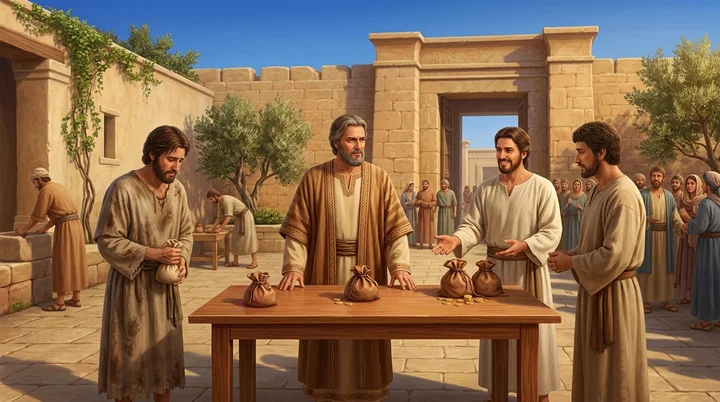
He also that had received two talents came and said, Lord, thou deliveredst unto me two talents: behold, I have gained two other talents beside them.
Translations
He also that had received two talents came and said, Lord, you delivered to me two talents: behold, I have gained two other talents beside them.
He also that had received two talents came and said, Lord, thou deliveredst unto me two talents: behold, I have gained two other talents beside them.
He also that had received two talents came and said, Lord, thou deliveredst unto me two talents: behold, I have gained two other talents besides them.
He also that had received two talents came, and said, Lord, thou deliveredst to me two talents: behold, I have gained two other talents besides them.
Revised Version, American Standard Version
And he also that received the two talents came and said, Lord, thou deliveredst unto me two talents: lo, I have gained other two talents.
'And he who also did receive the two talents having come, said, Sir, two talents thou didst deliver to me; lo, other two talents I did gain besides them.
And he also that had received the two talents came to [ him] and said, [ My] lord, thou deliveredst me two talents; behold, I have gained two other talents besides them.
He also of the two talents, coming forward, said—Lord! two talents, to me, didst thou deliver up: See! other two talents, I gained.
The servant who had received the two talents also came and said, ‘ Master, you entrusted me with two talents. See, I have gained two more.’
The servant who had received the two talents also came and said, ‘ Master, you entrusted me with two talents. See, I have gained two more besides them.’
“ He also who got the two talents came and said, ‘ Lord, you delivered to me two talents. Behold, I have gained another two talents in addition to them.’
And he who had the two talents came and said, Lord, you gave into my care two talents: see, I have got two more.
Also he that had receiued two talents, came, and said, Master, thou deliueredst vnto me two talents: behold, I haue gained two other talets more.
Douay-Rheims (Challoner revision)
And he also that had received the two talents came and said: Lord, thou deliveredst two talents to me: behold I have gained other two.
Pictures
Cross-references 20 of 53
- Luke 19:13-26
And he called his ten servants, and delivered them ten pounds, and said unto them, Occupy till I come.
Servants are accountable for how they use what their master entrusts to them.
- Matthew 25:27
Thou oughtest therefore to have put my money to the exchangers, and then at my coming I should have received mine own with usury.
The master expects the entrusted money to be put to work and produce a gain.
- Matthew 25:15
And unto one he gave five talents, to another two, and to another one; to every man according to his several ability; and straightway took his journey.
The master entrusts different amounts to servants according to their ability.
- 1 Peter 4:10
As every man hath received the gift, even so minister the same one to another, as good stewards of the manifold grace of God.
Both connect what people receive with serving others as stewards.
- Luke 12:48
But he that knew not, and did commit things worthy of stripes, shall be beaten with few stripes. For unto whomsoever much is given, of him shall be much required: and to whom men have committed much, of him they will ask the more.
Both connect entrusted gifts with greater responsibility and an account to give.
- Revelation 22:12
And, behold, I come quickly; and my reward is with me, to give every man according as his work shall be.
Both connect faithful use of talents with the reward Christ brings at his coming.
- 2 Corinthians 5:10
For we must all appear before the judgment seat of Christ; that every one may receive the things done in his body, according to that he hath done, whether it be good or bad.
Both connect each person’s deeds with an accounting before the Lord.
- 1 Corinthians 4:2
Moreover it is required in stewards, that a man be found faithful.
Stewards are required to be faithful with what is entrusted to them.
- Matthew 25:18
But he that had received one went and digged in the earth, and hid his lord’s money.
The servant buries his entrusted talent instead of putting it to work.
- Mark 13:34
For the Son of man is as a man taking a far journey, who left his house, and gave authority to his servants, and to every man his work, and commanded the porter to watch.
Both describe the master assigning work to each servant while he is away.
- Romans 14:12
So then every one of us shall give account of himself to God.
Each person gives an account to God for their service.
- Luke 16:10
He that is faithful in that which is least is faithful also in much: and he that is unjust in the least is unjust also in much.
Faithfulness in little things shows faithfulness in much.
- Luke 19:20-24
And another came, saying, Lord, behold, here is thy pound, which I have kept laid up in a napkin:
Both contrast faithful increase with hiding entrusted money.
- Matthew 25:30
And cast ye the unprofitable servant into outer darkness: there shall be weeping and gnashing of teeth.
The unfaithful servant who makes no return is cast into outer darkness.
- Matthew 25:1-13
Then shall the kingdom of heaven be likened unto ten virgins, which took their lamps, and went forth to meet the bridegroom.
The wise and foolish virgins illustrate readiness for the bridegroom’s coming.
- Matthew 25:26
His lord answered and said unto him, Thou wicked and slothful servant, thou knewest that I reap where I sowed not, and gather where I have not strawed:
Condemns the unfaithful servant for failing to use his entrusted talent.
- Luke 19:17
And he said unto him, Well, thou good servant: because thou hast been faithful in a very little, have thou authority over ten cities.
Both reward faithful use of entrusted resources with greater responsibility.
- Matthew 25:29
For unto every one that hath shall be given, and he shall have abundance: but from him that hath not shall be taken away even that which he hath.
Faithful use of entrusted gifts brings increase, while unused gifts are taken away.
- Romans 2:6
Who will render to every man according to his deeds:
God repays each person according to their deeds.
- Matthew 6:20
But lay up for yourselves treasures in heaven, where neither moth nor rust doth corrupt, and where thieves do not break through nor steal:
Faithful use of entrusted wealth lays up treasure in heaven.
Commentary part 1 of 5
Each commentary is drawn from primary sources: the writings of Ellen G. White and Adventist pioneers and periodicals. Each commentary is separate. Its own words are not a quotation; follow the references to read the source passages.
Ellen G. White
248 sources
The servant entrusted with two talents put them diligently to work, traded with them to gain two more and double the trust, and reported the increase to his master at his return.COL 325.1–2ST Nov 20, 188419MR 389.2–4 Distribution is not capricious but measured by ability, so that all from the humblest to the greatest are entrusted and held to personal account for abilities, opportunities, time, money and influence.6T 431.3STB 684.2–6Lt 77, 1896, par. 19–213MR 7.1–8.1Lt 29, 1897, par. 14–15 Faithful trading means active, unselfish use for God's glory to turn people from sin to truth and relieve the needy, and such use is blessed with increase, growth of powers, and fitness for greater trust.3T 455.1ST Jul 15, 1880Lt 43, 1899, par. 34–36Lt 21, 1897, par. 10–13 Value is measured by motive, devotion and diligence rather than size, so having fewer talents does not lessen duty and refusal of responsibility does not lessen guilt.Lt 55, 1895, par. 35–41Lt 23, 1885, par. 23–25Ms 94, 1902, par. 23–24Lt 127, 1897, par. 20–22Ms 8, 1892, par. 18–21 Burying the trust through idleness, self-interest or mere profession forfeits favor and the crown, while faithful use brings the Lord's approval and the joy of His kingdom.Lt 55, 1895, par. 35–41Lt 23, 1885, par. 23–25RH Jul 31, 19006T 425.2–426.1STBk 6.1
Setting and Wording
The servant who had received two talents put them to work and traded with them, gaining two more beside them to double the trust, and when his master returned he reported the increase that had been made with what was delivered to him.COL 325.1–219MR 389.2–4Ms 81, 1899, par. 1–7Ms 19, 1899, par. 5–7ST Oct 23, 1901 Watching for the return means diligent work rather than idle waiting, for the amount is suited to ability and every follower belongs to the master and must answer for service and for duty to work while there is opportunity.COL 325.1–2ST Nov 20, 1884 The talents committed are more than earthly employments and worldly goods, being a loan from the Master to be invested in work for Him as a stewardship of grace with endowments for a sacred higher trust where eternal interests are involved.19MR 389.2–4 They are to be turned to account for Him who bestowed them to His glory and advancement, not buried in worldly enterprises nor used merely to accumulate worldly goods, since obedience in this trust was secured at the cost of blood and suffering, so that even the humblest service becomes a consecrated gift when done in doing the bidding to promote glory.19MR 389.2–4 His work followed the plan of addition, adding grace to grace, and gifts belonging to God are to be used according to His Word for the work of truth, improving and multiplying in service to bring glory to God.Ms 81, 1899, par. 1–7ST Oct 23, 1901
Different amounts are entrusted according to ability, but each is to do the utmost with what is received, and the servant with two talents who was faithful received the same commendation and reward as the servant with five, being called good and faithful, promised greater responsibility, and welcomed into the joy of his master.Ms 81, 1899, par. 1–7Ms 19, 1899, par. 5–7ST Oct 23, 1901 The discourse belongs to teaching given shortly before entering Gethsemane after a day of work and questioning by the Pharisees, with predictions and warnings, and it stands in the parable in Matthew 25:14-23 and in Matthew 25:14-46 as among the last public parables spoken early in the morning after crossing the mount as warning of the second appearing.ST Nov 20, 1884Lt 214, 1906, par. 13RH Aug 2, 1906 Its waiting period ending with the bridegroom's coming connects with the 1844 midnight cry and call to prepare to meet the Lord.GC 400.1–401.2 The goods are committed to servants to be put to use in cooperation for the salvation of souls, each having a place in the eternal plan of heaven and a special place designated on earth where to work as surely as a place is prepared in the heavenly mansions.ST Jul 2, 1902
God gives not capriciously but according to several ability, five to him who can use five, two to him who can improve two, and one to him who can wisely use only one, so none with a smaller trust needs lament lack of larger gifts, for He who apportions is equally honored by improvement of each trust whether great or small.ST Jul 2, 1902 Each must render its improvement, five for five and one for one, for returns are expected according to what a man has and not according to what he has not.ST Jul 2, 1902 The instruction in Matthew 25:14-46 is to be studied and compared with the life record, requiring every man to put away boasting, since self-sufficiency is fearfully dangerous and makes the words of Christ of no effect, calling instead for obedience and humble service rather than boasting or self-trust in faithful stewardship and accountability before the Lord.Lt 214, 1906, par. 13RH Aug 2, 1906Ms 166, 1905, par. 9–10 God commands each person to make the most of talents and improve every talent, so that spending the mind on novel reading wastes God-given powers in disobedience to that command and brings a person under Satan's control, often without knowing it.6MR 262.1
The two talents are a gift entrusted to the individual, such as ability to write a book, for which the possessor is accountable, for to every man God has given his work and moral and spiritual capital to trade upon where he can in the best possible service for the Master.Lt 55, 1895, par. 35–41 One talent well used will gain other talents, and these still others, and by trading character is developed, while no one is accountable for talents never had and none should complain of smallness, for the man with a few pence who serves with his pence is judged as faithful as the one who improved five.Lt 55, 1895, par. 35–41 Stewardship is individual and cannot be sold, transferred, or merged into another man, council, conference, or publishing house, but each must appreciate the gifts, employ them to glory according to ability, exercise own judgment in investing the gain, and no man or council is to weigh another man's talents in human balances or make them as little as possible.Lt 55, 1895, par. 35–41 Condemnation is proportionate to grace and truth given, and faith, obedience, and love should grow in keeping with light and privileges received.Lt 23, 1885, par. 23–25
God values loyalty and diligent useful work, and those who bury their talents will be replaced by workers who put resources to good use, for whether much or little is held it must be used for His cause rather than selfishly kept, with all responsible to seek returns and put the salvation of others first.Ms 94, 1902, par. 23–24ST Jul 23, 1894 Even a small amount wisely used in ordinary duties can accomplish its appointed work and contribute to growth, and its proper use brings glory while misuse robs the Giver.COL 360.1–2ST Jan 23, 1893 Refusing to acknowledge responsibility does not lessen guilt, and those who choose to serve the power of darkness will be unconfessed at the final accounting.ST Jan 23, 1893 Hiding through idleness, self-interest, and mere profession forfeits favor and the crown, while value is measured by motive and devotion rather than size, and faithful use for salvation and relief of the needy brings increase.Lt 55, 1895, par. 35–41Ms 94, 1902, par. 23–24ST Jul 23, 1894COL 360.1–2ST Jan 23, 1893
Nature of Entrusted Talents
The two talents stand for differing measures of entrusted ability for which each person is accountable to use faithfully in the Master's service, and even what seems small is to be traded wisely rather than despised or charged as God's deficiency. 3T 455.1 Mental and physical abilities are gifts to be guarded, preserved, cultivated and improved, not left idle or spent on self-gratification but put to work for God's glory to bless others and turn people from sin to truth. ST Jul 15, 1880ST Dec 9, 1897CT 354.2 Faithful use requires close connection with Christ and can win souls, while misuse or neglect weakens usefulness, hinders good, and brings a fearful account at the judgment where justification is by faith but judgment is by works. 3T 455.1 What is entrusted rightly employed secures eternal riches, for every moment is a treasure with eternal results to be used for holy purposes and time given for God's glory must not be lost in selfish pleasure. DA 91.1CT 354.2
Time is itself such a talent, and wasting it wastes the powers of the mind, while mothers bear responsibility to cultivate their own minds and use their abilities in training children rather than becoming unprofitable servants through neglect for personal pleasure. 3T 146.3 Means entrusted are talents requiring personal account, to be used for God's work rather than hidden or spent on harmful indulgences and needless luxuries, as the doubled return of the two talents illustrates. RH Feb 6, 1879 The talents are money and means belonging to Christ as sacred trust and intrusted capital from the Source of wisdom, to be wisely employed in His service for winning souls, leaving no place for strife for supremacy or self-exaltation. STB 684.2–6RH Sep 4, 1900 Investing that capital in very uncertain enterprises such as mining stock buries the Lord's talent in the earth, a last-day snare to consume and tie up needed means, causing loss of capital and crippling God's work for lack of soul-winning talent. STB 684.2–6 The same tact, industry and enthusiasm used in temporal business, when consecrated, work with divine power to greater results, building the kingdom and preparing for the future life instead of being buried in worldly pursuits or mere property-getting. 5T 275.1–276.1 God commits talents to individual trust as a measure of light and privileges, including exalted heavenly attainments purchased at immense cost and freely offered, to be improved and rendered back with increase on pain of forfeiting His favor. 5T 92.2
Talents embrace temporal gifts and heavenly light, mental and moral powers to be cultivated, multiplied and increased for good and for God's glory and the good of others. CT 521.2–3ST May 4, 1882 Diligent cultivation of even few gifts is faithful service leading to success in this life and fitness for immortal life, and each life examined by a just God calls for consecrated doing of one's best for highest and holiest purposes. ST Dec 12, 1878STB 543.1 Affection and home duties belong to this trust to bless the needy, and sacred truths purchased at great cost are to be increased with no excuse for refusal. CT 521.2–3RH Aug 26, 1909 The church is therefore to train members for missionary work so that abilities spread truth, develop fitness for positions of trust and influence, and accomplish good for the Master while upholding pure principles. 6T 431.3
Burying capability in earthly business instead of making Christ known is unfaithfulness, for stewardship is assessed by diligence and results in productive service with increase. RH Aug 26, 19095T 275.1–276.1 Each is responsible for abilities and opportunities received, including capacities left unused, and judgment counts not only what was done but what could have been done to glorify God, so unused talents bring loss. MYP 309.2 Means belong to God as lent stewardship to advance His work and save souls, and since one soul purchased by Christ's blood outweighs other interests, fear of sacrifice must not withhold faithful use. ST Jun 25, 1894 Blessing and wisdom attend believing integral effort, and humble dependence as a branch in the vine brings greater fruit even amid opposition. RH Aug 26, 19095T 92.2 Refusal to improve what was entrusted forfeits favor, while training and faithful increase fit workers for greater trust. 6T 431.35T 92.2
Each must give individual account at judgment for abilities, opportunities, time, money and influence, with daily choices building the record and neglected opportunities still counted. ST Jan 14, 1886STMW9 38.1 Gifts and resources are to be carefully put to work for the kingdom to bring return in souls, developed and used diligently in practical temporal and religious work to help self and others advance toward life. RH Dec 24, 1903FE 119.2 Faithful effort gains greater ability rather than depending wholly on others, and resources are to be put to fruitful use in ordinary life and soul-saving. FE 119.2STMW9 38.1 Money and means belonging to Christ must be used wisely in winning souls, for burying them in uncertain speculations like mining stock loses entrusted capital and cripples God's work. STB 684.2–6 Training for missionary service develops fitness for trust, so that what is entrusted is increased and returned with gain. 6T 431.3
Distribution According to Ability
The two-talented servant shows that every responsible agent is entrusted, from the humblest to those with means and intellect, and that trading means putting what is lent to active use to gain more beside it.CT 521.2–3ST Dec 12, 1878STB 543.1Lt 77, 1896, par. 19–21 Wealth faithfully used honors God, while hiding from fear loses both increase and principal, and increased talents are given to those who wisely improve what they have through character development and sowing truth.Lt 77, 1896, par. 19–21Lt 29, 1897, par. 14–15Lt 95, 1895, par. 4 Diligent cultivation of gifts even when few is faithful service that succeeds in this life and prepares for immortal life, and each life will be examined by a just God so each must do their best in consecrated service.ST Dec 12, 1878STB 543.13MR 7.1–8.1 Time is such a trust, and wasting it wastes mental powers, so mothers must cultivate mind and ability to train children rather than seek personal pleasure lest they become unprofitable servants.3T 146.3Lt 95, 1895, par. 4 Accountability covers what was received and its faithful use, including capacities left unused, for judgment regards not only what was done but what could have been done to glorify God, and unused talents bring loss even where the soul is not eternally lost.MYP 309.2Lt 29, 1897, par. 14–15Ms 89, 1908, par. 28
Training members for missionary work develops fitness for trust and influence, upholding pure principles and accomplishing good for the Master by spreading truth.STB 743.56T 431.34T 52.1–2 The prospect of the soon coming calls for diligent service that blesses and benefits others rather than idleness, since inaction in God's cause destroys confidence in God and indolence weakens for further service.STB 743.5GW92 213.1ST Nov 14, 1878 Entrusted time, abilities and influence must be improved with answer to God, and mental powers with received light are to be used in sharing truth and helping save souls.6T 431.34T 52.1–2HSFM 285.5 Using a gift to turn others away from God is robbery bringing a fearful account, and failure to improve talents fails of everlasting life with reward corresponding to works, while eternal glory belongs to the faithful conqueror through energetic persistent labor.HSFM 285.5GW92 213.1
Stewardship must not be shifted to others or postponed until death, for means belong to God and are lent to stewards accountable to use them faithfully to advance His work and save souls.RH Aug 26, 1909ST Jun 25, 1894 Parents as stewards must decide use while sound in mind, without giving abundance to worldly children while neglecting God's cause, since the value of even one soul bought by blood outweighs other interests and fear of sacrifice must not withhold means.ST Jun 25, 1894RH Dec 3, 1901 Talents of mind, speech and body must be treasured and used to feed minds and bless the world, and faithful service means using opportunities and abilities to benefit others in salvation, for church membership alone does not secure heaven.RH Aug 26, 1909GW92 314.1 Withholding even a small offering reflects slothfulness in trading with what belongs to God and retards His work, while a gift given willingly and with understanding is accepted and increased in His hands.ST Jun 25, 1894RH Dec 3, 1901 All classes of talents are needed to make a perfect whole, from money, influence and wisdom to what the poor have such as simplicity, humility, tried virtue, confidence in God, patient toil, dependence on God, sympathy for the poor, a home for the needy, and a clear testimony of Jesus, with none to be depreciated, monopolized or shut out but each to act its part in diffusing light.GW92 314.1
Those improving where they are are blessed with divine teaching for mission work in home fields, cities, towns, highways and hedges, calling men to the supper, and trading is vineyard service learned by using ability in active service.OEWP 36.1–37.1ST May 4, 1882STB 684.2–6 Ministers are to apportion work to those standing idle rather than hinder them, correcting blunders and setting them to work again, instead of detaining students in prolonged education that wastes time and money and leaves souls lost.OEWP 36.1–37.1 Accountability includes what could have been done, and true use of God's gifts increases humility, obedience to the divine will and wisdom unto salvation, while claiming ability as one's own and idolizing the blessing withdraws affection from God and turns the gift into a curse.MYP 309.21RED 66.2 All capabilities belong to God and are given for a while as stewards to prove whether men will love and reverence the Giver, to be guarded and devoted to His glory alone with principal and interest required back with increase.1RED 66.2ST May 4, 1882RH Feb 6, 1879 Investing means in very uncertain enterprises such as mining stock buries the talent in the earth, a device to consume and tie up needed means that cripples God's work for lack of soul-winning talent, whereas wise use of money belonging to Christ advances winning souls.RH Feb 6, 1879STB 684.2–6
Precious time, abilities and influence are a present trust with account at the coming reckoning, and distribution is not capricious but according to God-given ability to use them, with greater returns required where more is lent.Lt 77, 1896, par. 19–21Ms 89, 1908, par. 28Lt 8, 1890, par. 35 The heaviest obligation rests where means and opportunity are greatest, yet the church is vessels large and small and the smaller is not expected to hold as much as the larger, each responsible in proportion to ability and opportunity.Lt 29, 1897, par. 14–15Lt 95, 1895, par. 4Lt 8, 1890, par. 35 Today is the day of trust and opportunity before the reckoning when accounts are shown, and each must consult God's expressed will and trade on what is had without remaining idle.Lt 77, 1896, par. 19–21Ms 89, 1908, par. 28Lt 8, 1890, par. 35 Faithful use grows from small beginnings through humble faith even amid opposition, for small or large resources alike diligently used bear greater fruit with heavenly wisdom given to those walking by faith.3MR 7.1–8.1Lt 29, 1897, par. 14–15Lt 95, 1895, par. 4 Physical, mental and moral powers multiply as employed for His glory, the good done to others is part of the increase, and reward is in proportion to efforts with divine aid assured to every believing soul trusting Christ's power to save.Lt 77, 1896, par. 19–21Ms 89, 1908, par. 28Lt 95, 1895, par. 4
Faithful Trading and Increase
Every talent in the churches is to be put to active doing of good with none left idle, for each person holds abilities, means, time, influence, capability and skill in trust and must trade personally upon them to gain other talents for the advancement of the work.Lt 43, 1899, par. 34–36Lt 21, 1897, par. 10–1316MR 51.1Ms 9, 1891, par. 6–8Ms 98, 1902, par. 31 No one is to hand stewardship to another or put it out of power to invest means, help the poor and meet necessities as they demand, but each man and woman is to manage his own business, praying and working and studying and planning to gain more correct knowledge of how to work, becoming producers rather than mere consumers.Lt 43, 1899, par. 34–36Lt 21, 1897, par. 10–13 Powers and gifts are given to bless fellow men, grace is given in proportion to capability to diffuse it, and even smaller capabilities humbly used cheerfully as service improve the power to do, so that the trader becomes a channel of light and grace, goes from strength to strength, and returns gifts according to gifts received.Lt 21, 1897, par. 10–13Ms 9, 1891, par. 6–8Ms 98, 1902, par. 31 The faithful keep every talent in circulation, yearly laying up treasure in the Bank of Heaven, finding home safety and consolation in true riches with salvation of body, soul and spirit as chief burden, and they do not bind up talents few or many in what God has warned against nor hide them in worldly enterprises and uncertain projects but invest the Lord's money to help secure His purchased possession and save souls for whom He died.Lt 43, 1899, par. 34–36Lt 122, 1902, par. 27 Houses, lands, money and every dollar belong to God as talents, burying them is failing to use them for good and for His cause, while rightly using them uplifts humanity, and even effort rescuing one soul is worthwhile because that soul is worth more than a world.16MR 51.1Ms 9, 1891, par. 6–8Ms 98, 1902, par. 31 Greater light brings greater responsibility, and truth shared to bless enriches and develops mental and spiritual powers, for using what is entrusted brings increase while failing to use it brings loss, and the worker remains both learner and teacher.Ms 9, 1891, par. 6–8Ms 98, 1902, par. 31
What God gives is to be put to work and returned with increase without pride, for prosperity is from Him and those receiving benefits are to use them generously to strengthen the work elsewhere and bless others.Ms 139, 1899, par. 16Lt 192, 1903, par. 26Lt 50, 1895, par. 10–12 Entrusted talents including material means are a loan to be used freely, unselfishly and cheerfully, especially to bring knowledge of God and His Word to unworked fields, and talents of intellect and money must not be buried in earth or in business tending to peril rather than saving of the soul.Lt 192, 1903, par. 26Lt 109, 1899, par. 36–37ST Jul 24, 1901 Means entrusted in proportion to ability must be traded wisely as the Lord's goods, not owned or spent for selfish gratification, impulse or friends' demands, but handled as sacred vineyard responsibility to advance truth, with buying, selling and giving under the same religious obligation as prayer, seeking wisdom from God and giving willingly.Lt 109, 1899, par. 36–37Lt 50, 1895, par. 10–12 Doing duty according to responsibility doubles the amount entrusted, and giving back God's own is honored with the Master's approval.Ms 139, 1899, par. 16Lt 50, 1895, par. 10–12 Talents are abilities, opportunities, privileges and material goods valuable when used for the Giver's purpose to glorify Him and benefit others especially by relieving suffering and helping the needy, while using them to accumulate wealth selfishly fails the purpose and brings loss to the Master, for at judgment none are accepted for becoming rich by cleverness or sharp dealing but all are held accountable for use.Lt 109, 1899, par. 36–37ST Jul 24, 1901 Eternal interests must not be given second place to earthly temporal things, God accepts no divided sacrifice and demands every power without exception for saving souls, and faithful use brings increase because saving one soul means saving many as Christ works through that one to let heaven's light shine to be imparted to others, forming character that decides fitness for eternal life and demanding full surrender without betrayal.Lt 109, 1899, par. 36–37
Entrusted resources of means, abilities and opportunities are given to be used faithfully in quiet work for others, helping the poor and suffering, sharing burdens of the weary, speaking sympathy, and repeating lessons of love, kindness and goodness, which makes users coworkers with Christ and wins people by representing His character.ST Oct 28, 1908COS 42.1–43.2 Every moment of time is of value, no human being is worthless, and even the roughest and most unpromising are to be encouraged because God loves them as children who may become like Him in character, following the example of sharing burdens and teaching from nature.4T 563.3COS 42.1–43.2 Followers bought at cost are to grow in knowledge of the will and continually improve in intellect and morals toward angelic perfection, for servants hold the Master's interests in trust during His absence and must give account at His return, each faithful in assigned work.5T 380.14T 563.3 Those who bury talents are replaced by workers who use them wisely, putting abilities and resources to useful service and producing gain.RH Jan 27, 1903RH Jun 16, 1903 Neglect calls for repentance and renewed faithful effort while time remains, in view of the near coming with little time left.RH Jan 27, 1903RH Jun 16, 1903
Burying talents in earth is refusing the trust, resisting Christ crucified and the pleading of the Spirit, refusing to yield the stubborn will to Christ lifted to draw sinners, and placing self on the apostate side to serve Satan instead of God, with all good influence and improvement that might have been done charged against the unfaithful steward who when weighed and found wanting has no excuse for wasted opportunity.Ms 65a, 1898, par. 31–32 God gives rich gifts of truth and grace to be freely imparted, keeping the heart filled with light of His presence so Christ is revealed, and neglecting to share leaves churches barren and unfruitful and starves the soul even amid constant preaching, for folding hands in contentment while expecting supply violates trust and every member must labor as one to give account.Ms 126, 1902, par. 49Ms 150, 1898, par. 19 Talents put to work in missionary service multiply in ingathered souls to present to the Master, while wealth and improved property are not lasting fruit and earthly possessions will be consumed.Lt 70, 1886, par. 5–6 God tests every professed believer as steward of goods including money, houses and lands to be treated as His and used with prayer-sought wisdom to advance His work and build His kingdom without glorifying self or indulging impulse, and even smallest gifts must be used with none excused as too small to do anything.Ms 150, 1898, par. 19Ms 138, 1903, par. 7 An exact record traces defects, idle hours in visiting and talk about unimportant matters instead of intense work, unseen unimproved opportunities to draw minds and sow truth, inconsequential words showing the warning not uppermost as soul burden, unfulfilled duties and prayerless days with nothing to show, and large expense with little result, while faithful improvement means profitable education, keeping the warning uppermost, praying daily, using every association to save, and doing better work with less expenditure.2MR 114.3–115.1 Even one talent is to be put to the exchangers by wise investment to become two, doing with might what hands find and using it so wisely it fulfills its mission, and embarrassed institutions need immediate return of goods.Ms 138, 1903, par. 7
Talents increase through exercise, the original multiplies when faithfully used in service, and proper use can develop even one talent into highest order, for talents are gifts from God not products of personal energy and those receiving them serve as agents of His providence with increased spiritual efficiency.Ms 144, 1897, par. 1–4Lt 74, 1898, par. 6–7Lt 22, 1897, par. 19 Entrusted means and abilities for which each must answer increase when put to work in the cause and advance the work, with what is possessed held in trust to be returned through tithes and offerings, and even the humblest may serve according to ability.Ms 144, 1897, par. 1–4Ms 26, 1891, par. 36–39 Faithful use increases ability to serve and transforms the user, as wholehearted obedience made Moses eloquent and competent, for God continually develops natural and spiritual abilities toward His likeness.Ms 144, 1897, par. 1–4Lt 22, 1897, par. 19 Means must be used while living, needs are supplied through economical self-denying stewards rather than miracles, and each worker is to exercise personal judgment and develop gifts rather than depend on one leader to direct every part.Ms 144, 1897, par. 1–4STB 517.3–518.1 Abilities are not personal property but are to be employed in assigned work to bless others and honor Him, and using them for independent or unappointed purposes fails the trust.STB 517.3–518.16T 243.1–244.3
Faithfulness consecrates abilities to carry mercy to the world, magnifying God's name with gifts held to account and reporting gain from what was received.7T 90.1ACSMHFP 6.6 Entrusted sacred trust for saving souls is great truths and a solemn testing message, to be used not merely to preach but to minister and come close to hearts, presenting precious light with skill and wisdom in the most pleasing and winning manner.RH Dec 14, 1916GW92 422.2 Means are to support salvation and the struggle against darkness, and each is responsible for using abilities to spread light of truth, for failure leaves the church weakened.RH Dec 14, 1916GW92 422.2 The talent of singing is influence to be cultivated for glory, and physical and mental powers are to be used in useful work and blessing others, not wasted on activities teaching nothing and helping no one that absorb the mind in distraction and turn it from God.MYP 293.3CT 274.3
Reckoning Reward and Judgment
The servant who doubled two talents pictures entrusted ability put to faithful work and returned with equal gain, and such faithfulness looks forward to the Master's approval and the joy of His kingdom.RH Jul 31, 1900ST Jan 18, 1883RH Aug 13, 1914 Talents are given for service and must be accounted for with increase, and to neglect them and fail to labor for the salvation of others is sin that will be met in the judgment, there exposed to bring self-condemnation.6T 425.2–426.1STBk 6.1 The reckoning measures not only what was done but what could have become and been accomplished by faithful use for God's glory, so unused powers and neglected opportunities bring loss.STBk 6.1ST Jan 18, 1883 Every believer holds a talent of testimony, help, strength, and burden-bearing in the vineyard that must be used and increased rather than buried by moving where help seems unneeded, feeling testimony unneeded in a large church, taking no special burden, and doing scarcely anything.2T 114.2–4 Such idleness makes one an idler and dead weight that increases the labor of burden-bearers, brings dearth of soul and declining spirituality, and makes one a withered branch, whereas faithfulness with two talents knows where to take hold, takes the burden where work would otherwise remain undone, and labors with double energy, watchfulness, prayer, and diligent duty instead of laying off burden.2T 114.2–4ST Jan 18, 1883 As gifts and truths increase the church's obligation increases with them, and failure to advance and improve faithfully means gradual loss of earlier spiritual life, while active use of varied gifts to reach people and impart knowledge also brings fresh understanding and experience in return.ST Jan 18, 1883RH Aug 13, 1914
Right use of entrusted ability brings knowledge that produces dissatisfaction with self, reveals the greatness of the work to be done, and shows the need to separate from every hurtful habit lest another soul be harmed.RH Mar 24, 1904 Working where one is and doing what one can to pass along precious truth prepares the faithful to fill vacancies and be called higher, to move forward trusting God with fresh honest experience and unswerving love even when reluctant to advance.RH Mar 24, 1904 Opening the heart to Christ's knock and welcoming Him as teacher keeps one placed in responsibility from vanity and opens beauties of the Word not yet comprehended, and what is received must be imparted and kept imparted in order to continue receiving, with the past improved and kept as treasured knowledge, as beams gathered and constantly added to, raising to a higher plane of service.RH Mar 24, 1904 Each is to make the most of what is placed in the hands for God's glory and others' good, for idleness and wasted time are inconsistent with the sacred trust.STE 79.3–80.1 Time and talents belong to Christ and are to be used with wise, earnest, determined effort at every opportunity to carry the gospel forward.ST Oct 1, 1885 One entrusted with talents is expected to use them faithfully in the Master's service, and genuine conversion is shown by practical faithful service in everyday work rather than high profession alone.MYP 72.2 This faithfulness includes training the abilities of young men and women for missionary work, with older members and ministers using earnest care and ingenuity to devise plans for cooperation, appointing work rather than merely preaching long sermons, and having the young do what is appointed and bring weekly reports of experience and success through Christ's grace, so that reports from consecrated workers fill meetings with interest and attendance.6T 435.4 Neglected God-given talents and opportunities and self-pleasing call for repentance, surrender to God, and earnest effort to redeem the time by putting neglected work to use in humble faith and prayer.CEv 40.3
Faithful doubling of what is entrusted is shown in practical mission work that serves a community, builds interest in the gospel, and does good leading people to glorify God.SBAWP 69.2 It requires putting every capability to work wisely and diligently without waste of time, including helping families better use energies, improve homes, and cultivate land.6T 188.3 It means cultivating and improving every God-given ability through thorough effort and directing it intelligently to useful service and God's glory so it can serve others.CT 476.1FE 45.1–2 The talents are the capabilities given to the human agent and the great treasure of knowledge committed to trust, and to improve them is to become Christlike by studying Christ's character and to cooperate with God in blessing, uplifting, strengthening, and ennobling others by exemplifying in one's own life the spirit, ways, and works of Christ.Ms 6, 1895, par. 5–6 The opposite is the slothful servant who hid his lord's talent, whose sin is neglect and failure to improve what was entrusted, letting self control to discourage, dishearten, and drive souls from the Saviour, leaving a wrong impression by discourteous, un-Christlike, unmerciful dealing with fellow men purchased by Christ's blood and weakening confidence in professed Christianity.Ms 6, 1895, par. 5–6 The two talents remain the Lord's, lent to be traded upon and improved continually by wise use, which is spending all powers from the heart in doing God's will and placing self on the altar as a living sacrifice after Him who gave His life for the world.Lt 189, 1905, par. 7–9 Such improvement comes only through entire dependence on God, humility of mind, looking to Jesus and trusting divine rather than human wisdom, refusing vanity, self-confidence, self-sufficiency, and presumption, and God makes such humble consecrated workers His representatives, imparts divine power, manifests Himself through them, makes them wise unto salvation, and greatly blesses them, while those who exalt themselves are left to their own wisdom and humbled by defeat.Lt 189, 1905, par. 7–9 Because life is bought with a price and not our own, every talent must be used to the utmost, now with special urgency because the end is at hand, to proclaim the last message of mercy.Lt 189, 1905, par. 7–9 Faithful use of means likewise includes liberal tithes, gifts, and offerings with self-denial to supply workers near and far, to preserve institutions and establish meetinghouses, sanitariums, schools, and buildings in Washington, to carry home and foreign missions, and to have established fields share with new fields.SBAWP 69.26T 188.3CT 476.1FE 45.1–2Ms 6, 1895, par. 5–6
The return is measured in relation to what was entrusted, for people are accountable for abilities, opportunities, and privileges received and for whether they use them for the Lord, and faithfulness may bring eternal life to the servant and help draw others into the kingdom.Lt 2, 1901, par. 4–8Ms 42, 1898, par. 5–9 Those entrusted yet hiding their talents instead of using them in Christ's service, then complaining of the Lord's dealings, need instruction and care to become fruitful workers.Ms 151, 1897, par. 30 God gives abilities and resources to test whether stewards are faithful and fit for eternal riches, and they must develop and use these gifts for His work and soul-winning rather than selfish worldly purposes or neglect.Lt 70, 1886, par. 8–9 Here doubling means laboring to save souls, which makes music for the angelic choir, and God values humble teachable servants who submit to His control and reveal His grace rather than loud authoritative speech, eloquence, or riches.Lt 99, 1901, par. 4 Stewardship is measured by faithful use of the trust given rather than by having as much as another, talents in service can increase, and unused opportunities are charged to the steward.Ms 42, 1898, par. 5–9 Servants must put what God gives to its best use and return it with increase at His coming, and such faithful stewardship requires self-sacrifice.Ms 63, 1901, par. 30 Probationary life with all its powers belongs unreservedly to God for entire consecration, both principal and interest must be handed back without mercenary demands, using talents means carrying burdens and leading out rather than wasting advantages, and abiding in Christ bears righteousness through zealous self-denying service.Lt 2, 1901, par. 4–8Ms 151, 1897, par. 30Lt 70, 1886, par. 8–9Lt 99, 1901, par. 4Ms 42, 1898, par. 5–9
God is now proving every man's fidelity with lent goods, and He alone can judge capabilities and discern time and talents employed for Him, so men err seriously when they decide who has done most good and treat workers accordingly.Lt 7, 1896, par. 29–31 The church holds servants with large and small endowments, and those with few talents who faithfully improve them in humble work as unto God receive as large a reward as those with many, even with less show, while bustle and parade that draws attention to self and interposes self between people and God proves a dead failure.Lt 7, 1896, par. 29–31 In the day He makes up His jewels every soul's work will stand clearly revealed, He who bestowed the gift will scrutinize returns from every talent and reward accordingly, and the faithful over few things will be made ruler over many and enter the joy of the Lord.Lt 7, 1896, par. 29–31 Work expected is proportionate to gifts received, God values faithful service even when small, and using present abilities and opportunities well prepares for greater responsibility.Lt 30, 1875, par. 5 Responsibility is measured by gifts received, and greater opportunities and clearer understanding of Scripture bring greater responsibility, calling workers to persist in the work God gives.Lt 178, 1899, par. 32–34 Money is a talent to be traded upon and increased rather than tied up or used only for show, and its greatest use is to keep it in active circulation in God's service so invested as to bring truth to souls in darkness who will in turn work for God.Lt 135, 1897, par. 4–5 Placing means where wasted, even on children, or letting children use money without thought of glorifying God, leaves stewards guilty, for God has work for money to do and will call all to account.Lt 135, 1897, par. 4–5 It is a privilege to trade diligently on the Lord's goods to increase the store and impart the increase to the distressed, so that in giving relief the trader becomes the Lord's right hand for His benevolent purposes.Ms 67, 1907, par. 9 God's claims on time, influence, and money are plain, the servant's gain shows proper appreciation and cooperation with God, and faithful use causes the trust to increase because God accepts the purpose and cooperates with the effort.Ms 86, 1901, par. 33
Talents include money and also mind, intellect, experience, and capability, and Christ designs all classes bound together to combine different energies and talents to strengthen, edify, bless one another, and make the work prosper, enlarge, and broaden.Lt 170, 1899, par. 21–22 Money belongs to God to be handled as His, a blessing when wisely used and invested to build and sustain His work and a curse when used to please and glorify self, of little use without proper sanctified management.Lt 170, 1899, par. 21–2216MR 262.1 Sanctified intellect must be united with money to give symmetry and efficiency, for there is unity in diversity and only wise investment makes money effective, minds prepared to use it wisely reveal cooperation of God's devising, while any scheme that under pretense of serving God serves self has nothing to do with the Lord.Lt 170, 1899, par. 21–22 Improving reason, intellect, opportunities, and means is a strong feature of the probationary state for developing character, this life being test and trial to reveal Christian character.16MR 259.1–2 Recognizing individual responsibility, seeking the Lord, and having moral courage brings conquering and the eternal benediction, while indifference to God's requirements, misuse of reason and intellect, and frittering opportunities on amusement and self-gratification lets the enemy conquer, deprives God of due service, and imperils eternal interests.16MR 259.1–2 Satan works to make entrusted means a source of evil corrupting the whole man by fastening the heart on earthly treasure unto ignoring God and physical, mental, and moral destruction, and he holds title as god of this world only as men choose him.16MR 259.1–2 In contrast, burying entrusted talents through worldly entanglements and neglect of godliness is unfaithfulness bringing the Master's judgment and loss of His confidence.Lt 36, 1890, par. 20–22 Gifts of influence, speech, and readiness to sacrifice grow when wisely and faithfully used, and Christ's servants keep them pure for God's glory through kind, sympathetic, compassionate, helpful, and encouraging words and deeds, each having work to do.Lt 89, 1902, par. 4–7 Prosperity and property held in trust must be used for good with glory and thanksgiving to God, growth in faith and love to God and men, and daily consecration of heart, mind, and soul, with faithfulness advancing His cause and bringing tithes and offerings into His treasury as property accumulates, lest talents turned to wrong channels do positive harm, foster trust in riches and impatience of restraint, and allure and harm souls for whom Christ died.16MR 262.1 Each moment carries weight toward the verdict of well done for the faithful or woe for the wicked and slothful.Ms 36, 1896, par. 9
Sources