Matthew 26:7
There came unto him a woman having an alabaster box of very precious ointment, and poured it on his head, as he sat at meat.
Translations
There came to him a woman having an alabaster box of very precious ointment, and poured it on his head, as he sat at meat.
There came unto him a woman having an alabaster box of very precious ointment, and poured it on his head, as he sat at meat.
there came unto him a woman having an alabaster box of very precious ointment, and poured it on his head, as he sat at meat.
There came to him a woman having an alabaster-box of very precious ointment, and poured it on his head as he sat at table.
Revised Version, American Standard Version
there came unto him a woman having an alabaster cruse of exceeding precious ointment, and she poured it upon his head, as he sat at meat.
there came to him a woman having an alabaster box of ointment, very precious, and she poured on his head as he is reclining (at meat).
a woman, having an alabaster flask of very precious ointment, came to him and poured it out upon his head as he lay at table.
there came unto him a woman, holding an alabaster-jar of costly perfume, and she poured it down upon his head, as he was reclining.
Berean Standard Bible, Majority Standard Bible
a woman came to Him with an alabaster jar of expensive perfume, which she poured on His head as He reclined at the table.
a woman came to him having an alabaster jar of very expensive ointment, and she poured it on his head as he sat at the table.
There came to him a woman having a bottle of perfume of great price, and she put the perfume on his head when he was seated at table.
There came vnto him a woman, which had a boxe of very costly oyntment, and powred it on his head, as he sate at the table.
Douay-Rheims (Challoner revision)
There came to him a woman having an alabaster box of precious ointment, and poured it on his head as he was at table.
Pictures



Cross-references
- John 12:3-8
Then took Mary a pound of ointment of spikenard, very costly, and anointed the feet of Jesus, and wiped his feet with her hair: and the house was filled with the odour of the ointment.
Mary’s costly anointing draws Judas’s objection and Jesus’ reproof.
- Mark 14:3-9
And being in Bethany in the house of Simon the leper, as he sat at meat, there came a woman having an alabaster box of ointment of spikenard very precious; and she brake the box, and poured it on his head.
Mark recounts the costly Bethany anointing and Jesus’ defense of the woman.
- Luke 7:37-38
And, behold, a woman in the city, which was a sinner, when she knew that Jesus sat at meat in the Pharisee’s house, brought an alabaster box of ointment,
A woman brings ointment and anoints Jesus while he is at a meal.
- John 12:5
Why was not this ointment sold for three hundred pence, and given to the poor?
Judas objects that the ointment should be sold for the poor, revealing his dishonest motive.
- John 11:1-44
Now a certain man was sick, named Lazarus, of Bethany, the town of Mary and her sister Martha.
Jesus raised Mary’s brother Lazarus, prompting her gratitude.
- Mark 14:5
For it might have been sold for more than three hundred pence, and have been given to the poor. And they murmured against her.
Records the objection that the costly ointment could have been sold for the poor.
- Matthew 26:13
Verily I say unto you, Wheresoever this gospel shall be preached in the whole world, there shall also this, that this woman hath done, be told for a memorial of her.
Her act of pouring out ointment is remembered wherever the gospel is preached.
- Mark 14:8
She hath done what she could: she is come aforehand to anoint my body to the burying.
Jesus commends her act as anointing his body beforehand for burial.
- Matthew 26:12
For in that she hath poured this ointment on my body, she did it for my burial.
The texts use different Greek words translated “pour.”
- John 12:7-8
Then said Jesus, Let her alone: against the day of my burying hath she kept this.
Jesus defends Mary’s anointing against the objection about helping the poor.
- Mark 14:9
Verily I say unto you, Wheresoever this gospel shall be preached throughout the whole world, this also that she hath done shall be spoken of for a memorial of her.
says the woman's deed will be told wherever the Gospel is preached
- John 12:1
Then Jesus six days before the passover came to Bethany, where Lazarus was which had been dead, whom he raised from the dead.
dates the Bethany visit six days before Passover
- John 12:2
There they made him a supper; and Martha served: but Lazarus was one of them that sat at the table with him.
identifies the supper with Martha serving and Lazarus present
Commentary
Each commentary is drawn from primary sources: the writings of Ellen G. White and Adventist pioneers and periodicals. Each commentary is separate. Its own words are not a quotation; follow the references to read the source passages.
Ellen G. White
28 sources
At a feast for Jesus in Simon's house in Bethany in the closing days of His ministry, with Lazarus present and Martha serving, Mary brought an alabaster box of very precious spikenard worth three hundred pence and broke it and poured it on His head and body and feet as He reclined at meat.DA 557Lt 70, 1910, par. 17–21DA 557.1–26T 310.1–2ST Jul 22, 1886 She did it quietly from deep love and gratitude for His forgiveness and mercy to her and her family, having heard Him speak of His approaching death, and so prepared His body for burial.Ms 28, 1897, par. 21–29DA 558.4–560.14RED 107.1–108.1 Christ understood her motive and accepted and defended the deed as a good work done for Him, teaching that such willing love is fitting testimony to His worth and not waste.Ms 28, 1897, par. 21–29Lt 70, 1910, par. 17–21Ms 28, 1897, par. 42 The disciples condemned it as waste, led by Judas whose plea for the poor was an excuse for covetousness and greed, and when Jesus reproved him his wounded pride and resentment opened the way for Satan and helped lead him to betray Jesus for money.Lt 70, 1910, par. 17–21ST May 20, 1897DA 720.1DA 563.2–564.13SP 125.2 Jesus declared the act would be told for a memorial wherever the gospel is preached, teaching that He is to be honored with the best and given first place and that love that willingly gives what is precious is joined with His own great sacrifice as a lesson for every age.Lt 70, 1910, par. 17–214T 550.46T 310.1–2Lt 4, 1899, par. 38–40Ms 28, 1897, par. 35–37
Setting and Anointing
The anointing took place at a feast prepared for Jesus in the house of Simon in Bethany during His last visit there in the closing days of His ministry.DA 557Lt 70, 1910, par. 17–21DA 557.1–2 Simon had been healed of leprosy and hosted the feast from gratitude, having openly joined Jesus' followers.DA 557.1–22SP 374.2 Lazarus, whom Jesus had raised from the dead, sat at table with them, Martha served, and many Jews were present watching Jesus closely amid growing excitement about His mission.DA 557.1–22SP 374.2
The woman was Mary, the penitent woman, the sister of Lazarus.Lt 70, 1910, par. 17–212SP 374.2 Christ had forgiven her many sins, lifted her from despair and demonic control, and through His grace she had overcome to become His close disciple, learning from Him and serving Him.EW 134.2DA 568.1–2 She listened to Jesus and felt gratitude for His mercy and for restoring her brother to life.Ms 28, 1897, par. 21–292SP 374.2EW 134.2
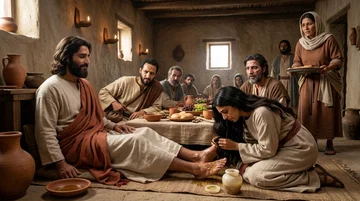
She brought an alabaster box of very precious ointment, spikenard worth three hundred pence, bought at great personal sacrifice to anoint His body after His death.ST Jul 22, 18862SP 375.1Ms 100, 1897, par. 6–7 She broke the box and poured it on His head as He reclined at meat, also upon His body and feet, and wiped His feet with her hair.DA 557ST Jul 22, 18862SP 375.1RH Aug 7, 1900Ms 100, 1897, par. 6–7 The broken container released a fragrance that made her act known to everyone present.6T 310.1–2RH Aug 7, 1900
She acted quietly, hoping to honor Jesus without drawing attention to herself.4RED 107.1–108.1 She believed reports that He would soon be honored as king in Jerusalem and would no longer be despised, rejected, or forced to flee.ST Jul 22, 18862SP 375.1 In love and gratitude she sought to honor Him first while she still could.4RED 107.1–108.1ST Jul 22, 1886
She had heard Jesus speak of His approaching death.DA 558.4–560.1 Her act prepared His body for burial.Ms 28, 1897, par. 21–29DA 558.4–560.1 He understood this and said the anointing was for His burial, as His death was near.Ms 28, 1897, par. 21–29
Love and Betrayal
Mary's pouring of the ointment on Jesus' head as He sat at meat was an outward expression of deep love, devotion, and gratitude for what He had done for her and her family, for His forgiveness of her many sins, His mercy, His service to others, His help to the poor, and His comfort to the oppressed.Ms 28, 1897, par. 21–29DA 558.4–560.14RED 107.1–108.1EW 134.2Ms 28, 1897, par. 42 Christ had lifted her from despair and demonic control, and through His grace she had overcome to become His close disciple, learning from Him and serving Him, grateful also for restoring her brother Lazarus to life.Ms 28, 1897, par. 21–29DA 558.4–560.14RED 107.1–108.1EW 134.2DA 568.1–2 Its value lay in the pure affection it expressed, given willingly without stopping to count the cost, and the greater its cost the more fully it expressed her gratitude.Ms 28, 1897, par. 21–29DA 558.4–560.1EW 134.2RH Aug 7, 1900 She used what she regarded as her own though it belonged to her only because it had first been Christ's, and she regretted that her gift was not richer and seemed feeble beside His boundless love.RH Aug 7, 1900
Christ took her motive into consideration, understood and accepted the gift, and gave it unqualified approval as a good work done for Him and for His burial.Ms 28, 1897, par. 21–29Lt 70, 1910, par. 17–21Ms 28, 1897, par. 42Ms 28, 1897, par. 35–37 He defended and commended her after she was condemned, teaching that her loving desire to serve Him as the world's Redeemer mattered more than the ointment itself.Lt 70, 1910, par. 17–21Ms 28, 1897, par. 35–37 Visible acts of love and gratitude are fitting testimonies to His supreme worth, not waste, and love for Christ makes one willing to give what is precious rather than calculating a gift's monetary cost.Ms 28, 1897, par. 42Ms 28, 1897, par. 35–37
The disciples had indignation at the deed and condemned it as waste, led by Judas the traitor who cared not for the poor.Lt 70, 1910, par. 17–214T 550.4 They said the ointment might have been sold for much and given to the poor, and Judas was vexed both by the anointing and by Christ rebuking them for condemning the woman.Lt 70, 1910, par. 17–21Ms 100, 1897, par. 6–7 The verse thus rebukes minds naturally inclined to question and criticize and condemn, like asking why wear a silk dress or why spend money for one worthy object instead of another.Lt 70, 1910, par. 17–21
Judas's appeal to care for the poor was an excuse for covetousness, avarice, selfish greed, and ambitious love of money, not concern for them.ST May 20, 1897EW 228.2SG1 181.1EW 134.2ST Mar 5, 1912 He coveted the money and imagined he could have managed it himself, was selfish and had taken money entrusted to him for the poor.4T 41.1–42.1EW 134.2 He prized his Lord so little that he later sold Him for a few pieces of silver.EW 228.2SG1 181.1
Until this anointing Judas had inwardly disagreed but made no open opposition, yet here he first murmured openly and manifested his covetous disposition.Ms 120, 1897, par. 7–8 When Jesus reproved him and impliedly rebuked his covetous spirit, wounded pride and revenge broke down his restraint, his spirit turned to resentment and to gall, and greed long indulged took control and overpowered every other trait.DA 720.1DA 563.2–564.13SP 125.2Ms 120, 1897, par. 7–8 The love of money had perverted the nobler nature of Judas.3SP 125.2
Judas let that rebuke deepen his resentment, which prepared the way for Satan's temptation to find a ready place and contributed to his betrayal of Jesus for money.4T 41.1–42.1DA 563.2–564.1EW 134.2Ms 120, 1897, par. 7–8 The account illustrates that persisting in tampering with sin and leaving depravity unresisted makes a person vulnerable to temptation and captive to Satan's will until the soul is led captive at his will.DA 720.1Ms 120, 1897, par. 7–8 A small indulged deviation grows until it leads to appropriating sacred trust and blindness to consequences, and exposes a parsimonious spirit that treats saving as godliness, with ambitious love of money, avarice, and selfish greed.Ms 100, 1897, par. 6–7
When Judas decided to sell his Master to the murderous priests and rulers he had no thought that Jesus would permit Himself to be taken, but thought the priests would be cheated of their bribe, he would secure the money to use for some purpose of his own, and Jesus would have a new opportunity to display divine power in delivering Himself from His enemies.3SP 125.2
Memorial and Giving
Jesus declared the anointing a good work that would be told for a memorial of her wherever the gospel is preached in the whole world.Lt 70, 1910, par. 17–214T 550.4 Its memory has inspired many to serve others and has prompted countless deeds of love through the centuries, showing that even one act can have widespread influence.6T 310.1–2ED 109.2–3 Mary will rejoice when she sees the good her gift has produced.6T 310.1–2
The act teaches that Christ is to be honored with the best of one's possessions and given first place, and that care for the poor must not cause neglect of God's cause.4T 550.4 Although the ointment could have been sold to provide food and clothing briefly for a few destitute people, Mary would have lost her one opportunity to minister to her Lord and show her love for Him.Lt 4, 1899, par. 38–40 Faithful stewards can do both, but they are not to direct all their labor and gifts to the poor and must also support those carrying out His commission to preach the gospel to everyone.4T 550.4Lt 4, 1899, par. 38–40
Christ joined her sacrifice of love with His own, the greatest sacrifice the world has known, as a lesson for the church in every age.Lt 4, 1899, par. 38–40 Her loving desire to serve Him as the world's Redeemer mattered more to Him than the ointment itself, and visible acts of love and gratitude are fitting expressions of His supreme worth.Ms 28, 1897, par. 35–37 Calculating a gift's monetary cost under pretense of helping the poor is less valuable than love for Christ that willingly gives what is precious.Lt 4, 1899, par. 38–40Ms 28, 1897, par. 35–37
Sources
Pioneers and periodicals
61 sources
Six days before the Passover near the close of his life, Jesus reclined at supper in Bethany in the house of Simon the leper, with Lazarus at meat and Martha serving and the twelve present.ST Sep 20, 1899RH Mar 24, 1910ST Aug 13, 1902 There Mary, once freed from seven demons and forgiven, broke a costly alabaster cruse of very precious liquid spikenard worth three hundred pence and poured it upon his head and his feet, wiping his feet with her hair until its fragrance filled the house.ST May 6, 1889ST Oct 9, 1879ST Sep 20, 1899ST Jan 10, 1911ST Apr 5, 1905 She gave from deep self-denying love and gratitude intending to honor him before his death, while Judas protested the waste from covetousness under pretense of care for the poor, and Jesus defended her as doing a good work upon him.ST May 20, 1897ST Oct 9, 1879ST Sep 20, 1899ST Mar 27, 1901RH Mar 24, 1910 Her act anointed his body beforehand for burial, and wheresoever the gospel is preached throughout the world it is spoken of for a memorial of her.ST Sep 20, 1899RH Jun 24, 1902ST Dec 20, 1905 No sacrifice made for him from love is waste, for an offering is measured not by money but by the love and self-denial poured out, and a life emptied in loving service becomes a lasting blessing.RH Jun 24, 1902ST Dec 2, 1880ST May 31, 1899ST Mar 27, 1901
Setting, Ointment, and Wording
The anointing took place at Bethany in the house of Simon the leper at a supper made for Jesus six days before the Passover at the beginning of A.D. 31, near the close of his earthly life and only a few days before his crucifixion.ST Sep 20, 1899RH Mar 24, 1910 At that supper Lazarus whom Jesus had raised sat at meat with him and Martha served, with the twelve present at a solemn feast.ST Sep 20, 1899ST Aug 13, 1902 Jesus reclined at meat, clad in plain garments beside Simon the host and Lazarus, while the household of Lazarus was expected to be present.ST Sep 20, 1899ST Jan 3, 1911ST Dec 20, 1910
The ointment was ointment of spikenard, very costly and liquid, imported from India by caravan and sold throughout the Roman Empire as among the most expensive perfumes of the ancient world.ST Sep 20, 1899ST Sep 20, 1899RH Mar 24, 1910 By the standards of the time its value exceeded £10 or about $50, was not less than three hundred denarii, and was worth more than three hundred pence.ST Sep 20, 1899ST Jan 10, 1911ST Dec 2, 1880RH Mar 24, 1910RH Mar 24, 1910 It was held in an alabaster cruse, a costly white-marble box of exquisite workmanship used to hold fine perfumes and precious things.ST Sep 20, 1899RH Mar 24, 1910ST Jan 3, 1911 The box was opened by breaking the cruse itself or by breaking its seal.ST Sep 20, 1899ST Jan 10, 1911RH Mar 24, 1910ST Jan 3, 1911
While he sat at meat the woman broke the box and poured it upon his head, and also poured upon his feet, wiping his feet with her long hair while her tears fell.ST Oct 9, 1879ST Sep 20, 1899ST Jan 10, 1911RH Mar 24, 1910ST Jan 3, 1911 She tried to act without attracting notice, but the fragrance filled the house and room and made her deed known to everyone present.ST May 6, 1889RH Aug 7, 1900ST Sep 20, 1899RH Mar 24, 1910 Anointing the head and feet was an ordinary act of honor and hospitality, customary for rabbis and honored guests at marriage feasts.ST Feb 24, 1914ST May 12, 1914ST Sep 20, 1899ST Apr 5, 1905 The fact that Matthew mentions the head does not mean the feet were not also anointed, for the accounts give complementary details and do not all mention every detail.ST Feb 24, 1914ST May 12, 1914
The Greek word translated pour is katacheo, meaning pour down.ST Jan 10, 1906 It occurs twice in the New Testament, here and in Mark 14:3.ST Jan 10, 1906 It differs from the Greek words translated pour in Matthew 26:12 and John 13:5.ST Jan 10, 1906
Harmony of Gospel Accounts
Matthew records that Mary poured costly ointment on the head of Jesus at Bethany.ST Feb 24, 1914ST May 12, 1914 John and Luke add the detail that his feet were anointed.ST May 12, 1914 The accounts give complementary details and do not all mention every detail.ST Feb 24, 1914ST May 12, 1914 Anointing both the head and the feet was an ordinary act of honor and hospitality, and Mary did both, so the mention of the head does not mean the feet were not also anointed.ST Feb 24, 1914ST May 12, 1914
This pouring of very costly ointment on his head as he reclined at meat belongs to the supper at the house of Simon the leper.ST Sep 20, 1899ST Sep 20, 1899 It is distinct from the earlier anointing described in Luke 7:36-50.ST Sep 20, 1899ST Sep 20, 1899 Similar events can be placed together in Scripture even when they occurred at different times, so this account need not be the same event as that earlier one.ST Sep 20, 1899
Woman, Motives, and Opponents
The woman is Mary, Mary Magdalene, once possessed by seven demons, once mad and cursing and blaspheming.ST Jan 10, 1911ST Jan 3, 1911 Jesus freed her from demonic possession and from Satan's bondage and forgave her sins, and her presence and act at the supper showed his power to free individuals.RH Aug 7, 1900ST Jan 10, 1911ST Apr 5, 1905RH Oct 16, 1913 Her great gratitude reflected the mercy shown her in that deliverance.ST Apr 5, 1905
She acted from deep, self-denying love, sympathy, gratitude, and worshipful love for her Lord as he faced the future near the close of his earthly life only a few days before his crucifixion.RH Mar 24, 1910ST Jan 3, 1911 She had secretly saved and bought the gift at great personal sacrifice and through self-denial, though she knew others might condemn her sacrifice.ST Oct 9, 1879ST Apr 5, 1905RH Mar 24, 1910 She had bought the ointment at great personal sacrifice intending to anoint his body after his death, having heard him speak of his approaching death.ST Oct 9, 1879ST Jul 22, 1886ST May 25, 1882 Yet believing reports that he would soon be raised to kingly authority in Jerusalem and become king, she rejoiced that he would no longer be despised, rejected, in danger, or forced to flee, and in love and gratitude sought to honor him first.ST Oct 9, 1879ST Jul 22, 1886ST May 25, 1882
She is described as beautiful, with soft shining hair falling about her shoulders and dark earnest eyes beaming worshipful love.ST Jan 3, 1911ST Jan 3, 1911 With nervous haste she crept close to his feet as he sat at meat.ST Jan 3, 1911ST Jan 3, 1911 Jesus knew the cost and commended her service as a good work on him, doing what she could.ST Sep 20, 1899ST Mar 27, 1901ST Jan 10, 1911 Her anointing of his head and feet also prepared his body beforehand for burial.ST Sep 20, 1899ST May 12, 1914
The disciples mistakenly called the act wasteful.ST Mar 27, 1901 Judas, the tall dark covetous man from Kerioth of Judea already meditating betrayal and his terrible deed, protested the waste and denounced her devotion as wasteful extravagance.ST Jan 10, 1911ST Jan 3, 1911 He claimed the spikenard should have been sold and given to the poor or to the temple treasury or put into his hand to divide among the poor, and expected honor for his piety and wisdom.ST Jan 10, 1911 His response illustrates a cautiousness about spending that can oppose faithful sacrifice for God.RH Nov 15, 1870
Judas's stated concern for the poor concealed his greed, covetousness, and dishonest use of the disciples' funds and served as an excuse for his covetousness.ST May 20, 1897ST May 6, 1889ST Mar 5, 1912RH Nov 15, 1870 His appeal to care for the poor was not truly for the poor but distress at what he saw as needless expenditure.RH Nov 15, 1870 Jesus rebuked Judas before the guests and defended her, saying Let her alone.ST Jan 10, 1911 Looking straight at Judas with flashing eyes that Judas could not meet, his rebuke exposed Judas's covetousness.ST Jan 10, 1911RH Nov 20, 1913 It stirred resentment and envy, helping lead him to betray Jesus, and the occasion marked the beginning of Judas's character becoming visible in outward actions.RH Nov 20, 1913ST Mar 27, 1901
The woman was present at the feast in Simon's house at Bethany, where seeing Jesus she remembered the love and pity in his eyes.ST Jan 31, 1911
Prophecy, Burial, and Remembrance
The verse belongs to the closing chapters of Matthew which recount Jesus' suffering, death, and resurrection.ST Sep 19, 1911 It is included in the account of the Messiah's rejection and suffering supporting the identification of Jesus with the one foretold in Isaiah 53.RH Nov 18, 1862 It is listed as part of the New Testament fulfillment of Zechariah 11:13.RH Jun 24, 1858
It belongs to the events at Bethany before Passover when Jesus told his disciples what was soon to happen.ST Dec 17, 1912 In the days that followed Judas betrayed Jesus to the priests for money, and the Lord was sold like a slave for temple money used to buy sacrifices.ST Dec 17, 1912 It is cited as part of the account of Jesus and his disciples eating the Passover, whose timing is used to calculate when Pentecost fell that year.ST Apr 15, 1889 If they kept the Passover at the proper time, Pentecost fell on the Sabbath, though Scripture does not settle the question.ST Apr 15, 1889
The act was a good work doing what she could, anointing his body beforehand for the burying.ST Sep 20, 1899 It was a timely expression of love and honor offered before his burial rather than after death when it would be too late to comfort or cheer him.ST Sep 20, 1899ST Dec 20, 1905 The breaking and pouring out gave the deed its place on the Gospel pages.ST Sep 20, 1899RH Jun 24, 1902 Wheresoever the Gospel shall be preached throughout the whole world what this woman did shall be spoken of for a memorial of her, so that its perfume now fills all the earth and her deed is remembered throughout the world.ST Sep 20, 1899RH Jun 24, 1902
Teachings on Love and Giving
The offering was an act of love whose fragrance filled the house, and though some called it waste the Lord orders that love poured out for him return as a blessing and spread among others.ST Apr 11, 1906 No sacrifice made for him is waste however great, and giving to Christ for a truly benevolent purpose does not deprive the poor, for her act is the example of generous sacrifice and devotion rather than wasteful extravagance.ST Mar 27, 1901 Things are valued in proportion to what they cost, and an offering's value is measured by the love and self-denial behind it.ST Dec 2, 1880RH Nov 11, 1915 She poured it all on him rather than keeping it to enjoy herself, counting nothing too good for Jesus, and lavishing costly sacrifice on Christ deepens Christian experience more than saving property does.ST Dec 2, 1880RH Nov 11, 1915
Her act was judged by love rather than financial calculation, for reason might call the gift wasteful but love moved her to lavish it on the one she loved.ST May 31, 1899ST Jan 10, 1906 Those who judged by money called it waste and would have prevented it, and when mammon rules costly acts of love are restricted.ST May 31, 1899ST Jan 10, 1906 Those who have received Christ's pardoning love give generously for his cause rather than calculating the value of their gifts.RH Feb 27, 1908RH Apr 14, 1859 Devotion does not stop to calculate value, its only regret is that the gift is not richer and more precious.RH Feb 27, 1908RH Apr 14, 1859
She gave her best to honor the one whom people despised, pouring very precious ointment on his head because her heart overflowed with love and nothing was too costly to give.RH Dec 3, 1867RH Sep 17, 1901 Christ deserves the best of affections and offerings in response to his giving his life and pouring out his precious blood.RH Sep 17, 1901 She used what she regarded as her own though it belonged to her only because it had first been Christ's.RH Aug 7, 1900 Her breaking of the alabaster box that was exceedingly precious is an example of uncommon, heroic service, refusing to be content with small service and attempting great things for God. It shows the kingliness in giving and serving that the King deserves and expects.
A life emptied out in loving service becomes a lasting blessing to the world and is remembered forever, while a life carefully kept and preserved from waste brings no reward or honor at the last.RH Jun 24, 1902 The breaking and pouring out gave the deed its place on the Gospel pages so that its perfume now fills all the earth and her deed is remembered throughout the world.RH Jun 24, 1902 The act represents worship and devotion, which are essential to the soul's life. Service cannot take the place of worship, and without devotion service becomes dead.
The deed revealed the witnesses' spiritual character, for those who failed to recognize its beauty showed blindness and hardness of heart and were judged by their inability to understand.ST Jul 6, 1915 Love is the first fruit of the Spirit and a test of character.RH Mar 18, 1858 Her anointing expresses sweet, holy, happy, constraining love that keeps her at Jesus' feet to hear his word so that she cannot leave him.RH Mar 18, 1858 It stands as the measure by which professed Christians must examine whether they abound in love that gladly spends and is spent for souls.RH Mar 18, 1858 The act is the right women have to support the cause of God, which Jesus recognized.ST Mar 13, 1884
Present Applications for Believers
The breaking of the alabaster box over Jesus while he was alive is the pattern for giving love beforehand, opening sympathy, affection, tenderness and sweetness during weary and troubled hours instead of keeping them sealed up until friends are dead.STRH Jul 3, 1913RH Mar 26, 1901 Approving, cheering words, tenderness, kind words and praise should be spoken in lifetime while ears can hear them and hearts can be thrilled and made happier by them, and flowers meant for the coffin should be sent to brighten and sweeten homes now.STRH Jul 3, 1913RH Mar 26, 1901 Post-mortem kindness does not cheer the troubled spirit, perfumes broken over the dead body do not refresh or cheer, and flowers on the coffin cast no fragrance backward over life's weary way.STRH Mar 26, 1901
The alabaster box pictures a heart full of love, praise and the Holy Spirit's message, and gracious affection flowing from a broken heart as humble love and devotion that is a sweet offering to Christ and brings heavenly sweetness to the soul.ST Mar 11, 1908RH Jan 6, 1859 These gifts should be poured out now in praise, testimony, loving gifts and service to Christ, despite criticism, as giving one's most precious possession, so others may be blessed and refreshed, rather than kept hidden until hardship forces them out.ST Mar 11, 1908RH May 8, 1879RH Jan 6, 1859 That costly act of devotion continues to bear fragrance as an example of service to the Lord whose value and reward endure.ST Jun 1, 1882
Love for him can make a home like Bethany, devoted to worship and daily sacrifice, with the costly ointment pictured as offered daily in a Christian home so its fragrance continually fills the house.ST Sep 23, 1875RH Apr 17, 1900 Christ's peace and the gospel so make home a foretaste of heaven and an inviting place.RH Apr 17, 1900 Sincere confession to God or to other people brings a blessing and fills a prayer meeting with a fragrance as sweet as the broken alabaster box, in contrast to showy, wordy claims of guilt which nauseate hearers and cannot deceive God.RH May 30, 1912
Something others dismiss as waste can be valuable, for the disciples called the pouring waste, and the verse defends missionary work in Africa from those who call its investment of time, money and life futile.ST Jun 29, 1904 The alabaster box of precious ointment poured out freely pictures a teacher offering love generously and treating a troubled child with kindness and gentleness.RH Jan 10, 1907 The woman's gift of precious ointment is a token of love and the better way.RH Aug 21, 1913
Sources