Matthew 9:11
And when the Pharisees saw it, they said unto his disciples, Why eateth your Master with publicans and sinners?
Translations
And when the Pharisees saw it, they said to his disciples, Why eats your Master with publicans and sinners?
King James Version, KJV Cambridge Paragraph Bible
And when the Pharisees saw it, they said unto his disciples, Why eateth your Master with publicans and sinners?
And when the Pharisees saw it, they said to his disciples, Why eateth your Master with publicans and sinners?
And when the Pharisees saw it, they said unto his disciples, Why eateth your Master with the publicans and sinners?
And when the Pharisees saw it, they said unto his disciples, Why eateth your Teacher with the publicans and sinners?
and the Pharisees having seen, said to his disciples, 'Wherefore with the tax-gatherers and sinners doth your teacher eat?'
And the Pharisees seeing [ it], said to his disciples, Why does your teacher eat with tax-gatherers and sinners?
And, the Pharisees, observing it, began to say unto his disciples,—Wherefore, with tax-collectors and sinners, doth your Teacher eat?
Berean Standard Bible, Majority Standard Bible
When the Pharisees saw this, they asked His disciples, “ Why does your Teacher eat with tax collectors and sinners?”
When the Pharisees saw it, they said to his disciples, “ Why does your teacher eat with tax collectors and sinners?”
And when the Pharisees saw it, they said to his disciples, Why does your Master take food with tax-farmers and sinners?
And when the Pharises sawe that, they saide to his disciples, Why eateth your master with Publicanes and sinners?
Douay-Rheims (Challoner revision)
And the Pharisees seeing it, said to his disciples: Why doth your master eat with publicans and sinners?
Pictures
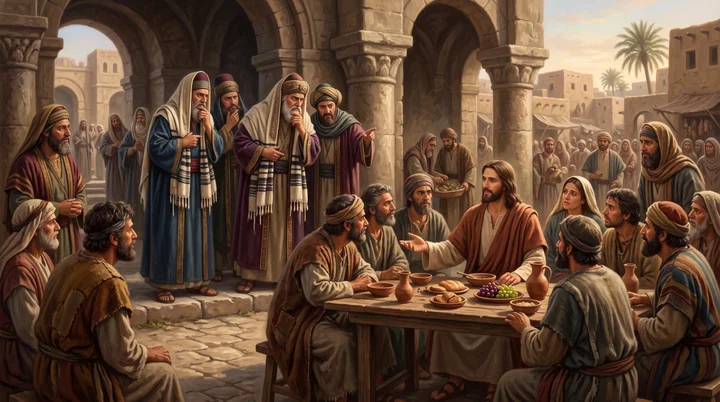
Cross-references
- Luke 5:30-32
But their scribes and Pharisees murmured against his disciples, saying, Why do ye eat and drink with publicans and sinners?
Jesus’ table fellowship with sinners draws Pharisaic criticism, and he explains his mission to call them.
- Mark 2:15-17
And it came to pass, that, as Jesus sat at meat in his house, many publicans and sinners sat also together with Jesus and his disciples: for there were many, and they followed him.
Jesus eats with publicans and sinners despite criticism, then explains his mission to call sinners.
- Hosea 6:6
For I desired mercy, and not sacrifice; and the knowledge of God more than burnt offerings.
God desires mercy rather than sacrifice, answering the Pharisees’ condemnation.
- Luke 19:7
And when they saw it, they all murmured, saying, That he was gone to be guest with a man that is a sinner.
People grumble when Jesus visits Zacchaeus, a publican.
- Mark 2:17
When Jesus heard it, he saith unto them, They that are whole have no need of the physician, but they that are sick: I came not to call the righteous, but sinners to repentance.
Jesus answers the Pharisees’ question by explaining his mission to sinners.
- Matthew 11:19
The Son of man came eating and drinking, and they say, Behold a man gluttonous, and a winebibber, a friend of publicans and sinners. But wisdom is justified of her children.
Jesus is accused of associating with publicans and sinners.
- Matthew 21:31-32
Whether of them twain did the will of his father? They say unto him, The first. Jesus saith unto them, Verily I say unto you, That the publicans and the harlots go into the kingdom of God before you.
Publicans and sinners respond to Christ, while the Pharisees do not.
- 1 Timothy 1:15
This is a faithful saying, and worthy of all acceptation, that Christ Jesus came into the world to save sinners; of whom I am chief.
Christ came into the world to save sinners.
- Luke 19:10
For the Son of man is come to seek and to save that which was lost.
Jesus came to seek and save the lost, including those counted as sinners.
- Mark 2:15
And it came to pass, that, as Jesus sat at meat in his house, many publicans and sinners sat also together with Jesus and his disciples: for there were many, and they followed him.
Jesus eats with publicans and sinners.
- Luke 15:2
And the Pharisees and scribes murmured, saying, This man receiveth sinners, and eateth with them.
Both record leaders’ complaints that Jesus received sinners and ate with them.
- Luke 7:36-50
And one of the Pharisees desired him that he would eat with him. And he went into the Pharisee’s house, and sat down to meat.
Jesus eats at a Pharisee’s table with a woman known as a sinner.
- Luke 19:5-6
And when Jesus came to the place, he looked up, and saw him, and said unto him, Zacchæus, make haste, and come down; for to day I must abide at thy house.
Both show Jesus entering a sinner’s home.
- Galatians 2:12
For before that certain came from James, he did eat with the Gentiles: but when they were come, he withdrew and separated himself, fearing them which were of the circumcision.
Both condemn refusing to eat with those judged inferior.
- Matthew 9:15
And Jesus said unto them, Can the children of the bridechamber mourn, as long as the bridegroom is with them? but the days will come, when the bridegroom shall be taken from them, and then shall they fast.
Christ's answer covers both groups of critics
- Matthew 5:46
For if ye love them which love you, what reward have ye? do not even the publicans the same?
Both condemn loving only one’s own circle.
- Luke 18:9-14
And he spake this parable unto certain which trusted in themselves that they were righteous, and despised others:
The penitent sinner is pardoned, unlike the self-righteous man.
- John 8:7-11
So when they continued asking him, he lifted up himself, and said unto them, He that is without sin among you, let him first cast a stone at her.
Jesus exposes the accusers’ sin and shows mercy to the condemned woman.
Commentary
Each commentary is drawn from primary sources: the writings of Ellen G. White and Adventist pioneers and periodicals. Each commentary is separate. Its own words are not a quotation; follow the references to read the source passages.
Ellen G. White
57 sources
The Pharisees saw Jesus sharing a meal with despised tax collectors and outcasts at Matthew's feast and challenged His disciples over why He would eat with such people.Ms 61, 1899, par. 9Lt 115, 1902, par. 22–28Ms 113, 1902, par. 22–237MR 310.1–311.1Ms 3, 1898 They asked the disciples rather than Christ Himself in hope of planting prejudice and shaking their trust in Him.ST Jun 23, 1898Lt 206, 1906, par. 28–31Ms 3, 1898, par. 5–8 Their question sprang from pride, envy and self-righteous contempt for those they counted as spiritually lost.Ms 61, 1899, par. 916MR 90.1–91.2ST Jun 23, 1898Ms 3, 1898, par. 5–82SP 188.1–2 Jesus sat with sinners in sympathy and social kindness to draw them toward truth and new life, not to share in their low habits or be corrupted by them.ST Jun 23, 1898GW 47.2STA 150.2MH 197.2–3MH 26.2 He did so because He came as a physician for the sin-sick to call sinners to repentance, showing that God desires mercy rather than exclusionary sacrifice.Ms 61, 1899, par. 9Lt 199, 1905, par. 7–8Lt 112, 1909, par. 26Lt 115, 1902, par. 22–287MR 310.1–311.1
Setting at Matthew's Feast
The question was asked at Matthew's feast in a house where Jesus sat at meat with His disciples when many publicans and sinners came and sat down with Him.7MR 310.1–311.1Ms 3, 1898
Publicans were hated as agents of Roman rule who often extorted the people and were despised as betrayers and outcasts.DA 272.1–273.2
Matthew was judged by the Pharisees according to that work, while Jesus saw his openness to truth.DA 272.1–273.2
At that feast the criticism of eating with tax collectors and sinners came from the Pharisees, but John's disciples joined them in condemning His practice.DA 360.4–361.2Ms 3, 1898, par. 13–15
This was while they were mourning and fasting over John's imprisonment.Ms 3, 1898, par. 13–15
They had not accepted Jesus as the world's Redeemer as fully as John had, and thinking He needed to reform His practice because He did not do in every particular as John did, they saw His disciples being molded differently from themselves and from the scribes and Pharisees.Ms 3, 1898, par. 13–15
Their condemnation came from misinterpreting His object in going where sinners were.Ms 3, 1898, par. 13–15
The chapter is interesting because it shows His work reached people from every class.Ms 138, 1908, par. 15
Pharisees' Accusation and Motives
When the Pharisees saw Jesus eating with publicans and sinners they did not address him himself but questioned his disciples, asking why their Master eats with such people.Ms 61, 1899, par. 9Lt 115, 1902, par. 22–28Ms 113, 1902, par. 22–23Ms 106, 1902, par. 2 Christ himself met the charge for his disciples.Lt 115, 1902, par. 22–28Ms 113, 1902, par. 22–23 His carrying the gospel to all people and accepting invitations to feasts and to houses of publicans was the occasion of the question, for he knew only in this way could he reach them with heaven's message.Ms 113, 1902, par. 22–23Ms 106, 1902, par. 2
They aimed the question at the disciples hoping to arouse prejudice already in their minds, spread doubt, shake their weak faith, turn them against him, and bruise and wound where it would harm his work.ST Jun 23, 1898Lt 206, 1906, par. 28–31Ms 3, 1898, par. 5–8DA 274.4–275.34RED 45.2–3 Their arrows were aimed where they would bruise and wound, yet the disciples' confidence in Christ kept them from accepting the insinuation.ST Jun 23, 1898Lt 206, 1906, par. 28–31 The attempt was malicious, meant to discredit him and alienate hearts from him.Ms 3, 1898, par. 5–84RED 45.2–3
The charge was scandal, reproach, falsehood and malicious misreading meant to make Christ appear a criminal and a deceiver, to furnish a pretext for condemning him, and to have him reported in a distorted light.16MR 90.1–91.2ST Dec 28, 1876 It belonged to constant spying in which every word and action was watched, with false witnesses greedily received.16MR 90.1–91.2 It is the same accusation brought against commandment-keeping people.16MR 90.1–91.2
The question arose from bitter prejudice and hostility, from envy and jealousy, from intense hatred, and from hearts closed to conviction that refused the evidence that he was the Teacher sent from God.Ms 61, 1899, par. 916MR 90.1–91.2Lt 206, 1906, par. 28–312SP 192.3–193.1 The envious and jealous Pharisees misread his conduct and accused him of impiety, misrepresenting his actions as impious company.Lt 206, 1906, par. 28–312SP 192.3–193.1 They misread his purpose and judged his practice by their own expectations.Lt 206, 1906, par. 28–31ST Jul 7, 1898
They exalted themselves and with pride, contempt, self-righteous bigotry, exclusiveness and narrow ideas of salvation depreciated, hated and despised publicans and sinners who had not their privileges and light.ST Jun 23, 1898Ms 3, 1898, par. 5–82SP 188.1–24RED 40.4–42.1ST Dec 28, 1876 They regarded them as disreputable and spiritually lost.2SP 188.1–2ST Dec 28, 1876DA 274.4–275.3 They resented that Jesus' example influenced the people while disregarding their customs and traditions, clinging to prejudice and reliance on tradition against those most in need of forgiveness and mercy and openness to truth.4RED 40.4–42.1ST Dec 28, 18762SP 188.3
Their guilt in God's sight was greater because heaven's light flashed across their pathway and they spurned the gift.ST Jun 23, 1898 Their strict observance of outward religious forms concealed envy and strife.DA 278.1–2 Their proud, foolish fasting in pride and self-righteousness for strife and debate, to smite with the fist of wickedness, the world's Redeemer could not honor.ST Jun 23, 1898DA 278.1–2
Their Pharisaism watches for flaws, refuses to forgive, turns from the erring youth or worker as from a pestilence, and finds it easier to destroy fallen human beings than to reform them.Lt 115, 1902, par. 22–28 By standing in the way their objection kept needy people from finding hope, freedom and courage in his words and works.Ms 115, 1906, par. 12–15Lt 115, 1902, par. 22–28
Christ's Fellowship with Sinners
Jesus sat at meat with publicans and sinners calm and self-possessed, kind and courteous and friendly, and in humility He drew them to Himself to declare that they were not shut out from His presence.ST Jun 23, 1898 His presence as an honored guest at a publican's table was sympathy and social kindness, affirming the human dignity of publicans and other outcasts whom others despised, and He did not approve those who stood apart in self-esteem and looked down on others.GW 47.2MH 164.2MH 26.22MR 109.1Ms 69, 1902, par. 6 His words awakened new desires and impulses in them and brought life to their hearts, enlightening them and strengthening those convicted of truth and drawing them toward His wisdom, so that the possibility of a new life opened before them and they longed to become worthy of His confidence.Ms 140, 1903, par. 45–46GW 47.2MH 26.22MR 109.1Ms 69, 1902, par. 6
He mingled with them and accepted invitations to feasts and to houses of publicans, and also of Pharisees, and He did not separate Himself from ordinary social life and common people.Ms 113, 1902, par. 22–236T 173.2Lt 66, 1878, par. 7 He met people where they were, at the guest table, in the streets, by the lakeside, in synagogues and the temple, and on crowded thoroughfares where multitudes were willing to admit they were sinners.Ms 128a, 1903, par. 14–15Ms 128, 1903, par. 18–19 He carried the gospel to all people knowing only in this way could He reach them with heaven's message, mingling with all classes so they could receive His blessings and learn His character.Ms 113, 1902, par. 22–23 That mingling rejected society's distinctions of birth, wealth, learning and rank, and let them see how His generous conduct and teaching differed from the Pharisees' censorious spirit, in contrast with their self-righteous bigotry and narrow ideas of salvation.MH 197.2–316MR 318.2–319.1Lt 2, 1878, par. 6–8
He did not eat with them to adopt their low habits or share their earthliness and debasement, nor to join their plans and work, nor to partake of luxuries, amusement and feasting, nor to become tainted and corrupted by their company and conversation.STA 150.2MH 197.2–3GW 394.1–2Lt 95, 1899, par. 24SW 2.2 He used every word and influence there with purpose to teach right principles by word and godly example, turning conversation and thoughts to matters of eternal importance and eternal interest and using His words and influence for their good.GW 394.1–2FE 482.2Lt 95, 1899, par. 24 His manner was to sit at table sowing seeds of truth in hearts, seeds that would spring up and bring forth fruit as some afterward responded to His call to follow Him and accepted Him as Redeemer and were converted.Ms 113, 1902, par. 22–23Ms 140, 1903, par. 45–46 Those seeds scattered in almost every place sprang up after His resurrection and ascension under the teaching of the apostles, when in one day five thousand believers were converted.Ms 128a, 1903, par. 14–15Ms 128, 1903, par. 18–19
His sharing a meal with them was holy, and He spoke to them words of life.4RED 45.2–3ST Dec 28, 18762SP 192.3–193.1 That eating at Matthew's feast was not mere indulgence but, like His fasting in the wilderness, part of His self-giving work to save the lost.DA 278.1–2 His high and noble and pure character let the light of truth shine in marked contrast to the Pharisees, priests and rulers who disregarded their commissioned work.Ms 128a, 1903, par. 14–15Ms 128, 1903, par. 18–19 True devotion is not shown by formal fasting or bodily humiliation but by surrendering self in willing service to God and others.DA 278.1–2 Many of those the Pharisees scorned accepted Him as their Redeemer and would be gathered into His kingdom, while the self-righteous accusers would share the portion and fate of hypocrites and unbelievers when He came in glory.4RED 45.2–3ST Dec 28, 18762SP 192.3–193.1
Christ's Mission and Answer
When the charge was brought to the disciples, Christ Himself met it for them.Lt 115, 1902, par. 22–287MR 310.1–311.1 His answer was that those who are whole do not need a physician, but those who are sick do.Lt 115, 1902, par. 22–287MR 310.1–311.1 He came to call sinners, not the righteous, to repentance.Ms 61, 1899, par. 9Lt 199, 1905, par. 7–8Lt 112, 1909, par. 26Ms 113, 1902, par. 22–23Lt 98, 1893, par. 18–19 His presence among the sin-sick was the work of a physician, to reach those most in need of forgiveness, mercy and repentance rather than to avoid them.Ms 61, 1899, par. 9Lt 199, 1905, par. 7–8Ms 113, 1902, par. 22–23Ms 106, 1902, par. 22SP 189.1–3
Their need made them fitting recipients of His help.2SP 189.1–3 The Pharisees' contempt and prejudice kept them from recognizing their own need.2SP 189.1–3 God will have mercy and not sacrifice, so mercy rather than religious exclusion or ritual sacrifice is the fitting response to sinners' need.Lt 199, 1905, par. 7–8Ms 115, 1906, par. 12–15Lt 112, 1909, par. 26RH Apr 30, 19017MR 310.1–311.1 Their objection stood in the way of people who needed His words and works to find hope, freedom and courage.Ms 115, 1906, par. 12–15
Seeking and saving the lost is His work.7T 18.1Ms 106, 1902, par. 2 His purpose in taking human nature and bearing the penalty of transgression was to uplift and elevate the race so that repentant sinners may stand accepted.Lt 115, 1902, par. 22–28 He restores in man the image of God by drawing sinners with pardoning love instead of pushing them into darkness and death.Lt 115, 1902, par. 22–28
Example for Followers
Seeking and saving the lost is the work given to followers, for the questioning of why eating with publicans and sinners drew the answer that the call is to sinners to repentance.7T 18.1Ms 106, 1902, par. 2Lt 282, 1907, par. 4 That work is to be done through personal effort and by direct appeals to the unconverted, rather than by concentrating effort only on people who already know the truth.7T 18.1Ms 106, 1902, par. 2Lt 282, 1907, par. 4 Willingness to share the company of tax collectors and sinners displayed generous mercy and gave them a chance to know him, in contrast to exclusiveness.MYP 403.1GW92 319.2–320.1 His example rebukes bigotry and exclusiveness, teaching followers to seek the company of others in order to bless them with the good received from God.MYP 403.1GW92 319.2–320.1 They are to join themselves to people and their concerns and meet every class where they are, including in homes and at social gatherings, without abandoning or avoiding social contact.MYP 403.1GW92 319.2–320.1
Followers are called by his example to mingle with common people, eat with publicans and sinners, and do good among unbelievers in order to teach right principles by word and example and lift them up.STA 150.2GW 394.1–2FE 482.2Lt 95, 1899, par. 24SW 2.2 Mingling gave a way to reach them, and accepting invitations to meals with both Pharisees and publicans became an occasion to teach lessons suited to the hearers.GW 394.1–2FE 482.2Lt 95, 1899, par. 246T 173.2 That presence did not mean joining their plans and work, becoming like them, adopting their low habits, or adopting the conversation usually heard there.STA 150.2GW 394.1–2FE 482.2Lt 95, 1899, par. 24SW 2.2 His words and influence were used for their good to turn conversation and thoughts toward matters of eternal importance and eternal interest.GW 394.1–2FE 482.2Lt 95, 1899, par. 2415MR 168.3–4 In the same way the words and speech of followers in such company can impart spiritual lessons, recommend Christ, and turn minds toward eternal realities.GW 394.1–2FE 482.26T 173.2
He associated with publicans and sinners not to share their character or spirit and not to be tainted or corrupted by their company or conversation.20MR 289.2Ms 10, 1891, par. 17–19 He did not eat with them to partake of luxuries, amusement, and feasting, but to diffuse and scatter the precious gems and jewels of truth while sitting at their table and to sow the seed of life through words that could take root in the heart.20MR 289.2Ms 10, 1891, par. 17–19Ms 9, 1891, par. 24–26 Those truths remain in hearts, and although they may not yield at once to the influences of the Spirit, they are affected by them and will finally yield because he keeps drawing them all the time.Ms 10, 1891, par. 17–19Ms 9, 1891, par. 24–26 Followers are therefore to remain among people in the world and shine amid its moral darkness, with effective influence that enlightens and unites to him, so others may see their good works and come to the light.20MR 289.2Ms 9, 1891, par. 24–26 Even with an unpopular faith that separates from the world, they must not place themselves in sympathy and views so far from the world that they cannot reach souls.Ms 6, 1875, par. 4 His sympathies were identified with suffering humanity, reaching the sinful, helpless, and needy where they were and making their necessities his own, and followers must not judge other men's consciences or bind exacting burdens that God does not bind, lest exacting traits close the door of access to souls by a burdening restraint they cannot endure.Ms 6, 1875, par. 4
His fellowship was an intentional way to encourage people who had gone wrong, meet their deepest needs, and offer the guidance the religious leaders withheld.7MR 310.1–311.115MR 168.3–4 His words were wise and truthful, reaching troubled hearts and turning minds toward eternal realities.7MR 310.1–311.115MR 168.3–4 The account belongs to a ministry to the sick that holds precious lessons for healing work, drawing the answer that those who are whole do not need a physician but those who are sick do, that God will have mercy and not sacrifice, and that the call is not to the righteous but to sinners to repentance.Ms 138, 1908, par. 157MR 310.1–311.1 The chapter is interesting because it shows the work reached people from every class, and this is applied to receiving and laboring for the poor and suffering in sanitariums.Ms 138, 1908, par. 157MR 310.1–311.1
Sources
Pioneers and periodicals
47 sources
The question was asked at the feast in the house of Levi called Matthew, where Jesus sat as honored guest with His disciples and many publicans and sinners including Matthew's former companions.ST Jun 23, 1898RH Jan 8, 1914ST Sep 13, 1899 The Pharisees saw Him calm and friendly while eating and put their question to His disciples rather than to Him, hoping to stir prejudice and shake their weak faith.ST Jun 23, 1898RH Nov 26, 1901RH Sep 9, 1909 Their words were criticism and accusation that treated His fellowship with despised tax collectors and sinners as a fault, springing from exclusiveness, pride and self-righteous intolerance.ST Jun 23, 1898RH Aug 26, 1862ST Oct 11, 1899ST Mar 10, 1898 He ate with them in humility to teach, help and save them, for He came to call sinners to repentance and save the lost, like a physician seeking the sick with mercy rather than ritual sacrifice.ST Dec 28, 1876RH Apr 30, 1901RH Aug 26, 1862ST May 26, 1914 His example calls His followers to mingle with all classes, even the degraded and outcast, to win them to God and lift them spiritually, without sharing their sins or sacrificing principle.ST Jun 3, 1886ST Jan 22, 1885RH Nov 3, 1863ST Nov 4, 1886
Feast Setting and Words
The question belongs to the feast at the house of Levi, also called Matthew, where Jesus sat at meat as an honored guest with His disciples together with many publicans and sinners, including Matthew's former companions.ST Oct 30, 1907RH Jan 8, 1914ST Dec 3, 1894 He did not refuse to eat at the same table with those judged as sinners, and His sitting there in mingling sympathy and social kindness affirmed their human dignity while His words gave life and inspired them to become worthy of His confidence.ST Oct 30, 1907RH Jan 8, 1914 Their disapproval of His association shows their complaint that He had gone into the home of a tax collector they regarded as a sinner.ST Sep 13, 1899
The setting is Capernaum on the west side of the Sea of Galilee near Chorazin and Bethsaida, a busy commercial city and thoroughfare between Jerusalem and Damascus where Jesus made His earthly home.ST Jun 2, 1898 There He found Matthew the tax-gatherer, collector of customs, a busy tax collector who left his profitable calling to cast in his lot with Him.RH Sep 28, 1916ST Jun 2, 1898 That calling of Matthew was one of the noted miracles, teachings, and special tokens of divine grace given to the favored city, bringing greater responsibility.ST Jun 2, 1898 It shows Christ does not call idle men to work in His vineyard.RH Sep 28, 1916
The Pharisees saw Jesus calm, self-possessed, kind, courteous and friendly while eating, yet unable to endure the picture because it was unlike their own course.ST Jun 23, 1898 They directed their question, Why eateth your Master with publicans and sinners, to His disciples rather than to Him, hoping to arouse prejudice already in their minds and thus shake their weak faith, aiming where they would bruise and wound.ST Jun 23, 1898RH Nov 26, 1901RH Sep 9, 1909 His presence at the publican's feast was a way of coming close to people in order to reach and elevate them spiritually.RH Nov 26, 1901
Jesus willingly entered homes and accepted invitations to be a guest without favoring rich over poor or avoiding places marked by trouble or ungodly people.ST Jul 21, 1898RH Apr 8, 1902 This is shown by dining with the publican, staying with Zacchaeus, dining at a covetous Pharisee's table, lodging in a manger rather than in rich surroundings, and preaching to the common people who heard Him gladly.ST Jul 21, 1898RH Apr 8, 1902 He accepted the invitation to dine with the publican in order to save sinners, and that fellowship with sinners and the poor was His method of helping the poor and unfortunate.ST Apr 2, 1912ST Jul 21, 1898
Pharisees' Criticism and Spirit
The question put to the disciples was criticism and objection, reproof and serious accusation, treating table fellowship and association with tax collectors and sinners as a fault to be condemned.RH Aug 26, 1862ST Oct 11, 1899ST Mar 10, 1898ST Jan 3, 1911RH Nov 3, 1863 It expressed disapproval of eating with Matthew's former companions and made His choice of company itself the ground of charge.ST Mar 10, 1898ST May 26, 1914ST Jan 3, 1911 The setting shows the objection arose precisely because He came to call sinners and not those who counted themselves righteous.RH Aug 26, 1862
Those who asked it regarded publicans and sinners with contempt and disdain, hatred and depreciation, as low and degraded and excluded.ST Dec 28, 1876ST May 26, 1914ST Jan 27, 1904 They looked down on them for social standing and circumstances and for lack of privileges and light.ST Dec 28, 1876STST Jan 27, 1904 Their complaint thus exposed exclusiveness and prejudice, and showed they did not understand His mission to reach and call sinners to repentance.ST May 26, 1914STST Jan 27, 1904
That spirit was pride and self-righteous intolerance, exalting self while depreciating, hating and despising those without the same privileges and light.ST Jun 23, 1898 The proud fasted in pride and self-righteousness for strife and debate, to smite with the fist of wickedness, fasts the Redeemer could not honor.ST Jun 23, 1898 Their guilt was greater in the sight of God because heaven's light flashed across their pathway and they spurned the gift.ST Jun 23, 1898 Love, by contrast, reaches out to those others reject, and tolerance toward sinners keeps covenant with God in letter and spirit rather than violating it.ST
They misread His holy purpose and judged His practice by their own expectations and restrictions.ST Jun 23, 1898ST Dec 28, 1876ST Jul 7, 1898 Their practice and restrictions did not establish what was right, nor did they bar sinners from receiving help and being welcomed by Christ.ST Apr 23, 1896 In this criticism the Pharisees even joined the disciples of John.ST Jul 7, 1898 Their charge was a malicious misreading meant to stir prejudice, aiming their arrows where they would bruise and wound.ST Jun 23, 1898ST Dec 28, 1876
In rejecting Him their prejudice kept them from recognizing the Messiah when He came among them, so they treated Him as an impostor.RH Nov 18, 1862 Many of the people they scorned accepted Jesus as Redeemer.ST Dec 28, 1876 The self-righteous accusers face the portion of hypocrites and unbelievers when Christ comes in glory.ST Dec 28, 1876
Christ's Mission to Sinners
Jesus sat with tax collectors and sinners in order to teach them, help them, and save them, for He came to call sinners to repentance and to save the perishing and the lost, and saving the lost was the purpose guiding all His dealings with people.ST Dec 28, 1876ST May 26, 1914ST Jun 3, 1886RH Nov 3, 1863ST Apr 2, 1912 Sinners are not to wait until they become worthy, but are to come to Him admitting their true condition, because they cannot cleanse or improve themselves and need His mercy and saving help.RH Aug 26, 1862 He mingled with people of many ranks and kinds, including the sick, the poor, and those regarded as morally depraved.RH Jan 27, 1863 He went among them without sharing the world's spirit or customs and without lowering His principles or indulging them.ST Jun 28, 1905RH Nov 26, 1901
Like a physician caring for the sick, He is a practical and loving physician of souls who goes after sinners to save them, not a wrathful figure who rejects any who come to Him.ST Dec 28, 1876RH Apr 30, 1901RH May 9, 1871 People afflicted by sin are not hopeless cases to be cast off, but need the help of the great Physician.ST May 26, 1914 Mercy, not ritual sacrifice, is the fitting response to their need.RH Apr 30, 1901 His sharing a meal with them was holy, and His presence at an unworthy table is not hindered but supplies forgiveness, peace, and perfect righteousness.ST Dec 28, 1876RH Dec 14, 1916RH Nov 26, 1901
He ate with them in humility to draw them to Himself and to declare that they were not excluded from His presence.ST Jun 23, 1898 His sympathy and social kindness at the publicans' table affirmed their human dignity, and His words gave life to their hearts and inspired them to become worthy of His confidence.ST Oct 30, 1907 He spoke to them with love and hope, for His contact with them belonged to a holy mission to save those who were lost.ST Oct 2, 1893 The questioning of His disciples treats His meal as grounds for accusation, but it was a malicious misreading meant to stir prejudice.ST Dec 28, 1876RH Nov 26, 1901 They heard Him gladly, came to hear Him, felt their need and believed He could meet it, and many of those who were scorned accepted Him as their Redeemer.ST Dec 28, 1876ST Jun 28, 1905
Pattern for Believers
His example in eating with publicans and sinners rather than excluding them from His company means Christians are to associate with sinners and show them tolerance.RH Dec 11, 1856RH May 28, 1861ST Aug 2, 1899 The gospel does not shut out those despised by society, nor does it treat social rank as the measure of human worth.RH Dec 11, 1856RH May 28, 1861 His welcoming of people across social divisions is the love needed to bridge social chasms.ST Aug 2, 1899 He even endured a sinner among the twelve and died for sinners, while self-righteous intolerance toward such association violates covenant with God in both letter and spirit.
Christians are therefore permitted and taught to mingle with any class of people to do good to their souls and bodies.ST Jun 3, 1886ST Jan 22, 1885RH Nov 3, 1863RH Sep 25, 1913 They should go among the poor, degraded, fallen, outcast, and those regarded as sinners, meeting people society rejected in order to reach them, rather than excluding them through pride or lack of sympathy.ST Jan 22, 1885RH Nov 3, 1863RH Sep 25, 1913ST Dec 4, 1901 They are not too good to reach them, but are to welcome and care for people in need and to reach and elevate them spiritually.ST Jan 22, 1885RH Nov 3, 1863RH Sep 25, 1913 Such willingness to share their table brings humble, direct contact with hardened and outcast people and opens the way for the kingdom of God, which His followers are called to do likewise.ST Dec 4, 1901 People may even adapt to social customs to help fallen humanity in this work.
That contact must be for the purpose of teaching, saving, helping, and winning them to God, faithfully seeking to turn them from evil.ST Jun 3, 1886ST Nov 4, 1886 It permits close contact with people who need God when the aim is to win them to Him, not to preserve friendship at the cost of Christian faithfulness.ST Nov 4, 1886 It does not mean sharing in their sins, acting like them, or being corrupted by the world, and Christians may associate with people in the world while remaining free from worldly influence.ST Jun 3, 1886RH Dec 12, 1865 People may adapt to social customs to help so long as they do not sacrifice principle.
Drawing nearer to Him obliterates exclusiveness, cliques, and separation from fellows.RH Apr 20, 1916 He did not choose a favored few and ignore others, mingle for benefit, or separate Himself by wealth, education, and attainments, but associated with those who needed His help, with rich and poor, learned and ignorant.RH Apr 20, 1916 Christian work requires such sympathy and contact with the poor, degraded, low and sinful, without repulsion toward them.ST Jan 27, 1904 Christians are thus made free to associate with all on the basis of real worth and character rather than position, wealth, education, fine clothes, fluent speech, or agreement in oddities, hobbies, and opinions, and serving and caring for those regarded as sinners is work done for Christ.RH Apr 20, 1916ST May 17, 1899
Refusing to eat with those judged lower or sinful comes from pride and religious bigotry.RH Jan 8, 1914 That spirit is seen in the caste system of India where custom forbids eating with or taking food from one of lower caste even if starving, and in Jews refusing to eat with Gentiles.RH Jan 8, 1914 It is deplorable when Christians act the same way without the same name by turning a cold shoulder to even a brother in the church and shunning him because of an evil report concerning him or because he spoke disparagingly, even going so far as to refuse to eat at the same table with one judged a sinner.RH Jan 8, 1914RH Jan 8, 1914
It is safe and right to follow His table fellowship and not turn a cold shoulder to or shun a brother or one judged a sinner.RH Jan 8, 1914 He did not refuse to eat at the same table with those judged as sinners, just as He ate the Passover at the same table with Judas while knowing his deceit and unfaithfulness.RH Jan 8, 1914 His followers must follow that example for His sake and not their own, loving those who hate and sin instead of loving only those who love them, mingling with the mean and unsaved, and carrying light where darkness reigns instead of where light already shines.ST Dec 21, 1915 They are to give to those who have nothing and cannot give in return, teach those who hate to be taught, comfort where comfort is craved, pray for all men, and sacrifice pleasure for pain, as shown when the missionary taught people while traveling with them and sitting in their shops to do them good.ST Dec 21, 1915ST Mar 1, 1899
His willingness to eat with publicans and sinners answers the reproach directed at Christian men who defended equal rights alongside non-religious people, just as His opponents maligned Him for that fellowship.ST Apr 2, 1896 It contrasts with condemning people who keep a different day holy, rebuking such condemnation by His conduct toward those challenged by the Pharisees.RH Sep 9, 1909 His example is also invoked against using civil law to compel religious observance.ST Sep 22, 1909
Sources