Nehemiah 8:2
And Ezra the priest brought the law before the congregation both of men and women, and all that could hear with understanding, upon the first day of the seventh month.
Translations
And Ezra the priest brought the law before the congregation both of men and women, and all that could hear with understanding, on the first day of the seventh month.
King James Version, KJV Cambridge Paragraph Bible, Webster Bible
And Ezra the priest brought the law before the congregation both of men and women, and all that could hear with understanding, upon the first day of the seventh month.
And Ezra the priest brought the law before the congregation, both men and women, and all that could hear with understanding, upon the first day of the seventh month.
And Ezra the priest brought the law before the assembly, both men and women, and all that could hear with understanding, upon the first day of the seventh month.
And Ezra the priest bringeth the law before the assembly, both of men and women, and every one intelligent to hear, on the first day of the seventh month,
And Ezra the priest brought the law before the congregation, both of men and women, and all that could hear with understanding, on the first day of the seventh month.
So then Ezra the priest brought the law, before the convocation of both men and women, and all that had understanding to hearken,—on the first day of the seventh month;
Berean Standard Bible, Majority Standard Bible
On the first day of the seventh month, Ezra the priest brought the Law before the assembly of men and women and all who could listen and understand.
Ezra the priest brought the law before the assembly, both men and women, and all who could hear with understanding, on the first day of the seventh month.
And Ezra the priest put the law before the meeting of the people, before the men and women and all those who were able to take it in, on the first day of the seventh month.
And Ezra the Priest brought the Lawe before the Congregation both of men and women, and of all that coulde heare and vnderstand it, in the first day of the seuenth moneth,
Douay-Rheims (Challoner revision)
Then Esdras the priest brought the law before the multitude of men and women, and all those that could understand, in the first day of the seventh month.
Pictures
Cross-references 20 of 24
- Nehemiah 8:8
So they read in the book in the law of God distinctly, and gave the sense, and caused them to understand the reading.
The law is read distinctly and its meaning explained so the people understand.
- Nehemiah 8:9-12
And Nehemiah, which is the Tirshatha, and Ezra the priest the scribe, and the Levites that taught the people, said unto all the people, This day is holy unto the LORD your God; mourn not, nor weep. For all the people wept, when they heard the words of the law.
Understanding the law leads to rejoicing and sharing with those in need.
- Nehemiah 8:14-18
And they found written in the law which the LORD had commanded by Moses, that the children of Israel should dwell in booths in the feast of the seventh month:
The people observe the Feast of Tabernacles according to the law’s instructions.
- Deuteronomy 31:24-26
And it came to pass, when Moses had made an end of writing the words of this law in a book, until they were finished,
Both identify the book of the law written by Moses.
- 2 Chronicles 34:30
And the king went up into the house of the LORD, and all the men of Judah, and the inhabitants of Jerusalem, and the priests, and the Levites, and all the people, great and small: and he read in their ears all the words of the book of the covenant that was found in the house of the LORD.
The book of the covenant is read aloud to the assembled people.
- 2 Chronicles 34:14
And when they brought out the money that was brought into the house of the LORD, Hilkiah the priest found a book of the law of the LORD given by Moses.
Both identify the book read as the law given through Moses.
- Ezra 7:10
For Ezra had prepared his heart to seek the law of the LORD, and to do it, and to teach in Israel statutes and judgments.
Ezra’s purpose of teaching the law is fulfilled in the public reading.
- Leviticus 23:24
Speak unto the children of Israel, saying, In the seventh month, in the first day of the month, shall ye have a sabbath, a memorial of blowing of trumpets, an holy convocation.
Both describe a holy convocation on the first day of the seventh month.
- Ezra 3:1-6
And when the seventh month was come, and the children of Israel were in the cities, the people gathered themselves together as one man to Jerusalem.
Both record observances in the seventh month.
- Exodus 20:1-17
And God spake all these words, saying,
The law read included the Ten Commandments.
- Nehemiah 9:2-3
And the seed of Israel separated themselves from all strangers, and stood and confessed their sins, and the iniquities of their fathers.
The people confess their sins after hearing the law.
- Ezra 7:6
This Ezra went up from Babylon; and he was a ready scribe in the law of Moses, which the LORD God of Israel had given: and the king granted him all his request, according to the hand of the LORD his God upon him.
Identifies Ezra, who brought the law.
- Deuteronomy 31:11-12
When all Israel is come to appear before the LORD thy God in the place which he shall choose, thou shalt read this law before all Israel in their hearing.
Commands reading the law aloud to the gathered people.
- Nehemiah 8:6
And Ezra blessed the LORD, the great God. And all the people answered, Amen, Amen, with lifting up their hands: and they bowed their heads, and worshipped the LORD with their faces to the ground.
The gathered people answer Amen and worship the LORD.
- Ezra 7:14
Forasmuch as thou art sent of the king, and of his seven counsellors, to enquire concerning Judah and Jerusalem, according to the law of thy God which is in thine hand;
Ezra carries the law from Babylon to the people.
- Exodus 24:12
And the LORD said unto Moses, Come up to me into the mount, and be there: and I will give thee tables of stone, and a law, and commandments which I have written; that thou mayest teach them.
Refers to the commandments written on stone tablets.
- Deuteronomy 17:18-19
And it shall be, when he sitteth upon the throne of his kingdom, that he shall write him a copy of this law in a book out of that which is before the priests the Levites:
The king is told to copy and read the law kept with the priests.
- Nehemiah 8:11
So the Levites stilled all the people, saying, Hold your peace, for the day is holy; neither be ye grieved.
The Levites calm the people and remind them that the day is holy.
- Nehemiah 10:29
They clave to their brethren, their nobles, and entered into a curse, and into an oath, to walk in God’s law, which was given by Moses the servant of God, and to observe and do all the commandments of the LORD our Lord, and his judgments and his statutes;
The people entered a solemn league of obedience to God’s law.
- Deuteronomy 5:1-21
And Moses called all Israel, and said unto them, Hear, O Israel, the statutes and judgments which I speak in your ears this day, that ye may learn them, and keep, and do them.
The passage contrasts the Ten Commandments with the broader law book.
Commentary
Each commentary is drawn from primary sources: the writings of Ellen G. White and Adventist pioneers and periodicals. Each commentary is separate. Its own words are not a quotation; follow the references to read the source passages.
Ellen G. White
7 sources
The first day of the seventh month was the time of the Feast of Trumpets.PK 661.1–2 The public reading belonged to that seventh month by appointment, a command that had not been observed during the captivity.ST Apr 28, 1898 After the return from captivity, many of the children of the covenant assembled at Jerusalem from all the surrounding country.PK 661.1–2ST Apr 28, 1898 The congregation brought together to hear the law consisted of men and women and all who could hear with understanding.PK 661.1–2Ms 156, 1902, par. 17–20PK 661.3
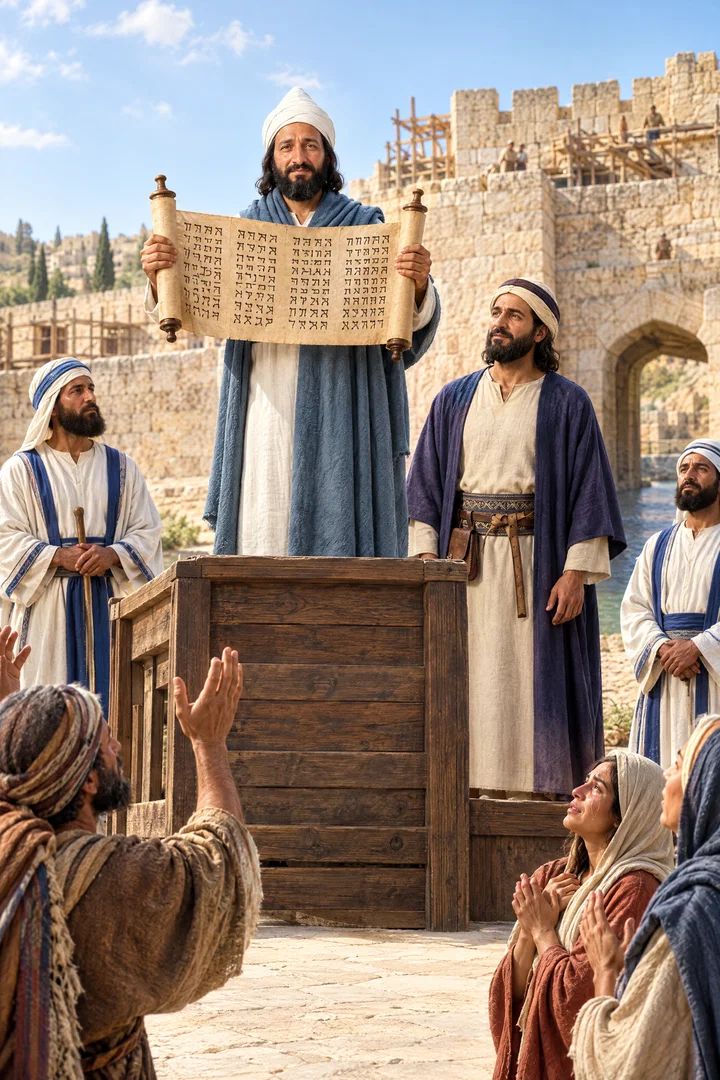
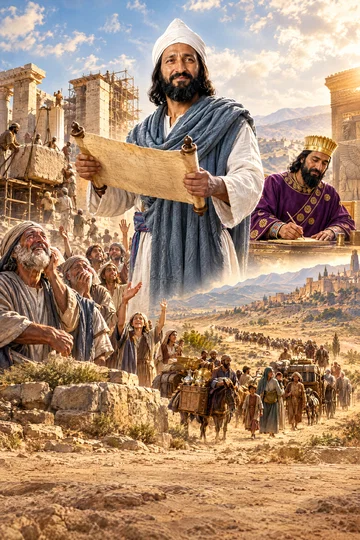
The wall of Jerusalem had been rebuilt and the gates set up, but a large part of the city still lay in ruins around the assembly, amid rough masonry and ruined buildings and sad reminders of departed glory.PK 661.1–2PK 661 At the people's request to hear the Scriptures, Ezra the priest, now an aged man, stood on a raised platform of wood erected in one of the broadest streets, with his fellow Levites gathered at his right and left looking down over a sea of heads, and held open the Book of the Law of Moses before the large congregation, who listened with close attention.PK 661.1–2PK 661ST Apr 28, 1898 The law he brought before them includes the Ten Commandments.PK 661 The reading lasted from morning until midday.ST Apr 28, 1898
The reading had to be explained in the people's language because intermarriage had corrupted their Hebrew, so that all could understand.PK 661.3 This explanation gave those who lacked understanding a sense of their sins and of God's requirements.Ms 156, 1902, par. 17–20Ms 41, 1900, par. 37–39 Hearing the law reminded the people of their neglect of God's commands and the resulting loss of blessing and exile.Ms 41, 1900, par. 37–39 Though they had sinned ignorantly, they were convicted, mourned and confessed, and the reading was expected to lead to deep repentance and a return to the Lord.Ms 156, 1902, par. 17–20DA 215.3–216.1Ms 41, 1900, par. 37–39 The public reading was a privilege and a holy occasion, not a day meant for general sadness, and the people were encouraged to rejoice and praise God for His mercy.Ms 41, 1900, par. 37–39
Sources
Pioneers and periodicals
23 sources
On the first day of the seventh month the returned remnant assembled as one at Jerusalem to hear the law as appointed for that month, and at their own request Ezra the priest brought it before them and read from morning till midday with the help of the Levites.RH Apr 7, 1904ST May 21, 1896RH Oct 16, 1900 The hearers were men and women and all, including children, who could hear with understanding, and because copies were scarce they depended on hearing and listened attentively.ST Dec 20, 1899RH Apr 7, 1904 The reading was given distinctly and its real meaning and broad requirements were explained so the people could understand, which is the duty of religious teachers.ST Dec 20, 1899 The law brought was the Book of the Law of Moses written by his hand in a book, distinct from the Ten Commandments engraved by the finger of God on tables of stone.RH Nov 25, 1852RH Oct 21, 1851RH Apr 21, 1851 That book contains the whole body of law given through Moses, whose carnal rites and sacrifices shadowed the good things of the gospel and were blotted out and nailed to the cross when the Lamb of God shed His blood.RH Nov 25, 1852RH Apr 21, 1851RH Oct 8, 1857 The gathering opened a great reformation wrought through the Word, for hearing convicted the people as transgressors so they wept, and then with the assurance that the joy of the Lord was their strength they turned to obedience in putting away sin.ST May 21, 1896ST Aug 19, 1897ST Aug 12, 1897ST Dec 30, 1913
Gathering and Public Reading
On the first day of the seventh month, the Feast of Trumpets, the remnant returned from Babylonian captivity assembled as one in Jerusalem at the water-gate to hear the law.ST May 21, 1896 The public reading was appointed for the seventh month, a command they had not observed in captivity, and they gathered at their own request to hear the Scriptures.ST Apr 28, 1898 It was the opening gathering of a reformation to finish God's work, when the people came together as one man to be taught.ST May 21, 1896
Ezra the priest, a descendant of Aaron and the congregation's principal teacher, brought the law before them.RH Apr 7, 1904RH Oct 16, 1900 In exile he had prepared his heart to seek the law of the Lord and do it and teach statutes and judgments in Israel, hopeless of Israel's rise by worldly prowess and set upon devout study of the ancient Scriptures when commentaries did not yet exist, and at Jerusalem he carried out that purpose.RH Oct 16, 1900 He stood on a pulpit erected for the occasion, blessed God, opened the book, and read from morning till midday, with Joshua and Nehemiah and the Levites helping to cause the people to understand.ST Apr 28, 1898ST May 21, 1896
The congregation before whom he brought it was both men and women and all, including children, who could hear with understanding, gathered to learn what God required.ST Dec 20, 1899RH Apr 7, 1904 Because copies of Scripture were scarce they depended on hearing it read and explained, and access to that reading was a great privilege.ST Aug 12, 1897 They listened attentively, as was right toward God's word.ST Feb 25, 1886
The law was read aloud and distinctly, and its real meaning and broad requirements were given so the people could understand God's requirements.ST Dec 20, 1899ST Aug 19, 1897 Giving people the sense of Scripture in this way is the duty of religious teachers.ST Dec 20, 1899 This public bringing showed a renewed regard for the word after affliction and misfortune in captivity directed minds to the Lord and His word, in contrast to the time before captivity when little regard was paid to it and it had fallen into disuse.ST Sep 26, 1895RH Oct 16, 1900
The verse stands as one record of observance of the seventh-month festivals.RH Dec 10, 1861 It is connected with the feast of tabernacles, celebrated in the seventh month as a time of rejoicing before the Lord.RH Jan 14, 1862 That feast probably typifies the rejoicing after God's people are gathered into His kingdom.RH Jan 14, 1862 Such records do not prove that the unmentioned Day of Atonement was neglected.RH Dec 10, 1861
Identity of the Law
The law Ezra brought before the congregation was the Book of the Law of Moses which the Lord had commanded Israel, written by the hand of Moses in a book and called the Book of the Covenant.RH Nov 25, 1852RH Oct 21, 1851RH Apr 21, 1851RH Dec 9, 1851RH Aug 5, 1851 That book-law is distinct from the Ten Commandments engraved by the finger of God on tables of stone, while the writing read to the people was called the Book of the Covenant as distinct from the covenant written on the stone tablets which contained the Ten Commandments.RH Nov 25, 1852RH Oct 21, 1851RH Apr 21, 1851RH Dec 9, 1851 The book contains the whole body of law given through Moses, not only moral or ceremonial precepts.RH Nov 25, 1852RH Apr 21, 1851RH Oct 8, 1857 It is the law of commandments contained in ordinances, whose carnal rites, burnt offerings and sacrifices, meats and drinks and divers washings shadowed the good things of the gospel and were blotted out and nailed to the cross when the Lamb of God shed His blood.RH Nov 25, 1852RH Apr 21, 1851
Though Moses wrote the law, its words were God's words and God's written law.ST Feb 12, 1885ST Feb 25, 1886ST Feb 25, 1886 The Bible is God's communication, teaching people how to live and find happiness and peace.ST Feb 25, 1886 Listening attentively to Scripture as it is read is respect for its Author, and its reading gave the people a clear basis for their duty.ST Feb 12, 1885ST Feb 25, 1886ST Feb 25, 1886 The Scriptures had been preserved after the Babylonian captivity even though the ark was said to have been burned.ST Dec 24, 1894 Ezra brought the law home after the return from Babylon when the law had fallen into disuse, with the object of leading the people back to practicing the laws and forms of worship enjoined by the writings of Moses.ST Sep 26, 1895 Their response in entering into a solemn covenant to keep the law of Moses established the Pentateuch as the canonical and authoritative book, and it has remained unquestioned ever since.ST Sep 26, 1895
Revival and Obedient Response
The gathering on the first day of the seventh month was the opening of a reformation to finish God's work, when the people came together as one to hear the law taught.ST May 21, 1896 It was a great reformation in which the lasting work was wrought through the Word of God, read from morning till midday to an attentive congregation, read distinctly with the sense given so the people understood.ST Aug 19, 1897 That Bible teaching brought a great spiritual uplift and new light in reproof and instruction.ST Aug 19, 1897ST Dec 30, 1913
Its words exposed sin, warned of danger, and awakened consciences. Hearing the law convicted the hearers as transgressors so that they wept.ST May 21, 1896 When sins were revealed they were put away, and the people were moved from indifference to repentance and reformation.ST Aug 19, 1897
Their passionate grief was calmed with the assurance to rejoice because the joy of the Lord was their strength.ST May 21, 1896 In a time when copies of Scripture were scarce and the people depended on hearing it read and explained, access to this reading was a great privilege and brought joy.ST Aug 12, 1897 The revival was a genuine and lasting outpouring of the Spirit, for the power in the Word is the power of the Spirit, and the work was done not by might nor by army but by the Spirit working through the Word.ST Aug 19, 1897
With understanding came obedience, for the reading of God's written law gave a clear basis for duty, and when they later found a command they had not been following they obeyed it without treating their ancestors' practice as reason to ignore it.ST Feb 12, 1885 The work began with the separation of the holy seed from amalgamation with the world and concluded with keeping the feast of tabernacles as a type of the day of eternal deliverance and entering a solemn league and covenant of obedience.ST May 21, 1896 That study also led them to recognize their duty to support the worship of God's house.RH Jul 9, 1908
After returning from captivity Israel determined on rigid observance of the law because they remembered that neglect of that law had caused their exile.ST That resolve was then pushed beyond true observance into fanatical over-observance burdened with fanciful rabbinical opinions and oppressive ceremonial restrictions.ST So when Jesus came as the embodiment of the true Sabbath idea He was persecuted.ST
Sources