Numbers 15:35
And the LORD said unto Moses, The man shall be surely put to death: all the congregation shall stone him with stones without the camp.
Translations
And the LORD said to Moses, The man shall be surely put to death: all the congregation shall stone him with stones without the camp.
And the LORD said unto Moses, The man shall be surely put to death: all the congregation shall stone him with stones without the camp.
And the Lord said unto Moses, The man shall be surely put to death: all the congregation shall stone him with stones without the camp.
And the LORD said to Moses, The man shall surely be put to death: all the congregation shall stone him with stones without the camp.
And the LORD said unto Moses, The man shall surely be put to death: all the congregation shall stone him with stones without the camp.
And Jehovah said unto Moses, The man shall surely be put to death: all the congregation shall stone him with stones without the camp.
And Jehovah saith unto Moses, 'The man is certainly put to death, all the company stoning him with stones, at the outside of the camp.'
And Jehovah said to Moses, The man shall certainly be put to death: the whole assembly shall stone him with stones outside the camp.
Then said Yahweh unto Moses, The man shall be, put to death,—all the assembly, stoning him with stones, outside the camp.
Berean Standard Bible, Majority Standard Bible
And the LORD said to Moses, “ The man must surely be put to death. The whole congregation is to stone him outside the camp.”
The LORD said to Moses, “ The man shall surely be put to death. All the congregation shall stone him with stones outside of the camp.”
Then the Lord said to Moses, Certainly the man is to be put to death: let him be stoned by all the people outside the tent-circle.
Then the Lord said vnto Moses, This man shall dye the death: and let al the multitude stone him with stones without the hoste.
Douay-Rheims (Challoner revision)
And the Lord said to Moses: Let that man die, let all the multitude stone him without the camp.
Pictures
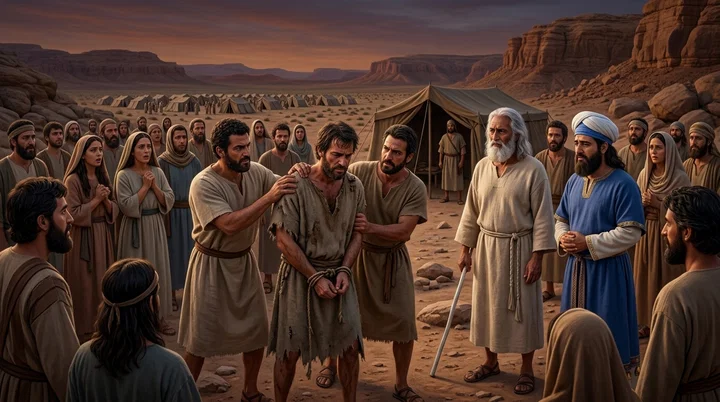
Cross-references 20 of 27
- Exodus 20:8-10
Remember the sabbath day, to keep it holy.
The Sabbath commandment was knowingly broken by gathering sticks.
- Exodus 31:14-15
Ye shall keep the sabbath therefore; for it is holy unto you: every one that defileth it shall surely be put to death: for whosoever doeth any work therein, that soul shall be cut off from among his people.
Prescribes death for Sabbath-breaking, the penalty carried out in Numbers.
- Exodus 35:2-3
Six days shall work be done, but on the seventh day there shall be to you an holy day, a sabbath of rest to the LORD: whosoever doeth work therein shall be put to death.
Prohibits Sabbath work and kindling fire, prescribing death for Sabbath-breaking.
- Leviticus 24:14
Bring forth him that hath cursed without the camp; and let all that heard him lay their hands upon his head, and let all the congregation stone him.
Both prescribe stoning by the congregation outside the camp for a capital offense.
- Numbers 15:30-31
But the soul that doeth ought presumptuously, whether he be born in the land, or a stranger, the same reproacheth the LORD; and that soul shall be cut off from among his people.
defines presumptuous sin punished by stoning
- 2 Corinthians 3:7-9
But if the ministration of death, written and engraven in stones, was glorious, so that the children of Israel could not stedfastly behold the face of Moses for the glory of his countenance; which glory was to be done away:
The law’s ministry of death and condemnation is surpassed by the Spirit’s ministry of righteousness.
- Leviticus 24:16
And he that blasphemeth the name of the LORD, he shall surely be put to death, and all the congregation shall certainly stone him: as well the stranger, as he that is born in the land, when he blasphemeth the name of the LORD, shall be put to death.
Both prescribe death by stoning for blasphemy.
- Exodus 35:2
Six days shall work be done, but on the seventh day there shall be to you an holy day, a sabbath of rest to the LORD: whosoever doeth work therein shall be put to death.
both prescribe death for Sabbath profanation
- Exodus 31:15
Six days may work be done; but in the seventh is the sabbath of rest, holy to the LORD: whosoever doeth any work in the sabbath day, he shall surely be put to death.
States the death penalty for Sabbath work, illustrated by the wood-gathering incident.
- Deuteronomy 17:5
Then shalt thou bring forth that man or that woman, which have committed that wicked thing, unto thy gates, even that man or that woman, and shalt stone them with stones, till they die.
Both prescribe stoning as punishment for idolatry.
- Exodus 20:13
Thou shalt not kill.
The commanded execution is distinguished from unlawful killing.
- Exodus 20:8
Remember the sabbath day, to keep it holy.
gives Sabbath command the penalty enforces
- 1 Kings 21:10-13
And set two men, sons of Belial, before him, to bear witness against him, saying, Thou didst blaspheme God and the king. And then carry him out, and stone him, that he may die.
Blasphemy is punished by stoning to death.
- Leviticus 20:2
Again, thou shalt say to the children of Israel, Whosoever he be of the children of Israel, or of the strangers that sojourn in Israel, that giveth any of his seed unto Molech; he shall surely be put to death: the people of the land shall stone him with stones.
Both offenses are punished by stoning.
- Leviticus 24:17
And he that killeth any man shall surely be put to death.
Both prescribe death as punishment for a person who kills.
- Hebrews 10:28
He that despised Moses’ law died without mercy under two or three witnesses:
Contrasts death under Moses’ law with judgment for rejecting Christ.
- Leviticus 24:23
And Moses spake to the children of Israel, that they should bring forth him that had cursed out of the camp, and stone him with stones. And the children of Israel did as the LORD commanded Moses.
Both describe carrying out the stoning penalty.
- Exodus 16:23-26
And he said unto them, This is that which the LORD hath said, To morrow is the rest of the holy sabbath unto the LORD: bake that which ye will bake to day, and seethe that ye will seethe; and that which remaineth over lay up for you to be kept until the morning.
Both concern defiance of the Sabbath’s no-work instruction.
- Exodus 21:15
And he that smiteth his father, or his mother, shall be surely put to death.
same death penalty for striking parents
- Exodus 21:12
He that smiteth a man, so that he die, shall be surely put to death.
same death penalty for murder
Commentary
Each commentary is drawn from primary sources: the writings of Ellen G. White and Adventist pioneers and periodicals. Each commentary is separate. Its own words are not a quotation; follow the references to read the source passages.
Ellen G. White
5 sources
The verse is God's answer when Moses asked how to punish a man caught gathering sticks on the Sabbath in the wilderness.PP 408.4–409.3 The man acted soon after Israel was told they would be disinherited, angry at exclusion from Canaan and determined to defy God's law.PP 408.4–409.3 Gathering fuel broke the strict ban on kindling fires on the seventh day in the wilderness, where fire was not needed for warmth as it would be in Canaan.PP 408.4–409.3
When a man openly went before the congregation to gather wood for a fire or do other unnecessary work, he acted against the Lord's commandment and was cut off from the people for his transgression.Ms 146, 1906, par. 16–28 His act was willful and deliberate presumption, not thoughtlessness or ignorance.PP 408.4–409.3 Death for Sabbath-breaking had already been declared, but the manner had not yet been revealed.PP 408.4–409.3 The prescribed manner for one who knowingly committed this sin was to be taken outside the camp and stoned to death by all the congregation.Ms 3, 1854, par. 3–8PP 408.4–409.3Ms 146, 1906, par. 16–28
Willful Sabbath-breaking received the same punishment as blasphemy because both equally express contempt for God's authority.PP 408.4–409.3 Although the Sabbath was made for the benefit of man, knowingly working on the seventh day and transgressing the holy commandment forbidding labor is a crime of great magnitude in the sight of Heaven.1T 533.1Ms 8, 1866, par. 4 Under the Mosaic law its magnitude was so great as to require the death of the offender.1T 533.1Ms 8, 1866, par. 4 That death was not all the offender was to suffer, for God will not take a transgressor of His law to heaven, and he must also suffer the second death, which is the full and final penalty for transgressing God's law.1T 533.1Ms 8, 1866, par. 4
The judgment also applies to breaking the seventh commandment, whose offenders faced temporal and eternal death.Ms 3, 1854, par. 3–8 God is very particular regarding observance of His holy law.Ms 146, 1906, par. 16–28 The death penalty for Sabbath-breaking is not now exacted and God may not now punish transgression with temporal penalties.PP 408.4–409.3Ms 146, 1906, par. 16–28
Because stoning is no longer the penalty, the sin is wrongly treated as a small offense.Ms 3, 1854, par. 3–8 The death penalty does not make the fourth commandment only Jewish, any more than the same penalty makes the third, the fifth, and nearly all the ten precepts only Jewish, for the wages of sin is death and in the final execution of judgment death will be the portion of those who violate His sacred precepts.PP 408.4–409.3 A time is coming when everyone must answer for every disregard of God's law, so there rests a solemn duty to study how to observe the Lord's Sabbath and to teach others its sacredness.Ms 146, 1906, par. 16–28
Sources
Pioneers and periodicals
89 sources
The verse records God's sentence on the man found gathering sticks on the Sabbath in the wilderness, that he must surely be put to death by the whole congregation stoning him with stones outside the camp.ST Aug 13, 1902RH Dec 16, 1915RH Jan 12, 1860 Moses did not decide the punishment himself, but put the man in confinement until the mind of the Lord was declared and then conveyed God's judgment.RH Jan 7, 1862RH Oct 26, 1911ST May 11, 1891 His act was not ignorance, mistake or necessity, but open deliberate presumptuous defiance despising the word of the Lord and reproaching Him.RH Jan 7, 1862ST Sep 26, 1911RH Oct 26, 1911 The death was a temporal civil punishment under Israel's theocratic government where God was civil King, not the final penalty for sin as a moral agent, and it belonged to the ministration of death done away at Christ's death while the Sabbath command itself remains binding.ST Nov 16, 1876RH May 2, 1854RH Oct 28, 1858RH Apr 16, 1872 Under the gospel the profaner is not now put to death by the congregation but is given time to repent and find pardon through Christ's blood, yet presumptuous violation must still meet God's judgment in the day of God.RH Oct 26, 1911ST Nov 16, 1876RH May 2, 1854RH Nov 25, 1852ST Jun 20, 1911
Wilderness Account and Wording
The sentence is God's own judgment on the man found gathering sticks on the Sabbath day in the wilderness, that he shall surely be put to death with all the congregation stoning him with stones outside the camp.ST Aug 13, 1902RH Dec 16, 1915RH Jan 12, 1860RH Apr 23, 1857ST Nov 3, 1881 It was given under Israel's theocratic government where God had authority to order the punishment, and the congregation carried it out only after God commanded them, making the stick-gatherer an object lesson so Israel then would regard God's law and Sabbath and later generations would not treat violation as light.ST Aug 13, 1902RH Dec 16, 1915RH Sep 8, 1853 Gathering sticks in defiance was as much a violation as openly working all day, and the severity underscores that Sabbath rest forbade needless work while not requiring endurance of cold or hunger, since acts of mercy or necessity were lawful.RH Dec 16, 1915RH Jan 12, 1860 The threatened punishment for neglecting the Sabbath was here carried out by the congregation outside the camp, showing Sabbath-breaking treated as serious violation of a definite command and as evidence that a definite Sabbath could be observed during the forty years in the wilderness.RH Sep 8, 1853ST Nov 3, 1881
Moses did not decide the punishment himself but put the man in ward in confinement until the mind of the Lord was declared, then received and conveyed God's judgment as lawgiver to the people, for God was the lawgiver and Moses only spoke the words given him.RH Jan 7, 1862ST May 11, 1891RH Dec 12, 1854ST Dec 17, 1896RH May 17, 1864 There was no regular law that seemed to cover the case, so the man was held until the Lord determined the penalty by special sentence, revealing a case of peculiar guilt and not an ordinary case under the existing penalty for work.RH Jan 7, 1862RH Oct 26, 1911ST May 11, 1891ST Dec 17, 1896 The execution was assigned to the whole congregation outside the camp rather than to one person, and Moses did not take it into his own hands nor did Moses and the congregation impose it on their own.ST Aug 13, 1902ST Aug 13, 1902RH Aug 27, 1857 The command came after priestly Sabbath work was already instituted, proving the Sabbath remained in fullest unrelaxed force, and putting the offender to death did not break the command not to kill but lawfully enforced its penalty, typifying the execution to be effected afterward by Christ.RH Aug 27, 1857
The account does not state the purpose for which he gathered the sticks, whether to make a fire or for a fence, though it is commonly taken as probably gathering fuel to kindle a fire for cooking, and the sticks were gathered to kindle a fire.RH Nov 25, 1852RH May 2, 1854RH May 19, 1851 If they were for a fence, gathering them violated the fourth commandment, which itself does not mention gathering sticks or kindling fires.RH Nov 25, 1852RH May 2, 1854 In Israel's wilderness circumstances kindling a fire was unnecessary work, since the climate was mild with no need of fire for warmth, food was manna to be cooked and prepared on the sixth day for the seventh, clothing was miraculously preserved, and there was not one feeble person among them.RH Nov 25, 1852RH Jan 12, 1860RH May 2, 1854RH Apr 23, 1857 To kindle a fire to wash clothes or cook manna was therefore not mercy or necessity but doing sixth-day labor on the seventh day, for fires were needed only for washing and cooking manna and that food was to be prepared beforehand.RH Nov 25, 1852RH May 2, 1854RH Apr 23, 1857 Changed conditions change application without changing the law, so where fires are needed in feebleness and cold weather kindling a fire can be lawful mercy and necessity like watering stock or lifting a sheep, while the desert prohibition on kindling except for unlawful purpose is not applicable there though the commandment remains binding and requires nothing hard or unmerciful.RH May 2, 1854
The same ordinance applied equally to the Israelite congregation and to the stranger sojourning among them, with the stranger to stand before the Lord as Israel did, proving in the service of the Lord there is no difference between Jews and Gentiles in Sabbath obligation under one law for ignorance and for presumption.RH Oct 1, 1861 The incident occurred in the wilderness before Israel reached Palestine, confirming the Sabbath was already in force before the law given at Sinai, and it occurred before the ministration associated with Moses' veiled face had begun, showing the law written on stone was not null without that ministration.ST Sep 29, 1881RH Mar 29, 1864RH Mar 7, 1854 From Moses to David, a period of five hundred years, Sabbath-breaking was enforced by death even though the Sabbath is not mentioned in the record of that time. The word Sabbath is then absent from the divine record for about four hundred to more than five hundred years, which proves nothing about its existence or binding force, just as its absence before the Exodus does not prove first institution at Sinai.RH Nov 25, 1852RH May 2, 1854 The case is the second recorded stoning to death, with the same penalty as for murder, striking parents, blasphemy, idolatry, disobedience to parents, and theft, proving the Sabbath stands with moral laws and not merely ceremonial or positive laws.RH Aug 13, 1857 The Sabbath-breaker was not treated worse than a murderer but received a fair trial with sympathy and without personal enmity or revenge, having what the law for the murderer only provided against private vengeance until trial.ST Jan 2, 1907 The passage stands in the part of Numbers telling of Israel's ceremonies, service, wanderings and murmurings and shows the very strict order God kept among His people, given not because God needed it but because they needed to learn systematic character through carrying out system.ST Mar 4, 1913
Presumptuous Defiant Sin
The gathering of sticks was not ignorance, mistake, or necessity but open, deliberate, high-handed defiance done to show disregard for what had been commanded.RH Jan 7, 1862ST Sep 26, 1911RH Oct 26, 1911RH Jan 8, 1857ST Feb 21, 1911 It despised the word of the Lord, broke His commandment, reproached the Lord, and showed contempt for the Law-giver.RH Jan 7, 1862ST Sep 26, 1911 It was daring rebellion against the direction to kindle no fire on the Sabbath, not an act forced by immediate need, and therefore differs from gathering grain when hungry without prior opportunity to provide.ST Sep 26, 1911RH Jan 8, 1857ST May 10, 1905 Building a fire then was a direct and daring act of presumption deserving death by stoning.ST May 10, 1905ST Feb 21, 1911
He had broken no regular law that seemed to cover the case, so he was held in ward in confinement until the mind of the Lord was declared and the penalty determined by special sentence.ST Sep 26, 1911RH Oct 26, 1911ST May 11, 1891ST Dec 17, 1896 Neither the death sentence in this case nor the prohibition of fire-building was a general law or part of the Sabbath law itself.ST Sep 26, 1911ST May 11, 1891 The fire ban was a local wilderness regulation for the warm climate then being passed through where fire was not needed and manna was prepared the day before, and because no specific penalty had been given the Lord revealed that the man was to be stoned by the congregation outside the camp.ST Sep 26, 1911ST Dec 17, 1896ST May 10, 1905 The case was one of peculiar, special, aggravated guilt under the sin of presumption described in Numbers 15:30-31, not an ordinary case under the existing penalty for work on the Sabbath.RH Jan 7, 1862RH Oct 26, 1911 Israel frequently violated the Sabbath without this penalty being visited, and even the whole congregation that stoned him were themselves guilty of Sabbath violation and had just been excluded from the promised land for that and other sins, so the sentence does not prove extraordinary strictness in ordinary Sabbath-keeping.RH Jan 7, 1862RH Oct 26, 1911
Gathering sticks in defiance was as much a violation as openly working all day.RH Dec 16, 1915 It was presumptuously pursuing ordinary labor and gathering timbers for mechanical industry rather than merely picking up sticks, with no connection in that judgment to kindling fires, and it was done when there was no occasion for building a fire. For that reason it does not forbid building a fire for the comfort, health, and life of a family on a cold morning, which as an act of mercy rather than sacrifice is lawful to do well on the Sabbath days. The case stands as an example of presumption in treating Sabbath-breaking as too small for God to punish while relying on His goodness without evidence for that confidence.ST Apr 19, 1883 It illustrates the demerit of presumptuous sins that cut the soul off from among his people, distinct from sins through ignorance for which pardon stands under one law, and in immediate connection with the declaration that the same law holds for him born among Israel and for the stranger sojourning among them.ST Apr 19, 1883
Gathering sticks on the Sabbath with a high hand may be punished with death, while gathering sticks privately and in need might receive a lesser punishment.ST Oct 17, 1916 Deliberately building a fire in defiance was forbidden and could bring the death penalty of stoning outside the camp, yet this did not forbid fires needed to save life or help those in need.ST May 14, 1896 After Sinai greater light brought greater responsibility and made sin more sinful, leaving no excuse for unbelief and disobedience, and though love still stood ready to pardon sin, wilful disobedience and stubborn selfish unbelief could not be overlooked, of which this stoning outside the camp is one instance.RH Jul 18, 1907 A person who sins unknowingly is still guilty, and when the sin becomes known must make the required offering for forgiveness, since ignorance does not remove sin or the need for atonement.ST Apr 26, 1883
Theocratic Civil Penalty
The death ordered was a temporal civil punishment under Israel's theocratic government, where God was civil King as well as moral Governor, not payment for sin as a moral agent nor the full and final penalty, which is eternal death, since sin is transgression of the law and the wages of sin is death.RH May 2, 1854RH Oct 28, 1858RH Nov 25, 1852RH Mar 7, 1871 The same temporal death was inflicted for breaking the third commandment, yet the third commandment remains binding without stoning now, because under the gospel the atoning blood of Christ can wash away blasphemy and Sabbath-breaking, so mercy pleads for the transgressor to be spared to repent, find pardon and live, showing the gospel as the better covenant whose ministration far excels the ministration of condemnation and death.RH May 2, 1854RH Nov 25, 1852 The putting to death by the whole congregation outside the camp was punishment as a violator of the law of the commonwealth, inflicted by the magistrate as the penalty of the law of the land, not inflicted by God as the penalty of His moral law.RH Oct 28, 1858RH Mar 7, 1871 The man so put to death must still answer before God for his crime at the general Judgment the same as if he had not suffered death, for infliction of the civil penalty was committed to Israel while the blessings and curses of obedience or transgression as moral law God retains in His own hands, so the abolition of the Jewish economy leaves the Ten Commandments and their blessings and curses still binding.RH Mar 7, 1871
Disobedience was both impiety against God as moral Governor and rebellion against God as theocratic King, and open violation of the social and civil law could not pass with impunity any more than breaking the law of the land in any well-ordered state.RH Oct 28, 1858RH Mar 7, 1871 The execution was the penalty prescribed for a public, deliberate breach of the nation's law, and the judgment is righteous in light of the offense and Israel's covenant relationship with God, who had delivered them from slavery and made them His people, with the Sabbath as a special sign of that relationship. Those stoned for transgression suffered as violators of the civil code, while their responsibility and the penalty due for violation of the law as an ethical code were left untouched for the general Judgment.RH Oct 28, 1858RH Mar 7, 1871
The death penalty belonged to the ministration of death, the Mosaic civil law and subsidiary sanitary or police regulations adapted to that people, time and wilderness environment, nailed to the cross and done away at Christ's death when the ministration of pardon began.ST Nov 16, 1876RH Apr 16, 1872ST Feb 1, 1905RH May 3, 1860 It was a specification added to the command and a detail outside the Decalogue, not part of the fourth commandment itself, and the restriction on gathering sticks is not found in the Decalogue but belongs to the ceremonial law separate from and outside the Ten Commandments.RH Apr 16, 1872ST Feb 1, 1905RH Mar 17, 1863RH May 3, 1860 The stoning of the man who in defiance gathered sticks was a special case of flagrant presumptuous sin, belonging not to the eternal constitution of God's government but to regulations easily distinguishable from the moral law, while the fourth commandment itself remains of permanent and universal obligation for all mankind, as binding as the third and the fifth.RH Apr 16, 1872ST Feb 1, 1905 Sabbath-breaking remains sin because sin is transgression of the Ten Commandments, and sin still brings death and condemnation unto the second death unless sinners repent and obtain pardon; the difference is that God now carries out the punishment rather than leaving it to sinful people, and now there is no stoning for any crime whatever.ST Nov 16, 1876RH May 3, 1860
The penalty was affixed in a separate code from the commandments themselves, so the Sabbath can remain binding now without stoning Sabbath-breakers now.RH Nov 25, 1852RH Mar 17, 1863RH May 3, 1860 Just as blasphemy, murder, idolatry, adultery, striking parents, disobedience to parents, and theft had stoning penalties though their prohibitions state no penalty, the stoning penalty for the Sabbath was given by Moses in the Mosaic law and lasted only as long as the law of Moses lasted.RH Mar 17, 1863RH May 3, 1860 The same penalty applied to blasphemy, yet the commandment against blasphemy remains binding without requiring the offender to be stoned.RH Nov 25, 1852 The penalty for breaking the Sabbath was death by stoning, the same penalty given for murder, proving the Sabbath stands with moral laws and not with merely ceremonial or positive laws.RH Aug 13, 1857 The case was the second recorded stoning to death, ordered with the whole congregation to stone the man outside the camp, with the same death given for striking parents, blasphemy, idolatry, disobedience to parents, and covetousness and theft.RH Aug 13, 1857 Under Israel's civil law idolatry, blasphemy and adultery also carried death, while punishment for sin ultimately belongs to God.ST Apr 30, 1894
Putting the offender to death did not break the command not to kill but lawfully executed its penalty and typified the execution of the penalty to be effected by Christ after that dispensation, just as the priests offering on the Sabbath typified remission.RH Aug 27, 1857RH Aug 27, 1857 Those who put the offender to death did not break the law, and priests laying hands on the offender to put him to death cannot be charged with breaking the law; to call such execution wrong would make no law maintainable except through wrong, and it is no proof that the Sabbath law is not moral.RH Aug 27, 1857RH Aug 27, 1857 The command came after the work of the priesthood on the Sabbath was already instituted, which proves the Sabbath law remained in its fullest, unrelaxed force and was no less binding and no less sacred because offerings were made on it.RH Aug 27, 1857 The command Thou shalt not kill is the duty of the individual soul, while this death sentence is the act of divine government to protect the lives and property of its subjects and to keep the whole nation from being destroyed by the influence of evil-doers. God as governor commanded death because He saw that contempt for His Sabbath leads into idolatry, and idolatry means the eternal destruction of many, so in His wisdom it is better that the one who subverts the whole nation perish than that the nation be destroyed, and the stoning was given to restrain evil-doers and to stand as an example to the young that they might turn from such demoralizing practices.
The theocracy worked with infallible precision when administration was in doubt: the judges put the offender in ward and God Himself revealed the true situation and pronounced the penalty, whether by prophets or by Urim and Thummim in the high priest's breastplate, and the rulers then only enforced what God had given.ST Jun 30, 1909 This gave infallible precision so no innocent person suffered and no unjust penalty was administered, a precision no earthly government today possesses.ST Jun 30, 1909 Moses did not take the execution into his own hands, and God assigned the act to the congregation rather than to one person, making a notable example of an aggravated offense.ST Aug 13, 1902 The verse does not authorize human governments or saints to punish violations of the first four commandments, which concern offenses against God; carrying out such penalties belonged to the magistrate under theocracy, and imposing death in the name of God would put government in God's place.ST Aug 13, 1902ST Oct 22, 1894RH Sep 2, 1851RH Apr 3, 1913 The penalty addressed deliberate, presumptuous breaking, not sins of ignorance, and its existence does not make the Sabbath commandment dangerous or cancel the duty to keep it, for gathering sticks was punished with death because God was the actual ruler and legislator of that nation.RH Sep 2, 1851RH Apr 3, 1913 That penalty belonged to a theocracy, not to modern civil governments, and is applied as a warning that Sunday reform could culminate in demands to execute those who violate the imposed Sunday observance.ST Oct 22, 1894
Sabbath Law Affirmed
The sentence fixes the Sabbath to the definite seventh day of the week and not to any indefinite seventh part of time.RH Aug 20, 1857RH Mar 9, 1869RH Jul 30, 1867 The man was stoned because he gathered sticks on that blessed and sanctified seventh day, working seven seventh parts of time instead of working six and resting the seventh as commanded after creation.RH Aug 20, 1857 If any seventh part would do, working twelve days and resting two or working eighteen and resting three would be just as well and punishment would be impossible, for the blessed portion is the seventh seventh part of time falling on the seventh day of the week, since rest after finishing the work of creation could not come before the work had commenced.RH Aug 20, 1857 Israel understood that only keeping the seventh day as holy time would answer the demands of the law, and even violators never claimed liberty to keep a different day, with every public act from this execution down to the Christian era proceeding on that ground.RH Mar 9, 1869RH Jul 30, 1867
God designated a particular day and was particular about its observance, and the death penalty by stoning proves His definite intention regarding the appointed day.RH Feb 14, 1907RH Feb 26, 1914 The Sabbath of Jehovah is more than resting one day in seven for rest and recuperation of body, mind, and spirit; it is a matter of obedience or disobedience to the command of God.RH Feb 14, 1907 To set it aside or reinterpret it to suit convenience is contempt of court, and what is required is precise obedience to the Sabbath command, not merely observance of a general principle.RH Feb 14, 1907RH Feb 26, 1914 The day had been made identifiable because God confirmed it through the manna, so that working on it was punishable by death and failure to know which day it was could not excuse disobedience. Those who thought it made no difference about the particular day paid for their thoughtlessness with their lives, which warns against attempting to change the commandments and ordinances of God, and tampering with God's law and His requirements is just as unholy now when thousands of souls are in the balances deciding for eternity.ST Jul 12, 1905
God made the stick-gatherer an object lesson so that Israel at that time would keep regard for God's law and Sabbath and so that later generations would not treat violation of divine law as a light matter.RH Dec 16, 1915 Gathering sticks in defiance of what God had said was as much a violation of the Sabbath as openly working all day.RH Dec 16, 1915 The command that the presumptuous gatherer of fuel be surely put to death by stoning outside the camp proves how vital the Sabbath is to God's work.ST Sep 8, 1909 The execution under divine orders illustrates what will come to all in the end when final rewards and penalties are executed, and the fact that sentence is not now immediately executed does not make it any less certain, for sin is sin in whatever age committed and will meet its certain end.ST Sep 8, 1909 Sabbath-breaking stands in the record alongside slander and unbelief as sin God condemns, and the death penalty expressed how strongly He abhorred the violation.RH Feb 24, 1916RH May 23, 1854
Sabbath rest forbade needless work but never required enduring cold or hunger, and acts of mercy or necessity were lawful.RH Jan 12, 1860RH May 2, 1854RH Jul 30, 1861ST Apr 14, 1898 The man's act was deliberate and presumptuous rather than forced by immediate need, probably gathering fuel to kindle a fire for cooking when there was no occasion for building a fire, and it therefore differs from gathering grain when hungry with no opportunity to provide beforehand.RH Jan 12, 1860RH Jan 8, 1857 The purpose for which he gathered the sticks is not stated and the fourth commandment itself does not mention gathering sticks or kindling fires, but his act was open violation because Israel then had no need of fires on the Sabbath.RH May 2, 1854 They were commanded to cook the manna on the sixth day for the seventh, they lived in a mild climate, their food was rained from heaven, their clothes were miraculously preserved, and there was not one feeble person among them, so to kindle a fire to wash clothes or cook manna would have been doing sixth-day labor on the seventh day.RH May 2, 1854 Changed conditions change the application without changing the law: in feebleness and cold weather kindling a fire can be a lawful act of mercy and necessity, like watering an ox or horse or lifting a sheep from a pit, and building a fire for the comfort, health, and life of a family on a cold morning is mercy rather than sacrifice and lawful to do well on the Sabbath days.RH May 2, 1854 The law still forbids doing on the seventh day what can be done on the sixth and what is not really mercy and necessity, it never obliges anyone to suffer cold or hunger, and it is holy and just and good.RH May 2, 1854 Only work truly necessary for sickness, warmth, health, and care is permitted, because the Sabbath was made for man and not to injure him.RH Jul 30, 1861
The commands to prepare food on the sixth day and to do no baking, boiling, frying, stewing, or fire-kindling on the Sabbath except from necessity remain just as stringent in this dispensation, with the preparation day still to be kept.RH May 2, 1854RH Jul 30, 1861 Under the Jewish economy profaning the Sabbath carried death like idolatry, by the whole congregation stoning the offender outside the camp, because Sabbath-breaking was treated as profane violation of the covenant and rejection of God's sovereign authority as Creator and Governor, having the nature of idolatry outright.RH Nov 4, 1858 It enforced the rigid outward observance then required, when all common work lawful on other days was forbidden, even making a fire, as seen in the man put to death for gathering sticks.RH Nov 4, 1858 Sabbath-breaking violates the fundamental obligation to honor God, for by refusing to set aside one day in seven for worship and spiritual good a person acts as though there is no God and promotes practical atheism in self and others.RH May 23, 1854
The command came after the work of the priesthood on the Sabbath was already instituted, which proves the Sabbath law remained in its fullest, unrelaxed force and was no less binding and no less sacred because offerings were made on it.RH Aug 27, 1857 Putting the man to death did not break the command not to kill but enforced its penalty, typifying the execution of the penalty to be effected by Christ afterward, so priests laying hands on the offender to put him to death cannot be charged with breaking the law.RH Aug 27, 1857 If priestly labor and traveling to holy convocation were real breaches, Christ and His disciples would have deserved the same fate as the man in the wilderness, but Christ did only what was lawful and kept His Father's commandments.RH Aug 27, 1857 Secular work of one's own accord, like carrying dry wood into the camp, goes beyond the law and is justly punished, while priests working in the temple on the Sabbath are blameless because temple work is service of the Lord that fulfills the law rather than secular affairs that break it. The commandment forbids people's own work and not work God appoints, so marching around Jericho was not Sabbath-breaking, though a violation appointed for punishment by God carried the death penalty.RH May 12, 1868 Even satisfying hunger for a few hours counted as such guilt then, because plucking barley ears was a kind of reaping and rubbing them in the hands was a kind of grinding or threshing and preparing food that was required to be prepared on Friday before sunset, and Jews became known over the world by readiness to die rather than break the holy day.ST Apr 14, 1881
Gospel Mercy and Judgment
Under the former covenant the profaner of the Sabbath was put to death by the congregation outside the camp, but under the gospel sinners are given time to repent before death and judgment come.ST Nov 16, 1876RH May 2, 1854RH Nov 25, 1852RH Apr 7, 1851RH Apr 7, 1851 That death penalty belonged to the ministration of death and condemnation, which was done away when the ceremonial ordinances were nailed to the cross and the ministration of pardon began, a better covenant that far excels it.ST Nov 16, 1876RH May 2, 1854 Christ's atoning blood can wash away Sabbath-breaking and blasphemy, so mercy pleads for the transgressor to be spared to repent, find pardon and live rather than suffer temporal execution.RH May 2, 1854RH Nov 25, 1852 When Jesus ceases His intercession, those still in sin will face destruction in the day of God's wrath.RH Apr 7, 1851
Sabbath-breaking remains sin because sin is transgression of the Ten Commandments, and sin still brings death; the difference is that God now carries out the punishment rather than leaving it to sinful people.ST Nov 16, 1876 The stoning penalty was not part of the fourth commandment itself but was affixed in the separate Mosaic code, just as blasphemy, murder, idolatry and adultery were punished with stoning though their prohibitions state no penalty, and it lasted only while the law of Moses lasted until the death of Christ, so now there is no stoning for any crime whatever.ST Nov 16, 1876RH May 3, 1860 Breaking the Sabbath or any other precept still brings condemnation, and sinners must die the second death, which is the full and final penalty and the wages of sin, unless they repent and obtain pardon.ST Nov 16, 1876RH May 2, 1854RH May 3, 1860 Forbearance may be shown when the work is a sin of ignorance rather than wilfulness.RH Oct 3, 1871
The execution under divine orders was an illustration of what will come to all in the end when final rewards and penalties are executed, proving how vital the Sabbath is to God's work.ST Sep 8, 1909 God does not now immediately execute the death penalty on all violators because He is long-suffering, not willing that any should perish but that all should come to repentance and obedience.ST Mar 31, 1898 The fact that sentence is not now immediately executed does not make it any less certain, for sin is sin in whatever age committed and will meet its certain end.ST Sep 8, 1909 When sentence is passed and judgment is executed His decisions will be uniform and parallel with the precedent already established, leaving the Sabbath-breaker at awful risk of death for violating God's holy law.ST Mar 31, 1898
While the letter of the law is not administered now as then, this signal punishment stands as expressing God's attitude against the sin of presumption described in Numbers 15:30-31.RH Oct 26, 1911 The case was one of special, aggravated guilt, since Israel frequently violated the Sabbath without this penalty being visited upon them, and here there was no regular law that seemed to cover the case so the man was put in ward until the matter was settled; he openly worked on the Sabbath contrary to instruction to show his disregard for what God had said.RH Oct 26, 1911 In the wilderness such rebellious Sabbath-breaking, done not from necessity but from deliberate defiant rebellion, was punished with death by the whole congregation outside the camp.ST Jun 20, 1911ST Dec 3, 1896ST May 25, 1904 Those who presumptuously break God's Sabbath or wilfully violate any other requirement must meet it in the day of God, and the same kind of presumptuous work will as surely be punished now, while works of necessity, of worship, and of direct labor for God remain in harmony with the Sabbath law.RH Oct 26, 1911ST Jun 20, 1911ST Dec 3, 1896ST May 25, 1904
Gathering a few sticks looked like a very little sin but was great in the sight of God and received the sentence of death by His command.RH Sep 4, 1860 Even the smallest sin can cut off communion with God because it is against an infinite God, displeases God as the best Friend, and is ungrateful to Him who sent His Son to die so that life could be given through Him.RH Sep 4, 1860 The verse proves the wages of every sin is death and warns against making light of any sin, since there is no little law to break, no little God to offend, no little guilt to contract, and no little wrath to incur.RH Sep 4, 1860 Boldness in little sins encourages greater sins, for the Devil tempts from one degree of sin to another.RH Sep 4, 1860
The fact that Sabbath-breakers now go on living well and hearty does not mean the law has passed away or that Christians are under no obligation to the fourth commandment.RH Jul 30, 1908 Delayed punishment does not abolish the commandment, just as lying remains sin even though liars do not now fall dead as Ananias and Sapphira did.RH Jul 30, 1908 A man held guilty for breaking the Sabbath could not escape responsibility for that past act by appealing to the later abolition of the law, for such an appeal would make judgment for sin impossible.RH Aug 22, 1865
Warnings and Misapplications
The sentence carries no duty for Christians now to put Sabbath-breakers to death, for the stoning has been taken away and is not to be enforced now.RH Oct 26, 1911RH Apr 16, 1872 It lasted only while the Mosaic civil law lasted, as one of the specifications and penalties added to the command, while the fourth commandment itself remains of permanent and universal obligation for all mankind, as binding as the third and the fifth.RH Apr 16, 1872 The case was one of special guilt rather than mere violation, since Israel frequently violated the Sabbath without this penalty being visited, and here there was no law that seemed to cover the case so the man was put in ward until the matter was settled.RH Oct 26, 1911 The penalty was directed against the presumption described in Numbers 15:30-31, because the man openly worked contrary to instruction to show disregard for what God had said.RH Oct 26, 1911 While the letter is not administered now as then, this signal punishment expresses God's attitude against presumption, and those who presumptuously break the Sabbath or wilfully violate any other requirement must meet it in the day of God.RH Oct 26, 1911
Against this stands the opposing argument that if the Sabbath is still in force the death penalty is still in force and someone must act as executioner, since a law without penalty would be a farce.RH Aug 27, 1908 On that ground the Mosaic order of executing Sabbath-breaking together with idolatry as the penalty of the moral law ought to be returned to today, with the penalty for violation of the moral law executed.ST Oct 26, 1904RH Jan 2, 1900 Colonial New England law hanging flagrant violators of the Sabbath is held up as nearer to that Mosaic order than present leniency.RH Jan 2, 1900 Under that Mosaic law the man who gathered sticks was sentenced to death by stoning outside the camp, with the whole congregation carrying out the punishment.ST Oct 26, 1904
In 1644 Massachusetts clergy transferred that penalty to Sunday by informing the magistrates that gathering sticks on Sunday might be punished with death, using civil law to enforce their ideas of worship.RH May 23, 1907 That penalty belonged to a theocracy, not to modern civil governments, and imposing death in God's name would put government in God's place.ST Oct 22, 1894 The verse is therefore applied as a warning that Sunday reform could culminate in demands to execute those who violate the imposed Sunday observance.ST Oct 22, 1894 By the same transfer, doing garden work such as hoeing weeds on Sunday is claimed by those who see it to deserve stoning to death under divine law, carried out by those who see the work, though forbearance may be shown when the work is a sin of ignorance rather than wilfulness.RH Oct 3, 1871
The council invokes this punishment as precedent for demanding death for Jesus, whom they accuse of breaking the Sabbath by healing a man and telling him to carry his bed.ST Oct 25, 1910 In the same way it is argued that if the Sabbath commandment remained in force, Jesus should have been stoned for breaking it, under the law requiring a Sabbath violator to be stoned.RH Oct 24, 1854 To call the wilderness day Sunday would imply that the ancient Jews kept Sunday.ST Sep 27, 1883 And to change the Sabbath to the following day would make Monday the Christian Sabbath.ST Sep 27, 1883
God enforced Sabbath-keeping with death but never swore that rebels should not keep the Sabbath, while He did swear that rebels should not enter Canaan.ST Jun 23, 1881 The wilderness generation kept the Sabbath yet missed the promised land-rest, so the rest from which rebels were shut out and which remains to the people of God in Hebrews is not the weekly Sabbath but the Canaan inheritance.ST May 15, 1884ST Jun 23, 1881 The Sabbath's validity and obligation did not depend on people's belief, though unbelief could prevent entering the promised rest. Thus Sabbath-breaking was treated as serious violation carrying death by stoning outside the camp by all the congregation, in contrast with the rest that unbelief forfeited.ST Jun 23, 1881
The verse is cited as an instance of threatened punishment for neglecting the Sabbath being carried out, and as an instance in which the Sabbath law was enforced according to its stated penalty.RH Sep 8, 1853 It shows Sabbath-breaking in the wilderness treated as serious violation of a definite command, with the stated penalty carried out by the congregation outside the camp.ST Nov 3, 1881ST Sep 30, 1886 The account also serves as evidence that a definite Sabbath could be observed during the forty years in the wilderness, and the cold weather did not make the punishment necessary or explain the command.ST Nov 3, 1881ST Sep 30, 1886
Under the dispensation in which the seventh-day Sabbath was enforced, breaking it carried the temporal penalty of death by stoning, in contrast with a claimed first-day Sabbath which carries no such penalty.RH Jan 8, 1867RH Aug 4, 1853 After the time of Moses the Sabbath was enforced by death, with the whole congregation stoning the offender with stones outside the camp.RH Mar 3, 1863 A violation appointed for punishment by God under the Sabbath commandment carried the death penalty, which does not mean marching around Jericho broke the Sabbath, since the commandment forbids people's own work, not work God appoints.RH May 12, 1868 Tampering with God's law and attempting to change His commandments and ordinances is a fearful responsibility, just as unholy now when thousands of souls are deciding for eternity.ST Jul 12, 1905 Those who thought it made no difference about the particular day paid for that thoughtlessness with their lives, warning that God's requirements including the Sabbath cannot be treated as interchangeable or altered without serious consequence.RH Feb 13, 1913ST Jul 12, 1905
Sources