Numbers 15:36
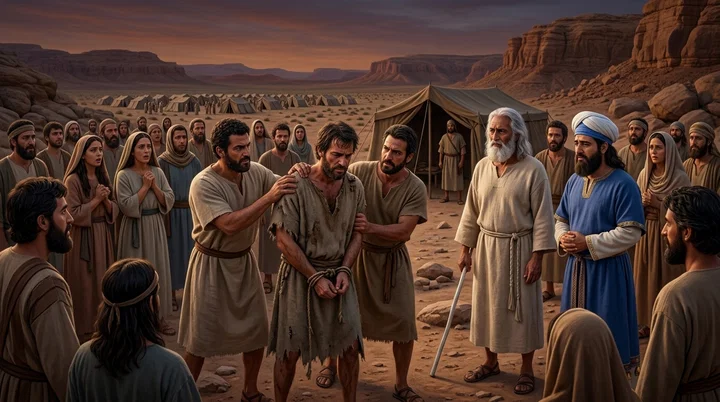
And all the congregation brought him without the camp, and stoned him with stones, and he died; as the LORD commanded Moses.
Translations
American King James Version, King James Version, Webster Bible, Revised Version
And all the congregation brought him without the camp, and stoned him with stones, and he died; as the LORD commanded Moses.
And all the congregation brought him without the camp, and stoned him with stones, and he died; as the Lord commanded Moses.
And all the congregation brought him without the camp, and stoned him to death with stones; as Jehovah commanded Moses.
And all the company bring him out unto the outside of the camp, and stone him with stones, and he dieth, as Jehovah hath commanded Moses.
And the whole assembly led him outside the camp, and stoned him with stones, and he died, as Jehovah had commanded Moses.
So then all the assembly, put him forth, outside the camp, and stoned him with stones, and he died,—As Yahweh commanded Moses.
Berean Standard Bible, Majority Standard Bible
So the whole congregation took the man outside the camp and stoned him to death, as the LORD had commanded Moses.
All the congregation brought him outside of the camp, and stoned him to death with stones, as the LORD commanded Moses.
So all the people took him outside the tent-circle and he was stoned to death there, as the Lord gave orders to Moses.
And all the Congregation brought him without the hoste, and stoned him with stones, and he died, as the Lord had commanded Moses.
Douay-Rheims (Challoner revision)
And when they had brought him out, they stoned him, and he died as the Lord had commanded.
Pictures
Cross-references 20 of 21
- Exodus 31:14-15
Ye shall keep the sabbath therefore; for it is holy unto you: every one that defileth it shall surely be put to death: for whosoever doeth any work therein, that soul shall be cut off from among his people.
Both texts prescribe death for Sabbath profanation.
- Exodus 20:8-10
Remember the sabbath day, to keep it holy.
The man’s stick-gathering violated the command to rest from work on the Sabbath.
- Numbers 15:30-31
But the soul that doeth ought presumptuously, whether he be born in the land, or a stranger, the same reproacheth the LORD; and that soul shall be cut off from among his people.
Describes the man’s transgression as presumptuous.
- Exodus 35:2
Six days shall work be done, but on the seventh day there shall be to you an holy day, a sabbath of rest to the LORD: whosoever doeth work therein shall be put to death.
Both prescribe death for working on the Sabbath.
- Leviticus 24:11-16
And the Israelitish woman’s son blasphemed the name of the LORD, and cursed. And they brought him unto Moses: (and his mother’s name was Shelomith, the daughter of Dibri, of the tribe of Dan:)
Both accounts prescribe stoning for blasphemy.
- 2 Corinthians 3:7
But if the ministration of death, written and engraven in stones, was glorious, so that the children of Israel could not stedfastly behold the face of Moses for the glory of his countenance; which glory was to be done away:
The stone-written law brings death and condemnation, contrasted with the gospel ministry.
- Leviticus 24:16
And he that blasphemeth the name of the LORD, he shall surely be put to death, and all the congregation shall certainly stone him: as well the stranger, as he that is born in the land, when he blasphemeth the name of the LORD, shall be put to death.
Both describe the congregation stoning someone to death for a sin.
- Deuteronomy 17:5
Then shalt thou bring forth that man or that woman, which have committed that wicked thing, unto thy gates, even that man or that woman, and shalt stone them with stones, till they die.
Both describe stoning as punishment for grave offenses.
- Exodus 31:15
Six days may work be done; but in the seventh is the sabbath of rest, holy to the LORD: whosoever doeth any work in the sabbath day, he shall surely be put to death.
The Sabbath death-penalty command is illustrated by the incident.
- Hebrews 10:28
He that despised Moses’ law died without mercy under two or three witnesses:
Both describe death as punishment under Moses’ law.
- Exodus 21:17
And he that curseth his father, or his mother, shall surely be put to death.
Both prescribe death for cursing or dishonoring parents.
- Joshua 7:25
And Joshua said, Why hast thou troubled us? the LORD shall trouble thee this day. And all Israel stoned him with stones, and burned them with fire, after they had stoned them with stones.
Achan is stoned for coveting and theft.
- Exodus 16:27-30
And it came to pass, that there went out some of the people on the seventh day for to gather, and they found none.
Both concern disobedience to the LORD’s Sabbath command.
- Exodus 20:8
Remember the sabbath day, to keep it holy.
gives the command the wilderness punishment enforces
- Numbers 35:30
Whoso killeth any person, the murderer shall be put to death by the mouth of witnesses: but one witness shall not testify against any person to cause him to die.
A person may not be condemned to death on one witness.
- Deuteronomy 13:9-10
But thou shalt surely kill him; thine hand shall be first upon him to put him to death, and afterwards the hand of all the people.
Those who entice others to idolatry are to be stoned.
- Exodus 21:15
And he that smiteth his father, or his mother, shall be surely put to death.
Both prescribe death as the penalty for a grave offense.
- John 8:7
So when they continued asking him, he lifted up himself, and said unto them, He that is without sin among you, let him first cast a stone at her.
Jesus says the sinless one must cast the first stone.
- Exodus 21:12
He that smiteth a man, so that he die, shall be surely put to death.
Both prescribe death as the penalty for a capital offense.
- Exodus 16:23-26
And he said unto them, This is that which the LORD hath said, To morrow is the rest of the holy sabbath unto the LORD: bake that which ye will bake to day, and seethe that ye will seethe; and that which remaineth over lay up for you to be kept until the morning.
Both texts concern obedience to commands governing the Sabbath.
Commentary
Each commentary is drawn from primary sources: the writings of Ellen G. White and Adventist pioneers and periodicals. Each commentary is separate. Its own words are not a quotation; follow the references to read the source passages.
Ellen G. White
4 sources
The Sabbath was made for man, for man's benefit.1T 533.1Ms 8, 1866, par. 4 In ancient times those who committed knowing sins, such as breaking the seventh commandment, were taken without the camp and stoned to death.Ms 3, 1854, par. 3–8 The offense here was wilfully gathering wood to make a fire or doing other unnecessary work on the Sabbath before the congregation, acting against the commandment of the Lord.Ms 146, 1906, par. 16–28
Knowingly working on the seventh day, deliberately transgressing the holy commandment forbidding labor on that day, is a great crime in the sight of Heaven, of such magnitude under the Mosaic law as to require the death of the offender, who was cut off from the people.1T 533.1Ms 8, 1866, par. 4Ms 146, 1906, par. 16–28 The temporal death by stoning was not the whole punishment, for God will not take a transgressor of His law to heaven.Ms 3, 1854, par. 3–81T 533.1Ms 8, 1866, par. 4 One deemed unworthy to live must also suffer eternal death, the second death, which is the full and final penalty for transgressing the law of God.Ms 3, 1854, par. 3–81T 533.1Ms 8, 1866, par. 4
The abolishing of the penalty of stoning to death does not make the sin smaller.Ms 3, 1854, par. 3–8 Because that penalty is gone the sin is indulged in beyond measure and regarded as a small offense, when it remains an enormous knowing sin that will receive the awful visitation of God and bring His frown and curse upon the camp.Ms 3, 1854, par. 3–8 God is very particular regarding observance of His holy law, and though the death penalty is not now required, a time is coming when everyone must answer for every disregard of God's law.Ms 146, 1906, par. 16–28 There rests therefore a solemn duty to study how to observe the Sabbath and to teach others its sacredness.Ms 146, 1906, par. 16–28
Sources
Pioneers and periodicals
79 sources
The whole congregation brought the man outside the camp and stoned him with stones until he died, exactly as the Lord commanded Moses.RH Nov 25, 1852RH Jul 3, 1856RH Dec 16, 1915 His gathering of sticks on the Sabbath was presumptuous, high-handed and defiant sin, despising the word of the Lord and reproaching the Law-giver, not error or ignorance.ST Sep 26, 1911RH Dec 16, 1915RH Jan 7, 1862 The stoning was ordered by God as ruler of Israel under its theocratic government and carried out by the whole congregation, a temporary civil penalty distinct from the eternal Ten Commandments.RH Dec 16, 1915ST Aug 13, 1902ST Feb 1, 1905 The penalty proves He designated a definite seventh day to be observed, not merely one day in seven, and that the Sabbath stands with the moral laws, not with merely ceremonial laws.RH Aug 13, 1857RH Feb 14, 1907RH Feb 13, 1913RH Aug 27, 1908RH Jul 30, 1867 God made the man an object lesson expressing forever His attitude against presumption, for Sabbath-breakers are now given time to repent under Christ's atoning blood, but profaning the Sabbath still brings certain death when God Himself carries out judgment.RH Dec 16, 1915RH Oct 26, 1911RH May 2, 1854RH Nov 25, 1852RH Apr 7, 1851
Stoning Outside the Camp
The whole congregation brought the man who gathered sticks on the Sabbath outside the camp and stoned him with stones until he died, exactly as the Lord commanded Moses.RH Nov 25, 1852RH Jul 3, 1856RH Dec 16, 1915ST Aug 13, 1902RH Jan 7, 1862 The sticks' purpose is not stated, though gathering them for a fence would plainly violate the fourth commandment, and gathering them in defiance was as much a violation as working openly all day.RH Nov 25, 1852RH Dec 16, 1915RH Jan 12, 1860 In Israel's wilderness circumstances kindling a fire for ordinary work such as washing clothes or cooking, likely for cooking since food was to be prepared on the sixth day, was not a matter of necessity or mercy and had no need for warmth or survival.RH Nov 25, 1852RH Jan 12, 1860 It was the second recorded stoning, after the stoning for blasphemy, and its death penalty was the same as for murder, blasphemy, idolatry, smiting or disobeying parents, covetousness and theft.RH Aug 13, 1857 The sameness of the penalty proves the Sabbath stands with moral laws and not with merely ceremonial positive laws.RH Aug 13, 1857
Under the theocratic government of Israel the punishment for Sabbath-breaking was death by stoning without the camp by all the congregation, and God ordered this punishment as ruler of Israel.RH Dec 16, 1915ST Aug 13, 1902 It was the only recorded case in which the death penalty for Sabbath-breaking was immediately carried out.ST Aug 13, 1902 God made the man an object lesson, for without severe punishment the whole congregation then would have had little regard for God's law and Sabbath, and all later generations would have regarded violation of divine law as a light matter.RH Dec 16, 1915 The account presents his execution as the prescribed punishment for breaking the Sabbath.RH Jul 3, 1856
The man was first put in custody to obtain the mind of the Lord about his guilt, because he had transgressed no regular law and no law seemed to cover his case and the required action was not yet known.ST Sep 26, 1911RH Jan 7, 1862RH Oct 26, 1911ST May 11, 1891 Moses did not decide the punishment himself but left the case to God, received God's words and relayed them to the people, showing God and not Moses as lawgiver, and then the congregation carried out that judgment through stoning as the Lord commanded.ST Sep 26, 1911RH Dec 12, 1854RH May 17, 1864 His death by special sentence from the Lord was the penalty for a presumptuous, daring sin, a case of special guilt and aggravated presumption rather than the general punishment prescribed by the Sabbath law for every violation.RH Oct 26, 1911ST May 11, 1891 Both the death sentence and the prohibition on building fire on the Sabbath were not general laws, for the fire prohibition applied only to the warm climate through which Israel was then passing where fire was not needed.ST Sep 26, 1911
The chapter belongs to the wilderness wanderings with its ceremonies, service, wanderings and murmurings, and shows the very strict order God had among His children.ST Mar 4, 1913 That order was given not because He needed it but because they needed to learn, so that in carrying out system they form a systematic character.ST Mar 4, 1913 Definite Sabbath observance was practicable for forty years in the wilderness, as shown with Exodus 16, and therefore could be required continually.ST Nov 3, 1881
Presumptuous Sabbath Breaking
The gathering of sticks on the Sabbath was presumptuous, high-handed, daring and defiant sin, not error or ignorance.RH Dec 16, 1915RH Jan 7, 1862RH Oct 26, 1911RH Jan 8, 1857 He despised the word of the Lord, broke His commandment, reproached the Lord, and intended contempt for the Law-giver and despite to the Spirit of grace, illustrating the law that the soul sinning with a high hand shall be utterly cut off.ST Sep 26, 1911RH Dec 16, 1915RH Jan 7, 1862RH Oct 26, 1911 Gathering sticks in defiance of what God had said was as much a violation of the Sabbath as working openly all day, done openly to show disregard for what God had said when there was no occasion or need for a fire.RH Dec 16, 1915RH Oct 26, 1911RH Jan 8, 1857 The terrible penalty was directed against that sin of presumption rather than mere Sabbath-breaking, as a special sentence for aggravated guilt and not the rule for every Sabbath violation, since Israel often violated the Sabbath without this penalty.RH Jan 7, 1862RH Oct 26, 1911 This signal punishment stands forever expressing God's attitude against presumption, made an object lesson lest the whole congregation then have little regard for God's law and all later generations regard violation as a light matter.RH Dec 16, 1915RH Oct 26, 1911
The purpose of his gathering is not stated and the act is not named in the fourth commandment.RH Nov 25, 1852RH May 2, 1854RH Apr 23, 1857 Gathering them for a fence would plainly violate it, and kindling a fire for ordinary work such as washing clothes or cooking manna was not necessity or mercy, since manna was to be prepared on the sixth day.RH Nov 25, 1852RH May 2, 1854RH Apr 23, 1857 He was not merely picking up sticks to build a fire but was presumptuously pursuing his ordinary labor, gathering timbers for some mechanical industry. The gathering has no connection with kindling fires except as joined by those wishing to excuse themselves from keeping the commandment.
The gathering is also connected with kindling a fire, likely for cooking, in violation of the requirement to prepare food on the sixth day.ST Sep 26, 1911RH Nov 25, 1852RH Jan 12, 1860RH Apr 23, 1857 In the wilderness fire was needed only for cooking and food preparation had been provided for beforehand, so a fire for that purpose was unnecessary and its kindling violated the fourth commandment.RH Nov 25, 1852RH Jan 12, 1860RH May 19, 1851 Open and defiant gathering deserved death, while gathering privily and in need could be met with a lesser punishment.ST Oct 17, 1916 By contrast, the man who sinned ignorantly was still guilty and had to be punished, showing with Leviticus 4 that ignorance does not make sin harmless or remove the need for atonement.RH Nov 10, 1863
His punishment is a typical case of presumption in wrongly trusting that God's goodness meant he would not be punished, and of defiant disobedience done to show he did not believe God's requirements.ST Apr 19, 1883ST Dec 30, 1913 The judgment has been twisted into a fable of a goodman who gathered sticks on Sunday morning, refused the command to put them down, and was lifted sticks and all to the moon to carry them forever where it is always Monday.RH Nov 19, 1914 The Sunday gathering, the endless carrying, and the man in the moon are untruth and superstition about Christian worship that undermines simple faith in the creative power of God and leaves children without saving faith.RH Nov 19, 1914 The verse is invoked to claim Jesus deserved death for healing on the Sabbath, though the stated offense was gathering sticks.ST Oct 25, 1910 Calling the wilderness stick-gathering a Sunday offense would imply the ancient Jews kept Sunday; if Christ then changed their Sabbath to the following day, Monday would be the Christian Sabbath, which exposes the inconsistency of that argument.ST Sep 27, 1883
Fire Necessity and Mercy
In the wilderness Israel had no occasion or need for a Sabbath fire, living in a mild, warm climate where fire was not needed for warmth, receiving manna to be prepared on the sixth day, having clothing miraculously preserved, and having not one feeble person among them.ST Sep 26, 1911RH Nov 25, 1852RH May 2, 1854RH Jan 12, 1860RH Apr 23, 1857 The sticks were for kindling a fire for ordinary work such as cooking manna or washing clothes, and gathering them for a fence would also plainly violate the fourth commandment, though the purpose is not stated.RH Nov 25, 1852RH May 2, 1854RH Jan 12, 1860RH Apr 23, 1857 That gathering is connected with kindling a fire, likely for cooking in violation of the requirement to prepare food on the sixth day.RH Jan 12, 1860RH Apr 23, 1857 Both the death sentence and the prohibition on building fire on the Sabbath were not general laws, the fire prohibition applying only to the warm climate through which Israel was then passing where fire was not needed.ST Sep 26, 1911
To build a fire on the Sabbath in the wilderness merely to prepare food that could have been prepared beforehand was a direct and daring act of presumption deserving death, with no necessity or excuse, the climate demanding none and the manna being prepared the day before.ST May 10, 1905ST Dec 30, 1913 The man was put to death because gathering sticks was a presumptuous, high-handed, defiant act done when there was no occasion or need for a fire. Fires that required much labor were unnecessary in the warm wilderness where Israel journeyed and should not have been built merely to prepare food.ST Dec 30, 1913
The Sabbath law forbids doing on the seventh day what can be done on the sixth and what is not really mercy and necessity, but it does not oblige suffering cold or hunger and does not forbid every fire or every act of work.RH May 2, 1854ST May 14, 1896ST Dec 30, 1913 Deliberately defying God was forbidden, yet the Sabbath law did not prohibit a fire needed to save life or help the needy, and works of necessity and mercy were lawful.ST Nov 18, 1889ST May 14, 1896 The verse does not forbid every fire or every act of work on the Sabbath, but only unnecessary work.ST Dec 30, 1913
Fires made necessary by cold, warmth, sickness, comfort, health, protection of life, or other necessity are lawful mercy and doing well on the Sabbath, to be done with as little work as possible while all other food is prepared beforehand, and refusing them for rigid observance would be mere sacrifice.RH May 2, 1854RH Jan 12, 1860RH Apr 23, 1857ST Dec 30, 1913 Kindling a fire in cold weather now can be a lawful act of mercy and necessity like watering an ox or horse or lifting a sheep from a pit.RH May 2, 1854 Works of necessity, of worship, and of direct labor for God are in harmony with the Sabbath law, while presumptuous, defiant, unnecessary self-serving work will surely be punished as in the wilderness.ST Jun 20, 1911ST Dec 3, 1896
The disciples' urgent hunger and lack of prior provision made their conduct fundamentally different from presumptuous, deliberate transgression, and did not warrant condemning them.RH Jan 8, 1857 Work God appoints does not break the Sabbath, for the Sabbath command forbids people's own work, not work God appoints, so marching around Jericho at God's direction did not break it.RH Aug 27, 1857RH May 12, 1868 The priests who labor in the temple on the Sabbath are blameless because they are not engaged in secular affairs but in the service of the Lord, fulfilling the law rather than going beyond it, while the man of his own accord carried dry wood into the camp of God and so went beyond the law.RH Aug 27, 1857 The Sabbath law remained in its fullest, unrelaxed force even after priestly labor was required, because that work was instituted before the man was stoned, and if priestly labor and the traveling of Christ and the disciples had been real breaches they would have deserved the same fate.RH Aug 27, 1857
The restrictions against gathering manna or picking up sticks to kindle a fire on the Sabbath were special rules given to Israel in the wilderness, not part of the Sabbath commandment itself.RH Apr 7, 1851
Theocratic Penalty Explained
The stoning was ordered by God acting as ruler of Israel under its theocratic government, in which He spoke through Moses as actual legislator and ruler, and it was carried out by the whole congregation outside the camp rather than by Moses or one appointed individual.RH Dec 16, 1915ST Aug 13, 1902ST Aug 13, 1902RH Apr 3, 1913 It was a temporary civil police regulation and subsidiary law given through Moses for that people, time and setting, easily distinguished from the eternal Ten Commandments as the great constitution of God's government.RH Dec 16, 1915ST Aug 13, 1902ST Feb 1, 1905 To apply that law to a society that is not a theocracy puts human government in God's place.ST Aug 13, 1902ST Oct 22, 1894
It was the only recorded case in which the death penalty for Sabbath-breaking was immediately carried out, for Israel often violated the Sabbath without this penalty.ST Aug 13, 1902RH Oct 26, 1911RH Sep 2, 1851 It cannot be quoted as evidence of extraordinary strictness by the Hebrews, for the very congregation that judged and stoned him had just been excluded from the promised land for that and other sins and greatly polluted the Sabbath during the whole forty years in the wilderness.ST Aug 13, 1902RH Jan 7, 1862 The man was first put in ward because no regular law seemed to cover his case and the required action was not yet known, to obtain the mind of the Lord about his guilt.RH Jan 7, 1862RH Oct 26, 1911ST May 11, 1891 The terrible penalty was a special sentence for aggravated guilt, directed against presumptuous, daring, high-handed sin and open disregard for what God had said rather than mere Sabbath-breaking, not the general punishment prescribed by the Sabbath law.RH Oct 26, 1911ST May 11, 1891ST Aug 13, 1902
The temporal death by stoning was a civil penalty under the Jewish economy and dispensation, not the full and final penalty of the fourth commandment, which says nothing about stoning and does not command it.RH May 2, 1854RH Nov 25, 1852RH May 3, 1860 The full penalty then and now is eternal death, for sin is transgression of the Ten Commandments and the wages of sin is death.ST Nov 16, 1876RH May 2, 1854RH Nov 25, 1852RH May 3, 1860 The same temporal stoning was inflicted for breaking the third commandment against blasphemy and for murder, idolatry, adultery, and breaking the first, sixth and seventh commandments.RH May 2, 1854RH Nov 25, 1852RH May 3, 1860 Ending stoning therefore proves the Sabbath no more abolished than it proves blasphemy now lawful, and the Sabbath commandment remains binding without imposing its former civil penalty just as the third does.RH May 2, 1854RH Nov 25, 1852RH Nov 25, 1852RH May 3, 1860
The death penalty belonged to the Mosaic civil law and the law Moses gave and is not now in force, while the Sabbath itself and the fourth commandment remain with permanent and universal obligation for all mankind, as binding as the third and fifth.RH Apr 16, 1872RH May 3, 1860 The penalty lasted only till the death of Christ, when the Mosaic law ended and the ministration of death ceased and a ministration of pardon began, so since then there is no stoning for any crime whatever, though those who now sin against any precept remain under condemnation to the second death unless they repent and obtain pardon.ST Nov 16, 1876RH May 3, 1860 Putting a transgressor to death by divine command does not break the sixth commandment, Thou shalt not kill, but executes its penalty.RH Aug 27, 1857 The command not to kill is the duty of the individual, while this execution was an act of government to protect the lives, property, existence and nation from evil-doers, to restrain evil-doers and to warn the young by example that they might turn from demoralizing practices, because treating the Sabbath as of no account leads to idolatry and idolatry means the eternal destruction of many, so that it is better that the one who subverts the whole nation should perish than that the nation should be destroyed.RH Aug 27, 1857
Those who laid hands on the condemned typified the execution of the penalty to be effected by Christ subsequent to that dispensation, just as the priests offering offerings on the Sabbath typified the work of remission.RH Aug 27, 1857 The case shows the Sabbath-breaker received a fair trial, without the personal spite or revenge that could affect a murder case.ST Jan 2, 1907 The right to punish offenses against the first four commandments was not delegated to human governments after the people rejected God's rule.ST Aug 13, 1902ST Oct 22, 1894 The verse gives no authority to modern civil governments to impose God's penalties or to use civil government to carry out ideas of religion and enforce a humanly appointed Sunday Sabbath, as in 1644 when the Massachusetts clergy told the magistrates that gathering sticks on Sunday might be punished with death.ST Aug 13, 1902ST Oct 22, 1894RH May 23, 1907
Sabbath Doctrine Confirmed
The stoning outside the camp shows how vital the Sabbath is to God, that breaking it is sin abhorrent to Him standing with slander and unbelief, that He means exactly what He commands about the appointed day, and that He required exact obedience to it.ST Sep 8, 1909RH Feb 24, 1916ST Mar 19, 1885RH Feb 14, 1907RH Feb 26, 1914 The death penalty proves He designated a particular definite seventh day to be observed, not merely one day in seven for rest and recuperation, and Israel understood the law to require that definite seventh day and not any day at personal choice.RH Feb 14, 1907RH Feb 13, 1913RH Jul 30, 1867RH Mar 9, 1869 The stoning is the first public act in a continuous line down to the Christian era proceeding on the hypothesis that keeping the seventh day alone answers the demands of the law, leaving the one-day-in-seven theory without ancient violators, friends, or apologists claiming latitude, and the civil penalty applied to that definite day, not to any day of the week.RH Jul 30, 1867RH Mar 9, 1869
The seventh-day Sabbath was required of God's chosen people in the wilderness for forty years before they reached Palestine, so observance was not confined to Jews inside Palestine and being in the wrong place or latitude did not remove obligation.ST Sep 29, 1881 God had made that rest day known to Israel through Moses, so the man who worked on that identified day was accountable and was brought outside the camp and stoned as commanded. The sameness of the death penalty as for murder, blasphemy, idolatry, smiting or disobeying parents, covetousness and theft proves the Sabbath stands with moral laws and not with merely ceremonial positive laws, it being the second recorded stoning after that for blasphemy.RH Aug 13, 1857 A Sabbath law carrying the death penalty shows a law is not without its penalty, which raises whether it was given only to Jews, whether it with stoning is still in force, and who would be executioner.RH Aug 27, 1908
Neglecting the Sabbath was a profane violation of the covenant itself and rejection of God's sovereign authority having the nature of idolatry outright, because from the beginning the Sabbath was a memorial of His sovereignty as Creator and Governor to be kept in acknowledgment of His supreme dominion and was made the sign of the covenant with Israel as His peculiar people taken out of the idolatrous world.RH Nov 4, 1858 The act violated a fundamental law and publicly acted as though there were no God, producing practical atheism in the offender and others, while showing how strongly God abhorred Sabbath-breaking.RH May 23, 1854 The Sabbath law remained in its fullest, unrelaxed force even after the priests were required to labor on the Sabbath, because that priestly work was instituted before the man was stoned, proving such labor did not relax the law or make the day less sacred.RH Aug 27, 1857 If priestly labor and the traveling of Christ and the disciples had been real breaches they would have deserved the same fate as the man in the wilderness, and since their acts were lawful Christ could truly say He had kept His Father's commandments, with the stoning enforcing the claim of the law by foreshadowing the necessary consequence of transgression.RH Aug 27, 1857 The law was binding before the later ministration associated with Moses' veiled face began, for the violator was stoned, so the law was not a nullity without that ministration.RH Mar 29, 1864
From Moses to David, a period of five hundred years, the Sabbath was enforced by the penalty of death, and after the time of Moses the offender was put to death by stoning outside the camp as the Lord commanded.RH Mar 3, 1863 The account illustrates the strictness then required and the rigid outward observance with ceremonial strictness added to the moral obligation, when all common employments lawful on other days were forbidden, even making a fire.RH Jul 30, 1861RH Nov 4, 1858 Divine law is presented as commanding death by stoning for Sabbath work such as hoeing weeds in a garden, to be carried out by those who see the act, with willful violation calling for immediate stoning while a sin of ignorance may warrant forbearance.RH Oct 3, 1871 Plucking ears of grain counted as a kind of reaping, and rubbing them counted as a kind of grinding or threshing and as preparing food required before Friday sunset, so gathering and eating grain on the Sabbath incurred the death penalty, a strictness Jews boasted made them known over the world by readiness to die rather than break the holy day even to satisfy hunger for a few hours.ST Apr 14, 1881
The stoning was the penalty for Sabbath-breaking for which there is no text changing the penalty, the penalty being a detail outside the specifications in the Decalogue while the time and general manner of observance specified there are unchangeable.ST Sep 13, 1905 Those who hold the sticks law to be separate teach it belongs to the ceremonial law and not to the Ten Commandments, which contain no restriction against gathering sticks for a fire, the Decalogue having been placed inside the ark while the other law was placed outside, with at least nineteen other scriptural distinctions between them. God never swore in His wrath that Israel should not keep the Sabbath but commanded rebellious breakers be put to death, proving the weekly Sabbath remained binding and distinct from the promised Canaan rest that wilderness unbelievers failed to enter.ST Jun 23, 1881 The rest barred by oath in Psalm 95 is the Canaan inheritance given by Joshua, not the seventh-day Sabbath which all Israel received and which Joshua did not give, and God required the Sabbath even of those who fell in the wilderness opposite His oath that those same rebels should not enter the land.ST Jun 23, 1881
The account illustrates the severity of the penalty, after which the Bible gives no further mention of the Sabbath for about four hundred years, and it is an example of the Bible mentioning the Sabbath-breaker while leaving long stretches unrecorded.RH Mar 7, 1854RH Nov 25, 1852 Even more than 500 years afterward the record still does not use the word Sabbath, though the Sabbath was already recognized at that later point marked by the death of the stoned man.RH May 2, 1854 The incident is cited as an example of the bondage associated with Sabbath observance under the old covenant, while under Mosaic legislation interpreting the moral law Sabbath-breaking stood together with idolatry to be punished by execution, giving the standard by which colonial laws hanging flagrant violators are counted nearer to the moral law than present leniency.RH Jan 2, 1900RH Mar 15, 1864
Warning for Today
God made the man an object lesson under the theocratic government, for without severe punishment by stoning without the camp the whole congregation then would have had little regard for God's law and Sabbath, and all later generations would have regarded violation of divine law as a light matter.RH Dec 16, 1915 Gathering sticks in defiance was as much a violation as working openly all day, and while the letter of the law is not now administered as then, this signal punishment stands forever as expressing God's attitude against the sin of presumption.RH Dec 16, 1915RH Oct 26, 1911 The stoning was a case of special guilt and not the rule for every violation, since Israel often violated the Sabbath without this penalty and the man was first put in ward because no regular law seemed to cover his case.RH Oct 26, 1911
God has spoken as distinctly about Sabbath observance as about any other duty, requiring no work on the seventh day, and the stoning stands as precedent revealing His displeasure against violation of His law.ST Mar 31, 1898 When sentence is passed and judgment executed His decisions will be uniform and parallel with the precedent already established, so to remain a violator is an awful risk and will still face condemnation.ST Mar 31, 1898 His immediate death illustrates what will come to all when final rewards and penalties are executed, for the fact that sentence is not now immediately executed does not make punishment less certain, since sin in whatever age will meet its certain end.ST Sep 8, 1909 How vital the Sabbath is to God is shown in that presumptuous gathering of fuel in sacred hours was met by divine order with death outside the camp.ST Sep 8, 1909
Under the law of Moses the breaker was taken outside the camp and stoned to death, but under the gospel God gives Sabbath-breakers and other sinners time to repent, for after death comes judgment.ST Nov 16, 1876RH Apr 7, 1851 The ministration of death has ended, but the wages of sin remain death, since sin is transgression of the Ten Commandments and profaning the Sabbath still brings death, though God now carries out the judgment rather than sinners, and the one without sin must be first to cast a stone.ST Nov 16, 1876 Temporal death by stoning was not the full and final penalty of the fourth commandment, which does not command stoning, for the full penalty then and now is eternal death; the same temporal stoning was inflicted for breaking the third commandment, so ending stoning proves the Sabbath no more abolished than it proves blasphemy now lawful.RH May 2, 1854RH Nov 25, 1852 Under the Jewish dispensation with no atonement reaching his case the breaker was removed from Israel, but under the better covenant Christ's atoning blood reaches his case and mercy pleads that he be spared to turn, find pardon, and live.RH May 2, 1854RH Nov 25, 1852
The death penalty is not now immediately executed because many object lessons have already been given and the Lord is long-suffering, not willing that any should perish but that all should come to repentance and obedience.ST Mar 31, 1898 Those who presumptuously break God's Sabbath or wilfully violate any other requirement will meet it in the day of God, for although a death penalty attached to the Sabbath law, the wages of all sin being death, the execution of punishment belongs to God.RH Oct 26, 1911ST Apr 30, 1894 The fact that Sabbath-breakers are now well and hearty and do not fall dead does not prove the law has passed away, just as daily lying without falling dead does not prove lying is no sin; its use under the ancient code does not mean breakers must be stoned now.RH Mar 17, 1863RH Jul 30, 1908 Enforcement belongs to the magistrate, not to believers simply as believers, and the existence of a penalty does not make it wrong to uphold the commandment, the penalty being just because God commanded it and presumptuous sin being distinct from sins of ignorance.RH Sep 2, 1851
Works of necessity, of worship, and of direct labor for God are in harmony with the Sabbath law, while Sabbath work done not from necessity but from presumption and defiant rebellion serving self instead of God will surely be punished as in the wilderness with death by stoning.ST Jun 20, 1911ST Dec 3, 1896ST May 25, 1904 Treating another day as interchangeable showed the particular day mattered, and those who thought it made no difference about the particular day paid for thoughtlessness with their lives.RH Feb 13, 1913ST Jul 12, 1905 It is fearful to take responsibility for attempting to change God's commandments, and tampering with His law is just as unholy now when thousands are deciding for eternity.ST Jul 12, 1905 The death penalty was a temporary civil penalty and not a rule for civil government in every age, showing how strongly God abhorred Sabbath-breaking as public practical atheism acting as though there were no God, while the Sabbath command remains binding and it is still wrong to neglect weekly rest from worldly pursuits for public worship and spiritual good.RH May 23, 1854
Both the death sentence and the prohibition on kindling fire on the Sabbath were not general laws, the fire prohibition applying only to the warm climate through which Israel was then passing where fire was not needed, and the man despised the word of the Lord by gathering in defiance after being put in custody until the Lord declared he should surely be put to death.ST Sep 26, 1911 The account does not say the punishment was because the morning was frosty, but identifies his offense as breaking the Sabbath.ST Sep 30, 1886
Sources