Numbers 19:4
And Eleazar the priest shall take of her blood with his finger, and sprinkle of her blood directly before the tabernacle of the congregation seven times:
Translations
American King James Version, King James Version, Webster Bible
And Eleazar the priest shall take of her blood with his finger, and sprinkle of her blood directly before the tabernacle of the congregation seven times:
and Eleazar the priest shall take of her blood with his finger, and sprinkle of her blood directly before the tabernacle of the congregation seven times:
and Eleazar the priest shall take of her blood with his finger, and sprinkle of her blood toward the front of the tent of meeting seven times:
and Eleazar the priest shall take of her blood with his finger, and sprinkle her blood toward the front of the tent of meeting seven times.
'And Eleazar the priest hath taken of its blood with his finger, and hath sprinkled over-against the front of the tent of meeting of her blood seven times;
And Eleazar the priest shall take of its blood with his finger, and shall sprinkle of its blood directly before the tent of meeting seven times.
and Eleazar the priest shall take of her blood with his finger,—and shall sprinkle towards the front of the tent of meeting: of her blood, seven times;
Berean Standard Bible, Majority Standard Bible
Eleazar the priest is to take some of its blood on his finger and sprinkle it seven times toward the front of the Tent of Meeting.
Eleazar the priest shall take some of her blood with his finger, and sprinkle her blood toward the front of the Tent of Meeting seven times.
Then let Eleazar the priest take some of her blood on his finger, shaking the blood seven times in the direction of the front of the Tent of meeting:
Then shall Eleazar the Priest take of her blood with his finger, and sprinkle it before the Tabernacle of the Congregation seuen times,
Douay-Rheims (Challoner revision)
And dipping his finger in her blood, shall sprinkle it over against the door of the tabernacle seven times,
Pictures
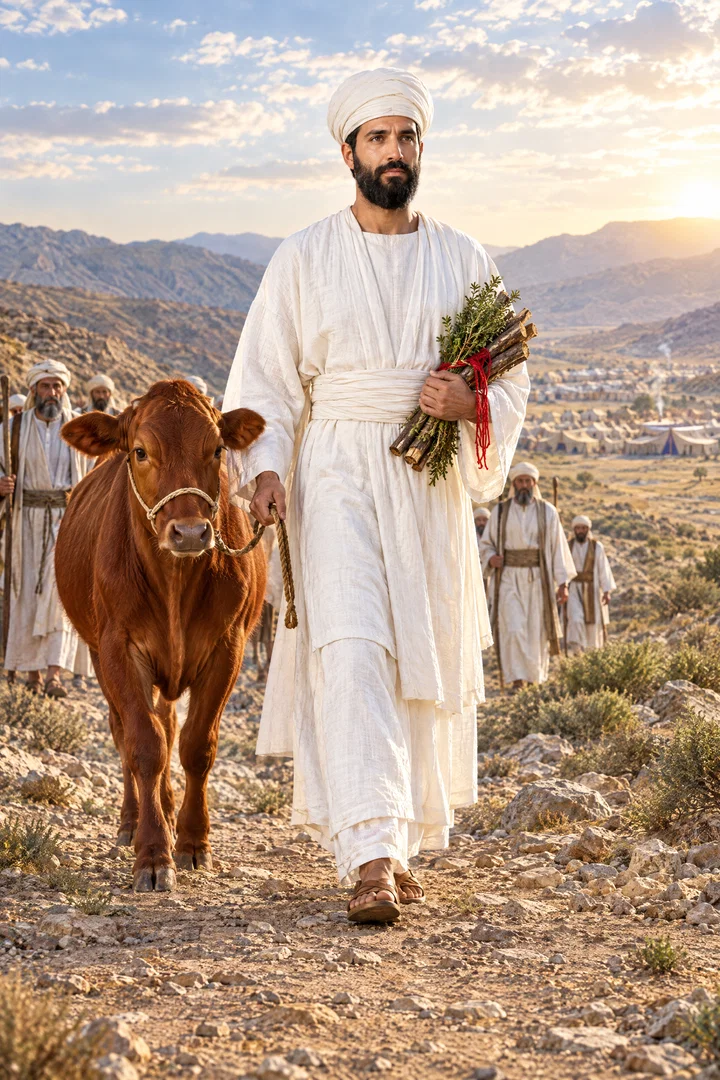
Cross-references
- Hebrews 13:12
Wherefore Jesus also, that he might sanctify the people with his own blood, suffered without the gate.
Jesus suffered outside the gate, like the red heifer offered outside the camp.
- Hebrews 9:13-14
For if the blood of bulls and of goats, and the ashes of an heifer sprinkling the unclean, sanctifieth to the purifying of the flesh:
The heifer’s cleansing rite is contrasted with Christ’s blood purifying the conscience.
- Leviticus 17:11
For the life of the flesh is in the blood: and I have given it to you upon the altar to make an atonement for your souls: for it is the blood that maketh an atonement for the soul.
Blood represents life and is given to make atonement.
- Hebrews 10:22
Let us draw near with a true heart in full assurance of faith, having our hearts sprinkled from an evil conscience, and our bodies washed with pure water.
Sprinkled blood accompanies drawing near to God with cleansed hearts.
- Hebrews 9:22
And almost all things are by the law purged with blood; and without shedding of blood is no remission.
Both texts connect purification with blood.
- Hebrews 9:23
It was therefore necessary that the patterns of things in the heavens should be purified with these; but the heavenly things themselves with better sacrifices than these.
Earthly sanctuary cleansing is a pattern of purification for heavenly things.
- Leviticus 16:14
And he shall take of the blood of the bullock, and sprinkle it with his finger upon the mercy seat eastward; and before the mercy seat shall he sprinkle of the blood with his finger seven times.
Both describe sprinkling blood with a finger seven times.
- Leviticus 4:6
And the priest shall dip his finger in the blood, and sprinkle of the blood seven times before the LORD, before the vail of the sanctuary.
Both describe dipping a finger in blood and sprinkling it seven times.
- Leviticus 14:7
And he shall sprinkle upon him that is to be cleansed from the leprosy seven times, and shall pronounce him clean, and shall let the living bird loose into the open field.
Both verses describe sprinkling seven times.
- Numbers 19:18
And a clean person shall take hyssop, and dip it in the water, and sprinkle it upon the tent, and upon all the vessels, and upon the persons that were there, and upon him that touched a bone, or one slain, or one dead, or a grave:
Both use sprinkling in the purification instructions.
- Numbers 19:9
And a man that is clean shall gather up the ashes of the heifer, and lay them up without the camp in a clean place, and it shall be kept for the congregation of the children of Israel for a water of separation: it is a purification for sin.
The ashes from the burning are kept as a sin-offering.
- Exodus 29:21
And thou shalt take of the blood that is upon the altar, and of the anointing oil, and sprinkle it upon Aaron, and upon his garments, and upon his sons, and upon the garments of his sons with him: and he shall be hallowed, and his garments, and his sons, and his sons’ garments with him.
Uses the same Hebrew word for sprinkling.
- Numbers 19:10
And he that gathereth the ashes of the heifer shall wash his clothes, and be unclean until the even: and it shall be unto the children of Israel, and unto the stranger that sojourneth among them, for a statute for ever.
offering kept for Israel and stranger
- 1 Peter 1:19
But with the precious blood of Christ, as of a lamb without blemish and without spot:
Christ is described as a spotless sacrificial lamb.
- Isaiah 52:15
So shall he sprinkle many nations; the kings shall shut their mouths at him: for that which had not been told them shall they see; and that which they had not heard shall they consider.
Listed as an occurrence of the same Hebrew word.
- Isaiah 63:3
I have trodden the winepress alone; and of the people there was none with me: for I will tread them in mine anger, and trample them in my fury; and their blood shall be sprinkled upon my garments, and I will stain all my raiment.
Listed as an occurrence of the same Hebrew word.
- Deuteronomy 12:23
Only be sure that thou eat not the blood: for the blood is the life; and thou mayest not eat the life with the flesh.
Blood is identified as representing life.
- Leviticus 16:27
And the bullock for the sin offering, and the goat for the sin offering, whose blood was brought in to make atonement in the holy place, shall one carry forth without the camp; and they shall burn in the fire their skins, and their flesh, and their dung.
The sacrificial bodies were burned outside the camp.
Commentary
Each commentary is drawn from primary sources: the writings of Ellen G. White and Adventist pioneers and periodicals. Each commentary is separate. Its own words are not a quotation; follow the references to read the source passages.
Ellen G. White
2 sources
Eleazar was to take the blood of the red heifer with his finger and sprinkle it seven times directly toward the tabernacle of the congregation as the offering for the congregation's purification.4T 121.2–122.14T 120.2–121.1 That blood was Christ's precious blood, shed in the full and complete sacrifice.4T 121.2–122.14T 120.2–121.1 The repeated sevenfold sprinkling signified the thorough cleansing, redemption, and purification from sin made possible through His sacrifice.4T 121.2–122.14T 120.2–121.1 The rite prefigured Christ's work of atonement and purification.4T 121.2–122.14T 120.2–121.1 His blood enters the holy place in the work of cleansing the sanctuary and reconciling God and humanity.4T 120.2–121.1
Sources
Pioneers and periodicals
14 sources
Eleazar the priest takes some of the slain red heifer's blood with his finger and sprinkles it seven times toward the front of the tent of meeting, and the word means sprinkle and not dipping or immersion.RH Apr 11, 1871ST May 6, 1880ST Jun 12, 1901RH Nov 11, 1909
It belongs to the rite of a spotless heifer slain and burned outside the camp to provide ashes for purification from impurity, fulfilled when Christ suffered outside Jerusalem's gate.ST Apr 23, 1912
The ordinance points to Christ, whose blood was offered for the whole world.RH May 16, 1912RH Apr 11, 1871
As part of that saving type, the blood sprinkled toward the tabernacle at a rough and worthless place teaches that Christ died for sinners, so that even the most wasted, sinful and outcast lives can seek mercy through Him and be saved.RH May 16, 1912ST Oct 29, 1912
The sacrifice was performed once for all for the whole people, yet it did not cleanse all indiscriminately, but made a provision that each impure person must lay hold of for himself to be freed.ST Jun 12, 1901
Words and Ritual Setting
The Hebrew word translated sprinkle means sprinkle, as the English version and the Septuagint also render it, and it does not mean dipping or immersion.ST May 6, 1880 Eleazar the priest takes some of the slain red heifer's blood with his finger and sprinkles it seven times directly before the tabernacle, toward the front of the tent of meeting.RH Apr 11, 1871ST Jun 12, 1901RH Nov 11, 1909 After this sprinkling the heifer is burned in his sight, her skin and her flesh and her blood with her dung, and cedar wood and hyssop and scarlet are cast into the midst of the burning.ST Jun 12, 1901
The verse belongs to the rite of a spotless heifer that is slain and burned outside the camp to provide ashes for purification from impurity.ST Apr 23, 1912 The red heifer offering is an exception to the Levitical sacrifices described in the first chapters of Leviticus.ST May 19, 1914 The heifer's red color is a substantial part of the divinely commanded service, so that substituting an animal of a different color would be disobedience, and its ashes are used to make the water of separation.ST Jan 1, 1885
The rite belongs to the earthly sanctuary's service and did not take place in the second apartment, showing that sanctuary services included rites beyond the work of the most holy place.RH Nov 11, 1909 The chapter is an example of purification for bodily defilement rather than sin, and such purification could be performed without blood and therefore does not contradict the teaching that forgiveness of sin requires blood, because blood represents life given for life.ST Feb 17, 1890 The ordinance of the red heifer was prescribed in the Pentateuch and remained in constant use, although it is not mentioned again in the Old Testament after the Pentateuch.RH Aug 3, 1869
Christ Foreshadowed and Applied
The ordinance points to Christ, while no separate meaning is assigned to the sprinkling itself or to the number seven.RH Apr 11, 1871 The blood sprinkled seven times toward the meeting place symbolizes Christ's blood, offered for the whole world.RH May 16, 1912 That blood making atonement for the soul and cleansing from sin carries the same meaning as the blood on the Israelite door lintel at the Passover and the blood sprinkled on Aaron and his sons at their consecration.RH Feb 26, 1901 It explains the prohibition of blood as food, that God designed blood to make atonement, and it points forward to Christ the perfect offering who ended the Levitical sacrifices by offering Himself.RH Feb 26, 1901 Where the blood of beasts cannot give peace or wash away stain, His blood purges the conscience from dead works.RH Feb 26, 1901
Two lives are represented in the sin offering, the innocent life of the victim and the imputed sinful life of the offerer, so that the same blood both conveys defilement to the sanctuary and cleanses the sinner.ST Jun 27, 1911 The priest who sprinkles the blood is made unclean by it, and the clean man who gathers the ashes and the one who sprinkles the ashes mingled with water must wash his clothes and be unclean until evening, while the unclean person sprinkled is cleansed.ST Jun 27, 1911 This means that Christ on the cross was made sin and suffered as the vilest of sinners, yet by virtue of His own pure life He at the same time cleansed the thief.ST Jun 27, 1911 The ceremonial sacrifice of the spotless heifer slain and burned outside the camp typified Christ's sacrifice for sin and was fulfilled when He suffered outside Jerusalem's gate.ST Apr 23, 1912
As part of a sanctuary type revealing Christ's saving work, the blood sprinkled toward the tabernacle at a rough, worthless place, the rough valley where the heifer was offered, teaches that Christ died for sinners.RH May 16, 1912ST Oct 29, 1912 Even those whose lives seem wasted or deeply sinful, the most worthless and outcast, can seek mercy through Christ and be saved.RH May 16, 1912ST Oct 29, 1912 The sacrifice of the red heifer was performed once for all for the whole people, yet it did not bring indiscriminate purification to the whole house of Israel.ST Jun 12, 1901 It made a provision that individual persons must lay hold of for themselves in order to be freed from personal impurity.ST Jun 12, 1901
Sources