Psalms 137:1
By the rivers of Babylon, there we sat down, yea, we wept, when we remembered Zion.
Translations
American King James Version, Webster Bible
By the rivers of Babylon, there we sat down, yes, we wept, when we remembered Zion.
King James Version, Revised Version
By the rivers of Babylon, there we sat down, yea, we wept, when we remembered Zion.
By the rivers of Babylon, there we sat down, yea, we wept,
When we remembered Zion.By the rivers of Babylon,
There we sat down, yea, we wept,
When we remembered Zion.By rivers of Babylon — There we did sit, Yea, we wept when we remembered Zion.
By the rivers of Babylon, there we sat down; yea, we wept when we remembered Zion.
By the rivers of Babylon, there, we sat down, yea we wept—when we remembered Zion:
Berean Standard Bible, Majority Standard Bible
By the rivers of Babylon we sat and wept
when we remembered Zion.By the rivers of Babylon, there we sat down.
Yes, we wept, when we remembered Zion.By the rivers of Babylon we were seated, weeping at the memory of Zion,
By the riuers of Babel we sate, and there wee wept, when we remembred Zion.
Douay-Rheims (Challoner revision)
Upon the rivers of Babylon, there we sat and wept: when we remembered Sion:
Pictures
Cross-references 20 of 21
- Micah 4:9-10
Now why dost thou cry out aloud? is there no king in thee? is thy counsellor perished? for pangs have taken thee as a woman in travail.
Portrays Zion’s distress and exile to Babylon as labor pains.
- 2 Chronicles 36:19-20
And they burnt the house of God, and brake down the wall of Jerusalem, and burnt all the palaces thereof with fire, and destroyed all the goodly vessels thereof.
Jerusalem’s destruction and the carrying of its people to Babylon prompt the lament.
- Psalms 126:1-2
When the LORD turned again the captivity of Zion, we were like them that dream.
The return from Zion’s captivity brings laughter and singing.
- Daniel 5:30-31
In that night was Belshazzar the king of the Chaldeans slain.
Babylon’s fall brings hope of deliverance to the exiles.
- Lamentations 1:1-5
How doth the city sit solitary, that was full of people! how is she become as a widow! she that was great among the nations, and princess among the provinces, how is she become tributary!
Mourns Jerusalem’s desolation and the people’s captivity.
- Jeremiah 25:11
And this whole land shall be a desolation, and an astonishment; and these nations shall serve the king of Babylon seventy years.
Both describe the captivity in Babylon as lasting seventy years.
- Jeremiah 29:10
For thus saith the LORD, That after seventy years be accomplished at Babylon I will visit you, and perform my good word toward you, in causing you to return to this place.
The promised end of the captivity gives hope of returning.
- Ezra 1:2-4
Thus saith Cyrus king of Persia, The LORD God of heaven hath given me all the kingdoms of the earth; and he hath charged me to build him an house at Jerusalem, which is in Judah.
Cyrus’s decree allows the exiles to return to Jerusalem and rebuild the temple.
- Psalms 137:8
O daughter of Babylon, who art to be destroyed; happy shall he be, that rewardeth thee as thou hast served us.
Babylon is named as the one who brought the captives’ suffering.
- Isaiah 35:10
And the ransomed of the LORD shall return, and come to Zion with songs and everlasting joy upon their heads: they shall obtain joy and gladness, and sorrow and sighing shall flee away.
The exiles weep remembering Zion; the ransomed are promised a joyful return there.
- Jeremiah 50:1-3
The word that the LORD spake against Babylon and against the land of the Chaldeans by Jeremiah the prophet.
Jeremiah foretells Babylon’s desolation.
- Zechariah 2:7
Deliver thyself, O Zion, that dwellest with the daughter of Babylon.
Both texts address Zion amid Babylonian exile.
- Jeremiah 51:63-64
And it shall be, when thou hast made an end of reading this book, that thou shalt bind a stone to it, and cast it into the midst of Euphrates:
The scroll cast into the Euphrates symbolizes Babylon sinking under judgment.
- Isaiah 47:1
Come down, and sit in the dust, O virgin daughter of Babylon, sit on the ground: there is no throne, O daughter of the Chaldeans: for thou shalt no more be called tender and delicate.
It refers to the daughter of Babylon.
- Revelation 18:2-4
And he cried mightily with a strong voice, saying, Babylon the great is fallen, is fallen, and is become the habitation of devils, and the hold of every foul spirit, and a cage of every unclean and hateful bird.
Babylon falls, and God calls his people to leave her.
- Jeremiah 51:25
Behold, I am against thee, O destroying mountain, saith the LORD, which destroyest all the earth: and I will stretch out mine hand upon thee, and roll thee down from the rocks, and will make thee a burnt mountain.
burnt mountain seen in ruins
- Jeremiah 51:42
The sea is come up upon Babylon: she is covered with the multitude of the waves thereof.
The sea overwhelms Babylon, echoing the sorrow of those exiled there.
- Jeremiah 51:36
Therefore thus saith the LORD; Behold, I will plead thy cause, and take vengeance for thee; and I will dry up her sea, and make her springs dry.
Drying Babylon’s sea explains the canals beside which the exiles wept.
- 2 Kings 25:12
But the captain of the guard left of the poor of the land to be vinedressers and husbandmen.
Describes those left in the land after the Babylonian conquest.
- Isaiah 13:21-22
But wild beasts of the desert shall lie there; and their houses shall be full of doleful creatures; and owls shall dwell there, and satyrs shall dance there.
contrasts busy past with desolate present
Commentary
Each commentary is drawn from primary sources: the writings of Ellen G. White and Adventist pioneers and periodicals. Each commentary is separate. Its own words are not a quotation; follow the references to read the source passages.
Ellen G. White
3 sources
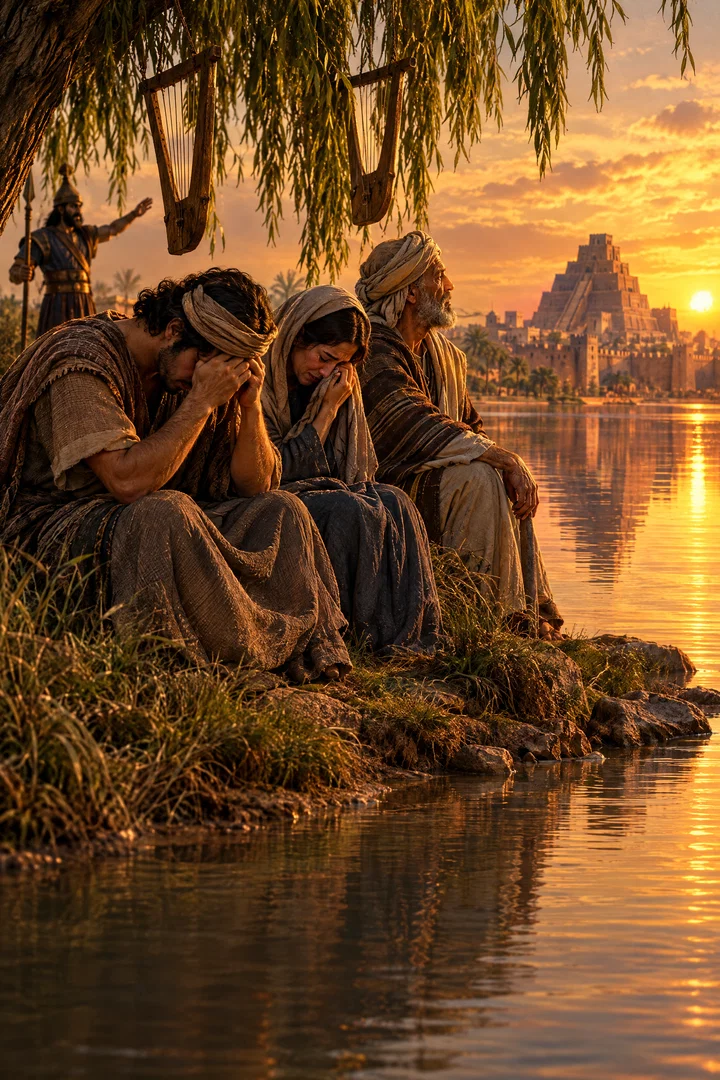
The verse pictures Judah's captives sitting down and weeping in Babylon when they remembered Zion and longed for Jerusalem.PK 7.4–8.1Lt 2c, 1892, par. 22–26HSFM 171.1 The rivers where they sat were the Euphrates, and the Jerusalem they remembered then lay desolate.PK 7.4–8.1 In its setting in Psalm 137:1-4, the harps hung on the willows represent people whose songs of Zion have been silenced.Lt 2c, 1892, par. 22–26 That silenced music can be restored when believers lay aside pride and selfishness and work in love to bring the truth to those who are lost.Lt 2c, 1892, par. 22–26 The same grief parallels the later experience of John Foxe, whose poverty and persecution while exiled in Basle matched the sorrow of the ancient exiles.HSFM 171.1
Sources
Pioneers and periodicals
49 sources
By the rivers of Babylon the exiles sat down and wept when they remembered Zion, as strangers far from Jerusalem and its worship in an enemy land, by the divided streams of the Euphrates lined with willows running through the city.RH May 27, 1858ST Apr 1, 1913ST Nov 21, 1900RH Oct 17, 1865ST They hung their harps on the willows and kept silent, refusing to sing the Lord's song in a strange land even when their captors mocked them and demanded mirth.RH Apr 22, 1915RH Jul 20, 1911ST May 16, 1911 Their captivity was God's punishment for forsaking Him and rejecting His messengers, especially for long-continued breaking of the Sabbath, which drove them from their land and laid the temple waste.RH Jul 20, 1911RH Mar 19, 1901ST Sep 9, 1886ST Nov 19, 1902RH Aug 19, 1873 That weeping marks the beginning of the church's long anguish and longing for the Deliverer, which gave way to hope when Babylon fell and pledged restoration and liberty.ST Oct 8, 1896ST May 16, 1911ST Apr 29, 1903ST May 20, 1880RH Jan 23, 1855 The same longing speaks to pilgrims still weary and far from home, who mourn in confusion yet take courage because deliverance draws near and the harps will be taken down when the heavenly home is reached.ST Feb 11, 1886ST Dec 19, 1916ST Apr 1, 1913RH Feb 5, 1867RH May 15, 1866
Historical Setting and Language
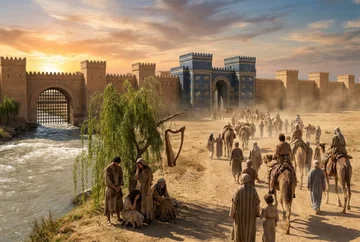
The plural rivers are streams inside the city of Babylon, for the single Euphrates was divided into several branches or canals that kept the Euphrates name as works of art.RH Oct 17, 1865 Those many streams with willows on their banks ran through gardens in the interior of the city, not above or below it, and the gardens were open and easily reached by the captives, not only the royal gardens.RH Oct 17, 1865 The waters also included a large lake or reservoir inside the city, called a sea, fed by the Euphrates.RH Oct 17, 1865
The scene stands on the banks of the Euphrates, whose banks were hoary with reeds and lined with gray osier willows still growing there, on which the captives hung their harps and refused to be comforted while Jerusalem was not.RH Nov 11, 1862 By the sparkling Euphrates they wept when they remembered Zion, oppressed more than cheered by the glory and prosperity of the land of their captivity.STST Feb 15, 1877 At that time the broken hills and long mounds now seen were palaces and streets, and the vast solitude was filled with the busy subjects of the proud daughter of the east.RH Nov 11, 1862
The psalm grew out of the exile and was sung by the captives in Babylon.ST May 13, 1908ST Dec 10, 1912 It was written after the Babylonian captivity and restoration by one of God's children who had endured the worst of it.ST
The weeping belongs to the seventy years of Babylonian captivity beginning when Daniel entered Babylon to serve as a captive.STST Jun 6, 1916 It expresses the sorrow and affliction of the Jews during that captivity, especially amid the persecution and distress of its later period.RH Aug 31, 1916 After seventy years in captivity, some Israelites had settled in Babylon, but others still yearned to return to their native land, mourning their separation from Zion and the land of their fathers.ST Apr 19, 1910ST Jun 6, 1916
The captivity followed forsaking virtue and rejecting God's messengers, so that God's protection was lost and the survivors were left to the Chaldeans who slew, desolated the sanctuary, and carried them away.RH Jul 20, 1911 Jerusalem's walls were broken down, its temple burned, the land laid waste, strangers occupied ancestral burial places, and Jerusalem lay in ruins.ST Nov 19, 1902ST May 23, 1911ST Oct 15, 1896 After the destruction of the temple in Jerusalem it has remained for nearly nineteen centuries only a sad memory, its mighty walls fallen and vanished, its joy and music hushed, its glorious psalms only a mournful memory of a departed glory, while its exiled children are strewn like wrecks on every foreign shore and a few sad exiles wail beside its ancient broken walls where anthems of praise were once heard.
Grief and Longing in Exile
By the rivers of Babylon the exiles sat down and wept when they remembered Zion, grieving as strangers in a foreign and enemy land far from home.RH May 27, 1858ST Apr 1, 1913ST Nov 21, 1900ST Jul 23, 1896 They were separated from Jerusalem and its worship and from the land of their fathers, remembering their homeland and the holy city they had lost.RH May 27, 1858ST Apr 1, 1913ST Dec 19, 1916 In Babylon, the land of their enemy and conqueror, where they did not want to be, they found no comfort, and their exile brought grief and longing for home and recalled their servitude.ST Nov 21, 1900ST Aug 28, 1884ST Jul 23, 1896 Their sorrow was set against surrounding celebration, as they remembered their native land and its sacred songs while the harp remained silent.ST Dec 19, 1916
Their mourning was for the joy and prosperity they had known in Jerusalem while obedient to God, now lost in captivity.ST Oct 8, 1896ST Sep 9, 1886 It reflected the languishing of God's cause, in contrast to the music and singing that marked times when God's work prospered and His people walked in faith and obedience.ST Sep 24, 1894 They mourned their lost privileges and the things they had lost, longing for salvation out of Zion.ST Oct 8, 1896ST Sep 9, 1886
They hung their harps on the willows and kept silent, leaving their harps there, for the Lord's song belonged to their own land and life and could not be sung in a strange land.RH Apr 22, 1915ST May 16, 1911ST Jan 30, 1896 Its melody was plaintive, and their music and worship were silenced, sung then as expressions of distress.ST Jan 30, 1896RH Aug 12, 1858 Their grief in a foreign land explains why they could not sing the Lord's songs there.
They were mocked by captors and oppressors who demanded mirth and their former joyful songs of praise and songs of Zion.RH Apr 22, 1915RH Jul 20, 1911 With backs furrowed by oppressors and with contempt and defiled bread, the once proud and joyful nation sat weeping with harps silent on the willows.RH Jul 20, 1911 They refused to satisfy those demands.RH Apr 22, 1915
Their refusal shows that Israel's music was an original expression of individual and national life, with both words and music composed to memorialize great events, not copied or borrowed from surrounding nations.RH Apr 22, 1915 After this their former glory never returned.RH Apr 22, 1915 The only further song given them to sing even in a foreign land was a funeral song, the Lamentations, which became the swan song and funeral dirge of a once mighty and glorious nation.RH Apr 22, 1915
The Psalms of David, once sung with glory in the halls of Zion, in the court of the tabernacle, and in the lofty space of the temple, were then sung with sorrow by the streams of Babylon.ST Jul 24, 1907RH Aug 12, 1858 There they were sung in exile as expressions of distress and sorrow.RH Aug 12, 1858 This displays their great power in the world in both triumph and exile.ST Jul 24, 1907
Prophecy of Captivity and Deliverance
The psalm is part of a prophecy of the Babylonian captivity and stands with those psalms understood as foretelling tribulation upon the enemies of the church.RH Sep 11, 1860RH Mar 12, 1861 Its sentence upon Babylon declares God's retributive justice, not a call for His people to do cruel deeds themselves.RH Sep 11, 1860
The weeping by Babylon's waters marks the beginning of the church's anguish, travail, crying, and longing for the Deliverer and for salvation out of Zion.ST Oct 8, 1896ST May 16, 1911ST Apr 29, 1903ST May 23, 1911ST Dec 9, 1908 Having lost the joy and prosperity known in Jerusalem while obedient to God, with worship silenced in a strange land, God's people mourned what was lost and waited for Israel's salvation.ST Oct 8, 1896ST May 16, 1911ST Apr 29, 1903 That longing continued about six hundred years until Jesus was born and came.ST Oct 8, 1896ST May 16, 1911ST Apr 29, 1903 Their grief over the past is also pictured as birth pangs for the coming Saviour, the Man child.ST May 23, 1911ST Oct 15, 1896
Their grief and longing for Zion gave way to hope when Babylon fell to the Persians and Belshazzar was killed.ST May 20, 1880RH Jan 23, 1855RH Aug 21, 1856 The ruined city where that sorrow had been felt saw its former feasting and song give way to desolation.ST May 20, 1880 The overthrow of the oppressors pledged deliverance, liberty, restoration, and the breaking of chains, so that the captives felt deliverance was beginning.RH Jan 23, 1855RH Aug 21, 1856
The weeping also marks the beginning of the captive state of the church in a broader sense, in which God's people have ever since lived in subjection to earthly powers and been more or less oppressed by them.STST Feb 15, 1877 That subjection will continue until earthly powers give way to Him whose right it is to reign, with the day of deliverance drawing near.STST Feb 15, 1877 In contrast to entering Babylon as captives into a foreign land, the redeemed will enter another city fifteen hundred miles in circumference, with walls of precious stones and jasper, streets of transparent gold, the river of life, and the glory of God and the Lamb for light.ST There ransomed multitudes will sing victory over death and the grave, returning to Zion with lasting joy instead of mourning, as exiles returning to the Father's house to home, freedom, peace, purity, bliss, and unending life.STST Dec 23, 1889
Doctrinal Warnings and Symbols
The weeping by the rivers of Babylon was the fruit of disobedience that drove Israel from its own land into captivity.RH Mar 19, 1901ST Sep 9, 1886RH Aug 19, 1873 That disobedience was long-continued breaking of the Lord's Sabbath, which made them forget that the Lord created the heavens and the earth and all their hosts and led them into idolatry.ST Sep 9, 1886 Had they kept the Sabbath, they could have remained safe in their homeland, and their lament as exiles remembering Zion expresses the sorrow and regret of that Sabbath-breaking people.RH Mar 19, 1901ST Sep 9, 1886 Their grief in exile over Sabbath-breaking is a type of the bitter regret of those lost in modern Babylon.RH Mar 19, 1901
Their place of grief was the land of their enemy and conqueror, where they did not want to be and found no comfort.ST Aug 28, 1884 As the captives were taken to Babylon, so those who die enter death, and that illustrates death as an enemy's land under Satan's power.ST Aug 28, 1884 The sorrow of Zion's people in Babylonian captivity, with their harps hanging on Babylonian willows, likewise illustrates the later captivity of those condemned for pride and excess.RH Jun 16, 1859
Present Comfort and Application
The longing for home in exile carries the hope of singing again when the Lord comes and the heavenly home is reached, for the grief of remembering Zion while living in Babylon makes it hard to sing Zion's songs until then.ST Feb 11, 1886 Believers amid the confusion of the world may likewise mourn and remember their heavenly home, keeping the songs of that homeland in their hearts, yet they should sing of its promised rest so as to touch and bless others.ST Dec 19, 1916 The tears of captives far from home and living as strangers in a foreign land speak to pilgrims still journeying, who may feel weary and far from home yet can take courage because the journey will end and they are nearing home.ST Apr 1, 1913 That sorrow in a foreign land, sitting beside Babylon's streams and weeping in remembrance of Zion so that the Lord's songs could not be sung there, illustrates the loneliness of those who rarely hear the prayers and praises of God's people.
The sitting and weeping pictures the disappointed, whose efforts have seemed vain and been crowned with failure and who are hurled back in gloom and defeat.RH Dec 30, 1915 They sit in sorrow with weary and bleeding feet and weep as they remember what they longed for while others more swift carry away the prize, so that the weeping and the willow belong to those who have failed in life's great conflict, borne the heaviest cross, and suffered regret and loss while praises greet the victors.RH Dec 30, 1915 God's few, feeble, scattered pilgrim people, weary, torn, and sinking under trials and strong enemies within, mourn in captivity with harps hung on the willows, tuning formal songs in vain while the heart murmurs and Jesus appears indifferent and to have left them to weep in sad despair.RH May 15, 1866 Then a smile from the Saviour, drops of refreshing grace, and a gentle ray of heavenly light break upon sorrowing minds, hope revives that His mighty arm alone saves and He will not leave them, and they long to behold His face in glory at His appearing.RH May 15, 1866 His dwelling among His followers takes those harps down, giving light in darkness to those groaning and toiling while generation after generation is swallowed by death, and His sweet melody moves their hearts and ends their weeping as they trust Him who has the power of eternal life to deliver them and restore again the kingdom to Israel.RH Feb 5, 1867
The language of weeping over Zion while far from it applies to sorrow for the church as it mingles with the world and follows worldly pleasures.RH Jul 2, 1857 The phrase down by the cold streams of Babylon applies to a backslidden condition of being among God's people yet spiritually cold and separated from the joy and help once experienced, with remembering Zion pointing to longing to return to God and renewed fellowship with His people. The exile's homesickness and note of longing is like a Turkish soldier's yearning for his distant family and for the poverty-stricken city of Diarbekir, which seemed like paradise to him.ST Mar 4, 1913 In that telling the Jewish captives beside Babylon's rivers grieve as they remember their native land and its sacred songs, with sorrow set against surrounding celebration and the harp silent, yet the Hebrew captive's longing is also expressed through those sacred songs of his land which he sings before the Babylonian ruler.ST Dec 19, 1916ST Dec 19, 1916
Sources