Psalms 88:11
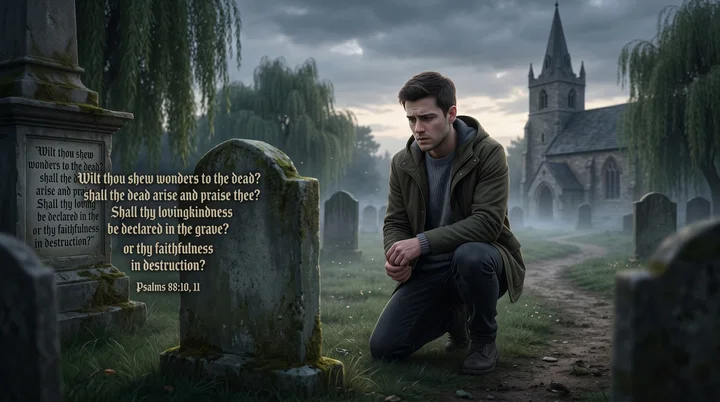
Shall thy lovingkindness be declared in the grave? or thy faithfulness in destruction?
Translations
Shall your loving kindness be declared in the grave? or your faithfulness in destruction?
Shall thy lovingkindness be declared in the grave? or thy faithfulness in destruction?
Shall thy lovingkindness be declared in the grave?
Or thy faithfulness in destruction?Shall thy loving-kindness be declared in the grave? or thy faithfulness in destruction?
Shall thy lovingkindness be declared in the grave? or thy faithfulness in Destruction?
Shall thy lovingkindness be declared in the grave?
Or thy faithfulness in Destruction?Is Thy kindness recounted in the grave? Thy faithfulness in destruction?
Shall thy loving-kindness be declared in the grave? thy faithfulness in Destruction?
Shall Thy lovingkindness be recounted in the grave? Thy faithfulness, in destruction?
Berean Standard Bible, Majority Standard Bible
Can Your loving devotion be proclaimed in the grave,
Your faithfulness in Abaddon?Is your loving kindness declared in the grave?
Or your faithfulness in Destruction?Will the story of your mercy be given in the house of the dead? will news of your faith come to the place of destruction?
Shall thy louing kindenes be declared in the graue? or thy faithfulnes in destruction?
Douay-Rheims (Challoner revision)
Shall any one in the sepulchre declare thy mercy: and thy truth in destruction?
Pictures
Cross-references 20 of 30
- Psalms 115:17
The dead praise not the LORD, neither any that go down into silence.
Both say the dead do not praise the Lord in silence.
- Psalms 6:5
For in death there is no remembrance of thee: in the grave who shall give thee thanks?
Both ask whether the dead can remember God or give thanks in the grave.
- Ecclesiastes 9:5-6
For the living know that they shall die: but the dead know not any thing, neither have they any more a reward; for the memory of them is forgotten.
The dead know nothing, and their love and other emotions have perished.
- Ecclesiastes 9:10
Whatsoever thy hand findeth to do, do it with thy might; for there is no work, nor device, nor knowledge, nor wisdom, in the grave, whither thou goest.
Both describe the grave as a place without work or knowledge.
- Isaiah 38:18-19
For the grave cannot praise thee, death can not celebrate thee: they that go down into the pit cannot hope for thy truth.
The grave cannot praise God or hope in his truth; the living declare it.
- Job 10:21-22
Before I go whence I shall not return, even to the land of darkness and the shadow of death;
Both describe the grave as a land of darkness.
- Psalms 146:4
His breath goeth forth, he returneth to his earth; in that very day his thoughts perish.
Both describe human thoughts perishing at death.
- Job 14:12-15
So man lieth down, and riseth not: till the heavens be no more, they shall not awake, nor be raised out of their sleep.
The dead lie asleep until God calls them and they answer.
- Psalms 31:17
Let me not be ashamed, O LORD; for I have called upon thee: let the wicked be ashamed, and let them be silent in the grave.
Both describe the dead as silent in the grave.
- Job 17:13-16
If I wait, the grave is mine house: I have made my bed in the darkness.
Both describe Sheol as darkness, corruption, and rest in the dust.
- Acts 2:34
For David is not ascended into the heavens: but he saith himself, The LORD said unto my Lord, Sit thou on my right hand,
Peter says David died and was buried, but had not ascended to heaven.
- Job 14:21
His sons come to honour, and he knoweth it not; and they are brought low, but he perceiveth it not of them.
The dead are unaware of whether their children are exalted or brought low.
- Psalms 89:48
What man is he that liveth, and shall not see death? shall he deliver his soul from the hand of the grave? Selah.
Both ask whether anyone can escape death and the grave’s power.
- Job 7:21
And why dost thou not pardon my transgression, and take away mine iniquity? for now shall I sleep in the dust; and thou shalt seek me in the morning, but I shall not be.
Both ask whether God’s faithfulness is known among the dead.
- Job 14:13
O that thou wouldest hide me in the grave, that thou wouldest keep me secret, until thy wrath be past, that thou wouldest appoint me a set time, and remember me!
Both ask about being hidden in the grave.
- John 5:28-29
Marvel not at this: for the hour is coming, in the which all that are in the graves shall hear his voice,
Both place the dead in graves until Christ calls them forth.
- Psalms 30:9
What profit is there in my blood, when I go down to the pit? Shall the dust praise thee? shall it declare thy truth?
Both ask whether the dead can declare God’s truth or praise him.
- Psalms 88:5
Free among the dead, like the slain that lie in the grave, whom thou rememberest no more: and they are cut off from thy hand.
Both verses use “grave” for the place of the dead.
- 1 Corinthians 15:55
O death, where is thy sting? O grave, where is thy victory?
Hades is given as equivalent to the grave.
- Psalms 30:3
O LORD, thou hast brought up my soul from the grave: thou hast kept me alive, that I should not go down to the pit.
Both ask whether God’s praise and faithfulness can be declared in the grave.
Commentary
Each commentary is drawn from primary sources: the writings of Ellen G. White and Adventist pioneers and periodicals. Each commentary is separate. Its own words are not a quotation; follow the references to read the source passages.
Pioneers and periodicals
30 sources
The verse asks whether God's lovingkindness is made known in the grave and His faithfulness in destruction, expecting the answer no.ST Feb 6, 1907ST Nov 25, 1886 The dead in the grave declare nothing, show no wonders, and offer no praise, because they lie unconscious and asleep in darkness, silence and forgetfulness until they are raised.RH Feb 2, 1864ST Feb 6, 1907RH Sep 26, 1865ST Nov 25, 1886RH Oct 2, 1855 This denies that man has natural immortality, for immortality is not possessed at death but is to be sought by patient continuance in well doing and is put on only at the resurrection through Christ.RH Feb 2, 1864RH Oct 20, 1874 Death is therefore not birth into a higher life or a gate to endless joy, and there is no hearing, responding, or probation after death, nor conscious suffering and converse in Sheol immediately after death.ST Mar 30, 1882ST Jun 23, 1881ST Mar 15, 1877RH Oct 20, 1874 Yet God's lovingkindness and faithfulness will still be declared in the grave through the resurrection of the dead, without which the ruin of death would be eternal destruction.RH Sep 26, 1854RH Sep 26, 1865RH Jul 10, 1860
Words and Setting
The question is whether tender mercy is made known in the burial place and covenant loyalty in the place of ruin, and the expected answer is no.ST Feb 6, 1907ST Nov 25, 1886 The grave is the place of the dead, where no testimony to divine character is given because the dead are unconscious.ST Feb 6, 1907ST Nov 25, 1886 It is the dark land of forgetfulness where the dead know nothing, remember nothing, and do nothing, and therefore they cannot praise the Lord or make known wonders, righteousness, and truth.ST Nov 25, 1886ST Dec 19, 1900RH Aug 27, 1872 They do not pass at death into heaven to join in praise, but lie in silence until they are brought again from the grave to live.ST Feb 6, 1907ST Nov 25, 1886
Death, the grave, and ruin name the same condition, which is Sheol or Hades.RH Sep 26, 1854ST Mar 30, 1882 While they remain there the dead do not praise God, and good and bad alike return to dust in a land of darkness where feeling and emotion are impossible.RH Sep 26, 1854ST Mar 30, 1882 The Hebrew word for grave in the question denotes the outward and visible burial place rather than the state of the dead as such.RH Apr 28, 1863 This is the one possible exception where that word is joined to language about the state of man in the grave.RH Apr 28, 1863
The grave is portrayed as darkness, silence, and forgetfulness, a place of secrecy, sleep, and rest, of corruption and worms, where wonders, righteousness, and truth are not known.ST Dec 19, 1900RH Aug 27, 1872ST Aug 25, 1881RH Mar 28, 1865RH May 5, 1874 It is silent and inactive, without conscious knowledge, remembrance of God, work, wisdom, or remembrance of His name.RH Aug 27, 1872ST Aug 25, 1881ST Mar 27, 1879 The dead do not rise to praise or to declare mercy and faithfulness, because their activity is suspended.ST Dec 19, 1900RH Aug 27, 1872ST Aug 25, 1881 Speech put in their mouths is personification, presenting the facts of their lives as though they were alive.ST Mar 27, 1879
The question was urged as a plea against the approach of death, on the ground that death stops remembrance and praise of God.RH Aug 5, 1862 Those in the grave and in ruin cannot speak of merciful love and faithfulness.RH Aug 5, 1862 The soul therefore does not survive to go at once to heaven to praise without ceasing, but the dead lie in darkness in the land of forgetfulness where wonders and righteousness are not known.ST Nov 25, 1886RH Aug 5, 1862
Unconscious Sleep of Dead
The grave declares nothing of divine lovingkindness and nothing of divine faithfulness, because those who lie there are unconscious and all their activity is suspended.ST Feb 6, 1907RH Sep 26, 1865ST Nov 25, 1886RH Nov 18, 1858ST Dec 19, 1900 No wonders are shown to them in destruction, they do not arise, and they give no praise, since destruction and darkness and the land of forgetfulness allow no conscious praise or testimony to God's character.RH Sep 26, 1865ST Nov 25, 1886RH Nov 18, 1858ST Dec 19, 1900ST Aug 18, 1881 The questions expect the answer no: the dead know nothing, remember nothing, and do nothing, and therefore cannot make known wonders, righteousness, and truth.ST Nov 25, 1886ST Dec 19, 1900ST Aug 18, 1881 This silence belongs to the whole person and not to the body alone, for whatever in man remembers, knows, thinks, and praises goes into silence and forgetfulness at death.RH Feb 2, 1864RH Oct 2, 1855RH Dec 23, 1862ST Dec 19, 1900 The power of memory belongs to the thinking soul and not to the lifeless body, since a body separated from the soul cannot remember or think or exercise any mental power and has no knowledge to forget; it is therefore the soul itself that enters forgetfulness and forgets its knowledge.RH Feb 2, 1864RH Oct 2, 1855 A living person's mind serves God, but in death there is no conscious remembrance or service, and man as a conscious being stops praising when thinking and activity cease.RH Oct 2, 1855RH Dec 23, 1862ST Dec 19, 1900
A man knows less when he enters that state than he did before, and if some things are forgotten there all things may be.RH Feb 2, 1864ST Oct 9, 1879 There is no work, knowledge, wisdom, feeling, emotion, remembrance, or thanks there, and the dead cannot praise God or hope in His truth.ST Dec 4, 1884ST Oct 9, 1879ST Mar 30, 1882ST Mar 27, 1879 They wait there for their return, unconscious and without concern for what happens on earth or in heaven, and they are not made more knowledgeable than the living by dying.ST Dec 4, 1884ST Apr 11, 1900ST Oct 9, 1879 All the dead go to that land of forgetfulness, where lovingkindness is not declared and faithfulness is not known.ST Dec 4, 1884ST Apr 11, 1900 They lie asleep and silent in darkness until they are raised, and death is not immediate entrance into conscious delight in God's presence with greater knowledge and nobler powers of praise.RH Sep 26, 1865ST Nov 25, 1886RH Aug 5, 1862RH Jun 12, 1860 The dead do not go to heaven at death to join in unceasing praise, but remain without awareness or activity while they are in the grave until God brings them again from the grave to live.ST Nov 25, 1886RH Aug 5, 1862ST Oct 2, 1884ST Nov 1, 1883 Praise and hope belong to the living and to awaking afterward in God's likeness, when remembrance and praise resume after sleep in unconsciousness without remembrance or thanks until the resurrection.RH Sep 26, 1865RH Aug 5, 1862RH Jun 12, 1860
Death brings good and bad alike back to dust, a state of decay and ruin in a dark land where God's wonders are not known.ST Aug 28, 1884RH Jul 10, 1860ST Mar 30, 1882 There the dead are in the enemy's power, and the mind is in utter unconsciousness where love and faithfulness are not made known.ST Aug 28, 1884RH Jul 10, 1860 Nothing of the person remains except the particles of the body, which without a resurrection would be eternal destruction.RH Jul 10, 1860 Speech elsewhere attributed to the dead is personification, presenting the facts of their lives as though they were alive, since the grave is darkness, silence, and forgetfulness where the dead have no knowledge, work, wisdom, or remembrance of the name of God and cannot consciously speak or act.ST Mar 27, 1879
Doctrines Proved and Denied
The grave answers the question about declaring lovingkindness and faithfulness with silence, for it is destruction and the land of forgetfulness where the dead do not arise and praise God.RH Feb 2, 1864RH Oct 20, 1874 Immortality is subject to neither death nor decay, so the soul that thinks and remembers must itself go into forgetfulness at death, since a body separated from the soul cannot remember or think or exercise any mental power.RH Feb 2, 1864 What knows less on entering that state than before may forget all things if it forgets some things, and therefore natural immortality of the soul is denied.RH Feb 2, 1864RH Oct 20, 1874 Immortality is not possessed at death but is to be sought by patient continuance in well doing, and is found only in the gospel of Christ to be put on at the resurrection.RH Oct 20, 1874
Death is not birth into a higher life or a gate to endless joy, but the domain of the enemy where remembrance ceases and lovingkindness and faithfulness are not declared.RH Oct 20, 1874 That condition refutes spiritualism, which depends on conscious life and communication after death.RH Oct 20, 1874 There is also no probation after death, because the grave is a land of forgetfulness and darkness where the dead cannot hear a message, respond to it, or praise God. For the same reason the preaching to the spirits mentioned in 1 Peter 3:18-19 was not fulfilled by preaching in Sheol, where lovingkindness and faithfulness are not declared and the dead do not praise God amid darkness and forgetfulness.ST Aug 18, 1881
The conscious suffering and conversation in the story of the rich man and Lazarus cannot take place in Sheol immediately after death.ST Mar 30, 1882ST Jun 23, 1881ST Mar 15, 1877RH May 5, 1874 Sheol or Hades is the grave and destruction, a land of darkness where good and bad alike return to dust and are unconscious and incapable of feeling or emotion.ST Mar 30, 1882RH May 5, 1874 Its dead are silent and do not praise God or know anything, and cannot declare lovingkindness or faithfulness.ST Mar 30, 1882ST Jun 23, 1881ST Mar 15, 1877RH May 5, 1874 It is a place of silence, darkness, rest, corruption, and worms.RH May 5, 1874
Death, the grave, and destruction describe the same condition, in which the dead do not praise God while they remain there.RH Sep 26, 1854 Yet lovingkindness and faithfulness will yet be declared in the grave through the resurrection of the dead.RH Sep 26, 1854 No wonders are shown to the dead in destruction, darkness, and the land of forgetfulness, and the dead do not arise to praise God apart from being raised.RH Sep 26, 1865 Death is not an immediate entrance into conscious delight with greater knowledge and nobler powers of praise, for praise and hope belong to the living and to awaking afterward in likeness to God.RH Sep 26, 1865 Death is utter unconsciousness for the mind and a state of decay and ruin leaving nothing of the person except the particles of the body, which without a resurrection would be eternal destruction.RH Jul 10, 1860
Sources