Ruth 4:1
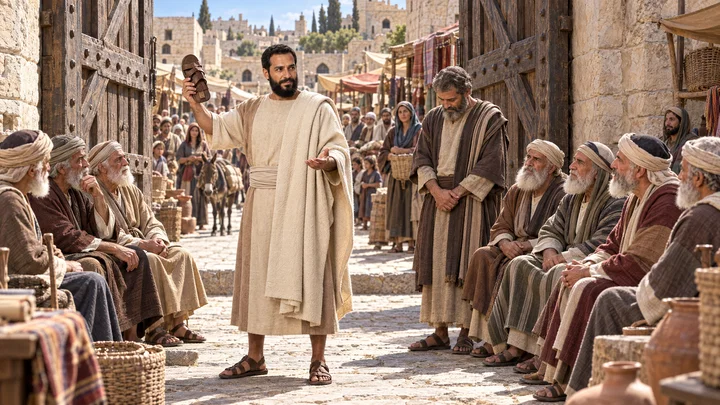
Then went Boaz up to the gate, and sat him down there: and, behold, the kinsman of whom Boaz spake came by; unto whom he said, Ho, such a one! turn aside, sit down here. And he turned aside, and sat down.
Translations
Then went Boaz up to the gate, and sat him down there: and, behold, the kinsman of whom Boaz spoke came by; to whom he said, Ho, such a one! turn aside, sit down here. And he turned aside, and sat down.
Then went Boaz up to the gate, and sat him down there: and, behold, the kinsman of whom Boaz spake came by; unto whom he said, Ho, such a one! turn aside, sit down here. And he turned aside, and sat down.
Then went Boaz up to the gate, and sat him down there: and behold, the kinsman of whom Boaz spake came by; unto whom he said, Ho, such a one, turn aside, sit down here. And he turned aside, and sat down.
Then Boaz went up to the gate, and sat down there: and behold, the kinsman of whom Boaz spoke came by; to whom he said, Ho, such a one! turn aside, sit down here. And he turned aside, and sat down.
Revised Version, American Standard Version
Now Boaz went up to the gate, and sat him down there: and, behold, the near kinsman of whom Boaz spake came by; unto whom he said, Ho, such a one! turn aside, sit down here. And he turned aside, and sat down.
And Boaz hath gone up to the gate, and sitteth there, and lo, the redeemer is passing by of whom Boaz had spoken, and he saith, 'Turn aside, sit down here, such a one, such a one;' and he turneth aside and sitteth down.
And Boaz went up to the gate, and sat down there. And behold, he that had the right of redemption, of whom Boaz had spoken, came by. And he said, Thou, such a one, turn aside, sit down here. And he turned aside and sat down.
Now, Boaz, went up to the gate, and sat him down there, and lo! the kinsman, passing by, of whom Boaz had spoken, so he said—Turn aside! and sit down here, such a one! And he turned aside, and sat down.
Berean Standard Bible, Majority Standard Bible
Meanwhile, Boaz went to the gate and sat down there. Soon the kinsman-redeemer of whom he had spoken came along, and Boaz said, “ Come over here, my friend, and sit down.” So he went over and sat down.
Now Boaz went up to the gate and sat down there. Behold, the near kinsman of whom Boaz spoke came by. Boaz said to him, “ Come over here, friend, and sit down!” He came over, and sat down.
And Boaz went up to the public place of the town, and took his seat there: and the near relation of whom he had been talking came by; and Boaz, crying out to him by name, said, Come and be seated here. And he came and was seated.
Then went Boaz vp to the gate, and sate there, and beholde, the kinsman, of whome Boaz had spoken, came by: and he sayd, Ho, snch one, come, sit downe here. And he turned, and sate downe.
Douay-Rheims (Challoner revision)
Then Booz went up to the gate, and sat there. And when he had seen the kinsman going by, of whom he had spoken before, he said to him, calling him by his name: Turn aside for a little while, and sit down here. He turned aside, and sat down.
Pictures
Cross-references
- Ruth 3:12-13
And now it is true that I am thy near kinsman: howbeit there is a kinsman nearer than I.
Identifies the nearer kinsman whose claim leads to the gate scene.
- Ruth 2:20
And Naomi said unto her daughter in law, Blessed be he of the LORD, who hath not left off his kindness to the living and to the dead. And Naomi said unto her, The man is near of kin unto us, one of our next kinsmen.
Identifies Boaz as a relative with a right to redeem.
- Leviticus 25:24-28
And in all the land of your possession ye shall grant a redemption for the land.
Gives the law for redeeming lost land.
- Leviticus 25:48-49
After that he is sold he may be redeemed again; one of his brethren may redeem him:
A close relative may redeem a family member, a law Boaz carries out.
- Deuteronomy 25:5-10
If brethren dwell together, and one of them die, and have no child, the wife of the dead shall not marry without unto a stranger: her husband’s brother shall go in unto her, and take her to him to wife, and perform the duty of an husband’s brother unto her.
Defines the duty Boaz settles at the gate.
- Matthew 1:5
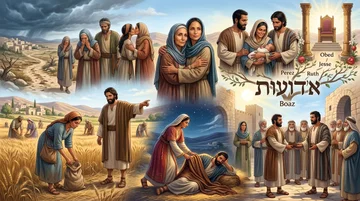
And Salmon begat Booz of Rachab; and Booz begat Obed of Ruth; and Obed begat Jesse;
Ruth becomes a progenitor of Christ in the flesh
- Deuteronomy 21:19
Then shall his father and his mother lay hold on him, and bring him out unto the elders of his city, and unto the gate of his place;
Both describe elders or judges sitting at the city gate.
- Hebrews 2:16-17
For verily he took not on him the nature of angels; but he took on him the seed of Abraham.
Christ took Abraham’s seed and was made like his brethren.
Commentary
Each commentary is drawn from primary sources: the writings of Ellen G. White and Adventist pioneers and periodicals. Each commentary is separate. Its own words are not a quotation; follow the references to read the source passages.
Pioneers and periodicals
9 sources
Ruth 4:1 belongs to the beautiful, brief, wonderfully interesting story of Ruth, a little pastoral tale from the time of the judges whose close brings out the ancestry of the Lord Jesus, into which a Moabite woman is brought.ST Mar 31, 1909 The book was probably written by Samuel, or in the early days of David, perhaps by Nathan the prophet.ST Mar 31, 1909
City gates were places of judgment where magistrates and judges sat each day to hear and decide complaints and litigation, and where councils of war were held.RH Mar 26, 1872 Ancient walled cities built for defense had at each gate an extra half-circle wall outside, leaving a crescent-shaped space where seats were erected for this work.RH Mar 26, 1872 Boaz going up to the gate and sitting down illustrates that custom, and the same custom explains Lot sitting in the gate of Sodom as filling a post of honor and influence as magistrate and judge in the place of his duty.RH Mar 26, 1872
Boaz going up to the city gate and sitting down is a formal legal meeting to settle the Goel obligation, calling the nearer kinsman who has a better right than himself to turn aside and sit.RH Mar 12, 1908 With ten elders of the city called to sit as witnesses, he begins the public proceedings to settle the family's inheritance and the kinsman's right concerning Ruth.RH Mar 12, 1908ST Nov 10, 1898 Boaz knows the family relationships better than Naomi and knows this other man must first be given the right to redeem.RH Mar 12, 1908
The law carried out at the gate is that the right to redeem a person or inheritance lost through poverty or bondage falls not merely to one near of kin but to the one nearest of kin by blood-relationship who is able.ST Nov 5, 1896RH Dec 25, 1900 Land rights were governed by the law connected with the Jubilee, as seen when Boaz addresses the nearer kinsman at the town gate about the redemption of property.ST Feb 10, 1914 The kinsman-marriage custom kept a dead man's inheritance in Canaan from passing out of his family, for if a man died without an heir his property would go into other hands, but if his brother or near kinsman married his widow the firstborn would be counted as the heir of the one who died so the homestead was retained.ST Jul 7, 1887
In this verse that law is applied to the redemption of Elimelech's land, also described as Naomi's inheritance, and to the marriage of Ruth the Moabitess to raise up the name of the dead upon his inheritance.RH Mar 12, 1908 The near kinsman is a type of Christ showing God's care for the Seed.ST Apr 8, 1913 Fallen humanity has lost its inheritance and is itself in bondage and cannot redeem itself or its inheritance, so the right falls to Jesus Christ as the only one in the universe who is able, who took part of the same flesh and blood as man in order to become his nearest kin by blood-relationship and thus his redeemer.ST Nov 5, 1896RH Dec 25, 1900 That redemption points forward to Christ, who had the right to redeem and gave His life to do so.
Through this work the Moabitess Ruth became one of the progenitors of Christ according to the flesh, chosen to belong to the family line through which Christ came.ST Apr 8, 1913 The passage gives a picture of the sweet, simple home life among the children of Israel.ST Apr 8, 1913 This whole kinsman-marriage arrangement will be unnecessary for those accounted worthy to obtain the resurrection from the dead, because they cannot die anymore and each person's inheritance in the restored new earth will remain unimpaired throughout eternity.ST Jul 7, 1887
Sources