Zechariah 13:6
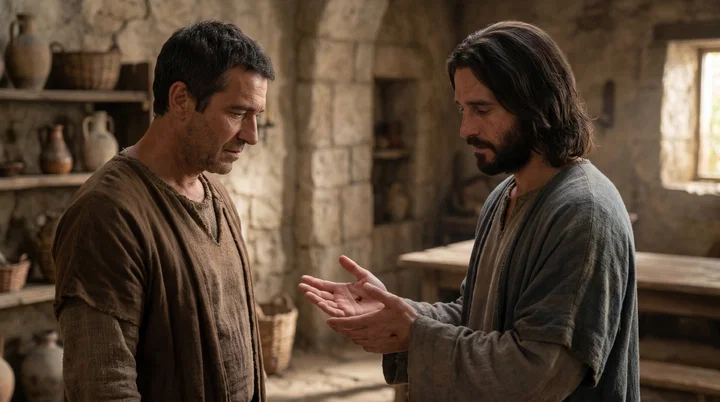
And one shall say unto him, What are these wounds in thine hands? Then he shall answer, Those with which I was wounded in the house of my friends.
Translations
And one shall say to him, What are these wounds in your hands? Then he shall answer, Those with which I was wounded in the house of my friends.
King James Version, KJV Cambridge Paragraph Bible
And one shall say unto him, What are these wounds in thine hands? Then he shall answer, Those with which I was wounded in the house of my friends.
And one shall say to him, What are these wounds in thy hands? Then he shall answer, Those with which I was wounded in the house of my friends.
Revised Version, American Standard Version
And one shall say unto him, What are these wounds between thine arms? Then he shall answer, Those with which I was wounded in the house of my friends.
And [one] hath said unto him, 'What [are] these wounds in thy hands?' And he hath said, 'Because I was smitten [at] home by my lovers.'
And one shall say unto him, What are those wounds in thy hands? And he will say, Those with which I was wounded in the house of my friends.
Then will one say unto him, What are these wounds between thy hands? And he will say, Wherewith I was wounded in the house of them who loved me.
Berean Standard Bible, Majority Standard Bible
If someone asks him, ‘ What are these wounds on your chest?’ he will answer, ‘ These are the wounds I received in the house of my friends.’
One will say to him, ‘ What are these wounds between your arms?’ Then he will answer, ‘Those with which I was wounded in the house of my friends.’
And if anyone says to him, What are these wounds between your hands? then he will say, Those with which I was wounded in the house of my friends.
And one shall say vnto him, What are these woundes in thine hands? Then he shall answere, Thus was I wounded in the house of my friendes.
Douay-Rheims (Challoner revision)
And they shall say to him: What are these wounds in the midst of thy hands? And he shall say: With these I was wounded in the house of them that loved me.
Pictures
Cross-references
- John 20:25-27
The other disciples therefore said unto him, We have seen the Lord. But he said unto them, Except I shall see in his hands the print of the nails, and put my finger into the print of the nails, and thrust my hand into his side, I will not believe.
The risen Jesus shows his hands’ nail marks.
- Isaiah 53:3
He is despised and rejected of men; a man of sorrows, and acquainted with grief: and we hid as it were our faces from him; he was despised, and we esteemed him not.
Christ was despised and rejected by those he came to save.
- Isaiah 53:5
But he was wounded for our transgressions, he was bruised for our iniquities: the chastisement of our peace was upon him; and with his stripes we are healed.
Christ’s wounds are linked to his saving sacrifice.
- Isaiah 49:16
Behold, I have graven thee upon the palms of my hands; thy walls are continually before me.
The engraved palms are identified with the nail prints.
- Isaiah 53:4
Surely he hath borne our griefs, and carried our sorrows: yet we did esteem him stricken, smitten of God, and afflicted.
Both describe the one who bore human griefs through suffering.
- Isaiah 53:9-10
And he made his grave with the wicked, and with the rich in his death; because he had done no violence, neither was any deceit in his mouth.
both prophesy His suffering and death
- Zechariah 12:10
And I will pour upon the house of David, and upon the inhabitants of Jerusalem, the spirit of grace and of supplications: and they shall look upon me whom they have pierced, and they shall mourn for him, as one mourneth for his only son, and shall be in bitterness for him, as one that is in bitterness for his firstborn.
The pierced one is mourned for as the Spirit brings personal conviction.
- Revelation 5:6
And I beheld, and, lo, in the midst of the throne and of the four beasts, and in the midst of the elders, stood a Lamb as it had been slain, having seven horns and seven eyes, which are the seven Spirits of God sent forth into all the earth.
The slain Lamb’s wounds remain a witness in heaven.
- Luke 22:38
And they said, Lord, behold, here are two swords. And he said unto them, It is enough.
The passage invokes Christ’s distinction between the swords.
Commentary
Each commentary is drawn from primary sources: the writings of Ellen G. White and Adventist pioneers and periodicals. Each commentary is separate. Its own words are not a quotation; follow the references to read the source passages.
Ellen G. White
3 sources
The verse foretells the manner of Christ's death, for the wounds in his hands are the marks of his crucifixion, inflicted in the house of his friends when he suffered death at the hands of evil men.AA 226.3–227.1 It also shows that Christ is wounded by his own friends when his professed people and ministers dishonor him.Lt 50, 1889, par. 6–9 That wounding comes not from open enemies but from brethren without just cause who act in the spirit of the scribes and Pharisees.Lt 50, 1889, par. 6–9 They do this through betrayal, false statements and accusation, presenting him and his work in the worst possible light.Lt 50, 1889, par. 6–9 They stir up the worst elements of the unsanctified natural heart, and make of no effect the true labors given for his people.Lt 50, 1889, par. 6–9
The verse applies when his own professed people connected with his institution depart from pure principles.Lt 18, 1901, par. 4–6 They put unjust, selfish, human principles in place of justice, mercy and the love of God.Lt 18, 1901, par. 4–6 They ignore the cautions, warnings and rebukes God sends to bar wrong principles.Lt 18, 1901, par. 4–6 That course offends God and makes his work go crookedly.Lt 18, 1901, par. 4–6 It brings a cloud over his institution that is not dispelled until cleansed by the bright beams of the Sun of Righteousness.Lt 18, 1901, par. 4–6
Those who acted a prominent part in that wrong must repent so their sins may be blotted out.Lt 18, 1901, par. 4–6 To refuse repentance and continue adds to transgression.Lt 18, 1901, par. 4–6 Such a course not only keeps wounding Christ in the house of his friends but betrays him into the hands of his enemies.Lt 18, 1901, par. 4–6
Sources
Pioneers and periodicals
66 sources
The verse speaks of Jesus Christ and the scars in His hands from His crucifixion.ST Aug 16, 1905ST Sep 27, 1910ST Dec 7, 1882 Those nail prints remained visible after His resurrection and will remain upon Him forever in glory as the lasting mark of the price He paid to save humanity.ST Aug 22, 1911ST Apr 14, 1909ST Apr 7, 1914ST He received those wounds among those who should have been His friends, when He came to His own people and was rejected, betrayed and put to death as a criminal.ST Aug 16, 1905ST May 24, 1883ST Jan 21, 1889RH Oct 14, 1902 He is still wounded in the house of His friends when professed believers live worldly and unconsecrated lives, bring reproach upon His cause, and hinder His work from within more deeply than open enemies do.RH Oct 5, 1911RH Sep 6, 1870RH Feb 28, 1856RH May 22, 1879 Each person must recognize that his own sin pierced Christ, hate the sins that wounded Him, and turn fully to Him for cleansing and control.ST Dec 17, 1902ST Nov 1, 1877RH Mar 13, 1866ST Mar 29, 1883
Identity and Context
The verse speaks of Christ and the wounds in His hands.ST Aug 16, 1905ST Sep 27, 1910ST Dec 7, 1882 The verse that follows, concerning the smiting of the Shepherd and the scattering of the sheep, confirms that the passage concerns Jesus, because He applied its words to Himself, and it was fulfilled when He was seized by the mob and His disciples forsook Him and fled.ST Aug 16, 1905ST Dec 7, 1882
The prophecy belongs to the restoration promised after the Babylonian captivity.ST Sep 16, 1913ST Oct 20, 1909ST Dec 15, 1909 It was fulfilled in measure in the return from exile and will be fulfilled in larger measure in the final restoration when Christ shall come.ST Sep 16, 1913ST Oct 20, 1909 It was given to encourage the building of the temple and the restoring of Jerusalem, and that restoration work and reformation movement is a type of the last reformation.ST Dec 15, 1909
The chapters around the verse contain prophecies for widely separated times and must not be read consecutively but must be divided by comparing Scripture with Scripture, spiritual things with spiritual, with no private interpretation or dogmatic assertion, to know exactly where each part applies.ST Sep 27, 1910 The pattern is seen when the prophecy beginning The Spirit of the Lord is upon Me was claimed as then fulfilled, yet the sentence was stopped before and the day of vengeance of our God, because vengeance was not yet due though all the other parts were then applicable.ST Sep 27, 1910 The first verse of chapter 13 is a prophecy of Jesus Christ fulfilled at His crucifixion, when a fountain was opened to the house of David and to the inhabitants of Jerusalem for sin and for uncleanness that still removes guilty stains from sinners plunged beneath it.ST Sep 27, 1910 The chapter prophesies Christ's death and burial at the time of His first advent.ST Apr 1, 1913
Wounds That Endure
The wounds are the literal scars of the nails in the hands and feet, borne as witness to a willing sacrifice on Calvary for humanity and remaining as the lasting mark of the price paid for salvation.ST Aug 22, 1911ST Apr 7, 1914 They were inflicted by those who had received help and love without gratitude.ST Apr 7, 1914 The nail prints stayed visible after the resurrection and may continue as enduring evidence of that sacrifice for humanity.ST Apr 14, 1909 They remain visible in glory, and the Redeemer will carry the marks of the crucifixion in the body into the new earth as the only reminder of sin.ST Aug 22, 1911ST The wicked will not be kept alive in endless suffering to mar the renewed work of God.ST
They will stay upon Him forever as glorified prints of the scars that sin made, so that the sacrifice is eternal. This means becoming in the likeness of men made lower than the angels, giving up the outward glory of God-likeness, living for man and suffering for man and dying for man, and taking the human form to retain it forever, never again to be outwardly in form what was possessed in the beginning. During the Gospel age people ask why Christ was wounded and allowed to suffer, so the prophecy finds fulfillment in part in this life.ST Sep 27, 1910 It also points to a future time when those who lived faithfully according to the light they had, but never learned of the crucifixion or heard Jesus and the gospel, will see the nail prints in the hands and ask about them.ST Sep 27, 1910 In God's kingdom they will recognize Him by these wounds, and He will answer that He was wounded among His friends, even among those who were His own.ST Sep 27, 1910
Rejection by His Own
He was wounded in the house of His friends when He came to His own and was not received, but was rejected and wounded by His own people, betrayed by one of His disciples and put to death by His own people as a criminal, suffering for those for whom He gave His life.ST Aug 16, 1905RH Oct 14, 1902ST Oct 31, 1895 While some praise and worship Him, others curse Him and seek to destroy Him, and He is wounded by those counted among His friends who should have been His friends. The following verse about the smiting of the Shepherd confirms that the passage concerns Jesus, because He applied its words to Himself.ST Aug 16, 1905
The verse describes a universal pattern in which men and even their teachings suffer rejection and harm by their own friends after coming to them with blessing, despite carrying a divine mission to save, bless, benefit, or deliver humanity.ST Nov 22, 1899 Christ is the chief example of this rejected man as Saviour, yet He is not the only one, for Joseph was put out of the way before being entrusted with a divine mission, Moses was rejected before becoming deliverer forty years later, and Jephthah was cast out by his brethren before being called back in trouble to deliver them.ST Nov 22, 1899 Micaiah was set aside against four hundred popular priests before being proved alone right, and likewise Jeremiah, Daniel, all the apostles and prophets, and the Lord Himself were rejected by friends.ST Nov 22, 1899
That wounding by a friend was fulfilled when Peter, one of His closest and best friends who had professed love and willingness to die for Him and never to deny Him though all others did, denied Him thrice within an hour and pierced His bleeding side afresh.ST May 24, 1883ST Jan 21, 1889ST Jan 28, 1913 Christ's loving face full of sorrow and sorrowful look upon Peter brought memory of sin, of cruelty and ingratitude, leading to weeping, asking the Master for forgiveness, and restoration to fellowship and communion with Him.ST May 24, 1883ST Jan 21, 1889ST Jan 28, 1913 Afterward Peter trusted no longer in himself for sustaining grace but in Christ to strengthen his brethren.ST May 24, 1883ST Jan 21, 1889ST Jan 28, 1913 The deepest blow came not from a brutal hand, scoffer, or open enemy, but from one's own betrayal and denial, and each person must recognize himself as the smiter, repent, and receive Christ's forgiveness.RH Mar 21, 1871
Each person must recognize that personal sin pierced Christ and that He died for them, for this is an individual work of conviction and mourning and not merely a national matter concerning the Jews.ST Dec 17, 1902 As people see His wounded hands they recognize their unfaithfulness to Him, hate the sins that wounded Him, and turn from them to His control.ST Dec 17, 1902 His wounds recall His suffering at Gethsemane and Calvary and describe the pain of being denied or betrayed by professed followers, applying to Christians who turn away from Christ or wound Him through unfaithfulness.RH Nov 24, 1859
Wounded by Professed Friends
Christ is wounded by those counted among His friends, and when people profess holiness but live inconsistently their conduct wounds Him and hinders the witness of holiness. Wounds inflicted by those counted as friends can be especially painful, and internal opposition and betrayal wound and hinder the work more deeply than opposition from outside.RH Oct 5, 1911 A deep wound can be inflicted by those counted as friends, for the cause of God is wounded more severely by professed believers who oppose it from within than by open enemies.RH Feb 28, 1856 The image of wounds received in the house of one's friends applies to the cause being wounded by those within its own community, through opposition raised by people connected with the work.RH Dec 10, 1861
Those who claim to be His chosen friends can strike at Him and direct a poisonous attack against the people for whom He gave His life.RH May 9, 1912 His professed followers wound Him when their conduct is worldly, frivolous, or impure, and they often offend and crucify Him yet fail to mourn or repent for doing so.RH Sep 6, 1870 The cause of Christ is wounded when professed believers act inconsistently and become a stumbling block that keeps others from the Saviour.RH May 22, 1879 Professed followers who act inconsistently with their faith wound Christ and His religion and weaken their influence in leading unbelievers to Jesus.RH Aug 25, 1859 When professed Christians live like people of the world, they give His enemies cause to reproach His cause, and Christ is thus wounded in the house of His friends.ST Mar 27, 1893
Unconsecrated professors wound Jesus through unholy lives and overt sins, which place stumbling blocks before others and make the way of life appear unlovely to the world.RH May 11, 1869 The Saviour is grieved and wounded by those in the house of His friends through sin, a wrong that will end when life's journey is over.RH Nov 24, 1868 A church that becomes popular and conformed to the world and lacks a godly example brings reproach and shame on His cause.ST Mar 27, 1893RH May 11, 1869 Christianity is injured when church members damage its reputation from within through practices such as gambling.RH Apr 5, 1870 Professed Christians can injure Him through irreverence toward sacred things.RH Apr 23, 1901
The church dishonors Christ and sets aside the faith and piety of the gospel when its pleasure-seeking and fundraising entertainments take His place.RH Feb 4, 1862 Christ is wounded in the house of His friends when professed Christians refuse to give up drink for Him, as when a professed Christian teacher remains a drunkard, becomes furiously drunk and violent, and makes a shameful spectacle before unbelievers and children being trained to be Christians, wounding Christ by that unfaithfulness and evil example.ST Jan 6, 1881 When a church tolerates scandal, it betrays and injures Christ's cause and is like crucifying Christ again, whereas the church should mourn for the transgressor and pray for the backslider.RH Jul 6, 1868 Shame is brought on the Son of God when young people leave the cause of God for worldly work, for Christ is put to open shame among those who belong to His professed friends.RH Apr 22, 1915
When commandment keepers are accused of turning from Christ and returning to Moses, Christ is wounded in the house of His friends.RH Jan 5, 1905 Christianity is hurt by lukewarmness and schism within the church, for Christ is wounded by those who should be His friends.RH Jun 9, 1868 Christ is wounded when His followers are treated with hatred or unkindness, since insults, neglect of their needs, envy, and false accusations against them are injuries to Christ Himself because He lives in His saints, and caring for them is therefore caring for Him.RH Dec 8, 1859 Though she is bound to Him as His bride, the church wounds Him by unfaithfulness when she has rejected His offered grace and presence, denied that consecrated holiness is possible, and turned to worldly loves instead.RH Jan 14, 1858
He is wounded in the house of His friends when Christianity is attacked from within by men who profess to be preachers of the gospel, whose traitorous utterances in books and weekly preaching leave God out and center on man.ST Jul 17, 1907 That inward attack denies the virgin birth, the incarnation, the resurrection and physical resurrection of Christ, ignores the atonement, and casts aside the fall, the second advent, and the last judgment, even while claiming the reality of sin and the atoning power of the cross.ST Jul 17, 1907 Such attack by friends is a sign of the times and does more harm than the fiercest onslaughts of skeptics or the most grievous persecutions.ST Jul 17, 1907 Sin wounds Jesus even when it is committed by those who are His friends, so temptation is a call not to wound Him.ST Nov 1, 1877 His passion reveals the injury done to Him by human sins, which continue to crucify Him, so sin against Him should grieve a deeply contrite heart.RH Mar 13, 1866
Wounding Christ through disloyal acts is like wounding a friend, for resentment, dishonesty, and other acts of unfaithfulness grieve Him and should stir remorse and keep His followers loyal to Him.ST Mar 29, 1883 When His followers are tempted to sin, His presence rebukes them with the reminder that He is wounded among those who should be His friends.RH May 19, 1863 His followers are to meet injury with meekness, forgiveness, and kindness, as He bore injury.RH Mar 13, 1866
Truth and Institutions Wounded
The Sabbath, though consecrated at creation in a sinless Eden, has been trodden down and figuratively wounded among friends like its Lord, and its suffering will end when it is restored to eternal honor in the renewed Paradise.ST Apr 8, 1889 It was harmed by its own keepers when English Sabbath-keepers treated its violation as unimportant and served as pastors to first-day churches, thereby suggesting that the fourth commandment could be broken without consequence.ST Jan 4, 1883RH May 27, 1862 The decline of those Sabbatarian ministers and congregations came not chiefly from persecution or lack of able defenders but from this internal failure to uphold the Sabbath in practice.ST Jan 4, 1883RH May 27, 1862 The same wounding occurs when professed friends detract from divinely appointed institutions, dethrone the seventh-day Sabbath, and give its sacredness and law to Sunday, a usurper with no scriptural foundation, for the worst wounds are made in the house of friends.ST May 6, 1889
The Scriptures are wounded in the house of their friends by wanton sacrificing of the Bible by its professed defenders, who manufacture difficulties and then dispose of them as infidels do by denying the inspiration of the writers and attributing their words to ignorance, misconception, or carelessness of expression.ST Nov 2, 1882 To be so wounded by friends makes it impossible to maintain reverence for the Scriptures in the public mind.ST Nov 2, 1882 Christianity is also wounded from within when it is taught that the Bible supports endless torment for the wicked, since that makes the Bible appear to violate justice and mercy and leads many to reject it.RH Jan 28, 1862 Though thus rejected and wounded within the professed church, God's Word remains living and works effectively in sincere believers, and God sends the message of Christ's soon coming to heal its wounds.RH Nov 10, 1910 That the Bible should be opposed by its professed friends is betrayal by those who should be trusted and is deeply sad.RH Jul 14, 1904
God's truth is wounded by those supposed to be its friends when religious teachers give the church a political mission and let civic righteousness and national aims take the place of the Gospel.ST Feb 22, 1905 Christ and His cause are wounded when professed Christians corrupt His teachings and pervert His character as the Prince of Peace by advocating and glorifying war.ST Jan 10, 1900ST Jan 10, 1900 The gospel was wounded when professed Christians used coercion and violence, especially when religion was enforced as a state religion, for power of the state behind preaching robbed it of soul-winning power and produced hypocrites instead of genuine Christians. When professed followers set aside love, gentleness, persuasion, and evidence for penalties, ostracism, or boycotts, they crucify Him afresh and repeat the suffering inflicted by His own.RH Jan 6, 1910 Even a sincere desire to promote Christianity harms it when pursued by a method that is not Christian, such as teaching religion through public schools.RH Apr 20, 1905
Warning and Comfort for Believers
The Messiah was wounded among those who should have been His friends, so His followers should expect the same treatment from the world and from popular religious people, and they can take courage because suffering with Him leads to reigning with Him.RH Apr 5, 1860 Remembering that Jesus was wounded by those close to Him brings comfort to the afflicted when earthly friends forsake them or wound them with unkind words, for He bore their griefs and knows how to sustain them.RH Apr 5, 1860
Wounds suffered in the house of friends show love wounded by the cruelty of those it serves, yet remaining loyal and tender toward them.ST Jun 27, 1911 Such suffering is a supreme test of human love, since wounded feelings can quickly turn to hatred, but love should endure without requiring affection or recognition in return.ST Jun 27, 1911 With God's help and in the spirit of Christ, the wounded person can respond with patience, pray for those who hurt them, and continue to love even when the hurt is repeated.ST Jun 27, 1911 His scarred and crimson hands touch and transform human hands, enabling service through surrender, cleansing, calm, and dependence on divine power.RH Sep 2, 1915
Violence and suffering can come from those who appear to be friends, as if people were stabbed in the houses of professed friends.ST Dec 16, 1903 That hurt is felt when a sermon on the fourth commandment challenges a Baptist community and leads a believer to keep the seventh-day Sabbath.RH Aug 10, 1876 The words of the verse warn that Jesus Christ must not be insulted among those who profess to honor Him.ST Aug 29, 1895
Sources