Zechariah 5:8
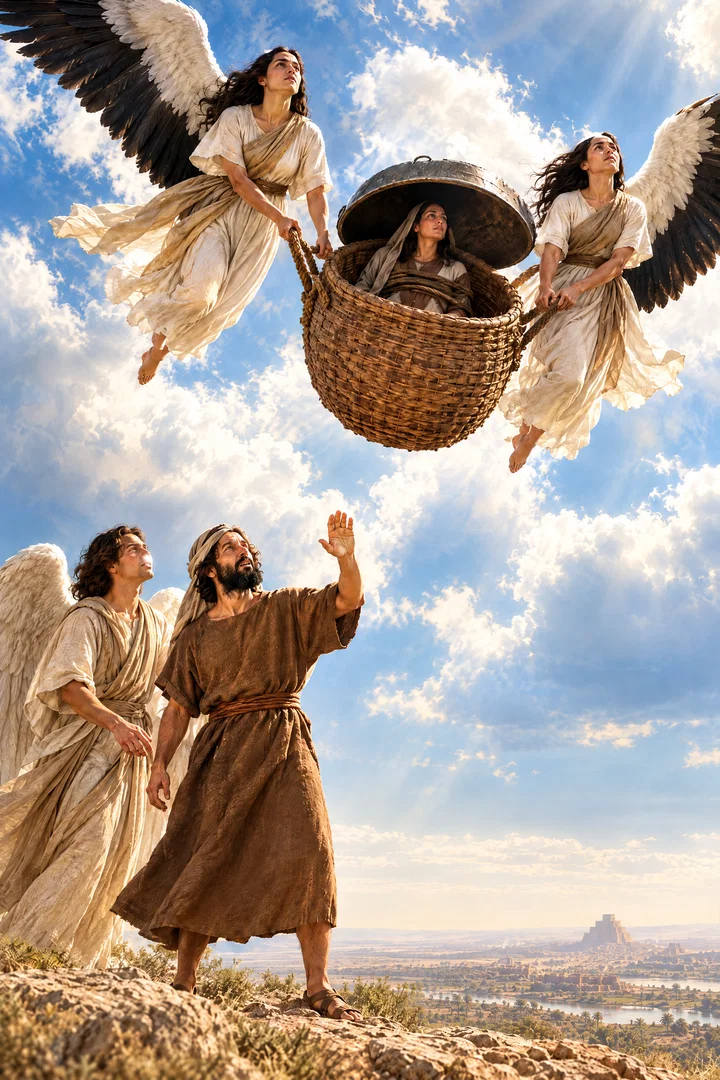
And he said, This is wickedness. And he cast it into the midst of the ephah; and he cast the weight of lead upon the mouth thereof.
Translations
And he said, This is wickedness. And he cast it into the middle of the ephah; and he cast the weight of lead on the mouth thereof.
King James Version, KJV Cambridge Paragraph Bible
And he said, This is wickedness. And he cast it into the midst of the ephah; and he cast the weight of lead upon the mouth thereof.
And he said, This is wickedness. And he cast it into the midst of the ephah; and he cast the weight of lead upon its mouth.
And he said, This is Wickedness; and he cast her down into the midst of the ephah: and he cast the weight of lead upon the mouth thereof.
And he said, This is Wickedness: and he cast her down into the midst of the ephah; and he cast the weight of lead upon the mouth thereof.
And he saith, 'This [is] the wicked woman.' And he casteth her unto the midst of the ephah, and casteth the weight of lead on its mouth.
And he said, This is Wickedness: and he cast her into the midst of the ephah; and he cast the weight of lead upon the mouth thereof.
Then said he, This, is Lawlessness. So he thrust her back inside the ephah,—and then thrust the leaden weight into the mouth thereof.
Berean Standard Bible, Majority Standard Bible
“ This is Wickedness,” he said. And he shoved her down into the basket, pushing down the lead cover over its opening.
He said, “ This is Wickedness;” and he threw her down into the middle of the ephah basket; and he threw the lead weight on its mouth.
And he said, This is Sin; and pushing her down into the ephah, he put the weight of lead on the mouth of it.
And he said, This is wickednes, and he cast it into the middes of the Ephah, and hee cast the weight of lead vpon the mouth thereof.
Douay-Rheims (Challoner revision)
And he said: This is wickedness. And he cast her into the midst of the vessel, and cast the weight of lead upon the mouth thereof.
Pictures
Cross-references
- Zechariah 5:1-4
Then I turned, and lifted up mine eyes, and looked, and behold a flying roll.
The flying roll represents God's standard of measure, contrasted with the ephah's false standard.
- Leviticus 19:35-36
Ye shall do no unrighteousness in judgment, in meteyard, in weight, or in measure.
God commands just measures and weights.
- Amos 8:5
Saying, When will the new moon be gone, that we may sell corn? and the sabbath, that we may set forth wheat, making the ephah small, and the shekel great, and falsifying the balances by deceit?
Both condemn dishonest measures and weights used to cheat the poor.
- Deuteronomy 25:15
But thou shalt have a perfect and just weight, a perfect and just measure shalt thou have: that thy days may be lengthened in the land which the LORD thy God giveth thee.
It commands just weights and measures.
- Ezekiel 45:10
Ye shall have just balances, and a just ephah, and a just bath.
God requires just weights and measures.
Commentary
Each commentary is drawn from primary sources: the writings of Ellen G. White and Adventist pioneers and periodicals. Each commentary is separate. Its own words are not a quotation; follow the references to read the source passages.
Pioneers and periodicals
14 sources
This is wickedness cast into the midst of the ephah and shut under a weight of lead set over its mouth, held under restraint so it cannot escape.ST May 24, 1883ST Aug 22, 1911ST Apr 9, 1902 The ephah is a bushel measure, the largest Jewish dry measure, representing the full measure of corruption with the same appearance throughout the earth, and the heavy lead cover shows sin as base and heavy, with guilt and condemnation closing the measure in. The ephah is also a false standard sent throughout the earth, with which a corrupt church surrounds itself contrary to God's law and seeks to bring people into conformity, so that wickedness grows within that enclosure.ST Oct 29, 1902ST Oct 29, 1902ST Oct 29, 1902ST Oct 29, 1902 Shut beneath lead and unable to escape, wickedness is shown as helpless captives carried away from their land for sin to Babylon to have a house built for it in the land of Shinar, recalling the first destruction of Jerusalem and warning so the later destruction and dispersion might be avoided.ST Apr 9, 1902ST May 24, 1883ST May 24, 1883ST May 24, 1883ST May 24, 1883
Symbols in the Vision
The woman is wickedness, cast into the midst of the ephah and put back inside it, with the weight of lead set over its mouth and opening to enclose and cover her and seal her inside.ST May 24, 1883ST Aug 22, 1911ST Apr 9, 1902 She is thus held under restraint and confined inside under a heavy lead cover.ST May 24, 1883ST Aug 22, 1911ST Apr 9, 1902 The vision then places this restrained wickedness as carried away to have a house built for it in the land of Shinar.ST Apr 9, 1902 The ephah is a bushel measure, the largest Jewish dry measure. It represents the full measure of corruption, having the same appearance throughout the earth.
The lead cover is heavy, and the lead represents sin as both base and heavy. Together the ephah, the woman, and the lead cover picture wickedness enclosed under the weight of guilt and condemnation. The cover signifies guilt and condemnation closing in that measure of wickedness so that it cannot escape. The ephah is a just standard of measure, like the sanctuary shekel kept under the priest's care.ST May 24, 1883 It presents God's eye condemning those who cheat in weights and measures.ST May 24, 1883
It supplements the vision of the roll, whose curse falls on thieves and those who swear falsely, because these same wrongdoers also defraud others in their measures.ST May 24, 1883 Wickedness is confined within the ephah because of fraud in buying and selling, which a just measure condemns.ST May 24, 1883 The lead placed over the ephah represents God's hand extended to punish the woman for her sin and keep her confined.ST May 24, 1883 Through the woman corruption enters among God's people, and the lead weight placed over the ephah's opening confines that corrupting presence within it.ST Jul 15, 1913
False Religious Standard Exposed
The measure is a false standard that seeks to bring people into conformity with itself, contrary to God's law.ST Oct 29, 1902 It is a standard sent throughout the earth, and the woman within it is a church that has surrounded itself with that false standard.ST Oct 29, 1902 That application is to the Roman Catholic Church and its changes to God's law, with wickedness found within that false standard.ST Oct 29, 1902
She surrounds herself with a false standard of right by omitting the second commandment, removing the seventh day from the fourth commandment and substituting Sunday, and dividing the tenth commandment to keep the number ten.ST Oct 29, 1902 She requires people within her sphere to follow this standard and seeks to enforce it on the world, and wickedness grows within that enclosure.ST Oct 29, 1902 The lead weight is the Reformation, which struck the church and its false standard like a crushing weight and seemed for a time likely to destroy both.ST Oct 29, 1902 The ephah is also a false standard of religious measure which Protestants and Catholics unite to exalt and establish by law, with the lead weight keeping this wickedness confined within that measure.ST Oct 29, 1902
The ephah is the corrupt church in its commercialism, and the lead weight is the guilt and condemnation of those who rejected the light of truth that had shone at Babylon for seventy years. Their iniquity became an organized religious system that enabled people to continue in evil without conscience, and the institution was established on its own base. The ephah is associated with Babylonian idolatrous religion, and the vision applies to the period before the Christian age.
The two women are corruption of the light and truth given through God's servants, blended with Babylonian idolatry. The woman's sin and rebellion are kept within bounds only because the forces joined to her give her their power and authority. This pattern holds for the blending of Christianity with paganism in Christ's time and for the union of Spiritualism with apostate Protestantism in the present.
Judgment on Wickedness Foretold
The thrusting of wickedness into the ephah and sealing her inside under a heavy lead cover places wickedness under restraint as the ephah is carried away to have a house built for it in the land of Shinar.ST Apr 9, 1902 The woman shut beneath the lead weight and unable to escape is the Jews as helpless captives carried away from their land because of their sins, while their conquerors triumphantly transport them to Babylon.ST Apr 9, 1902ST May 24, 1883
The woman is the small remnant of the Jewish nation carried captive to Babylon after Nebuchadnezzar destroyed Jerusalem.ST May 24, 1883ST May 24, 1883 The nation had been greatly diminished, for many were killed and only a few thousand were taken captive.ST May 24, 1883 Shut inside the ephah and closed beneath its mass of lead, that remnant is portrayed as helpless and confined in Babylon, crushed beneath its covering.ST May 24, 1883ST May 24, 1883 The confining of wickedness in this way recalls the Jews' sin and the first destruction of Jerusalem and their captivity, warning them so that the city's later destruction and the nation's dispersion might be avoided.ST May 24, 1883
Sources