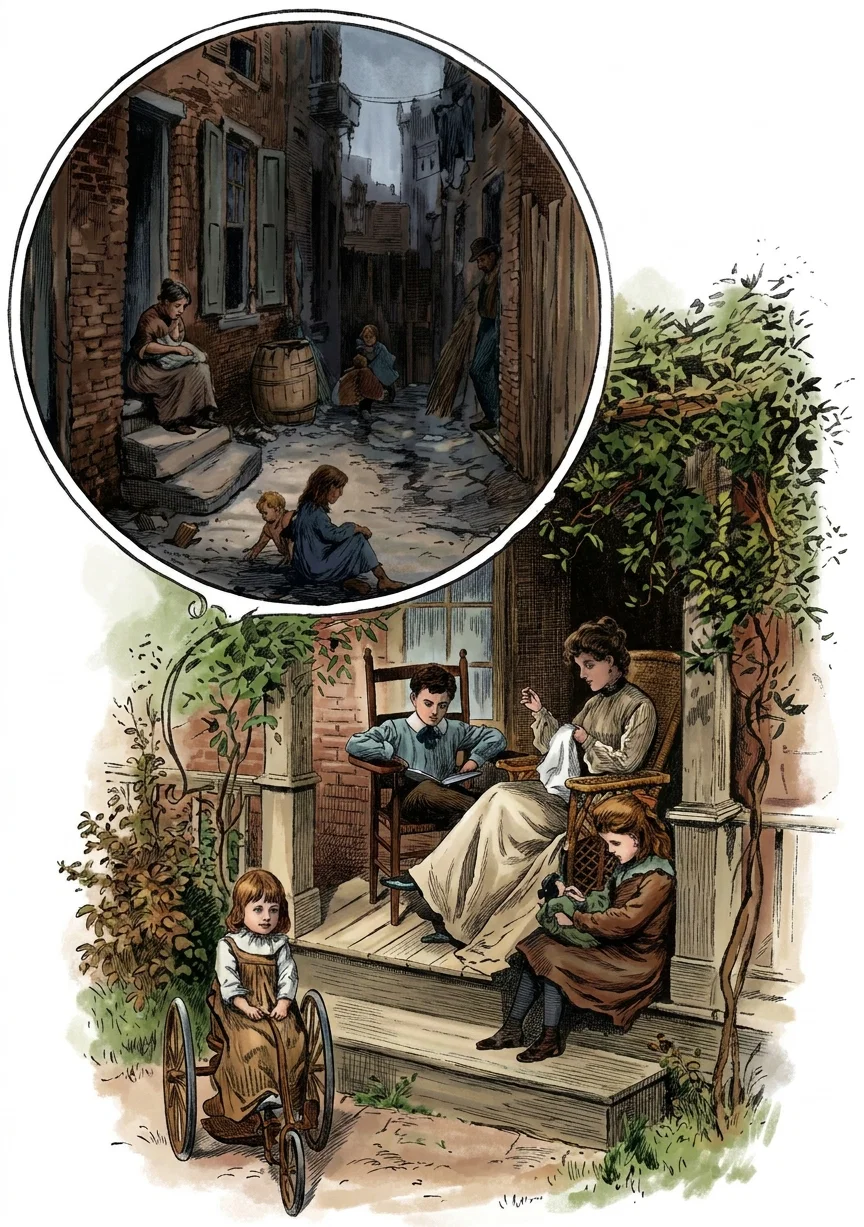
In the great cities are multitudes who receive less care and consideration than are given to dumb animals. Think of the families herded together in miserable tenements, many of them dark basements, reeking with dampness and filth. In these wretched places children are born and grow up and die. They see nothing of the beauty of natural things190that God has created to delight the senses and uplift the soul. Ragged and half starved, they live amid vice and depravity, molded in character by the wretchedness and sin that surround them. Children hear the name of God only in profanity. Foul speech, imprecations, and revilings fill their ears. The fumes of liquor and tobacco, sickening stenches, moral degradation, pervert their senses. Thus multitudes are trained to become criminals, foes to society that has abandoned them to misery and degradation.
Not all the poor in the city slums are of this class. God-fearing men and women have been brought to the depths of poverty by illness or misfortune, often through the dishonest scheming of those who live by preying upon their fellows. Many who are upright and well-meaning become poor through lack of industrial training. Through ignorance they are unfitted to wrestle with the difficulties of life. Drifting into the cities, they are often unable to find employment. Surrounded by the sights and sounds of vice, they are subjected to terrible temptation. Herded and often classed with the vicious and degraded, it is only by a superhuman struggle, a more than finite power, that they can be preserved from sinking to the same depths. Many hold fast their integrity, choosing to suffer rather than to sin. This class especially demand help, sympathy, and encouragement.
Homes in the Country
If the poor now crowded into the cities could find homes upon the land, they might not only earn a livelihood, but find health and happiness now unknown to them. Hard work, simple fare, close economy, often hardship and privation, would be their lot. But what a blessing would be theirs in leaving the city, with its enticements to evil, its turmoil and crime, misery and foulness, for the country’s quiet and peace and purity.
To many of those living in the cities who have not a spot of green grass to set their feet upon, who year after192year have looked out upon filthy courts and narrow alleys, brick walls and pavements, and skies clouded with dust and smoke,—if these could be taken to some farming district, surrounded with the green fields, the woods and hills and brooks, the clear skies and the fresh, pure air of the country, it would seem almost like heaven.
“If the poor now crowded into the cities could find homes upon the land.”
Cut off to a great degree from contact with and dependence upon men, and separated from the world’s corrupting maxims and customs and excitements, they would come nearer to the heart of nature. God’s presence would be more real to them. Many would learn the lesson of dependence upon Him. Through nature they would hear His voice speaking to their hearts of His peace and love, and mind and soul and body would respond to the healing, life-giving power.
The Need of Industrial Education
If they ever become industrious and self-supporting, very many must have assistance, encouragement, and instruction. There are multitudes of poor families for whom no better missionary work could be done than to assist them in settling on the land and in learning how to make it yield them a livelihood.
The need for such help and instruction is not confined to the cities. Even in the country, with all its possibilities for a better life, multitudes of the poor are in great need. Whole communities are devoid of education in industrial and sanitary lines. Families live in hovels, with scant furniture and clothing, without tools, without books, destitute both of comforts and conveniences and of means of culture. Imbruted souls, bodies weak and ill-formed, reveal the results of evil heredity and of wrong habits. These people must be educated from the very foundation. They have led shiftless, idle, corrupt lives, and they need to be trained to correct habits.
How can they be awakened to the necessity of improvement? How can they be directed to a higher ideal of life? How can they be helped to rise? What can be done where poverty prevails, and is to be contended with at every step? Certainly the work is difficult. The necessary reformation will never be made unless men and women are assisted by a power outside of themselves. It is God’s purpose that the rich and the poor shall be closely bound together by the ties of sympathy and helpfulness. Those who have means, talents, and capabilities are to use these gifts in blessing their fellow men.
A Work for Christian Farmers
Christian farmers can do real missionary work in helping the poor to find homes on the land, and in teaching them how to till the soil and make it productive. Teach them how to use the implements of agriculture, how to cultivate various crops, how to plant and care for orchards.
Many who till the soil fail to secure adequate returns because of their neglect. Their orchards are not properly cared for, the crops are not put in at the right time, and a mere surface work is done in cultivating the soil. Their ill success they charge to the unproductiveness of the land. False witness is often borne in condemning land that, if properly worked, would yield rich returns. The narrow plans, the little strength put forth, the little study as to the best methods, call loudly for reform.
Let proper methods be taught to all who are willing to learn. If any do not wish you to speak to them of advanced ideas, let the lessons be given silently. Keep up the culture of your own land. Drop a word to your neighbors when you can, and let the harvest be eloquent in favor of right methods. Demonstrate what can be done with the land when properly worked.
Establishment of Industries
Attention should be given to the establishment of various industries so that poor families can find employment. Carpenters, blacksmiths, and indeed every one who understands some line of useful labor, should feel a responsibility to teach and help the ignorant and the unemployed.
In ministry to the poor there is a wide field of service for women as well as for men. The efficient cook, the housekeeper, the seamstress, the nurse,—the help of all is needed. Let the members of poor households be taught how to cook, how to make and mend their own clothing, how to nurse the sick, how to care properly for the home. Let boys and girls be thoroughly taught some useful trade or occupation.
Missionary Families
Missionary families are needed to settle in the waste places. Let farmers, financiers, builders, and those who are skilled in various arts and crafts, go to neglected fields, to improve the land, to establish industries, to prepare humble homes for themselves, and to help their neighbors.
The rough places of nature, the wild places, God has made attractive by placing beautiful things among the most unsightly. This is the work we are called to do. Even the desert places of the earth, where the outlook appears to be forbidding, may become as the garden of God.
“In that day shall the deaf hear the words of the book,
And the eyes of the blind shall see out of obscurity, and out of darkness.
The meek also shall increase their joy in the Lord,
And the poor among men shall rejoice in the Holy One of Israel.”
Help Men to Help Themselves
By instruction in practical lines, we can often help the poor most effectively. As a rule, those who have not been trained to work, do not have habits of industry, perseverance,195economy, and self-denial. They do not know how to manage. Often through lack of carefulness and right judgment, there is wasted that which would maintain their families in decency and comfort if it were carefully and economically used. “Much food is in the tillage of the poor; but there is that is destroyed for want of judgment.”
We may give to the poor, and harm them, by teaching them to be dependent. Such giving encourages selfishness and helplessness. Often it leads to idleness, extravagance, and intemperance. No man who can earn his own livelihood has a right to depend on others. The proverb, “The world owes me a living,” has in it the essence of falsehood, fraud, and robbery. The world owes no man a living who is able to work and gain a living for himself.
Real charity helps men to help themselves. If one comes to our door and asks for food, we should not turn him away hungry; his poverty may be the result of misfortune. But true beneficence means more than mere gifts. It means a genuine interest in the welfare of others. We should seek to understand the needs of the poor and distressed, and to give them the help that will benefit them most. To give thought and time and personal effort costs far more than merely to give money. But it is the truest charity.
Those who are taught to earn what they receive will more readily learn to make the most of it. And in learning to be self-reliant, they are acquiring that which will not only make them self-sustaining, but will enable them to help others. Teach the importance of life’s duties to those who are wasting their opportunities. Show them that Bible religion never makes men idlers. Christ always encouraged industry. “Why stand ye here all the day idle?” He said to the indolent. “I must work . . . while it is day; the night cometh, when no man can work.”
Object Lessons
It is the privilege of all to give to the world in their home life, in their customs and practises and order, an evidence of what the gospel can do for those who obey it. Christ came to our world to give us an example of what we may become. He expects His followers to be models of correctness in all the relations of life. He desires the divine touch to be seen upon outward things.
Our own homes and surroundings should be object lessons, teaching ways of improvement, so that industry, cleanliness, taste, and refinement may take the place of idleness, uncleanness, coarseness, and disorder. By our lives and example we can help others to discern that which is repulsive in their character or their surroundings, and with Christian courtesy we may encourage improvement. As we manifest an interest in them, we shall find opportunity to teach them how to put their energies to the best use.
Hope and Courage
We can do nothing without courage and perseverance. Speak words of hope and courage to the poor and the disheartened. If need be, give tangible proof of your interest by helping them when they come into strait places. Those who have had many advantages should remember that they themselves still err in many things, and that it is painful to them when their errors are pointed out, and there is held up before them a comely pattern of what they should be. Remember that kindness will accomplish more than censure. As you try to teach others, let them see that you wish them to reach the highest standard, and that you are ready to give them help. If in some things they fail, be not quick to condemn them.
Simplicity; Self-Denial
Simplicity, self-denial, economy, lessons so essential for the poor to learn, often seem to them difficult and unwelcome.197The example and spirit of the world is constantly exciting and fostering pride, love of display, self-indulgence, prodigality, and idleness. These evils bring thousands to penury, and prevent thousands more from rising out of degradation and wretchedness. Christians are to encourage the poor to resist these influences.
Jesus came to this world in humility. He was of lowly birth. The Majesty of heaven, the King of glory, the Commander of all the angel host, He humbled Himself to accept humanity, and then He chose a life of poverty and humiliation. He had no opportunities that the poor do not have. Toil, hardship, and privation were a part of every day’s experience. “Foxes have holes,” He said, “and birds of the air have nests; but the Son of man hath not where to lay His head.”
Jesus did not seek the admiration or the applause of men. He commanded no army. He ruled no earthly kingdom. He did not court the favor of the wealthy and honored of the world. He did not claim a position among the leaders of the nation. He dwelt among the lowly. He set at naught the artificial distinctions of society. The aristocracy of birth, wealth, talent, learning, rank, He ignored.
He was the Prince of heaven, yet He did not choose His disciples from among the learned lawyers, the rulers, the scribes, or the Pharisees. He passed these by, because they prided themselves on their learning and position. They were fixed in their traditions and superstitions. He who could read all hearts chose humble fishermen who were willing to be taught. He ate with publicans and sinners, and mingled with the common people, not to become low and earthly with them, but in order by precept and example to present to them right principles, and to uplift them from their earthliness and debasement.
Jesus sought to correct the world’s false standard of judging the value of men. He took His position with the198poor, that He might lift from poverty the stigma that the world had attached to it. He has stripped from it forever the reproach of scorn, by blessing the poor, the inheritors of God’s kingdom. He points us to the path He trod, saying, “If any man will come after Me, let him deny himself, and take up his cross daily, and follow Me.”
Christian workers are to meet the people where they are, and educate them, not in pride, but in character building. Teach them how Christ worked and denied Himself. Help them to learn from Him the lessons of self-denial and sacrifice. Teach them to beware of self-indulgence in conforming to fashion. Life is too valuable, too full of solemn, sacred responsibilities, to be wasted in pleasing self.
Life’s Best Things
Men and women have hardly begun to understand the true object of life. They are attracted by glitter and show. They are ambitious for worldly preeminence. To this the true aims of life are sacrificed. Life’s best things,—simplicity, honesty, truthfulness, purity, integrity,—can not be bought or sold. They are as free to the ignorant as to the educated, to the humble laborer as to the honored statesman. For every one God has provided pleasure that may be enjoyed by rich and poor alike,—the pleasure found in cultivating pureness of thought and unselfishness of action, the pleasure that comes from speaking sympathizing words and doing kindly deeds. From those who perform such service the light of Christ shines to brighten lives darkened by many shadows.
God Will Give Success
While helping the poor in temporal things, keep always in view their spiritual needs. Let your own life testify to the Saviour’s keeping power. Let your character reveal the high standard to which all may attain. Teach the gospel199in simple object lessons. Let everything with which you have to do be a lesson in character building.
In the humble round of toil, the very weakest, the most obscure, may be workers together with God, and may have the comfort of His presence and sustaining grace. They are not to weary themselves with busy anxieties and needless cares. Let them work on from day to day, accomplishing faithfully the task that God’s providence assigns, and He will care for them. He says:
“In nothing be anxious; but in everything by prayer and supplication with thanksgiving let your requests be made known unto God.” “And the peace of God which passeth all understanding, shall keep your hearts and minds through Christ Jesus.”
The Lord’s care is over all His creatures. He loves them all, and makes no difference, except that He has the most tender pity for those who are called to bear life’s heaviest burdens. God’s children must meet trials and difficulties. But they should accept their lot with a cheerful spirit, remembering that for all that the world neglects to bestow, God Himself will make up to them in the best of favors.
It is when we come into difficult places that He reveals His power and wisdom in answer to humble prayer. Have confidence in Him as a prayer-hearing, prayer-answering God. He will reveal Himself to you as One who can help in every emergency. He who created man, who gave him his wonderful physical, mental, and spiritual faculties, will not withhold that which is necessary to sustain the life He has given. He who has given us His word—the leaves of the tree of life—will not withhold from us a knowledge of how to provide food for His needy children.
How can wisdom be obtained by him who holds the plow and drives the oxen?—By seeking her as silver, and searching for her as for hid treasure. “For his God doth instruct him to discretion, and doth teach him.” “This also cometh200forth from Jehovah of hosts, who is wonderful in counsel, and excellent in wisdom.”
He who taught Adam and Eve in Eden how to tend the garden, desires to instruct men to-day. There is wisdom for him who drives the plow and sows the seed. Before those who trust and obey Him, God will open ways of advance. Let them move forward courageously, trusting in Him to supply their needs according to the riches of His goodness.
He who fed the multitude with five loaves and two small fishes is able to-day to give us the fruit of our labor. He who said to the fishers of Galilee, “Let down your nets for a draught,” and who, as they obeyed, filled their nets till they broke, desires His people to see in this an evidence of what He will do for them to-day. The God who in the wilderness gave the children of Israel manna from heaven still lives and reigns. He will guide His people, and give skill and understanding in the work they are called to do. He will give wisdom to those who strive to do their duty conscientiously and intelligently. He who owns the world is rich in resources, and will bless every one who is seeking to bless others.
We need to look heavenward in faith. We are not to be discouraged because of apparent failure, nor should we be disheartened by delay. We should work cheerfully, hopefully, gratefully, believing that the earth holds in her bosom rich treasures for the faithful worker to garner, stores richer than gold or silver. The mountains and hills are changing; the earth is waxing old like a garment; but the blessing of God, which spreads for His people a table in the wilderness, will never cease.
The Helpless Poor
“BLESSED IS HE THAT CONSIDERETH THE POOR.”
When all has been done that can be done in helping the poor to help themselves, there still remain the widow and the fatherless, the aged, the helpless, and the sick, that claim sympathy and care. Never should these be neglected. They are committed by God Himself to the mercy, the love, and the tender care of all whom He has made His stewards.
The Household of Faith
“As we have therefore opportunity, let us do good unto all men, especially unto them who are of the household of faith.”
In a special sense, Christ has laid upon His church the duty of caring for the needy among its own members. He suffers His poor to be in the borders of every church. They are always to be among us, and He places upon the members of the church a personal responsibility to care for them.
As the members of a true family care for one another, ministering to the sick, supporting the weak, teaching the ignorant, training the inexperienced, so is the “household of faith” to care for its needy and helpless ones. Upon no consideration are these to be passed by.
Widows and Orphans
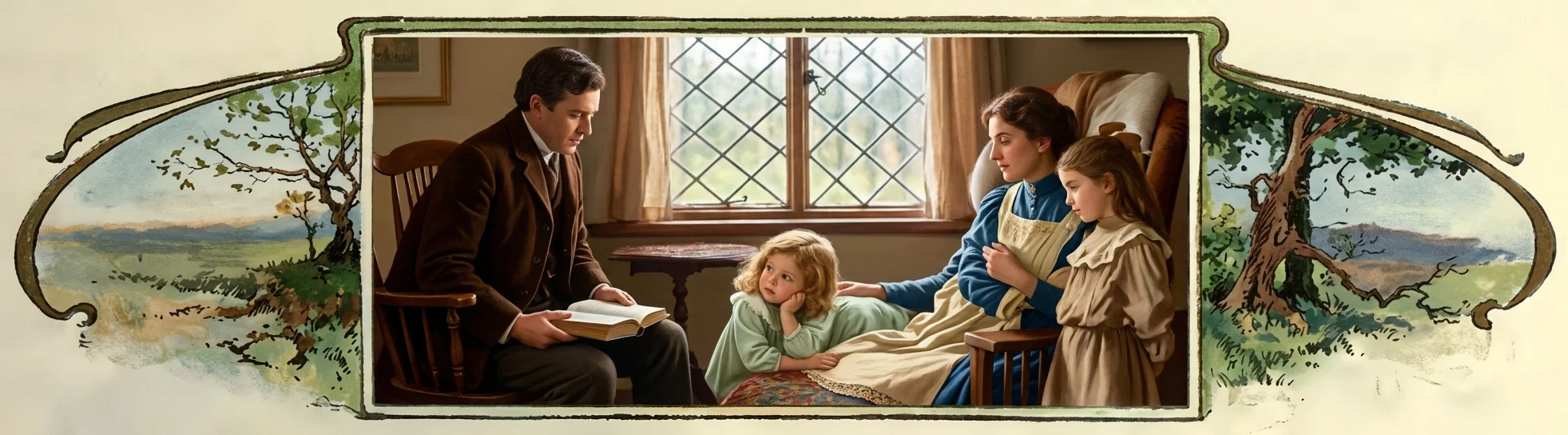
The widow and the fatherless are the objects of the Lord’s special care.
I leave
my
fatherless
children
“A Father of the fatherless and a Judge of the widows, Is God in His holy habitation.” “Thy Maker is thy husband; Jehovah of hosts is His name; And the Holy One of Israel is thy Redeemer; The God of the whole earth shall He be called.” “Leave thy fatherless children, I will preserve them alive, And let thy widows trust in Me.”
Many a father, when called upon to part from his loved ones, has died resting in faith upon God’s promise to care for them. The Lord provides for the widow and the fatherless, not by a miracle in sending manna from heaven, not by sending ravens to bring them food; but by a miracle upon human hearts, expelling selfishness, and unsealing the fountains of Christlike love. The afflicted and bereaved ones He commits to His followers as a precious trust. They have the very strongest claim upon our sympathy.
I call progressive thinking
In homes supplied with life’s comforts, in bins and granaries filled with the yield of abundant harvests, in warehouses stocked with the products of the loom, and vaults stored with gold and silver, God has supplied means for the sustenance of these needy ones. He calls upon us to be channels of His bounty.
Many a widowed mother with her fatherless children is bravely striving to bear her double burden, often toiling far beyond her strength in order to keep her little ones with her, and to provide for their needs. Little time has she for their training and instruction, little opportunity to surround them with influences that would brighten their lives. She needs encouragement, sympathy, and tangible help.
God calls upon us to supply to these children, so far as we can, the want of a father’s care. Instead of standing aloof, complaining of their faults, and of the trouble they may cause, help them in every way possible. Seek to aid the care-worn mother. Lighten her burdens.
And let thy children trust in me
Then there are the multitudes of children who have been wholly deprived of the guidance of parents and the subduing influence of a Christian home. Let Christians open their hearts and homes to these helpless ones. The work that God has committed to them as an individual duty should not be turned over to some benevolent institution, or left to the chances of the world’s charity. If the children have no relatives able to give them care, let the members of the church provide homes for them. He who made us ordained that we should be associated in families, and the child nature will develop best in the loving atmosphere of a Christian home.
Many who have no children of their own could do a good work in caring for the children of others. Instead of giving attention to pets, lavishing affection upon dumb animals, let them give their attention to little children, whose characters they may fashion after the divine similitude. Place your love upon the homeless members of the human family. See how204many of these children you can bring up in the nurture and admonition of the Lord. Many would thus be greatly benefited themselves.
The Aged
The aged also need the helpful influences of the family. In the home of brethren and sisters in Christ can most nearly be made up to them the loss of their own home. If encouraged to share in the interests and occupations of the household, it will help them to feel that their usefulness is not at an end. Make them feel that their help is valued, that there is something yet for them to do in ministering to others, and it will cheer their hearts, and give interest to their lives.
So far as possible let those whose whitening heads and failing steps show that they are drawing near to the grave remain among friends and familiar associations. Let them worship among those whom they have known and loved. Let them be cared for by loving and tender hands.
Whenever they are able to do so, it should be the privilege of the members of every family to minister to their own kindred. When this can not be, the work belongs to the church, and it should be accepted both as a privilege and as a duty. All who possess Christ’s spirit will have a tender regard for the feeble and the aged.
The presence in our homes of one of these helpless ones is a precious opportunity to co-operate with Christ in His ministry of mercy and to develop traits of character like His. There is a blessing in the association of the old and the young. The young may bring sunshine into the hearts and lives of the aged. Those whose hold on life is weakening need the benefit of contact with the hopefulness and buoyancy of youth. And the young may be helped by the wisdom and experience of the old. Above all, they need to learn the lesson of unselfish ministry. The presence of205one in need of sympathy and forbearance and self-sacrificing love would be to many a household a priceless blessing. It would sweeten and refine the home life, and call forth in old and young those Christlike graces that would make them beautiful with a divine beauty, and rich in heaven’s imperishable treasure.
A Test of Character
“Ye have the poor with you always,” Christ said, “and whensoever ye will ye may do them good.” “Pure religion and undefiled before God and the Father is this, To visit the fatherless and widows in their affliction, and to keep himself unspotted from the world.”
In placing among them the helpless and the poor, to be dependent upon their care, Christ tests His professed followers. By our love and service for His needy children we prove the genuineness of our love for Him. To neglect them is to declare ourselves false disciples, strangers to Christ and His love.
Orphans’ Homes
If all were done that could be done in providing homes in families for orphan children, there would still remain very many requiring care. Many of them have received an inheritance of evil. They are unpromising, unattractive, perverse, but they are the purchase of the blood of Christ, and in His sight are just as precious as are our own little ones. Unless a helping hand is held out to them, they will grow up in ignorance, and drift into vice and crime. Many of these children could be rescued through the work of orphan asylums
Such institutions, to be most effective, should be modeled as closely as possible after the plan of a Christian home. Instead of large establishments, bringing great numbers together, let there be small institutions in different places.206Instead of being in or near some town or large city, they should be in the country, where land can be secured for cultivation, and the children can be brought into contact with nature, and can have the benefits of industrial training.
Those in charge of such a home should be men and women who are large-hearted, cultured, and self-sacrificing; men and women who undertake the work from love to Christ, and who train the children for Him. Under such care, many homeless and neglected ones may be prepared to become useful members of society, an honor to Christ themselves, and in their turn helping others.
Economy: Self-Denial
Many despise economy, confounding it with stinginess and narrowness. But economy is consistent with the broadest liberality. Indeed, without economy, there can be no true liberality. We are to save, that we may give.
No one can practise real benevolence without self-denial. Only by a life of simplicity, self-denial, and close economy, is it possible for us to accomplish the work appointed us as Christ’s representatives. Pride and worldly ambition must be put out of our hearts. In all our work, the principle of unselfishness revealed in Christ’s life is to be carried out. Upon the walls of our homes, the pictures, the furnishings, we are to read, “Bring the poor that are cast out to thy house.” On our wardrobes we are to see written, as with the finger of God, “Clothe the naked.” In the dining-room, on the table laden with abundant food, we should see traced, “Is it not to deal thy bread to the hungry?”
A thousand doors of usefulness are open before us. Often we lament the scanty resources available, but were Christians thoroughly in earnest, they could multiply the resources a thousandfold. It is selfishness, self-indulgence, that bars the way to our usefulness.
How much means is expended for things that are mere idols, things that engross thought and time and strength which should be put to a higher use! How much money is wasted on expensive houses and furniture, on selfish pleasures, luxurious and unwholesome food, hurtful indulgences! How much is squandered on gifts that benefit no one! For things that are needless, often harmful, professed Christians are to-day spending more, many times more, than they spend in seeking to rescue souls from the tempter.
Many who profess to be Christians spend so much on dress that they have nothing to spare for the needs of others. Costly ornaments and expensive clothing they think they must have, regardless of the needs of those who can with difficulty provide themselves with even the plainest clothing.
My sisters, if you would bring your manner of dressing into conformity with the rules given in the Bible, you would have an abundance with which to help your poorer sisters. You would have not only means, but time. Often this is most needed. There are many whom you might help with your suggestions, your tact and skill. Show them how to dress simply and yet tastefully. Many a woman remains away from the house of God because her shabby, ill-fitting garments are in such striking contrast to the dress of others. Many a sensitive spirit cherishes a sense of bitter humiliation and injustice because of this contrast. And because of it many are led to doubt the reality of religion and to harden their hearts against the gospel.
Christ bids us, “Gather up the fragments that remain, that nothing be lost.” While thousands are every day perishing from famine, bloodshed, fire, and plague, it becomes every lover of his kind to see that nothing is wasted, that nothing is needlessly expended, whereby he might benefit a human being.
Gather up the fragments that nothing be lost.
It is wrong to waste our time, wrong to waste our thoughts. We lose every moment that we devote to self-seeking. If every moment were valued and rightly employed, we should have time for everything that we need to do for ourselves or for the world. In the expenditure of money, in the use of time, strength, opportunities, let every Christian look to God for guidance. “If any of you lack wisdom, let him ask of God, that giveth to all men liberally, and upbraideth not; and it shall be given him.”