From the representations given by the Holy Spirit to His prophets, let us learn the greatness of our God. The prophet Isaiah writes:
“In the year that king Uzziah died I saw the Lord sitting upon a throne, high and lifted up, and His train filled the temple. Above Him stood the seraphim; each one had six wings; with twain he covered his face, and with twain he covered his feet, and with twain he did fly. And one cried unto another, and said, Holy, holy, holy, is Jehovah433of hosts: the whole earth is full of His glory. And the foundations of the thresholds shook at the voice of him that cried, and the house was filled with smoke.
“Then said I, Woe is me! for I am undone; because I am a man of unclean lips, and I dwell in the midst of a people of unclean lips; for mine eyes have seen the King, Jehovah of hosts.”
“Then flew one of the seraphim unto me, having a live coal in his hand, which he had taken with the tongs from off the altar: and he touched my mouth with it, and said, Lo this hath touched thy lips; and thine iniquity is taken away, and thy sin expiated.”
“There is none like unto Thee, O Lord;
Thou art great,
And Thy name is great in might,
Who would not fear Thee, O King of nations?”
“O Lord, Thou hast searched me, and known me. Thou knowest my downsitting and mine uprising, Thou understandest my thought afar off. Thou compassest my path and my lying down, And art acquainted with all my ways. For there is not a word in my tongue, But, lo, O Lord, Thou knowest it altogether. Thou hast beset me behind and before, And laid Thine hand upon me. Such knowledge is too wonderful for me; It is high, I can not attain unto it.”
“Great is our Lord, and of great power; His understanding is infinite.”
“The ways of man are before the eyes of the Lord, and He pondereth all his goings.”
“He revealeth the deep and secret things. He knoweth what is in the darkness, and the light dwelleth with Him.”
“Known unto God are all His works from the beginning of the world.” “Who hath known the mind of the Lord? or who hath been His counselor? or who hath first434given to Him, and it shall be recompensed unto him again? For of Him, and through Him, and to Him are all things; to whom be glory forever.”
“Unto the King eternal, immortal, invisible,” “who only hath immortality, dwelling in the light which no man can approach unto; whom no man hath seen, nor can see, to whom be honor and power everlasting.”
“Shall not His excellency make you afraid? And His dread fall upon you?”
“Is not God in the height of heaven?
And behold the height of the stars, how high they are!”
“Is there any number of His armies? And upon whom doth not His light arise?”
“Great things doeth He, which we can not comprehend.
For He saith to the snow,
Fall thou on the earth;
Likewise to the shower of rain,
And to the showers of His mighty rain.
He sealeth up the hand of every man,
That all men whom He hath made may know it. . . .
He spreadeth abroad the cloud of His lightning:
And it is turned round about by His guidance,
That they may do whatsoever He commandeth them
Upon the face of the habitable world;
Whether it be for correction, or for His land,
Or for loving-kindness that He cause it to come.
“Hearken unto this; . . .
Stand still, and consider the wondrous works of God.
Dost thou know how God layeth His charge upon them,
And causeth the lightning of His cloud to shine?
Dost thou know the balancings of the clouds,
The wondrous works of Him who is perfect in knowledge? . . .
Canst thou with Him spread out the sky,
Which is strong as a molten mirror?
Teach us what we shall say unto Him;
For we can not set our speech in order by reason of darkness. . . .
And now men can not look on the light when it is bright in the skies;435
“When the wind hath passed, and cleared them.
Out of the north cometh golden splendor:
God hath upon Him terrible majesty.
Touching the Almighty, we can not find Him out:
He is excellent in power;
And in justice and plenteous righteousness. . . .
Men do therefore fear Him.” 20
“Who is like unto the Lord our God, who dwelleth on high,
Who humbleth himself to behold the things that are in heaven,
and in the earth?”
“The Lord hath His way in the whirlwind and in the storm, And the clouds are the dust of His feet.”
“Great is the Lord, and greatly to be praised;
And His greatness is unsearchable.
One generation shall praise Thy works to another,
And shall declare Thy mighty acts.
I will speak of the glorious honor of Thy majesty,
And of Thy wondrous works.
And men shall speak of the might of Thy terrible acts:
And I will declare Thy greatness.
They shall abundantly utter the memory of Thy great goodness,
And shall sing of Thy righteousness. . . .
“All Thy works shall praise Thee, O Lord;
And Thy saints shall bless Thee.
They shall speak of the glory of Thy kingdom,
And talk of Thy power;
To make known to the sons of men His mighty acts,
And the glorious majesty of His kingdom.
Thy kingdom is an everlasting kingdom,
And Thy dominion endureth throughout all generations. . . .
My mouth shall speak the praise of the Lord:
And let all flesh bless His holy name forever and ever.”
Warnings against Presumption
As we learn more and more of what God is, and of what we ourselves are in His sight, we shall fear and tremble before Him. Let men of to-day take warning from the fate of those who in ancient times presumed to make free with that which God had declared sacred. When the Israelites436ventured to open the ark on its return from the land of the Philistines, their irreverent daring was signally punished.
Again, consider the judgment that fell upon Uzzah. As in David’s reign the ark was being carried to Jerusalem, Uzzah put forth his hand to keep it steady. For presuming to touch the symbol of God’s presence, he was smitten with instant death.
Sacredness of God’s Presence
At the burning bush, when Moses, not recognizing God’s presence, turned aside to behold the wonderful sight, the command was given:
“Draw not nigh hither; put off thy shoes from off thy feet, for the place whereon thou standest is holy ground. . . . And Moses hid his face; for he was afraid to look upon God.”
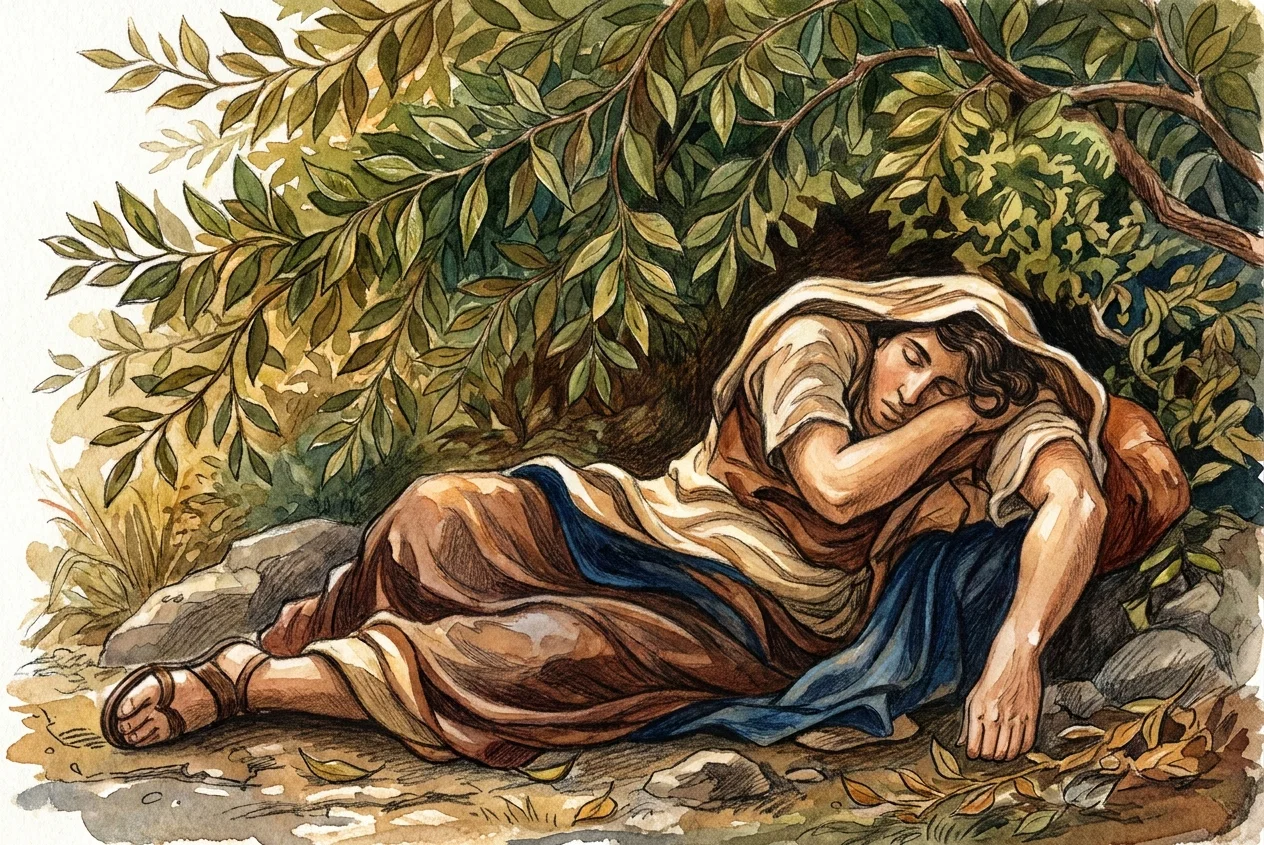
“And Jacob went out from Beer-sheba, and went toward Haran. And he lighted upon a certain place, and tarried there all night, because the sun was set; and he took of the stones of that place, and put them for his pillows, and lay down in that place to sleep.
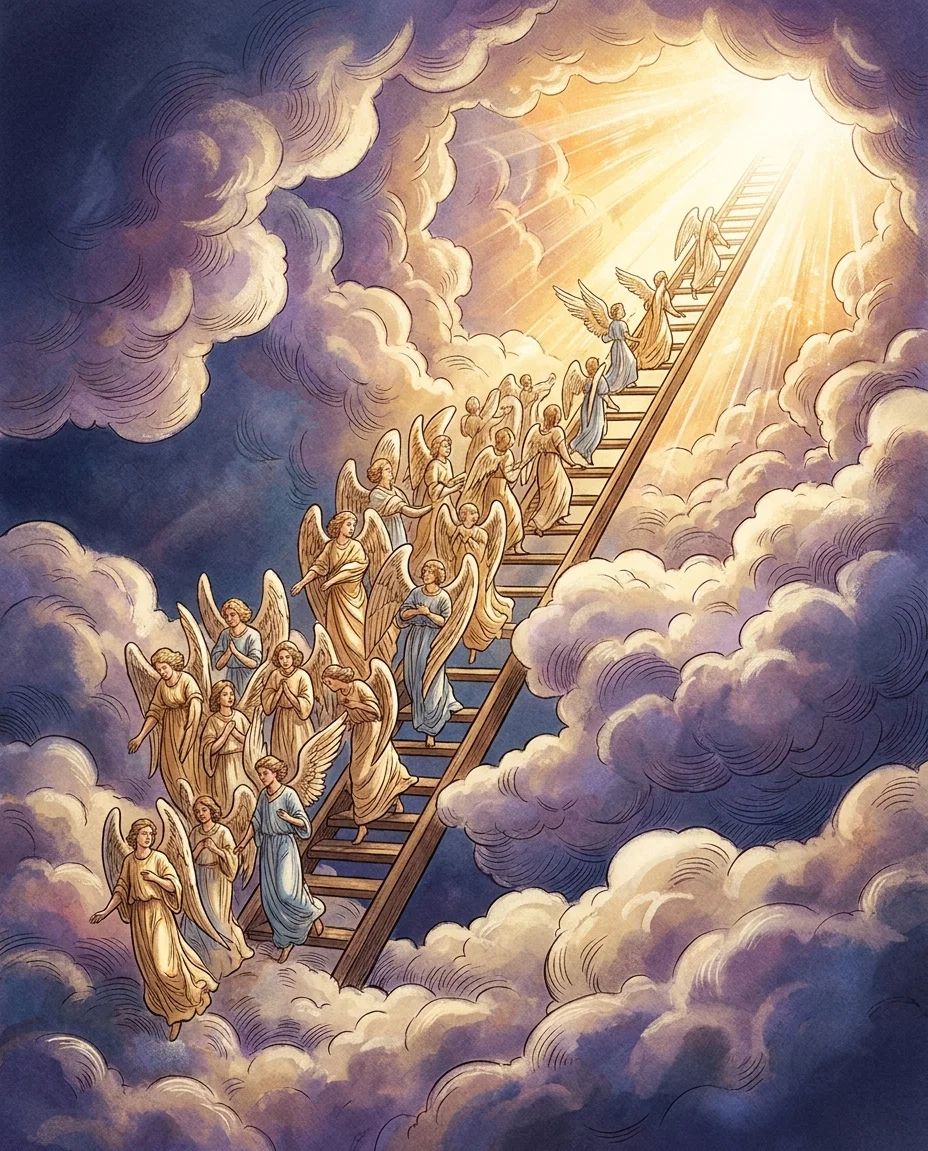
“And he dreamed, and behold a ladder set up on the earth, and the top of it reached to heaven; and behold the angels of God ascending and descending on it. And, behold, the Lord stood above it, and said:
“I am the Lord God of Abraham thy father, and the God of Isaac; the land whereon thou liest, to thee will I give it, and to thy seed. . . . And, behold, I am with thee, and will keep thee in all places whither thou goest and will bring thee again into this land; for I will not leave thee, until I have done that which I have spoken to thee of.
"Jacob lay down to sleep."
“And Jacob awaked out of his sleep, and he said,437Surely the Lord is in this place; and I knew it not. And he was afraid, and said, How dreadful is this place! this is none other but the house of God, and this is the gate of heaven.”
The angels ascended and descended on it.
In the sanctuary of the wilderness-tabernacle and of the temple that were the earthly symbols of God’s dwelling-place, one apartment was sacred to His presence. The veil inwrought with cherubim at its entrance was not to be lifted by any hand save one. To lift that veil, and intrude unbidden into the sacred mystery of the most holy place, was death. For above the mercy-seat dwelt the glory of the Holiest,—glory upon which no man might look and live. On the one day of the year appointed for ministry in the most holy place, the high priest with trembling entered God’s presence, while clouds of incense veiled the glory from his sight. Throughout the courts of the temple every sound was hushed. No priests ministered at the altars.438The host of worshippers, bowed in silent awe, offered their petitions for God’s mercy.
“ He dreamed, and behold a ladder.”
“These things happened unto them for ensamples, and they are written for our admonition, upon whom the ends of the world are come.”
“The Lord is in His holy temple;
Let all the earth keep silence before Him.”
“The Lord reigneth; let the people tremble;
He sitteth between the cherubim; let the earth be moved.
The Lord is great in Zion;
And He is high above all the people.
Let them praise Thy great and terrible name;
For it is holy.”
“The Lord’s throne is in heaven, His eyes behold, His eyelids try, the children of men.” “From the height of His sanctuary” “He hath looked down;” “From the place of His habitation He looketh Upon all the inhabitants of the earth, He fashioneth their hearts alike; He considereth all their works.” “Let all the earth fear the Lord: Let all the inhabitants of the world stand in awe of Him.”
Man can not by searching find out God. Let none seek with presumptuous hand to lift the veil that conceals His glory. “Unsearchable are His judgments, and His ways past finding out.” It is a proof of His mercy that there is the hiding of His power; for to lift the veil that conceals the divine presence is death. No mortal mind can penetrate the secrecy in which the Mighty One dwells and works. Only that which He sees fit to reveal can we comprehend of Him. Reason must acknowledge an authority superior to itself. Heart and intellect must bow to the great I AM.
The False and the True in Education
“WHEREFORE DO YE SPEND MONEY FOR THAT WHICH IS NOT BREAD?”
The master mind in the confederacy of evil is ever working to keep out of sight the words of God, and to bring into view the opinions of men. He means that we shall not hear the voice of God, saying, “This is the way, walk ye in it.” Through perverted educational processes he is doing his utmost to obscure heaven’s light.
Philosophical speculation and scientific research in which God is not acknowledged are making skeptics of thousands. In the schools of to-day the conclusions that learned men have reached as the result of their scientific investigations are carefully taught and fully explained; while the impression is distinctly given that if these learned men are correct, the Bible can not be. Skepticism is attractive to the human mind. The youth see in it an independence that captivates the imagination, and they are deceived. Satan triumphs. He nourishes every seed of doubt that is sown in young hearts. He causes it to grow and bear fruit, and soon a plentiful harvest of infidelity is reaped.
It is because the human heart is inclined to evil that it is so dangerous to sow the seeds of skepticism in young minds. Whatever weakens faith in God robs the soul of power to resist temptation. It removes the only real safeguard against sin. We are in need of schools where the youth shall be taught that greatness consists in honoring God by revealing His character in daily life. Through His word and His works we need to learn of God, that our lives may fulfil His purpose.
Infidel Authors
In order to obtain an education, many think it essential to study the writings of infidel authors, because these works contain many bright gems of thought. But who was the originator of these gems of thought?—It was God, and God only. He is the source of all light. Why then should we wade through the mass of error contained in the works of infidels for the sake of a few intellectual truths, when all truth is at our command?
How is it that men who are at war with the government of God come into possession of the wisdom which they sometimes display? Satan himself was educated in the heavenly courts, and he has a knowledge of good as well as of evil. He mingles the precious with the vile, and this is what gives him power to deceive. But because Satan has robed himself in garments of heavenly brightness, shall we receive him as an angel of light? The tempter has his agents, educated according to his methods, inspired by his spirit, and adapted to his work. Shall we co-operate with them? Shall we receive the works of his agents as essential to the acquirement of an education?
If the time and effort spent in seeking to grasp the bright ideas of infidels were given to studying the precious things of the word of God, thousands who now sit in darkness and in the shadow of death would be rejoicing in the glory of the Light of life.
Historical and Theological Lore
As a preparation for Christian work, many think it essential to acquire an extensive knowledge of historical and theological writings. They suppose that this knowledge will be an aid to them in teaching the gospel. But their laborious study of the opinions of men tends to the enfeebling of their ministry, rather than to its strengthening. As I see libraries filled with ponderous volumes of historical and theological lore, I think, Why spend money for that which is not bread? The sixth chapter of John tells us more than can be found in such works. Christ says: “I am the bread of life: he that cometh to Me shall never hunger; and he that believeth on Me shall never thirst.” “I am the living bread which came down from heaven: if any man eat of this bread, he shall live forever.” “He that believeth on Me hath everlasting life.” “The words that I speak unto you, they are Spirit, and they are life.”
There is a study of history that is not to be condemned. Sacred history was one of the studies in the schools of the prophets. In the record of His dealings with the nations were traced the footsteps of Jehovah. So to-day we are to442consider the dealings of God with the nations of the earth. We are to see in history the fulfilment of prophecy, to study the workings of Providence in the great reformatory movements, and to understand the progress of events in the marshaling of the nations for the final conflict of the great controversy.
Such study will give broad, comprehensive views of life. It will help us to understand something of its relations and dependencies, how wonderfully we are bound together in the great brotherhood of society and nations, and to how great an extent the oppression and degradation of one member means loss to all.
But history, as commonly studied, is concerned with man’s achievements, his victories in battle, his success in attaining power and greatness. God’s agency in the affairs of men is lost sight of. Few study the working out of His purpose in the rise and fall of nations.
And, to a great degree, theology, as studied and taught, is but a record of human speculation, serving only to “darken counsel by words without knowledge.” Too often the motive in accumulating these many books is not so much a desire to obtain food for mind and soul, as it is an ambition to become acquainted with philosophers and theologians, a desire to present Christianity to the people in learned terms and propositions.
Not all the books written can serve the purpose of a holy life. “Learn of Me,” said the great Teacher, “Take My yoke upon you,” learn My meekness and lowliness.” Your intellectual pride will not aid you in communicating with souls that are perishing for want of the bread of life. In your study of these books, you are allowing them to take the place of the practical lessons you should be learning from Christ. With the results of this study the people are not fed. Very little of the research which is so wearying to the mind furnishes that which will help one to be a successful laborer for souls.
The Saviour came “to preach the gospel to the poor.” In His teaching He used the simplest terms and the plainest symbols. And it is said that “the common people heard Him gladly.” Those who are seeking to do His work for this time need a deeper insight into the lessons He has given.
“The words of the living God are the highest of all education. Those who minister to the people need to eat of the bread of life. This will give them spiritual strength; then they will be prepared to minister to all classes of people.”
The Classics
In the colleges and universities, thousands of youth devote a large part of the best years of life to the study of Greek and Latin. And while they are engaged in these studies, mind and character are molded by the evil sentiments of pagan literature, the reading of which is generally regarded as an essential part of the study of these languages.
We all, beholding as in a glass the glory of the Lord, are changed into the same image.
Those who are conversant with the classics declare that “the Greek tragedies are full of incest, murder, and human sacrifices to lustful and revengeful gods.” Far better would it be for the world were the education gained from such sources to be dispensed with. “Can one go upon hot coals, and his feet not be burned?” “Who can bring a clean thing out of an unclean?—Not one.” Can we then expect the youth to develop Christian character while their education is molded by the teaching of those who set at defiance the principles of the law of God?
In casting off restraint, and plunging into reckless amusement, dissipation, and vice, students are but imitating that which is kept before their minds by these studies. There are callings in which a knowledge of Greek and Latin is needed. Some must study these languages. But the knowledge of them essential for practical uses might be gained without a study of literature that is corrupt and corrupting.
And a knowledge of Greek and Latin is not needed by many. The study of dead languages should be made secondary to a study of those subjects that teach the right use of all the powers of body and mind. It is folly for students to devote their time to the acquirement of dead languages or of book knowledge in any line, to the neglect of a training for life’s practical duties.
What do students carry with them when they leave school? Where are they going? What are they to do? Have they the knowledge that will enable them to teach others? Have they been educated to be true fathers and mothers? Can they stand at the head of a family as wise instructors? The only education worthy of the name is that which leads young men and young women to be Christlike, which fits them to bear life’s responsibilities, fits them to stand at the head of their families. Such an education is not to be acquired by a study of heathen classics.
Sensational Literature
Many of the popular publications of the day are filled with sensational stories, that are educating the youth in wickedness, and leading them in the path to perdition. Mere children in years are old in a knowledge of crime. They are incited to evil by the tales they read. In imagination they act over the deeds portrayed, until their ambition is aroused to see what they can do in committing crime and evading punishment.
To the active minds of children and youth, the scenes pictured in imaginary revelations of the future are realities.445As revolutions are predicted, and all manner of proceedings described that break down the barriers of law and self-restraint, many catch the spirit of these representations. They are led to the commission of crimes even worse, if possible, than these sensational writers depict. Through such influences as these society is becoming demoralized. The seeds of lawlessness are sown broadcast. None need marvel that a harvest of crime is the result.
Romance
Works of romance, frivolous, exciting tales, are, in hardly less degree, a curse to the reader. The author may profess to teach a moral lesson, throughout his work he may interweave religious sentiments; but often these serve only to veil the folly and worthlessness beneath.
The world is flooded with books that are filled with enticing error. The youth receive as truth that which the Bible denounces as falsehood, and they love and cling to deception that means ruin to the soul.
High-Class Fiction
There are works of fiction that were written for the purpose of teaching truth or exposing some great evil. Some of these works have accomplished good. Yet they have also wrought untold harm. They contain statements and highly wrought pen-pictures that excite the imagination and give rise to a train of thought which is full of danger, especially to the youth. The scenes described are lived over and over again in their thoughts. Such reading unfits the mind for usefulness, and disqualifies it for spiritual exercise. It destroys interest in the Bible. Heavenly things find little place in the thoughts. As the mind dwells upon the scenes of impurity portrayed, passion is aroused, and the end is sin.
Even fiction which contains no suggestion of impurity, and which may be intended to teach excellent principles, is harmful. It encourages the habit of hasty and superficial reading, merely for the story.446Thus it tends to destroy the power of connected and vigorous thought; it unfits the soul to contemplate the great problems of duty and destiny.
" Seeds of sin."
By fostering love for mere amusement, the reading of fiction creates a distaste for life’s practical duties. Through its exciting, intoxicating power, it is not infrequently a cause of both mental and physical disease. Many a miserable, neglected home, many a lifelong invalid, many an inmate of the insane asylum, has become such through the habit of novel reading.
It is often urged that in order to win the youth from sensational or worthless literature, we should supply them with a better class of fiction. This is like trying to cure the drunkard by giving him, in the place of whisky or brandy, the milder intoxicants, such as wine, beer, or cider. The use of these would continually foster the appetite for stronger stimulants. The only safety for the inebriate, and the only safeguard for the temperate man, is total abstinence. For the lover of fiction the same rule holds true. Total abstinence is his only safety.
Myths and Fairy Tales
In the education of children and youth, fairy tales, myths, and fictitious stories are now given a large place. Books of this character are used in the schools, and they are to be found in many homes. How can Christian parents permit their children to use books so filled with falsehood? When the children ask the meaning of stories so contrary to the teaching of their parents, the answer is that the stories are447not true; but this does not do away with the evil results of their use. The ideas presented in these books mislead the children. They impart false views of life, and beget and foster a desire for the unreal.
“ The good seed.”
The wide-spread use of such books at this time is one of the cunning devices of Satan. He is seeking to divert the minds of old and young from the great work of character building. He means that our children and youth shall be swept away by the soul-destroying deceptions with which he is filling the world. Therefore he seeks to divert their minds from the word of God, and thus prevent them from obtaining a knowledge of those truths that would be their safeguard.
Never should books containing a perversion of truth be placed in the hands of children or youth. Let not our children, in the very process of obtaining an education, receive ideas that will prove to be seeds of sin. If those with mature minds had nothing to do with such books, they would themselves be far safer, and their example and influence on the right side would make it far less difficult to guard the youth from temptation.
A Purer Fountain
We have an abundance of that which is real, that which is divine. Those who thirst for knowledge need not go to polluted fountains. The Lord says:
“Bow down thine ear, and hear the words of the wise,
And apply thine heart unto My knowledge. . . .
That thy trust may be in the Lord,
I have made known to thee this day, even to thee.”
“Have not I written to thee excellent things In counsels and knowledge, That I might make thee know the certainty of the words of truth; That thou mightest answer the words of truth to them that send unto thee?”
“He established a testimony in Jacob,
And appointed a law in Israel,
Which He commanded our fathers,
That they should make them known to their children;”
“Showing to the generation to come the praises of the Lord,
And His strength, and His wonderful works that He hath done.”
“That the generation to come might know them, Even the children which should be born; Who should arise and declare them to their children: That they might set their hope in God.”
“The blessing of the Lord, it maketh rich; And He addeth no sorrow with it.”
Christ’s Teaching
So also Christ presented the principles of truth in the gospel. In His teaching we may drink of the pure streams that flow from the throne of God. Christ could have imparted to men knowledge that would have surpassed any previous disclosures, and put in the background every other discovery. He could have unlocked mystery after mystery, and could have concentrated around these wonderful revelations the active, earnest thought of successive generations till the close of time. But He would not spare a moment from teaching the science of salvation. His time, His faculties, and His life were appreciated and used only as the means for working out the salvation of the souls of men. He had come to seek and to save that which was lost, and He would not be turned from His purpose. He allowed nothing to divert Him.
Christ imparted only that knowledge which could be utilized. His instruction of the people was confined to the needs of their own condition in practical life. The curiosity that449led them to come to Him with prying questions, He did not gratify. All such questionings He made the occasion for solemn, earnest, vital appeals. To those who were so eager to pluck from the tree of knowledge, He offered the fruit of the tree of life. They found every avenue closed, except the way that leads to God. Every fountain was sealed, save the fountain of eternal life.
Our Saviour did not encourage any to attend the rabbinical schools of His day, for the reason that their minds would be corrupted with the continually repeated, “They say,” or, “It has been said.” Why, then, should we accept the unstable words of men as exalted wisdom, when a greater, a certain wisdom is at our command?
That which I have seen of eternal things, and that which I have seen of the weakness of humanity, has deeply impressed my mind, and influenced my life-work. I see nothing wherein man should be praised or glorified. I see no reason why the opinions of worldly-wise men and so-called great men should be trusted in and exalted. How can those who are destitute of divine enlightenment have correct ideas of God’s plans and ways? They either deny Him altogether and ignore His existence, or they circumscribe His power by their own finite conceptions.
Let us choose to be taught by Him who created the heavens and the earth, by Him who set the stars in their order in the firmament, and appointed the sun and the moon to do their work.