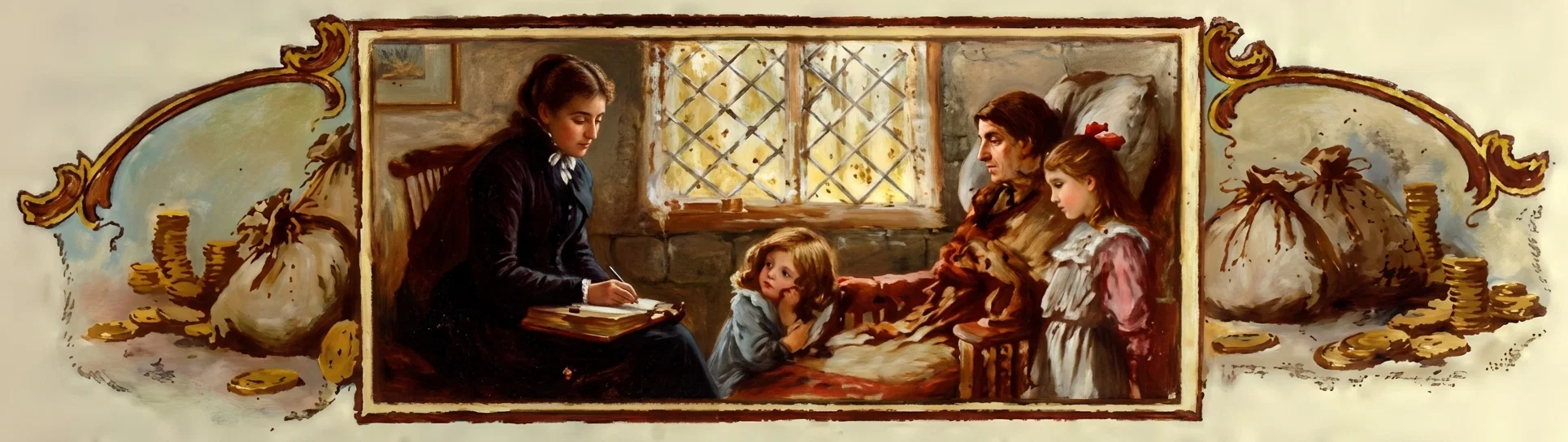
“Do good, and lend, hoping for nothing again; and your reward shall be great, and ye shall be the children of the Highest: for He is kind unto the unthankful and to the evil.”
“He that hideth his eyes shall have many a curse;” but “he that giveth unto the poor shall not lack.”
“Give, and it shall be given unto you, good measure, pressed down, and shaken together, and running over, shall men give into your bosom.”
Ministry to the Rich
“THAT THEY TRUST NOT IN UNCERTAIN RICHES.”
CORNELIUS, the Roman centurion, was a man of wealth and of noble birth. His position was one of trust and honor. A heathen by birth, training, and education, through contact with the Jews, he had gained a knowledge of the true God, and he worshiped Him, showing the sincerity of his faith by compassion to the poor. He gave “alms to the people, and prayed to God always.”
Cornelius had not a knowledge of the gospel as revealed in the life and death of Christ, and God sent a message direct from heaven to him, and by another message directed the apostle Peter to visit and instruct him. Cornelius was not united with the Jewish church, and he would have been looked upon by the rabbis as a heathen and unclean; but God read the sincerity of his heart, and sent messengers from His throne to unite with His servant on earth in teaching the gospel to this officer of Rome.
So to-day God is seeking for souls among the high as well as the low. There are many like Cornelius, men whom He desires to connect with His church. Their sympathies are with the Lord’s people. But the ties that bind them to the world hold them firmly. It requires moral courage for these men to take their position with the lowly ones.210Special effort should be made for these souls, who are in so great danger because of their responsibilities and associations.
Much is said concerning our duty to the neglected poor; should not some attention be given to the neglected rich? Many look upon this class as hopeless, and they do little to open the eyes of those, who, blinded and dazed by the glitter of earthly glory, have lost eternity out of their reckoning. Thousands of wealthy men have gone to their graves unwarned. But indifferent as they may appear, many among the rich are soul-burdened. “He that loveth silver shall not be satisfied with silver; nor he that loveth abundance with increase.” He that says to fine gold, “Thou art my confidence,” has “denied the God that is above.” “None of them can by any means redeem his brother, nor give to God a ransom for him; for the redemption of their soul is precious, and it ceaseth forever.”
Riches and worldly honor can not satisfy the soul. Many among the rich are longing for some divine assurance, some spiritual hope. Many long for something that will bring to an end the monotony of their aimless lives. Many in official life feel their need of something which they have not. Few among them go to church; for they feel that they receive little benefit. The teaching they hear does not touch the heart. Shall we make no personal appeal to them?
Among the victims of want and sin are found those who were once in possession of wealth. Men of different vocations and different stations in life have been overcome by the pollutions of the world, by the use of strong drink, by the indulgence of lust, and have fallen under temptation. While these fallen ones demand pity and help, should not some attention be given to those who have not yet descended to these depths, but who are setting their feet in the same path?
Thousands in positions of trust and honor are indulging habits that mean ruin to soul and body. Ministers of the gospel, statesmen, authors, men of wealth and talent, men of vast business capacity, and power for usefulness, are in deadly peril because they do not see the necessity of self-control in all things. They need to have their attention called to the principles of temperance, not in a narrow or arbitrary way, but in the light of God’s great purpose for humanity. Could the principles of true temperance thus be brought before them, there are very many of the higher classes who would recognize their value and give them a hearty acceptance.
Trusting in God’s help I solemnly promise to abstain from the use of alcoholic drinks as a beverage, including wine, beer, and cider, and from the use of tobacco and opium in any form.
We should show these persons the result of harmful indulgences in lessening physical, mental, and moral power. Help them to realize their responsibility as stewards of God’s gifts. Show them the good they could do with the money they now spend for that which does them only harm. Present the total abstinence pledge, asking that the money they would otherwise spend for liquor, tobacco, or like indulgences, be devoted to the relief of the sick poor, or for the training of children and youth for usefulness in the world. To such an appeal not many would refuse to listen.
There is another danger to which the wealthy are especially exposed, and here is also a field for the medical missionary. Multitudes who are prosperous in the world, and212who never stoop to the common forms of vice, are yet brought to destruction through the love of riches. The cup most difficult to carry is not the cup that is empty, but the cup that is full to the brim. It is this that needs to be most carefully balanced. Affliction and adversity bring disappointment and sorrow; but it is prosperity that is most dangerous to spiritual life.
Those who are suffering reverses are represented by the bush that Moses saw in the desert, which, though burning, was not consumed. The angel of the Lord was in the midst of the bush. So in deprivation and affliction the brightness of the presence of the Unseen is with us to comfort and sustain. Often prayer is solicited for those who are suffering from illness or adversity; but our prayers are most needed by the men entrusted with prosperity and influence.
In the valley of humiliation, where men feel their need, and depend on God to guide their steps, there is comparative safety. But the men who stand, as it were, on a lofty pinnacle, and who, because of their position, are supposed to possess great wisdom,—these are in greatest peril. Unless such men make God their dependence, they will surely fall.
The Bible condemns no man for being rich, if he has acquired his riches honestly. Not money, but the love of money, is the root of all evil. It is God who gives men power to get wealth; and in the hands of him who acts as God’s steward, using his means unselfishly, wealth is a blessing, both to its possessor and to the world. But many, absorbed in their interest in worldly treasures, become insensible to the claims of God and the needs of their fellow men. They regard their wealth as a means of glorifying themselves. They add house to house, and land to land; they fill their homes with luxuries, while all about them are human beings in misery and crime, in disease and death. Those who thus213give their lives to self-serving are developing in themselves, not the attributes of God, but the attributes of the wicked one.
These men are in need of the gospel. They need to have their eyes turned from the vanity of material things to behold the preciousness of the enduring riches. They need to learn the joy of giving, the blessedness of being coworkers with God.
The Lord bids us, “Charge them that are rich in this world,” that they trust not “in uncertain riches, but in the living God, who giveth us richly all things to enjoy; that they do good, that they be rich in good works, ready to distribute, willing to communicate, laying up in store for themselves a good foundation against the time to come, that they may lay hold on eternal life.”
It is by no casual, accidental touch that wealthy, world-loving, world-worshipping souls can be drawn to Christ. These persons are often the most difficult of access. Personal effort must be put forth for them by men and women imbued with the missionary spirit, those who will not fail or be discouraged.
Some are especially fitted to work for the higher classes. These should seek wisdom from God to know how to reach these persons, to have not merely a casual acquaintance with them, but by personal effort and living faith to awaken them to the needs of the soul, to lead them to a knowledge of the truth as it is in Jesus.
Many suppose that in order to reach the higher classes, a manner of life and method of work must be adopted that will be suited to their fastidious tastes. An appearance of wealth, costly edifices, expensive dress, equipage, and surroundings, conformity to worldly customs, the artificial polish of fashionable society, classical culture, the graces of oratory,214are thought to be essential. This is an error. The way of worldly policy is not God’s way of reaching the higher classes. That which will reach them effectually is a consistent, unselfish presentation of the gospel of Christ.
The experience of the apostle Paul in meeting the philosophers of Athens has a lesson for us. In presenting the gospel before the court of the Areopagus, Paul met logic with logic, science with science, philosophy with philosophy. The wisest of his hearers were astonished and silenced. His words could not be controverted. But the effort bore little fruit. Few were led to accept the gospel. Henceforth Paul adopted a different manner of labor. He avoided elaborate arguments and discussion of theories, and in simplicity pointed men and women to Christ as the Saviour of sinners. Writing to the Corinthians of his work among them, he said:
Sell that ye have and give alms; provide yourselves bags which wax not old, a treasure in the heavens that faileth not, where no thief approacheth, neither moth corrupteth.
“I, brethren, when I came to you, came not with excellency of speech or of wisdom, declaring unto you the testimony215of God. For I determined not to know anything among you, save Jesus Christ, and Him crucified. . . . My speech and my preaching was not with enticing words of man’s wisdom, but in demonstration of the Spirit and of power; that your faith should not stand in the wisdom of men, but in the power of God.”
Again in his letter to the Romans, he says:
“I am not ashamed of the gospel of Christ; for it is the power of God unto salvation to every one that believeth; to the Jew first, and also to the Greek.”
What shall it profit a man, if he shall gain the whole world, and lose his own soul?
Let those who work for the higher classes bear themselves with true dignity, remembering that angels are their companions. Let them keep the treasure-house of mind and heart filled with, “It is written.” Hang in memory’s hall the precious words of Christ. They are to be valued far above gold or silver.
Christ has said that it is easier for a camel to go through the eye of a needle than for a rich man to enter the kingdom of God. In the work for this class many discouragements will be presented, many heart-sickening revelations will be made. But all things are possible with God. He can216and will work through human agencies upon the minds of men whose lives have been devoted to money-getting.
There are miracles to be wrought in genuine conversion, miracles that are not now discerned. The greatest men of the earth are not beyond the power of a wonder-working God. If those who are workers together with Him will do their duty bravely and faithfully, God will convert men who occupy responsible places, men of intellect and influence. Through the power of the Holy Spirit, many will be led to accept the divine principles.
When it is made plain that the Lord expects them as His representatives to relieve suffering humanity, many will respond, and will give of their means and their sympathies for the benefit of the poor. As their minds are thus drawn away from their own selfish interests, many will surrender themselves to Christ. With their talents of influence and means they will gladly unite in the work of beneficence with the humble missionary who was God’s agent in their conversion. By a right use of their earthly treasures they will lay up for themselves “a treasure in the heavens that faileth not, where no thief approacheth, neither moth corrupteth.”
When converted to Christ, many will become agencies in the hand of God to work for others of their own class. They will feel that a dispensation of the gospel is committed to them for those who have made this world their all. Time and money will be consecrated to God, talent and influence will be devoted to the work of winning souls to Christ.
Only eternity will reveal what has been accomplished by this kind of ministry,—how many souls, sick with doubt, and tired of worldliness and unrest, have been brought to the great Restorer, who longs to save to the uttermost all that come unto Him. Christ is a risen Saviour, and there is healing in His wings.217“They shall lay hands on the sick, and they shall recover.”
The Care of the Sick
In the Sick-Room
“AS YE HAVE DONE IT UNTO ONE OF THE LEAST OF THESE MY BRETHREN, YE HAVE DONE IT UNTO ME.”
Those who minister to the sick should understand the importance of careful attention to the laws of health. Nowhere is obedience to these laws more important than in the sick-room. Nowhere does so much depend upon faithfulness in little things on the part of the attendants. In cases of serious illness, a little neglect, a slight inattention to a patient’s special needs or dangers, the manifestation of fear, excitement, or petulance, even a lack of sympathy, may turn the scale that is balancing life and death, and cause to go down to the grave a patient who otherwise might have recovered.
The efficiency of the nurse depends, to a great degree, upon physical vigor. The better the health, the better will she be able to endure the strain of attendance upon the sick, and the more successfully can she perform her duties. Those who care for the sick should give special attention to diet, cleanliness, fresh air, and exercise. Like carefulness on the part of the family will enable them also to endure the extra burdens brought upon them, and will help to prevent them from contracting disease.
Where the illness is serious, requiring the attendance of a nurse night and day, the work should be shared by at least two efficient nurses, so that each may have opportunity for rest and for exercise in the open air. This is especially important in cases where it is difficult to secure an abundance of fresh air in the sick-room. Through ignorance of the importance of fresh air, ventilation is sometimes restricted, and the lives of both patient and attendant are often in danger.
If proper precaution is observed, non-contagious diseases need not be taken by others. Let the habits be correct, and by cleanliness and proper ventilation keep the sick-room free from poisonous elements. Under such conditions, the sick are much more likely to recover, and in most cases neither attendants nor the members of the family will contract the disease.
The darkened room
Sunlight, Ventilation, and Temperature
To afford the patient the most favorable conditions for recovery, the room he occupies should be large, light, and cheerful, with opportunity for thorough ventilation. The room in the house that best meets these requirements should be chosen as the sick-room. Many houses have no special provision for proper ventilation, and to secure it is difficult; but every possible effort should be made to arrange the sick-room so that a current of fresh air can pass through it night and day.
So far as possible, an even temperature should be maintained in the sick-room. The thermometer should be consulted. Those who have the care of the sick, being often deprived of sleep or awakened in the night to attend to the patient, are liable to chilliness, and are not good judges of a healthful temperature.
Diet
An important part of the nurse’s duty is the care of the patient’s diet. The patient should not be allowed to suffer or become unduly weakened through lack of nourishment, nor should the enfeebled digestive powers be overtaxed. Care should be taken so to prepare and serve the food that it will be palatable, but wise judgment should be used in adapting it to the needs of the patient, both in quantity and quality. In times of convalescence especially, when the appetite is keen, before the digestive organs have recovered strength, there is great danger of injury from errors in diet.
“Plenty of sunlight and pure air.”
“Plenty of sunlight and pure air.”
Duties of Attendants
Nurses, and all who have to do with the sick-room, should be cheerful, calm, and self-possessed. All hurry, excitement, or confusion, should be avoided. Doors should be opened and shut with care, and the whole household be kept quiet. In cases of fever, special care is needed when the222crisis comes and the fever is passing away. Then constant watching is often necessary. Ignorance, forgetfulness, and recklessness have caused the death of many who might have lived had they received proper care from judicious, thoughtful nurses.
Visiting the Sick
It is misdirected kindness, a false idea of courtesy, that leads to much visiting of the sick. Those who are very ill should not have visitors. The excitement connected with receiving callers wearies the patient, at a time when he is in the greatest need of quiet, undisturbed rest.
A token of remembrance
To a convalescent or a patient suffering from chronic disease, it is often a pleasure and a benefit to know that he is kindly remembered; but this assurance conveyed by a message of sympathy or by some little gift will often serve a better purpose than a personal visit, and without danger of harm.
Institutional Nursing
In sanitariums and hospitals, where nurses are constantly associated with large numbers of sick people, it requires a decided effort to be always pleasant and cheerful, and to show thoughtful consideration in every word and act. In these institutions it is of the utmost importance that the nurses strive to do their work wisely and well. They need223ever to remember that in the discharge of their daily duties, they are serving the Lord Christ.
The sick need to have wise words spoken to them. Nurses should study the Bible daily, that they may be able to speak words that will enlighten and help the suffering. Angels of God are in the rooms where these suffering ones are being ministered to, and the atmosphere surrounding the soul of the one giving treatment should be pure and fragrant. Physicians and nurses are to cherish the principles of Christ. In their lives His virtues are to be seen. Then, by what they do and say, they will draw the sick to the Saviour.
A home for the sick away from the noise of the city
The Christian nurse, while administering treatment for the restoration of health, will pleasantly and successfully draw the mind of the patient to Christ, the healer of the soul as well as of the body. The thoughts presented, here a little and there a little, will have their influence. The older224nurses should lose no favorable opportunity of calling the attention of the sick to Christ. They should be ever ready to blend spiritual healing with physical healing.
In the kindest and tenderest manner nurses are to teach that he who would be healed must cease to transgress the law of God. He must cease to choose a life of sin. God can not bless the one who continues to bring upon himself disease and suffering by a wilful violation of the laws of heaven. But Christ, through the Holy Spirit, comes as a healing power to those who cease to do evil and learn to do well.
Sin no more, lest a worse thing came unto thee.
Those who have no love for God will work constantly against the best interests of soul and body. But those who awake to the importance of living in obedience to God in this present evil world will be willing to separate from every wrong habit. Gratitude and love will fill their hearts. They know that Christ is their friend. In many cases, the realization that they have such a friend means more to the suffering ones in their recovery from sickness than the best treatment that can be given. But both lines of ministry are essential. They are to go hand in hand.
Prayer for the Sick
“THE PRAYER OF FAITH SHALL
SAVE THE SICK.”
THE Scripture says that “men ought always to pray, and not to faint;” and if ever there is a time when they feel their need of prayer, it is when strength fails, and life itself seems slipping from their grasp. Often those who are in health forget the wonderful mercies continued to them day by day, year after year, and they render no tribute of praise to God for His benefits. But when sickness comes, God is remembered. When human strength fails, men feel their need of divine help. And never does our merciful God turn from the soul that in sincerity seeks Him for help. He is our refuge in sickness as in health.
“Like as a father pitieth his children,
So the Lord pitieth them that fear Him.
For He knoweth our frame;
He remembereth that we are dust.”
“Because of their transgression,
And because of their iniquities,” men “are afflicted;
Their soul abhorreth all manner of food,
And they draw near unto the gates of death.”
“Then they cry unto the Lord in their trouble,
And He saveth them out of their distresses.
He sendeth His word, and healeth them,
And delivereth them from their destructions.”
God is just as willing to restore the sick to health now as when the Holy Spirit spoke these words through the psalmist. And Christ is the same compassionate physician now that He was during His earthly ministry. In Him there is healing balm for every disease, restoring power for every infirmity. His disciples in this time are to pray for the sick as verily as the disciples of old prayed. And recoveries will follow; for “the prayer of faith shall save the sick.” We have the Holy Spirit’s power, the calm assurance of faith, that can claim God’s promises. The Lord’s promise, “They shall lay hands on the sick, and they shall recover,” is just as trustworthy now as in the days of the apostles. It presents the privilege of God’s children, and our faith should lay hold of all that it embraces. Christ’s servants are the channel of His working, and through them He desires to exercise His healing power. It is our work to present the sick and suffering to God in the arms of our faith. We should teach them to believe in the great Healer.
The Saviour would have us encourage the sick, the hopeless, the afflicted, to take hold upon His strength. Through faith and prayer the sick-room may be transformed into a Bethel. In word and deed, physicians and nurses may say, so plainly that it can not be misunderstood, “God is in this place” to save, and not to destroy. Christ desires to manifest His presence in the sick-room, filling the hearts of physicians and nurses with the sweetness of His love. If the life of the attendants upon the sick is such that Christ can go with them to the bedside of the patient, there will come to him the conviction that the compassionate Saviour is present, and this conviction will itself do much for the healing of both the soul and the body.
And God hears prayer. Christ has said, “If ye shall ask anything in My name, I will do it.” Again He says, “If any man serve Me, . . . him will My Father honor.” If we live according to His word, every precious promise227He has given will be fulfilled to us. We are undeserving of His mercy, but as we give ourselves to Him, He receives us. He will work for and through those who follow Him.