The Creator chose for our first parents the surroundings best adapted for their health and happiness. He did not place them in a palace, or surround them with the artificial adornments and luxuries that so many to-day are struggling to obtain. He placed them in close touch with nature, and in close communion with the holy ones of heaven.
In the garden that God prepared as a home for His children, graceful shrubs and delicate flowers greeted the eye at every turn. There were trees of every variety, many of them laden with fragrant and delicious fruit. On their branches the birds caroled their songs of praise. Under their shadow the creatures of the earth sported together without a fear.
Adam and Eve, in their untainted purity, delighted in the sights and sounds of Eden. God appointed them their work in the garden, “to dress it and to keep it.” Each day’s labor brought them health and gladness, and the happy pair greeted with joy the visits of their Creator, as in the cool of the day He walked and talked with them. Daily God taught them His lessons.
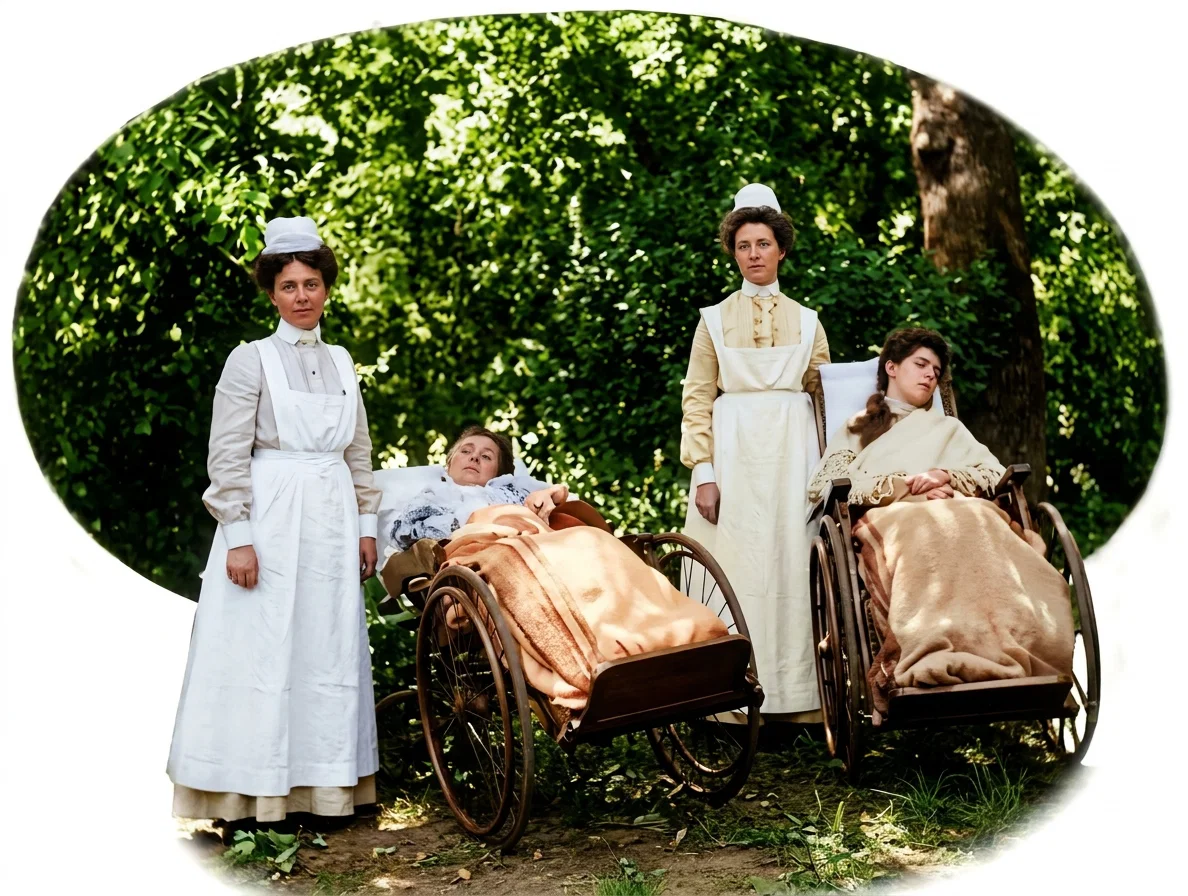
The plan of life which God appointed for our first parents has lessons for us. Although sin has cast its shadow over262the earth, God desires His children to find delight in the works of His hands. The more closely His plan of life is followed, the more wonderfully will He work to restore suffering humanity. The sick need to be brought into close touch with nature. An outdoor life amid natural surroundings would work wonders for many a helpless and almost hopeless invalid.
Invalids enjoying outdoor life
The noise and excitement and confusion of the cities, their constrained and artificial life, are most wearisome and exhausting to the sick. The air, laden with smoke and dust, with poisonous gases, and with germs of disease, is a peril to life. The sick, for the most part shut within four walls, come almost to feel as if they were prisoners in their rooms. They look out on houses and pavements and hurrying crowds, with perhaps not even a glimpse of blue sky or sunshine, of grass or flower or tree. Shut up in this263way, they brood over their suffering and sorrow, and become a prey to their own sad thoughts.
And for those who are weak in moral power, the cities abound in dangers. In them, patients who have unnatural appetites to overcome are continually exposed to temptation. They need to be placed amid new surroundings, where the current of their thoughts will be changed, they need to be placed under influences wholly different from those that have wrecked their lives. Let them for a season be removed from those influences that lead away from God, into a purer atmosphere.
A sanitarium in the forest
Institutions for the care of the sick would be far more successful if they could be established away from the cities. And so far as possible, all who are seeking to recover health should place themselves amid country surroundings, where they can have the benefit of outdoor life. Nature is God’s264physician. The pure air, the glad sunshine, the flowers and trees, the orchards and vineyards, and outdoor exercise amid these surroundings, are health-giving, life-giving.
Physicians and nurses should encourage their patients to be much in the open air. Outdoor life is the only remedy that many invalids need. It has a wonderful power to heal diseases caused by the excitements and excesses of fashionable life, a life that weakens and destroys the powers of body, mind, and soul.
How grateful to the invalids weary of city life, the glare of many lights, and the noise of the streets, are the quiet and freedom of the country! How eagerly do they turn to the scenes of nature! How glad would they be to sit in the open air, rejoice in the sunshine, and breathe the fragrance of tree and flower! There are life-giving properties in the balsam of the pine, in the fragrance of the cedar and the fir, and other trees also have properties that are health-restoring.
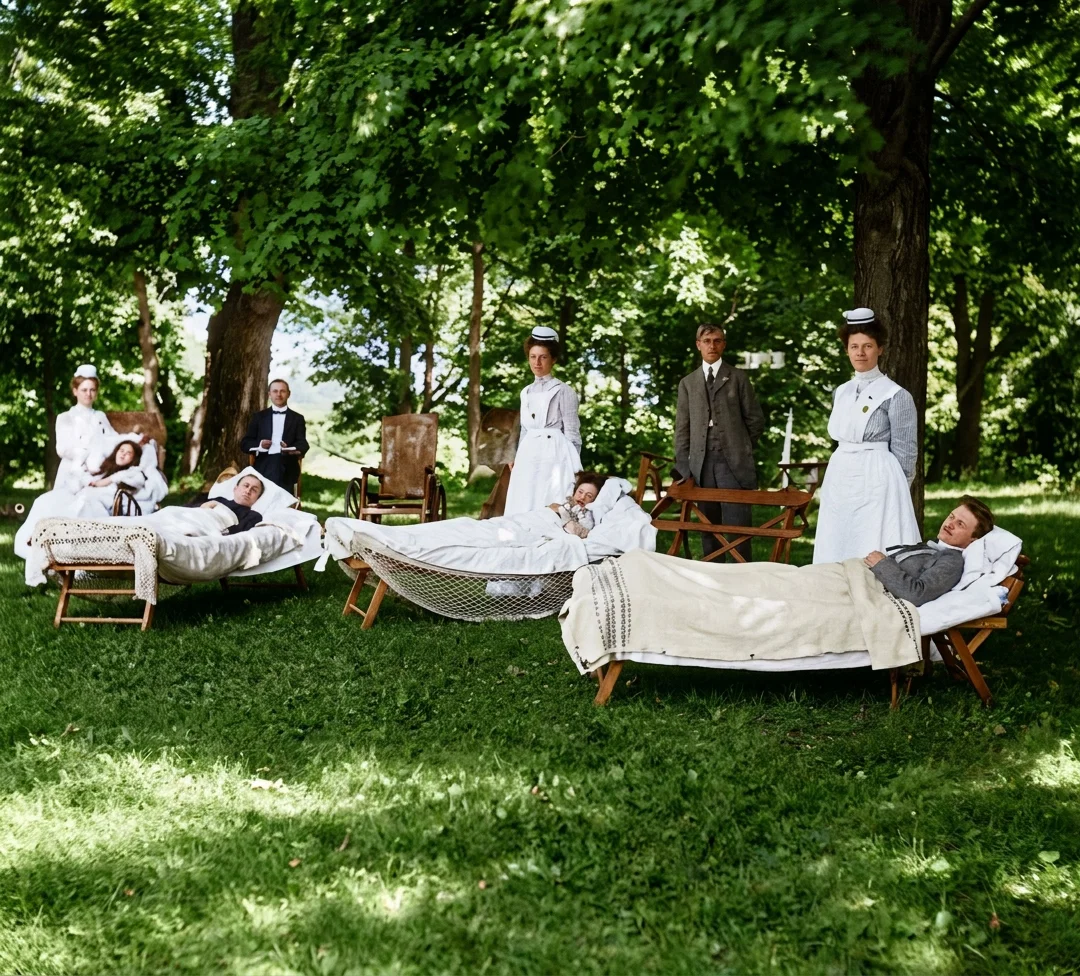
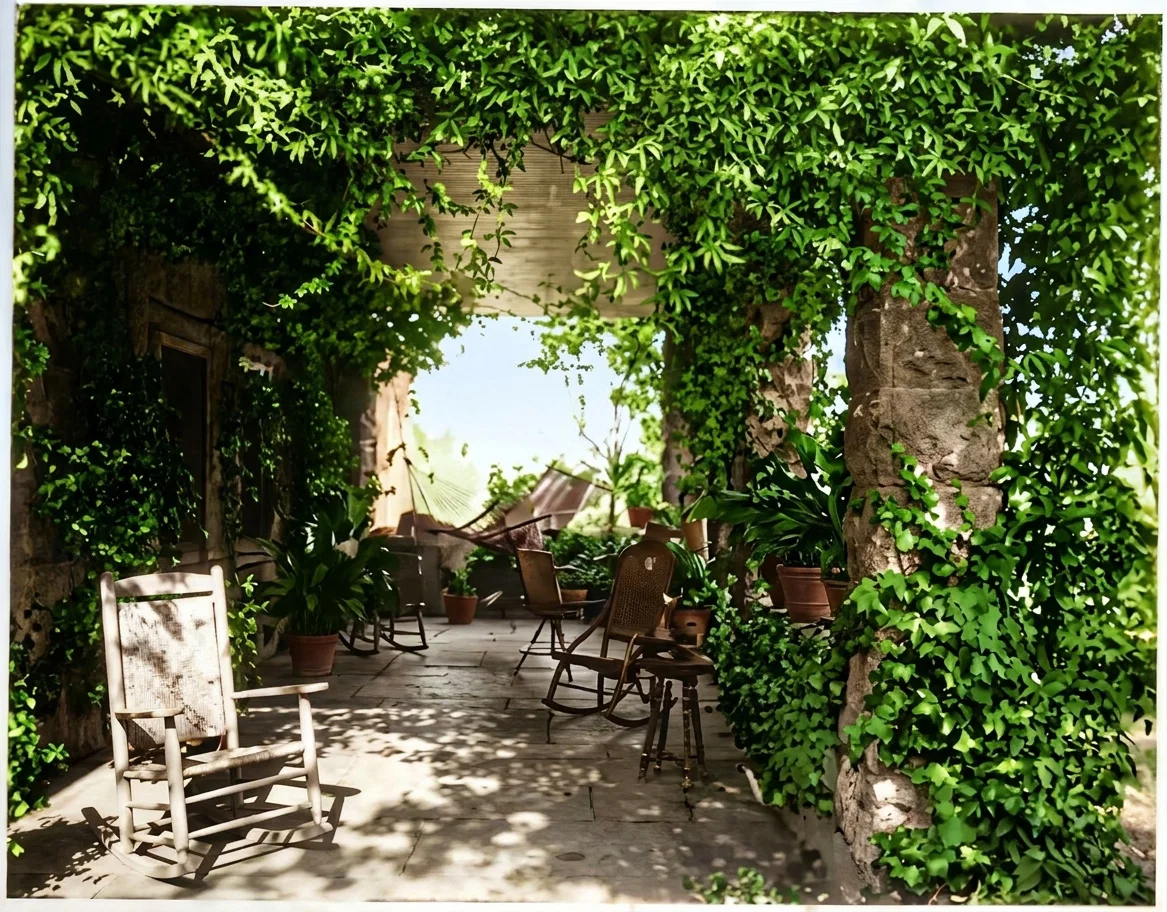
To the chronic invalid, nothing so tends to restore health and happiness as living amid attractive country surroundings. Here the most helpless ones can sit or lie in the sunshine or in the shade of the trees. They have only to lift their eyes to see above them the beautiful foliage. A sweet sense of restfulness and refreshing comes over them as they listen to the murmuring of the breezes. The drooping spirits revive. The waning strength is recruited. Unconsciously the mind becomes peaceful, the fevered pulse more calm and regular. As the sick grow stronger, they will venture to take a few steps to gather some of the lovely flowers, precious messengers of God’s love to His afflicted family here below.
Plans should be devised for keeping patients out-of-doors. For those who are able to work, let some pleasant, easy employment be provided. Show them how agreeable and helpful this outdoor work is. Encourage them to breathe the fresh air. Teach them to breathe deeply, and in breathing and speaking to exercise the abdominal muscles. This is an education that will be invaluable to them.
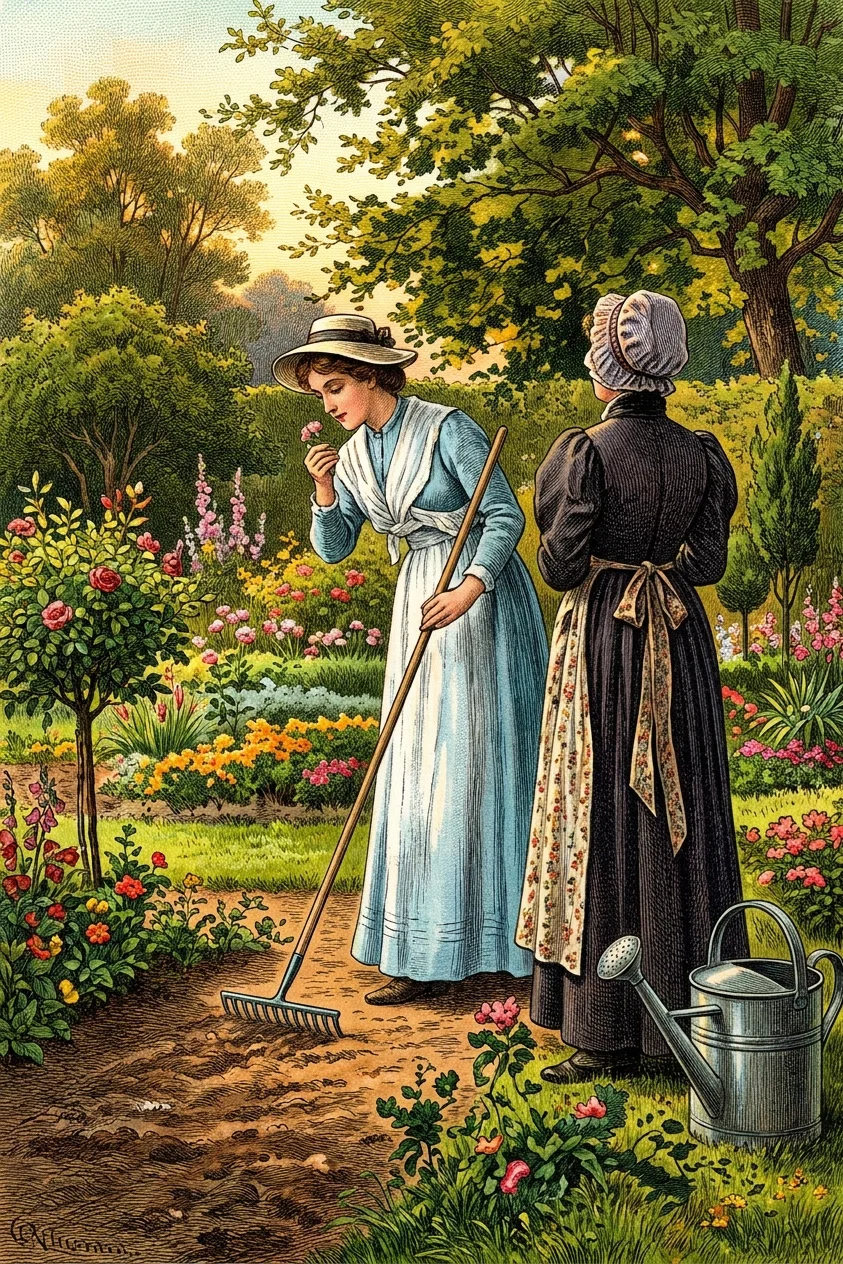
Exercise in the open air should be prescribed as a life-giving necessity. And for such exercises there is nothing better than the cultivation of the soil. Let patients have flower beds to care for, or work to do in the orchard or vegetable garden. As they are encouraged to leave their rooms and spend time in the open air, cultivating flowers or doing some other light, pleasant work, their attention will be diverted from themselves and their sufferings.
“Exercise in the open air should be prescribed as a life-giving necessity. . . . Let patients have flower beds to care for.”
The more the patient can be kept out of doors, the less care will he require. The more cheerful his surroundings, the more hopeful will he be. Shut up in the house, be it ever so elegantly furnished, he will grow fretful and gloomy. Surround him with the beautiful things of nature; place him where he can see the flowers growing and hear the birds singing, and his heart will break into song in harmony with the songs of the birds. Relief will come to body and mind. The intellect will be awakened, the imagination quickened, and the mind prepared to appreciate the beauty of God’s word.
“Exercise in the open air should be prescribed as a life-giving necessity. . . . Let patients have flower beds to care for.”
In nature may always be found something to divert the attention of the sick from themselves and direct their thoughts to God. Surrounded by His wonderful works, their minds are uplifted from the things that are seen to the things that are unseen. The beauty of nature leads them to think of266the heavenly home, where there will be nothing to mar the loveliness, nothing to taint or destroy, nothing to cause disease or death.
Let physicians and nurses draw from the things of nature, lessons teaching of God. Let them point the patients to Him whose hand has made the lofty trees, the grass, and the flowers, encouraging them to see in every bud and flower an expression of His love for His children. He who cares for the birds and the flowers will care for the beings formed in His own image.
Under the trees
Out-of-doors, amid the things that God has made, breathing the fresh, health-giving air, the sick can best be told of the new life in Christ. Here God’s word can be read. Here the light of Christ’s righteousness can shine into hearts darkened by sin.267Lord, I desire with Thee to live
Anew from day to day,
In joys the world can never give,
Nor ever take away.
Blest Jesus, come, and rule my heart,
And make me wholly Thine,
That I may nevermore depart,
Nor grieve Thy love divine.
Men and women in need of physical and spiritual healing are to be thus brought into contact with those whose words and acts will draw them to Christ. They are to be brought under the influence of the great Medical Missionary, who can heal both soul and body. They are to hear the story of the Saviour’s love, of the pardon freely provided for all who come to Him confessing their sins.
Under such influences as these, many suffering ones will be guided into the way of life. Angels of heaven co-operate with human instrumentalities in bringing encouragement and hope and joy and peace to the hearts of the sick and suffering. Under such conditions the sick are doubly blessed, and many find health. The feeble step recovers its elasticity. The eye regains its brightness. The hopeless become hopeful. The once despondent countenance wears an expression of joy. The complaining tones of the voice give place to tones of cheerfulness and content.
As physical health is regained, men and women are better able to exercise that faith in Christ which secures268the health of the soul. In the consciousness of sins forgiven, there is inexpressible peace and joy and rest. The clouded hope of the Christian is brightened. The words express the belief, “God is our refuge and strength, a very present help in trouble.” “Yea, though I walk through the valley of the shadow of death, I will fear no evil; for Thou art with me; Thy rod and Thy staff they comfort me.” “He giveth power to the faint; and to them that have no might He increaseth strength.”269Without a knowledge of health principles, no one is fitted for life’s responsibilities.
Health Principles
General Hygiene
“YE ARE THE TEMPLE OF GOD.”
“THERE SHALL IN NOWISE ENTER INTO IT ANYTHING UNCLEAN.”
The knowledge that man is to be a temple for God, a habitation for the revealing of His glory, should be the highest incentive to the care and development of our physical powers. Fearfully and wonderfully has the Creator wrought in the human frame, and He bids us make it our study, understand its needs, and act our part in preserving it from harm and defilement.
The Circulation of the Blood
In order to have good health, we must have good blood; for the blood is the current of life. It repairs waste, and nourishes the body. When supplied with the proper food elements and when cleansed and vitalized by contact with pure air, it carries life and vigor to every part of the system. The more perfect the circulation, the better will this work be accomplished.
At every pulsation of the heart, the blood should make its way quickly and easily to all parts of the body. Its circulation should not be hindered by tight clothing or bands, or by insufficient clothing of the extremities. Whatever hinders the circulation forces the blood back to the vital organs, producing272congestion. Headache, cough, palpitation of the heart, or indigestion, is often the result.
Respiration
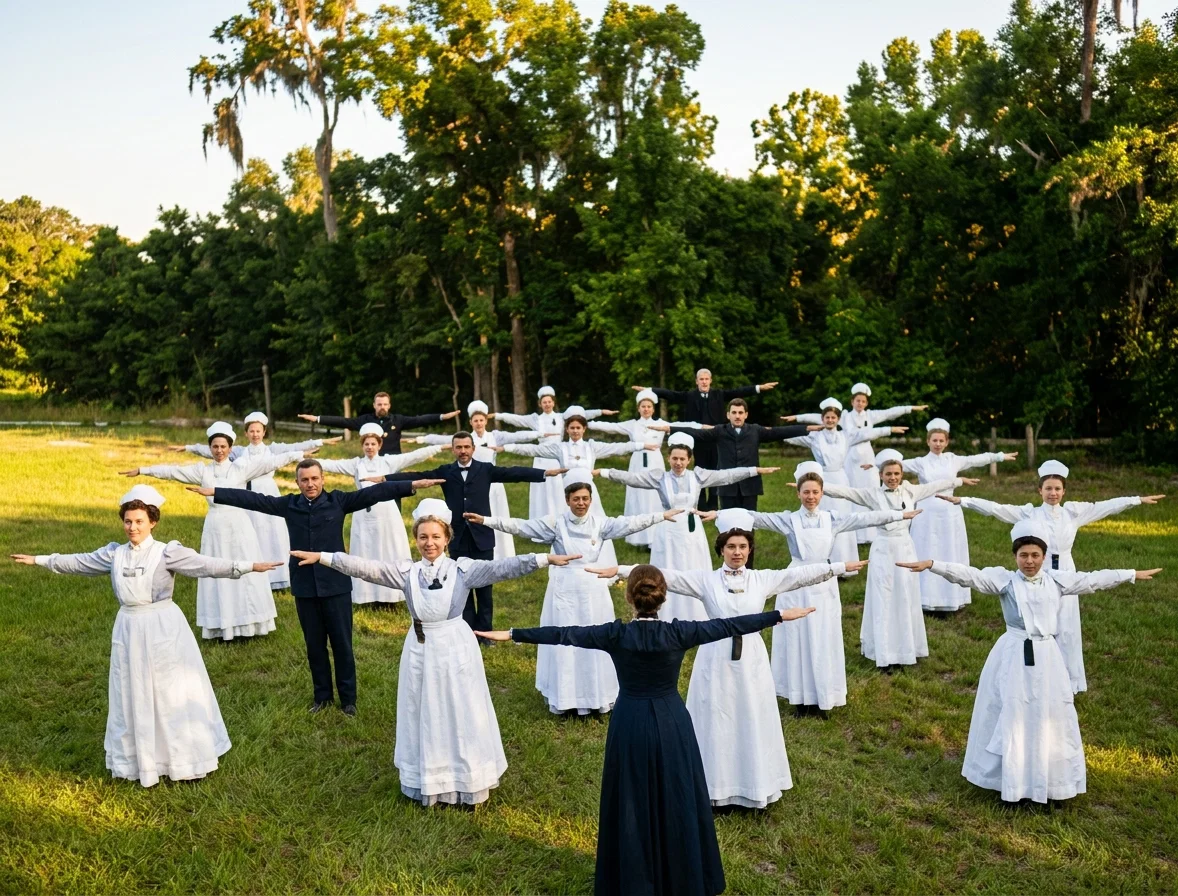
In order to have good blood, we must breathe well. Full, deep inspirations of pure air, which fill the lungs with oxygen, purify the blood. They impart to it a bright color, and send it, a life-giving current, to every part of the body. A good respiration soothes the nerves; it stimulates the appetite, and renders digestion more perfect: and it induces sound, refreshing sleep.
Sanitarium nurses taking breathing exercises
The lungs should be allowed the greatest freedom possible. Their capacity is developed by free action; it diminishes if they are cramped and compressed. Hence the ill effects of the practise so common, especially in sedentary pursuits,273of stooping at one’s work. In this position it is impossible to breathe deeply. Superficial breathing soon becomes a habit, and the lungs lose their power to expand. A similar effect is produced by tight lacing. Sufficient room is not given to the lower part of the chest; the abdominal muscles, which were designed to aid in breathing, do not have full play, and the lungs are restricted in their action.
Good ventilation and plenty of sunlight
Thus an insufficient supply of oxygen is received. The blood moves sluggishly. The waste, poisonous matter, which should be thrown off in the exhalations from the lungs, is retained, and the blood becomes impure. Not only the lungs, but the stomach, liver, and brain are affected. The skin becomes sallow, digestion is retarded; the heart is depressed; the brain is clouded; the thoughts are confused; gloom settles upon the spirits; the whole system becomes depressed and inactive, and peculiarly susceptible to disease.
Pure Air
The lungs are constantly throwing off impurities, and they need to be constantly supplied with fresh air. Impure air does not afford the necessary supply of oxygen, and the blood passes to the brain and other organs without being vitalized. Hence the necessity of thorough ventilation. To live in close, ill-ventilated rooms, where the air is dead and vitiated, weakens the entire system. It becomes peculiarly sensitive to the influence of cold, and a slight exposure induces disease. It is close confinement indoors that makes many women pale and feeble. They breathe the same air over and over, until it becomes laden with poisonous matter thrown off through the lungs and pores; and impurities are thus conveyed back to the blood.
Ventilation and Sunlight
In the construction of buildings, whether for public purposes or as dwellings, care should be taken to provide for good ventilation and plenty of sunlight. Churches and school-rooms are often faulty in this respect. Neglect of proper ventilation is responsible for much of the drowsiness and dullness that destroy the effect of many a sermon and make the teacher’s work toilsome and ineffective.
So far as possible, all buildings intended for human habitation should be placed on high, well-drained ground. This will insure a dry site, and prevent the danger of disease from dampness and miasma. This matter is often too lightly regarded. Continuous ill health, serious diseases, and many deaths result from the dampness and malaria of low-lying, ill-drained situations.
In the building of houses it is especially important to secure thorough ventilation and plenty of sunlight. Let there be a current of air and an abundance of light in every room in the house. Sleeping-rooms should be so arranged as to275have a free circulation of air day and night. No room is fit to be occupied as a sleeping-room unless it can be thrown open daily to the air and sunshine. In most countries bedrooms need to be supplied with conveniences for heating, that they may be thoroughly warmed and dried in cold or wet weather.
The guest-chamber should have equal care with the rooms intended for constant use. Like the other bedrooms, it should have air and sunshine, and should be provided with some means of heating, to dry out the dampness that always accumulates in a room not in constant use. Whoever sleeps in a sunless room, or occupies a bed that has not been thoroughly dried and aired, does so at the risk of health, and often of life.
In building, many make careful provision for their plants and flowers. The greenhouse or window devoted to their use is warm and sunny; for without warmth, air, and sunshine, plants would not live and flourish. If these conditions are necessary to the life of plants, how much more necessary are they for our own health and that of our families and guests!
If we would have our homes the abiding-place of health and happiness, we must place them above the miasma and fog of the lowlands, and give free entrance to heaven’s life-giving agencies. Dispense with heavy curtains, open the windows and the blinds, allow no vines, however beautiful, to shade the windows, and permit no trees to stand so near the house as to shut out the sunshine. The sunlight may fade the drapery and the carpets, and tarnish the picture-frames; but it will bring a healthy glow to the cheeks of the children.
Those who have the aged to provide for should remember that these especially need warm, comfortable rooms. Vigor declines as years advance, leaving less vitality with which to resist unhealthful influences; hence the greater necessity for the aged to have plenty of sunlight, and fresh, pure air.
Cleanliness
Scrupulous cleanliness is essential to both physical and mental health. Impurities are constantly thrown off from the body through the skin. Its millions of pores are quickly clogged unless kept clean by frequent bathing, and the impurities which should pass off through the skin become an additional burden to the other eliminating organs.
Most persons would receive benefit from a cool or tepid bath every day, morning or evening. Instead of increasing the liability to take cold, a bath, properly taken, fortifies against cold, because it improves the circulation; the blood is brought to the surface, and a more easy and regular flow is obtained. The mind and the body are alike invigorated. The muscles become more flexible, the intellect is made brighter. The bath is a soother of the nerves. Bathing helps the bowels, the stomach, and the liver, giving health and energy to each, and it promotes digestion.
It is important also that the clothing be kept clean. The garments worn absorb the waste matter that passes off through the pores; if they are not frequently changed and washed, the impurities will be reabsorbed.
Every form of uncleanliness tends to disease. Death-producing germs abound in dark, neglected corners, in decaying refuse, in dampness and mold and must. No waste vegetables or heaps of fallen leaves should be allowed to remain near the house, to decay and poison the air. Nothing unclean or decaying should be tolerated within the home. In towns or cities regarded perfectly healthful, many an epidemic of fever has been traced to decaying matter about the dwelling of some careless householder.
Perfect cleanliness, plenty of sunlight, careful attention to sanitation in every detail of the home life, are essential to freedom from disease and to the cheerfulness and vigor of the inmates of the home.
Hygiene among the Israelites
THERE IS HEALTH IN OBEDIENCE TO GOD’S LAW.
In the teaching that God gave to Israel, the preservation of health received careful attention. The people who had come from slavery with the uncleanly and unhealthful habits which it engenders, were subjected to the strictest training in the wilderness before entering Canaan. Health principles were taught, and sanitary laws enforced.
Prevention of Disease
Not only in their religious service, but in all the affairs of daily life was observed the distinction between clean and unclean. All who came in contact with contagious or contaminating diseases were isolated from the encampment, and they were not permitted to return without thorough cleansing of both the person and the clothing. In the case of one afflicted with a contaminating disease, the direction was given:
“Every bed whereon he lieth . . . is unclean; and everything whereon he sitteth shall be unclean. And whosoever toucheth his bed shall wash his clothes, and bathe himself in water, and be unclean until the evening. And he that sitteth on anything whereon he sat . . . shall wash his clothes, and bathe himself in water, and be unclean until the evening.278And he that toucheth the flesh of him . . . shall wash his clothes, and bathe himself in water, and be unclean until the evening. . . . And whosoever toucheth anything that was under him shall be unclean until the evening; and he that beareth any of those things shall wash his clothes, and bathe himself in water, and be unclean until the evening. And whomsoever he toucheth . . . and hath not rinsed his hands in water, he shall wash his clothes, and bathe himself in water, and be unclean until the evening. And the vessel of earth that he toucheth . . . shall be broken; and every vessel of wood shall be rinsed in water.”
The law concerning leprosy is also an illustration of the thoroughness with which these regulations were to be enforced:
“All the days wherein the plague shall be in him [the leper] he shall be defiled; he is unclean; he shall dwell alone; without the camp shall his habitation be. The garment also that the plague of leprosy is in, whether it be a woolen garment or a linen garment, whether it be in the warp or woof; of linen or of woolen; whether in a skin or in anything made of skin; . . . the priest shall look upon the plague. . . . If the plague be spread in the garment, either in the warp or in the woof or in a skin, or in any work that is made of skin; the plague is a fretting leprosy; it is unclean. He shall therefore burn that garment, whether warp or woof, in woolen or in linen, or anything of skin, wherein the plague is; for it is a fretting leprosy; it shall be burnt in the fire.”
So, too, if a house gave evidence of conditions that rendered it unsafe for habitation, it was destroyed. The priest was to “break down the house, the stones of it, and the timber thereof, and all the mortar of the house; and he shall carry them forth out of the city into an unclean place. Moreover he that goeth into the house all the while that it is shut up shall be unclean until the evening. And he that279lieth in the house shall wash his clothes; and he that eateth in the house shall wash his clothes.”
Cleanliness
The necessity of personal cleanliness was taught in the most impressive manner. Before gathering at Mount Sinai to listen to the proclamation of the law by the voice of God, the people were required to wash both their persons and their clothing. This direction was enforced on pain of death. No impurity was to be tolerated in the presence of God.
Ye shall be holy unto me; for I the Lord am holy and have severed you from other people that ye should be mine.
During the sojourn in the wilderness, the Israelites were almost continually in the open air, where impurities would have a less harmful effect than upon the dwellers in close houses. But the strictest regard to cleanliness was required both within and without their tents. No refuse was allowed to remain within or about the encampment. The Lord said:
“The Lord thy God walketh in the midst of thy camp, to deliver thee, and to give up thine enemies before thee; therefore shall thy camp be holy.”
Diet
The distinction between clean and unclean was made in all matters of diet:
“I am the Lord your God, which have separated you from other people. Ye shall therefore put difference between clean beasts and unclean, and between unclean fowls and clean; and ye shall not make your souls abominable by beast or by fowl, or by any manner of living thing, . . . which I have separated from you as unclean.”
Many articles of food eaten freely by the heathen about them were forbidden to the Israelites. It was no arbitrary distinction that was made. The things prohibited were unwholesome. And the fact that they were pronounced unclean taught the lesson that the use of injurious foods is defiling. That which corrupts the body tends to corrupt the soul. It unfits the user for communion with God, unfits him for high and holy service.
Advantages and Regulations
In the promised land, the discipline begun in the wilderness was continued under circumstances favorable to the formation of right habits. The people were not crowded together in cities, but each family had its own landed possession, insuring to all the health-giving blessings of a natural, unperverted life.
Concerning the cruel, licentious practises of the Canaanites, who were dispossessed by Israel, the Lord said:
“Ye shall not walk in the manners of the nation which I cast out before you; for they committed all these things; and therefore I abhorred them.” “Neither shalt thou bring an abomination into thine house, lest thou be a cursed thing like it.”
In all the affairs of their daily life, the Israelites were taught the lesson set forth by the Holy Spirit:
“Know ye not that ye are the temple of God, and that the Spirit of God dwelleth in you? If any man defile the temple of God, him shall God destroy; for the temple of God is holy, which temple ye are.”