It is axiomatic that Panama has long needed a canal. Navigation has suffered untold loss for the lack of a waterway across the isthmus. But what a loss have its aboriginal and Latin people suffered for the lack of the Word of God! Who today bemoans the delinquencies of the church, and who is willing to sacrifice to retrieve the loss? At tremendous cost in life and property, men have cut through the mountains to bring to accomplishment the mighty furrow from ocean to ocean. But who has been stirred to sacrifice to offer the Maya Indian and these Latins the message of salvation? The world has remembered its own, but to the Christian church, Panama is still as she was—sadly neglected.
B. E. CONNERLY.
Ancon, C. Z.
Karmatar Mission Home, west Bengal.
“Out of the Depths Have I Cried”
By Vera Chilton
SHE is a dear little woman, this pupil of mine, with two bright baby boys, whom she loves dearly. She is learning to love the Saviour, and now finds comfort in praying to him. Yes, she is a Mohammedan, but she has got to that place where her old scruples are laid aside and she prays to a divine Saviour. She knows there is a time before her which may mean separation from those she loves perhaps more than life itself, and her whole being shrinks. I had just read to her the precious promise of Jesus that he who leaves brethren, sisters, father, mother, children, for his name’s sake, shall receive a hundredfold, and shall inherit everlasting life. As the picture of the day’s lesson was opened with tender reverence, she stroked the garments of the Saviour in the picture, and as her lips moved almost silently I heard the earnest, fervent prayer breathed forth, “Do thou make me firm and strong. O, do thou give strength to this heart!”
Ah, yes! she needs strength for that which is before her; yet we believe that even from the depths of Mohammedan darkness, out of which she cries, she will be enabled to “do all things through Christ which strengtheneth.”
VERA CHILTON.
An Effective Agency
By J. L. Shaw
MISSIONARY NURSES ON TOUR AMONG THE SANTALI VILLAGES, WEST BENGAL, INDIA
PERHAPS no other single agency of mission work appeals more strongly to the Indian mind than the mission school. It furnishes one of the happiest combinations of influences for doing good to soul and mind that can be devised by the missionary. The very character of heathenism makes Christian schools a necessity. The philosophy and ethics of Hinduism have a strong hold upon the people. Its castes and superstitions are wrought into the very framework of society. The intellect and heart of every man, woman, and child have been thoroughly steeped in principles and practises that are utterly opposed to the gospel of Christ. For these reasons, more can be accomplished in Christian lands in a single sermon than by several months of effort in a Hindu congregation. Heathen errors must be corrected and right thinking encouraged. For this reason, mission schools offer the means of accomplishing this end. They form a regular congregation and give the missionary the surest means of overthrowing heathen sophistries, cultivating right principles, and erecting Bible standards. It is through schools that people are being brought to see the foolishness of the caste system. Here Hindu, Jewish, and Mohammedan children meet on common ground.
J. L. SHAW.
Lucknow, India.
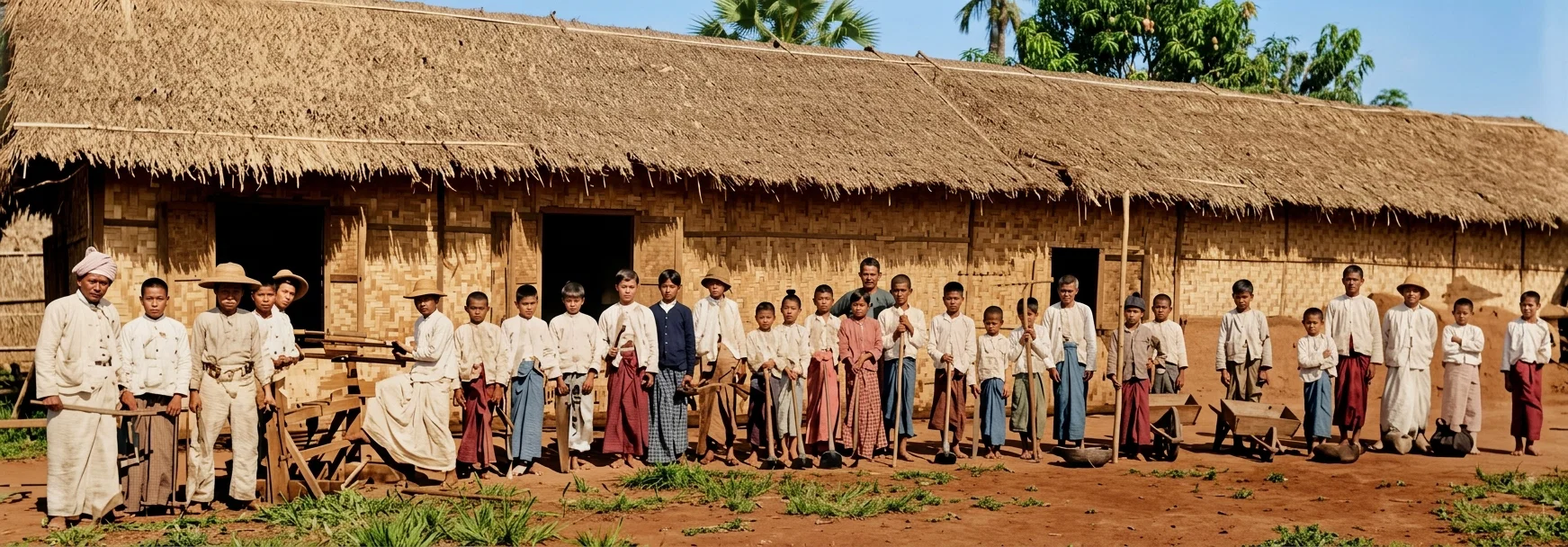
WORKSHOPS OF THE MEIKTILA INDUSTRIAL SCHOOL, BURMA—CLASSES READY FOR WORK
Karmatar mission workers.
Burmese Students at Work
By R. B. Thurber
HERE in the East industry suggests work, work a coolie, and a coolie disgrace. Our great problem is how to show the people that industry and work are not synonymous with toil and drudgery, to show that the hand connected with the brain will do greater wonders than will either working alone, that labor is a great uplift toward a better life.
At the Meiktila school we are attempting the wood-, cane-, and leather-working trades. Each department now just about pays for cost of materials and wages of the teacher and boys. We believe that with more room and better facilities and help we can make the trades fully self-supporting. With the cheap labor all about us, we must make something different; so we are specializing on mission furniture, shoes made on American lasts, and cane furniture after the Chinese patterns.
Most of our students are Burmese, but there are also Karens, Chinese, and natives of India. Three boys have been baptized, and many appear to be favorably inclined toward the gospel message.
R. B. THURBER.
Meiktila, Burma.
A Moslem Woman’s Need
By M. Belle Shryock
A FEW weeks ago, after we began work at our dispensary in Najibabad, north India, some people came from a village eight miles away, bringing a woman in a very critical condition. They had heard of our work, but did not know just here our bungalow is, so went to the government dispensary to inquire for us. Her brother, who was with her, insisted that she remain there and let the doctor care for her. But she replied, “No, I shall go home and die if I cannot find the European women.”
Our Santali boarding-school, west Bengal. Converts from devil-worship are teachers in this school.
She was taken to the Mohammedan inn for a rest before going home. While there her brother mentioned to the man in charge that they had been trying to find us. He said, “I know where they live, and will call them for you.” So he came for us. She was in a critical condition, and could not have lived long without help. We worked hard over her for three hours, and left her much better. She needed careful nursing; and as we had no place to keep her, she had to remain at the inn, and we went twice a day to give her treatment. After two weeks she was able to return to her village. She cried and begged us to take her home with us. She said, “I want to come and stay with you and learn from you.” We have made many visits to her village, and are always given a hearty welcome. M. BELLE SHRYOCK.
A CROWD OF WORSHIPPERS AT A HINDU FESTIVAL, DEHRA DUN, NORTH INDIA
The Hindu’s Gift
By W. R. French
A BENGAL Hindu, who is feeling after the Christian’s God, had been attacked by fellow Hindus, with some loss of his goods, for having deeded to the mission a plat of land—the finest in the village—for a Christian church.
“Are you sorry now that you gave the land to the mission?” I asked, seated with him on the mat covering the dirt floor of his little cottage.
“Sorry?—Never!” he replied. “Why should I be sorry? I have done nothing wrong, and why should I be sorry when I have only made an offering to my God?”
This man’s gift represents a twentieth of his entire wealth, and I am sure his heart goes with the gift. Many of the Hindu people in this village are favorable to the truth, and they have erected a school building where we teach about one hundred of their boys.
W. R. FRENCH.
Calcutta.
A GROUP OF EIGHTEEN BAPTIZED AT ONE TIME,
TINNEVELLI, SOUTH INDIA
What a Heathen Said
By Edward D. Thomas
Every night I had been holding lectures on Bible truth in our mission schoolhouse, heathen as well as Christians attending. Our gardener — a worshiper of idols from childhood — had been coming.
“Friend,” I said to him one evening, “what do you think of all you have heard?”
“Sir,” he said, “I have never heard this kind of gospel before. How foolish I have been all these days to worship dumb idols! And I am ashamed to think of the foolish ideas I have had of the dead. I have spent time and money to satisfy the dead and to keep them from doing us injury. Sir, I wish that you would teach me more of this good Saviour and his gospel.”
The poor man’s voice rang with a longing to find this Saviour as his own.
“Sir,” he again appealed, “my little girl should study this way of salvation.”
Now he is sending her to our school. There are multitudes in India waiting for the light.
EDWARD D. THOMAS.
Nazareth, Tinnevelli.
Chinese Republic Buys Bibles
THE new Chinese Republic is a Bible buyer. The American Bible Society has issued for the first six months of the current year nearly 60,000 more Bibles for China than during the corresponding period last year, and in addition, its agent, Dr. John R. Hykes, of Shanghai, has sent word to New York that he has orders for 200,000 copies. This number is greater, he reports, than the society is able to supply.
GENERAL ARTICLES
By C. M. S.
Commissioned of Our God
THIS wicked world rolls toward its judgment-day,
And God has given to his chosen band
A work to do, a message to proclaim,
A faithful warning of impending doom.
To every soul who owns the claims of Christ
And hopes through him eternal life to gain,
The call has come to sound the warning forth,
That men may hear, and heed, and choose, and live;
And, with the smitten Christ who died for us,
Eternal pleasure know at his right hand.
And hast thou heard, and hast not heeded yet?
Then turn, in Heaven’s name, and take the hand,
Nail-pierced for you, that stretches out in love
To give you gifts more precious than the wealth
Of all earth’s millions blended into one.
O grasp that hand, and know the blessed joy
Of sins forgiven, and the comfort of
His all-abounding grace that heals the wounds
Of sin, and every sadness mollifies.
Thy Saviour waits, and shall he wait in vain?
And you who know him, what a work awaits!
The conflicts of an age are focused here,
And Satan’s cohorts press on every hand.
A cloud of doubt rolls ’round this smitten world
To blind and stupefy a fallen race.
A thousand noxious dogmas issue forth,
And seeds of death are sown with lavish hand.
The Christ we love is smitten in the house
Of those who call themselves his chosen friends;
And they who smite him hurl a poisoned shaft
At those for whom he gave his precious blood.
The day draws on when he will come again
To reckon with a recreant world, and give
A just reward to all who honor him.
He calls on all, the youth, the middle-aged,
And those whose heads have whitened with the snows
Of many years; he calls them, one and all,
Who own his kinship and his love supreme,
Not to a life with pleasure stupefied
And filled with ease and comfort, but a life
Of service and of hardship oft,—a life
Free-given to a righteous cause in which
He laid aside the glories of the blest
And suffered ’neath the curse that sin had brought.
In that hard strife he gave his all, and you
Are called to follow in the path he trod.
God calls you all; his standard is upreared;
The muster-roll is free to youth and age.
Let none refuse, and none rejected be,
Who seek to give the message God has given.
Speak courage to the faltering, speed the foot
That runs the errands of our glorious King.
Let glad cooperation be our theme,
While valiantly we press the battle on
Till that glad day when we shall see his face
And know the wonders of redeeming grace.
C. M. S.
Go, Teach All Nations
By Ellen G. White
Standing but a step from his heavenly throne, Christ gave the commission to his disciples. “All power is given unto me in heaven and in earth,” he said. “Go ye therefore, and teach all nations.” “Go ye into all the world, and preach the gospel to every creature.” Again and again the words were repeated that the disciples might grasp their significance. Upon all the inhabitants of the earth, high and low, rich and poor, was the light of heaven to shine in clear, strong rays. The disciples were to be co-laborers with their Redeemer in the work of saving the world.
The commission had been given to the twelve when Christ met with them in the upper chamber; but it is now to be given to a larger number. At the meeting on a mountain in Galilee, all the believers who could be called together were assembled.
Christ’s words on the mountainside were the announcement that his sacrifice in behalf of man was full and complete. The conditions of the atonement had been fulfilled; the work for which he came to this world had been accomplished. He was on his way to the throne of God, to be honored by angels, principalities, and powers. He had entered upon his mediatorial work. Clothed with boundless authority, he gave his commission to the disciples: “Go ye therefore, and teach all nations, baptizing them in the name of the Father, and of the Son, and of the Holy Ghost; teaching them to observe all things whatsoever I have commanded you: and, lo, I am with you alway, even unto the end of the world.”
Christ commissioned his disciples to do the work he had left in their hands, beginning at Jerusalem. Jerusalem had been the scene of his amazing condescension for the human race. There he had suffered, been rejected and condemned. The land of Judea was his birthplace. There, clad in the garb of humanity, he had walked with men, and few had discerned how near heaven came to the earth when Jesus was among them. At Jerusalem the work of the disciples must begin.
But the work was not to stop here. It was to be extended to the earth’s remotest bounds. To his disciples Christ said: You have been witnesses of my life of self-sacrifice in behalf of the world. You have witnessed my labors for Israel. Although they would not come unto me that they might have life, although priests and rulers have done unto me as they listed, although they have rejected me as the Scripture foretold, they shall have still another opportunity of accepting the Son of God. You have seen that all who come to me confessing their sins, I freely receive. He that cometh to me I will in no wise cast out. All who will, may be reconciled to God, and receive everlasting life. To you, my disciples, I commit this message of mercy. It is to be given to Israel first, and then to all nations, tongues, and peoples. It is to be given to Jews and Gentiles. All who believe are to be gathered into one church.
Through the gift of the Holy Spirit the disciples were to receive a marvelous power. Their testimony was to be confirmed by signs and wonders. Miracles would be wrought, not only by the apostles, but by those who received their message. Jesus said, “In my name shall they cast out devils; they shall speak with new tongues; they shall take up serpents; and if they drink any deadly thing, it shall not hurt them; they shall lay hands on the sick, and they shall recover.”
The disciples were to begin their work where they were. The hardest and most unpromising field was not to be passed by. So every one of Christ’s workers is to begin where he is. In our own families may be souls hungry for sympathy, starving for the bread of life. There may be children to be trained for Christ. There are heathen at our very doors. Let us do faithfully the work that is nearest. Then let our efforts be extended as far as God’s hand may lead the way. The work of many may appear to be restricted by circumstances; but wherever it is, if performed with faith and diligence it will be felt to the uttermost parts of the earth. Christ’s work when upon earth appeared to be confined to a narrow field, but multitudes from all lands heard his message. God often uses the simplest means to accomplish the greatest results. It is his plan that every part of his work shall depend on every other part, as a wheel within a wheel, all acting in harmony. The humblest worker, moved by the Holy Spirit, will touch invisible chords, whose vibrations will ring to the ends of the earth, and make melody through eternal ages.
But the command, “Go ye into all the world,” is not to be lost sight of. We are called upon to lift our eyes to the “regions beyond.” Christ tears away the wall of partition, the dividing prejudice of nationality, and teaches love for all the human family. He lifts men from the narrow circle which their selfishness prescribes; he abolishes all territorial lines and artificial distinctions of society. He makes no difference between neighbors and strangers, friends and enemies. He teaches us to look upon every needy soul as our brother, and the world as our field.
In the commission to his disciples, Christ not only outlined their work, but gave them their message. Teach the people, he said, “to observe all things whatsoever I have commanded you.” The disciples were to teach what Christ had taught. That which he had spoken, not only in person, but through all the prophets and teachers of the Old Testament, is here included. Human teaching is shut out. There is no place for tradition, for man’s theories and conclusions, or for church legislation. No laws ordained by ecclesiastical authority are included in the commission. None of these are Christ’s servants to teach. “The law and the prophets,” with the record of his own words and deeds, are the treasure committed to the disciples to be given to the world. Christ’s21name is their watchword, their badge of distinction, their bond of union, the authority for their course of action, and the source of their success. Nothing that does not bear his superscription is to be recognized in his kingdom.
The first disciples went forth preaching the word. They revealed Christ in their lives; and the Lord worked with them, “confirming the word with signs following.” These disciples prepared themselves for their work. Before the day of Pentecost they met together, and put away all differences. They were of one accord. They believed Christ’s promise that the blessing would be given, and they prayed in faith. They did not ask for a blessing for themselves merely; they were weighted with the burden for the salvation of souls. The gospel was to be carried to the uttermost parts of the earth, and they claimed the endowment of power that Christ had promised. Then it was that the Holy Spirit was poured out, and thousands were converted in a day.
The Saviour longs to manifest his grace and stamp his character on the whole world. It is his purchased possession, and he desires to make men free, and pure, and holy. Though Satan works to hinder this purpose, yet through the blood shed for the world there are triumphs to be achieved that will bring glory to God and the Lamb. Christ will not be satisfied till the victory is complete, and “he shall see of the travail of his soul, and shall be satisfied.”
Mrs. E. G. WHITE.
The Message for Today
The Christian church has passed through many crises in its history. Through the ages it has stood as the conservator of the truth of God and the one through whom his messages have been proclaimed to the world. Great movements have engaged her attention. Some of these movements have been specific in their character. To the antediluvians, Noah, the representative of God, preached the message of the coming flood, and under Heaven’s direction provided a means of deliverance to all who would accept the proffered salvation. Jonah was sent to warn Nineveh of its impending doom. Through heeding the message which he bore, the inhabitants were saved and the threatened destruction long delayed. When Christ was about to appear among men, chosen messengers from God, the holy angels, John the Baptist, Simeon, Anna, and others proclaimed the glad news of the coming Saviour.
In the order of God other great religious awakenings occurred. The Lord raised up Luther, Melanchthon, Zwingli, and others for the accomplishment of a great work in the Reformation of the sixteenth century. Later a great quickening impulse was given to the cause of Christianity through the Spirit-filled preaching of John and Charles Wesley, George Whitefield, and others.
These movements and messages came for the most part in response to the voice of prophecy. John the Baptist was “the voice of one crying in the wilderness,” long before predicted by Isaiah the prophet. Luther and his colaborers clearly did a work outlined on the prophetic page.
We have reached a period in the history of the church and of the world when, according to the prophecies of the Scripture, the time has come for another great religious awakening. Another message is due the church and the world,—the message of the second coming of the Lord and Saviour to this earth.
This earth’s history is soon to close. Fulfilling prophecy and signs—conditions existing in the social, political, industrial, and religious worlds—plainly indicate that a time has been reached when events of a significant, startling, and most stupendous character are about to take place; that the long reign of sin is soon to be cut short; and that the generation now living will witness the appearing of Christ in the clouds of heaven. The message based upon these fulfilling prophecies and signs is now being proclaimed. To the advocacy of this message the people represented by this movement have devoted their lives and their fortunes.
For the benefit of those who may desire to know more particularly the cardinal features of the faith held by this denomination, we shall state that Seventh-day Adventists believe,—
1. In the divine Trinity. This Trinity consists of the eternal Father, a personal, spiritual being, omnipotent, omniscient, infinite in power, wisdom, and love; of the Lord Jesus Christ, the Son of the eternal Father, through whom all things were created, and through whom the salvation of the redeemed hosts will be accomplished; the Holy Spirit, the third person of the Godhead, the one regenerating agency in the work of redemption.
2. That the Holy Scriptures of the Old and New Testaments were given by the inspiration of God, and contain a full revelation of his will to men, and are the only infallible rule of faith and practise.
3. That Jesus Christ, while retaining his divine nature, took upon himself the nature of the human family, lived on this earth as a man, gave his life for the salvation of the race; and that forgiveness and remission of sins, the attainment of spiritual perfection, and the securing of eternal life at last, can be obtained only by faith in his atoning blood and through the redeeming grace which he supplies.
4. That, in fulfilment of the Old Testament types, Jesus, the Son of God, is now “a minister of the sanctuary, and of the true tabernacle, which the Lord pitched, and not man.” That, as our great High Priest in this heavenly sanctuary, he presents his own sacrifice before the Father in behalf of sinful men, and to those who will accept it he ministers the needed grace with which they carry on their warfare against sin. Thus he serves as the one Mediator between God and man, rendering both unnecessary and impossible any other system of mediation.
5. That the proper form of baptism is by immersion, and that this ordinance of the Christian church should follow repentance and forgiveness of sins, and that through its celebration faith is shown in the death, burial, and resurrection of Christ.
6. That every soul in order to obtain salvation must experience the new birth. That this comprises an entire transformation of the life and character through the recreative agency of the Holy Spirit.
7. That the will of God for his children is comprehended in the law of the ten commandments, and that these are great moral, unchangeable precepts binding upon the children of God in every age of the church.
8. That through the new covenant relationship the Spirit of Christ writes this law upon the heart, and in this way only can its precepts find expression in the life in sincere, faithful obedience.
9. That the fourth commandment of this unchangeable law requires the observance of the seventh-day Sabbath, an institution which was established and ordained in the garden of Eden before man sinned, embosomed in the great law of moral precepts spoken from Mt. Sinai, observed by prophet and priest throughout the old dispensation, kept by Christ and his apostles in the Christian dispensation, and given to mankind in every age to keep alive in their hearts the knowledge of its Author, the Creator of all things.
10. That Christian temperance embraces the proper use of that which is good, and total abstinence from all that is bad. That the liquor traffic, being only evil, should be prohibited by appropriate legislation.
11. That the church and the state occupy different spheres of operation, the former dealing with questions of a religious character, the sphere of the latter pertaining alone to questions of a civil character. The church and the state should therefore be kept forever separate.
12. That the Scriptural means for the support of Christian evangelical work in the earth is by the payment of one tenth of the regular income, and by free-will offerings from the thankful, grateful children of God.
13. That man possesses a nature inherently sinful and dying; that eternal life and immortality come only through the gospel, and are bestowed as the free gift of God by Jesus Christ in the day of final awards.
14. That the time has been reached when the work of the gospel will soon be consummated; when Christ, who now officiates as our great High Priest in the heavens above, will close his ministry and come to this earth to take his children home. That at that time the righteous dead will be raised to meet their Lord, and, together with the righteous living, be changed to glorious immortality.
15. That in the fires of the last day, this earth will be regenerated and cleansed from the effects of the curse; and that in the final conflagration, Satan and all the impenitent will be destroyed. The creation of God will be restored to its pristine beauty and purity, and will forever constitute the abode of the saints of the Lord.
The glad news of the coming kingdom is now going to the world. By tongue and pen, by gospel herald and by printed page, in more than ninety of earth’s languages and dialects, the message of the Saviour’s soon coming is being carried to the nations of men. The Scriptures of Truth do not reveal the hour nor day nor year when Christ will return, but conditions on every hand proclaim his coming near. He bids us watch and be ready. He bids us give to those in darkness a knowledge of his saving grace. May we prove true to our high calling of God in Christ Jesus