I CALL aloud her name: she answers not; Her chair stands lone beside the shadowy hearth; An awful silence smites my trembling heart With fear; an emptiness, that drives me mad. She must be here, her fragrance lingers round; But when I seek her room, she is not there.
Gone? my mother gone, no more to come? My life's companion and my childhood's friend, The only one who knew and understood My inmost hopes and fears, my joys and woes; The one, of all, whose love remained the same Through fickle youth and tried maturity, Whose patience with my weakness was great As was her pure unselfishness and love,— My mother gone?
O mother, mother, how I miss you, dear! I bow my weary head upon your chair, And floods of unavailing tears flow down. There are so many things I wish to tell You,— things that you would love to know. I long to ask your counsel in a matter That your experience alone could give. I want to kneel and pray with you once more, And feel your hand, in blessing, on my head; And, here, I brought your little favorite flower— And you are gone!
O God, my mother's God, I turn to thee! To whom else shall I, can I go, this hour? Thou hast the words of everlasting life. “As one his mother comforteth, so will I comfort you.” Thy promise, Lord, I claim.
Uphold me in thine everlasting arms; Pillow my weary head upon thy breast; And fill this “aching void” within my heart With pure, unselfish love, from out the fount Whence mother's love was drawn. And if thou deem Me worthy, Lord, cast round me, as I kneel, My mother's beauteous mantle. Give me grace To carry on the work that she began. Thou prayer-hearing, prayer-answering God, I praise, and laud, and magnify thy name For this great peace and comfort thou hast given.
O, teach me how to comfort troubled hearts With this same comfort thou hast given me. — Helen Adair, in Signs of the Times.
The Time to Be Pleasant
“MOTHER’S cross!” said Maggie, coming out into the kitchen with a pout on her lips.
Her aunt was busy ironing, but she looked up and answered Maggie: “Then it is the very time for you to be pleasant and helpful. Mother was awake a good deal in the night with the poor baby.”
Maggie made no reply. She put on her hat and walked off into the garden; but a new idea went with her.
“The very time to be helpful and pleasant is when other people are cross. Sure enough,” thought she, “that would be the time when it would do the most good. I remember when I was sick last year, I was so nervous that if any one spoke to me I could hardly help being cross; and mother never got angry or out of patience, but was just so gentle with me. I ought to pay it back now, and I will.”
And she sprang up from the grass where she had thrown herself, and turned a face full of cheerful resolution toward the room where her mother sat tending a fretful, teething baby. Maggie brought out the pretty ivory balls, and began to jingle them for the little one. He stopped fretting, and a smile dimpled the corners of his lips.
“Couldn’t I take him out to ride in his carriage, mother?” she asked. “It’s such a nice morning.”
“I should be glad if you would,” said her mother.
The little hat and sack were brought, and the baby was soon ready for his ride.
“I’ll keep him as long as he is good,” said Maggie, “and you must lie on the sofa and get a nap while I am gone. You are looking dreadfully tired.”
What a happy heart beat in Maggie’s bosom as she trundled the little carriage up and down on the walk! She had done real good. She had given back a little of the help and forbearance that had so often been bestowed upon her. She had made her mother happier, and given her time to rest. She resolved to remember and act on her aunt’s good word. The very time to be helpful and pleasant is when everybody is tired and cross.—Selected.
Some Interesting Figures
THE United States is the largest beer-drinking nation of the world, consuming annually 500,000,000 gallons more than England, 100,000,000 gallons more than Germany, and 1,000,000,000 gallons more than any one of the countries of France, Austria, Belgium, Russia, Norway, Sweden, Denmark, Switzerland, Italy, Australia, and Canada. Our annual consumption of wines is but a little over 60,000,000 gallons, while that of France is 1,500,000,000; that of Italy is 1,120,000,000, over eighteen times as much as ours. In the use of distilled liquors Russia leads the world with 232,000,000 gallons, the United States coming second, consuming a little more than half that quantity, and Germany, France, and Belgium following with 95,000,000, 70,000,000, and 54,000,000 gallons, respectively. It has been reckoned that the various kinds of liquor used in this country would fill enough cars to make a train that would stretch from New York to San Francisco. The nation's drink bill is almost half as much again as the total of the necessaries of life. The people of this country spend annually for bread $154,154,000, for meat and milk products, $150,500,000, for wearing apparel $281,000,000, for building material $232,500,000, for publishing $69,000,000, and for other necessaries a little more than $100,000,000, making $1,000,000,000, and the drink bill for one year is far more than that.— The Christian Herald Almanac for 1913.
“Scrouged Up Close”
THE comfort that often comes from contact, even wordless, with one's own human kind, is touchingly illustrated in a little story told by a Western publisher:—
The boy in the car sat cuddled so close to the woman in gray that everybody thought he belonged to her. So when he unconsciously dug his muddy shoes into the broadcloth skirt of his left-hand neighbor, she leaned over, and said: “Pardon me, madam; will you kindly make your little boy square himself around? He is soiling my skirt with his muddy shoes.”
The woman in gray blushed a little, and nudged the boy away.
“My boy?” she said. “He isn't mine!”
The boy squirmed uneasily. He was such a little fellow that he could not begin to touch his feet to the floor, so he stuck them out straight in front of him like pegs to hang things on, and looked at them deprecatingly.
“I'm sorry I got your dress dirty,” he said to the woman on his left; “I hope it will brush off.”
The timidity in his voice took a short cut to the woman's heart, and she smiled upon him kindly.
“O, it doesn't matter!” she said. Then as his eyes were still fastened on her, she added, “Going up-town alone?”
“Yes, ma'am,” he said. “I always go alone; there isn't anybody to go with me. Father's dead, and mother's dead. I live with Aunt Clara over in Belmar. But she says Aunt Anna ought to help do something for me, so once or twice a week, when she gets tired out and wants to go some place to get rested up, she packs me off over here to stay with Aunt Anna. I'm going up there now. Sometimes I don't find Aunt Anna at home, but I hope she will be at home today, because it looks like it is going to rain, and I don't like to hang around in the streets in the rain.”
The woman felt something move inside her throat. “You are a very little boy,” she said rather unsteadily, “to be knocked about in this way.”
“O, I don't mind!” he replied. “I never get lost. But I get lonesome sometimes on these long trips, and when I see anybody I think I'd like to belong to, I scrouge up close to her, so I can make believe that I really am her little boy. This morning I was playing that I belonged to that lady on the other side of me, when I got so int'rested that I forgot all about my feet. That is why I got your dress dirty.”
The woman put her arms around the tiny lad, and “scrouged” him up so close that she hurt him, and every other woman who had overheard his artless confidence looked as if she would let him wipe his shoes on her best dress.—The Continent.
Love Never Fails
“LOVE suffereth long, and is kind.”
“Love never faileth.”
The Lesson That Constance Learned
By Susan Hubbard Martin
CONSTANCE saw her sitting at a table immediately adjoining theirs. They had gone into Baxter’s for a cup of hot chocolate—she and Marion.
“Do look at that dowdy little woman in that funny bonnet,” she said in a low voice to Marion. “She looks old-fashioned enough to be one’s great-grandmother.”
“Hush!” replied Marion, warningly. “She will hear you, Constance. I believe she has.”
The plain little woman so near them raised her eyes, then dropped them; she had heard.
With a shrug of her shoulders, Constance turned to Marion. “What if she did hear? People have no business to go about looking so out of date. Of course she would hear remarks.”
And then Constance plunged into a full tide of small talk, all about Betty’s new diamond ring her father had just given her, Maude’s coat which had come from New York, and the astonishing fact that Julia Roger’s clothes were all given to her by a rich aunt who lived abroad.
They finished their chocolate and went out, and no one saw the wistful look the little woman in the plain bonnet gave them. They could not have understood it had they seen it, these two young girls just blossoming into womanhood. To them life with its stern realities and hard lessons was as yet only a lovely place peopled with delightful things. The real work of the world had as yet never been reckoned by them.
Marion was over at Constance’s that evening. It was just after dinner, and the two girls were preparing for a whole delightful evening together. All at once the telephone rang. When Constance returned from answering it, her face wore an annoyed look.
“It was only Aunt Penelope,” she said. “She wants you and me to go with her to church tonight, to hear a Miss Foote, from China. I don’t care to hear ‘Miss Foote, from China,’ do you?”
“No,” replied Marion slowly, “though I know we should be interested in what our missionaries are doing; and your Aunt Penelope is always so nice to us, we ought to go, if only to please her.”
“I suppose we’ll have to,” assented Constance unwillingly. “She’ll stop for us.”
The church was filling rapidly when they reached it, and Aunt Penelope ushered them into a seat where she could hear well.
There were gay little flags all about, palms graced the platform, and in full view was a tall vase full of lovely carnations.
An immense card bearing the words, “I have opened the door. I leave it to you that no one closes it after me,” and signed “Livingstone,” faced the audience.
“I didn’t know they went to all this trouble just for a missionary, did you?” whispered Constance.
Marion smiled. “I’ve heard that Miss Foote is a wonderful speaker,” she answered. “And everybody isn’t like us, Constance; some people are not only interested, but work for them with all their might.”
And then, after the singing of the hymn, some one came to the platform and introduced the speaker for the evening—“Miss Catherine Foote, lately from China.”
There was a hand-clapping. Constance and Marion stared. Then a slow flush rose to Constance’s cheek, for it was no other than the same little woman who had sat so near them at Baxter’s, and whom she had termed in no uncertain language both “dowdy” and “old-fashioned.” And she had heard what she had said!
The girls settled back into their seats after one look at each other, and then from the lips of that little, plain woman Constance had so rudely criticized there issued such a flood of eloquence that even the two thoughtless girls were electrified by it.
She told of China as it was with its little mud huts, its degradation, and its misery. She told of the lack of good American dollars that the people at home had but would not give. Of the sacrifices and self-denials she had made she did not speak. But Constance, looking at her with awakened eyes, knew why she chose to wear plain clothes. And she had called her “dowdy,” this noble woman with the pure eyes and the compelling voice! O, the power that lay in that slight frame, the wonderful, God-given power that could sweep an audience off its feet, moving them both to laughter and to tears! In her humility, Constance felt as if never, never would she criticize any one again; she would not dare to do it. She did not say another word, but when that address was over, she turned to Aunt Penelope. “I’d like to speak to her for just a moment; may I?” she whispered, and Aunt Penelope nodded, well pleased.
There happened to be no one standing very near her when Constance arrived at the platform, and she went straight to her. The little missionary looked at the tall, graceful girl with the flushed cheeks.
“I came to beg your pardon,” said Constance humbly.
The little missionary remembered. “For what you said about me in Baxter’s? You need not. I never was an adept in the art of dressing. Do you know, all the time I sat there I was looking at you, and thinking what a lovely thing youth is—so full of possibilities. My dear child, all things are yours.”
Constance looked at her. “You mean, all things are yours,” she cried. “O, tell me you forgive me for daring to speak so lightly of you!”
“My child, yes; you are forgiven already. Doubtless I am dowdy, but I have been busy with so many things it had not occurred to me. And do you know that I am one of the few in this big world that all the fine feathers one could deck them with could not make beautiful? I’m just modest ‘Jenny Wren,’ a plain little woman, my dear, with no beauty of features whatever. I used to grieve about it, until God showed me differently. Now it ceases to trouble me. My panacea lies in the saving of souls.”
She smiled, and Constance, catching the sweetness of it, bent suddenly and kissed her cheek.
“You’re beautiful to me now,” she said in a moved voice. “I know I’m young, and ignorant, too, as to the work you are doing, but I feel and recognize the nobleness of it, and I’m going to be interested too; and—”
“Yes,” said the little missionary.
“I want to be your friend, may I? Not that you need me, but I need you. Please, let me.”
There were quick tears in the little missionary’s eyes as she answered: “You dear child, yes. I need friends, too.”
And then from that moment began one of the most beautiful friendships of Constance’s young life, a friendship which was never afterward broken, and which opened to her new vistas of what life meant lived as the little missionary had lived it. And from it she gleaned her greatest lesson. —Susan Hubbard Martin, in Pittsburgh Christian Advocate.
God Understands
It is so sweet to know,
When we are tired, and when the hand of pain
Lies on our hearts, and when we look in vain
For human comfort, that the Heart Divine
Still understands these cares of yours and mine:
Not only understands, but day by day
Lives with us while we tread the earthly way,
Bears with us all our weariness, and feels
The shadow of the faintest cloud that steals
Across our sunshine, ever learns again
The depth and bitterness of human pain.
There is no sorrow that he will not share,
No cross, no burden, for our hearts to bear
Without his help, no care of ours too small
To cast on Jesus: let us tell him all—
Lay at his feet the story of our woes,
And in his sympathy find sweet repose.
— Selected.
Why I Am Against the Saloon
By Rev. Wm. C. Burns
I AM against the saloon because it takes all I have and gives me no equivalent.
I step into a shoe store and purchase a pair of shoes; result, my feet are kept warm.
I step into a clothing store and purchase a suit of clothes; result, my body is protected from heat or cold.
I step into a grocery store and purchase bread, meat, potatoes; as a result my body is fed and made strong.
I step into a bookstore and purchase a good book; result, my mind is fed and enriched.
I step into a saloon and take a drink. As I wish to be regarded as a good fellow, I take another. Soon my brain is less clear, my hand less steady, and my walk less firm. Soon my value as a doctor, a lawyer, a merchant, or a mechanic is lessened. By and by I cease to have any economic or social value. Finally I am an outcast and a wanderer.
My opposition to the saloon and the liquor traffic is simply a matter of decency and manhood. It is simply saying that I prefer prosperity to poverty, sobriety to drunkenness, and honesty to dishonesty. It is but an expression of a preference to remain clean and strong and manly.—Rev. Wm. C. Burns, in the Amethyst.
MISSION WORK AT HOME
By Ole Andres Olsen
For Other Tongues in the United States and Canada
BROADVIEW SWEDISH SEMINARY
The Home Foreign Mission Field
“LIFT up your eyes, and look on the fields; for they are white already to harvest.” — Jesus.
“Through foreign missions we are sending the gospel to the ends of the earth. As a home mission God is sending the ends of the earth to our shores and very doors.” — Howard B. Grose.
The population of our country is a unique one. Besides the English-speaking people, which are known as the native stock, we have here peoples from all nations and tongues on the globe. There is nothing like it in any other part of the world.
One writer places the estimate of this total immigration at forty-six per cent of our entire population. No wonder that thoughtful Americans stand aghast before it. At the same time the only thing to fear is failure to understand the situation and meet it.
The tide of immigration from lands across the sea, which began to trickle this way a hundred years ago, has now become a veritable flood. New England is foreign today; the Middle States are foreign today. Not only the great cities, but the smaller towns as well; not only the hillsides, but the valley farms are peopled with men and women who have strange faces and strange ways. So much for the conditions of this foreign population in general. We now come to —
The Situation in Our Cities
New York is a city in America, but is hardly an American city. It is “a Hebrew-German-Irish-Italian-Bohemian-Hungarian city — a veritable cosmopolitan race conglomeration.” “In thirty-three of our largest cities the foreign population is larger than the native; in Milwaukee and Fall River the foreign percentage rises as high as eighty-five per cent.”
In 1907, 1,285,349 immigrants landed on our shores, breaking all previous records for the number coming in one year. This number is larger than the entire population of Nebraska at its last census, and larger than the single population of twenty-one States of the Union. In view of this, we can appreciate what one writer has said: “Through immigration the United States is in a unique sense the most foreign country and the greatest mission field on the globe.”
Our Duty
What can be the meaning of this situation? Is it a mere “happen so,” a mere accident? That cannot be; O, no! We must see in this a divine providence, a part of the great plan to hasten the finishing of the gospel to all the world in this generation.
That being so, what is our duty? Is it not to exert ourselves to give the message to these people of many nationalities, and thus hasten the work to its conclusion? If it is a duty to send missionaries to bring the gospel to people of other lands, are we not under even greater obligations to bring the message of God to these millions of foreigners that the divine providence has brought to our very doors? Surely it is. This immense foreign element in our midst presents a marvelous opportunity for missionary work, but I fear we have neither fully appreciated nor improved it as we should have done.
Nor Is This a Barren Field
The Christian missionary has found the immigrant as ready to respond to his earnest efforts here as in foreign lands. One writer has stated, “I know of no instance where individual work has been undertaken in the true spirit without being a success,” and with this our own experience agrees.
But for some reason it is easier to raise an interest and create sympathy for missions abroad than for the same people when they come to our own shores. That is not as it should be. Are not the foreigners who have come here as worthy of the gospel as those that remain at home?
The work among the Germans represents 109 churches with nearly 4,000 members; and the results from our efforts among the Swedes, Danes, and Norwegians are well up to that among the Germans. Our Swedish, German, and Danish-Norwegian seminaries are well patronized, and we have in attendance nearly three hundred students of as fine and promising a class of young people as can be found anywhere, under preparation and training for missionary work in the needy home field as well as in foreign lands.
For some time a work has been in progress among the French-speaking people in the States and Canada. We have a number scattered in various places in Illinois, Wisconsin, Michigan, New England, and Canada. The work among the French has been neglected, but an effort is being made to revive the work, and the outlook is favorable.
Our Hungarian mission in New York City has been blessed the past year. Twenty-one have been added by baptism. The outlook for the present is very promising. A beginning has been made in New York among the Italians, Bohemians, Slovaks, and Finns. At Newark, N. J., we have a mission among the Slovaks, Bohemians, and Poles. The last year a commodious chapel has been built. This will add greatly to their facilities, and give a new impetus to the work there.
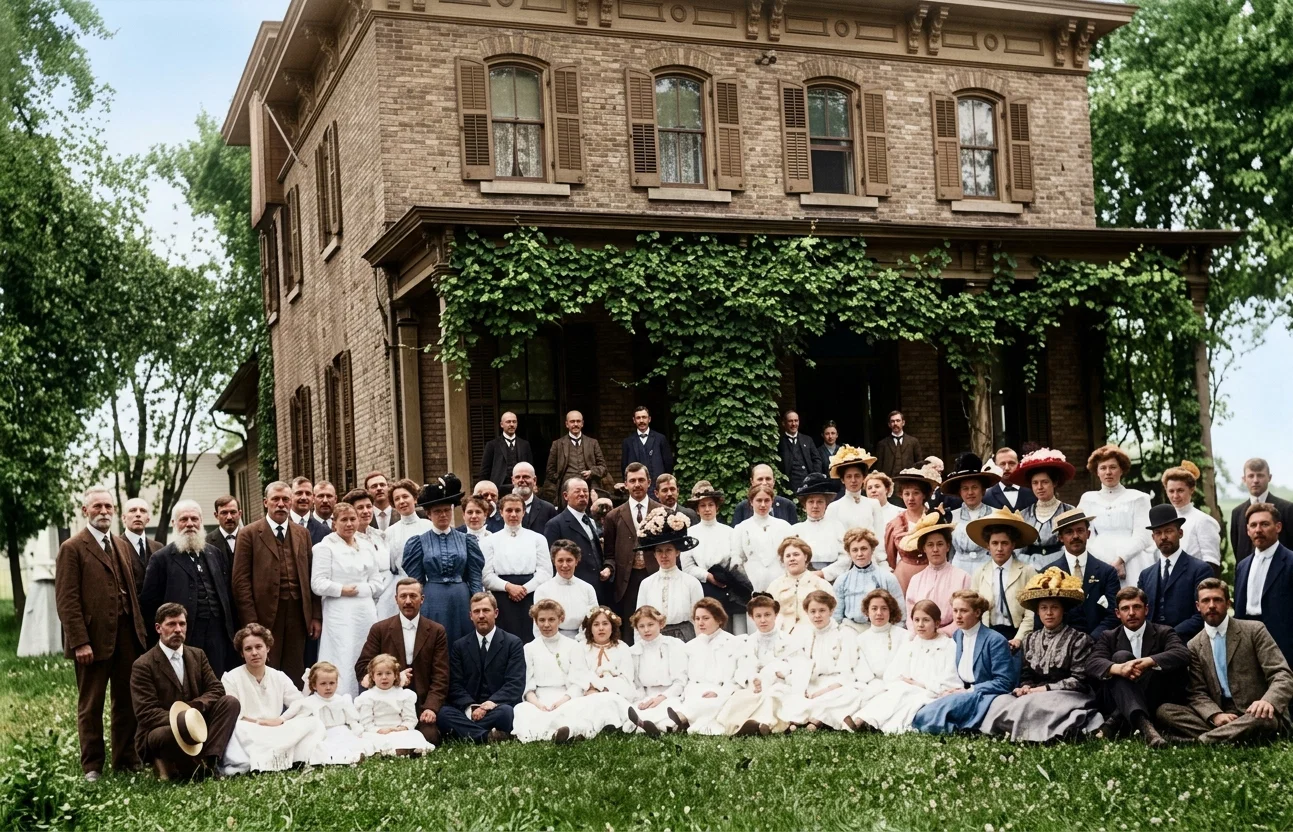
CLINTON GERMAN SEMINARY
A small beginning has also been made among the Italians and Hungarians in Chicago; and in Cleveland, Ohio, among the Roumanians. In North Dakota work has started among the Russians, and several churches have been organized. A Russian department, though small, has been opened at the Sheyenne River Academy, in North Dakota, for the training of workers in the Russian tongue. In Rouleau, Saskatchewan, Canada, an interesting29work has been started among Roumanians, Bohemians, and Servians. Thus we find these people responsive to the call of the gospel wherever earnest work is done.
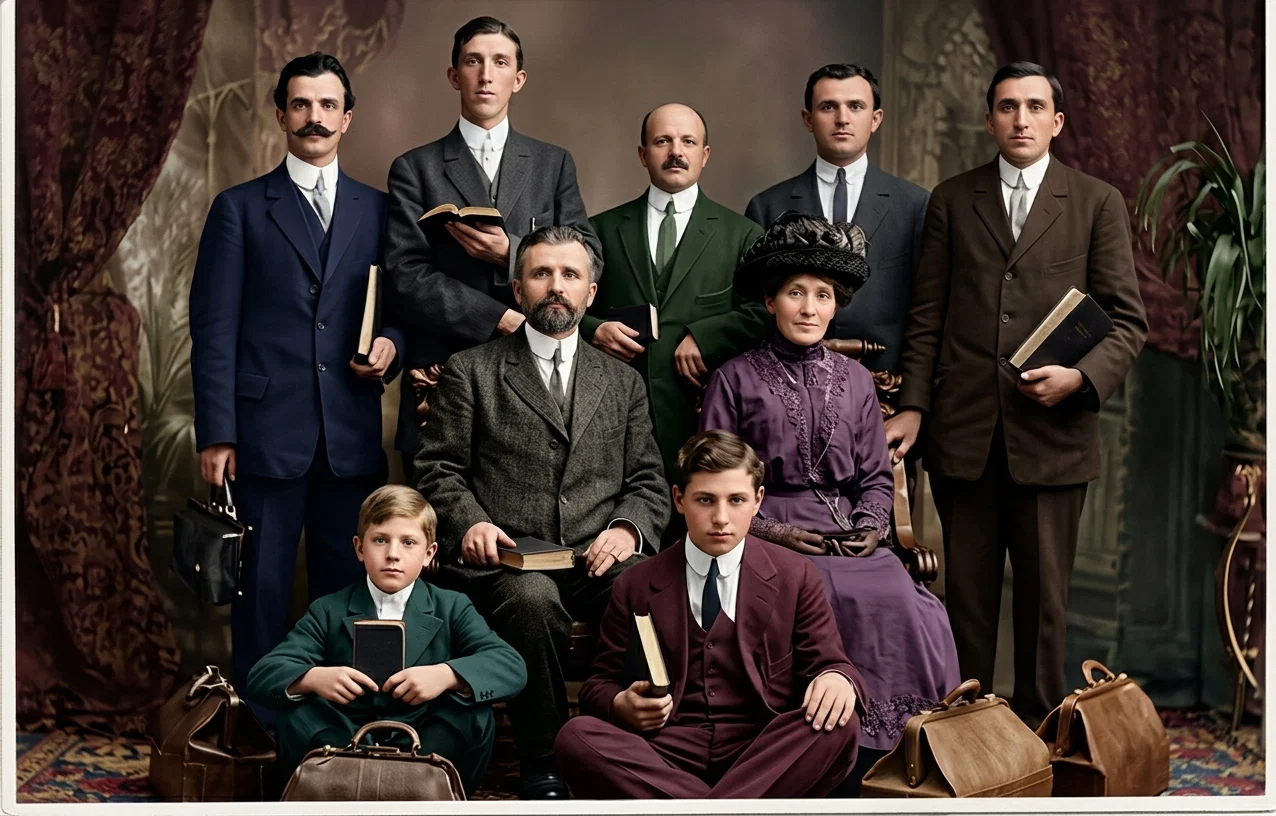
HUNGARIAN COLPORTEURS IN NEW YORK
Urgent Needs
We are glad for the beginning that has been made among the Germans, Scandinavians, and others, but so far we have touched only the fringe of the work. Here are scores of nationalities among whom not even the smallest beginning has been made. In Chicago alone we have more than one hundred thousand Bohemians, and not a single worker. We have one hundred thousand Poles, and not a worker among them. We might mention more than a score of other nationalities in the same situation. What we have said of Chicago is true of all our large cities. Truly, we have here a home-foreign mission field that is both large and important.
Workers of proper experience and adaptability, persons with a passion for souls, whether American or European, must be set apart to lead out among the Italians, Hungarians, Roumanians, Portuguese, Slovaks, Poles, Bohemians, Servians, and many others, not in a desultory manner, but in real earnest, just as they would were they in a foreign land. Then, as individuals from these various nations and tongues accept the truth, this home foreign missionary should assist and instruct them to labor for their own people.
Now is the time to work. The fields are truly white for the harvest, and unless immediate help is rendered, much will be lost. Why should these foreigners at home be neglected? Again we say, Now is the time to work, soon it will be too late.
O. A. OLSEN,
Secretary North American Foreign Dept.
The Power of God
WE are often reminded of the peculiar situation in our great cities, the unamalgamated masses of recent immigrants. But look into the New Testament (Acts 2:9-11). What a mixture!—Parthians, Medes, Elamites, the dwellers in Mesopotamia, and in Judea and Cappadocia, in Pontus and Asia, Phrygia and Pamphylia, Egypt and in the parts of Libya about Cyrene, and strangers of Rome, Jews and Gentiles, Cretes and Arabians. There is no difference between that multitude and the masses in our great cities. There are those who have never heard the gospel, those who have rejected it, and the Jews. The gospel met the needs of all. It changed the Ethiopian, converted the Jew, and conquered the corruption of Rome, for it is the power of God by his Holy Spirit. It is able to meet all needs and conditions today. Man, especially modern man, sometimes thinks he can change the social side of life, and he thinks, and plans, and works, earnestly and determinedly. But his thoughts are vanity, and his labors are vain.
The church has the twofold purpose— spiritual and social. The emphasis must be placed on the spiritual, and when sinners are saved and believers are quickened, then new social life will follow. The word of the Lord which came to Solomon (2 Chron. 7:14) is true still: “If my people, which are called by my name, shall humble themselves, and pray, and seek my face, and turn from their wicked ways; then will I hear from heaven, and will forgive their sin, and will heal their land.” Paul always emphasized the spiritual. Whenever the church has maintained this same emphasis, she has prospered. Whenever she has shifted the emphasis upon the social side, she has become weak. The church in all her work should place the emphasis today upon the declaration that Christ came into the world to save sinners.—Selected.
A Nickel for the Lord
YESTERDAY he wore a rose on the lapel of his coat, and when the plate was passed he gave a nickel to the Lord. He had some gold in his pocket, and Sunday change, perhaps a dollar's worth, but he hunted about, and, finding this poor little nickel, he laid it on the plate to aid the church militant in its fight against the world, the flesh, and the devil.
And this very man had his shoes polished on Saturday afternoon, and he handed out a dime without a murmur. He had a shave, and paid fifteen cents with equal alacrity. He took a box of candies home to his wife, and paid forty cents for it, and the box was tied with a dainty piece of ribbon. Yes, and he also gave a nickel to the Lord.
Who is this Lord? Who is he? Why, the man worships him as Creator of the universe, the one who put the stars in order and by whose immutable decree the heavens stand. Yes, he does, and he dropped a nickel in to support the church militant.
And what is the church militant? The church militant is the church that represents upon the earth the church triumphant of the great God the man gave a nickel to.
And the man knew he was but an atom in space, and he knew that the Almighty was without limitations, and knowing this, he put his hand in his pocket and picked out the nickel and gave it to the Lord.
BOHEMIAN CHURCH IN NEWARK, N. J.
And the Lord, being gracious and slow to anger and knowing our frame, did not slay the man for the meanness of his offering, but gives him this day his daily bread.
But the nickel was ashamed, if the man was not. The nickel hid beneath a quarter that was given by a poor woman who washes and irons for a living.—Toronto Star.
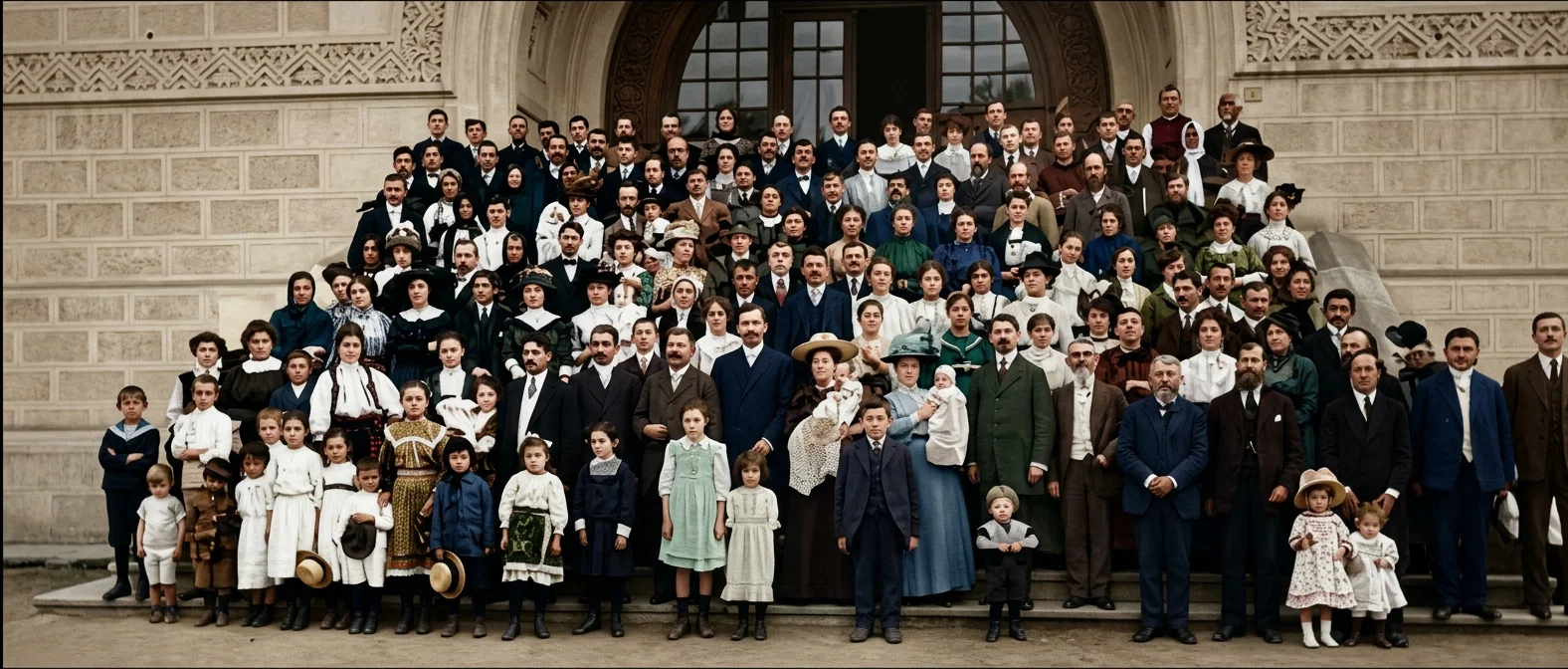
MEMBERS OF CHURCH IN BUKAREST, CAPITAL OF ROUMANIA
IN THE BALKANS
By R. S. Greaves
In Little-Known Albania and Greece
LIVING among his mountain fastnesses, the Albanian has cared little, if anything, for the outside world. For years he has been leading a life of half-warrior, half-farmer, just about as ready for one occupation as for the other. He may be a Mohammedan, Greek Orthodox, or Roman Catholic, but he is still a good Albanian patriot. No doubt he has been a thorn in the flesh to Turkey, which has sent expedition after expedition against him, which, though apparently successful, have never really subdued him. He loves his homestead and village, and his world has pretty well lain within the surrounding mountains.
Coming down farther south, into Epirus, we find the population largely composed of Greeks. Here it is very interesting to watch the country people coming into town to buy their provisions. The man generally rides on a pony or donkey, while his wife trudges along quite happily by his side. When she brings the baby, she brings the cradle too, and has both strapped on her back. This leaves her hands free to spin or knit as she walks along.
R. S. AND MRS. GREAVES, GRECIAN MISSION
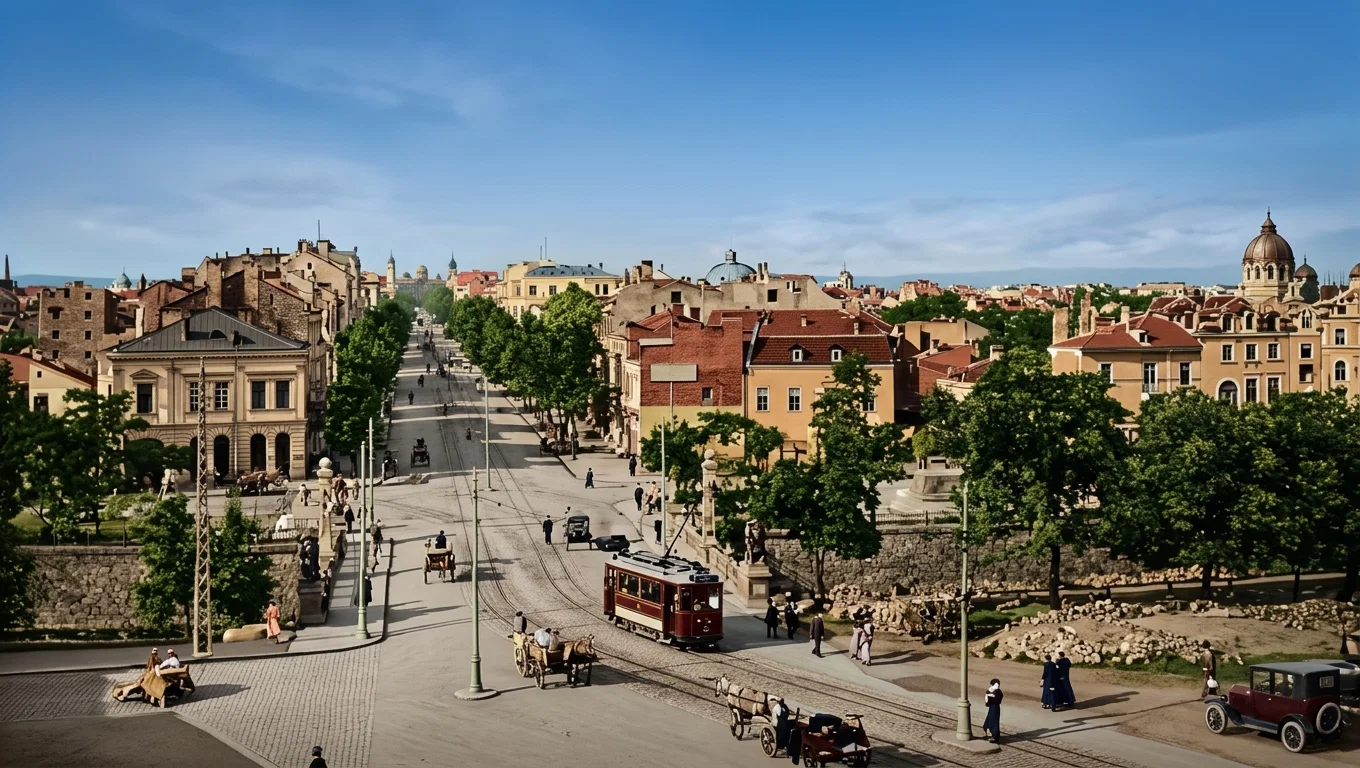
SOFIA, CAPITAL OF BULGARIA
Crossing the old Turkish border and entering Greek territory, one finds the religion just the same, except that the people do not close their stores or stop work on most of the holy days. In the large cities the people are becoming indifferent to religious affairs, and what attention they do give is more from a national standpoint. A patriotic Greek must be a member of the Orthodox Church, and to leave the church is looked upon as being unfaithful to the country.
In some respects we find the Greeks have changed very little from what they were nearly two thousand years ago. They look upon the missionary much as their fathers looked upon Paul when they said, “What will this babbler say? . . . He seemeth to be a setter forth of strange gods.”
The Word of God is practically withheld from the people. It is allowed to be published only in the ancient Greek language, which the common people do not understand. The need of the living Word is great, and we must pray and work to plant the leaven of truth among these people. At times the way seems so barred that we know not how to start. Then we seek the Lord, and he hears, praise his name! R. S. GREAVES.