1 Kings 12:30
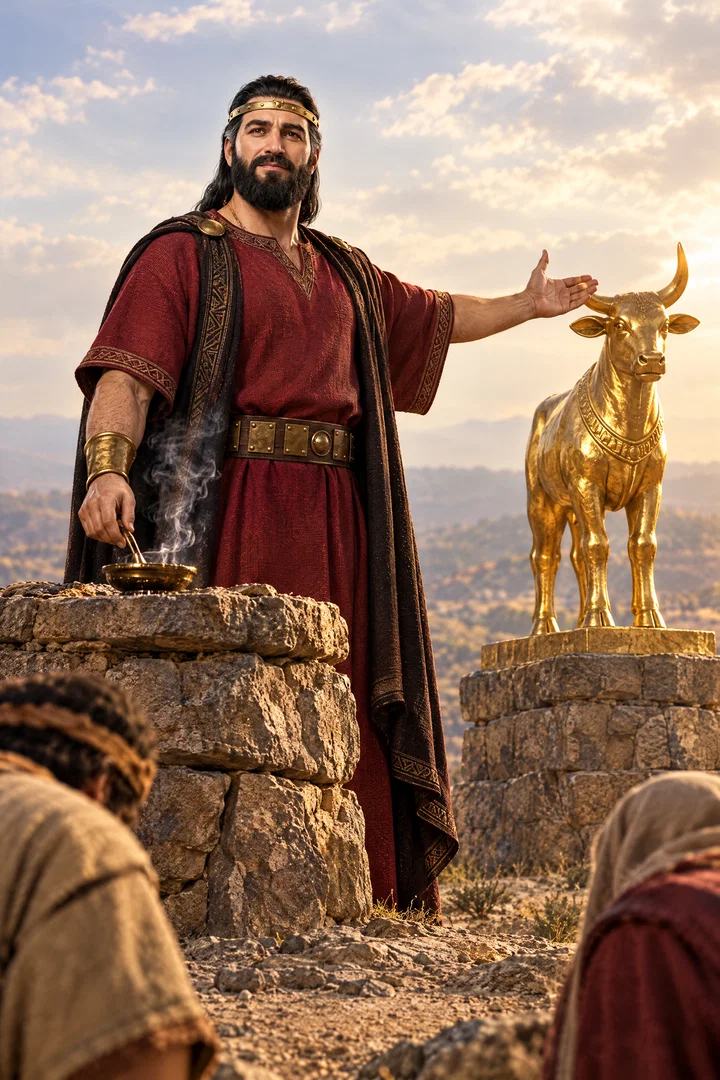
And this thing became a sin: for the people went to worship before the one, even unto Dan.
Translations
American King James Version, Webster Bible
And this thing became a sin: for the people went to worship before the one, even to Dan.
King James Version, KJV Cambridge Paragraph Bible, Revised Version
And this thing became a sin: for the people went to worship before the one, even unto Dan.
And this thing became a sin; for the people went to worship before the one, even unto Dan.
and this thing becometh a sin, and the people go before the one — unto Dan.
And this thing became a sin; and the people went [ to worship] before the one, as far as Dan.
And this thing became a sin,—and the people went before the one, as far as Dan.
Berean Standard Bible, Majority Standard Bible
And this thing became a sin; the people walked as far as Dan to worship before one of the calves.
This thing became a sin, for the people went even as far as Dan to worship before the one there.
And this became a sin in Israel; for the people went to give worship to the one at Beth-el, and to the other at Dan.
And this thing turned to sinne: for the people went (because of the one) euen to Dan.
Douay-Rheims (Challoner revision)
And this thing became an occasion of sin: for the people went to adore the calf as far as Dan.
Pictures
Cross-references 20 of 27
- 1 Kings 13:1-2
And, behold, there came a man of God out of Judah by the word of the LORD unto Beth-el: and Jeroboam stood by the altar to burn incense.
A man of God proclaims judgment against Jeroboam’s altar at Bethel.
- Exodus 32:4-5
And he received them at their hand, and fashioned it with a graving tool, after he had made it a molten calf: and they said, These be thy gods, O Israel, which brought thee up out of the land of Egypt.
Aaron and Israel made and worshiped a golden calf, echoing Jeroboam’s image worship.
- 1 Kings 16:31-33
And it came to pass, as if it had been a light thing for him to walk in the sins of Jeroboam the son of Nebat, that he took to wife Jezebel the daughter of Ethbaal king of the Zidonians, and went and served Baal, and worshipped him.
Ahab continued Jeroboam’s worship practices and promoted Baal worship.
- Amos 7:13
But prophesy not again any more at Beth-el: for it is the king’s chapel, and it is the king’s court.
Bethel is identified as Jeroboam’s royal sanctuary and a center of rival worship.
- 2 Kings 17:7-8
For so it was, that the children of Israel had sinned against the LORD their God, which had brought them up out of the land of Egypt, from under the hand of Pharaoh king of Egypt, and had feared other gods,
Israel’s worship of other gods is condemned as sin.
- Exodus 20:4-5
Thou shalt not make unto thee any graven image, or any likeness of any thing that is in heaven above, or that is in the earth beneath, or that is in the water under the earth:
Jeroboam’s images violated the command against making and worshiping graven images.
- Romans 1:25
Who changed the truth of God into a lie, and worshipped and served the creature more than the Creator, who is blessed for ever. Amen.
Both describe people forsaking God to worship created things.
- 2 Kings 23:15-16
Moreover the altar that was at Beth-el, and the high place which Jeroboam the son of Nebat, who made Israel to sin, had made, both that altar and the high place he brake down, and burned the high place, and stamped it small to powder, and burned the grove.
Josiah destroyed the Bethel altar, fulfilling the prophet’s warning.
- Amos 8:14
They that swear by the sin of Samaria, and say, Thy god, O Dan, liveth; and, The manner of Beer-sheba liveth; even they shall fall, and never rise up again.
The people swear by Dan’s god, and those who do so fall.
- Judges 18:30
And the children of Dan set up the graven image: and Jonathan, the son of Gershom, the son of Manasseh, he and his sons were priests to the tribe of Dan until the day of the captivity of the land.
The Danites establish worship at Dan with a graven image and priests.
- Judges 17
And there was a man of mount Ephraim, whose name was Micah.
Micah’s idols and hired priest are part of the history behind Dan’s worship.
- 1 Kings 11:38
And it shall be, if thou wilt hearken unto all that I command thee, and wilt walk in my ways, and do that is right in my sight, to keep my statutes and my commandments, as David my servant did; that I will be with thee, and build thee a sure house, as I built for David, and will give Israel unto thee.
Jeroboam was promised a secure throne if he obeyed God, but later turned to idolatry.
- 1 Kings 14:9-10
But hast done evil above all that were before thee: for thou hast gone and made thee other gods, and molten images, to provoke me to anger, and hast cast me behind thy back:
God condemns Jeroboam’s idolatry and announces judgment on his house.
- 2 Chronicles 11:15
And he ordained him priests for the high places, and for the devils, and for the calves which he had made.
Jeroboam appointed priests to serve the calves he had made.
- Exodus 32:8
They have turned aside quickly out of the way which I commanded them: they have made them a molten calf, and have worshipped it, and have sacrificed thereunto, and said, These be thy gods, O Israel, which have brought thee up out of the land of Egypt.
Both accounts describe Israel worshiping a calf image.
- 1 John 5:21
Little children, keep yourselves from idols. Amen.
Warns against the idols Jeroboam introduced.
- Genesis 28:18-19
And Jacob rose up early in the morning, and took the stone that he had put for his pillows, and set it up for a pillar, and poured oil upon the top of it.
Jacob names Bethel after setting up a pillar there.
- Deuteronomy 12:13-14
Take heed to thyself that thou offer not thy burnt offerings in every place that thou seest:
The Lord commands Israel to worship only at the place he chooses.
- 2 Kings 17:21
For he rent Israel from the house of David; and they made Jeroboam the son of Nebat king: and Jeroboam drave Israel from following the LORD, and made them sin a great sin.
Jeroboam led Israel into sin.
- 2 Chronicles 13:8
And now ye think to withstand the kingdom of the LORD in the hand of the sons of David; and ye be a great multitude, and there are with you golden calves, which Jeroboam made you for gods.
The golden calves are identified as part of Israel’s false worship.
Commentary
Each commentary is drawn from primary sources: the writings of Ellen G. White and Adventist pioneers and periodicals. Each commentary is separate. Its own words are not a quotation; follow the references to read the source passages.
Ellen G. White
6 sources
The thing that became a sin was Jeroboam's golden calves and the rival worship centers at Bethel and Dan, for the people went to worship before the calf even unto Dan instead of going to Jerusalem to worship.PK 99Ms 103a, 1899, par. 35–37PK 114.1 This worship turned Israel away from the true worship of God and dishonored the worship at the temple in Jerusalem.PK 99PK 102.3 Jeroboam set up the separate centers to keep the people from going to Jerusalem, thwarting God's purpose that their going to Jerusalem would restore unity and reunite the kingdom.Ms 103a, 1899, par. 35–37 Establishing two places for worship divides God's people.Ms 103a, 1899, par. 35–37
The warning of this sin should have led Jeroboam to repent and abandon his wicked plans, but he hardened his heart and chose his own way.PK 102.3 The idolatry led the people into performing and permitting terrible evils, spreading into more corrupt forms until it helped turn nearly all the people toward nature worship.RH Feb 5, 1914Lt 113, 1903, par. 14 Ahab continued to encourage these sinful forms of worship at Bethel and Dan, then went further by turning the people from worshiping Jehovah to worshiping Baal.PK 114.1
The same spirit Jeroboam manifested endangers people today with work of the same character, and as the Judge of all the earth lays the awful results to Jeroboam's charge, so the results of their wrong course will be laid to the charge of all who follow his example.Lt 113, 1903, par. 14 By the same principle, establishing two places for tithe-paying divides God's people, for the medical work and the ministry are to be one united interest with no separation.Ms 103a, 1899, par. 35–37
Sources
Pioneers and periodicals
54 sources
After the ten tribes revolted from Rehoboam to Jeroboam, Jeroboam set up golden calves at Bethel and Dan with unauthorized priests and feasts, and the people went to worship before them even as far as Dan.ST Jul 2, 1885RH May 5, 1868ST Jun 29, 1904RH Jan 16, 1872 He did it as a political measure from fear that going up to Jerusalem would turn their loyalty back to Rehoboam, seeking by religion to keep worship inside his kingdom and secure his rule.RH Jul 17, 1913ST Dec 7, 1882ST Sep 7, 1904 The calves were meant to represent Jehovah rather than at first another god, directing the true God to be worshiped before images in violation of the second commandment.ST Sep 8, 1881RH Aug 1, 1871RH Apr 2, 1867 This thing became a sin that swept Israel into apostasy and moral darkness, widening within less than fifty years into nature worship and Baal worship under Ahab while Israel tried to serve both Jehovah and Baal.RH Feb 5, 1914ST Jun 29, 1904RH May 13, 1875ST It warns against diverting worship to an easier way suited to human preference, for claiming to worship the same God in a different way without keeping His commands is not true worship.ST Jul 2, 1885ST Jul 2, 1885
Historical Setting and Wording
The setting is after Israel rebelled against Rehoboam and chose Jeroboam as king, when Jeroboam established Shechem as his capital about thirty-four miles north of Jerusalem.ST Jul 2, 1885 The division came under the weak and foolish Rehoboam, when the ten tribes revolted to Jeroboam. He was the strong young man who induced the revolt, and the division followed Solomon multiplying wives to himself.ST May 20, 1913 After Solomon's death the ten tribes separated from Judah and Benjamin and carried copies of the books of Moses with them.RH May 1, 1879
Jeroboam set up two golden calves at Bethel and Dan to keep Israel from going to Jerusalem.RH Jul 17, 1913RH May 5, 1868RH Sep 8, 1853 He appointed unauthorized priests from outside the tribe of Levi, chosen from the lowest of the people, and set up high places and sacrifices.RH Jul 17, 1913RH Sep 8, 1853RH Dec 22, 1910 He also devised a feast date of his own, imitating Judah's feast while changing its observance.RH Jul 17, 1913RH May 5, 1868 This invented worship turned Israel away from God toward an independent form of worship.RH May 5, 1868RH Dec 22, 1910
The verse records the outcome that this arrangement became a sin, for the people went to worship before the calves, even as far as Dan.ST Jun 29, 1904RH Jan 16, 1872 They went to Dan to worship at the calf set up there.ST Jun 29, 1904RH Jan 16, 1872 Dan was already an established center of idolatry, for the tribe of Dan had taken the idols and priest from Micah's house, destroyed Laish, renamed it Dan, and maintained idolatrous worship there until the ten tribes went into captivity.ST Jul 2, 1885 This existing practice made it easier for Jeroboam to turn the people to worship his calf at Dan.ST Jul 2, 1885 His work there revived Dan's earlier practice of keeping images and a priest at its sanctuary, established after the Danites took Micah's images and Levite, and this idolatry became known in the oath, Thy god, O Dan, liveth, as the sin of Samaria.RH Dec 22, 1910
Jerusalem's temple could be seen from Bethel, continually reminding the worshipers of their departure from true worship.ST Sep 29, 1898 Most of Israel turned from God, though a faithful remnant remained.ST Sep 8, 1898 Many who remained faithful to God went to Jerusalem to worship according to His requirements.RH Jul 17, 1913ST Sep 8, 1898
Nature of the Sin
Jeroboam set up the calves at Bethel and Dan as a political measure to keep the people from going to Jerusalem, fearing that going up to worship there would return their loyalty to Rehoboam.RH Jul 17, 1913ST Dec 7, 1882ST Apr 26, 1910ST Apr 24, 1901 He sought to keep the people worshiping within his own kingdom in order to keep his influence, secure their political allegiance, and strengthen his rule and the state, thus using religion for political ends.ST Sep 7, 1904ST Apr 26, 1910ST Apr 24, 1901 To that end he appointed priests outside the tribe of Levi, set up sacrifices and a feast of his own devising, and drew the people to those sites instead of Jerusalem, though many who remained faithful to God still went to Jerusalem to worship according to His requirements.RH Jul 17, 1913ST Dec 7, 1882 The strange altar and new form of worship dishonored Jehovah, and his determination to pursue his own way rather than heed God's solemn warnings brought lasting sin upon the ten tribes.RH Jul 17, 1913ST Apr 26, 1910
The arrangement diverted the people from Jerusalem, the place the Lord had appointed, to an unauthorized, independent and rival sanctuary that turned ten of the twelve tribes away from the worship of the living God.RH Jul 17, 1913RH Feb 15, 1870ST Jul 1, 1880ST Jul 2, 1885 It encouraged a way that was easier and suited to human preference, while claiming to worship the same God.ST Jul 2, 1885 Claiming unity despite different practices does not make disobedience true worship, for those who insist on worshiping in their own way worship themselves.ST Jul 2, 1885
The calves were intended to represent Jehovah and not at first another god, the people being directed to worship the true God before images.ST Sep 8, 1881RH Aug 1, 1871ST Apr 26, 1910 That use of images to represent Jehovah violated the second commandment, distinct from Ahab's later substitution of Baal for Jehovah which violated the first commandment.ST Sep 8, 1881RH Aug 1, 1871 This departure could lead to treating images as gods and abandoning Jehovah, and it prepared the way for forsaking God and for the later worship of idols as gods.ST Sep 8, 1881RH Aug 1, 1871 Acting as a magistrate to require forsaking the Lord's altar for images, Jeroboam the son of Nebat acted as a tempter who drove Israel from following the Lord and made them sin a great sin.RH Apr 2, 1867 His requirement was a legalized temptation to disobedience to the second command of the Decalogue, whose sanction by the usage of many years did not make it innocent, and his guilt was increased by the extent of his influence and power, fixing a foul blot forever upon his character.RH Apr 2, 1867
Claiming to preserve the worship of Jehovah by the seemingly small change of introducing images, he copied Egyptian worship he had learned while living in Egypt after fleeing Solomon.ST Jul 2, 1885ST The calves were images of Egyptian gods and may have been treated as symbols of the true God, copying the Egyptian sun-god Apis, and the worship was as degraded as that of the gods of the Ammonites, Moabites, and Zidonians, except that it did not include burning children in the fire.ST Jul 2, 1885ST Sep 8, 1898 It fell upon a worship of Jehovah already weakened by Solomon's idolatry, and God's warning through a prophet had little effect, though a faithful remnant remained.ST Sep 8, 1898 That departure from God's way of worship led toward open paganism and tended to widen rather than stop where intended, so that within less than fifty years Ahab's reign brought the worship of Sidonian Baal into Israel, warning that symbolic and sensory aids in worship can become hindrances.ST
The account belongs to people leaving God to worship gods of their own making, establishing worship like that commanded by God but changing its observance to maintain separation from God's true people.RH May 5, 1868 Obeying a ruler's religious commands in violation of God's law is sin, and civil authority must not be obeyed when its religious demands conflict with God's law.RH May 12, 1868
The calf worship was a usurping religious institution set up with claimed zeal for the Lord, yet God's blessing rests on heart and motive and not on honoring a false institution.ST Sep 10, 1894ST Dec 4, 1893 People may be blessed in spite of such observance and not because of it, as with professed worshipers of Christ who reject one form of false worship only to embrace other idols in its place.ST Sep 10, 1894ST Dec 4, 1893
Consequences in Israel's History
This thing became a sin that led Israel into grave idolatrous offense, a public and far-reaching evil that swept the people into apostasy and moral darkness and marked Israel's early departure from God into false worship.ST Jun 29, 1904RH May 13, 1875ST Jan 17, 1884ST Jun 27, 1911ST Apr 30, 1912 A man of God was sent to condemn the calf worship at Dan as a grave offense against God.RH May 13, 1875
God had given Jeroboam a magnificent opportunity when a prophet announced his future sovereignty over the ten tribes that would revolt from the house of David and promised his throne would be made sure like the throne of David if he walked in the way of the Lord's commandments.RH May 9, 1871 But selfish considerations took supreme possession of his soul, he turned away, cast God behind his back, and did evil above all that were before him.RH May 9, 1871 His sin brought God's rebuke and set Israel on a downward course, leaving a shameful mark on Israel's history and bringing a curse rather than a blessing.ST Apr 28, 1909RH Mar 4, 1873 God matched the evil with good by raising up a man of God who testified against the king and by raising Ahijah the prophet, the same who had announced his elevation to the throne, to announce his utter overthrow and rejection for his iniquities, so that the light of their lives relieved the surrounding darkness, while in righteous indignation God determined to root his house and posterity from the land of the living with frequent reference throughout Scripture to him as a leader in sin and terrible denunciation of wrath against his iniquity.RH May 13, 1875RH May 9, 1871
The idolatry spread into more corrupt forms of worship and helped turn nearly all the people toward nature worship.RH Feb 5, 1914 The departure widened rather than stopping where intended, so that within less than fifty years Ahab's reign brought the worship of Sidonian Baal into Israel.ST Since Jeroboam, Israel tried to worship Jehovah while also serving Baal, a persistent compromising divided service that continued despite long efforts to reclaim the people.STST Jun 17, 1886
The sin remained in the kingdom of the ten tribes, and all the kings who came before Omri held to that worship of the golden calves.ST Apr 17, 1907 Omri took the kingdom in a brief time and ruled strongly for twelve years and made a center for the kingdom by building Samaria as its capital city, yet held to it with them, and his son and successor Ahab followed after.ST Apr 17, 1907 Jeroboam had set up rival worship centers with unauthorized high places and priests who were not Levites to keep the people from going to Jerusalem, and the people went to worship at the calf, with most turning from God though a faithful remnant remained.RH Sep 8, 1853ST Sep 8, 1898 Their continued worship of the idols led to removal from the land, captivity and dispersion, with God's warning through a prophet having little effect, and the robbery of the temple and palace treasures stands in the history as punishment for idolatry.RH May 25, 1916RH Sep 8, 1853ST Sep 8, 1898ST Apr 12, 1883ST Jun 17, 1886
The record illustrates the lesson that when leaders fail to lead in God's ways, the people fail with them.ST Apr 26, 1910 Jeroboam's fear of losing influence led him to keep the people from worshiping God in the way God had appointed and to lead them away from loyalty to God's Word.ST Sep 7, 1904 His influence as a magistrate drove Israel from following the Lord and made them sin a great sin by requiring them to forsake the altar of the Lord, and his influence caused others to sin and suffer.ST Apr 12, 1883RH Apr 2, 1867 His guilt was increased by the extent of his influence and power, and for his iniquitous commandment a foul blot is fixed forever upon his character.RH Apr 2, 1867
Doctrine and Scriptural Connections
Jeroboam's calves at Bethel formed a rival sanctuary set up after Solomon's temple was built, drawing ten of the twelve tribes away from worship of the living and true God.RH Sep 1, 1863RH Feb 3, 1853RH Feb 15, 1870ST Jul 1, 1880 That rival worship at Bethel and Dan was sin, diverting the people from the true worship of God to a competing sanctuary.RH Mar 11, 1858RH Feb 3, 1853RH Feb 15, 1870ST Jul 1, 1880 God's sanctuary trodden under foot is seen in this turning aside, as one of Satan's efforts to lead people from Jehovah's sanctuary to heathen rites.RH Sep 1, 1863 The history marks the worship of Israel's separate kingdom as sinful, with the people's going to worship before the calves even unto Dan as the outcome of Jeroboam's idolatry.RH May 25, 1916ST Jun 29, 1904 Its lesson is to keep from idols, while the robbery of temple and palace treasures stands in the same history as punishment for idolatry.RH May 25, 1916ST Jun 29, 1904
Dan became a center of idolatrous worship, and because Dan had become a leader in idol worship Dan is omitted from the tribal list in Revelation.ST The calf worship was false worship that forsook God's commandments, and it is linked with the later exaltation of Sunday as a sign of Baal or sun-worship.ST Sep 4, 1901 Turning from the Creator to worship created things is exemplified here, showing how people may also adopt new days of worship in rivalry with the Creator's institutions and memorial.RH May 5, 1868 By taking Bethel, the house of God, for his own chapel and court, Jeroboam failed to leave God's way to be God's all the way.RH Dec 23, 1915 That act was leaving the path of the Lord's commandments for the bypath of man's tradition.RH Dec 23, 1915
Present Application
The setting up of worship away from Jerusalem, the place the Lord had appointed, became sin because it diverted the people into a way that was easier and suited to human preference.ST Jul 2, 1885 Claiming to worship the same God, or claiming unity despite different practices, does not make disobedience true worship.ST Jul 2, 1885 Insisting on worshiping in one's own way is worshiping oneself.ST Jul 2, 1885
The same lesson reaches leaders who urge setting aside God's Sabbath and disregarding Christ's coming for the sake of ease, social standing, and popular entertainments, while claiming to worship the same God in a different way without following His commands.ST Jul 2, 1885 Religious activity centered on pleasure rather than service to God is not truly God's service, and those who love pleasure more than God are to be avoided.ST Jul 2, 1885 Using a religious practice deemed useful to gain an aim corrupts worship, and likewise when Christians use questionable methods to gain unity, popularity, or influence they degrade the understanding of God's character, undermine faith, corrupt the church, and lead to ruin.RH Apr 7, 1910 The idolatry at Dan shows that the worship of wealth is idolatry found far beyond calf-worship places, and that professed worshipers of Christ who reject one form of false worship may still embrace other idols in its place.ST Dec 4, 1893ST Dec 23, 1903
Sources