Exodus 32:4
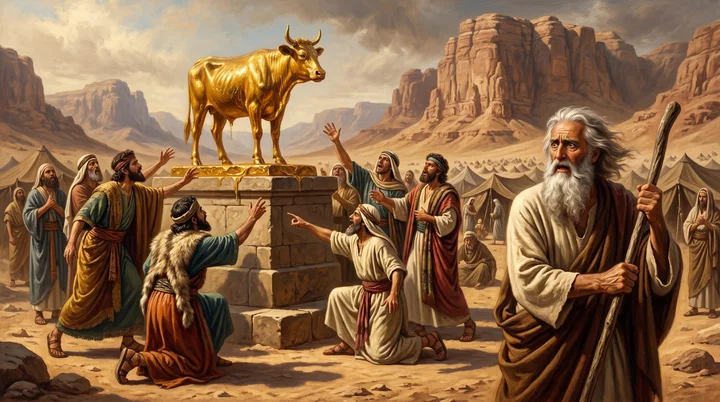
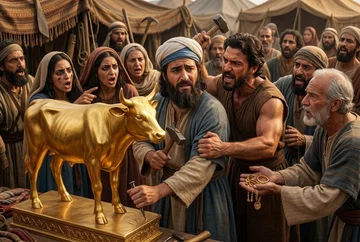
And he received them at their hand, and fashioned it with a graving tool, after he had made it a molten calf: and they said, These be thy gods, O Israel, which brought thee up out of the land of Egypt.
Translations
And he received them at their hand, and fashioned it with a engraving tool, after he had made it a molten calf: and they said, These be your gods, O Israel, which brought you up out of the land of Egypt.
King James Version, KJV Cambridge Paragraph Bible
And he received them at their hand, and fashioned it with a graving tool, after he had made it a molten calf: and they said, These be thy gods, O Israel, which brought thee up out of the land of Egypt.
And he received them at their hand, and fashioned it with a graving tool, after he had made it a molten calf: and they said, These are thy gods, O Israel, which brought thee out of the land of Egypt.
And he received it at their hand, and fashioned it with a graving tool, and made it a molten calf: and they said, These be thy gods, O Israel, which brought thee up out of the land of Egypt.
And he received it at their hand, and fashioned it with a graving tool, and made it a molten calf: and they said, These are thy gods, O Israel, which brought thee up out of the land of Egypt.
and he receiveth from their hand, and doth fashion it with a graving tool, and doth make it a molten calf, and they say, 'These thy gods, O Israel, who brought thee up out of the land of Egypt.'
And he took [ them] out of their hand, and fashioned it with a chisel and made of it a molten calf: and they said, This is thy god, Israel, who has brought thee up out of the land of Egypt!
And he received [the gold] at their hand, and fashioned it with a graving tool, and made it a molten calf, and they said—These, are thy gods, O Israel, who brought thee up, out of the land of Egypt.
Berean Standard Bible, Majority Standard Bible
He took the gold from their hands, and with an engraving tool he fashioned it into a molten calf. And they said, “ These, O Israel, are your gods, who brought you up out of the land of Egypt!”
He received what they handed him, fashioned it with an engraving tool, and made it a molded calf. Then they said, “ These are your gods, Israel, which brought you up out of the land of Egypt.”
And he took the gold from them and, hammering it with an instrument, he made it into the metal image of a young ox: and they said, This is your god, O Israel, who took you out of the land of Egypt.
Who receiued them at their handes, and facioned it with the grauing toole, and made of it a molte calfe: then they said, These be thy gods, O Israel, which brought thee out of ye lad of Egypt
Douay-Rheims (Challoner revision)
And when he had received them, he fashioned them by founders’ work, and made of them a molten calf. And they said: These are thy gods, O Israel, that have brought thee out of the land of Egypt.
Pictures
Cross-references 20 of 68
- Exodus 20:3-5
Thou shalt have no other gods before me.
calf worship defied the law just written
- Exodus 24:18
And Moses went into the midst of the cloud, and gat him up into the mount: and Moses was in the mount forty days and forty nights.
Moses remains on the mountain forty days while Israel turns to the calf.
- Psalms 106:19-21
They made a calf in Horeb, and worshipped the molten image.
Israel made the calf, exchanged God’s glory for it, and forgot their deliverer.
- Exodus 32:19-20
And it came to pass, as soon as he came nigh unto the camp, that he saw the calf, and the dancing: and Moses’ anger waxed hot, and he cast the tables out of his hands, and brake them beneath the mount.
Moses sees the calf and breaks the tablets before destroying the idol.
- Exodus 32:26-28
Then Moses stood in the gate of the camp, and said, Who is on the LORD’s side? let him come unto me. And all the sons of Levi gathered themselves together unto him.
The Levites carry out judgment after Israel’s golden-calf idolatry.
- Exodus 20:3
Thou shalt have no other gods before me.
The calf worship violated the command to have no other gods.
- Exodus 32:24
And I said unto them, Whosoever hath any gold, let them break it off. So they gave it me: then I cast it into the fire, and there came out this calf.
Aaron’s account falsely suggests the calf emerged from the fire without his deliberate shaping.
- Exodus 24:3-8
And Moses came and told the people all the words of the LORD, and all the judgments: and all the people answered with one voice, and said, All the words which the LORD hath said will we do.
Israel pledged obedience to God before turning to idolatry.
- Romans 1:23
And changed the glory of the uncorruptible God into an image made like to corruptible man, and to birds, and fourfooted beasts, and creeping things.
Both describe turning God’s glory into an image of a created thing for worship.
- Deuteronomy 9:20
And the LORD was very angry with Aaron to have destroyed him: and I prayed for Aaron also the same time.
The Lord’s anger toward Aaron was stayed through Moses’ intercession.
- Isaiah 40:19-20
The workman melteth a graven image, and the goldsmith spreadeth it over with gold, and casteth silver chains.
Both describe images fashioned by human hands.
- 1 Corinthians 10:11
Now all these things happened unto them for ensamples: and they are written for our admonition, upon whom the ends of the world are come.
Israel’s idolatry is recorded as a warning example for later generations.
- 1 Kings 12:28
Whereupon the king took counsel, and made two calves of gold, and said unto them, It is too much for you to go up to Jerusalem: behold thy gods, O Israel, which brought thee up out of the land of Egypt.
Jeroboam used a similar claim about the calves at Bethel and Dan.
- Psalms 106:21-22
They forgat God their saviour, which had done great things in Egypt;
Israel forgot their Savior and worshipped the calf.
- Exodus 32:11-14
And Moses besought the LORD his God, and said, LORD, why doth thy wrath wax hot against thy people, which thou hast brought forth out of the land of Egypt with great power, and with a mighty hand?
Moses pleads for Israel’s pardon after the calf apostasy, invoking God’s promises to Abraham.
- Exodus 34:1
And the LORD said unto Moses, Hew thee two tables of stone like unto the first: and I will write upon these tables the words that were in the first tables, which thou brakest.
God commands replacement tablets after Moses broke the first ones.
- Colossians 3:5
Mortify therefore your members which are upon the earth; fornication, uncleanness, inordinate affection, evil concupiscence, and covetousness, which is idolatry:
Covetousness is identified as idolatry.
- Exodus 19:5-8
Now therefore, if ye will obey my voice indeed, and keep my covenant, then ye shall be a peculiar treasure unto me above all people: for all the earth is mine:
Israel’s promise of covenant obedience at Sinai was broken in calf worship.
- Exodus 33:13-14
Now therefore, I pray thee, if I have found grace in thy sight, shew me now thy way, that I may know thee, that I may find grace in thy sight: and consider that this nation is thy people.
Moses intercedes after the golden-calf sin, and God promises his presence and rest.
- Deuteronomy 9:16
And I looked, and, behold, ye had sinned against the LORD your God, and had made you a molten calf: ye had turned aside quickly out of the way which the LORD had commanded you.
Moses recalls Israel making the molten calf and turning aside from God’s command.
Commentary part 1 of 2
Each commentary is drawn from primary sources: the writings of Ellen G. White and Adventist pioneers and periodicals. Each commentary is separate. Its own words are not a quotation; follow the references to read the source passages.
Ellen G. White
74 sources
While Moses was in the mount receiving the law, Aaron himself took the people's gold at their hand and fashioned it with a graving tool into a molten calf, set it up prominently with an altar before it, and the people hailed it as their gods that had brought Israel up out of Egypt.Ms 13, 1906, par. 5–7SG3 281.2–282.11SP 249.2–250.1Ms 170, 1904, par. 12Lt 69, 1904, par. 29–30 The demand came after only forty days of waiting, when the people grew impatient for Moses' return, pressed especially by the mixed multitude clinging to Egyptian ideas, and wanting something visible to go before them.Ms 16, 1896, par. 3–5PP 315.2–3Ms 58, 1900, par. 23–25SG3 275.1ST May 13, 1880 In doing this only weeks after hearing the Ten Commandments and pledging obedience, Israel broke its covenant and violated the first and second commandments, replacing Jehovah its invisible Deliverer with a work of human hands and insultingly crediting their deliverance to an idol in imitation of Egypt's gods.Ms 185, 1907, par. 13–161SP 242.3–244.1SG3 275.1ST May 13, 1880PP 316.1–317.1 Aaron, left as guardian of the people, failed to oppose the first beginning of wrong from fear of displeasing the people and desire for their approval, and his yielding set in motion an apostasy that firm, decisive refusal could have stopped.Ms 83, 1907, par. 4–8Ms 16, 1896, par. 3–5CT 351.23T 340.2RH Feb 4, 1909 The rebellion forced a decision for loyalty in which about three thousand persistent rebels perished while the repentant were mercifully pardoned, and the history stands as a perpetual warning against idolatry, trusting men and human substitutes, and yielding leadership that pleases people at the expense of truth.Ms 185, 1907, par. 13–16PP 335.1–2Ms 125, 1909, par. 40–414T 12.1–3
Sinai Setting and Background
The molten calf was fashioned while Moses was in the mount with God receiving the tables of stone, the law and the sacred oracles, with Israel left at the foot of Sinai under Aaron's charge as guardian and leader.Ms 83, 1907, par. 4–8RH Feb 4, 1909CT 351.2SG3 273.2Ms 92, 1900, par. 22–25 Aaron had been left in charge during Moses' absence with God, yet yielded to the people's complaints and desire to return to Egypt instead of holding them back from wrong.CT 351.24T 514.1–2Ms 92, 1900, par. 22–25 While Moses was away the people quickly turned from their solemn allegiance and corrupted themselves at the foot of the mount.SG3 273.24T 514.1–2
Moses had been gone only forty days and forty nights, a delay of only a few weeks, yet the people wearied of waiting for his return.SG3 275.1SG3 274.1–3Ms 1, 1865, par. 8 They grew discontented and impatient in his absence, and their unbelief became open idolatry and clamor for some visible representation of God.Ms 16, 1896, par. 3–5Ms 58, 1900, par. 23–251SP 242.3–244.1 Having seen him go up into the mount and enter the cloud with fire on the top, they concluded he would never return and that the cloud resting on the mount would no longer guide their route through the wilderness.SG3 274.1–3
The sin was committed in sight of the mount on which they had shortly before seen a wonderful display of God's power, amid recent evidence of His power and care.Ms 13, 1906, par. 3–4RH Feb 4, 1909SG3 275.1 God's glory and cloud still rested there, even while they replaced trust in the invisible God with idolatry.Ms 16, 1896, par. 3–5PP 315.2–3 It came only weeks after Israel had heard the Ten Commandments proclaimed from Sinai, pledged united obedience to the covenant, and in terror asked Moses to speak for them instead of hearing God directly.Ms 185, 1907, par. 13–161SP 242.3–244.13T 296.1–3Ms 1, 1865, par. 8
The demand was pressed principally by the mixed multitude that came up from Egypt with Israel, Hebrews intermarried with Egyptians who were especially impatient and rebellious.SG3 275.1SG3 274.1–3 Old habits of thought and feeling asserted their power, with the gods of Egypt kept in mind and Egyptian symbols of deity echoed in the calf.Ms 16, 1896, par. 3–5PP 315.2–3ST May 13, 1880 They wanted something visible they could look upon to resemble God and to go before them in place of Moses and the guiding cloud.PP 316.1–317.1SG3 274.1–3 They planned that if Moses never returned they could carry this image before them back to Egypt and by acknowledging it as their god find favor with the Egyptians, and Aaron gave in to their demand for gods to lead them back despite the deliverance already accomplished.PP 316.1–317.1SG3 274.1–3RH Apr 23, 1901
The movement grew from doubt, unbelief, murmuring and distrust of divine power despite recent deliverance and revelation at Sinai.RH Feb 4, 1909RH Sep 6, 1906Lt 206, 1906, par. 34–37 Instead of exercising faith and trusting divine power, the people insisted on something visible and dependable.Ms 16, 1896, par. 3–5Lt 206, 1906, par. 34–37 Satan used the absence of their appointed leader to tempt them to imitate Egyptian idolatry, and the act was idolatry brought about by his devising.RH Feb 4, 1909SG3 275.1SG3 274.1–3 At the very foot of Sinai during the forty days of law-writing he excited doubt, apostasy and rebellion to overthrow the law of God, carrying forward the same work begun in heaven.PP 335.1–2
Making and Proclaiming Calf
Aaron received the gold, earrings and ornaments from the people's hand and himself fashioned it with a graving tool into a molten calf.Ms 13, 1906, par. 5–7SG3 281.2–282.119MR 109.2–3Ms 16, 1896, par. 3–51SP 242.3–244.1 He took pride in his workmanship and was pleased with the people over the image he had graven, placing it prominently where all could see and building an altar before it.Ms 16, 1896, par. 3–5SG3 275.13T 296.1–3PP 316.1–317.1
The people and their leading men then hailed the calf as their gods and declared that it had brought Israel up out of the land of Egypt.Ms 13, 1906, par. 5–7Ms 170, 1904, par. 12Lt 69, 1904, par. 29–3019MR 109.2–3Ms 13, 1906, par. 3–4 They credited a man-made idol with the deliverance God had accomplished, assigning to the image what belonged to Him alone.Ms 13, 1906, par. 5–719MR 109.2–3Ms 13, 1906, par. 3–4Ms 112, 1897, par. 431SP 242.3–244.1
The worship offered to the calf included bowing down and sacrifice upon the altar Aaron had built.SG3 281.2–282.1SG3 275.13T 296.1–3PP 316.1–317.1 Aaron proclaimed a feast to the Lord, presenting the false worship as service to the Lord while Satan's banner was raised as though it were God's.3T 296.1–3PP 316.1–317.1RH Jul 29, 1873 That feast became eating and drinking and reveling, gluttony and licentious conduct and heathen practices under pretense of worship.3T 296.1–3PP 316.1–317.1Ms 112, 1897, par. 42
Aaron afterward tried to lessen his guilt by claiming the calf came out of the fire by miraculous power, concealing his deliberate fashioning of it to make his sin appear excusable.SG3 281.2–282.11SP 249.2–250.1 He blamed the people as set on mischief and clamoring for gods to lead them because Moses had disappeared and would never return.SG3 281.2–282.1Ms 16, 1896, par. 3–5 He excused his compliance by saying he feared the people and feared for his life, that they would have killed him if he had refused, rather than acknowledging his own wrongdoing and betrayal of trust.SG3 281.2–282.1Ms 16, 1896, par. 3–53T 341.2
Idolatry Against God
The cry that the calf had brought Israel out of Egypt was idolatry and rebellion against the Lord, an apostasy that turned from Him to a thing made by human hands.Ms 170, 1904, par. 12Lt 69, 1904, par. 29–30Ms 112, 1897, par. 43TBC1882 38.2 The people credited an idol with the deliverance God had accomplished, rejecting their true divine Leader for something they themselves had fashioned.Ms 112, 1897, par. 43PP 315.2–3 It was treason against the King whose authority they had pledged themselves to obey, replacing trust in the invisible God with worship of a visible representation even while the cloud of His presence remained before them.PP 315.2–3 In giving divine honor to something other than God, they set aside Jehovah, the invisible all-powerful Helper, for an object of their own making.TBC1882 38.2PP 316.1–317.1
That making and worship came only weeks after Israel had covenanted to obey and had heard the law proclaimed from Sinai, and by it they broke their united promise and their covenant with God.Ms 185, 1907, par. 13–163T 296.1–3ST Jul 29, 1897PP 371.2–4 It was a great step into idolatry and disloyalty, violating the first and second commandments against having other gods and bowing to graven images, which they had so recently heard.1SP 242.3–244.1SG3 275.13T 296.1–3 Aaron gave in to the people rather than standing firm, and the people treated the calf as an object of worship with sacrifice and feasting, breaking the commands not to make or worship graven images.1SP 242.3–244.1SG3 275.13T 296.1–3
To ascribe the exodus to the calf was an insult to Jehovah, a denial of loyalty to Him and a rejection of Him as deliverer in open defiance of commands just pledged, so soon after hearing His law amid great displays of divine power.SG3 275.1ST May 13, 1880PP 335.1–2 Aaron permitted the claim and built an altar before the image, and the proclamation that it had brought Israel up out of Egypt dishonored God when the people should have humbled themselves before Him.PP 316.1–317.1Ms 2, 1904, par. 20–27 It was daring insult and blasphemy against Him, coming from a people who had witnessed His deliverance and glory yet turned to idolatry.PP 335.1–2Ms 2, 1904, par. 20–27
The calf imitated and echoed the gods of Egypt, made in imitation of Egyptian symbols of deity to take the place of Moses and the guiding cloud as a visible image to go before them.PP 315.2–3ST May 13, 1880PP 316.1–317.1 Although the feast was proclaimed as service to the Lord and the worship was professed as worship of Jehovah through the image, its real object was not Jehovah but Egyptian sun-worship.PP 316.1–317.1PP 761.1–3 What was presented as honoring God was in truth adoration of the sun-god under pretense of worship.PP 761.1–3
Israel's swift fall, only a few weeks after agreeing to obey, exposed its sinfulness and its inability by its own strength and without Christ to keep God's law.PP 371.2–4RH Oct 17, 1907 That failure showed its need for pardon and for the Saviour promised in the Abrahamic covenant.PP 371.2–4
God allowed the evil to develop so that the design hidden in human hearts would be revealed and still greater evils could be prevented, in the shameful apostasy that took place in sight of Sinai.Ms 13, 1906, par. 15 The plain biblical record lays bare the sin so later generations can learn from it and avoid the same evil, and the history stands as a perpetual testimony to the guilt and punishment of idolatry.PP 335.1–24T 12.1–3
Aaron's Weak Leadership
Aaron had been left as guardian and responsible general over the people while Moses was in the mount receiving the tables of stone, and he failed to stand firmly for righteousness, to exercise his authority to hold the congregation back, and to oppose the first beginning of wrong.Ms 83, 1907, par. 4–8CT 351.2Ms 92, 1900, par. 22–25 At the very first permission he gave to go contrary to God's commands in the least particular he lost his power of command as a leader.CT 351.2RP 45.1Ms 73, 1912, par. 13 By permitting a spirit of reveling, hilarity and commonness to come into the camp he allowed the spirit of idolatry to enter with the making of the calf, setting in motion a current that could not be stayed until stern and decisive measures had been taken.Ms 83, 1907, par. 4–8CT 351.2RP 45.1Ms 73, 1912, par. 13 His failure to speak decisively against the request allowed the apostasy to proceed, though a timely rebuke could have helped turn the people back, and his failure to lead them through that severe temptation made him an unfaithful guardian.Ms 92, 1900, par. 22–253T 341.1
His yielding came from fear of displeasing and offending the people and from fear that they would take his life if he resisted, and from desire for their approval leading him to please them even at the sacrifice of principle.Ms 16, 1896, par. 3–5CT 351.23T 340.24T 514.1–2SG3 275.1 He sought to preserve peace at the expense of truth, showing the same defective administration he had shown with his children in his home.CT 351.2Ms 73, 1912, par. 13 He first objected but then lost courage and trust in God, and against God's commands collected the golden ornaments, fashioned the molten calf with a graving tool, built an altar before it, placed it prominently where all Israel could see it, and was pleased with the people over the image and proud of his workmanship.Ms 83, 1907, par. 4–8Ms 16, 1896, par. 3–5SG3 275.1 Then the leaders declared that the calf had brought Israel up out of Egypt, and the people bowed down in worship before it, betraying their allegiance to God only weeks after covenanting to obey and hearing His law proclaimed from Sinai amid great displays of divine power.Ms 16, 1896, par. 3–53T 340.24T 514.1–2SG3 275.13T 296.1–3
A courageous rebuke could have stopped the apostasy and checked the evil.3T 340.23T 341.1 A firm, decisive refusal would have enabled the people to remain faithful instead of bringing disgrace upon them, for the people looked up to him as a good leader.Ms 6, 1889, par. 27–28 He could have prevented the apostasy by citing them to the perils of Sinai and reminding them of their solemn covenant with God to obey His law, and he should instead have stood firm with unwavering integrity and stood for the right irrespective of consequences while maintaining his own allegiance to God.RH Feb 4, 1909Lt 83, 1896, par. 4–5 Instead his compliance emboldened them to go to greater lengths in sin than had before entered their minds.RH Feb 4, 1909
He is shown as a man of much ability who was morally weak for lack of firm decision.Ms 121, 1898, par. 24–2612MR 255.1 He was changed by every current, waited to hear what others thought and accepted their opinion as true, let another be conscience for him and think for him, and spoke and acted as they spoke and acted.Ms 121, 1898, par. 24–2612MR 255.1 When placed where he had to think and act for himself he dared express no settled opinion, yielding to influence brought by men acting without spiritual guidance instead of leaning wholly upon God to know His will, and his conduct stands as an example of a divided, half-and-half position.Ms 121, 1898, par. 24–26Ms 114, 1894, par. 1–212MR 255.1 His weakness proves he did not bear the burden of the work as Moses did, though he supposed he shared it equally because God had also spoken by him.SG4 19.2 Moses alone felt his own weakness and the greatness of the work committed to him as no other man had felt, with God ever as his counselor.SG4 19.2
His sin was especially heinous because he was blessed and honored far above the people as the saint of the Lord, appointed spokesman for Moses, through whom God had worked in bringing judgments upon the Egyptians and their gods, admitted with Moses to behold the glory of the Lord where there was nothing to copy into an image, and entrusted with the government of the people in Moses' absence.RH Feb 4, 1909 Yet he failed to check the idolaters and sanctioned their rebellion by changing that glory into the similitude of an ox, calmly carrying out their plan, announcing its feast, and hearing unmoved the heaven-daring claim crediting it with bringing Israel up from Egypt.RH Feb 4, 1909 His course was a grievous sin that marred the record of his otherwise noble life, for entrusted with the people he joined the idolaters and failed as a leader.Ms 92, 1900, par. 22–25PP 425.4Ms 13, 1906, par. 8 It brought the Lord's anger to destroy him, so that God declared he would have been slain, yet in answer to the earnest intercession of Moses his life was spared, and in penitence and humiliation for his great sin he was restored to the favor of God, while Moses also pleaded with God on behalf of the people after the transgression.RH Feb 4, 1909Ms 26, 1900, par. 5–8GW92 33.1–34.3
Judgment Mercy and Prophecy
The disloyalty of crediting the calf with the deliverance from Egypt forced a decision for or against loyalty.Ms 185, 1907, par. 13–16 When Moses called for all on the Lord's side to come to him, those who yielded their lives were preserved.Ms 125, 1909, par. 40–41 About three thousand men who would not take their stand with him perished.Ms 185, 1907, par. 13–16
Swift punishment of the persistent rebels upheld divine justice and protected the people from further corruption and ruin. God showed mercy by allowing repentance and cutting off only those who stubbornly ranged themselves against Him.PP 335.1–2 The humbled and repentant were mercifully pardoned, so that sinful Israel was not wholly destroyed.PP 335.1–2
The experience and the signs of God's displeasure in broken ranks and reduced numbers should have taught a lasting lesson.3T 342.1 Israel failed to learn from it and again yielded to temptation.3T 342.1
Satan intended this sin at the very foot of Sinai during the forty days of law-writing to cause ruin.PP 335.1–2 He believed God would divorce degraded and pledge-breaking Israel and devote them to destruction.PP 335.1–2 By that destruction he sought the extinction of Abraham's seed that was to preserve the knowledge of the living God and through whom the true Seed was to come to conquer Satan and thwart God's purposes.PP 335.1–2 He was defeated.PP 335.1–2
Lessons for Today
The fashioning and worship of the calf as the gods that brought Israel out of Egypt stands as an example for God's people today, and the plain record of that sin is laid bare so later generations can learn from it and avoid the same evil.4T 12.1–319MR 107 It warns especially of the danger in pleasure seeking among youth and teaches the development of Christian character.19MR 107 The history of that apostasy through looking to men is to be presented now, because little dependence can be placed on men who trust in men and do not make God their reliance.RH Feb 4, 1909 That apostasy came by trusting human leaders who were themselves practicing evil, and the lesson is to return to God in penitence and trust Him rather than people.RH Feb 4, 1909Ms 34, 1900, par. 87–88 The episode warns against relying on a humanly made substitute and on human leaders who lead into apostasy and false worship.Ms 13, 1906, par. 9
Those in responsibility must not follow Aaron's example of weakness and yielding when he should have stood firm for righteousness while Moses was in the mount receiving the tables of stone.Ms 83, 1907, par. 4–8 Yielding to the people's demand, he made the golden calf, set it prominently where all could see, and they bowed down before it and credited it with their deliverance from Egypt.Ms 83, 1907, par. 4–8 As God punished the idolaters then, so He will deal with those today who despise His word and refuse to humble their proud hearts before His wisdom and righteousness.Ms 83, 1907, par. 4–8 Aaron's yielding was also acting in favor of men who opposed God's work, receiving what they gave and fashioning it for them even though they resisted light and evidence and did not repent.5MR 452.1 His conduct is set forth as standing opposed to God's word and acting contrary to God's direction.Lt 121, 1906, par. 3–5Lt 121, 1906, par. 6
Because the people looked up to him as a good leader, his failure to give a firm, decisive refusal enabled their worship and brought disgrace upon God's people, warning leaders not to act cowardly when counsel and example are needed to keep people faithful.Ms 6, 1889, par. 27–28 A person's influence like his can lead others to act contrary to what God has directed and help them persist in spiritual blindness.Lt 242, 1906, par. 43–45Lt 121, 1906, par. 6 Preserving peace at the expense of truth leads to grave wrongdoing.Ms 8, 1875, par. 13 Unfaithful leadership weakens the cause and leaves things needing restoration, and those in charge must refuse cowardice, build up the cause in right lines, and not act in favor of opposers of God's work.5MR 452.1Ms 6, 1889, par. 27–28
In the last days the same words are repeated by modern Aarons whose ingenuity and wrong philosophy press in to cause confusion and division.RH Feb 4, 1909 Men who had great light have become self-sufficient, and men who ought to stand firm as a rock to principle are treading the same path Israel followed and acting Aaron's part, building up what God said should not be built up, when every soul should be working to seal the law among disciples.RH Feb 4, 1909 Acting Aaron's part means helping the work of apostasy, as illustrated by association with men opposed to God's work and failure to resist their influence.Lt 100, 1896, par. 2–6Lt 356, 1907, par. 5–6 It means using influence to destroy confidence in the messages of reproof and warning God sends to prepare a people to stand, making that word of none effect and doing the enemy's work.Lt 356, 1907, par. 5–6 Those who do so betray the cause, make it the sport of sinners by sneering at and scorning messages of heavenly origin, spoil their record, prove untrustworthy, and stand weighed in the balances and found wanting.Lt 356, 1907, par. 5–6
Satan brought about that idolatry in sight of the mount by his devising, and he is using the same devising today to introduce the same evils with the same deadly results that laid so many Israelites in their graves.RH Feb 4, 1909 The same tempting, insinuating spirits work now, requiring time, labor, anxiety, and every jot of influence to discern the devising and keep souls from being drawn into the net.Ms 185, 1907, par. 13–16RH Feb 4, 1909 Therefore young and old must be Bible students, pray, and obey God's Word to have strength of character under every temptation and not lose hold on God.Ms 185, 1907, par. 13–16 That disloyalty forced a decision for or against loyalty, when all on the Lord's side were called to come, and three thousand men who would not take their stand perished, showing the cost of refusing to decide for God.Ms 185, 1907, par. 13–16
The same idolatry lives today in idols cherished in families and churches that corrupt and separate from God with the same separating influence on the heart.Ms 52, 1898, par. 23–27 That modern idolatry includes pride budding and blossoming in apparel, outward adornment of hair and gold and costly dress, conformity to the world in fashions of dress, speech and deportment, self-gratification, selfishness, and worship of self, which steal away love and trust and confidence in God and mar religious experience.Ms 52, 1898, par. 23–27 God's people must search themselves in small as well as large matters, see their idolatry, and be ashamed and repentant under reproof.Ms 52, 1898, par. 23–27 They must be distinct and separate from the world, clothe themselves in modest apparel in harmony with faith, practice self-denial and economy to relieve the poor and suffering near and far, and turn from worship of self to missionary work for souls.Ms 52, 1898, par. 23–27
By analogy the replacing of Jehovah with the calf exposes substituting a human-made day of rest for the commanded seventh-day Sabbath as worshiping what human hands have made and following Egypt's example and heathen sun-worship.Ms 91, 1894, par. 12–13 The episode more broadly illustrates how people substitute their own ideas for God's plans, treating human ideas as wiser and better than God's and thereby degrading their conception of Him.Ms 60, 1890, par. 11 The image of bowing to the golden calf is also applied to the worship of commercial gain when sacred things are commercialized, and more generally as an image of idolatry.CH 5.3–5SG2 77.1–79.1
Sources