1 Kings 12:33
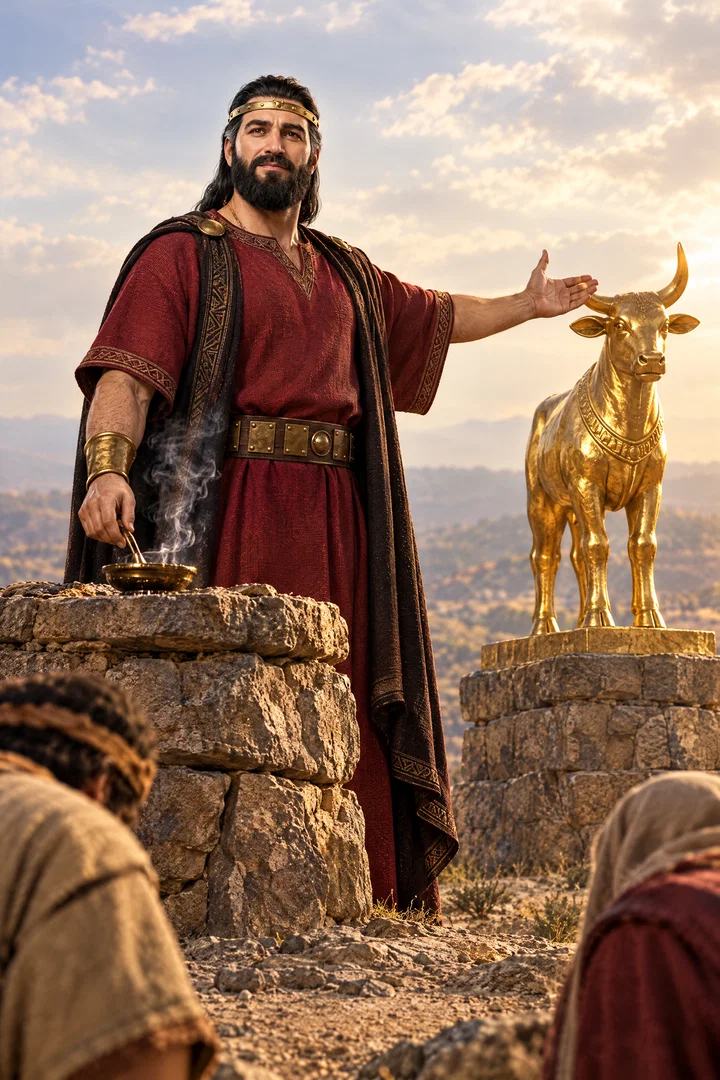
So he offered upon the altar which he had made in Beth-el the fifteenth day of the eighth month, even in the month which he had devised of his own heart; and ordained a feast unto the children of Israel: and he offered upon the altar, and burnt incense.
Translations
So he offered on the altar which he had made in Bethel the fifteenth day of the eighth month, even in the month which he had devised of his own heart; and ordained a feast to the children of Israel: and he offered on the altar, and burnt incense.
King James Version, KJV Cambridge Paragraph Bible
So he offered upon the altar which he had made in Beth-el the fifteenth day of the eighth month, even in the month which he had devised of his own heart; and ordained a feast unto the children of Israel: and he offered upon the altar, and burnt incense.
So he offered upon the altar which he had made in Beth-el the fifteenth day of the eighth month, even in the month which he had devised of his own heart; and ordained a feast to the children of Israel: and he offered upon the altar, and burnt incense.
Revised Version, American Standard Version
And he went up unto the altar which he had made in Beth-el on the fifteenth day in the eighth month, even in the month which he had devised of his own heart: and he ordained a feast for the children of Israel, and went up unto the altar, to burn incense.
And he offereth up on the altar that he made in Beth-El, on the fifteenth day of the eighth month, in the month that he devised of his own heart, and he maketh a festival to the sons of Israel, and offereth on the altar — to make perfume.
And he offered upon the altar that he had made in Bethel, on the fifteenth day of the eighth month, in the month which he had devised of his own heart; and he made a feast for the children of Israel, and he offered upon the altar, burning incense.
And he offered up on the altar which he had made in Bethel, on the fifteenth day in the eighth month, in the month which he had devised out of his own heart,—thus made he a festival for the sons of Israel, and offered up on the altar, to make a perfume.
Berean Standard Bible, Majority Standard Bible
On the fifteenth day of the eighth month, a month of his own choosing, Jeroboam offered sacrifices on the altar he had set up in Bethel. So he ordained a feast for the Israelites, offered sacrifices on the altar, and burned incense.
He went up to the altar which he had made in Bethel on the fifteenth day in the eighth month, even in the month which he had devised of his own heart; and he ordained a feast for the children of Israel, and went up to the altar to burn incense.
He went up to the altar he had made in Beth-el on the fifteenth day of the eighth month, the month fixed by him at his pleasure; and he gave orders for a feast for the people of Israel, and went up to the altar, and there he made the smoke of his offerings go up.
And he offered vpon the altar, which he had made in Beth-el, the fifteenth day of the eight moneth, (euen in the moneth which he had forged of his owne heart) and made a solemne feast vnto the children of Israel: and he went vp to the altar, to burne incense.
Douay-Rheims (Challoner revision)
And he went up to the altar, which he had built in Bethel, on the fifteenth day of the eighth month, which he had devised of his own heart: and he ordained a feast to the children of Israel, and went upon the altar to burn incense.
Pictures
Cross-references 20 of 22
- Amos 7:13
But prophesy not again any more at Beth-el: for it is the king’s chapel, and it is the king’s court.
Bethel’s chapel is identified as the king’s sanctuary.
- 1 Kings 13:1-5
And, behold, there came a man of God out of Judah by the word of the LORD unto Beth-el: and Jeroboam stood by the altar to burn incense.
A prophet denounces Jeroboam’s altar, and its breaking confirms God’s displeasure.
- Leviticus 23:34
Speak unto the children of Israel, saying, The fifteenth day of this seventh month shall be the feast of tabernacles for seven days unto the LORD.
Sets the appointed seventh-month feast that Jeroboam imitated.
- Exodus 32:4
And he received them at their hand, and fashioned it with a graving tool, after he had made it a molten calf: and they said, These be thy gods, O Israel, which brought thee up out of the land of Egypt.
Both texts credit an idol with bringing Israel out of Egypt.
- Genesis 28:19
And he called the name of that place Beth-el: but the name of that city was called Luz at the first.
Jacob named Bethel as God’s house, while Jeroboam established his altar at Bethel.
- Genesis 35:6-7
So Jacob came to Luz, which is in the land of Canaan, that is, Beth-el, he and all the people that were with him.
Jacob built an altar at Bethel, where God appeared to him.
- 1 Kings 11:38
And it shall be, if thou wilt hearken unto all that I command thee, and wilt walk in my ways, and do that is right in my sight, to keep my statutes and my commandments, as David my servant did; that I will be with thee, and build thee a sure house, as I built for David, and will give Israel unto thee.
God promised Jeroboam a lasting house if he obeyed.
- 1 Kings 14:16
And he shall give Israel up because of the sins of Jeroboam, who did sin, and who made Israel to sin.
Jeroboam’s sin led Israel into sin and brought judgment.
- Amos 7:9
And the high places of Isaac shall be desolate, and the sanctuaries of Israel shall be laid waste; and I will rise against the house of Jeroboam with the sword.
Israel’s idolatrous worship places are called sanctuaries.
- Genesis 12:8
And he removed from thence unto a mountain on the east of Beth-el, and pitched his tent, having Beth-el on the west, and Hai on the east: and there he builded an altar unto the LORD, and called upon the name of the LORD.
Abraham built an altar and worshiped at Bethel.
- 1 Kings 16:31-33
And it came to pass, as if it had been a light thing for him to walk in the sins of Jeroboam the son of Nebat, that he took to wife Jezebel the daughter of Ethbaal king of the Zidonians, and went and served Baal, and worshipped him.
Ahab’s Baal worship carries Jeroboam’s departure from Jehovah further.
- 1 John 5:21
Little children, keep yourselves from idols. Amen.
The lesson’s golden text warns against idols.
- 1 Kings 12:28-29
Whereupon the king took counsel, and made two calves of gold, and said unto them, It is too much for you to go up to Jerusalem: behold thy gods, O Israel, which brought thee up out of the land of Egypt.
Jeroboam set up a calf at Bethel to keep Israel from Jerusalem.
- 1 Kings 13:4
And it came to pass, when king Jeroboam heard the saying of the man of God, which had cried against the altar in Beth-el, that he put forth his hand from the altar, saying, Lay hold on him. And his hand, which he put forth against him, dried up, so that he could not pull it in again to him.
Jeroboam’s hand withers when he reaches against the prophet at Bethel.
- Deuteronomy 12:13-14
Take heed to thyself that thou offer not thy burnt offerings in every place that thou seest:
The Lord appointed where Israel was to worship, unlike Jeroboam’s chosen place and time.
- 2 Chronicles 11:15
And he ordained him priests for the high places, and for the devils, and for the calves which he had made.
Describes Jeroboam’s unauthorized worship centers and priests.
- 1 Kings 14:7-11
Go, tell Jeroboam, Thus saith the LORD God of Israel, Forasmuch as I exalted thee from among the people, and made thee prince over my people Israel,
Ahijah announces judgment on Jeroboam for his iniquity.
- 1 Kings 16:2
Forasmuch as I exalted thee out of the dust, and made thee prince over my people Israel; and thou hast walked in the way of Jeroboam, and hast made my people Israel to sin, to provoke me to anger with their sins;
Baasha’s sin recalls the sin Jeroboam led Israel to commit.
- 1 Kings 15:30
Because of the sins of Jeroboam which he sinned, and which he made Israel sin, by his provocation wherewith he provoked the LORD God of Israel to anger.
The continuing consequences reflect Jeroboam’s sins that led Israel into sin.
- 2 Kings 2:23-24
And he went up from thence unto Beth-el: and as he was going up by the way, there came forth little children out of the city, and mocked him, and said unto him, Go up, thou bald head; go up, thou bald head.
Elisha’s ministry near Bethel is contrasted with Jeroboam’s unlawful worship there.
Commentary
Each commentary is drawn from primary sources: the writings of Ellen G. White and Adventist pioneers and periodicals. Each commentary is separate. Its own words are not a quotation; follow the references to read the source passages.
Ellen G. White
2 sources
The verse describes Jeroboam himself mounting the altar he had erected at Bethel to burn incense and proclaiming a feast for Israel in the fifteenth day of the eighth month, a time chosen out of his own heart rather than by divine appointment.Lt 113, 1903, par. 14PK 102.3 By staging that dedication with great solemnity he sought to give sacred weight to his rival center, and the effect was to foster contempt and neglect for the appointed worship in the temple at Jerusalem.PK 102.3 Those plans, devised from his own spirit, drew the children of Israel away from God into idolatry and led them on to commit and to tolerate terrible evils.Lt 113, 1903, par. 14 Even when confronted by the prophet's message, which should have brought him to repentance and to abandonment of his scheme to turn Israel from true worship, he hardened his heart and determinedly persisted in his own way.PK 102.3
The Judge of all the earth holds Jeroboam accountable for the awful consequences that flowed from such a course.Lt 113, 1903, par. 14 That same accountability falls upon all who follow his example, for to their charge are laid the results of their own wrong course.Lt 113, 1903, par. 14 The spirit that moved him and a work of like character remain a living danger in the present time.Lt 113, 1903, par. 14
Sources
Pioneers and periodicals
49 sources
Jeroboam himself went up to the altar he had built at Bethel on the fifteenth day of the eighth month, ordained a feast for Israel, and offered sacrifice and burned incense there in a month he had devised out of his own heart.RH May 5, 1868ST Jul 2, 1885RH Jul 17, 1866 The feast kept the outward form of the Feast of Tabernacles appointed for the fifteenth day of the seventh month, but shifted it about a month later, so that keeping a feast in some month did not obey the command to keep it at its appointed time.ST Dec 7, 1882RH Oct 12, 1916ST Dec 7, 1882 In this he completed a self-made system of calf worship with its own place, priests, and time, setting up a rival sanctuary at Bethel against God's temple in Jerusalem to keep the ten tribes from going up to Jerusalem and turning their loyalty to its king.RH May 5, 1868ST Jun 29, 1904ST Jun 29, 1904RH Aug 1, 1871RH May 5, 1868 His change of the appointed time illustrates the same disobedience as changing the Sabbath to another day by human authority, for keeping a different day does not obey the command to keep the seventh day.RH Oct 22, 1861ST Dec 7, 1882ST Jun 3, 1886 This humanly devised worship was not appointed by God and He did not accept it, but rebuked it and brought sin upon the people and judgment against Jeroboam's house.RH Jul 17, 1866RH May 13, 1875ST Apr 28, 1909
Historical Setting After Division
After Solomon's death the ten tribes revolted from his son Rehoboam and elected Jeroboam king over them, separating from Judah and Benjamin under Jeroboam.ST Dec 7, 1882RH May 1, 1879 They so completely severed the houses of Judah and Israel that they were never united again under the same government.ST Dec 7, 1882 Rehoboam was weak and foolish, rejecting the reasonable complaints of the men of Israel that Solomon had overtaxed and oppressed them by haughtily answering that his little finger should become greater than his father's loins and that whereas his father had chastised them with whips he would chastise them with scorpions.ST Dec 7, 1882 Jeroboam was a man of genius and a stronger king than Rehoboam, to whom Jehovah had given the kingdom through the prophesying of Elijah, yet he had a defect of reverence for God, for no sooner was he firmly seated upon his throne than he deliberately set at naught the commands of the God who had given him his empire.ST Dec 7, 1882ST May 20, 1913 Those tribes carried copies of the books of Moses with them, and this verse shows Jeroboam's idolatry and deliberate disobedience after the division.ST Dec 7, 1882RH May 1, 1879
The verse belongs to the history of the kings after the division of Israel into the kingdoms of Israel and Judah.RH May 25, 1916ST Apr 26, 1910ST Jul 30, 1885 It stands within the account of the two separate kingdoms after the ten tribes revolted, in a history spanning about eighty years and covering the reigns of several kings of both kingdoms.RH May 25, 1916ST Jul 30, 1885 That historical record shows a general downward moral tendency.ST Apr 26, 1910 It teaches that faithful leaders influence the people toward God, while leaders who fail to lead rightly contribute to the people's failure.ST Apr 26, 1910
Jeroboam induced the ten tribes to revolt from Rehoboam when the kingdom was divided, and his great mistake was to set up altars against the altar of God.ST May 20, 1913 Bethel's sacred associations with Abraham, Jacob, the ark, and Samuel helped him draw Israel there for an idolatrous system of worship.ST Jul 2, 1885 Its location made the apostasy especially conspicuous, since worshipers coming from the north could see Solomon's temple in Jerusalem.ST Sep 29, 1898 The account also associates Bethel with the prophet whose warning Jeroboam rejected when he reached toward him.ST Sep 29, 1898
Feast Date and Worship
Jeroboam himself went up to the altar he had made in Bethel on the fifteenth day of the eighth month, ordained a feast for the children of Israel, and offered sacrifices and burned incense there.RH May 5, 1868ST Jun 29, 1904ST Jul 2, 1885RH Jul 17, 1866ST Jun 29, 1904 He set the feast for that date by his own decision and choice rather than following God's appointed way of worship and rather than following the feast in Judah.RH May 5, 1868ST Jul 2, 1885RH Jul 17, 1866ST Sep 7, 1904 His feast and worship were human substitutes for the worship God had appointed, part of a rival system that kept the people from going to Jerusalem, and God did not accept them.RH May 5, 1868ST Jul 2, 1885RH Jul 17, 1866 That worship connected with the calves soon cut Israel short.RH Jul 17, 1866
The feast resembled Judah's autumn Feast of Tabernacles held on the fifteenth day of the seventh month, preserving its outward form and appearance while shifting it about a month later.ST Dec 7, 1882RH Oct 12, 1916ST Dec 7, 1882 This humanly devised festival was a counterfeit that replaced the divinely appointed annual observance, imitating the feast in Judah while subverting God's appointed time.ST Dec 7, 1882RH Oct 12, 1916ST Dec 7, 1882 Keeping a feast in some month does not obey the command to keep it at its appointed time.RH Mar 23, 1852 Changing the time of a divinely appointed observance to suit human choice or convenience is disobedience even when the observance is not abandoned altogether.ST Dec 7, 1882ST Dec 7, 1882
All this service at Bethel — the altar Jeroboam made, the feast he ordained, its date in a month devised out of his own heart and by his own judgment and choice, and his going up to offer incense — was of his own devising.ST Jun 29, 1904ST Jun 29, 1904RH Aug 1, 1871RH Dec 23, 1915 In doing so he left the path of the Lord's commandments for the bypath of human tradition.RH Dec 23, 1915 He thereby completed a self-made system of calf worship with its own place, priests, and time, which is idolatry to be kept from.ST Jun 29, 1904 He made Bethel, the house of God, into his own chapel and court, drawing disciples after himself rather than leading God's disciples.RH Dec 23, 1915
Rival Sanctuary and Idolatry
Jeroboam established a rival sanctuary and chapel at Bethel in opposition to God's temple and sanctuary in Jerusalem, where he made an altar, set a feast on a date of his own choosing, and offered sacrifices and burned incense.RH Sep 1, 1863RH Feb 3, 1853RH Feb 15, 1870RH Nov 10, 1863 By this counterfeit sanctuary he drew ten of Israel's twelve tribes away from the worship of the living and true God toward the golden calves, turning them aside from God's sanctuary.RH Sep 1, 1863RH Feb 3, 1853ST Jul 1, 1880RH Feb 15, 1870 His setting of the feast and his worship by his own devising showed rejection of God's appointed worship.RH Sep 1, 1863RH Feb 3, 1853RH Feb 15, 1870RH Nov 10, 1863 This rival place of worship raised after Solomon's temple was built belonged to Satan's opposition to God's sanctuary.RH Nov 10, 1863
The Bethel chapel is called a sanctuary even though it was used for idolatrous worship, showing that the Bible can apply that name to a place of heathen worship.ST Aug 3, 1915RH Jan 6, 1853 It stood as a rival to the temple of Jehovah at Jerusalem, with its self-chosen feast date, its man-made altar, and its burnt incense.ST Aug 3, 1915RH Jan 6, 1853
The calves were not presented as a change to another god but as representations of Jehovah, the God who brought their ancestors out of Egypt, set up with a claim of zeal for Jehovah.RH Aug 1, 1871ST Apr 26, 1910ST Jul 2, 1885ST Dec 4, 1893 Yet this image worship violated the second commandment and made Israel sin, and the sin continued despite God's solemn warnings.RH Aug 1, 1871ST Apr 26, 1910 It was counterfeit worship replacing devotion to God with idolatry, described as attempting to worship Jehovah while compromising with Baal.ST Dec 4, 1893ST Jun 17, 1886 That divided worship persisted from Jeroboam's time and contributed to Israel's eventual captivity.ST Jun 17, 1886 Bethel's sacred associations with Abraham, Jacob, the ark, and Samuel helped draw Israel there into this idolatrous system.ST Jul 2, 1885
The calf worship and feast were a political measure to keep the people from going to Jerusalem lest they transfer loyalty to its king, and thereby to maintain separation from the true people of God.RH May 5, 1868RH May 5, 1868ST Apr 24, 1901ST Feb 14, 1884ST Apr 24, 1901 By creating a rival system of worship imitating God's commanded festival while changing its timing, Jeroboam extended his rule from civil government into religion.RH May 5, 1868RH May 5, 1868ST Apr 24, 1901 In this way he strengthened the state by keeping religious allegiance under the king's control.ST Apr 24, 1901ST Apr 24, 1901
Changing Times and Sabbath
Jeroboam set a feast at Bethel on a date he had chosen himself and not the appointed date, offering sacrifices and incense on an altar he had made, and in this Israel's apostasy began with changes to what God had ordained.RH Oct 22, 1861ST Dec 7, 1882ST Jun 3, 1886 To change the Sabbath to another day is the same kind of change, for to choose another day for Sabbath observance without divine authority is to disregard God's command.RH Oct 22, 1861ST Dec 7, 1882 Keeping a feast in some month does not obey the command to keep it at its appointed time, and likewise keeping a different day does not obey the fourth commandment's requirement to keep the seventh day.RH Oct 22, 1861RH Mar 23, 1852 The seventh day is joined to the Sabbath by God and is not to be put aside by human choice, in contrast to a religious day set up by human choosing.ST Jun 3, 1886RH Mar 23, 1852 The setting of a worship feast in Bethel on a date chosen by a ruler rather than the appointed time is an example of replacing seventh-day worship commanded by the Great King with a day devised by a ruler, and of adding humanly appointed religious days, ceremonies, and rites that turn people away from God.RH Oct 22, 1861ST Dec 7, 1882
The feast held on the fifteenth day of the eighth month resembled Judah's autumn Feast of Tabernacles held on the fifteenth day of the seventh month, preserving its outward form while shifting it about a month later and subverting God's appointed time.ST Dec 7, 1882ST Dec 7, 1882RH Mar 23, 1852 The verse thus shows the difference between keeping a divinely appointed observance at its specified time and changing its timing to suit human choice or convenience.ST Dec 7, 1882ST Dec 7, 1882 Changing the time of a divinely appointed observance to suit human choice is disobedience even when the observance is not abandoned altogether.ST Dec 7, 1882ST Dec 7, 1882
The choice of a new observance date accompanied worship of the calves and rivaled the worship centered in Jerusalem, being used in worship at the altar he had made rather than following the established feast calendar.RH May 5, 1868RH May 5, 1868 The feast imitated God's commanded festival but changed its timing, helping maintain separation from the true people of God.RH May 5, 1868RH May 5, 1868 In this way those who turn from the Creator and establish other gods may also establish new days of observance in place of God's institutions.RH May 5, 1868RH May 5, 1868
Doctrinal Lessons and Warnings
Jeroboam's feast and worship at Bethel were human substitutes for the worship God had appointed, devised from his own judgment and choice and not appointed by God, and God did not accept them.RH Jul 17, 1866RH May 13, 1875ST Apr 28, 1909 His offering of sacrifices and burning of incense on the altar he had made was part of his idolatry over the ten tribes and brought God's rebuke.RH Jul 17, 1866RH May 13, 1875ST Apr 28, 1909 That self-devised worship left a shameful mark at Bethel and Dan, bringing no blessing but a curse, and Israel was soon cut short.RH Jul 17, 1866RH Mar 4, 1873 Though God had offered Jeroboam a secure throne if he obeyed the Lord's commandments, he chose selfish interests and devised worship for himself, bringing sin upon the people and provoking God's judgment against his house.RH Mar 4, 1873RH May 9, 1871
He established worship according to his own choice rather than God's command in order to achieve his desired end.ST Jul 2, 1885ST Jul 2, 1885RH Apr 7, 1910 The worship he offered provided an easier and more appealing alternative to going to Jerusalem and following the place and manner of worship the Lord had appointed, treating worship of the same God in a different way as acceptable despite disobedience.ST Jul 2, 1885ST Jul 2, 1885 Choosing a more convenient form of worship according to one's own wishes is not worshiping the Lord but worshiping oneself.ST Jul 2, 1885 The principle of putting the end above the means by using religious means that are not right can corrupt faith and lead people into sin and ruin.RH Apr 7, 1910 His changes, while presented as retaining the worship of Jehovah, began a departure from God that could widen into open pagan worship, showing that symbolic and sensory additions to worship are dangerous because they can become hindrances and lead people farther from God, and standing as a warning against prideful, impatient action.RH Mar 4, 1873ST
His attempt to give solemnity to this strange worship by dedicating a man-made altar at Bethel dishonored the worship of Jehovah at the temple in Jerusalem.RH Jul 17, 1913RH Mar 11, 1858 The feast and its date were devised by himself rather than appointed by God, and the verse illustrates an effort to divert people from the worship of the true God through heathen rites toward the golden calves.RH Mar 11, 1858 The calves are compared to an unauthorized religious institution: God's blessing on people who honor it comes in spite of the institution, not because of it.ST Sep 10, 1894
Sources