1 Kings 13:4
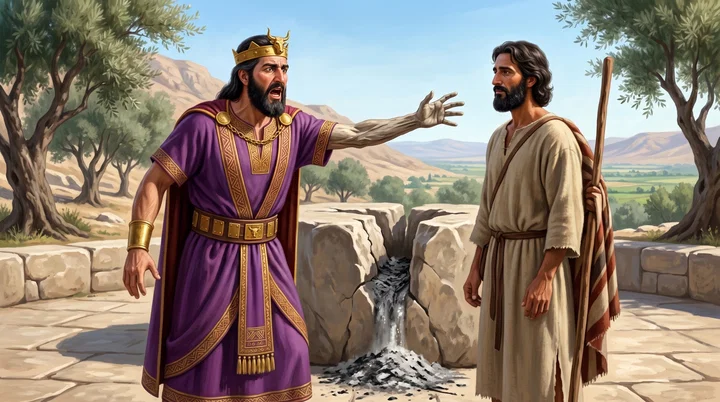
And it came to pass, when king Jeroboam heard the saying of the man of God, which had cried against the altar in Beth-el, that he put forth his hand from the altar, saying, Lay hold on him. And his hand, which he put forth against him, dried up, so that he could not pull it in again to him.
Translations
And it came to pass, when king Jeroboam heard the saying of the man of God, which had cried against the altar in Bethel, that he put forth his hand from the altar, saying, Lay hold on him. And his hand, which he put forth against him, dried up, so that he could not pull it in again to him.
King James Version, KJV Cambridge Paragraph Bible
And it came to pass, when king Jeroboam heard the saying of the man of God, which had cried against the altar in Beth-el, that he put forth his hand from the altar, saying, Lay hold on him. And his hand, which he put forth against him, dried up, so that he could not pull it in again to him.
And it came to pass when king Jeroboam heard the saying of the man of God, who had cried against the altar in Beth-el, that he put forth his hand from the altar, saying, Lay hold on him. And his hand, which he put forth against him, dried up, so that he could not draw it to him again.
Revised Version, American Standard Version
And it came to pass, when the king heard the saying of the man of God, which he cried against the altar in Beth-el, that Jeroboam put forth his hand from the altar, saying, Lay hold on him. And his hand, which he put forth against him, dried up, so that he could not draw it back again to him.
And it cometh to pass, at the king's hearing the word of the man of God that he calleth against the altar in Beth-El, that Jeroboam putteth forth his hand from off the altar, saying, 'Catch him;' and his hand is dried up that he hath put forth against him, and he is not able to bring it back unto him,
And it came to pass when the king heard the word of the man of God, which he cried against the altar in Bethel, that Jeroboam stretched forth his hand from the altar, saying, Lay hold on him. And his hand which he stretched out against him dried up, so that he could not bring it back again to him.
And it came to pass, when the king heard the word of the man of God which he proclaimed against the altar in Bethel, Jeroboam thrust forth his hand, from off the altar, saying—Lay hold of him! and his hand which he had thrust forth against him was dried up, that he could not draw it back to him.
Berean Standard Bible, Majority Standard Bible
Now when King Jeroboam, who was at the altar in Bethel, heard the word that the man of God had cried out against it, he stretched out his hand and said, “ Seize him!” But the hand he stretched out toward him withered, so that he could not pull it back.
When the king heard the saying of the man of God, which he cried against the altar in Bethel, Jeroboam put out his hand from the altar, saying, “ Seize him!” His hand, which he put out against him, dried up, so that he could not draw it back again to himself.
Then the king, hearing the man of God crying out against the altar at Beth-el, put out his hand from the altar, saying, Take him prisoner. And his hand, stretched out against him, became dead, and he had no power of pulling it back.
And when the King had heard the saying of the man of God, which he had cryed against the altar in Beth-el, Ieroboam stretched out his hand from the altar, saying, Lay holde on him: but his hande which he put foorth against him, dryed vp, and he could not pull it in againe to him.
Douay-Rheims (Challoner revision)
And when the king had heard the word of the man of God, which he had cried out against the altar in Bethel, he stretched forth his hand from the altar, saying: Lay hold on him. And his hand which he stretched forth against him withered: and he was not able to draw it back again to him.
Pictures


Cross-references
- 2 Kings 23:15-16
Moreover the altar that was at Beth-el, and the high place which Jeroboam the son of Nebat, who made Israel to sin, had made, both that altar and the high place he brake down, and burned the high place, and stamped it small to powder, and burned the grove.
Josiah’s actions at Bethel fulfilled the prophecy against the altar.
- 1 Kings 13:24
And when he was gone, a lion met him by the way, and slew him: and his carcase was cast in the way, and the ass stood by it, the lion also stood by the carcase.
The lion’s slaying confirms the punishment for disobeying God’s command.
- 1 Kings 12:28-33
Whereupon the king took counsel, and made two calves of gold, and said unto them, It is too much for you to go up to Jerusalem: behold thy gods, O Israel, which brought thee up out of the land of Egypt.
Jeroboam’s calf worship at Bethel is condemned by the man of God.
- 1 Kings 13:18
He said unto him, I am a prophet also as thou art; and an angel spake unto me by the word of the LORD, saying, Bring him back with thee into thine house, that he may eat bread and drink water. But he lied unto him.
The man of God trusts the prophet’s lie and disobeys the LORD’s command.
- 1 Kings 13:33-34
After this thing Jeroboam returned not from his evil way, but made again of the lowest of the people priests of the high places: whosoever would, he consecrated him, and he became one of the priests of the high places.
Jeroboam persisted in evil and unauthorized worship despite signs, bringing judgment on his house.
- 1 Kings 12:32
And Jeroboam ordained a feast in the eighth month, on the fifteenth day of the month, like unto the feast that is in Judah, and he offered upon the altar. So did he in Beth-el, sacrificing unto the calves that he had made: and he placed in Beth-el the priests of the high places which he had made.
Jeroboam’s unauthorized changes to worship at Bethel are followed by judgment there.
- 1 Kings 12:33
So he offered upon the altar which he had made in Beth-el the fifteenth day of the eighth month, even in the month which he had devised of his own heart; and ordained a feast unto the children of Israel: and he offered upon the altar, and burnt incense.
Jeroboam devised a feast month from his own heart.
- 1 Kings 13:8
And the man of God said unto the king, If thou wilt give me half thine house, I will not go in with thee, neither will I eat bread nor drink water in this place:
prophet refuses Jeroboam's hospitality after healing
- 1 Kings 12:31
And he made an house of high places, and made priests of the lowest of the people, which were not of the sons of Levi.
Jeroboam’s false worship persisted despite the altar warning.
- 1 Kings 13:21-22
And he cried unto the man of God that came from Judah, saying, Thus saith the LORD, Forasmuch as thou hast disobeyed the mouth of the LORD, and hast not kept the commandment which the LORD thy God commanded thee,
The disobedient prophet receives a sentence of judgment.
- 2 Chronicles 26:19
Then Uzziah was wroth, and had a censer in his hand to burn incense: and while he was wroth with the priests, the leprosy even rose up in his forehead before the priests in the house of the LORD, from beside the incense altar.
Both kings respond angrily to reproof and suffer divine judgment.
- 1 Kings 13:16-17
And he said, I may not return with thee, nor go in with thee: neither will I eat bread nor drink water with thee in this place:
repeats divine ban on eating and returning
- 1 Kings 12:27
If this people go up to do sacrifice in the house of the LORD at Jerusalem, then shall the heart of this people turn again unto their lord, even unto Rehoboam king of Judah, and they shall kill me, and go again to Rehoboam king of Judah.
Jeroboam feared Israel would return to Jerusalem and Rehoboam, so he sought to alienate them.
- 2 Chronicles 13:19
And Abijah pursued after Jeroboam, and took cities from him, Beth-el with the towns thereof, and Jeshanah with the towns thereof, and Ephrain with the towns thereof.
Bethel’s capture did not end its role as a rival sanctuary.
Commentary
Each commentary is drawn from primary sources: the writings of Ellen G. White and Adventist pioneers and periodicals. Each commentary is separate. Its own words are not a quotation; follow the references to read the source passages.
Ellen G. White
14 sources
At Bethel a messenger cried against the altar with the sign that it would split and spill its ashes, and when Jeroboam in anger stretched out his hand to order him seized, that hand dried up, withered and became powerless so he could not draw it back.Ms 1, 1912, par. 9–10Ms 153, 1906Ms 1, 1912, par. 11Ms 153, 1906, par. 1–2 The sudden withering stopped the profane offering and restrained the attack as a swift rebuke confirming the word by divine power and showing God's displeasure with defiance and idolatrous worship, yet God spared the king's life and healed the arm when he earnestly asked for prayer.Ms 153, 1906Ms 1, 1912, par. 11Ms 153, 1906, par. 1–2PK 102.1–2Ms 153, 1906, par. 7–9 That sign should have led Jeroboam to repent, abandon his evil course and serve the Lord, but he was not humbled and instead hardened his heart and persisted in wrongdoing.Ms 153, 1906Ms 153, 1906, par. 1–2PK 102.3RH Jul 24, 1913Ms 1, 1912, par. 17 The memory of the withered arm lived on to Ahab, filling him with dread of God's messenger so that though he feared and hated Elijah he dared not lift his hand against him and obeyed the summons to meet him.RH Sep 11, 1913PK 139.2–33T 278.1–2
Hand Withered at Bethel
The verse belongs to the confrontation at Bethel, where a man of God cried a message against the altar, giving as its accompanying sign that the altar would be split apart and its ashes poured out.Ms 1, 1912, par. 9–10 In anger at those words against the altar, Jeroboam ordered the messenger to be seized.Ms 153, 1906Ms 1, 1912, par. 11Ms 153, 1906, par. 1–2 When he put forth his hand from the altar against the man of God, that outstretched hand immediately dried up, withered, became powerless and paralyzed, so that he could not pull it back again to himself.Ms 153, 1906Ms 1, 1912, par. 11Ms 153, 1906, par. 1–2PK 102.1–2Ms 153, 1906, par. 7–9
The sudden withering interrupted the idolatrous offering and the profane sacrifice he was making.Ms 153, 1906Ms 153, 1906, par. 1–2 It restrained his attack on the messenger and left his arm and hand helpless.Ms 153, 1906, par. 7–9 Rather than destroying the defiant king at once, God bore with him to arouse him.Ms 153, 1906, par. 1–2 When the king earnestly asked the man of God to pray for him, the hand was healed.Ms 153, 1906, par. 7–9
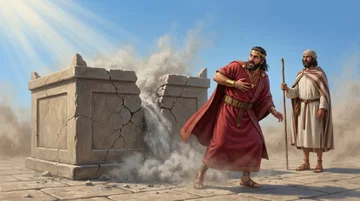
The stroke was a swift rebuke and a confirming sign that the word spoken against the altar was backed by divine power.Ms 1, 1912, par. 11PK 102.1–2PK 107.1 It showed God's displeasure with defiance and with the attempt to seize His messenger.PK 102.1–2Ms 153, 1906, par. 7–9PK 102.3 It marked the idolatrous sacrifices as an abomination to God.Ms 153, 1906, par. 7–9 It declared His displeasure with the attempt to establish false worship and to turn Israel away from worship at Jerusalem, while the palsied arm together with the tearing apart of the altar warned the king that he should stop doing wrong.PK 102.3PK 107.1
Warning Rejected and Remembered
The withered hand, together with the altar torn apart and the fate and death of the disobedient prophet, was meant to bring Jeroboam to repentance.PK 102.3RH Jul 24, 1913Ms 1, 1912, par. 17PK 107.1 It should have led him to abandon his evil ways and his plans for false worship, to stop doing wrong, and to turn and serve the Lord.PK 102.3RH Jul 24, 1913Ms 1, 1912, par. 17PK 107.1 The rent altar, the palsied arm, and the prophet's end stood as united warnings of divine displeasure that he should have heeded.RH Jul 24, 1913Ms 1, 1912, par. 17PK 107.1
He was not humbled by the warning before the judgment fell.Ms 153, 1906 When the message was cried against the altar he answered not with humility but by ordering the messenger seized.Ms 153, 1906, par. 1–2 Instead of repenting he hardened his heart, chose his own way, and persisted in wrongdoing, showing how sin hardens the heart.Ms 153, 1906, par. 1–2PK 102.3RH Jul 24, 1913
The memory of that withered arm lived on and stayed with Ahab.RH Sep 11, 1913PK 139.2–33T 278.1–2 It filled him with dread mingled with astonishment when Elijah summoned him.PK 139.2–3 Though he feared and hated Elijah as God's messenger and dreaded another woe against Israel, he dared not lift his hand to harm him.RH Sep 11, 1913PK 139.2–33T 278.1–2 He could not avoid obeying the summons, so the trembling king went to meet the prophet.PK 139.2–3
The larger story of the disobedient prophet in this chapter does not by itself prove anyone to be a deceived prophet.Lt 11, 1890, par. 13 To call a person a deceived prophet on that ground alone is an accusation that must be supported.Lt 11, 1890, par. 13 It must be supported by showing how that person has walked contrary to God.Lt 11, 1890, par. 13
Sources
Pioneers and periodicals
28 sources
Jeroboam was officiating as priest at his rival altar at Bethel when a prophet from Judah cried against the altar itself, and in anger and defiance the king stretched out his hand to order the messenger seized, whereupon that hand withered and became paralyzed so that he could not draw it back again.ST Apr 28, 1909RH Mar 17, 1904ST Dec 2, 1880ST Dec 7, 1882RH Apr 7, 1910 At his plea the prophet prayed for him and the smitten arm was fully restored, after which the king invited him home to refresh himself and offered him a reward.RH Mar 17, 1904ST Dec 2, 1880ST Dec 7, 1882 The word cried against the altar was fulfilled about 340 years later when Josiah overthrew it and burned the bones of its priests upon it, showing God's words to be steadfast and exact.ST Mar 31, 1898ST May 10, 1910ST Jun 3, 1913 The account requires unquestioning obedience to God's explicit command, for the man of God at first obeyed but later turned back at another prophet's word and lost his life, teaching that personal duty must not be shifted by another's influence even when he is a prophet.RH Mar 17, 1904ST Feb 7, 1911ST Mar 31, 1898ST Dec 7, 1882ST Oct 23, 1884 The same history warns those who admit God commanded the seventh day yet hallow Sunday, for God is jealous of His right to prescribe time and will punish, not excuse, men changing it to suit their convenience.ST Dec 7, 1882
Confrontation at Bethel Altar
The verse stands in the wholly historical record of 1 Kings 3-21, part of the history of Israel's kings after the kingdom divided.ST Jul 30, 1885 It is a sad record full of important lessons showing the general downward moral tendency after David and the responsibility of leaders, where faithful kings and priests mold the people for good and unfaithful leaders cause the people to fail with them.ST Apr 26, 1910
Jeroboam was acting in his own capacity as high priest, making an offering upon the altar at Bethel in the presence of the people when the man of God cried against the altar.ST Dec 7, 1882 He was himself attempting to consecrate that altar as a rival to the true sanctuary altar at Jerusalem, to alienate the northern tribes from Jerusalem, after the sanctuary at Dan farthest away had already been consecrated.RH Apr 7, 1910 Bethel lay twelve miles north of Jerusalem at the consecrated abode of the patriarchal sanctuary, where Jeroboam had set up one of two altars with a golden figure of Egypt's sacred calf.RH Apr 7, 1910 The nameless prophet from Judah cried not so much against the king as against the altar being set apart, and at his word the altar was rent asunder as a sign of God's displeasure upon its existence, yet Jeroboam was not deterred but maintained the altars at Dan and Bethel.RH Apr 7, 1910
That calf worship was purely a political measure to hold the people from going up to Jerusalem to worship.ST Apr 26, 1910 It was not an abandonment of the great Jehovah, for Jeroboam still believed in Jehovah and the calves were set up as representatives of Jehovah to the people.ST Apr 26, 1910 It was a curse to the ten tribes from that time forward, so that Jeroboam made Israel to sin and that sin persisted among the ten tribes.ST Apr 26, 1910 The man of God had been commissioned and sent to Bethel to Jeroboam to condemn Bethel's false worship and cry out against the idolatry there, and this confrontation provides the setting for the prophet's later disobedience and death.RH May 13, 1875RH Dec 14, 1905ST Oct 23, 1884
When Jeroboam heard the saying cried against the altar in Bethel, he answered angrily and with defiance, putting forth his hand from the altar and ordering the man of God seized.ST Apr 28, 1909ST Dec 2, 1880ST Dec 7, 1882 Whether he reached out himself or commanded his arrest, the hand he stretched out against the messenger immediately dried up, withered and became paralyzed so completely that he could not pull it in again to him.ST Apr 28, 1909ST Dec 7, 1882ST Feb 7, 1911ST Dec 3, 1894 That withering halted his attempt to arrest the prophet, humbled the haughty king, attested the testimony, and showed that his power could not resist God's judgment.ST Apr 28, 1909ST Dec 2, 1880 It stands as God's rebuke of Jeroboam for his idolatry, showing that anger at divine correction brings a striking consequence in contrast to submission to reproof.ST Apr 28, 1909RH Mar 17, 1904
Jeroboam then asked the prophet to pray for him, the prophet's prayer was heard, and the smitten hand and arm were fully restored.RH Mar 17, 1904ST Dec 2, 1880ST Dec 7, 1882RH Dec 14, 1905ST Dec 7, 1882 Afterward from gratitude or curiosity Jeroboam invited the seer to go home with him to refresh himself and promised him a reward.ST Dec 7, 1882 The rent altar, the withered arm, and the prophet's fate were solemn warnings against the calf worship that Jeroboam should have heeded instead of persisting in wrongdoing.RH Jul 24, 1913ST Apr 26, 1910 Remembering this judgment, Ahab feared raising his hand against Elijah, whom he feared and hated, and dared not harm him.RH Sep 11, 1913RH Sep 30, 1873
Prophecy Against Altar Fulfilled
The verse belongs to God's prophecy against Jeroboam and his altar at Bethel.ST May 10, 1910ST May 20, 1913ST Dec 7, 1882 It was delivered by an unknown, nameless prophet from Judah who himself later disobeyed.ST May 20, 1913ST Dec 7, 1882 That prophet was sent to cry against the altar, predicting its overthrow and the burning of the bones of Jeroboam's priests upon it.ST Dec 7, 1882 That prophecy was fulfilled hundreds of years later, about 340 years later in the reign of Josiah, in Josiah's reformation, just as the Lord had declared.ST May 10, 1910ST Jun 3, 1913ST Dec 7, 1882 The long-delayed yet exact fulfillment shows that God's words are steadfast and exact.ST Mar 31, 1898
The king's attempt to seize the man of God was met with a miraculous sign in the withering of the outstretched hand.ST Jun 3, 1913ST Mar 4, 1880RH Mar 11, 1873ST Dec 7, 1882 The prophet's miracles in that encounter attested the truth of his warning against Bethel.ST Mar 4, 1880RH Mar 11, 1873
Authority Obedience and Warning
The withered hand at Bethel shows that God's commands and judgments are serious and that disobedience brings consequences.RH Mar 17, 1904ST Mar 31, 1898 The same account shows that His words are steadfast and exact, and that He requires unquestioning obedience from His people, then and now.RH Mar 17, 1904ST Mar 31, 1898
The man of God had been given an explicit command in no wise to take up lodging at Bethel, not to eat or drink there, and not to return by the same route but by a different route.ST Dec 7, 1882ST Mar 4, 1880ST Oct 23, 1884 That command was to be carried out to the letter until the same God with equal explicitness revoked it.ST Dec 7, 1882ST Mar 4, 1880 He obeyed at first, refusing food and lodging, yet later he turned back at another prophet's word and lost his life.ST Feb 7, 1911ST Mar 4, 1880ST Oct 23, 1884
God did not change the command He had given, even when the prophet was deceived into believing God had changed His mind.ST Dec 3, 1894ST Mar 4, 1880 The man should not have accepted another prophet's claim that the command had been changed, for one divine command cannot be nullified by a later claim of inspiration.ST Dec 3, 1894ST Mar 4, 1880 To alter a command by claiming divine authority is unreliable.ST Dec 3, 1894ST Mar 4, 1880
God's condemnation and visitation of wrath upon that man for disobedience was just, not harsh or unreasonable, though he was deceived by one who came claiming prophetic authority.ST Dec 7, 1882 That deceiver was one God never commanded him to listen to, and men are sometimes responsible for having been deceived when they fail to carry out God's explicit command and instead listen to an irresponsible party.ST Dec 7, 1882 The lesson is to hold to what God has made one's duty and not let another's influence shift that personal responsibility, even when that person is a prophet.ST Feb 7, 1911ST Dec 7, 1882
A disobedient prophet could still deliver a message from God and speak God's inspired word even though he was not obedient.ST Oct 1, 1894ST Dec 26, 1892 Inspiration came from God and not from the prophet's own character or understanding.ST Oct 1, 1894 The prophet's use as God's instrument did not depend on his holiness.ST Oct 1, 1894ST Dec 26, 1892
The Great Ruler is jealous of His right to prescribe the time at which things are to be done and will not tolerate men changing it to suit their convenience.ST Dec 7, 1882 To attempt to change the time of His statute is a palpable affront to His sovereignty that He will punish, not excuse.ST Dec 7, 1882 Jeroboam's devising a month of his own heart and the condemnation of the man of God sent to Bethel warn those who admit God commanded the seventh day yet hallow Sunday.ST Dec 7, 1882 If the Lord did not excuse the man of God who at least had the word of one who once had been a prophet, He surely will not excuse those who have not a single word from any inspired man for the first day as the Sabbath or for its substitution, but only the decrees of the pope who claims power to transfer the Sabbath from the last to the first day.ST Dec 7, 1882
Sources