1 Kings 13:3
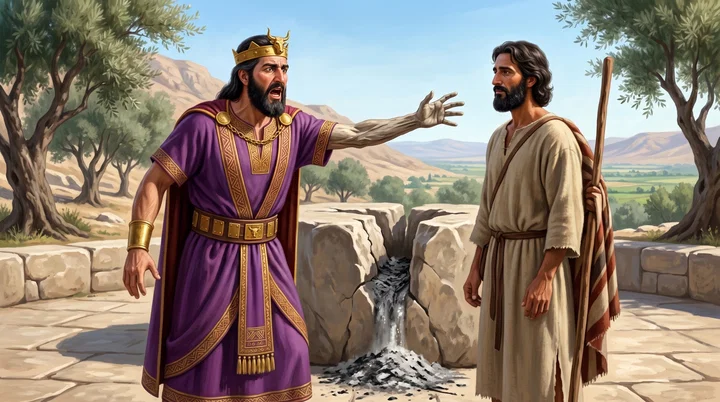
And he gave a sign the same day, saying, This is the sign which the LORD hath spoken; Behold, the altar shall be rent, and the ashes that are upon it shall be poured out.
Translations
And he gave a sign the same day, saying, This is the sign which the LORD has spoken; Behold, the altar shall be rent, and the ashes that are on it shall be poured out.
King James Version, Webster Bible
And he gave a sign the same day, saying, This is the sign which the LORD hath spoken; Behold, the altar shall be rent, and the ashes that are upon it shall be poured out.
And he gave a sign the same day, saying, This is the sign which the Lord hath spoken; Behold, the altar shall be rent, and the ashes that are upon it shall be poured out.
And he gave a sign the same day, saying, This is the sign which the LORD hath spoken: Behold, the altar shall be rent, and the ashes that are upon it shall be poured out.
And he gave a sign the same day, saying, This is the sign which Jehovah hath spoken: Behold, the altar shall be rent, and the ashes that are upon it shall be poured out.
And he hath given on that day a sign, saying, 'This [is] the sign that Jehovah hath spoken, Lo, the altar is rent, and the ashes poured forth that [are] on it.'
And he gave a sign the same day, saying, This is the sign that Jehovah hath spoken: Behold, the altar shall be rent, and the ashes that are upon it shall be poured out.
and he shall give, on that day, a sign, saying, This, is the sign of which Yahweh hath spoken,—Lo! the altar, is to be rent, and the ashes that are upon thee shall be, poured out!
Berean Standard Bible, Majority Standard Bible
That day the man of God gave a sign, saying, “ The LORD has spoken this sign: ‘ Surely the altar will be split apart, and the ashes upon it will be poured out.’”
He gave a sign the same day, saying, “ This is the sign which the LORD has spoken: Behold, the altar will be split apart, and the ashes that are on it will be poured out.”
The same day he gave them a sign, saying, This is the sign which the Lord has given: See, the altar will be broken and the burned waste on it overturned.
And he gaue a signe the same time, saying, This is the signe, that the Lord hath spoken, Behold, the altar shall rent, and the ashes that are vpon it, shall fall out.
Douay-Rheims (Challoner revision)
And he gave a sign the same day, saying: This shall be the sign, that the Lord hath spoken: Behold the altar shall be rent, and the ashes that are upon it shall be poured out.
Pictures
Cross-references
- 2 Kings 23:15-16
Moreover the altar that was at Beth-el, and the high place which Jeroboam the son of Nebat, who made Israel to sin, had made, both that altar and the high place he brake down, and burned the high place, and stamped it small to powder, and burned the grove.
Josiah fulfills the prophecy against Jeroboam’s altar.
- 1 Kings 13:24
And when he was gone, a lion met him by the way, and slew him: and his carcase was cast in the way, and the ass stood by it, the lion also stood by the carcase.
The prophet’s death after disobedience confirms the foretold judgment.
- 1 Kings 12:32
And Jeroboam ordained a feast in the eighth month, on the fifteenth day of the month, like unto the feast that is in Judah, and he offered upon the altar. So did he in Beth-el, sacrificing unto the calves that he had made: and he placed in Beth-el the priests of the high places which he had made.
shows further corruption at the rival worship
- 1 Kings 13:8-10
And the man of God said unto the king, If thou wilt give me half thine house, I will not go in with thee, neither will I eat bread nor drink water in this place:
The man of God refuses the king’s invitation and follows the Lord’s instructions.
- 1 Kings 13:18
He said unto him, I am a prophet also as thou art; and an angel spake unto me by the word of the LORD, saying, Bring him back with thee into thine house, that he may eat bread and drink water. But he lied unto him.
A false prophet lies about an angel’s message, tempting the man of God to disobey.
- 1 Kings 13:33-34
After this thing Jeroboam returned not from his evil way, but made again of the lowest of the people priests of the high places: whosoever would, he consecrated him, and he became one of the priests of the high places.
Jeroboam persists in wrongdoing despite the warning, bringing judgment on his house.
- 1 Kings 12:27
If this people go up to do sacrifice in the house of the LORD at Jerusalem, then shall the heart of this people turn again unto their lord, even unto Rehoboam king of Judah, and they shall kill me, and go again to Rehoboam king of Judah.
gives motive for the Bethel altar condemned
- 1 Kings 13:17
For it was said to me by the word of the LORD, Thou shalt eat no bread nor drink water there, nor turn again to go by the way that thou camest.
He recounts the Lord’s command that he disobeyed.
Commentary
Each commentary is drawn from primary sources: the writings of Ellen G. White and Adventist pioneers and periodicals. Each commentary is separate. Its own words are not a quotation; follow the references to read the source passages.
Ellen G. White
10 sources
At the dedication of Jeroboam son of Nebat's unconsecrated altar at Bethel, the man of God from Judah denounced the worship and gave an immediate sign the same day.PK 101.3–4PK 401.2–402.2 That altar had been set up in bold defiance of God to turn Israel away from the temple in Jerusalem to new forms of worship where many in years to come would be seduced into idolatrous practices.PK 401.2–402.2
The sign was that the altar would be split apart and the ashes upon it poured out, proving that the word spoken against it was from the Lord and confirming the message, warning, and prophecy to Jeroboam.Ms 1, 1912, par. 9–10Ms 153, 1906PK 101.3–4Ms 153, 1906, par. 1–2PK 102.3 The sign came to pass as foretold and immediately, when the altar was rent and the ashes poured out, showing the Lord's warning being fulfilled.Ms 1, 1912, par. 9–10Ms 153, 1906PK 101.3–4 The sign interrupted the king's idolatrous and profane offering, restrained his power in his assault on the messenger, and was meant to arouse him from his idolatrous course.Ms 153, 1906Ms 153, 1906, par. 1–2Ms 153, 1906, par. 7–9
The public splitting of the altar and pouring out of its ashes displayed God's displeasure with Israel's idolatrous worship and sacrifices, which were an abomination and could not make worship acceptable to Him.Ms 153, 1906, par. 7–9 It was meant to make a deep impression on the people, awaken awe, lead them to repentance, and warn the king and people of the consequences of apostasy.Ms 153, 1906, par. 7–9PK 102.3 The rent altar, together with the king's palsied arm and the death of the disobedient prophet who brought the message, formed three evidences confirming the truth of the prophecy and God's displeasure and warning Jeroboam to stop doing wrong, turn from evil, abandon his plans, and serve the Lord.PK 102.3RH Jul 24, 1913Ms 1, 1912, par. 17PK 107.1 He should have repented, but he hardened his heart and persisted in his chosen course.PK 102.3
The sign accompanied the announcement that a child named Josiah of the house of David would offer the priests of the high places upon that altar and burn men's bones upon it, a prophecy fulfilled literally three centuries later when Josiah stood at Bethel in his reformation.PK 401.2–402.2
Sources
Pioneers and periodicals
24 sources
The sign was to take place that very day, when the altar at Bethel would be torn apart and its ashes poured out and scattered as proof of the judgment pronounced against it and against Jeroboam.ST Dec 2, 1880RH Apr 6, 1905 It was given when a prophet from Judah was sent to confront the rival calf-worship Jeroboam had set up at Bethel and Dan with unworthy priests to keep Israel from Jerusalem, a political religion that made Israel to sin and drew God's rebuke.RH Jul 17, 1913RH May 25, 1916RH Dec 14, 1905ST May 20, 1913ST Dec 7, 1882 It came to pass exactly as spoken that same day, and with the withering of Jeroboam's outstretched hand and its healing at the prophet's prayer it proved the warning was truly from the Lord and humbled the king.ST Dec 2, 1880RH Apr 6, 1905ST Mar 4, 1880 Beyond that day it also sealed a far-reaching prediction of the altar's overthrow and the burning of its priests' bones upon it, fulfilled hundreds of years later in the reign of Josiah.ST Dec 7, 1882ST May 10, 1910ST Jun 3, 1913 Though the prophet later disobeyed God's plain command at another's word and was slain by a lion, the sign remained God's inspired word through an imperfect instrument, teaching that what God has clearly commanded must be obeyed to the letter and not set aside for any human claim, even as those who keep Sunday while admitting God commanded the seventh day will not be excused for changing His appointed time.RH Mar 17, 1904ST Feb 7, 1911RH May 13, 1875ST Dec 3, 1894ST Oct 1, 1894
Sign, Setting, and Fulfillment
The sign was to be fulfilled the same day: the altar at Bethel would be split apart and the ashes upon it poured out and scattered, confirming the announced judgment against Jeroboam and the altar.ST Dec 2, 1880RH Apr 6, 1905ST Feb 7, 1911RH Dec 14, 1905 The Lord confirmed the prophet's testimony by that sign, attesting His word and humbling the king, and the prophet's prayer afterward was heard.ST Dec 2, 1880RH Apr 6, 1905 The man of God announced the sign when he pronounced judgment on the altar, and the chapter's unnamed prophet who gave it afterward disobeyed God.ST Feb 7, 1911ST May 20, 1913
The verse belongs to the history of the divided kingdoms of Judah and Israel, falling within the period from the revolt of the ten tribes to Jehoshaphat's death.RH May 25, 1916 During that history an unnamed prophet from Judah was sent to Bethel to condemn the false worship Jeroboam had established there, crying out against the altar itself.RH Dec 14, 1905ST May 20, 1913RH Apr 7, 1910 The cry was directed not so much against the king as against the altar because it was being set apart as a rival to the true sanctuary altar at Jerusalem to alienate the northern tribes from worship there.RH Apr 7, 1910 He came when Jeroboam attempted to consecrate the Bethel altar after first consecrating the sanctuary at Dan farthest from Jerusalem, and at his word the altar was rent asunder as a sign of God's displeasure upon its existence and of God's opposition bringing judgment against that worship.RH Dec 14, 1905RH Apr 7, 1910
Jeroboam, while officiating himself as high priest, had erected golden-calf worship at Bethel and Dan with priests of the baser sort to keep the people from returning to the temple at Jerusalem.ST Dec 7, 1882 It was purely a political measure to hold the people from going up to Jerusalem to worship, yet Jeroboam still believed in the great Jehovah and the calves were designed as representatives of Jehovah to the people.ST Dec 7, 1882ST Apr 26, 1910 But the effect was that Jeroboam made Israel to sin, and that sin persisted despite solemn warnings, becoming a curse to the ten tribes from that time forward.ST Apr 26, 1910 That defiant worship drew God's rebuke, for the sign accompanying the prophet's warning at Jeroboam's altar was given by the word of the Lord and occurred immediately.RH Jul 17, 1913
Beyond the immediate rending, the verse confirms the long-range prophecy of the altar's overthrow and the burning of the bones of Jeroboam's priests upon it at a future time.ST Dec 7, 1882ST Dec 7, 1882 That destruction was fulfilled about 340 years later, hundreds of years later, during Josiah's reign, when Josiah carried out the prophesied action foretold by the disobedient prophet.ST Dec 7, 1882ST May 10, 1910ST Jun 3, 1913ST Dec 7, 1882 The immediate sign came to pass as the Lord had spoken that same day, showing that the message and its warning were from the Lord.RH Apr 6, 1905ST Mar 4, 1880RH Mar 11, 1873 When Jeroboam stretched out his arm and hand to arrest or order the arrest of the prophet, they became fully withered so he could not draw them back until the prophet prayed for his deliverance, and together with the altar's splitting and the king's palsied arm and later the prophet's own death after disobeying, the miracles confirmed the prophecy's truth, humbled the king, and warned Jeroboam not to persist in wrongdoing.RH Jul 24, 1913ST Dec 2, 1880ST Mar 4, 1880ST Dec 7, 1882
Obedience, Inspiration, and Warning
The man sent to Bethel at first obeyed the explicit command to take no lodging and to eat no bread and drink no water there, refusing the king's invitation and reward, but he afterward turned back and disobeyed after an old prophet deceived him by claiming a message from the Lord, and a lion met and killed him for that sin, though he had been in God's favor when sent.RH Mar 17, 1904ST Feb 7, 1911RH May 13, 1875ST Mar 4, 1880ST Dec 7, 1882 The sign he had announced attested that his warning and its confirming miracles were truly from the Lord, yet he should not have accepted a later claim that contradicted the Lord's command, and his disobedience cost him his life.RH Mar 17, 1904ST Feb 7, 1911ST Mar 4, 1880ST Dec 7, 1882 His command was as explicit as words could make it, and it was his business to carry it out to the letter until the same God who gave it revoked it with equal explicitness and emphasis.RH Mar 17, 1904ST Feb 7, 1911ST Dec 7, 1882
No person may lead another away from what God has commanded, and each person must hold to what God has clearly commanded and must not let another person, even a prophet, shift that personal responsibility or turn him from God's word.RH Mar 17, 1904ST Feb 7, 1911ST Mar 4, 1880ST Dec 7, 1882 No claimed divine message may be accepted as permission to alter a command God has already given personally, for God's word does not change, and a man was punished for believing that God had changed a command given to him personally.RH Mar 17, 1904ST Feb 7, 1911ST Dec 3, 1894ST Mar 4, 1880ST Dec 7, 1882 One must wait for an explicit Thus saith the Lord from God Himself, and not allow himself to be turned by the utterances of an irresponsible party whom God never commanded him to listen to and whom the devil controlled, since men are sometimes responsible for having been deceived.RH Mar 17, 1904ST Feb 7, 1911ST Mar 4, 1880ST Dec 7, 1882 The account shows that God means what He says and requires unquestioning obedience, and its lesson applies to people today.RH Mar 17, 1904ST Feb 7, 1911ST Mar 31, 1898ST Dec 3, 1894ST Dec 7, 1882 His condemnation of the disobedient man and visitation of wrath by the lion was just and not harsh, unreasonable, or unjust, and the death of one who turns from obedience illustrates facing the second death.RH May 13, 1875ST Mar 31, 1898ST Dec 7, 1882
Though the prophet disobeyed, the message of the sign was still God's inspired word spoken as God gave it and not the prophet's own, for he spoke what God gave him.ST Oct 1, 1894ST Dec 26, 1892 It is an example of God using an imperfect instrument to speak an inspired message, since a disobedient prophet delivered a message from God.ST Oct 1, 1894ST Dec 26, 1892 The verse confirms God's condemnation of changing what He appointed about time, for the Great Ruler is jealous of His right to prescribe when things are to be done and does not tolerate disregard of His command in point of time even where the manner of worship is kept.ST Dec 7, 1882 As the man of God was not excused when he disobeyed the word of the Lord through the word of one who had once been a prophet, those who hallow Sunday while admitting God commanded the seventh day will surely not be excused.ST Dec 7, 1882 They have no word ever spoken by any inspired man favoring the first day as the Sabbath or its substitution for the seventh under any circumstances, but only the decrees of the pope of Rome.ST Dec 7, 1882
Sources