1 Kings 17:13
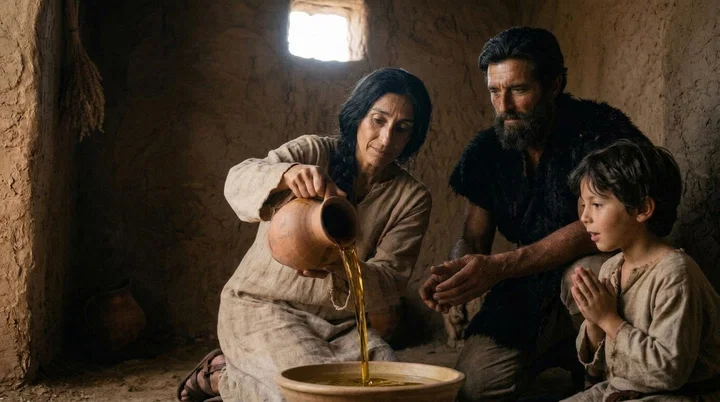
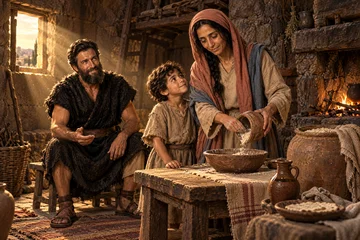
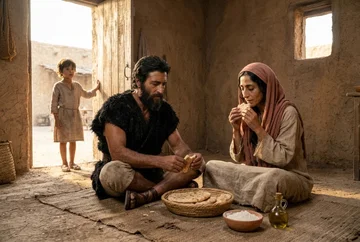
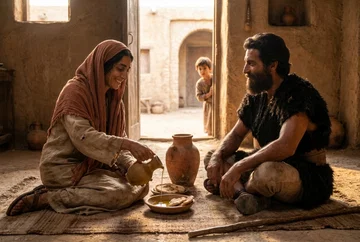
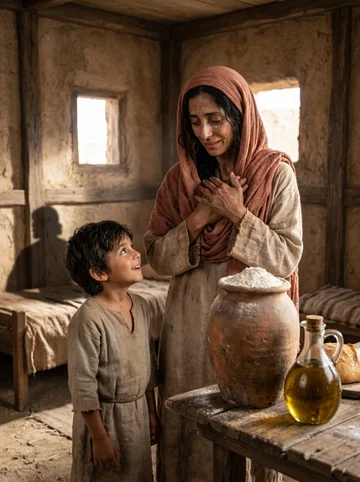
And Elijah said unto her, Fear not; go and do as thou hast said: but make me thereof a little cake first, and bring it unto me, and after make for thee and for thy son.
Translations
And Elijah said to her, Fear not; go and do as you have said: but make me thereof a little cake first, and bring it to me, and after make for you and for your son.
King James Version, KJV Cambridge Paragraph Bible
And Elijah said unto her, Fear not; go and do as thou hast said: but make me thereof a little cake first, and bring it unto me, and after make for thee and for thy son.
And Elijah said to her, Fear not; go and do as thou hast said: but make me of it a little cake first, and bring it to me, and afterward make for thee and for thy son.
And Elijah said unto her, Fear not; go and do as thou hast said: but make me thereof a little cake first, and bring it forth unto me, and afterward make for thee and for thy son.
And Elijah said unto her, Fear not; go and do as thou hast said; but make me thereof a little cake first, and bring it forth unto me, and afterward make for thee and for thy son.
And Elijah saith unto her, 'Fear not, go, do according to thy word, only make for me thence a little cake, in the first place, and thou hast brought out to me; and for thee and for thy son make — last;
And Elijah said to her, Fear not; go, do as thou hast said; but make me thereof a little cake first; and bring it to me; and afterwards make for thee and for thy son.
And Elijah said unto her—Do not fear, go in—make ready according to thy word,—howbeit, make me thereof a little cake, first, and bring it out to me, and, for thyself and thy son, make ready, afterwards.
Berean Standard Bible, Majority Standard Bible
“ Do not be afraid,” Elijah said to her. “ Go and do as you have said. But first make me a small cake of bread from what you have, and bring it out to me. Afterward, make some for yourself and your son,
Elijah said to her, “Don’t be afraid. Go and do as you have said; but make me a little cake from it first, and bring it out to me, and afterward make some for you and for your son.
And Elijah said to her, Have no fear; go and do as you have said, but first make me a little cake of it and come and give it to me, and then make something for yourself and your son.
And Eliiah said vnto her, Feare not, come, do as thou hast sayd, but make me thereof a litle cake first of all, and bring it vnto mee, and afterward make for thee, and thy sonne.
Douay-Rheims (Challoner revision)
And Elias said to her: Fear not, but go, and do as thou hast said: but first make for me of the same meal a little hearth cake, and bring it to me: and after make for thyself and thy son.
Pictures
Cross-references
- Luke 4:25-26
But I tell you of a truth, many widows were in Israel in the days of Elias, when the heaven was shut up three years and six months, when great famine was throughout all the land;
Jesus recalls Elijah’s mission to the widow of Sarepta during the famine.
- 1 Kings 17:1
And Elijah the Tishbite, who was of the inhabitants of Gilead, said unto Ahab, As the LORD God of Israel liveth, before whom I stand, there shall not be dew nor rain these years, but according to my word.
Elijah announces the drought that forms the setting for his visit to the widow.
- 1 Kings 17:6
And the ravens brought him bread and flesh in the morning, and bread and flesh in the evening; and he drank of the brook.
God miraculously provides food to preserve Elijah’s life.
- James 5:17
Elias was a man subject to like passions as we are, and he prayed earnestly that it might not rain: and it rained not on the earth by the space of three years and six months.
Elijah’s example shows a human prophet whose earnest prayer affected the rain.
- 1 Kings 17:9
Arise, get thee to Zarephath, which belongeth to Zidon, and dwell there: behold, I have commanded a widow woman there to sustain thee.
God sends Elijah to a widow whom he has commanded to sustain him.
- Matthew 14:19-21
And he commanded the multitude to sit down on the grass, and took the five loaves, and the two fishes, and looking up to heaven, he blessed, and brake, and gave the loaves to his disciples, and the disciples to the multitude.
Jesus multiplies a small offering to provide abundantly for a large crowd.
- 1 Kings 17:17-24
And it came to pass after these things, that the son of the woman, the mistress of the house, fell sick; and his sickness was so sore, that there was no breath left in him.
Elijah restores the life of the widow’s son, comforting his mother.
- Luke 7:12-15
Now when he came nigh to the gate of the city, behold, there was a dead man carried out, the only son of his mother, and she was a widow: and much people of the city was with her.
Both accounts portray a widow whose only son is restored to her.
- Mark 12:41-44
And Jesus sat over against the treasury, and beheld how the people cast money into the treasury: and many that were rich cast in much.
The widow gives all she has, like the widow of Zarephath.
- Malachi 4:5
Behold, I will send you Elijah the prophet before the coming of the great and dreadful day of the LORD:
Elijah is presented as a type of people who will serve before the day of the Lord.
- John 6:11
And Jesus took the loaves; and when he had given thanks, he distributed to the disciples, and the disciples to them that were set down; and likewise of the fishes as much as they would.
Jesus uses a little given to him to feed a multitude.
- 1 Kings 18
And it came to pass after many days, that the word of the LORD came to Elijah in the third year, saying, Go, shew thyself unto Ahab; and I will send rain upon the earth.
The chapter recounts rain returning through prayer.
- Luke 4:27
And many lepers were in Israel in the time of Eliseus the prophet; and none of them was cleansed, saving Naaman the Syrian.
Jesus pairs Elijah’s ministry to the widow with Naaman’s cleansing.
- Matthew 15:32-38
Then Jesus called his disciples unto him, and said, I have compassion on the multitude, because they continue with me now three days, and have nothing to eat: and I will not send them away fasting, lest they faint in the way.
Jesus feeds four thousand people with limited food.
- Luke 21:2-4
And he saw also a certain poor widow casting in thither two mites.
The widow is compared with one who gave all her living.
Commentary
Each commentary is drawn from primary sources: the writings of Ellen G. White and Adventist pioneers and periodicals. Each commentary is separate. Its own words are not a quotation; follow the references to read the source passages.
Ellen G. White
32 sources
Elijah, hidden by Cherith and then driven by drought and danger in Israel, was sent to a heathen Gentile widow of Zarephath in Sidon, whom he met gathering sticks at the city gate in famine and asked first for water and then for bread.PK 129.1–32SP 112.2–113.13T 288.1–2SLP 250.3LC1 53.2–54.1 She was poverty-stricken down to her last morsel and expecting to eat with her son and die, and his word to fear not but make a little cake for him first and afterward for herself and her son tested her faith to the utmost on God's promise to keep her meal and oil from failing.RH Aug 28, 19136T 345.4–346.1PK 130.1–2 She bore witness to her faith by sharing in hospitality and trust, and God by daily miracle sustained Elijah and preserved her and her son, showing His loving care.RH Aug 28, 19136T 345.4–346.1PK 130.1–22T 28.2 She lived faithfully by the light she had with kindness and liberality and became an asylum for God's servant, and she stands counted more righteous than God's chosen people whose unbelief, rebellion and rejection of warnings cut them off from blessing.PK 129.1–3DA 238.2–239.1ST Feb 17, 18812SP 113.2–3SLP 229.1–230.2 God sent Elijah to this Sidonian widow rather than to the many widows in Israel because He could not trust him with Israel, as Jesus recalled to show blessing going to Gentiles willing to trust, and His care then assures His self-sacrificing people that though in hardship they will be shielded and supplied and need not cling to earthly treasure for fear of want.SLP 229.1–230.22SP 112.2–113.1LC1 56.1Ms 40, 1887, par. 8–11LC1 53.2–54.1
Setting and Meaning
The woman is the widow of Zarephath, which belongs to Zidon or Sidon and is called Sarepta in New Testament times.PK 129.1–32SP 112.2–113.1ST Jun 23, 1909 She is a heathen Gentile woman, not an Israelite, without the privileges and blessings of the chosen people.PK 129.1–32SP 112.2–113.1DA 239.2–240.1 After denouncing judgment on Ahab for apostasy, Elijah had been hidden for many months by the brook Cherith and fed morning and evening by miracle.PK 129.1–3RH Oct 7, 1873 The continued drought dried the brook, and with no safety for him in Israel from hatred and Jezebel's power, God sent him to find refuge, asylum, protection and help in a heathen land.PK 129.1–33T 288.1–2SLP 250.3RH Nov 9, 1911AA 430.4–431.2
Elijah met the widow at the gate of the city gathering sticks during the three-and-a-half-year drought and famine.PK 129.1–32SP 112.2–113.1LC1 53.2–54.1 He first asked her for a little water to drink and then for a morsel of bread, which leads to the command in the verse.PK 129.1–3 She is poverty-stricken with almost no food left, down to her last morsel on the very day her meager fare seems about to fail.RH Aug 28, 19136T 345.4–346.1PK 130.1–2 She and her son are near starvation and expect to eat and die.RH Aug 28, 1913PK 130.1–2
In the verse Elijah tells her not to fear and to go and do as she had said.RH Aug 28, 1913PK 130.1–2DA 238.2–239.1 But she is to share her scarce food by making a little cake first for him and bringing it to him.RH Aug 28, 19136T 345.4–346.1PK 130.1–22T 28.2ST Feb 17, 1881 And afterward she is to make food for herself and for her son.RH Aug 28, 19136T 345.4–346.1PK 130.1–2DA 238.2–239.12T 28.2 His instruction tests to the utmost her faith in the power of the living God to provide for her necessities.RH Aug 28, 1913PK 130.1–2 It rests on God's promise to keep the meal and oil from running out until rain returns.RH Aug 28, 1913
Trust and Provision
Even in dire extremity she bore witness to her faith by complying with the word fear not and sharing her morsel with the prophet.6T 345.4–346.1PK 130.1–22T 28.2 She had almost no food left for herself and her son, down to her last morsel on the very day her meager fare seemed about to fail, when she expected to eat and die with her son, yet when asked for scarce food before preparing for herself and her son she gave a small cake first.6T 345.4–346.1PK 130.1–22T 28.2 That obedience in sharing with God's prophet was hospitality and generosity, and it was faith and trust in the power of the living God to provide for her necessities, tested to the utmost.6T 345.4–346.1PK 130.1–22T 28.2
His direction to make a little cake first for him and bring it to him, and afterward make for herself and her son, rested on God's promise to keep the meal and oil from running out until rain returns, given when she and her child were near starvation.RH Aug 28, 19136T 345.4–346.1 The meal and oil then lasted as God had promised, by a daily miracle that sustained Elijah and sustained her and her son and preserved their lives.6T 345.4–346.12T 28.2PK 131.53T 288.1–2RH Aug 28, 1913 That constant provision for Elijah and the widow's family showed His loving care and gave reason to trust, provision that should have kept Elijah from ever distrusting God.RH Aug 28, 19133T 288.1–2
By giving to him first in time of want and receiving God's provision, with her life and her son's life preserved in return for sharing her small portion, her act illustrates God's promise to bless those who give sympathy and help to others who are more needy and in need.PK 131.5RH Aug 28, 1913 God's care for Elijah during famine shows He will likewise care for His self-sacrificing people and self-sacrificing children who trust Him.GC88 629.2–4RH Nov 26, 1857SG2 243.1–245.1 Though they may suffer hardship and lack food, even in famine, they will not be left to perish but will be shielded and supplied with food and water and what they need.GC88 629.2–4RH Nov 26, 1857 The assurance that their bread and water will be sure encourages them to give their possessions to advance His work rather than cling to earthly treasure from fear of want.SG2 243.1–245.1
Light Accepted and Rejected
Though a heathen, the widow was a believer in the true God who walked in all the light shining on her pathway.PK 129.1–3ST Feb 17, 18814RED 5.3–7.12SP 113.2–3 She was favored and commanded to sustain Elijah because she lived faithfully according to the light she had, doing right as far as she could distinguish right from wrong.PK 129.1–3ST Feb 17, 18814RED 5.3–7.12SP 113.2–3 She had followed the light she received with kindness and liberality and was open to greater light from God through the prophet.DA 238.2–239.1ST Feb 17, 1881Ms 40, 1887, par. 8–11ST Jun 23, 1909 By her care for Elijah during the famine her home became an asylum and refuge for God's servant.PK 129.1–34RED 5.3–7.1ST Feb 17, 18812SP 113.2–3
Her faithfulness stands in contrast to people with greater light and privileges who profess godliness but live contrary to it.ST Feb 17, 18812SP 113.2–3Ms 8, 1888, par. 9–14 Israel's unbelief, rebellion, misuse of privileges, and rejection of warnings kept God from working for them and cut them off from the channel of blessing.2SP 113.2–3Ms 40, 1887, par. 8–11ST Jun 23, 1909 She lived up to the light she had received amid that unbelief and rebellion, and so is counted more righteous than God's chosen people who turned from Him and sacrificed principle for convenience and worldly honor.2SP 113.2–3SLP 229.1–230.2AA 416.2–417.1
During Israel's apostasy and famine God sent Elijah to this Sidonian widow rather than to the many widows in Israel.SLP 229.1–230.22SP 112.2–113.1Ms 40, 1887, par. 8–11LC1 53.2–54.1ST Jun 23, 1909 He could not trust him with Israel.SLP 229.1–230.22SP 112.2–113.1 She was a heathen woman who lived faithfully according to the light she had received, responding with kindness and liberality, so God sustained Elijah and provided for her.2SP 112.2–113.1Ms 40, 1887, par. 8–11ST Jun 23, 1909
Jesus recalled the event to show that Elijah was sent to a widow outside Israel rather than to the many widows in Israel.LC1 56.1LC1 53.2–54.1DA 239.2–240.1 It is connected to His reminder that God's prophets brought blessings to Gentiles when Israel rejected God.LC1 53.2–54.1DA 239.2–240.1 His ministry as a prophet chosen for a special work reached those willing to trust the evidence God gave.LC1 56.1LC1 53.2–54.1DA 239.2–240.1
Hatred forced Elijah to flee for safety and seek help, refuge, succor, protection and support from the widow of Sarepta.SLP 250.3RH Nov 9, 1911AA 430.4–431.2ST May 22, 1884ST May 22, 1884 That hatred was born of bigotry and self-righteousness, and her home among the heathen gave him refuge when he was unsafe among those who had rejected heavenly light.ST May 22, 1884RH Nov 9, 1911ST May 22, 1884ST May 22, 1884 The episode shows that a servant of God may be driven to seek protection and help beyond the people who have rejected God's light, finding safety and support among Gentiles.ST May 22, 1884RH Nov 9, 1911ST May 22, 1884 This is compared with Paul's greater safety among heathen rulers than before Jewish authorities.ST May 22, 1884RH Nov 9, 1911
Sources
Pioneers and periodicals
80 sources
Elijah meets a poor widow gathering sticks at the gate of Zarephath to bake a last meal from only a handful of meal and a little oil for herself and her son before they starve, and he tells her not to fear but to go as she planned yet make him a little cake first and bring it to him and afterward make for herself and her son.RH Aug 28, 1913RH Jun 24, 1902ST Jun 23, 1898 This happens in the long drought and famine after his word that there would be no dew nor rain, when want presses for three to three and a half years.ST Apr 17, 1907 His request to be served first when supplies are nearly gone tests her faith, and her obedience in trusting God's promise that the meal and oil would last until rain returns opens the way for blessing.RH Aug 28, 1913ST Jun 23, 1898RH Jan 16, 1872 God then makes her small supply sufficient for Elijah and the widow and her son for many days, daily replenished for a full year so the barrel does not waste and the cruse does not fail.ST Apr 6, 1888RH Jun 12, 1900ST Jun 6, 1900 The word first is the test, teaching to put God's claim and cause before immediate need whether one has abundance or little, trusting He will keep the supply unfailing.RH Mar 17, 1903RH Jan 16, 1872ST Mar 25, 1903 During Israel's famine he is sent past the many widows in Israel to only this heathen widow at Zarephath in Sidon, showing God's blessing is received by faith and is not limited to Israel.ST Dec 23, 1889ST Feb 19, 1894
Words and Setting
Elijah's word to the widow is "Fear not," bidding her to go and do as she had said, yet to make him a little cake first from what she has and bring it to him, and afterward to make for herself and for her son.RH Aug 28, 1913RH Jun 24, 1902ST Jun 23, 1898RH Mar 4, 1873ST Dec 5, 1895 He speaks this at the gate of Zarephath in answer to her statement that she has only a handful of meal and a little oil for a last meal for herself and her son, still urging his request for bread while giving encouragement.RH Aug 28, 1913RH Jun 24, 1902ST Jun 23, 1898 The request tests her faith when supplies are nearly gone and she and her child are near starvation, and it rests on God's promise that the meal and oil would last until rain returns, so that her obedience in giving first opens the way for promised provision and blessing.RH Aug 28, 1913ST Jun 23, 1898RH Mar 4, 1873 Her acting on it despite such scanty store brings no loss, for the supply does not fail, showing trust in God and submission to circumstances rather than neglect of the means God has provided, since no miracle is to be expected by those who neglect such means.RH Jun 24, 1902RH Mar 4, 1873ST Dec 5, 1895
The words are spoken to a poor widow found gathering sticks to bake her last cake so that she and her son might eat and die, having only enough food for one small meal from a handful of meal and a little oil.ST Jun 23, 1898RH Mar 13, 1900RH Feb 25, 1873RH Nov 1, 1853 God sends Elijah to her in her poverty to provide for the prophet, showing His care for His children when driven to their last extremity.RH Mar 13, 1900RH Feb 25, 1873 Because the Lord has said the barrel of meal would not waste and the cruse of oil would not fail, He lengthens that last provision and keeps alive the widow, her child, and His faithful servant through the famine.RH Feb 25, 1873RH Nov 1, 1853 By this He sustains the prophet through a most severe famine of three years, placing Elijah's ministry amid severe hardship and scarcity in her humble hut, circumstances through which his faith is strengthened.RH Feb 25, 1873
The setting is the long drought and famine after Elijah's word that there would be no dew nor rain, a period of suffering and want in which he prayed for Israel to turn from idolatry and waited patiently, trusting God's timing.ST Apr 17, 1907 It is reckoned as three years and as three years and six months when heaven was shut and great famine came over all the land, when there were many widows in Israel.RH Oct 7, 1873 After denouncing judgment on Ahab for apostasy, Elijah is hidden by the brook Cherith and fed morning and evening from heaven, and when the brook dries God sends him to the widow of Sarepta and works a miracle daily to keep the widow's family and Elijah in food.RH Oct 7, 1873 During that famine Ahab curses Elijah instead of repenting and hunts through his own and other kingdoms to find and kill him, but God preserves His servant's life, first by ravens and later through a poor widow of Sidon, to whom He makes the prophet a blessing.ST Apr 17, 1907
The work belongs to the region of Tyre and Sidon, for Elijah's help to the woman in 1 Kings 17:8-24 is in that region, the same region where Christ later met the Canaanite woman, also called the Syrophoenician woman.ST Mar 17, 1898ST Jul 4, 1900 Together with that later account it shows the object and mission of miracles.ST Mar 17, 1898
Zarephath is one of Elijah's hiding-places from the wrath of Ahab, where he finds refuge in the widow's humble dwelling and is upheld and protected by God.ST Mar 14, 1878ST Sep 8, 1898 It is a refuge and succor from the hatred and power of Jezebel, sought when he has to flee and is unsafe among those who have rejected heavenly light.RH Nov 9, 1911RH Oct 7, 1873ST May 22, 1884 Hatred born of bigotry and self-righteousness forces him to flee, so that a servant of God is driven to seek protection and help beyond the people who have rejected God's light, even among the heathen.RH Nov 9, 1911ST May 22, 1884ST May 22, 1884 The poor widow takes him in and gives him welcome refuge and help, though not a secure asylum, the same kind of shelter John Huss found with a poor widow at Constance.ST May 28, 1885
Divine Provision in Famine
God made the widow's little meal and oil enough to keep three people alive, Elijah with the widow and her son, by renewing the supply day by day so that the barrel did not waste and the cruse did not fail.ST Apr 6, 1888RH Dec 17, 1914ST Oct 22, 1902RH Nov 1, 1853 The household ate for many days, for a full year through the famine, on the food thus furnished after Elijah told her to make him a little cake first and afterward make for herself and her son.ST Apr 6, 1888RH Jun 12, 1900RH Dec 17, 1914ST Oct 22, 1902 That miraculous increase stands as an Old Testament example of God providing food, showing He can make a little go far and can be trusted to provide for His servants.ST Apr 6, 1888RH Jun 12, 1900ST Jun 6, 1900 His request came with the promise that meal and oil would last, and obedience to it in scarcity expressed trust in that promise.RH Dec 17, 1914ST Oct 22, 1902
The account shows His care for His own in the three and a half years of famine, that He is prepared for any emergency and uses the crisis to teach.ST Sep 7, 1904RH Jun 15, 1911 His promise to those who trust and obey and do what is right is that He will never leave nor forsake them but will sustain them, giving even in famine food and water to His self-sacrificing children.RH Nov 26, 1857ST Sep 7, 1904RH Dec 5, 1871 Trust in His care for His work can therefore hold in severe hardship, as He sustained Elijah and the widow and provided month after month without special appeal, supporting confidence that He will provide for those who rely on Him and do not depend on human support.RH Dec 5, 1871RH Aug 27, 1914ST Jun 24, 1889
The power to provide was God's, while the widow's food was the instrument He used to feed prophet, widow and son from her cruse in famine.ST Jul 23, 1912ST Feb 18, 1886 That daily miracle of keeping the widow's family and Elijah in food after the brook dried was evidence of His love and care that should have kept Elijah from ever distrusting Him.RH Oct 7, 1873ST Jul 23, 1912 It proves He has His people on His heart, giving strength enough for every legitimate load to those who cast care on Him.RH Oct 7, 1873ST Feb 18, 1886
After ravens fed him, God used the poor widow to supply Elijah's daily food during the famine.RH Apr 9, 1914ST Jul 27, 1904 He sent him to the lone widow at Zarephath so that she might be preserved.RH Apr 9, 1914ST Oct 1, 1896 Dependence on her tested Elijah's faith and courage, since she was a heathen who knew he was an Israelite.ST Jul 27, 1904ST Oct 1, 1896
As that meal did not run out, a small provision can by grace be multiplied to feed not only one's own household but also a neighbor.ST Feb 27, 1893RH Sep 2, 1915 So too money for needs and work at hand can seem continually supplied.ST Feb 27, 1893RH Sep 2, 1915
Faith Tested and Rewarded
Elijah's word not to fear, to go and do as she had said but to make him a little cake first and bring it to him and afterward make for herself and her son, tested the widow's faith when she had only enough meal and oil for one last meal for herself and her son and she and her child were near starvation.RH Aug 28, 1913ST Jun 23, 1898RH Jan 16, 1872ST Oct 22, 1902ST Jan 14, 1886 The word first was the test, requiring her to put God's claim before her own immediate need and to act on the Lord's promise that the meal and oil would last until rain comes.RH Aug 28, 1913RH Jan 16, 1872ST Oct 22, 1902 Her obedience in giving first, trusting that promise even when food was scarce and supplies were nearly gone, opened the way for the promised provision and blessing, so that her household ate for many days without either supply running out and blessing came to her household.ST Jun 23, 1898RH Jan 16, 1872ST Oct 22, 1902ST Jan 14, 1886
Trusting God when warehouses and bags are full and tables are spread is no hard thing, but trusting Him when purses are empty with only a handful of meal and a cruse of oil left and all ways of relief stopped is the wisdom of Christian grace.ST Nov 27, 1884RH Dec 5, 1871 That trust acts in faith despite appearances and despite having almost nothing, rather than depending on human support, and becomes an example of God sustaining those who do what is right and trust Him for the result.ST Nov 27, 1884ST Jan 14, 1886RH Dec 5, 1871 The portion used wisely under God's direction proved more than enough, showing that a poor person can give from limited means and that God cares for those who trust Him.ST Jan 14, 1886RH Mar 4, 1873 Yet a miracle is not to be expected if the means God has provided are neglected.RH Mar 4, 1873
Elijah's ministry itself was placed amid severe hardship and scarcity in the humble hut of the poor widow whose only food was a handful of flour and a little oil, circumstances through which his faith was strengthened.
Giving God First
The word first is the test, for the widow is asked to make a small cake for the prophet before making food for herself and her son when she has only enough meal and oil for one last meal.RH Mar 17, 1903RH Jan 16, 1872ST Mar 25, 1903 She must put God's claim and God's cause before her own immediate need and act on the promise that the food will last until rain comes.RH Mar 17, 1903RH Jan 16, 1872RH Jan 14, 1873 The lesson is to put God first in plans, gifts, thoughts and times of need, whether one has abundance or little.RH Jan 16, 1872 Giving first to God's cause in scarcity does not empty what is left, and those who give freely to send out the light of truth can trust God to keep the treasury supplied.RH Mar 17, 1903RH Jan 16, 1872ST Mar 25, 1903RH Jan 14, 1873
Her gift comes from poverty, not abundance, for she shares her last food and what little she has in famine rather than clinging to her possessions.ST Mar 26, 1885RH Jun 24, 1902ST Mar 18, 1889RH Apr 2, 1914 Sharing that scant portion to serve God and help others requires trust, and by that giving she is sustained through the famine.ST Mar 26, 1885RH Jun 24, 1902ST Mar 18, 1889 Her trust and generosity are followed by provision renewed, for the meal does not run out and the oil does not fail, and the heart grows rich in giving.ST Mar 18, 1889RH Apr 2, 1914 Willingness to sacrifice what little is on hand for someone in need brings no loss, for the supply remains unfailing.RH Jun 24, 1902RH Jun 24, 1902RH Jun 24, 1902 The little divided with the prophet is multiplied and keeps want far away, proving that by giving one best receives and that deeds of love are done in this way, while selfishly holding on to what one has can lead to loss and passing on blessings brings increase.RH Jun 24, 1902RH Jun 24, 1902ST Jun 12, 1901RH May 6, 1902
It is a divine law that giving is the way to receive.ST Jan 27, 1904 When the cruse of comfort is failing, rising to share it with another causes God to impart more, so that through all the years of famine it serves both giver and brother.ST Jan 27, 1904ST Mar 24, 1898RH Jul 13, 1911 Scanty fare for one becomes a royal feast for two because love fills the storehouse and renews the handful, and giving is living while denying is dying.ST Jan 27, 1904ST Mar 24, 1898 Making up the mind to create sunshine for those around brings gain in health even to a poor invalid.ST Jan 27, 1904 The widow's hospitality and sympathy in sharing her small portion in time of want preserves her life and her son's life and brings blessing to her household in temporal things.RH Aug 28, 1913CO 73.5 Her hospitality gives succor to the prophet sent to her for help, illustrates God's promise to bless those who give sympathy and help to others in need, and is followed by the restoration of her son to life.RH Aug 28, 1913CO 73.5RH Sep 10, 1872
Her act of giving for God and another person is an example of missionary service.RH Oct 3, 1907 With the later healing of her son, it shows tender sympathy for a mother's anguish and answers her love for her child.RH Sep 16, 1902 As her meal in the barrel remains low but does not run out, so the mission treasury under growing demands keeps receiving enough to sustain the work.RH Feb 4, 1909RH Aug 27, 1914RH Nov 12, 1901 Funds for sending truth, the Bible school's finances without special appeal, and ordinary needs are sustained month after month by trusting God, who provides unexpectedly and meets ordinary needs in miraculous ways, as when a nearly empty sack of flour supplies food until money becomes available.RH Dec 17, 1914RH Feb 4, 1909RH Aug 27, 1914RH Nov 12, 1901
Gentile Widow Chosen
In the famine Elijah was sent to none of the many widows in Israel but only to a widow at Zarephath in Sidon, a heathen woman of Sarepta chosen to shelter and provide for him.ST Jun 23, 1909ST Dec 23, 1889ST Feb 19, 1894 The heaven was shut up three years and six months and great famine came over all the land, yet he bypassed Israel for a Gentile widow, illustrating that no prophet is acceptable in his own country. As Jesus was rejected in His own country at Nazareth, so Elijah was sent beyond Israel in Israel's famine.ST Jun 23, 1909
She was highly favored because she showed kindness and liberality to God's servant and lived according to the light she had received.ST Jun 16, 1887ST Feb 17, 1881ST Feb 17, 1881 Though a heathen, she did right as far as she could distinguish right from wrong and was open to further light through the prophet.ST Feb 17, 1881ST Jun 23, 1909 Her faithfulness stands in contrast to those who have greater light and profess godliness but live contrary to that profession.ST Feb 17, 1881 She received God's help and the blessing of his presence because she responded in faith to the light she had received.ST Feb 17, 1881ST Jun 23, 1909ST Feb 19, 1894
Her faith in receiving Elijah shows that God's blessing is received by faith and is not limited to Israel.ST Jun 23, 1909ST Dec 23, 1889ST Feb 19, 1894 God has precious souls in every nation and calls people beyond Israel to serve His purposes.ST Dec 23, 1889 Israel's rejection of God's warnings had cut it off from the channel of blessing.ST Jun 23, 1909 Elijah thus found safety, support, refuge, succor and help among Gentiles when those who had received heaven's light rejected it.ST May 22, 1884RH Nov 9, 1911ST May 22, 1884 Driven by hatred and forced to flee, even to seek protection beyond those who rejected God's light, he was as Paul who was safer among heathen rulers than before Jewish authorities, hatred born of bigotry driving God's servant to the heathen home that became his refuge.ST May 22, 1884RH Nov 9, 1911ST May 22, 1884
The account belongs to a great apostasy in Elijah's time, when God found a faithful remnant that would respond to the call of His prophet. While Jezebel supported the many prophets of Baal and image worship, the poor widow fed Elijah by a continuing miracle.ST Oct 22, 1894
Resurrection Prophecy and Scripture
The wider history to which the command belongs includes the raising of the widow's son to life before the resurrection of Christ.RH Aug 6, 1872RH May 28, 1861ST Apr 30, 1896 That raising was a resurrection from the dead just as real as a raising to immortality, for Scripture makes no distinction between a resurrection to mortality and a resurrection to immortality and calls the raising of both righteous and wicked a resurrection.RH Aug 6, 1872RH May 28, 1861 Together with other raisings before Christ it shows that Christ being called the firstfruits, the first to rise, the first-begotten and the first-born from the dead does not mean no one was raised in time before Him.RH Aug 6, 1872ST Apr 30, 1896 He is preeminent, and the raising of others depends on His power.ST Apr 30, 1896
God's two witnesses spoke by Elijah's mouth in this work.ST May 10, 1883 The two witnesses are the two olive trees, which are the Old Testament and the New Testament, the law and the gospel.ST May 10, 1883 They bear testimony to God's will concerning duty in the law and to His power to save from sin by the gospel, and they threaten death to those who refuse to repent.ST May 10, 1883 Their word by Elijah's mouth shut heaven so that it did not rain.ST May 10, 1883
In the days when heaven was shut up three years and six months and great famine came over all the land, there were many widows in Israel, yet Elijah was sent to none of them but only to Zarephath in the land of Sidon to a woman that was a widow. This illustrates that no prophet is acceptable in his own country and that Jesus was rejected in His own country at Nazareth as Elijah bypassed Israel for a Gentile widow. Elijah's work lay in the region of Tyre and Sidon, the same region where Christ later met the Canaanite woman, and together they show the object and mission of miracles.ST Mar 17, 1898
The multiplying of the meal and oil is a true manifestation of God's mighty miraculous power and a true event rather than legend or myth.ST Jan 24, 1906 The Bible that contains it is infallible, a Book that has regenerated men, changed the face of the world, brought hope to unnumbered souls, and lighted the dark valley entered by God's trusting saints, with every word to be cherished and every promise proving a staff and stay on life's rough journey. To call this miracle a myth, allegory, or fancy is soul-destroying error against the giving, story, mission, work, and central figure Jesus Christ of the whole Bible, and he who denies its miracles will deny at last its every essential saving truth.
The widow's oil and meal that did not fail pictures the Bible as daily food.ST Nov 24, 1898 As the oil and meal could be fed upon every day without growing less, the Bible can be fed upon daily without being diminished and without growing stale or tiresome, unlike honey and condiments, so it remains enough bread for every day.ST Nov 24, 1898 The cruse of oil also means a mother's store of cheer, love, and useful influence in the home, and everyone's cruse of abilities and opportunities is increased by pouring it out without doubting.ST Dec 5, 1895ST Dec 5, 1895 That increase fills all the vessels at hand, including home duty among young children and straitened means, done just where one is and as one is situated without waiting for favorable circumstances, for being shut in by ill health and by the care of children does not leave her with nothing that counts.ST Dec 5, 1895ST Dec 5, 1895 She wastes the oil in her cruse when she frets over her confinement, complains at each new event such as the birth of another child, shows no gratitude for a safe delivery and a well-formed infant, and darkens her home with gloom, reproach, and fault-finding, which defeats her own aims, lessens her husband's solicitude, and widens the breach between them.ST Dec 5, 1895
The widow with oil of life kept in a cruse also pictures desolation when loss empties the heart.ST May 24, 1905 When her best loved husband died and then her only son was borne away dead, the oil dried up within her cruse.ST May 24, 1905 Her heart was left desert and bare, with no solace from the past and no hope in days to come.ST May 24, 1905
Sources