John 6:11
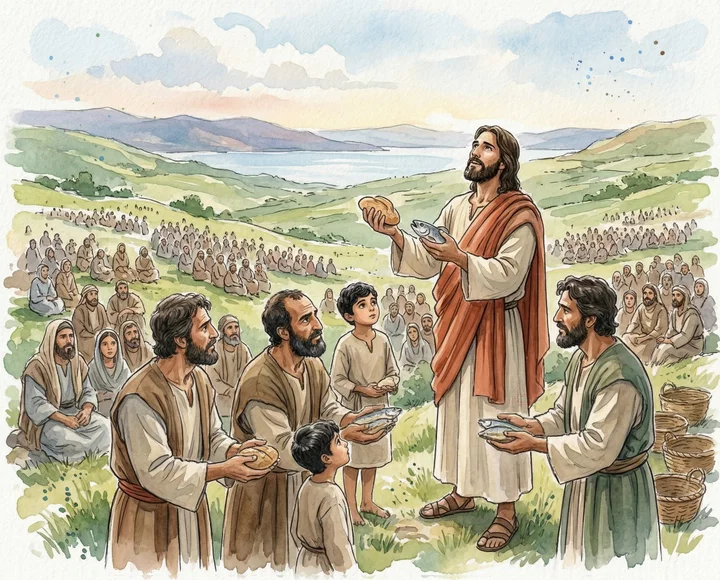
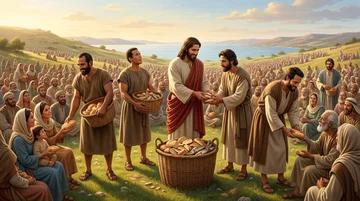
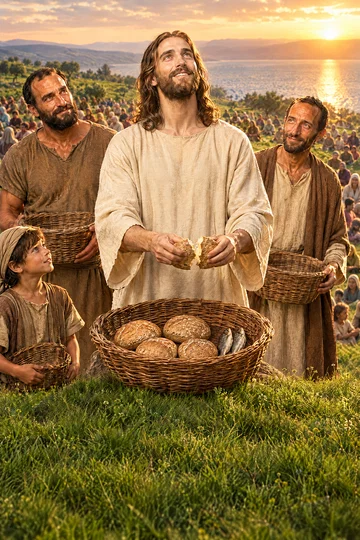
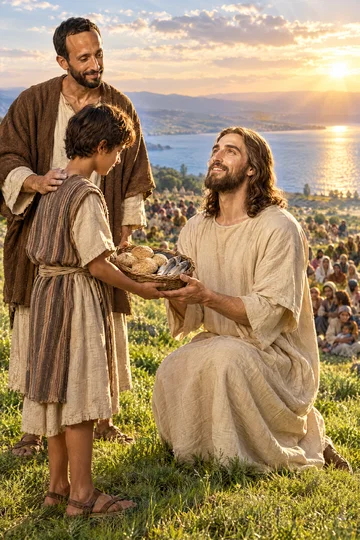
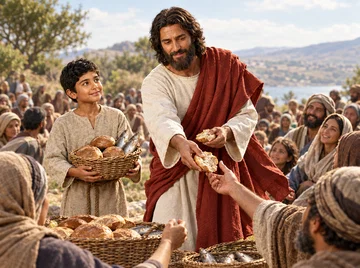
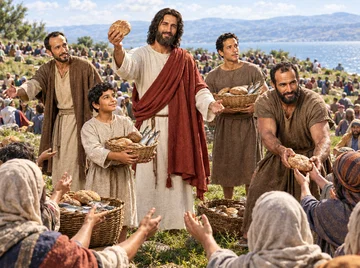
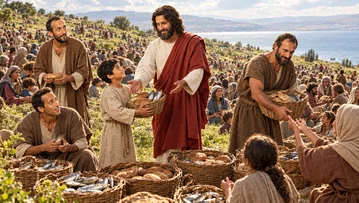
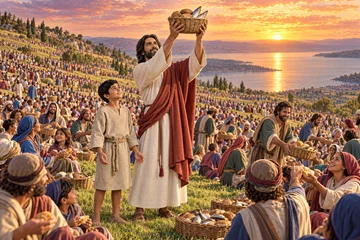
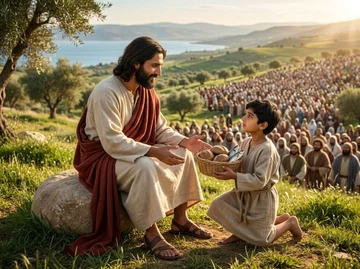
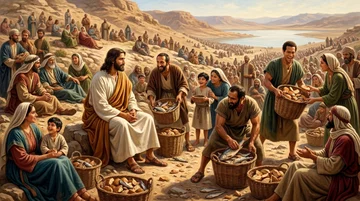
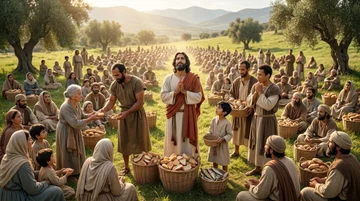
And Jesus took the loaves; and when he had given thanks, he distributed to the disciples, and the disciples to them that were set down; and likewise of the fishes as much as they would.
Translations
American King James Version, King James Version, KJV Cambridge Paragraph Bible
And Jesus took the loaves; and when he had given thanks, he distributed to the disciples, and the disciples to them that were set down; and likewise of the fishes as much as they would.
And Jesus took the loaves; and when he had given thanks, he distributed to the disciples, and the disciples to them that were set down; and likewise of the fishes, as much as they would.
Revised Version, American Standard Version
Jesus therefore took the loaves; and having given thanks, he distributed to them that were set down; likewise also of the fishes as much as they would.
and Jesus took the loaves, and having given thanks he distributed to the disciples, and the disciples to those reclining, in like manner, also of the little fishes as much as they wished.
And Jesus took the loaves, and having given thanks, distributed [ them] to those that were set down; and in like manner of the small fishes as much as they would.
Jesus therefore took the loaves, and, giving thanks, went on distributing unto them that reclined; in like manner, of the small fishes also: as much as they were wishing.
Then Jesus took the loaves and the fish, gave thanks, and distributed to those who were seated as much as they wanted.
Then Jesus took the loaves, gave thanks, and distributed them to the disciples, and the disciples to those who were seated— and the fish— as much as they wanted.
Jesus took the loaves, and having given thanks, he distributed to the disciples, and the disciples to those who were sitting down, likewise also of the fish as much as they desired.
Then Jesus took the cakes and having given praise to God, he gave them to the people who were seated, and the fishes in the same way, as much as they had need of.
And Iesus tooke the bread, and gaue thanks, and gaue to the disciples, and the disciples, to them that were set downe: and likewise of the fishes as much as they would.
Douay-Rheims (Challoner revision)
And Jesus took the loaves: and when he had given thanks, he distributed to them that were set down. In like manner also of the fishes, as much as they would.
Pictures
Cross-references 20 of 39
- Matthew 14:19-21
And he commanded the multitude to sit down on the grass, and took the five loaves, and the two fishes, and looking up to heaven, he blessed, and brake, and gave the loaves to his disciples, and the disciples to the multitude.
Both describe Jesus blessing and distributing food to the multitude.
- Mark 6:41-44
And when he had taken the five loaves and the two fishes, he looked up to heaven, and blessed, and brake the loaves, and gave them to his disciples to set before them; and the two fishes divided he among them all.
Parallel account of Jesus distributing the loaves and fishes until the crowd was satisfied.
- Luke 9:16-17
Then he took the five loaves and the two fishes, and looking up to heaven, he blessed them, and brake, and gave to the disciples to set before the multitude.
A parallel account shows Jesus distributing the loaves and fishes until the crowd is satisfied.
- John 6:35
And Jesus said unto them, I am the bread of life: he that cometh to me shall never hunger; and he that believeth on me shall never thirst.
Names the spiritual bread for which the multitudes are hungry.
- John 6:26
Jesus answered them and said, Verily, verily, I say unto you, Ye seek me, not because ye saw the miracles, but because ye did eat of the loaves, and were filled.
Jesus says the crowd sought him because they had eaten and been filled.
- John 6:15
When Jesus therefore perceived that they would come and take him by force, to make him a king, he departed again into a mountain himself alone.
After the feeding, the crowd tries to make Jesus king, but he withdraws.
- John 6:51
I am the living bread which came down from heaven: if any man eat of this bread, he shall live for ever: and the bread that I will give is my flesh, which I will give for the life of the world.
Christ gives himself as living bread for the life of the world.
- Matthew 14:16
But Jesus said unto them, They need not depart; give ye them to eat.
Jesus tells the disciples to feed the crowd.
- 2 Kings 4:42-44
And there came a man from Baal-shalisha, and brought the man of God bread of the firstfruits, twenty loaves of barley, and full ears of corn in the husk thereof. And he said, Give unto the people, that they may eat.
Both accounts show barley loaves miraculously feeding a crowd, with food left over.
- Exodus 16:4-15
Then said the LORD unto Moses, Behold, I will rain bread from heaven for you; and the people shall go out and gather a certain rate every day, that I may prove them, whether they will walk in my law, or no.
Both texts recount miraculous food provided in the wilderness.
- John 21:13
Jesus then cometh, and taketh bread, and giveth them, and fish likewise.
Jesus gives bread and fish to his disciples, recalling his feeding of the multitude.
- John 6:32-33
Then Jesus said unto them, Verily, verily, I say unto you, Moses gave you not that bread from heaven; but my Father giveth you the true bread from heaven.
The earthly food points to Christ, the true bread from heaven who gives life.
- 1 Kings 17:14-16
For thus saith the LORD God of Israel, The barrel of meal shall not waste, neither shall the cruse of oil fail, until the day that the LORD sendeth rain upon the earth.
Both show God miraculously providing food in abundance.
- John 6:27
Labour not for the meat which perisheth, but for that meat which endureth unto everlasting life, which the Son of man shall give unto you: for him hath God the Father sealed.
Jesus contrasts the feeding miracle’s perishable food with food that endures to eternal life.
- John 6:53-56
Then Jesus said unto them, Verily, verily, I say unto you, Except ye eat the flesh of the Son of man, and drink his blood, ye have no life in you.
The feeding leads to Jesus’ teaching about receiving him as food and drink.
- Mark 6:37
He answered and said unto them, Give ye them to eat. And they say unto him, Shall we go and buy two hundred pennyworth of bread, and give them to eat?
Jesus commands his disciples to feed the people.
- Mark 6:38
He saith unto them, How many loaves have ye? go and see. And when they knew, they say, Five, and two fishes.
Both recount the feeding of the five thousand and the available loaves and fishes.
- Luke 9:13
But he said unto them, Give ye them to eat. And they said, We have no more but five loaves and two fishes; except we should go and buy meat for all this people.
Jesus directs the disciples to feed the crowd with their available food.
- Matthew 16:9-10
Do ye not yet understand, neither remember the five loaves of the five thousand, and how many baskets ye took up?
Recalls the feedings and the baskets of fragments gathered.
- Matthew 14:21
And they that had eaten were about five thousand men, beside women and children.
Gives the crowd’s number, including men, women, and children.
Commentary part 1 of 2
Each commentary is drawn from primary sources: the writings of Ellen G. White and Adventist pioneers and periodicals. Each commentary is separate. Its own words are not a quotation; follow the references to read the source passages.
Ellen G. White
127 sources
Jesus took the five barley loaves and two small fishes, gave thanks and blessed them, broke and divided them, and gave them to the disciples to distribute to the multitude seated in orderly companies, giving of the fishes likewise until each had as much as was wanted.DA 364Ms 188, 1907, par. 10Lt 304, 1906, par. 6–13Ms 130, 1909, par. 4–6Ms 124, 1909, par. 21 The little supply multiplied in His hands and in the hands of the distributors as it passed from hand to hand, so that more than ten thousand ate and were filled and twelve baskets of fragments remained to be gathered that nothing be lost.Ms 188, 1907, par. 10Lt 252, 1906, par. 2–6Lt 268, 1903, par. 21–24RH Apr 8, 19093RED 55.2 In tender pity He would not send the weary, hungry crowd away fasting, and by this display of divine creative power He proved Himself the Messiah, the Son of God, the prophet Moses foretold.Lt 9, 1902, par. 1–717MR 252.1Ms 130, 1909, par. 4–6DA 364.2ST May 20, 1886 The loaves point beyond themselves to Christ Himself as the Bread of life, whose flesh and blood are received by receiving and assimilating His words until they become part of daily life and give eternal life.11MR 340.3CH 400.4–401.1RH Jun 18, 1901Lt 343, 1905, par. 9Lt 40, 1899, par. 17–18 Christ remains the source of every temporal and spiritual blessing, and the disciples as channels who could give only what they received from Him show that what is entrusted to Him and shared in faith multiplies, so His workers are to receive before giving and trust Him to make little means sufficient.MH 49.2–4DA 369.2–4ST Aug 19, 18976T 467.1RH Apr 4, 1907
Setting and Order of Miracle
The feeding happened in a secluded, remote desert place beyond the sea from Capernaum, on a grassy mountainside and barren shore and beach by the Sea of Galilee, at nightfall near the Passover season.Ms 156, 1902, par. 1–5DA 364.1ST May 20, 1886DA 809.3 The spot was within sight of where the disciples later gathered and not far from Capernaum, and the surrounding natural beauty helped connect God's works in nature with truth and make the teaching interesting and memorable.DA 809.3RH May 30, 1871 Jesus had withdrawn there with His disciples, but the crowd followed by land and by boat and waited for Him on the shore.DA 364.12SP 270.2
About five thousand men besides women and children, more than ten thousand in all, had stayed through the entire day to hear teaching such as they had never heard and to be healed.Ms 156, 1902, par. 1–5Lt 268, 1903, par. 21–24ST May 20, 1886ST May 20, 1886DA 809.3 Toward sunset they were weary and hungry without food after being all day without eating, unable to buy what they needed.Ms 124, 1909, par. 21ST May 20, 1886ST May 20, 1886 Jesus knew their bodily need mattered and that a tired, hungry throng could not receive spiritual benefit, so He would not send them home fasting or let them faint by the way.ST May 20, 1886RH May 30, 1871
The supply began with only five barley loaves and two small fishes found among the company, a boy's simple ordinary offering that seemed nothing among so many.Ms 156, 1902, par. 1–5Ms 130, 1909, par. 4–6Ms 124, 1909, par. 21ST May 20, 1886ED 217.1–2 The food was coarse barley bread and fish, yet under necessity with Christ's blessing it became palatable and met genuine need.Lt 304, 1906, par. 6–13DA 365.3–366.1 He had the little food brought to Him after testing His disciples about obtaining bread, though He already knew how He would provide.Ms 124, 1909, par. 21ST May 20, 1886
He had the disciples seat the people on the grass in orderly companies of fifty and one hundred to preserve order, give rest, and let all witness the miracle.ST May 20, 1886DA 365.3–366.1 He then took the loaves and the fishes, gave thanks and blessed and broke and divided them, and handed them to the disciples to serve the multitudes who were set down.Lt 304, 1906, par. 6–13Lt 268, 1903, par. 21–24Ms 197, 1907, par. 1–4Lt 131, 1900, par. 1–3ST May 20, 1886 He distributed in the same manner likewise of the fishes, giving through the disciples to everyone seated in whatever amount they wanted, in quantities sufficient to satisfy appetite.DA 364Ms 188, 1907, par. 10Lt 268, 1903, par. 21–24Lt 131, 1900, par. 1–3
Food Multiplied to Satisfy All
Jesus gave thanks for the loaves and fishes, then gave them to the disciples to carry to those seated, giving of the fishes in the same way, each person receiving as much as was wanted.Ms 188, 1907, par. 10Lt 252, 1906, par. 2–6Lt 268, 1903, par. 21–24ST Mar 1, 1877STB 772.1–2 The small supply grew as it was shared, increasing in his own hands and in the hands of those who distributed it as it passed from hand to hand.Ms 188, 1907, par. 10Lt 252, 1906, par. 2–6RH Apr 8, 19092SP 261.2–262.221MR 138.4–5 It did not diminish in the giving but was supplied fresh, so that whenever the disciples came back for more there was more to take.3RED 55.2ST Mar 1, 18772SP 261.2–262.2Ms 64, 1910, par. 10–1121MR 138.4–5 In this way the provision continued until the vast assembly had all eaten and were filled.Ms 188, 1907, par. 10RH Apr 8, 19093RED 55.22SP 261.2–262.2Ms 64, 1910, par. 10–11
When all had eaten, twelve baskets of fragments were left over and gathered, showing that the provision was more than sufficient and that nothing was to be lost.Lt 268, 1903, par. 21–243RED 55.2Ms 64, 1910, par. 10–112T 292.121MR 138.4–5 Five loaves and two small fishes had fed five thousand men besides women and children, with everyone eating as much as was wanted, and those who saw it recognized the miracle.Lt 268, 1903, par. 21–243RED 55.2Ms 64, 1910, par. 10–112T 292.121MR 138.4–5 That careful gathering teaches thrift and economy even amid abundance, that what can be saved should be saved and nothing wasted, and that Christ's works and helpful acts done in his name are to be valued and remembered.STB 772.1–2Ms 64, 1910, par. 10–112T 292.121MR 138.4–5
The power that multiplied those few barley loaves is the same creative power that every day brings the harvest from the seed to feed millions.ED 107.3ST May 7, 1912ST Aug 12, 1897DA 367.33MR 352.4 Through rain and sunshine and air, with human labor in growing grain and making bread, God continually supplies what sustains life, working through nature and able also to provide in an instant.ED 107.3ST May 7, 1912ST Aug 12, 1897DA 367.33MR 352.4 Because human work and natural process stand in view, people often overlook his part and give the credit to natural causes or human effort.ED 107.3ST May 7, 1912ST Aug 12, 1897DA 367.3 His gifts are acts of mercy to be acknowledged with glory to him and used as blessings rather than turned to selfish ends or to gratify perverted appetite, for he met a genuine need and made simple food sufficient.ED 107.3ST May 7, 1912ST Aug 12, 1897DA 367.3
Compassion and Power of Christ
With pity and tender benevolence He met bodily hunger and spiritual need together, giving thanks over the loaves and fishes and supplying food for all through His power, and His continuing care still provides for the physical needs of followers while teaching that the living bread giving eternal life matters more than perishable food.Lt 9, 1902, par. 1–717MR 252.1DA 364.2 He would not send the weary multitude home unrefreshed after they had followed to hear words of life and been taught and healed all day without food, nor let them faint by the way, but had the disciples seat them on the grass in orderly companies to preserve order, give them rest, and let all witness the miracle.ST May 20, 1886DA 365.3–366.1 In giving spiritual food and also miraculous temporal food to satisfy physical hunger, He bound missionary work to the ministry of the word, and the merciful provision of bodily food fastened His gracious words of truth in their minds.RH Apr 4, 1907 His care extended to body as well as soul, and through plain food without luxury He showed power and tender care while teaching that God's natural provisions had been perverted for gratification of appetite.DA 365.3–366.1
The feeding bounteously satisfied thousands who had followed all day to hear teaching such as they had never heard and to be healed, for His pure and simple doctrine laid hold of their minds and sank into their hearts, He healed their sick and comforted their sorrow, and rather than send them away hungering He created from five barley loaves and two small fishes food sufficient for all.ST May 20, 1886 No human power could do so mighty a miracle, and the food did not diminish as it was passed along but was enough for everyone to eat until satisfied, displaying divine creative power and benevolence.ST May 20, 1886STST May 10, 1883 While eating what He provided they were fully convinced by His teaching, healing, and feeding together that His power was divine and that He is indeed the Messiah, the prophet Moses foretold, the Son of God.ST May 20, 1886STST May 10, 1883ST Mar 18, 19132SP 262.3–263.1 The miracle is one of the very works proving that He is in the Father and the Father in Him, recalling God's manna for Israel.Ms 130, 1909, par. 4–6
He relied fully on His Father and trusted Him to provide in emergency when no food was available nearby at nightfall in a remote place, understanding that thousands were hungry and many unable to buy, and would not send them home fasting.DA 368.2–3ST Aug 19, 1897ST Aug 19, 1897 Dependence on God in such difficulty does not mean acting recklessly or neglecting the means and abilities God provides, but seeking His help with confidence when following His directions, for His resources are sufficient to meet the need.DA 368.2–3 He performed the feeding not to exalt His own power or display it, but with intelligent purpose to meet real necessity and satisfy hunger when it truly occurred.21MR 139.2 So He who would not work a miracle to satisfy His own hunger in the wilderness fed the multitude, the food multiplying in His hands and the disciples' hands being repeatedly refilled as they passed it to the people.ST May 20, 1886ST Aug 19, 1897
The simple meal met a genuine need of weary and hungry people, and Christ's actions in blessing and breaking the bread and fish, giving them to the disciples to distribute until all were satisfied, can leave a lasting impression on human minds.Ms 197, 1907, par. 1–4DA 365.3–366.1ST Aug 12, 1897 As a man of poverty walking from place to place with thousands following to hear His teaching, He pitied the multitude, had the little food brought to Him, divided it, gave it to eat until all were satisfied, then had the fragments gathered that nothing be lost.Ms 130, 1909, par. 4–6 His poverty, humility, and simple doctrine, without luxury to attract people, left their mark, while the same power that makes the harvest grow sustains people through ordinary food as a continuing miracle for which He deserves glory.Ms 130, 1909, par. 4–6DA 365.3–366.1ST Aug 12, 1897 The loaves and fishes belong with His walking on the water and His statement to His hearers that He was the Bread of life, which caused some of His disciples to turn from Him, forming together teaching of intense interest and highest value comprising many subjects.14MR 335.1–39MR 242.1Lt 13, 1876, par. 1–39MR 32.3–5
Bread of Life Teaching
The sixth chapter of John reveals Christ Himself as the Bread of life and the rich manna of heaven on which to feed.11MR 340.3Lt 88, 1900, par. 2Lt 93, 1901, par. 11 Eating His flesh and drinking His blood means receiving and assimilating His words and living oracles until they become part of the self and of daily experience.CH 400.4–401.1Lt 241, 1903, par. 9–10Lt 93, 1901, par. 11 Its truths are to be studied, meditated upon, and committed to memory, bringing its principles home to the soul and grasping the mysteries of godliness.Lt 343, 1905, par. 9Lt 241, 1903, par. 9–10Ms 68, 1897, par. 9 Truth can be revealed only as it is known in Him, through prayer, communion with God, and proving the very mind of God.Lt 241, 1903, par. 9–10
To study the Word is to eat it: to receive and take in its truths as food, keep its precepts, bring them into practical life, and live by every word God has revealed as necessary for salvation.CH 400.4–401.1Lt 241, 1903, par. 9–10Lt 99, 1904, par. 4–5 Not all has been revealed, which could not be borne, but all necessary for salvation has been revealed, and His Word is not to be left for the suppositions of men.Lt 241, 1903, par. 9–10 The whole chapter is very instructive but only faintly understood, holding most precious and important lessons for all being educated in schools, giving an education that endures through time and eternity when its wonderful truths are brought into practical life.Ms 68, 1897, par. 9 Those ministering in word and doctrine are built up spiritually from the food they give the mind, and must feed the mind on this bread sent down from heaven for spiritual growth and not spend time on books and magazines that lead the mind astray and hinder spiritual life.CH 400.4–401.1Lt 43, 1905, par. 4
Eating Christ's flesh and drinking His blood gives eternal life with resurrection at the last day, so that even if a believer dies as Christ died the Saviour's life is in him and his life is hid with Christ in God.RH Jun 18, 1901 Jesus came that they might have life more abundantly, and He carries on the great process by which believers are made one with Him in this present life to be one with Him throughout all eternity.RH Jun 18, 1901 This points to His work as the substitute for sin, Israel's only hope even before His crucifixion, the divine antidote for the sin of the whole world, gained by holding truth that works by love and purifies the soul cherished in the heart unto humble Christian fruit.RH Jun 18, 1901Lt 40, 1899, par. 17–18Lt 95, 1901, par. 18–19 Tasting that the Lord is gracious is an actual personal experience, learned as newborn babes desire the sincere milk of the word that they may grow thereby, which is true conversion and being born again without which no one can see or discern the requirements of the spiritual kingdom.FE 458.2–459.2Ms 68, 1897, par. 19 Feeding on Him creates soul hunger for God and is the appointed means to gain spiritual strength and comfort, peace, joy, hope, and assurance, a life-or-death choice of whom to serve requiring an undivided heart.11MR 340.3
The verse defines the righteousness of Christ that must be accepted to have on the wedding garment and be counted a fit guest at the wedding.Ms 13, 1899, par. 1–2 The wedding is the marriage of humanity with divinity and shows God's standard of character, which cannot be measured by human ideas, requiring taking a firm stand for Christ and surrendering to God what is already His, while continuing in sin through presumption results in loss of the soul.Ms 13, 1899, par. 1–2 The chapter's testimony from Christ tests those who claim to be His disciples, for truth brought home to the heart can expose defects and call for reform, and some reject it rather than accept reproof.Lt 146, 1900, par. 14–15 Its truths call people to depend on God rather than on human beings, and its plain expression of God's will is given to cure dissension and bring unity and love among believers, so that those who live it out in practical life have strength instead of weakness to withstand the attacks of Satan.Ms 42, 1902, par. 6–921MR 346.1–3 God's Word contains the Holy Spirit, the living and undying element.9MR 113.1–2 As temporal bread gives the body health and strength, so faith in Christ and obedience to His teaching give the soul spiritual vigor and everlasting life.2SP 282.1–283.24RED 95.1
Disciples Receiving to Impart
Christ is the source of all power and giver of every temporal and spiritual blessing, without whom nothing can be done.DA 369.2–4ST Aug 19, 1897RH Apr 4, 1907ST Jan 22, 1902Lt 90, 1900, par. 6–7 He took the small store, relied fully on God, gave thanks, and put the bread into the disciples' hands to be given by them to the multitude, employing human beings as co-workers and His helping hand.DA 369.2–4ST Aug 19, 1897RH Apr 4, 1907ST Jan 22, 1902MH 49.1 The disciples acted as channels, instruments and appointed means of communication between Christ and the people, able to give spiritual nourishment only as they received it from Him, the Bread of life.DA 369.2–4ST Aug 19, 1897RH Apr 4, 1907ST Jan 22, 1902MH 49.1 They were to receive precious truth to give to those fainting by the wayside, not to hoard for self-gratification but to impart to others, and as they emptied their hands in imparting they received more to impart, continuing to receive as they gave.DA 369.2–4ST Aug 19, 1897RH Apr 4, 1907ST Jan 22, 1902 Those who work for Him are only instruments entrusted with talents to cooperate with the great Master-Worker who slumbers not and constantly works to accomplish His purposes, never thinking the credit belongs to them, and all the glory for feeding the five thousand is to be given to God; the miracle thus illustrates cooperation in service and the part His disciples in all ages are to act.RH Apr 4, 1907ED 286.1
The food multiplied in His hands and in the distributors' hands as it passed from hand to hand, and the disciples' hands were not left empty but were repeatedly refilled as they served until all were fed.Lt 252, 1906, par. 2–6MH 49.2–4DA 369.2–4ST Aug 19, 1897ST Jan 22, 1902 As they shared what they had received the supply increased until the people were filled, and the disciples themselves also ate with Christ.MH 49.2–46T 263.1Ms 38, 1895, par. 58–60 What is too little by itself becomes abundance when entrusted to Christ and faithfully shared, and blessings both temporal and spiritual accompany such giving.MH 49.2–46T 263.1Ms 47, 1894, par. 10–11 God's truth multiplies in the same way when distributed, talents used to impart the Bread of life are increased, and precious light and means when appreciated and shared are more abundantly bestowed.RH Aug 27, 1903Ms 127, 1903, par. 10Ms 47, 1894, par. 10–11Ms 38, 1895, par. 58–60 Even fragments of literature containing present truth are therefore to be treasured as the fragments were gathered so nothing would be lost, since even a torn page may influence a seeker after truth.RH Aug 27, 1903Ms 127, 1903, par. 10
By placing the disciples before the large crowd to distribute, He gave them standing so many would recognize their work as done as He did, and deeds of mercy thus open a door for His disciples.21MR 138.2–3 Supplying temporal food to the hungry opened the way for Him to take the place of instruction as a field preacher and teacher with authority giving the Word which is the bread of life, an event long remembered, and the sharing of food prepared the way for the gospel message.21MR 138.2–3Ms 81, 1906, par. 2–8Lt 252, 1906, par. 2–6 He binds missionary work to the ministry of the word, meeting bodily hunger and spiritual need together so that merciful provision of bodily food fastens His gracious words of truth in the minds of the people.Lt 252, 1906, par. 2–6RH Apr 4, 1907ST Apr 24, 1901 Following His example His disciples are to take the bread of life and the water of salvation to those longing for spiritual help, passing His Word and grace to souls needing instruction, and where there is need to feed the hungry and clothe the naked.Lt 252, 1906, par. 2–6RH Apr 4, 1907RH Apr 4, 1907ST Apr 24, 1901 The beauty and usefulness of work for God lies in its symmetry and harmony and in its all-round adaptability and efficiency, and the feeding was done with thanksgiving and met real need rather than serving to display power.Ms 81, 1906, par. 2–8Lt 252, 1906, par. 2–6RH Apr 4, 1907
Judas helped distribute the loaves to the hungry multitude and helped bring the sick and suffering to Christ, with opportunity to see the benefit he could impart to others and to feel the satisfaction that always comes in service to God.DA 718.2Ms 106, 1903, par. 46 At that feeding he saw what relief, joy and gladness come to human hearts through healing, an experience that could have taught him Christ's methods.DA 718.2Ms 106, 1903, par. 46 But he was blinded by selfish desire for Christ to reign as an earthly king in Jerusalem on David's throne.DA 718.2Ms 106, 1903, par. 46Ms 28, 1897, par. 10–12 He was first to take advantage of the enthusiasm excited by the miracle and set on foot the project to take Christ by force and make Him king, with high hopes that ended in bitter disappointment.DA 718.2Ms 106, 1903, par. 46Ms 28, 1897, par. 10–12 Jesus stopped it with a rebuke spoken with greater authority than usual, and Judas was dissatisfied with how the miracle turned out, was provoked by the rebuke, and grew more separated from Jesus in feeling and love while still expecting the people He had helped to rally to His help.Ms 28, 1897, par. 10–12
His command to give the people food carried the power to meet their need even when the available means seemed far too small.DA 369.1 The feeding opened the disciples' work as His representatives: they were to give the bread of life to people hungry for it, and He directs His servants to the source of supply.RH Aug 11, 1910COL 140.4–5 Their own resources were insufficient, so they had to seek spiritual food from God and receive before they could give to others, and they were not to send anyone away unfed.RH Aug 11, 1910COL 140.4–5 The small supply in His hands remained undiminished as it was distributed until the multitude had enough, teaching that God can provide abundant resources from what is wisely used in His service and that those who rely on Him in faith will be sustained and enabled to give others the bread of life.DA 370.4Lt 90, 1900, par. 6–7 His way of meeting people's needs is thus the example for those who study and follow His work.Lt 90, 1900, par. 6–7
Responses Then and Afterward
While they ate the food provided from five barley loaves and two small fishes, many were fully convinced by teaching such as they had never heard together with healing of the sick, comforting of sorrow, and feeding of thousands that no human power could do such a miracle and that His power was divine and He is indeed the Messiah.ST May 20, 1886STST May 10, 1883 The pure and simple doctrine had laid hold of their minds and sunk into their hearts, and His tender benevolence won them, confirming a growing belief that had already begun.ST May 20, 1886STST May 10, 1883 Yet many followed and sought Him not because they saw the miracles or recognized His divinity as the Teacher sent to save the world, but because they ate of the loaves and were filled and wanted the temporal advantages to be obtained.4RED 97.2Lt 17, 1897, par. 6–8Ms 50, 1898, par. 4–8 They desired health, wealth, freedom from oppression, an earthly throne, and ease, and that desire kept them from understanding the spiritual meaning of His teaching as bread from heaven and left them unwilling to accept the self-denial involved in following Him.4RED 97.2Lt 17, 1897, par. 6–8Ms 50, 1898, par. 4–8
The miracle heaped evidence upon evidence sufficient to convince any mind open to evidence, and the thoughtful and candid who witnessed it were led to take exalted views of His character and office.Ms 57, 1898, par. 22–25ST Nov 3, 1898ST Jan 11, 1899 Those who heard only with their ears and closed their understanding against Him had no faith, for the Word must be brought home to the understanding until mind and soul are filled with its greatness and power.Ms 57, 1898, par. 22–25ST Jan 11, 1899 Priests, rabbis, and later sign-seekers who had witnessed the feeding and been fed still demanded a sign, closing their eyes to the light rather than seeing and being converted.ST Nov 3, 1898Lt 73, 1901, par. 16–18ST Jan 11, 1899 Their problem was not lack of evidence but unwillingness to accept the Gospel and its call to self-denial, and some hoped He would repeat the feeding so they could discover how He increased the food, as if it were a technique to be learned.ST Nov 3, 1898Lt 73, 1901, par. 16–1813MR 219.4–220.1 That inquiry missed the intended lesson to awaken faith and lead them to accept Him as the Son of God and the Bread of life, the bread of God come down from heaven giving life to the world, so that he who comes to Him never hungers and he who believes on Him never thirsts.Ms 57, 1898, par. 22–25Lt 73, 1901, par. 16–1813MR 219.4–220.1
The enthusiasm after eating to satisfaction issued in a project to take Him by force and make Him king.Ms 9, 1898, par. 31–32Ms 28, 1897, par. 10–12 That plan was started by Judas, who wanted Him crowned on David's throne and expected the people He had helped to rally to His help.Ms 28, 1897, par. 10–12 Jesus refused to become king and stopped the movement with a rebuke spoken with greater authority than usual.Ms 9, 1898, par. 31–32Ms 28, 1897, par. 10–12 Judas was dissatisfied with how the miracle turned out, was provoked by the rebuke, and grew more separated from Jesus in feeling and love.Ms 28, 1897, par. 10–12 From that refusal His popularity began to wane as He devoted Himself more earnestly to teaching His disciples and defining His kingdom as spiritual rather than temporal.Ms 9, 1898, par. 31–32
He made the loaves the occasion for His sermon on the Bread of life, setting forth the conditions of eternal life and entrance into the kingdom of God through dying to self.Lt 17, 1897, par. 6–8 That discourse, joined to the loaves and fishes and to His walking on the water and His statement that He is the Bread of life, forms teaching of intense interest and highest value comprising many subjects.14MR 335.1–39MR 242.19MR 32.3–5 When the crowds heard those demands, many went back and walked no more with Him, apostatizing almost immediately after having been fed.Lt 17, 1897, par. 6–8Lt 13, 1876, par. 1–3 Some of His own disciples also turned away from Him at that teaching.14MR 335.1–39MR 242.1Lt 13, 1876, par. 1–39MR 32.3–5
News of the wonderful miracle on the barren shore spread far and near.2SP 270.23RED 63.2DA 383.2–384.1 The multitude had left Him on that shore knowing no boat was left by which He could depart, while He watched their departure with compassionate eyes.2SP 270.2 On the following morning large numbers arrived early by land and water at the spot where they had last seen Him and searched in vain for Him.2SP 270.23RED 63.2 Finding no boat there, they finally returned to Capernaum still seeking Him.2SP 270.2DA 383.2–384.1
The same manner of breaking the food and dividing it among the disciples for distribution marked Him after His resurrection.DA 810.46RED 46.1–23SP 227.2–228.1 When on the shore of Galilee He bade the seven come and dine and then broke the bread and the fish and divided it among them, the feeding of the five thousand on the mountainside was brought distinctly to their minds.DA 810.46RED 65.3–66.16RED 46.1–23SP 227.2–228.1 By that familiar act He was known and acknowledged by all seven, who gazed upon their risen Saviour in mysterious awe and kept silence.DA 810.46RED 46.1–23SP 227.2–228.1 The later breaking and providing was done to make the earlier feeding more impressive, to teach that though deprived of His personal companionship they would still be cared and provided for by a risen Saviour while doing His work, and that they could trust Him to provide for their needs while they carried out His work.ST Oct 3, 18786RED 46.1–2 That seaside meal followed a private interview in which He had given His disciples much precious instruction, which was then interrupted by the arrival of those who had been searching for Him.
The feeder is the Coming One who in Old Testament times did the same work when one hundred men were fed from twenty loaves, who guided Israel in the wilderness with bread and clear flowing streams and with His glory, who said Before Abraham was I AM, and who walked the earth in lowliness and poverty yet is greater than Moses.Ms 114, 1899, par. 1–3 His grace upon a small portion makes it all-sufficient, His hand can multiply it a hundredfold, and from His resources He can spread a table in the wilderness for more than a million people.Ms 114, 1899, par. 1–3 By the touch of His hand He can increase scanty provision and make it sufficient for all.Ms 114, 1899, par. 1–3
Practical Lessons for Today
After the crowd had eaten as much as they wanted, the fragments that remained were to be gathered so that nothing would be lost, for God's gifts are not to be wasted.STB 772.1–2ST Dec 15, 1909Ms 64, 1910, par. 10–11CH 283.1–22T 292.1 Christ's care for what was left was as essential as His provision of the food and showed the value He places on His blessings, and even when provision is abundant there is to be care and economy.ST Dec 15, 1909Ms 64, 1910, par. 10–112T 292.1 In trying circumstances institutions and individuals are to practice frugality and thrift, wisely saving what can be saved and making careful use of good necessary food.STB 772.1–2CH 283.1–2Ms 3, 1912, par. 4–5 The bread left over was shared with others, teaching that spiritual advantages like material gifts are to be passed on to benefit people in need, and helpful acts done in His name are to be valued and remembered.ST Dec 15, 1909Ms 64, 1910, par. 10–11
What is too little by itself becomes a rich feast when placed in His hands and faithfully shared, for in His hands the small supply of five barley loaves and two fishes multiplied as it was distributed through the disciples until five thousand men besides women and children ate and were filled and twelve baskets remained.MH 49.2–421MR 138.4–5Ms 47, 1894, par. 10–11Lt 121, 1904, par. 14–16Ms 66a, 1900, par. 30–31 The food increased as it was shared and the disciples' hands were not left empty but were repeatedly refilled as they served, and they themselves ate with Him.MH 49.2–421MR 138.4–5 Simple reliance on Him turns a meager gift into abundance, and He works with His people when they give and serve on unselfish principles, supplying what is needed to carry His work forward and to meet the needs of hungry souls.MH 49.2–421MR 138.4–5Ms 66a, 1900, par. 30–31 Workers are not to measure advance by what can be seen but to trust His promises, to plan and work whether means are large or small, and to expect Him to multiply offerings given in love for diffusing the gospel and feeding multitudes starving for the bread of life.6T 467.1Ms 47, 1894, par. 10–11Ms 66a, 1900, par. 30–31 Precious light and means when appreciated and shared are more abundantly bestowed, and the talents used to impart the Bread of life are increased.6T 467.1Ms 47, 1894, par. 10–11
The simple meal without luxury met genuine need and showed both power and loving care for ordinary wants, teaching that hospitality need not be luxurious.6T 345.1–3Ms 186, 1907, par. 8–9Ms 182, 1907, par. 21–23 Those who have are to share what God has given, to care for the hungry, to consider those who lack the truth, and to trust Christ to supply what is lacking until all are satisfied.6T 345.1–3Ms 180, 1907, par. 27–28Ms 186, 1907, par. 8–9Ms 182, 1907, par. 21–23 Those who dedicate themselves to God may receive the Holy Spirit to share with others in need.Ms 186, 1907, par. 8–9
Gifts sent with thanksgiving and prayer are multiplied and blessed as the food given through the disciples was, and making the best use of available means opens the way for God to bless financial giving for soul-saving medical missionary work and sanitariums such as Glendale and Paradise Valley.STB 148.2–3STB 119.3–4 His example in feeding the multitude is to be studied in carrying forward the food work in the right way and without selfish private interests that obstruct its progress, for the food business is His instrumentality.Lt 302, 1906, par. 5MH 200.217MR 252.3 The miracle that satisfied hunger with five loaves and two small fishes proves He will supply the needs of His children today and bless their labor, giving wisdom, skill, talent and ingenuity to devise means, to be taught the preparation of the best foods, and to manufacture necessary wholesome inexpensive foods from the productions of the earth and sell them to the hungry poor at as low a rate as possible.MH 200.2Lt 27, 1902, par. 17–1917MR 252.3 His benevolence continues in giving His people knowledge to find food in different places and ways.17MR 252.3
The same divine power that fed the five thousand was His while He worked daily to support His family, yet He did not use it to ease the burdens of His labor.RP 26.5–6CT 276.3–4 His example shows that useful, patient, industrious work is honorable.RP 26.5–6CT 276.3–4
Feeding on Him who is the rich manna of heaven creates soul hunger for God and is the appointed means to gain spiritual strength and comfort, peace, joy, hope and assurance.11MR 340.3 Receiving Him is a life-or-death choice of whom to serve that requires an undivided heart, while keeping theatrical transactions before the eyes and ears and giving the mind to the stage closes the heart to light, kills love for Bible religion, and leaves no peace, joy or hope.11MR 340.3
Being connected with Him means doing one's best however little it is and then casting the helpless soul upon Him as Saviour and Redeemer with a faith that works by love and purifies the soul, as shown when the poor itinerant Teacher pitied the weary hungry multitude, asked what food there was, had the little brought to Him, divided it and had it given out until all were satisfied and five or seven bushels of fragments were gathered.Ms 130, 1909, par. 4–6 Food created by God and distributed among the multitude reminds that the food and possessions entrusted to the rich are God's goods lent in trust, and He is provider and keeper.Lt 199, 1901, par. 18–20Ms 156, 1902, par. 12 No human being is to be put in God's place by restricting others from producing food or doing the work He has given them to do.Lt 199, 1901, par. 18–20
Sources