Translations
American King James Version, King James Version, KJV Cambridge Paragraph Bible, Webster Bible
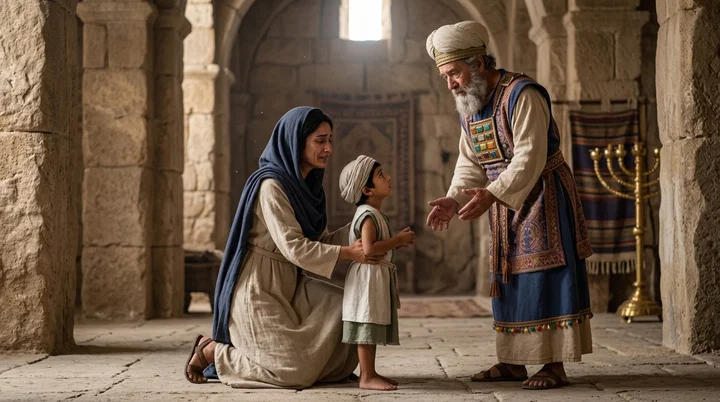
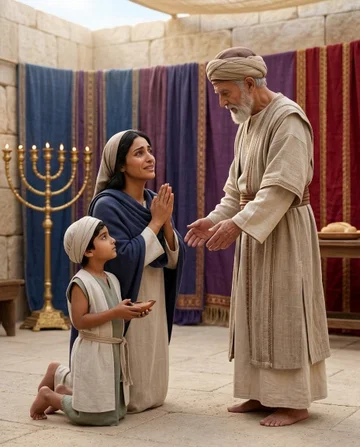
And they slew a bullock, and brought the child to Eli.
Revised Version, American Standard Version
And they slew the bullock, and brought the child to Eli.
And they slaughter the bullock, and bring in the youth unto Eli,
And they slaughtered the bullock, and brought the boy to Eli.
So they slew the bullock,—and took the boy in, unto Eli.
Berean Standard Bible, Majority Standard Bible
And when they had slaughtered the bull, they brought the boy to Eli.
They killed the bull, and brought the child to Eli.
And when they had made an offering of the ox, they took the child to Eli.
And they slewe a bullocke, and brought the childe to Eli.
Douay-Rheims (Challoner revision)
And they immolated a calf, and offered the child to Heli.
Pictures
Cross-references
- 1 Samuel 1:11
And she vowed a vow, and said, O LORD of hosts, if thou wilt indeed look on the affliction of thine handmaid, and remember me, and not forget thine handmaid, but wilt give unto thine handmaid a man child, then I will give him unto the LORD all the days of his life, and there shall no razor come upon his head.
Hannah’s vow to give Samuel to the Lord is fulfilled when she brings him to the tabernacle.
- 1 Samuel 2:19
Moreover his mother made him a little coat, and brought it to him from year to year, when she came up with her husband to offer the yearly sacrifice.
Hannah brings Samuel a coat each year.
- 1 Samuel 2:12-17
Now the sons of Eli were sons of Belial; they knew not the LORD.
Samuel’s godly upbringing contrasts with Eli’s sons’ wickedness and abuse of priestly duties.
- 1 Samuel 2:26
And the child Samuel grew on, and was in favour both with the LORD, and also with men.
Samuel grows in favor with the Lord and with people.
- 1 Samuel 2:27-30
And there came a man of God unto Eli, and said unto him, Thus saith the LORD, Did I plainly appear unto the house of thy father, when they were in Egypt in Pharaoh’s house?
God rebukes Eli for honoring his sons above Him and failing in priestly responsibility.
- 1 Samuel 2:1-11
And Hannah prayed, and said, My heart rejoiceth in the LORD, mine horn is exalted in the LORD: my mouth is enlarged over mine enemies; because I rejoice in thy salvation.
Hannah’s prayer follows the presentation of Samuel to Eli.
- 1 Kings 14:4
And Jeroboam’s wife did so, and arose, and went to Shiloh, and came to the house of Ahijah. But Ahijah could not see; for his eyes were set by reason of his age.
Ahijah lived at Shiloh.
- 1 Samuel 3:4-10
That the LORD called Samuel: and he answered, Here am I.
Samuel’s early obedience prepared him to hear and answer God’s call.
- 1 Samuel 4:11
And the ark of God was taken; and the two sons of Eli, Hophni and Phinehas, were slain.
The ark was taken from Shiloh and captured by the Philistines.
- Joshua 18:1
And the whole congregation of the children of Israel assembled together at Shiloh, and set up the tabernacle of the congregation there. And the land was subdued before them.
Shiloh was Israel’s central place of worship.
- 1 Samuel 2:22-25
Now Eli was very old, and heard all that his sons did unto all Israel; and how they lay with the women that assembled at the door of the tabernacle of the congregation.
Eli confronts his sons over their wrongdoing and their refusal to heed him.
Commentary
Each commentary is drawn from primary sources: the writings of Ellen G. White and Adventist pioneers and periodicals. Each commentary is separate. Its own words are not a quotation; follow the references to read the source passages.
Ellen G. White
17 sources
After they had offered sacrifice at Shiloh, Hannah and her husband slew a bullock as an offering and brought Samuel, weaned in early childhood, to Eli to be left there and trained under the high priest for service in God's house and tabernacle.PP 569.3–4Lt 12, 1884, par. 8CE 214.4–215.1PP 570.4Ms 51, 1900, par. 22 In doing so Hannah fulfilled her vow to give back to God the child asked of God if her prayer was answered, placing that vow above natural affection for a beloved son.ST Oct 27, 1881 The surrender cost her sorrow and great self-denial in giving up daily care, yet it was made gratefully and joyfully and God accepted the offering for His service.RH Sep 8, 1904Lt 12, 1884, par. 8Ms 100, 1901, par. 10 In his first three years his mother had carefully taught him to distinguish good from evil and to see God in creation, providence and daily life, so that home and school were one and his heart was prepared like good ground for precious seed.RH Sep 8, 1904Ms 100, 1901, par. 10RH Oct 30, 1900 That faithful training stands in contrast to Eli's failure to restrain his own sons, and it enabled Samuel to keep his integrity amid evil influences at the tabernacle, showing that a child consecrated to God from youth is pure, valuable to Him, and can be used as a channel of light.RH Sep 8, 1904ST Nov 10, 1881Ms 100, 1901, par. 1020MR 43.5Ms 51, 1900, par. 22
Setting and Presentation
The verse belongs to the worship at Shiloh where the family sacrificed and then shared a solemn, joyful feast after presenting thank-offerings.PP 569.3–4 A bullock was slain as an offering in connection with presenting the child, after the parents had offered sacrifice.PP 570.4Ms 51, 1900, par. 22
After weaning him in early childhood, Hannah with her husband brought Samuel to Eli at Shiloh and left him there to be trained under the high priest for service in God's house and tabernacle.CE 214.4–215.1PP 570.4ST Nov 10, 1881 It was a sacrifice in surrendering her beloved child to serve God, requiring her to give up daily care of him, yet done gratefully and joyfully, and God accepted her offering and gift for His service.Lt 12, 1884, par. 87MR 5.2 The bringing was done after his weaning and after his early childhood, in fulfillment of her vow and promise to dedicate him to God's service.Lt 12, 1884, par. 8PP 570.4ST Nov 10, 18817MR 5.2LSEGW 120.2–4 By bringing Samuel to the tabernacle and dedicating him to the Lord after his birth, Hannah kept her vow, so that his service to God began while he was still a child.
Dedication and Early Training
The bringing of the child to Eli fulfilled Hannah's vow to dedicate him to the Lord if her prayer for a child was granted, a vow her husband confirmed in worship, and after the answer she named him Samuel, meaning Asked of God, and when he was old enough to be separated she kept her promise by giving the beloved child back to God as a gift entrusted to her, with faith giving strength to place the vow above natural affection.ST Oct 27, 1881
Giving Samuel to Eli meant surrendering the daily care of a beloved child with sorrow and great self-denial in placing him under the high priest to be trained for service in God's house, yet it was done gratefully and joyfully, and God accepted the offering for His service.RH Sep 8, 1904Lt 12, 1884, par. 8Ms 100, 1901, par. 107MR 5.2
During his first three years his mother had carefully taught him to distinguish between good and evil, leading his thoughts by every familiar object up to the Creator.RH Sep 8, 1904Ms 100, 1901, par. 10
His early training shows that home and school were one, with the loving hearts of father and mother rather than stranger lips giving instruction to the child.RH Oct 30, 1900 It meant teaching God's requirements and acquainting him with God's dealings, associating thoughts of God with all the events of daily life, recounting God's mighty works of deliverance with eloquence and reverential awe, and impressing God's providence and the future life upon the young mind.RH Oct 30, 1900 It meant teaching the true, the good and the beautiful, illustrating lessons by figures and symbols to fix them in memory, initiating the child almost from infancy into the mysteries, wisdom and hopes of his fathers, and guiding thought and feeling and anticipation beyond things seen and transitory to the unseen and eternal, so that youth come forth vigorous in body and mind, quick to perceive and strong to act, with the heart prepared like good ground for precious seed and the mind trained to see God in revelation and nature.RH Oct 30, 1900
Hannah's faithfulness, firmness and self-denial stand in contrast to Eli, who failed to restrain his sons and to train his own children faithfully, while Samuel was accepted by God for a special work while still young.ST Nov 10, 1881Ms 38, 1895, par. 38–40 That early training enabled Samuel, though his youth was passed at the tabernacle amid evil influences and sinful example where Eli's sons feared not God nor honored their father, to refuse their company and evil ways and maintain his integrity.RH Sep 8, 1904Ms 100, 1901, par. 10 He was given to God as a consecrated offering accepted from childhood because his heart was pure and he revered God, and God made him a channel of light.20MR 43.5Ms 51, 1900, par. 22
Example and Application
Samuel was brought to Eli after he was weaned, in fulfillment of the promise to dedicate him to the Lord, and his upbringing illustrates a mother's powerful influence in a child's earliest years and the importance of faithful parental guidance.ST Nov 10, 1881 Fulfilling the vow meant giving Samuel to the Lord by placing him, with great self-denial, under the care of Eli the high priest to be trained for service in the house of God.RH Sep 8, 1904 During the first three years of his life his mother had carefully taught him to distinguish between good and evil, leading his thoughts by every familiar object up to the Creator.RH Sep 8, 1904 That early training enabled him, though his youth was passed at the tabernacle amid evil influences and sinful example where the sons of Eli feared not God nor honored their father, to refuse their company and evil ways and maintain his Christian integrity, and Hannah's reward in Samuel's faithfulness is an encouragement to parental faithfulness.RH Sep 8, 1904
Samuel was given to God as a consecrated offering, brought to Eli after his parents offered a sacrifice.20MR 43.5Ms 51, 1900, par. 22 He was accepted from childhood because his heart was pure and he revered God, and God made him a channel of light.20MR 43.5Ms 51, 1900, par. 22 His life shows that a young person consecrated to God is valuable to Him and can be accepted and used in His work, showing the value of consecrating oneself to God's service from youth.20MR 43.5Ms 51, 1900, par. 22
Hannah's entrusting of Samuel to Eli after his early childhood provides a parallel to giving a child into another family's care while the parents serve God, as in the care of Henry by the Howland family.LSEGW 120.2–4SG2 107.2–108.1 Her continued care, including her yearly gift to him, belongs to that parallel of entrusting and remembering the child left with others.LSEGW 120.2–4 Hannah stands as one of the faithful saints whose patient, prayerful, and persevering fidelity is needed in the church, Sabbath school, and society.TSSW 109.4–5
Sources
Pioneers and periodicals
16 sources
Hannah had vowed before his birth to give her asked-for son to the Lord, and when Samuel was weaned and old enough to leave her she and her husband fulfilled that vow at Shiloh by slaying a bullock and bringing the young child to Eli at the tabernacle to serve God from childhood.ST Oct 27, 1881ST Apr 23, 1912ST Nov 10, 1881RH Jun 24, 1875 Her bringing him was a gift of love and faith that placed her vow above natural affection after long, agonizing prayer.ST Oct 27, 1881RH Jan 12, 1860 The slain bullock pointed to Christ offered to bear the sins of many, and Eli as high priest was a type of Christ as the great High Priest. During his first three years at home she had taught him obedience, to distinguish good from evil, and to see God in creation, providence and daily life, so that the godly home shaped his character and prepared him to hear the Lord's voice by his master's side.RH Sep 8, 1904ST Nov 10, 1881RH Feb 27, 1908ST Sep 9, 1880 Her self-denying faithfulness in placing him under Eli's training, where he refused the evil example of Eli's unrestrained sons and kept his integrity, stands in contrast to Eli's weakness and remains the pattern of devotion required of Christian parents who dedicate their children to God's service.RH Sep 8, 1904ST Nov 10, 1881ST Apr 6, 1888RH Nov 17, 1904
The Vow Fulfilled
1 Samuel 1:25 belongs to the account of Samuel's birth, for Samuel was asked of God and his mother's prayer was answered.ST Apr 8, 1913 It belongs also to the account of Hannah's devoted care for Samuel, whom God raised up from childhood to become a prophet for Israel.ST Apr 2, 1912
Hannah had promised before his birth to dedicate the child if God granted her request, and her husband confirmed the vow in worship.ST Oct 27, 1881 After her prayer was answered she named the child Samuel, meaning Asked of God.ST Oct 27, 1881 She kept the promise when he was weaned and old enough to be separated from her, bringing the young child to the tabernacle and placing him in the Lord's service.ST Oct 27, 1881ST Apr 23, 1912ST Nov 10, 1881 After he was weaned his mother brought him to the temple, where he began a life of service to God as a child.ST Nov 10, 1881ST Jul 13, 1904 His upbringing illustrates the mother's powerful influence in a child's earliest years and the importance of faithful parental guidance.ST Nov 10, 1881
The scene is at Shiloh, where Eli officiated as high priest, in the tabernacle or temple where the youthful Samuel would serve.RH Jun 24, 1875ST Sep 29, 1898ST Jul 13, 1904 After consecrating him to God from infancy, his parents slew a bullock and brought the child to Eli.RH Jun 24, 1875 That bringing began his life of service to God as a child.ST Jul 13, 1904 His mother returned each year at the annual sacrifice bringing a little coat she had made for him.RH Jun 24, 1875
The bringing of the child was Hannah's dedication of Samuel to the Lord. It was her giving of her son at God's altar as an offering of love, faith, and hope after waiting on God with silent, agonizing prayer.RH Jan 12, 1860 She gave to God the child she loved as a gift entrusted to her, and her faith gave her strength to place her vow above her natural affection.ST Oct 27, 1881
Christ and Parental Faithfulness
The bullock slain at the dedication pointed to Christ, offered to bear the sins of many, and Eli the high priest was a type of Christ as the great High Priest. Hannah's faithfulness, firmness, and self-denial stand in contrast to Eli's failure to restrain his sons.ST Nov 10, 1881 Eli the old priest was kind and benevolent but lacking in strength of character, while Hannah showed beautiful motherhood and mother spirit in bringing the child to Eli, and the little lad Samuel showed faithful truth to duty in his message to Eli.
Hannah fulfilled her vow with great self-denial by placing Samuel under Eli's care to be trained for service in the house of God.RH Sep 8, 1904 Eli thus became responsible for his education, and Samuel had to be kept apart from Eli's corrupt sons lest their influence harm him.ST Apr 6, 1888 Though his youth was passed at the tabernacle amid evil influences and sinful example where the sons of Eli feared not God nor honored their father, that early training enabled him to refuse their company and evil ways and maintain his Christian integrity.RH Sep 8, 1904
During the first three years she had carefully taught him to distinguish between good and evil and taught him obedience very early, leading his thoughts by every familiar object up to the Creator.RH Sep 8, 1904RH Feb 27, 1908 Home and school were one, with the loving hearts of father and mother rather than stranger lips giving instruction, teaching God's requirements and His dealings, associating thoughts of God with all daily events, and recounting God's mighty works in deliverance with eloquence and reverential awe.RH Oct 30, 1900 That instruction impressed providence and the future life on the young mind, taught the true, the good, and the beautiful, illustrated lessons by figures and symbols to fix them in memory, initiated the child almost from infancy into the mysteries, wisdom, and hopes of his fathers, and guided thought and feeling beyond things seen and transitory to the unseen and eternal.RH Oct 30, 1900 This shows the mother's powerful influence in the earliest years and the importance of faithful parental guidance, for the godly home life formed a child who served God and the atmosphere parents create can shape character and faith.ST Nov 10, 1881ST Sep 9, 1880 So trained, youth come forth vigorous in body and mind, quick to perceive and strong to act, with heart prepared like good ground for precious seed and mind trained to see God in revelation and nature.RH Oct 30, 1900
That early teaching of obedience is proved by Samuel being by his master's side at the first call, which prepared him for the Lord speaking to him.RH Feb 27, 1908 Children so taught when young are much more likely to hear and heed the voice of the Lord.RH Feb 27, 1908 Hannah's reward in Samuel's faithfulness is an encouragement to parental faithfulness, and it is the duty of parents, especially the mother, to teach obedience and to command and expect it.RH Sep 8, 1904RH Feb 27, 1908
Hannah's sacrifice in bringing Samuel to Eli is the pattern for Christian mothers who dedicate their sons to God's service and for godly fathers whose wish is that they grow up to speak for Christ.RH Nov 17, 1904 Birthday consecration alone does not form souls, and dedication is of value only when, like the vow of the Nazarite, it receives constant renewal and obedience.RH Nov 17, 1904 While the same sacrifice may not be required now, the same devotion is required to make children heralds who proclaim the coming kingdom.RH Nov 17, 1904
Sources