1 Samuel 1:24
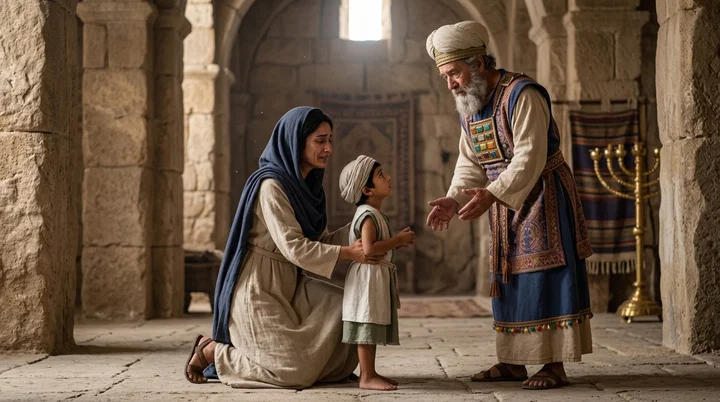
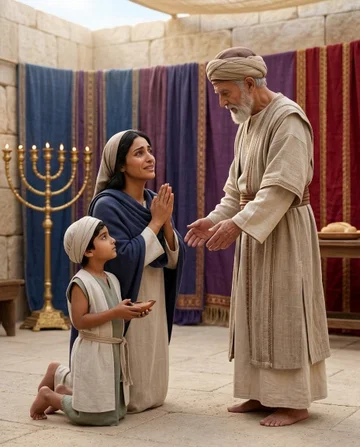
And when she had weaned him, she took him up with her, with three bullocks, and one ephah of flour, and a bottle of wine, and brought him unto the house of the LORD in Shiloh: and the child was young.
Translations
American King James Version, Webster Bible
And when she had weaned him, she took him up with her, with three bullocks, and one ephah of flour, and a bottle of wine, and brought him to the house of the LORD in Shiloh: and the child was young.
And when she had weaned him, she took him up with her, with three bullocks, and one ephah of flour, and a bottle of wine, and brought him unto the house of the LORD in Shiloh: and the child was young.
And when she had weaned him, she took him up with her, with three bullocks, and one ephah of flour, and a bottle of wine, and brought him unto the house of the Lord in Shiloh: and the child was young.
And when she had weaned him, she took him up with her, with three bullocks, and one ephah of meal, and a bottle of wine, and brought him unto the house of the LORD in Shiloh: and the child was young.
And when she had weaned him, she took him up with her, with three bullocks, and one ephah of meal, and a bottle of wine, and brought him unto the house of Jehovah in Shiloh: and the child was young.
and she causeth him to go up with her when she hath weaned him, with three bullocks, and one ephah of flour, and a bottle of wine, and she bringeth him into the house of Jehovah at Shiloh, and the youth [is but] a youth.
And she took him up with her when she had weaned him, with three bullocks, and one ephah of flour, and a flask of wine, and brought him to the house of Jehovah to Shiloh; and the boy was young.
Then took she him up with her, when she had weaned him, with a bullock of three years old, and one ephah of meal, and a skin of wine, and took him to the house of Yahweh, at Shiloh,—the boy yet being young.
Berean Standard Bible, Majority Standard Bible
Once she had weaned him, Hannah took the boy with her, along with a three-year-old bull, an ephah of flour, and a skin of wine. Though the boy was still young, she brought him to the house of the LORD at Shiloh.
When she had weaned him, she took him up with her, with three bulls, and one ephah of meal, and a container of wine, and brought him to the LORD’s house in Shiloh. The child was young.
Then when she had done so, she took him with her, with a three-year old ox and an ephah of meal and a skin full of wine, and took him to the house of the Lord at Shiloh: now the child was still very young.
And when she had weined him, she tooke him with her with three bullockes and an Ephah of floure and a bottell of wine, and brought him vnto the house of the Lord in Shiloh, and the childe was yong.
Douay-Rheims (Challoner revision)
And after she had weaned him, she carried him with her, with three calves, and three bushels of flour, and a bottle of wine, and she brought him to the house of the Lord in Silo. Now the child was as yet very young:
Pictures
Cross-references 20 of 23
- 1 Samuel 1:11
And she vowed a vow, and said, O LORD of hosts, if thou wilt indeed look on the affliction of thine handmaid, and remember me, and not forget thine handmaid, but wilt give unto thine handmaid a man child, then I will give him unto the LORD all the days of his life, and there shall no razor come upon his head.
Hannah’s vow to dedicate her son to the Lord is fulfilled when she brings Samuel.
- 1 Samuel 2:19
Moreover his mother made him a little coat, and brought it to him from year to year, when she came up with her husband to offer the yearly sacrifice.
Hannah brought Samuel a coat each year.
- Joshua 18:1
And the whole congregation of the children of Israel assembled together at Shiloh, and set up the tabernacle of the congregation there. And the land was subdued before them.
The tabernacle was set up at Shiloh.
- 1 Samuel 2:26
And the child Samuel grew on, and was in favour both with the LORD, and also with men.
Samuel grows in favor with the Lord and with people.
- 1 Samuel 2:14
And he struck it into the pan, or kettle, or caldron, or pot; all that the fleshhook brought up the priest took for himself. So they did in Shiloh unto all the Israelites that came thither.
Eli’s sons abused the sacrifices at Shiloh, where Hannah brought Samuel.
- 1 Samuel 1:3
And this man went up out of his city yearly to worship and to sacrifice unto the LORD of hosts in Shiloh. And the two sons of Eli, Hophni and Phinehas, the priests of the LORD, were there.
Israelites went to Shiloh yearly to worship.
- 1 Samuel 3:1
And the child Samuel ministered unto the LORD before Eli. And the word of the LORD was precious in those days; there was no open vision.
Samuel served the Lord at Shiloh as a boy.
- Jeremiah 7:12
But go ye now unto my place which was in Shiloh, where I set my name at the first, and see what I did to it for the wickedness of my people Israel.
Both texts identify Shiloh as the place of the LORD’s house.
- Judges 21:19
Then they said, Behold, there is a feast of the LORD in Shiloh yearly in a place which is on the north side of Beth-el, on the east side of the highway that goeth up from Beth-el to Shechem, and on the south of Lebonah.
Both texts locate Shiloh.
- 1 Samuel 3:3
And ere the lamp of God went out in the temple of the LORD, where the ark of God was, and Samuel was laid down to sleep;
Also calls the sanctuary at Shiloh the temple of the Lord.
- 1 Samuel 1:9
So Hannah rose up after they had eaten in Shiloh, and after they had drunk. Now Eli the priest sat upon a seat by a post of the temple of the LORD.
Calls the sanctuary at Shiloh the temple of the Lord.
- 1 Samuel 2:1-11
And Hannah prayed, and said, My heart rejoiceth in the LORD, mine horn is exalted in the LORD: my mouth is enlarged over mine enemies; because I rejoice in thy salvation.
Hannah praises the LORD after bringing Samuel to Shiloh.
- 1 Samuel 4:4
So the people sent to Shiloh, that they might bring from thence the ark of the covenant of the LORD of hosts, which dwelleth between the cherubims: and the two sons of Eli, Hophni and Phinehas, were there with the ark of the covenant of God.
Confirms that the sanctuary remained at Shiloh.
- 1 Samuel 1:20
Wherefore it came to pass, when the time was come about after Hannah had conceived, that she bare a son, and called his name Samuel, saying, Because I have asked him of the LORD.
Samuel was born as the answer to Hannah’s prayer.
- Psalms 78:60
So that he forsook the tabernacle of Shiloh, the tent which he placed among men;
Both texts identify Shiloh as the site of the LORD’s tabernacle.
- Joshua 18:10
And Joshua cast lots for them in Shiloh before the LORD: and there Joshua divided the land unto the children of Israel according to their divisions.
Israel’s land was divided by lot at Shiloh.
- 1 Samuel 1:7
And as he did so year by year, when she went up to the house of the LORD, so she provoked her; therefore she wept, and did not eat.
Also calls the sanctuary at Shiloh the house of the Lord.
- 1 Kings 14:2-4
And Jeroboam said to his wife, Arise, I pray thee, and disguise thyself, that thou be not known to be the wife of Jeroboam; and get thee to Shiloh: behold, there is Ahijah the prophet, which told me that I should be king over this people.
Jeroboam’s wife went to Shiloh to seek Ahijah about her child.
- 1 Samuel 3:4-5
That the LORD called Samuel: and he answered, Here am I.
Samuel’s early obedience led him to answer the LORD’s call.
- 1 Samuel 3:15
And Samuel lay until the morning, and opened the doors of the house of the LORD. And Samuel feared to shew Eli the vision.
Uses the same name for the sanctuary at Shiloh.
Commentary
Each commentary is drawn from primary sources: the writings of Ellen G. White and Adventist pioneers and periodicals. Each commentary is separate. Its own words are not a quotation; follow the references to read the source passages.
Ellen G. White
18 sources
The verse records Hannah bringing her weaned but still young son Samuel to the house of the Lord at Shiloh with offerings, to fulfill her vow and dedicate him to God.PP 569.3–4ST Oct 27, 1881PP 570.4 His dedication meant he was given to the Lord as a consecrated offering to serve Him, placed under the care of Eli the high priest to be trained for service in the house of God.RH Sep 8, 1904Lt 12, 1884, par. 8CE 214.4–215.1 The gift required faith and involved sorrow, self-denial, separation, and real sacrifice in not keeping back her only deeply loved son, yet she was grateful and joyful that God accepted her offering.ST Oct 27, 1881RH Sep 8, 1904Lt 12, 1884, par. 8 During his first three years his mother carefully taught him at home to love and reverence God and to distinguish between good and evil, which prepared his heart and led him to maintain his integrity when exposed to the evil example of Eli's sons at the tabernacle.RH Sep 8, 1904CE 214.4–215.1Ms 100, 1901, par. 10RH Oct 30, 1900 Faithful Hannah's firmness and self-denial stand in contrast to Eli's failure to restrain and train his sons, showing the value God places on a life consecrated to Him from childhood and encouraging parents to faithfulness in child training.RH Sep 8, 1904ST Nov 10, 188120MR 43.5Ms 38, 1895, par. 38–40Ms 51, 1900, par. 22
Hannah's Dedication at Shiloh
The verse belongs to the going up of the family to Shiloh for worship and sacrifice, when Hannah brought the weaned Samuel to the house of the Lord there with offerings as she dedicated him to God.PP 569.3–4 After he was weaned, while he was still young but old enough to be separated from her, she fulfilled her vow by taking her only, deeply loved son to Shiloh and to the tabernacle to dedicate him to God for service.ST Oct 27, 1881PP 570.4 Though he was her only son and deeply loved, she would not keep back from God the child she had received as a gift, and faith strengthened her to give him over.ST Oct 27, 1881PP 570.4
His dedication meant he was given to the Lord as a consecrated offering to serve Him, placed with self-denial under the care of Eli the high priest to be trained for service in the house of God.RH Sep 8, 1904Lt 12, 1884, par. 8CE 214.4–215.1Ms 100, 1901, par. 107MR 5.2 He was left there at Shiloh, still a young child, to be trained for service in the house of God under Eli.Lt 12, 1884, par. 8CE 214.4–215.1 In fulfillment of her vow she gave him to Eli for service to God, treating as consecrated to God the child she had received from God.PP 570.4Ms 100, 1901, par. 10
The gift required faith and involved sorrow, self-denial, separation, and real sacrifice, for she could have cherished and cared for the son God had given her, yet she gave him up.ST Oct 27, 1881RH Sep 8, 1904Lt 12, 1884, par. 8Ms 100, 1901, par. 107MR 5.2 She accepted the separation as a real sacrifice, and her yearly care for him did not lessen the sacrifice of giving him up.Lt 12, 1884, par. 87MR 5.2 Yet she was grateful and joyful that God accepted her gift and her offering.Lt 12, 1884, par. 87MR 5.2
Even after leaving him, she continued to care for him with love and prayers, preparing and bringing him a little coat or garment each year when she came up for the yearly sacrifice.Lt 12, 1884, par. 8CE 214.4–215.17MR 5.2 The annual coat she made reflected her continuing care and affection and expressed her love and prayers for his character and service.Lt 12, 1884, par. 8CE 214.4–215.1 Her example in entrusting Samuel to the Lord's service and remembering him with a yearly present is the pattern for a mother who must leave her child in another family's care while serving God.LSEGW 120.2–4SG2 107.2–108.1
Early Training and Example
During the first three years of his life, while his childhood was still being shaped, his mother carefully taught him at home, where home and school were one.RH Sep 8, 1904ST Nov 10, 1881RH Oct 30, 1900 She taught him to love and reverence God and to see himself as the Lord's.CE 214.4–215.1 She taught him to distinguish between good and evil.RH Sep 8, 1904Ms 100, 1901, par. 10 She used every familiar object around him to lead his thoughts up to the Creator, and joined thoughts of God to all the events of daily life.RH Sep 8, 1904RH Oct 30, 1900 She told with reverence the mighty works of God in delivering His people, and pressed on the young mind the great truths of God's providence and the future life.RH Oct 30, 1900 She made him acquainted with the true, the good, and the beautiful, fixed lessons in memory by figures and symbols, and led him almost from infancy into the mysteries, wisdom, and hopes of his fathers to think and feel beyond things seen and passing to the unseen and eternal.RH Oct 30, 1900
That early training prepared his heart like good ground for seed, and made him vigorous in body and mind, quick to see and strong to act.RH Oct 30, 1900 It led him to choose to maintain his integrity when his youth at the tabernacle exposed him to evil influences and sinful example.RH Sep 8, 1904Ms 100, 1901, par. 10 For the sons of Eli feared not God nor honored their father, but Samuel did not seek their company nor follow their evil ways.RH Sep 8, 1904 Faithful Hannah's firmness and self-denial stand in contrast to Eli's failure to restrain his sons and train his children rightly.ST Nov 10, 1881Ms 38, 1895, par. 38–40 So God accepted Samuel and chose him for a special work, while the aged priest Eli was passed by because he had neglected his sacred duty.Ms 38, 1895, par. 38–40
Because his heart was pure and he reverenced God, the Lord accepted him from childhood and made him a channel of light.20MR 43.5Ms 51, 1900, par. 22 His life shows the value God places on a life consecrated to Him, and that young people who consecrate themselves to God may be accepted and used in His work.20MR 43.5Ms 51, 1900, par. 22 Hannah's reward in Samuel's faithfulness is an encouragement to faithfulness in child training, showing that God can do a great work for children when parents cooperate with Him.RH Sep 8, 1904Ms 38, 1895, par. 38–40 Her patient, prayerful, and persevering fidelity is an example needed for the church, the Sabbath school, and society to prosper.TSSW 109.4–5 The verse provides a model for a mother who must leave her child in another family's care while serving God, entrusting him to the Lord's service.LSEGW 120.2–4SG2 107.2–108.1LS 254.2–255.1 She remembers him with a yearly present or provision as Hannah did for Samuel, as when caregivers had full charge of a child for five years without payment and provided his clothing apart from his mother's annual gift.LSEGW 120.2–4SG2 107.2–108.1LS 254.2–255.1
Sources
Pioneers and periodicals
27 sources
After she had weaned him, Hannah brought her young, only son to the tabernacle at Shiloh with three bullocks, an ephah of flour and wine, to fulfill her vow to give to the Lord the child asked of God and received in answer to prayer.ST Oct 27, 1881ST May 19, 1914RH Jan 6, 1853 To give him to the Lord was to sanctify him, to separate him for holy use for life, which God gladly accepted.ST Sep 16, 1913RH Jan 12, 1860 She left him there under Eli's care to be trained for service in the house of God, with self-denying firmness that kept him apart from evil influence, in contrast to Eli's failure to restrain his own sons.RH Sep 8, 1904ST Nov 10, 1881ST Apr 6, 1888 In his first three years she had taught him at home to know good from evil and to obey, leading his thoughts from familiar things to the Creator, so that he kept integrity amid corruption and heard the Lord speak while still a child.RH Sep 8, 1904RH Oct 30, 1900RH Feb 27, 1908 Her godly motherhood and his early consecration remain the model for parents to dedicate their children to God, to teach the fear of God from earliest intelligence, and to keep that consecration by constant renewal and obedience.ST Nov 10, 1881ST Sep 9, 1880RH Nov 17, 1904
Words and Historical Setting
The verse belongs to the account of Samuel's birth, whose very name marks him as asked of God and given in answer to his mother's prayer.ST Apr 8, 1913RH Aug 31, 1869 Hannah's prayer was answered in his birth, and after he was weaned she brought him to the house of the Lord at Shiloh and dedicated him to the Lord's service.RH Aug 31, 1869 It falls in the history of ancient Israel in the period between the judges and the kings, when everyone did what seemed right in his own eyes and spiritual life was corrupt. The first chapters record a noted backsliding of Israel that was restored again through the ministrations of Samuel the prophet. The book opens a new era for Israel as God raises up Samuel as prophet, reared from childhood through his devoted mother Hannah.ST Apr 2, 1912
The house of the Lord in Shiloh is the Lord's tabernacle, the sanctuary at Shiloh where Hannah brought Samuel after he was weaned.RH Jan 6, 1853RH Mar 1, 1870RH Sep 2, 1852 It was a curtained dwelling place rather than a tract of land, pitched at Shiloh when Israel divided the land.RH Sep 2, 1852 Shiloh was a place of worship where Israelites gathered for the yearly feasts, and where Samuel, still young, stood and served where the tabernacle stood.RH Dec 14, 1905ST Sep 29, 1898 Hannah brought with the child three bullocks and one ephah of flour and a bottle of wine.ST May 19, 1914 That wine was part of the drink-offering, which represented the worshiper's life poured out in service to God, with fermented wine representing sinful human life in contrast to pure unfermented wine as the symbol of Christ's sinless blood.ST May 19, 1914
The child was young when brought after weaning, and from infancy he served God.ST Jul 13, 1904 God gave warnings and instruction through him even as a child, and he became Israel's prophet through whom people sought divine guidance.ST Jul 13, 1904 His priestly background shows that the prophetic office was not restricted to one class or calling.
Hannah's Vow Fulfilled
After he was weaned Hannah fulfilled her vow by bringing her young son to the house of the Lord at Shiloh to dedicate him to God to serve there for life.ST Oct 27, 1881ST Apr 23, 1912 He was her only son and deeply loved, yet she would not keep from God the child she had received as a gift in answer to her prayer, for faith strengthened her self-denial to give him over for His service.ST Oct 27, 1881RH Sep 8, 1904 His parents' faith and self-denial were seen in dedicating him while he was still very young, and God gladly accepted him. His consecration also gave the other children an example of worship.
To give him to the Lord was to sanctify him, which means to separate or set apart for a holy use or purpose.ST Sep 16, 1913 She brought him to God's altar after waiting in prayer as an offering of love and faith and hope.RH Jan 12, 1860
With great self-denial she placed him under the care of Eli the high priest at the sanctuary to be trained for service in the house of God, so that his education became Eli's responsibility.RH Sep 8, 1904ST Apr 6, 1888 He needed to be kept apart from Eli's wicked sons so their influence would not corrupt him, for they feared not God nor honored their father, but he did not seek their company nor follow their evil ways.RH Sep 8, 1904ST Apr 6, 1888 Her firmness and self-denial stand in contrast to Eli's failure to restrain his sons.ST Nov 10, 1881 Her reward in his faithfulness is an encouragement to faithfulness in child training.RH Sep 8, 1904
She did not cease to care for him but continued to care for him, bringing him a little mantle or coat she had made each year when she came up to offer the yearly or annual sacrifice.RH Jun 24, 1875 The child grew from a beautiful childhood into a holy prophet and honest judge.RH Jun 24, 1875 Her entrusting him after weaning to the Lord's service and leaving him in another family's care is like a child left for five years in caregivers' full charge without payment for care and clothing apart from an annual gift from his mother.LS 254.2–255.1
Model for Parents
During the first three years at home his mother carefully taught him to distinguish between good and evil and to be obedient, using every familiar object around him to lead his thoughts up to the Creator.RH Sep 8, 1904RH Feb 27, 1908 His standing by his master Eli's side at the first call proves that early home training.RH Feb 27, 1908 That obedience led him to maintain integrity when his youth at the tabernacle exposed him to evil influences and sinful example, for he did not seek the company of Eli's sons nor follow their evil ways though they feared not God nor honored their father, and it led to the Lord speaking to him while still a child, a grand privilege growing out of obedience, since children taught obedience when young are much more likely to hear and heed the voice of the Lord.RH Sep 8, 1904RH Feb 27, 1908 Parents must expect obedience, and commanding obedience is the mother's work.RH Feb 27, 1908
His early education was at home where home and school were one, with loving parents giving the instruction and joining thoughts of God to all the events of daily life.RH Oct 30, 1900 The mighty works of God in delivering His people were told with reverence, and the great truths of God's providence and the future life were pressed on the young mind.RH Oct 30, 1900 The child was made acquainted with the true, the good, and the beautiful, lessons were fixed in memory by figures and symbols, and almost from infancy he was led into the mysteries, wisdom, and hopes of his fathers and taught to think and feel beyond things seen and passing to the unseen and eternal.RH Oct 30, 1900 This training made him vigorous in body and mind, quick to see and strong to act, with heart prepared like good ground for seed and mind trained to see God in revelation and in nature.RH Oct 30, 1900
A godly home atmosphere helped form him for service to God.ST Sep 9, 1880 His history illustrates the mother's great influence in forming a child's character from the earliest years, while childhood was still being shaped through faithful care and self-denial in dedicating him to God.ST Nov 10, 1881 That dedication displays beautiful motherhood and mother spirit in giving her young child to the house of the Lord in Shiloh.
Christian parents dedicate their sons to God, yet a consecration made once at birth does not form the soul.RH Nov 17, 1904 Dedication has value only when kept with constant renewal and obedience like the Nazarite vow.RH Nov 17, 1904 Making children into heralds who proclaim the coming kingdom does not necessarily demand surrendering them as Hannah did, but it demands steady devotion.RH Nov 17, 1904
His early life is a model for studying the earliest training of children and learning principles of parental government.RH Feb 18, 1902 His story is a familiar Scripture narrative for leading infant minds up to God, a model for teaching children the sacred names of God and the Saviour from the earliest dawn of intelligence and for training them in the fear of God within the home.RH Jul 2, 1908 It is presented as a story offering children a high ideal of faith in God.RH Dec 14, 1911 Brought to the house of the Lord at Shiloh after weaning to serve there for life, his consecration also gave the other children an example of worship, and his faithfulness in return for his parents' faith and self-denial in dedicating him while very young encourages faithfulness in child training.RH Sep 8, 1904
Sources