2 Kings 25:1
And it came to pass in the ninth year of his reign, in the tenth month, in the tenth day of the month, that Nebuchadnezzar king of Babylon came, he, and all his host, against Jerusalem, and pitched against it; and they built forts against it round about.
Translations
American King James Version, King James Version, KJV Cambridge Paragraph Bible
And it came to pass in the ninth year of his reign, in the tenth month, in the tenth day of the month, that Nebuchadnezzar king of Babylon came, he, and all his host, against Jerusalem, and pitched against it; and they built forts against it round about.
And it came to pass in the ninth year of his reign, in the tenth month, in the tenth day of the month, that Nebuchadnezzar king of Babylon came, he, and all his army, against Jerusalem, and encamped against it; and they built forts against it on all sides.
Revised Version, American Standard Version
And it came to pass in the ninth year of his reign, in the tenth month, in the tenth day of the month, that Nebuchadnezzar king of Babylon came, he and all his army, against Jerusalem, and encamped against it; and they built forts against it round about.
And it cometh to pass, in the ninth year of his reign, in the tenth month, in the tenth of the month, come hath Nebuchadnezzar king of Babylon, he and all his force, against Jerusalem, and encampeth against it, and buildeth against it a fortification round about.
And it came to pass in the ninth year of his reign, in the tenth month, on the tenth of the month, [ that] Nebuchadnezzar king of Babylon came, he and all his army, against Jerusalem, and encamped against it; and they built turrets against it round about.
And it came to pass, in the ninth year of his reign, in the tenth month, on the tenth day of the month, that Nebuchadnezzar king of Babylon came—he and all his force, against Jerusalem, and encamped against it,—and they built against it a siege wall, round about.
Berean Standard Bible, Majority Standard Bible
So in the ninth year of Zedekiah’s reign, on the tenth day of the tenth month, Nebuchadnezzar king of Babylon marched against Jerusalem with his entire army. They encamped outside the city and built a siege wall all around it.
In the ninth year of his reign, in the tenth month, in the tenth day of the month, Nebuchadnezzar king of Babylon came, he and all his army, against Jerusalem, and encamped against it; and they built forts against it around it.
Now in the ninth year of his rule, on the tenth day of the tenth month, Nebuchadnezzar, king of Babylon, came against Jerusalem with all his army and took up his position before it, building earthworks all round the town.
And in the ninth yeere of his reigne, the tenth moneth and tenth day of the moneth Nebuchad-nezzar King of Babel came, he, and all his hoste against Ierusalem, and pitched against it, and they built fortes against it round about it.
Douay-Rheims (Challoner revision)
And it came to pass in the ninth year of his reign, in the tenth month, the tenth day of the month, that Nabuchodonosor king of Babylon came, he and all his army against Jerusalem: and they surrounded it: and raised works round about it.
Pictures
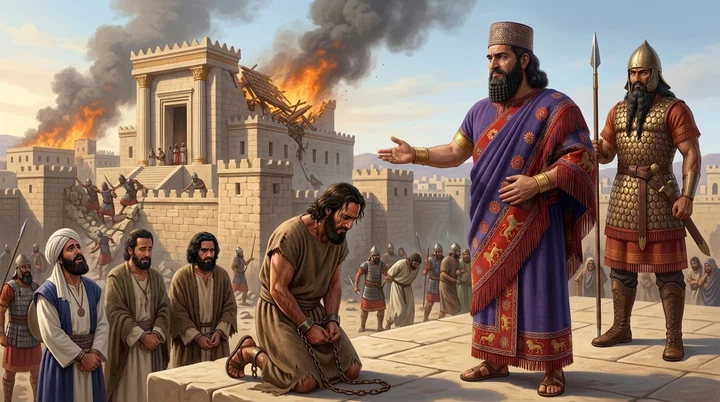
Cross-references
- Jeremiah 52:4
And it came to pass in the ninth year of his reign, in the tenth month, in the tenth day of the month, that Nebuchadrezzar king of Babylon came, he and all his army, against Jerusalem, and pitched against it, and built forts against it round about.
Both texts date the beginning of Jerusalem’s siege.
- 2 Kings 24:10-16
At that time the servants of Nebuchadnezzar king of Babylon came up against Jerusalem, and the city was besieged.
Both recount Babylon’s siege of Jerusalem and the capture and deportation of its people.
- Ezekiel 24:1-2
Again in the ninth year, in the tenth month, in the tenth day of the month, the word of the LORD came unto me, saying,
Records the date when the siege began.
- Jeremiah 39:1
In the ninth year of Zedekiah king of Judah, in the tenth month, came Nebuchadrezzar king of Babylon and all his army against Jerusalem, and they besieged it.
Recounts the Babylonian siege of Jerusalem.
- Jeremiah 32:2
For then the king of Babylon’s army besieged Jerusalem: and Jeremiah the prophet was shut up in the court of the prison, which was in the king of Judah’s house.
Describes the Babylonian siege of Jerusalem and Jeremiah’s presence there.
- 2 Chronicles 36:17-19
Therefore he brought upon them the king of the Chaldees, who slew their young men with the sword in the house of their sanctuary, and had no compassion upon young man or maiden, old man, or him that stooped for age: he gave them all into his hand.
Recounts Babylon’s siege and destruction of Jerusalem under Zedekiah.
- Jeremiah 37:8
And the Chaldeans shall come again, and fight against this city, and take it, and burn it with fire.
It foretells the Babylonian army’s return to besiege and capture Jerusalem.
- Micah 4:10
Be in pain, and labour to bring forth, O daughter of Zion, like a woman in travail: for now shalt thou go forth out of the city, and thou shalt dwell in the field, and thou shalt go even to Babylon; there shalt thou be delivered; there the LORD shall redeem thee from the hand of thine enemies.
Zion’s grief accompanies Judah’s exile to Babylon.
- Revelation 18:2
And he cried mightily with a strong voice, saying, Babylon the great is fallen, is fallen, and is become the habitation of devils, and the hold of every foul spirit, and a cage of every unclean and hateful bird.
Babylon that held Judah captive is destined to fall.
- 2 Kings 24:18-20
Zedekiah was twenty and one years old when he began to reign, and he reigned eleven years in Jerusalem. And his mother’s name was Hamutal, the daughter of Jeremiah of Libnah.
Cited with 2 Kings 25 as a comparison.
- Jeremiah 44:30
Thus saith the LORD; Behold, I will give Pharaoh-hophra king of Egypt into the hand of his enemies, and into the hand of them that seek his life; as I gave Zedekiah king of Judah into the hand of Nebuchadrezzar king of Babylon, his enemy, and that sought his life.
Pharaoh-hophra is given into his enemies’ hands, as Zedekiah was to Nebuchadnezzar.
- Ezekiel 17:15-17
But he rebelled against him in sending his ambassadors into Egypt, that they might give him horses and much people. Shall he prosper? shall he escape that doeth such things? or shall he break the covenant, and be delivered?
Describes Zedekiah’s rebellion and Egypt’s failed attempt to help him.
- Jeremiah 34:21-22
And Zedekiah king of Judah and his princes will I give into the hand of their enemies, and into the hand of them that seek their life, and into the hand of the king of Babylon’s army, which are gone up from you.
Judah’s failure to free servants brought a warning that Babylon would return, besiege the city, and destroy it.
Commentary
Each commentary is drawn from primary sources: the writings of Ellen G. White and Adventist pioneers and periodicals. Each commentary is separate. Its own words are not a quotation; follow the references to read the source passages.
Ellen G. White
1 source
In the ninth year of Zedekiah's reign, Nebuchadnezzar, king of Babylon, came against Jerusalem with his whole army.PK 452.1 He pitched against the city and built forts round about it, thus beginning its encirclement and siege.PK 452.1 That encirclement was the formal start of the siege operation against Jerusalem.PK 452.1
The siege marked the start of a hopeless outlook for Judah.PK 452.1 It brought the Lord's judgment upon the city, with fear and defeat to follow.PK 452.1 This coming judgment with its fear and defeat is what Ezekiel's prophecies describe.PK 452.1
Sources
Pioneers and periodicals
14 sources
In the ninth year of Zedekiah's reign, on the tenth day of the tenth month, Nebuchadnezzar came in person with all his host against Jerusalem, overran the open country, then encamped against the city and built siege works round about it to crush Judah's revolt.ST Aug 20, 1885ST Jun 21, 1883RH Apr 30, 1908 It closes the continuous history of the kingdom of Judah from Solomon to the captivity, ending the line of its last wicked and weak kings after Josiah and beginning the account of Jerusalem laid waste.ST Dec 9, 1897ST Jun 10, 1913ST May 10, 1910 Zedekiah, whom Nebuchadnezzar had crowned, had served eight years as a faithful vassal but in his ninth year rebelled to regain independence by alliance with Egypt, not seeing that Judah between two great powers had only a choice of masters.ST Aug 20, 1885ST May 12, 1909RH Apr 30, 1908 Though the siege was briefly raised when Pharaoh Uaphris marched to relieve the city, the Egyptians were driven back and the blockade was renewed for a year and a half until Jerusalem fell, the temple and chief houses were burned, the walls were broken down, and king, household, leaders and craftsmen were carried to Babylon, ending independent rule in Judah.ST Aug 20, 1885ST Jun 21, 1883ST May 12, 1909ST Nov 4, 1897RH Apr 30, 1908 In this Babylon finally succeeded in subverting the kingdom and carrying Judah captive as the dragon's agent to destroy God's people, fulfilling His warnings against disobedience, yet God's overruling hand is seen in it among the nations from Babel to the captivity, and the siege and captivity were molded to typify events to transpire under the gospel at the close of this dispensation.ST Nov 7, 1906RH Oct 8, 1861ST Feb 11, 1897RH Sep 17, 1872
History and Siege
In Kings the verse belongs to the third great section of the history, covering the remaining kingdom of Judah after the ten tribes were swept away, at the end of the continuous record running from the accession of Solomon to the Babylonian captivity.ST Dec 9, 1897 It closes the history of the kingdom of Judah and starts the story of Jerusalem laid waste by the siege of Nebuchadnezzar with all his host against the city.ST Dec 9, 1897ST Jun 10, 1913 It stands within the account of Judah's final kings after Josiah's death, whose reigns were wicked and weak, and marks Judah falling before Nebuchadnezzar into captivity.ST May 10, 1910
The verse records Nebuchadnezzar coming in person with all his host against Jerusalem to crush Judah's fourth revolt against him.RH Apr 30, 1908 Zedekiah, crowned by Nebuchadnezzar, had served eight years as a faithful vassal, but in his ninth year sought independence to throw off Babylon's yoke and re-establish Hebrew autonomy.RH Apr 30, 1908 He rebelled through alliance with the young Egyptian king Uaphris, sending ambassadors to make a treaty and obtain a powerful contingent of foot and horse, not seeing that Judea lying between two great states had only a choice of masters.RH Apr 30, 1908 Upon that revolt Nebuchadnezzar came against the city, beginning the account of the taking of Jerusalem and the final capture of the Jewish nation and the carrying of many of the children of God into captivity.ST Aug 20, 1885ST May 12, 1909RH Apr 30, 1908
In the ninth year of Zedekiah's reign, in the tenth month on the tenth day, Nebuchadnezzar first overcame and pillaged the open country, then pitched against the city and built forts round about it as a siege.ST Aug 20, 1885RH Apr 30, 1908 When Uaphris marched from Egypt to relieve his ally, the Babylonians raised the siege to meet the new enemy.RH Apr 30, 1908 The Egyptians were defeated or retreated without effect, the relief failed, and the siege was renewed as a complete blockade lasting a year and a half until the city fell.ST Aug 20, 1885RH Apr 30, 1908 Its beginning in the tenth month gave rise to the Jews' fast of the tenth month.ST Jun 21, 1883
The siege ended with Jerusalem's capture, the burning of the temple and the houses of its leading men, the breaking down of the city walls, and the deportation of the king, royal household, leaders, skilled workers and many people to Babylon, while the poorest remained in the land.ST Aug 20, 1885ST Jan 14, 1886 After the capture only a little company under Gedaliah was left in the land.ST May 12, 1909 With the downfall of Zedekiah, the last king of God's chosen people, whose eyes were put out before he was carried to Babylon where he died in captivity, independent government in Judah ended, and whatever self-rule Judah afterward enjoyed was only as a province subservient to the great ruling kingdoms.ST Nov 4, 1897
The surrounding passage also recalls the earlier capture of Jehoiachin, when Nebuchadnezzar took him with his family and officials, carried away the temple treasures and vessels, and deported the leading people and craftsmen.ST Jan 14, 1886 Jehoiachin remained imprisoned in Babylon for thirty-seven years until Evil-merodach released him, treated him kindly, and set him above the other captive kings.ST Jan 14, 1886
Judgment and Significance
The conquest begun here is the point when Babylon finally succeeded in subverting the kingdom of Judah and Jerusalem and carrying the people captive, acting as an agent of the dragon in the effort to destroy God's promised people.ST Nov 7, 1906 The destruction of Jerusalem and the state with the captivity that followed fulfilled God's warnings against Israel's adoption of slavery, as judgment for disobedience to commands protecting servants' freedom and affirming human equality.RH Oct 8, 1861 Standing at the close of the history of the great empires from the confusion of tongues to the Babylonian captivity, among Shinar, Chaldea, Elam, Accad, Babel, Assyria, Egypt and Israel, the verse shows God's overruling hand in the history of nations.ST Feb 11, 1897
The siege of Jerusalem by Nebuchadnezzar and all his host that led to the captivity in Babylon and the final destruction of Jerusalem, with the captivity and the prophecies relating to it and that destruction, are typical of events to transpire either under the gospel or at the close of this dispensation.RH Sep 17, 1872 Type must be distinguished from antitype so that what applies to the later gospel fulfillment is not applied only to ancient Judah, and those living in the Christian dispensation have a special interest in what began here because it was molded to also represent their events.RH Sep 17, 1872 As a historical account of the Babylonian captivity, the passage is a past event believed as truth but does not by itself reveal God's truth for the present needs of later generations.ST May 11, 1915
Sources