2 Kings 24:11
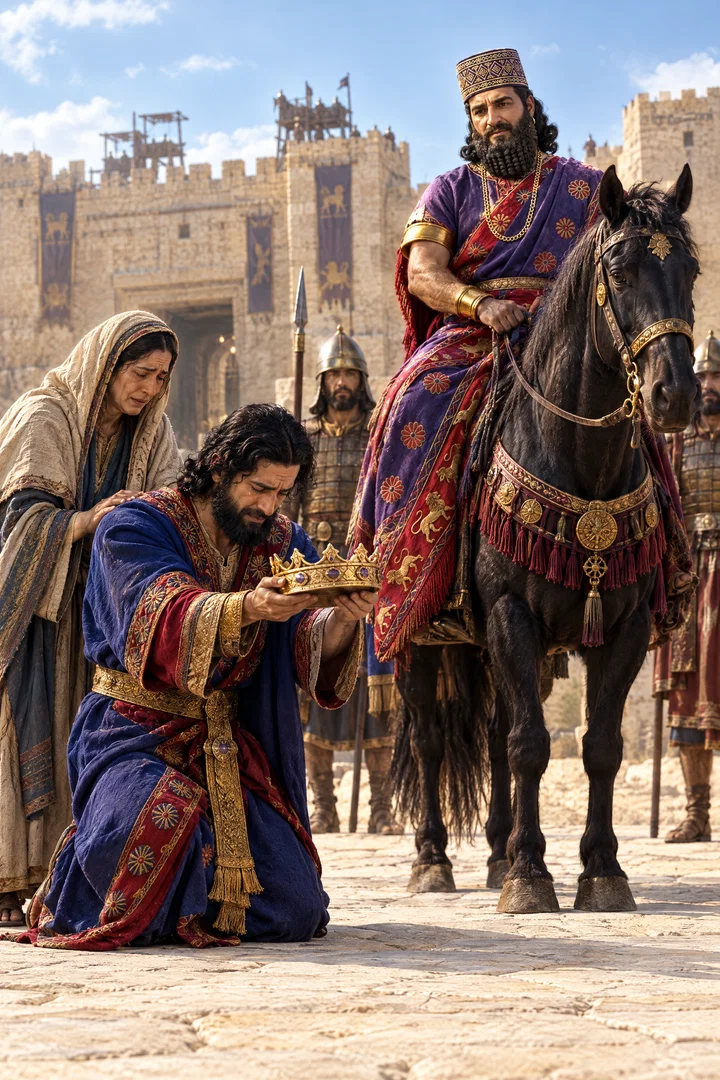
And Nebuchadnezzar king of Babylon came against the city, and his servants did besiege it.
Translations
American King James Version, King James Version, KJV Cambridge Paragraph Bible
And Nebuchadnezzar king of Babylon came against the city, and his servants did besiege it.
And Nebuchadnezzar king of Babylon came against the city, and his servants besieged it.
Revised Version, American Standard Version
And Nebuchadnezzar king of Babylon came unto the city, while his servants were besieging it;
and Nebuchadnezzar king of Babylon cometh against the city, and his servants are laying siege to it,
And Nebuchadnezzar king of Babylon came against the city, while his servants were besieging it.
And Nebuchadnezzar king of Babylon came against the city, and his servants were about to besiege it.
Berean Standard Bible, Majority Standard Bible
And Nebuchadnezzar king of Babylon came to the city while his servants were besieging it.
Nebuchadnezzar king of Babylon came to the city while his servants were besieging it,
And Nebuchadnezzar, king of Babylon, came there, while his servants were shutting in the town;
And Nebuchad-nezzar King of Babel came against the citie, and his seruants did besiege it.
Douay-Rheims (Challoner revision)
And Nabuchodonosor king of Babylon came to the city with his servants to assault it.
Pictures
Cross-references
- 2 Chronicles 36:9-10
Jehoiachin was eight years old when he began to reign, and he reigned three months and ten days in Jerusalem: and he did that which was evil in the sight of the LORD.
Recounts Nebuchadnezzar’s capture of Jerusalem and deportation to Babylon.
- 2 Chronicles 36:17
Therefore he brought upon them the king of the Chaldees, who slew their young men with the sword in the house of their sanctuary, and had no compassion upon young man or maiden, old man, or him that stooped for age: he gave them all into his hand.
The king of the Chaldees besieges Jerusalem and brings judgment on Judah.
- 2 Kings 25:1-7
And it came to pass in the ninth year of his reign, in the tenth month, in the tenth day of the month, that Nebuchadnezzar king of Babylon came, he, and all his host, against Jerusalem, and pitched against it; and they built forts against it round about.
Continues the siege and recounts Jerusalem’s fall and Zedekiah’s fate.
- Jeremiah 39:1-3
In the ninth year of Zedekiah king of Judah, in the tenth month, came Nebuchadrezzar king of Babylon and all his army against Jerusalem, and they besieged it.
Describes Babylon’s siege and capture of Jerusalem.
- Daniel 1:1-2
In the third year of the reign of Jehoiakim king of Judah came Nebuchadnezzar king of Babylon unto Jerusalem, and besieged it.
Connects the Babylonian attack on Jerusalem with captives and sanctuary vessels taken to Babylon.
- Jeremiah 52:28-30
This is the people whom Nebuchadrezzar carried away captive: in the seventh year three thousand Jews and three and twenty:
Gives the numbers deported in successive captivities.
- Jeremiah 52:12-16
Now in the fifth month, in the tenth day of the month, which was the nineteenth year of Nebuchadrezzar king of Babylon, came Nebuzar-adan, captain of the guard, which served the king of Babylon, into Jerusalem,
Jerusalem is destroyed, and its people are carried away captive.
- Jeremiah 32:1
The word that came to Jeremiah from the LORD in the tenth year of Zedekiah king of Judah, which was the eighteenth year of Nebuchadrezzar.
Jeremiah dates his prophecy to the year Nebuchadnezzar besieged Jerusalem.
- Jeremiah 29:10
For thus saith the LORD, That after seventy years be accomplished at Babylon I will visit you, and perform my good word toward you, in causing you to return to this place.
Jeremiah foretold the return after seventy years.
- Jeremiah 25:12
And it shall come to pass, when seventy years are accomplished, that I will punish the king of Babylon, and that nation, saith the LORD, for their iniquity, and the land of the Chaldeans, and will make it perpetual desolations.
Jeremiah foretold the end of Babylon’s rule.
- Jeremiah 37:5-8
Then Pharaoh’s army was come forth out of Egypt: and when the Chaldeans that besieged Jerusalem heard tidings of them, they departed from Jerusalem.
Egypt’s failed aid briefly lifts the Babylonian siege, but the Chaldeans return to attack Jerusalem.
- Micah 4:10
Be in pain, and labour to bring forth, O daughter of Zion, like a woman in travail: for now shalt thou go forth out of the city, and thou shalt dwell in the field, and thou shalt go even to Babylon; there shalt thou be delivered; there the LORD shall redeem thee from the hand of thine enemies.
Zion is taken from the city into exile in Babylon.
- 2 Kings 25:18-21
And the captain of the guard took Seraiah the chief priest, and Zephaniah the second priest, and the three keepers of the door:
The siege of Jerusalem leads to the killing of its leaders and Judah’s deportation.
- Jeremiah 44:30
Thus saith the LORD; Behold, I will give Pharaoh-hophra king of Egypt into the hand of his enemies, and into the hand of them that seek his life; as I gave Zedekiah king of Judah into the hand of Nebuchadrezzar king of Babylon, his enemy, and that sought his life.
Pharaoh-hophra would meet the same Babylonian enemy who besieged Jerusalem.
- Ezekiel 17:15-17
But he rebelled against him in sending his ambassadors into Egypt, that they might give him horses and much people. Shall he prosper? shall he escape that doeth such things? or shall he break the covenant, and be delivered?
Zedekiah’s rebellion and reliance on Egypt bring Babylon’s judgment.
- Revelation 18
And after these things I saw another angel come down from heaven, having great power; and the earth was lightened with his glory.
Describes Babylon’s eventual destruction.
Commentary
Each commentary is drawn from primary sources: the writings of Ellen G. White and Adventist pioneers and periodicals. Each commentary is separate. Its own words are not a quotation; follow the references to read the source passages.
Pioneers and periodicals
14 sources
2 Kings 24:11 records Nebuchadnezzar himself coming against Jerusalem while his servants maintained the siege, during the brief reign of Jehoiachin after his rebellion against Babylon.ST Jan 14, 1886ST Aug 9, 1905ST Aug 20, 1885 It belongs to the closing history of Judah's kings after the ten tribes were swept away, part of the continuous history from Solomon's accession to the Babylonian Captivity, whose fuller account of the fall is told in 2 Kings 24-25.ST Dec 9, 1897ST Nov 4, 1897ST May 10, 1910 The siege ended in the capture of the city, the removal of the temple's treasures, and the deportation of Jehoiachin with his court to Babylon, after which Zedekiah was placed on the throne.ST Jan 14, 1886ST Aug 20, 1885RH May 28, 1908 Those carried away were the king, his royal family, the wealthy, the artisans and many of God's people, leaving only the poorest in Judah as a nation greatly diminished by destruction and death.ST May 24, 1883ST May 12, 1909 Judah fell because she followed Israel's departure from God and leaned toward Babylonian idolatry, so God permitted the captivity as chastisement to bring remaining truth to light, beginning the capture, scattering and overthrow of the kingdom through which the promise came; it is also understood of Nebuchadnezzar's coming in Jehoiakim's reign when Daniel and his companions were carried to Babylon.ST Jun 3, 1913ST Oct 22, 1894ST Nov 7, 1906
Context and Siege Narrative
The verse stands in the closing history of Judah's kings.ST May 10, 1910 It belongs to the third great section of the history of the kings, the history of the remaining kingdom of Judah after the ten tribes had been swept away, covering 2 Kings 18-25.ST Dec 9, 1897 It is part of the continuous history from the accession of Solomon to the Babylonian Captivity told as one whole by the books of Kings.ST Dec 9, 1897 The fuller account of Zedekiah's fall is told in 2 Kings 24-25, to which this arrival against Jerusalem and siege by his servants belongs as part of Judah's downfall.ST Nov 4, 1897
It records Nebuchadnezzar himself returning to Jerusalem during Jehoiachin's brief reign and coming against the city while his servants did besiege it.ST Jan 14, 1886RH May 28, 1908 The return and siege followed Jehoiachin's rebellion against Babylon.ST Aug 20, 1885 It came soon after Josiah's death, when Judah fell before Nebuchadnezzar the Babylonian conqueror. During that brief reign the Babylonian occupation left Jehoiachin with no meaningful rule over Judah.ST Aug 9, 1905 The siege ended in taking the king and many of Judah's people captive.ST Jan 14, 1886
The coming was in Nebuchadnezzar's seventh year, B.C. 598, only a few years after his victorious campaign against Neco.RH Apr 30, 1908 At that time Phoenicia revolted under the leadership of Tyre, and Jehoiakim of Judah renounced his allegiance after obtaining a promise of aid from Egypt.RH Apr 30, 1908 He marched into Palestine at the head of a vast army composed partly of his own Babylonian subjects and partly of his Mede allies.RH Apr 30, 1908 He first invested Tyre and then, finding that city too strong to be taken by assault, left a portion of his army to continue its blockade while he himself pressed forward against Jerusalem.RH Apr 30, 1908 Thus the city was besieged by his servants under his personal direction while the Egyptians failed to come to Jehoiakim's aid.RH Apr 30, 1908 The verse is cited as part of the account of Nebuchadnezzar's successive attacks and captivities, in which the third captivity, in 586 B.C., is identified with Jerusalem's complete destruction.ST Aug 9, 1899
Fall, Captivity, and Lessons
Nebuchadnezzar himself returned to Jerusalem during Jehoiachin's brief reign and came against the city while his servants besieged it, after Jehoiachin rebelled against Babylon.ST Jan 14, 1886ST Aug 20, 1885RH May 28, 1908 The siege ended in the capture of the city, the removal of the treasures of the temple, and the capture and deportation of Jehoiachin with his court and many of the people to Babylon.ST Jan 14, 1886ST Aug 20, 1885 Jehoiachin was removed to Babylon and Zedekiah was placed on the throne in his stead.ST Jan 14, 1886RH May 28, 1908
Those carried away were the king, the royal family, the wealthy people and the artisans, with many of God's people taken into captivity, while only the poorest people remained in Judah.ST May 12, 1909 Only a small remnant of a few thousand captives was taken, representing a nation greatly diminished by destruction and death.ST May 24, 1883 This deportation is dated about 599 B.C.
The coming against Jerusalem is also reckoned to the reign of Jehoiakim, when the city was taken and some of the chief men were carried away to Babylon. Among them were Daniel and his three companions, and this provides the historical setting for Daniel 1, for their learning and wisdom and promotion in Babylon.
Judah fell because she followed Israel's course of departure from God until captivity came upon her.ST Jun 3, 1913 Her people were inclined to imitate Babylonian idolatry, and God permitted captivity by Babylon as chastisement, with affliction and reverses meant to bring any remaining truth to light.ST Oct 22, 1894 Babylon's successful assault and siege began the capture and scattering of Judah and the overthrow of its kingdom, the culmination of repeated efforts by hostile nations to destroy or oppress the people through whom the promise came.ST Jun 3, 1913ST Oct 22, 1894ST Nov 7, 1906
Sources